This fall, the NRA is releasing a definitive, 575-page history of the National Matches. The $59.95 book, entitled The National Matches: 1903-2003 The First 100 Years covers all the National Match venues, starting with New Jersey’s Sea Girt, followed by Creedmoor in New York, and finally the present-day home at Camp Perry, Ohio.
Richly illustrated with hundreds of photos, this special Collectors’ Edition includes National Match facts, complete National Match results, and notable shooter histories. The book also covers the evolution of match rifles and pistols over the past century.
Any shooter who has competed at the National Matches, or who has an interest in National Match history, should consider adding this book to his personal collection. The National Matches: 1903-2003 The First 100 Years will soon be available for purchase from the NRA Program Materials Center, item number CC19740.
Applied Ballistics, run by top Palma shooter Bryan Litz, now offers extremely high-quality loaded match ammunition for .308 Fullbore (Palma) shooters. The new Applied Ballistics “FULLBORE” ammo, priced at $38.00/box, is unlike anything on the market. It features the best available components, with individually-weighed charges. Independent testing shows this ammo offers extremely low ES and SD with accuracy comparable to precision hand-loaded cartridges.
Bryan Litz tells us: “Applied Ballistics’ FULLBORE ammunition is not just another ‘factory ammo’ option. This ammo is loaded specifically for the rifles and chambers commonly used in international-style Palma and Fullbore shooting.” Bryan cited the important qualities which make his FULLBORE ammo unique:
AB FULLBORE is the only .308 Win Ammo with Individually-Weighed Charges.
AB FULLBORE is the only .308 Win Ammo with Berger Bullets AND Lapua Brass.
AB FULLBORE is the only .308 Win Ammo Optimized for Int’l Fullbore Competition.
AB FULLBORE is the only .308 Win Ammo with Independently-Verified Single-Digit SD.
What Makes Applied Ballistics’ FULLBORE Ammo Special
Unlike most factory ammo, AB FULLBORE powder charges are carefully weighed, not metered, which helps to minimize muzzle velocity variation. Velocity averages over 3000 fps from 30″ barrels with Standard Deviation (SD) typically under 10 fps. Components are the best available, according to Bryan: “The ammo is loaded with Berger 155.5 grain bullets and Lapua brass. These are the same components I’ve had success with for years. The brass preparation, loading techniques, and QC steps that I’ve implemented for larger-scale production insure this ammo is good enough to win at the highest levels.”
Applied Ballistics FULLBORE Ammo Already Proven in Competition
Can this pre-loaded FULLBORE ammo really rival handloads in competition? Yes it can, according to Bryan: “I’ve been prototyping and testing ammo this past year and have had very good results. One notable achievement was a 150-15X fired at 900 yards during a coached team match in Lodi, WI during the Midwest Palma Tournament.”
Brian adds: “This ammo is the perfect option for someone who doesn’t enjoy handloading but still wants the accuracy, consistency and performance of handloaded ammunition. It’s also a good option for beginners who haven’t learned how to reload and/or don’t yet have the equipment but want to train and compete with quality ammunition.”
Tierney Tests New FULLBORE Ammo and Rates It Highly
Jerry Tierney, past NBRSA 600-yard and 1000-yard Champion and skilled Palma shooter, has tested the new ammo extensively. In comparison tests with Jerry’s own .308 Win handloads, the Applied Ballistics FULLBORE ammo shot great. Jerry concluded: “The Applied Ballistics 155.5 grain FULLBORE loads matched the best I can do hand loading. They fit the new 2011 fullbore chamber very well. I would not hesitate to use this FULLBORE ammo in any match anywhere.”
Notably, the Applied Ballistics ammo had a lower ES and SD than Jerry’s handloads. One five-shot group of the FULLBORE ammo had an ES of 7 fps and SD of 2 fps — that’s remarkably low. Four groups shot with Tierney’s handloads at 300 yards averaged 0.449 MOA, vs. 0.498 MOA for two groups of the Applied Ballistics ammo, so the accuracy is very close to the best precision handloads.
Coming Next — Applied Ballistics Tactical .308 Win and .338 Lapua Magnum Ammo
Applied Ballistics plans to release more types of high-quality loaded ammo in the months ahead. Bryan reports: “Future plans include a .308 load optimized for tactical applications. This will be a magazine-length round probably with a 175 grain bullet with favorable transonic stability. Eventually I’d like to offer a .338 Lapua Magnum tactical/hunting round loaded with Berger’s 300 grain Hybrid bullet.”
Bryan explains that he is developing .308 Win tactical ammo, because the FULLBORE product is made specifically for Palma work: “The fact that the FULLBORE ammo is optimized for the target application means it’s not necessarily ideal for other uses. For example, the rounds are too long to feed through standard-length magazines so they’re not of much use for tactical shooters. Also the seating depth is optimized for the chambers typically used in custom target rifles so it’s not the best option for factory (SAAMI) chambers.”
To order Applied Ballistics’ .308 Win FULLBORE ammo, visit Bryan’s AppliedBallisticsLLC.com website, which features secure online ordering. Currently, .308 Win FULLBORE ammo is priced at $38.00 per 20-round box (shipping extra).
Leupold’s Mark 4 Tactical Spotting Scope is now the standard Scout Sniper Observation Telescope (SSOT) of the U.S. Marine Corps, the first new spotting scope the Corps has used in decades. Leupold’s compact MK4 variable-power spotter replaces the fixed 20X M49 spotting scope fielded by the Marines since World War II. The Mark 4 Tactical spotter was also selected by the U.S. Army for use with its XM110 Semi-Auto Sniper System (SASS). This same Mark 4 spotting scope, with either Mil-dot or Horus reticles, is available for civilian purchase.
Only 12.4 inches long, the MK4 spotting scope is extremely compact for its magnification level. Though it weighs just 37 ounces, it boasts a rugged, armored magnesium body that is nitrogen charged and 100% waterproof. Other good features of the MK4 include generous eye relief, multi-coated lenses, and rubber fold-down eyecups. A front focal plane (FFP) reticle magnifies the reticle along with the image, so users can estimate range at any power setting using the Mil Dot or Tactical Milling Reticle. CLICK HERE for full MK4 Spotting Scope Specs.
Folded Light Path Design Yields High Power in Small Package
By “folding” the entering light in a ‘Z’-path, the Newtonian-reflector design achieves high magnification in a very compact optic that is easy to pack and carry. Leupold’s efficient Folded Light Path (FLP) lens and mirror optical system allow the Mark 4 to deliver the effective optical path of a scope twice its length. We have also found that, compared to conventional spotting scopes, the Leupold spotter is more stable in windy conditions because it has much less overhang and a smaller cross-section than conventional designs. The folded-path Newtonian design makes perfect sense for spotting scopes that need to be carried in the field. A similar folded-light-path design is used in the superb, $5000.00 Zeiss Optronics 20-60x72mm Tactical Spotting Scope.
Leupold Now Offers Horus Reticle Options in MK4 Spotting Scopes
While the Marines use the MK4 Spotting scope with a conventional Mil Dot reticle, Leupold now offers Horus H32 and H36 ranging reticles as options. The H32 has a mil line for target measurement and speed estimation, while the H36 features an inverted “L” in Inch Of Angle (IOA) for easy ranging. The Mil Dot reticle matches those found in military riflescopes, allowing a spotter to quickly range a target, while viewing the same sight picture as the shooter. The Horus H32 and H36 provide a more complex grid that allows range estimation, target speed calculation, and 2nd-shot-correction.
To learn about more about the sophisticated Horus reticles, visit HorusVision.com.
John Perkins of 21st Century Shooting has created new, benchrest-grade hand priming tool that offers the ability to adjust primer seating depth. John is a skilled tool-maker and machinist who has designed reloading tools for major companies including Davidsons and Sinclair International. Guaranteed for life and beautifully constructed from anodized aluminum, the unit costs just $79.99 with five (5) precision brass shell-holders (Lee shellholders can be used as well). The current tool design employs Lee plastic primer trays, though billet aluminum trays will be offered in the future.
Adjustable Seating Depth and Great ‘Feel’
Brad told us: “With this new priming tool you can control, set, and adjust the seating depth of your primers. It was made adjustable because each person has a different idea about the [ideal primer seating depth]. Not only are you able to control the depth, but once you find the depth you are looking for, you lock down the adjustment and thereafter each primer is set at the same depth. So it’s a consistency thing as much or more than the seating depth. With a standard hand priming tool you are relying on feel each time, with no way to know exactly how deep you are seating them from round to round.”
Brad added: “One of the greatest things about this new tool is the quality feel of the tool while you are seating primers. I have handled almost every priming tool on the market and I have never found anything even close to this tool.”
The tool will come with five popular shell holders, including #2, #4, #5, M and PPC. Shellholders are made of brass and “fit much nicer” than the Lee shellholders, according to the tool’s designer. You can also use normal Lee shellholders.
You can order the priming tool directly from 21st Century Shooting, 260-273-9909. Price is $79.99 plus shipping. The tool comes complete with five shell-holders (#2, 4, 5, M, PPC) and allen wrench, but you will need to supply your own Lee plastic primer tray. 21st Century Shooting provides a 100% Money Back Guarantee.
Leupold has launched a dedicated website to educate hunters and shooters about the Custom Dial System (CDS™) feature for VX-3® riflescopes. The innovative CDS system is darn clever. Basically what Leupold has done is create calibrated elevation knobs that allow hunters and varminters to simply dial the yardage to their targets, rather than input a specific number of clicks. For example, to shoot a buck at 300 yards, you simply rotate the elevation turret to “3” on the scale. CDS helps hunters and shooters get on target at any range, with any load, by matching their scopes to the ballistics of their ammunition.
Leupold’s CDS system is a user-friendly invention that can really simplify shooting at multiple yardages. The big single-digit Arabic numerals on the elevation dial correspond to 100-yard intervals, while the smaller numbers show 50-yard intervals. (Click values are otherwise 1/4-MOA.) No longer do you have to remember specific come-ups for particular distances. For the CDS system to work correctly however, your load’s ballistics must match a set of master loads that Leupold uses to calibrate the dial scales. Hunters using most common cartridges should find a calibrated load that matches their muzzle velocity and bullet BC. CDS turrets are available on these scopes: VX-3 3.5-10x40mm, VX-3 3.5-10x50mm, VX-3 4.5-14x40mm, VX-3L 3.5-10x50mm and VX-3L 4.5-14x50mm.
Free CDS Calibrated Dials with Purchase of VX-3 Scopes
Leupold’s CDS system is explained at www.leupold.com/VX-3CDS. Visitors to the VX-3 CDS webpage will find an educational video and graphics, an overview of how the system works and its advantages, and details on a special offer. With the purchase of any VX-3 CDS riflescope, shooters receive two customized, ballistically-matched adjustment dials ($100 retail value) at no extra cost. This offer ends December 31, 2010. Click the image below to learn more (turn down your speakers before clicking as a loud video will auto-play).
This year Kimber introduced a new line of ‘Super Carry’ 1911-style pistols. Assembled in Kimber’s Custom Shop, the Super Carry Pro (4″) and Super Carry Custom (5″) feature aluminum frames with an Ed Brown Kobra-style cut-back heel and snakeskin-style serrations. The Kimber’s slide is blackened stainless, making for a very handsome two-tone handgun. By using an aluminum frame (as found on the “classic” Sig-Sauer p226 and p228), Kimber has shaved significant weight off the Super Carrys — an important factor for guns intended to be carried all day long. The Super Carry Pro, a Commander-sized 1911 with 4″ barrel, weighs just 28 ounces (with empty mag) — that’s 7 ounces lighter than an Ed Brown Kobra Carry. Kimber’s 5″-barreled, full-size Super Carry Custom is 31 ounces with empty mag. By comparison, a full-size Smith & Wesson SW1911 weighs 41 ounces. A ten-ounce difference is significant when you’re packing.
Kimber Super Carry Pro Copies Kobra Carry
It’s obvious that Kimber copied styling features from the Ed Brown Kobra Carry, notably the slide serrations and the cut-back grip heel, which mimics Brown’s Bobtail™ frame. Kimber can’t call its frame a “Bobtail” since Ed Brown has trademarked that term, but the looks and function of Kimber’s “round-heel frame” are much the same. If you’ve every carried a 1911 right behind the hip, you know the bottom of a standard 1911 frame can dig into the kidney area. So Kimber’s adaptation of Ed Brown’s Bobtail was a smart move, as was the use of aluminum (for weight savings). What about wear? Is there a problem with steel sliding over aluminum? Well, that hasn’t been a problem with the aluminum-framed Sig Sauer pistols, and Kimber’s aluminum frames are coated with KimPro II, a proprietary coating that Kimber claims is “self-lubricating and highly durable.”
Ambi-Safety Makes Sense on Carry Gun
We like the new Kimber Super Carry models, though we could live without the snakeskin treatment on top of the slide. That’s over-doing it in our book. Having shot both the Super Carry and the Ed Brown Kobra I actually prefer the feel of the Kimber’s nicely radiused grip safety and I think Kimber is wise to put an ambi-safety on the gun by default (an ambidextrous safety is $75.00 extra on the Kobra Carry). In a self-defense scenario, a right-hander might have his strong-side arm disabled, so it is important that he be able to operate the gun left-handed.
How about accuracy? I only had a chance to shoot a few rounds with the Kimber Super Carry Pro, and it didn’t group as tight at 10 yards as the Kobra Carry I’ve shot, but the difference wasn’t that great. Also the nearly-new Kimber’s trigger was a bit heavy and gritty, and I didn’t have a chance to work up a custom load. Neither gun shot as accurately as this Editor’s SW1911 with my handloads (VV N320 and Precision Bullets 200gr semi-wadcutters) which cost just $700.00 a few years ago. That SW1911 prints easy 1/2″ groups at 10 yards with handloads. So, is the Kimber Super Carry a good buy? Street price for the Super Carry Pro is about $1300.00, and that includes night sights. That’s over $1000.00 less than a Kobra Carry which costs $2445.00 with night sights. We predict those who are in the market for a Bobtail, two-tone carry gun will look very seriously at the Kimber Super Carry Pro, given the huge price savings over Ed Brown’s Kobra Carry. This Editor likes the lighter, “round-heel” aluminum frame (particularly in the 4″ model which balances well), and I like the overall feel and appearance of the gun. For $1300.00, however, I expected more from the Kimber’s trigger. As with most production 1911s it can benefit from a trigger job by a competent 1911 smith.
Hodgdon will introduce two new propellants in 2011, LEVERevolution and Superformance. According to Chris Hodgdon, these powders will allow hand-loaders to replicate Hornady’s factory-loaded LEVERevolution and Superformance ammunition. Hornady used proprietary powder blends to achieve impressive velocities in its Superformance ammo. Now reloaders can take advantage of that blending technology to get more performance from their hand-loaded cartridges.
According to the Shooting Times website, the two new powders should be available starting in January 2011: “This is welcome news to handloaders who until now have had to sit by and watch as factories make the best use of new bullets such as Hornady’s FTX and mass-produced loads that handloaders couldn’t safely duplicate. This should also be welcome news to shooters who until now have avoided new high performance cartridges over concerns about future high performance ammunition availability.”
Bore-Tech has released a new line of coated cleaning rods. Bore-Tech’s new V-STIX cleaning rods feature a free-floating ball-bearing handle, a durable, long-lasting shaft coating, and steel cores that resist bending and bowing. Priced at about $28.00 each, the rods are affordable, and we like the handle shape, and the fact that the handles are different colors for different calibers. Right now Grafs.com carries V-STIX rods in multiple lengths, and three rifle bore sizes: 17-20 caliber, 22-26 caliber, and 27-50 Caliber. For a long-barreled 6mm bolt gun, we recommend the 40″ or 44″ V-STIX. These V-STIX are $3-4 cheaper less than Dewey rods, and the V-STIX are way less expensive than Pro Shot rods.
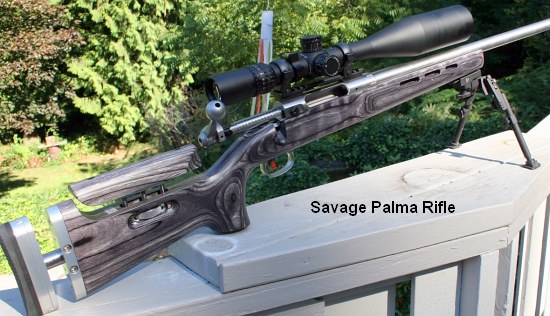
Savage’s Fullbore (Palma) rifle team performed well in recent competitions. The four-man team (Darrell Buell of Damascus, OR, John Weil of Welches, OR, Monte Milanuk of Wenatchee WA, and Stan Pate of Milwaukie, OR) wrapped up the season with two internationally-sanctioned matches. The first was the Canadian International Fullbore Championships in Chilliwack, B.C. and and the second was the Pacific International Fullbore Championships held just outside of Portland, OR. At both matches, elite shooters from around the world competed at 800, 900 and 1,000 yards. The two matches combined constitute a “Super Aggregate”, or Continental Title.
Team members (L to R): John Weil, Darrell Buell, Monte Milanuk and Stan Pate. (File Photo 2009).
Team Savage loaded up on the hardware at both matches, winning multiple medals at the various distances. Savage’s four shooters captured the team gold at the Canadian match and Gold and Silver in the individual Super Aggregate.
At the Pacific Int’l match in Oregon, local knowledge helped Team Savage rack up the medals. This competition was held on Weil and Pate’s home range at the Douglass Ridge Rifle Club. With John Weil leading the way, Team Savage put on a clinic: Weil won all seven gold medals available, while teammate Pate won six silvers. Milanuk added three bronzes. Weil also shot an impressive 148-4X at 1000 yards. In the video below, Team Captain Stan Pate demonstrates the accuracy of the Savage Palma (Fullbore) rifle, nailing a steel target at 1169 yards.
Chrysler is offering a lockable gun storage compartment on its new series of Outdoorsman pickup trucks. These trucks can be configured with twin, lighted, lockable and watertight “RamBox” compartments — one on each side of the truck bed. The dual RamBox option costs $1895, and for $205 more Chrysler adds internal, vertical cradles that hold two rifles or shotguns. These cradles can be rotated 90 degrees to hold up to six fishing rods.
We think Chrysler’s built-in gun storage is a very cool feature — for the man who has everything. It will certainly create envious looks when you roll up to the shooting range in your new truck. From a practical standpoint however, it might be better to forgo the gun cradles in favor of open storage in both side-boxes. You could then use both lockable side compartment for any purpose. When you need to haul firearms, simply put cased guns inside one or both side compartments.
For more information on Chrysler’s Outdoorsman pickups, which start at $28,350, visit the Chrysler Truck Blog. Ram Outdoorsman trucks go on sale 3rd quarter 2010 (just in time for hunting season).


 This fall, the NRA is releasing a definitive, 575-page history of the National Matches. The $59.95 book, entitled The National Matches: 1903-2003 The First 100 Years covers all the National Match venues, starting with New Jersey’s Sea Girt, followed by Creedmoor in New York, and finally the present-day home at Camp Perry, Ohio.


 Leupold’s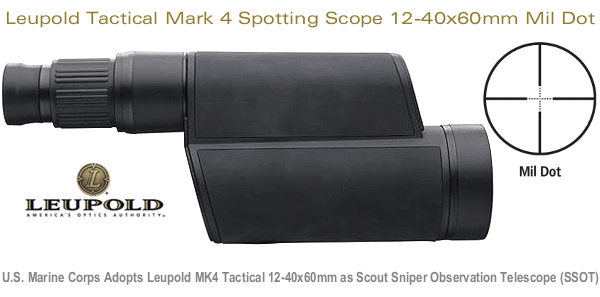


 John Perkins of

 Leupold’s CDS system is a user-friendly invention that can really simplify shooting at multiple yardages. The big single-digit Arabic numerals on the elevation dial correspond to 100-yard intervals, while the smaller numbers show 50-yard intervals. (Click values are otherwise 1/4-MOA.) No longer do you have to remember specific come-ups for particular distances. For the CDS system to work correctly however, your load’s ballistics must match a set of master loads that Leupold uses to calibrate the dial scales. Hunters using most common cartridges should find a calibrated load that matches their muzzle velocity and bullet BC. CDS turrets are available on these scopes: VX-3 3.5-10x40mm, VX-3 3.5-10x50mm, VX-3 4.5-14x40mm, VX-3L 3.5-10x50mm and VX-3L 4.5-14x50mm.
 Ambi-Safety Makes Sense on Carry Gun