|
|
October 10th, 2010
 RCBS has recently started shipping two new Rifle Bullet Feeder Kits for progressive metallic reloading presses. Availble for 30-caliber and 22-caliber, the Rifle Bullet Feeder Kits are designed to fit on most 7/8″-14 threaded progressive presses. An electrically-powered collator unit orients the bullets to drop directly into the feed mechanism where they are placed precisely in the case-mouths of your cartidges.
Feeder Kit Can Increase Load Rate by 50%
The 30-Cal hopper holds approximately 125 (180gr) 30-caliber bullets while the 22-Cal feeder holds about 250 (55gr) 22-caliber bullets. RCBS claims that both units increase load rates by 50%. We’d say that depends on how fast you operate your machine. On this Editor’s RCBS 2000 Progressive press I can usually pick up a bullet and place it in the case mouth in about 2-3 seconds. But now and then I will fumble with a bullet or place it in slightly tilted, requiring me to do it all over again. That’s where the feeder comes in very handy — the bullets always orient correctly in the case. We just wish RCBS offered .45 caliber and 9mm versions for pistol ammo and a 6mm version for rifles. RCBS says these calibers may be offered in the future.
RCBS Bullet Feeder Features:
• Available for either 22-caliber or 30-caliber
• Large hopper for non-stop reloading and max output
• Bullets are oriented to drop directly into feed mechanism/seat die
• Bullet feeding and seating are accomplished in one station.
• Adjustable collator height
• RCBS® two-year warranty
Feeders Increase Reloading Efficiency
The power-operated collator unit ensures each bullet component is properly oriented for feeding directly into the seat die. “This steady stream of properly-aligned bullets increases the consistency of your reloading process,” explains Kent Sakamoto, product line manager. “Red, green or blue, our new Rifle Bullet Feeders fit all progressive presses and increase the seed and consistency of reloading. That’s what these Bullet Feeders bring to the reloading table.” Here is a video we took at SHOW Show 2010 where the RCBS Bullet Feeder was previewed by Sakamoto:

October 9th, 2010
Stephen Ivey has engineered a set of gimbaled scope rings allowing up to 150 Minutes of Angle (MOA) of elevation. These rings have precision hinge pins front and rear allowing the entire scope to be tilted by a micrometer-controlled cam in the rear. This allows the scope to tilt upwards (in the rear) with the front ring as the axis while both rings remain parallel to prevent scope binding. The rear ring tilts to match the front while a cam pushes it up. Ivey also makes tilting +150 MOA Picatinny riser rails.

Ivey offers two scope-mounting products. First is the RT-150 Ring set (above). This has two, polished 30mm or 34mm 6061-T6 aluminum rings with bases to fit a Picatinny profile or mil-spec 1913 rail with standard 5mm cross slots at 10mm spacing. (Weaver installation requires extra cross-slots to be cut.) Total elevation is +150 MOA. The micrometer adjuster is graduated in true 1 MOA intervals, with 5 MOA of elevation change per rotation. This product costs $525.00 and requires at least 5-1/2″ length mounting base.

The newest product is the MSRR-150MOA Riser Rail, a pivoting 5.75″-long Picatinny-style rail that accepts Weaver-style clamping scope rings. This Adjusts from Zero to +150 MOA and raises the scope 1.45″ from the top of the action. The extra height provides clearance for large objectives when the unit is tilted for a full +150 MOA elevation. Cross slots are 5mm wide at 10mm (.394″) spacing. The $525.00 riser rail is made of 6061 T6 Aluminum hard-anodized black. Clamps are heat-treated steel. The micrometer thimble is marked for 1 MOA gradations, and provides 20 MOA per revolution.

The Ivey products are expensive, to be sure, but they are beautifully machined, and they offer unique capabilities for ultra-long-range shooters. With the +150 MOA units you have enough elevation to shoot at 2000+ yards! We like the idea of using the micrometer to dial within 1 MOA and then just using the scope turrets for fine-tuning. To learn more, visit the Ivey Shooting website, or call Stephen Ivey at (615) 896-9366, or email him at sales [at] iveyshooting.com .
October 6th, 2010
Hornady plans to release a brand new 285gr, .338-caliber match bullet within the next few weeks. This bullet, which boasts a mind-blowing 0.735 G1 BC, has already proven itself in competition. At the 2010 IBS 1000-yard Nationals in September, Scott Fletcher won the Heavy Gun (HG) group title shooting the new Hornady 285gr BTHPs. Scott’s 4-match, 10-shot per target group Aggregate was 9.148″. Scott was shooting a large wildcat, the .338 Sloan. That cartridge is nearly identical to the new .338 Norma Magnum*, which could be described as a “chopped” .338 Lapua Mag — shorter with less case capacity.

Weight is unlimited in the 1000-yard Heavy Gun class. Weight soaks up the recoil of big cartridges like the .338 Norma Magnum, making them manageable to shoot. The Big 30-Cals have long dominated this HG category, but some shooters like Fletcher are experimenting with some really big cartridge/bullet combinations, in pursuit of class-leading ballistics. We don’t know how fast Fletcher pushes his prototype Hornady 285s, but that 0.735 BC has to give the bullets awesome performance in the wind.
Artist’s concept — No photos of the new bullet are available.

New Manufacturing Process Produces Bullets with Near-Zero Run-out
According to Hornady’s Chief Ballistic Scientist Dave Emary, the new 285-grainer is a VLD-style, secant ogive projectile with a standard, drawn-copper jacket and lead core. This is a BTHP, NOT a plastic tip bullet like Hornady’s A-Max designs. Emary says, “This bullet was originally developed for the military. It has just about the lowest drag possible with conventional bullet construction and ogive design.” The .338-caliber 285gr bullet is the first of two new super-low drag bullets Hornady will be releasing before the end of the year.
The new 285gr bullets are built with a new manufacturing process that improves jacket concentricity to previously unattainable levels. Emary says: “Measured along the entire jacket, these bullets have extremely low eccentricity. We measured zero to a couple ten-thousandths total run-out along the whole jacket. As a result the bullet has show truly outstanding long-range performance, with sub-half-MOA accuracy at extreme ranges.” Hornady Project Engineer (and 1K shooter) Joe Thielen added: “These bullets are specifically designed and built for long-range use, and the jackets are the some of best I’ve ever seen.”
When will the new bullets be available? End of the year at the latest. Emary says the 285s should be available “before the end of November”. When we asked Hornady Marketing guru Steve Johnson, he said “Soon. They’ll be out soon.” When pressed as to “how soon”, Steve responded: “The release is imminent… imminent”.
*The .338 Norma Magnum was originally developed by the American sport shooter Jimmie Sloan as a long-range sport shooting wildcat cartridge. It was designed to shoot the .338-caliber, 300gr Sierra MatchKing projectile from actions/magazines too short for a .338 Lapua Magnum. Sloan licensed the design to the Norma group. Both the .338 Norma Mag and the larger .338 Lapua Mag are derived from the .416 Jeffreys, but the .338 Norma Mag fits in a shorter action.
October 5th, 2010
South African Pieter L.R. (aka “Baboonstalker” in our Shooters’ Forum), has crafted an impressive single-torch annealing machine with a compact footprint. Pieter’s new KinetiX Precision Annealer holds cartridge brass cases in a dished carousel (wheel) machined from billet. An electric motor advances the carousel while a separate belt-driven spindel rotates each case when it in positioned in the flame. The standard wheel holds cases up to .308 bolt-face in diameter, and Magnum wheels are available.

Precision Mount for Torch-Head
One of the most impressive features of the new machine is the 4-way mount that holds the torch tip. This adjusts for height, flame angle (up/down), and flame distance to case. It can also rotate around a vertical axis. The mount looks like something NASA would produce for vectoring rocket thrusters.
Compared to some other annealers, Pieter’s KinetiX unit is quite compact, with a small footprint. The entire unit (less torch) would fit in a large hat-box. Pieter kept the footprint small by placing all the drive motors and gears under the carousel, rather than off to the side. Pieter optimized his machine for a single torch: “Dual torches are good on some other models to distribute the heat around the neck or to get longer exposure time on the constant-motion models. On this model the case turns in the flame so i do not see a real need for a secondary torch. However, if you want two or more torches i would be more than happy to add brackets for them.”

Basic KinetiX Annealer Will Cost $540.00
Pieter plans to put his KinetiX annealer into production: “I will be selling these units for $540 USD not including shipping, which is about $105 USD for airmail and $35 USD for surface mail. I hope to have my own website up and running soon but you can reach me on gokinetix[at]telkomsa.net in the meantime.” The $540.00 price includes the annealing machine, speed controller, power supply (100-260V) and standard wheel which up to .308-rim-diameter cartridges (including 284s). Pieter tells us: “I have tested [the standard wheel] down to .22 Hornet, but anything that sticks out above the plate (7/8″) should work fine. If you have a specific case in mind that does not fit, i can just make up a special wheel for you.” Pieter also plans to offer Magnum wheels for cases up to .338 Lapua, and Super Magnum wheels for cases up to .50 BMG.
October 3rd, 2010
Ask any Palma shooter and he’ll tell you that Barnard makes one of the smoothest, most reliable actions available. And now there is a new modular metal stock system that adapts the Barnard SM action for use in target and tactical rifles.

The new Barnard 07 Target-Tactical Stock (TTS) from MTGuns features an anodized aluminum chassis with a floating tubular handguard. The TTS is designed for the Barnard small repeater action, and the chassis is configured to use reliable H.S. Precision detachable box magazines. One H.S. Precision .308-sized magazine comes with each stock, allowing the rifle to be chambered for any round with a .308-spec case head and a maximum overall length of 2.800″. That means you can mag-feed and shoot a 6XC, .243 Win, 6.5×47, 6.5 Creedmoor, .260 Rem, .308 Win, or 7mm-08.
Fully Adjustable Cheekpiece and 4-Way Buttplate
One of the most impressive features of the Barnard 07 TTS stock is the ease with which it can be configured for different shooters or different shooting positions. The stock comes with an adjustable cheekpiece secured with a large, ergonomic rotary knob. The Barnard TTS stock also includes a 4-way adjustable butt plate at no extra cost. This allows the shooter to easily modify length of pull (LOP), pad height, offset, and cant (buttpad L/R tilt). Also included with the stock is an elevated Picatinny-spec scope rail, and the Barnard SM action is drilled and tapped for a Remington-type rear sight base.


While there are many metal chassis systems offered for Remington-footprint receivers, the TTS system gives you the advantage of a Barnard action. Like its ‘P’-model big brother, the SM action boasts a very fast lock time, easily removable striker assembly — no spring compression issues — with a 1/16″ firing pin in a three-lug bolt. Overall bolt/receiver tolerances are machined to very exacting standards. The SM action can use Remington-style triggers.

The TTS stock is strong and stiff, yet light in weight. Using a TTS stock, you can build a rifle that is comfortable to carry in the field. A complete rifle fitted with a 26″ medium Palma contour barrel (and included Picatinny scope rail) weighs just 12 pounds. The Barnard Target-Tactical stock comes standard with sling swivel studs, one on the handguard and the other near the bottom of the adjustable buttplate.
For more information on the Barnard 07 Target-Tactical Stock, visit MTGuns.com, or call MTGuns (in California) at (805) 720-7720. The Barnard 07 Target-tactical stock, complete with floating handguard, 4-way buttplate, H.S. Prec. magazine, and scope rail, normally retails for under $1300.00, but prices are subject to currency fluctuations (Barnard products are crafted in New Zealand).
Disclosure: MT Guns has purchased advertisements on this site.
September 30th, 2010
Earlier this month Wilson Combat launched its new gun blog, which is worth a visit. Though focused primarily on handguns, the Wilson Combat Blog also features tactical rifles and shotguns. While there are match reports and gun maintenance articles, the Wilson Blog is mainly a showcase for products, which are illustrated with really superb photography (some of the best “gun glamour” images on the web). Here are some examples of the “eye candy” Wilson combat offers on its site…
Case Colored 1911 for Trey of Jackson Armory in Texas
Trey calls this unique, Case-Colored custom the “Patriot Elite”. The slide is hand polished and then sent to Doug Turnbull for his exceptional bluing and color case hardened finish on the frame. The frontstrap was left bare to show off case colors.

Custom Professional with Flush-Crowned Barrel
Another interesting gun is this 4″ Commander-style 1911 K-5 with beautiful, fan-pattern Cocobolo grips. Notice that the muzzle is flush crowned. A new option for Wilson, the flush crown is made possible by the use of a flat wire, Glock-style recoil spring. This new feature is only available for compact/professional length slides at this time.

Wilson Arms AR Trigger — Long-Term Test
The Wilson Arms Blog also links to a Military Times long-term test of the Wilson Tactical Trigger Unit (TTU) for AR-type lowers. The Times tested the TTU over six months with 10,000 drops of the hammer. Click Here to read the full review, published on Sept. 29, 2010.

September 27th, 2010
 We’ve confirmed that Danny Biggs, the Spirit of America’s F-Open Class Winner, shot the match using a bipod, rather than a pedestal rest. This is pretty remarkable because top F-Open competitors have traditionally preferred the stability and quick adjustability you get with a deluxe pedestal rest such as a Farley, John Loh (J.J. Industries), or SEB. Of course, Danny had a trick up his sleeve — his prototype Sinclair International bipod features a quick-adjusting elevation control. No, you can’t buy a bipod like Danny’s — at least not yet. Sinclair Int’l hopes to offer production versions before the end of 2010.
Sinclair staffer Pete Petros competed at the 2010 SOA Match, and recounted his experiences in Sinclair’s Reloading Press. Concerning Biggs’ bipod, Petros wrote:
An interesting fact about Biggs’ win is that he was shooting off of the Sinclair F-Class Bipod which is generally used in F-TR competition. In F-Class open most competitors shoot off of a bench-type rest modified to shoot off of the ground in the prone position. The bipod Biggs [used] is a new-model Sinclair Elevation-Adjustable version of the newer Sinclair F-Class Bipod. Danny has been testing this product for us during the past year and obviously is having great results. We should have these bipods ready for production in a few months. Keep posted to our website for announcements. But trust me, I think Danny would shoot well balancing his gun on a rock –- he’s that good!
 While most F-Open shooters used a front pedestal rest, either a joystick design or a center column pedestal with remote-adjustable windage top, Danny used a wide-base bipod, as he had done at past Nationals in the F-TR class. But Danny’s bipod was very special. It is a prototype, modified Sinclair design with height adjustment via a central, vertical-axis knob.
As you can see from the pictures below, the left and right bipod legs are attached to a T-shaped silver (aluminum) bracket. This bracket moves up and down as the silver knob is turned clockwise or counter-clockwise. As the knob turns, its threads pull the T-shaped bracket up and down relative to a center block of aluminum bolted to the bipod’s attachment to the rifle’s forearm accessory rail. With this system, Danny can easily reach forward and make precise adjustments in elevation. Note that the Sinclair bipod’s secure rail attachment is retained and Danny can still adjust rifle cant (tilt), using the rear push-button handle. This rear handle functions like a Pod-lock allowing the rifle to be tilted a few degrees to one side or the other to compensate for side-sloping terrain.


September 26th, 2010
 Here’s a product that should interest varminters and Service Rifle shooters. Mossberg has just introduced its new Tactical .22 auto-loading rimfire rifle. With a $276 MSRP, the Mossberg Tactical .22 provides the look and feel of an AR-style rifle with an affordable price. This gun, officially sold by Mossberg Int’l, promises to be a fun plinker that can also work for very close-range varmint hunting on small prey.
Service Rifle shooters looking for an inexpensive trainer will find that the Mossberg Tactical .22 shares most of the ergonomics of their centerfire AR-15 match rifles. With the rising costs of centerfire ammunition, Mossberg’s new Tactical .22 rimfire can provide a cost-effective training platform.
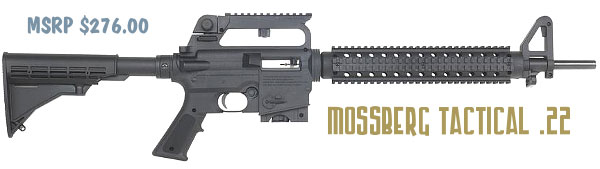
 Model 702 Action in AR-Style Chassis
The lightweight Mossberg Tactical .22 is based on Mossberg’s proven model 702 rimfire autoloader. Mossberg adapted the Model 702 action to an AR-style chassis with an 18″ barrel and a quad-rail fore-end. (We would rather see standard AR-style handguards, but this does allow a varminter to mount lights or other accessories on the forearm.) The Mossberg Tactical .22 will be offered with two stock configurations — a fixed stock with 13″ LOP, or a 6-position stock that can adjust length of pull from 10-3/4″ – 14.5″. The adjustable stock may be good for young kids, but otherwise we recommend the fixed stock. The Tactical .22 comes with an A2-style carry handle and an adjustable rear peep/front blade iron sights. On top of the carry handle is a Picatinny rail for mounting optics. Groan — that’s the wrong position for a scope, because you can’t maintain a cheek weld, but the rail is better than nothing if you need to mount a red dot or other sighting system. A 10-rd magazine is standard.
September 22nd, 2010
Our readers were very interested in the recent announcement that Remington Arms was selected to build the new M24E1 Sniper Weapon System, the successor to the venerable M24 Sniper Rifle used by the U.S. Army for many years.

 New Leupold Scope for M24E1
A key component of the M24E1 system is the new Leupold Mark 4 6.5-20x50mm Extended Range/Tactical (ER/T) M5 riflescope (34mm locking version). This scope features First Focal Plane (FFP) Horus ranging reticles (H27 or H58), side parallax adjustment, and a beefy 34mm maintube.
Other key features of the new ER/T include M5 windage and elevation adjustment dials with audible, tactile 1/10 (0.1) milrad clicks to match the mil-based Horus reticles. An elevation zero-stop helps prevent under-rotation in high-stress situations. The eyepiece offers long eye relief and it employs a “lockable” fast-focus design to ensure that the reticle remains in sharp focus. The scope has an auto-locking elevation adjustment.
 With either a Horus H27 or H58 reticle in the front focal plane, the scope can accurately range at all magnification settings (the reticle magnifies with the image). The 34mm maintube allows for ample windage and elevation adjustment — a full 100 MOA of elevation and 100 MOA of windage adjustment.
The Mark 4 6.5-20x50mm ER/T M5 Locking Adjustment riflescope is waterproof, fog proof and shock proof. With its M5 Locking Adjustment, the scope’s platform is unique in the Mark 4 ER/T line. It is controlled under International Traffic in Arms Regulations (ITAR) and limited to domestic and international government sales only.
September 21st, 2010
The United States Army’s Joint Munitions and Lethality Contracting Center has awarded Remington Arms a 5-year contract to upgrade 3,600 current M24 sniper rifles to the new M24E1 Sniper Weapon System. The major change will be a conversion from the 7.62mm NATO (.308 Winchester) cartridge to .300 Winchester Magnum to provide “additional precision engagement capability and range”. The contract, potentially worth over $28 million, was awarded after a 9-month competitive evaluation. CLICK HERE for Remington Press Release.
The Army’s new M24E1 sniper rifle will share the Rem 700 long action (receiver) and trigger from the currently-fielded M24, but little else. (The Army specifically required that the M24E1 be built around the same 700 series long action and fire control system.) The M24E1 is considered a “total conversion upgrade”, by which the barrel, stock, magazines, muzzlebrake, suppressor, and even the optics will be changed. The M24E1 will carry a 6.5-20×50 variable power Leupold scope with a first focal plane (FFP) reticle that includes .300 Win Magnum bullet-drop compensation markings.

To the new M24E1s, Remington will fit 24″, 10-Twist (5R) hammer-forged barrels, chambered in .300 Win Mag. After the change in chambering, the most notable difference between the M24 and M24E1 is the new modular metal chassis/stock. There are a variety of adjustments in the rear buttstock section, which also folds forward for easier transport. The forearm has removable Mil Std 1913 Picatinny Rails to allowing fitting of night-vision devices and other accessories. Click Here for Forearm Photo.
M24E1 Contract Follows Production of 15,000 M24s By Remington
It is no great surprise that Remington won the contract to upgrade the older M24 sniper rifles. Remington has been produced nearly 15,000 M24 Sniper Weapon Systems for the military over the past 22 years. The M24E1 may be seen as the “natural evolution” of the Army’s existing Rem sniper platform. While the M24E1 rifle looks radically different on the outside, it remains much the same on the inside. According to Remington:
This long tradition of production and repair makes Remington the natural choice to upgrade this venerable system[.] Current operations in Southwest Asia exposed the need for a more powerful and longer-range sniper round. The baseline M24 was designed from inception to chamber a longer and more powerful round than the 7.62mm NATO, so an obvious solution to the capability gap was to finally exploit the M24’s long bolt action and chamber it for .300 Winchester Magnum.
|


