Our friend Robert Whitley of 6mmAR.com has come up with a new, accurate 6mm wildcat based on the new Lapua 22-250 brass that has just started arriving. Robert provides this report:
“I just received a box of the new Lapua 22/250 cases — beautiful brass! My real desire with it was to make it into a 6mm version, preferably something that was ‘no neck-turn’ with a .308 Win-type body taper that would work well in bolt gun and semi-auto magazines and would have a capacity to allow superior velocities. I considered the 6XC, but since you have to bring a whole lot of the shoulder of the brass up into the neck (when you re-form the brass from 22-250 to 6XC) that would necessitate neck-turning it because with Lapua brass the shoulder metal is thicker than neck metal of the brass.
I wanted a simple ‘neck it up and shoot it’ approach so I made up a 6mm-250 Improved 30 cartridge (i.e. 6mm-250 Improved with a 30 degree shoulder) and this thing works great — just neck up the brass, load it and shoot it! The case is like a 6XC with a .030″ longer body and a .030″ shorter neck, which works out fine if you are going to be shooting mainly the 105-108 gr bullets (which it will do very well shooting 2950 – 3000 fps). If you want to hot-rod things, which I do not, I am certain the case can push the 105-108 gr bullets a fair amount faster.
I set it up and throated the reamer for the Sierra 107s and the Berger or JLK 105 VLDs (i.e. a .090″ free bore on the reamer) and it works great with them. If I was going to use it with the Lapua 105s or the Berger 108s I would add about .025″ – .030″ to the freebore of the reamer (i.e. make the freebore around .115″ to .120″).
The great thing is you can use a 6XC die set for it without modification, and all you need to do is keep the dies about .030″ up off the shell holder from their normal position and use them as is. You can make a spacer washer about .030″ thick that you can put on and take off the 6XC dies and use the dies for both cartridges (i.e. 6XC and 6mm-250 Imp 30).
6mm-250 Imp 30 Shows Great Accuracy
Fire-forming loads are real accurate. Here is a 10-shot group I shot prone at 100 yards shooting fire-forming loads with it — the group is the size of a dime. For fire-forming I use a milder, but still very accurate load: 32.0 grains of N140 with a Sierra 107 and a BR2 primer. For fire-formed cases you can jump up to N160 (around 38-40 grains — depending on lot) and it will push the 105-108 gr bullets real accurately in the 2950-3000 fps range, with low ES and SD. This cartridge has a neck length of .268″ which is plenty long for a 6mm shooting bullets with varying bearing surface lengths. The reamer diagram (link below) leaves about a .003″ neck clearance over a loaded round, which seems to work out very well for a ‘no-turn neck’ set-up.
So there you have it … the 6mm-250 Imp 30 is simple, easy to make, accurate as all get out, there are available factory die sets you can use, and it uses great new Lapua brass — what’s not to like!”
MidwayUSA recently sent us its new Compact Competition Range Bag for review. Overall, we were very impressed. The bag is made from a strong, heavy-duty PVC-coated polyester, with high-quality, large-toothed zippers. A comfortable, curved carry strap is secured by sturdy, all-metal clips. The “build quality” is visibly much better than most range bags on the market. I wish my airline carry-on bags were built as well as this. The bag is offered in black for $26.99 or olive-drab for $39.99. We tested the handsome olive-drab version which is a good match for our khaki AIM 60 Tactical Drag Bag.
Measuring 16″L x 12″W x 10″H, this Compact Range Bag is definitely smaller than MidwayUSA’s popular Large Range Bag (22″L x 15″W x 10″H). However, the “Compact” version will hold plenty of gear — pretty much all a pistol shooter will need at the range. For a rifle shooter, it will haul ammo boxes, earmuffs, magazines, and other miscellaneous gear. You CAN get a rear sandbag in the MidwayUSA range bag, but it’s probably best to use the bag for ammo boxes and the like. Overall, we really like this bag, as do most buyers. Among 43 MidwayUSA customer reviews, the average rating is 4.9 out of 5 stars. Here are two typical buyer reports:
“This bag is great. It easily holds both my S&W MP9s, hearing and eye protection, 6 magazines, magazine loader, targets and enough ammo (200-300 rds) for a good session at the range. The quality is comparable to bags costing twice as much.” — Richard B, Virginia
“I have used many different range bags over the years, but I have to say that this is by far the best…. Plenty of room for ammo, hearing and eye protection, documentation and other materials. This bag is a great buy.” — Mark C, Oklahoma
Quality Revealed in the Details
The details of this bag reveal smart design and quality construction. On the bottom, two plastic foot pads with ¼” high ribs are stitched to the fabric for grip and moisture standoff. On the inside of the bag a removable, waterproof sole further protects the contents. On both ends of the bag are full-width zippered pockets, with a handy clear identification window on one side. Metal D-rings above the end pockets provide solid attachment points for the heavy-duty shoulder strap. The shoulder strap pad has a rubberized underside that keeps the strap from sliding off your shoulder.
The main compartment is conveniently accessed through a Velcro end closure plus two long, parallel zippers whose pull-tabs are connected with a cord. The main compartment is big enough to hold two large MTM Caseguard R-100 series rifle ammo boxes, with plenty of room left over. Unfortunately, there’s no easy way to lock any compartment on the bag. That’s too bad, since some jurisdictions require handgun cases to be locked during transport.
Deceptively Large Capacity for a ‘Compact’ Bag
To test the carrying capacity of the MidwayUSA bag, we loaded it up with 100 rounds of rifle ammo, 600 rounds of centerfire pistol ammo, 500 rounds rimfire, earmuffs and FOUR pistols tucked in the padded side sleeves. All that gear fit nicely with room to spare. (We recommend putting handguns in protective sleeves if you load two per side). The padded, full-width, zippered main pocket keeps seven spare magazines organized and protected. On the reverse side of the bag, a similar, full-length padded pocket provides undivided storage space. That large outside pocket also has a zippered compartment with dividers for pens and a small notepad. The bag’s many pockets make it easy to organize miscellaneous gear such as staple gun, target stickers, small binoculars, timers, and radios.
The durable fabric, thick padding, heavy-duty zippers, and quality stitching should deliver many years of hard duty. This is a bag that holds its shape more like a luggage piece, not a thin bag that will squash flat and lay on the shelf out of the way when not in use. The black Compact Range Bag is available now. The olive drab version we tested should be in in stock on 5/28/2010.
The NRA Training Counselor Guide (TC Guide) is the “textbook” used for training new NRA instructors. It includes lesson plans and course outlines for Basic Instructor Training, plus NRA Instructor qualifications and assessment exercises. The new THIRD Edition of the TC Guide (complete with PowerPoint CD) has just been released. Shooting organizations involved in training NRA Instructors should replace older TC Guides with the new Third Edition.
The new TC Guide incorporates several policy changes and formatting has been standardized. The new edition also allows revisions to be posted as addenda, making it easier to update. The print version of the new TC Guide (3rd Ed.) is available from the NRA program materials center for $45.00. Later this year the NRA hopes to release a digital version of the TC Guide at a reduced cost.
The Creedmoor Sports 2010 catalog will be mailed out to Creedmoor’s customer list next week. Want a sneak peek? The complete, 88-page 2010 catalog, in digital format, is available online. CLICK THIS LINK to browse through the pages, search for products and zoom in for details.
There are many new products in the 2010 Creedmoor Catalog, such as a new fullbore prone coat, with special features for belly shooters. Creedmoor worked with Dennis Flaherty, U.S. Palma Team Captain, to develop this product. $50.00 from the sale of each coat goes to support the U.S. Palma Team. Also new this year is a “No-Pulse” sling, item NPS-01, $81.95. The 2″-wide sling is made of synthetic material so it won’t stretch or shrink, no matter what the weather. Special “grippy” backing stabilizes the sling on your arm, while a unique dual-strap connection on the cuff dramatically reduces pulse effects. In addition, Creedmoor has a new, deluxe spotting scope mounting head (“Polecat” series) which comes in three versions, so it can fit 5/8″, 3/4″, or 1″ stands.
Sporting Classics, a specialty publisher, has released a new edition of 45 true-to-life Jack O’Connor stories from the pages of Outdoor Life, Field & Stream, Petersen’s Hunting and other popular magazines of his day. The new book, Classic O’Connor, is a sequel of sorts to Sporting Classics’ popular compendium, The Lost Classics of Jack O’Connor.
In the new 440-page book, Jack O’Connor recounts his worldwide hunting adventures, during which he pursued everything from ducks to grizzlies, pheasants to kudu. Classic O’Connor presents several of the author’s greatest gun stories and a large selection of never-before-published photographs of the celebrated sportsman and his family on hunting adventures around the world. The book is illustrated with 40+ drawings by acclaimed artist Ron Van Gilder. Hardcover with dust jacket, the book lists for $35, but it can be pre-ordered on Amazon.com for just $23.10, with an August 1st delivery date. To get the book a soon as possible, call Sporting Classics at (800) 849-1004 or visit www.sportingclassics.com.
Another O’Connor title worth reading is The Hunting Rifle, still considered one of the definitive works on selecting a hunting rifle and cartridge. One owner of The Hunting Rifle explains: “It would benefit every hunter to take the time and read this book. It offers a corrective to the spirit of things that have gripped the hunting scene lately. Today, if one reads a hunting magazine, [one is] offered the view that you need the fastest and loudest cartridges, rifles with special finishes and the most expensive of anything. Ole Jack reminds us that many have killed game with ‘lesser’ guns for a very long time, and that these new gimmicks will not make you a more lethal hunter.”
With the Cerberus-owned Freedom Group family of companies preparing for an IPO later this year, industry experts wondered: “Will Cerberus purchase a handgun manufacturer, or launch a line of Remington handguns?” With the announcement of the new Remington 1911 R1 pistol, Cerberus has showed its hand. The new 1911 R1 is the first pistol Remington has produced in decades, and the first 1911-design in 91 years.
Remington’s 1911 R1 is featured in the current issue of Shooting Times (left). A blued-steel retro design, the Remington 1911 R1 is faithful to the 1911 A1 with some modern upgrades. Like the original 1911, Remington’s R1 has a flat mainspring housing, internal extractor, short trigger and double diamond grips. Modern enhancements include a flared ejection port, beveled magazine well, loaded chamber indicator, tall single-dot front and two-dot rear sights, and a black-oxided stainless barrel. The 1911 R1 also has a Series 80-style firing pin block safety.
Classic Lines with Some Modern Features
From a subjective standpoint, this Editor likes the looks of Remington’s 1911 R1 and I favor some of its design features. I personally can shoot 1911s better with the short trigger, and I prefer the clean look of a slide without forward serrations. However, I question the decision, based on styling, to use an internal extractor, and the tall blocky sights look somewhat out of place on a retro-styled 1911. However, the big sights will unquestionably help the gun’s shootability.
Remington’s 1911 R1 will be officially launched at the NRA Annual Meeting in NC in May. The gun, which is made in Remington’s Ilion, NY facility, should be available in June, 2010, and dealers are already taking advance orders. The Remington 1911 R1 will be shipped in a custom carry case with two 7-round magazines and a barrel bushing wrench (see photo below). Suggested retail price is $699.00.
Do We Need Yet Another 1911?
It’s easy to be cynical about Remington’s entry into the 21st-century handgun market. Rather than give us something new and really remarkable, Remington merely recycled the tried and trued 1911, a design that is already produced by dozens of companies. Do we really need yet another 1911? One clever gun writer joked: “‘1911′ is supposed to be the model name, not the number of companies building versions of it.” Does Remington bring anything to the marketplace that one can’t buy elsewhere? Well, 1911 fans like the pricing of Remington’s 1911, predicting it will sell very well at the $700.00 mark. And Remington does have a history of producing 1911 handguns for the U.S. Military — Remington-UMC built 21,677 1911s for the U.S. Ordnance Dept. in 1918.
But still, one wonders how much market share Remington will grab from Kimber, Springfield Armory, Smith & Wesson, Les Baer, STI, Wilson Combat, USFA and other proven 1911-makers. Is Remington too late to the party with its retro-styled 1911 R1? Would it have been better for Remington to launch an all-new pistol design that creates a whole new market segment, as did Glock and Keltec? If Remington wants to become a major player in the pistol market, wouldn’t it have been better to engineer a more modern pistol that could compete for lucrative LEO and military pistol markets? Perhaps the answer to these questions is that Remington simply took the cheap and easy route — producing a pistol that required minimal engineering and testing. As ToddG writes on the Pistol-training.com Blog: “Building a 1911 is just a lazy way to enter the handgun market. There is little design and testing needed compared to making something new from scratch. Pick a design, build some prototypes, do a little testing to make sure the CNC machines are set right, and start pumping out guns.”
With a standard AR-15 we’ve never had problems with the standard coil-spring-equipped buffer system (other than the annoying spring noise). But with the AR-15’s big brother, the heavier-recoiling AR-10, an enhanced buffer system is welcome. A upgraded buffer won’t reduce recoil force, but it can soften the perceived recoil pulse, allowing the shooter to get back on target more quickly while reducing shooter fatigue over an extended string of fire.
Buffer Technologies of Jefferson City, MO, has introduced a new hydraulic buffer for AR-10-type rifles. Priced at $99.95, the hydraulic buffer weighs 0.38 pounds, has a 5.8-inch compression length, and fits AR-10s with full-length buttstocks. The buffer, crafted from black-oxided steel and black-anodized aluminum, is optimized for use with the .308 Winchester cartridge.
Buffer Technologies claims that its hydraulic buffer can help prevent failures of internal parts and optics by reducing shock and taming recoil. According to Rob Parham, Buffer Tech’s Military/LEO Sales Director: “Our new buffer makes a great gun even better, while protecting the valuable accessories on the firearm. This product is great in assisting target acquisition and allows for quicker follow-up shots.”
We thought we’d seen “all things tactical” — tactical trousers, hats, gloves, boots, duffle bags, even tactical beer mugs. But here’s something new: a tactical energy drink from THOR Global Defense Group.
So, when you “operators” need go-juice after fast-roping down from a Blackhawk in an Afghan firefight, now you can get the liquid energy blast you need to save the planet. An 8.4-oz can of THOR tactical energy drink contains 27 grams of sugar and 75 mg of caffeine (twice as much as an ordinary cola drink). A can of THOR also contains a whopping 1000 mg of Taurine, an amino sulfonic acid thought to improve athletic performance and lessen the effect of hangovers. So, if you partied too hard the night before your big mission, THOR’s tactical energy drink might be just the ticket.
Downsides of Energy Drinks
In all seriousness, we’ve found that energy drinks of this kind (Monster, Red Bull, Rock Star), can improve alertness when driving or working late — even if you end up feeling more drained afterward. However, we question the effect of all that sugar, caffeine, and stimulants on your trigger finger control. Maybe real shooters should avoid this kind of beverage until AFTER the shooting match. These caffeine-laced energy drinks can be potent diurectics — causing you to dehydrate faster. REAL Tactical operators would probably be better off consuming plain water before most missions. Credit Steve of The Firearms Blog for telling us about THOR Tactical Energy Drink. Steve asks: “Who will be the first to develop tactical beer?”
We talked recently with our friend Darrell Jones, a talented benchrest shooter from Tennessee, who operates a brass processing business, DJ’s Brass Restoration Service. Darrell ultrasonically cleans old cartridge brass then carefully anneals each case, using temp-sensitive lacquers to ensure the brass is neither over-annealed or under-annealed. As far as we know, DJ’s Brass Restoration Service is the ONLY business in the country offering combined ultrasonic cleaning and annealing. And now Darrell can process your brass with even great efficiency.
Darrell told us he has just received his new, automated dual-torch, carousel annealing machine from Bench-Source. This microprocessor-controlled unit may be the most advanced bench-top annealing machine ever created. Two torches are used to provide intersecting flames for uniform heating. The micro-processor precisely controls the heating time, and a special motor spins each case around its axis while in the heating position. This ensures that the neck and shoulder are annealed evenly.
Combined Ultrasonic Cleaning and Case Annealing
If you have “tired” brass with inconsistent neck tension from case to case, give Darrell a call. His cleaning/annealing process will extend the useful life of your brass, and his service is quite affordable. Darrell’s Basic Service starts at $20.00 per hundred cases — and that includes ultrasonic cleaning AND annealing. (Flat rate USPS shipping is extra.) Note: very large cases (such as the .338 Lapua) or damaged, dented cases may cost more.
In addition to the Basic Service, Darrell offers a 4-Step Full Service starting at $25.00 per hundred cases (plus shipping). Darrell’s Full Service brass restoration includes: Uniforming primer pockets; Chamfering Case Mouths; Ultra Cleaning and polishing; Annealing case necks.
Ultrasonic Muzzle Brake Cleaning
In addition to cleaning and annealing cartridge brass, Darrell offers Ultrasonic Cleaning for muzzle brakes. This removes carbon buildup to restore critical bullet clearance requirements. The price is $15.00 per brake (plus shipping).
For more information, visit DJsBrass.com, or call Darrell at (901) 826-1503. IMPORTANT: Contact Darrell for shipping instructions BEFORE sending any brass for processing. ALL BRASS MUST BE DE-PRIMED before you send it.
Last month we profiled the new, affordable Savage Edge hunting rifle. Though starting MSRP is just $329.00, this new Savage has many nice features, including a detachable box magazine, free-floated barrel, and handy thumb safety on the tang. The bolt copies the Savage 10/110 floating-head design and the Edge uses the familiar Savage barrel nut to secure the barrel and set headspace.
Jeff Quinn of Gunblast.com got his hands on the new Savage Edge. He was impressed with the gun, which he called “an excellent rifle at an amazing price.” Despite its low cost, Quinn’s test gun delivered sub-MOA accuracy with a variety of .243 Winchester factory loads: “Several [three-shot] groups were fired that measured under one-half inch, but the five-eighths inch group shown was typical for the day. No groups measured in excess of the magical one-inch mark.”
Overall, writer Jeff Quinn praised the Edge as a good, solid hunting rifle that offers great value: “There were no surprises in the handing of the Edge; it balances and handles very well. There were no surprises in the accuracy of the Edge; it shoots where you point it. There were no surprises in the reliability of the Edge; it fed, fired, and ejected perfectly. The surprise is in the price. As of this writing, the Edge has an MSRP of only $329 US. For only fifty bucks more, you can get the Edge with a 3 to 9 power scope already mounted and bore-sighted.”


 Our friend Robert Whitley of 6mmAR.com has come up with a new, accurate 6mm wildcat based on the new Lapua 22-250 brass that has just started arriving. Robert provides this report:
 6mm-250 Imp 30 Shows Great Accuracy
 MidwayUSA recently sent us its new
 The NRA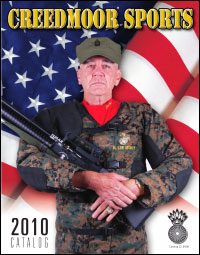


 With the Cerberus-owned
  Classic Lines with Some Modern Features

 So, when you “operators” need go-juice after fast-roping down from a Blackhawk in an Afghan firefight, now you can get the liquid energy blast you need to save the planet. An 8.4-oz can of THOR tactical energy drink contains 27 grams of sugar and 75 mg of caffeine (twice as much as an ordinary cola drink). A can of THOR also contains a whopping 1000 mg of Taurine, an amino sulfonic acid thought to improve athletic performance and lessen the effect of hangovers. So, if you partied too hard the night before your big mission, THOR’s tactical energy drink might be just the ticket.