[Update 5/24/2010: Amazon raised its price to $32.97; Shipping is still free.]
The new, 2320-page, 31st Edition of the Blue Book of Gun Values is now on sale for just $29.21 with FREE Shipping. (List price is $49.99!) Released in April 2010, this is the latest version of this definitive resource. This new edition has been expanded to over 2,300 pages, all gun values have been thoroughly updated for both modern and antique firearms, including military-style guns. It also includes new 2010-model guns, both US-made and imported. Other features include an 80-page color Photo Percentage Grading System to aid in accurately determining condition of firearms and serialization and proofmark sections to help in identifying firearms.
For hunters and Tactical operators with big thirsts, here is the ultimate “Après-shoot” accessory. The new Tactical 6-pack beer holster from Dillyeo will hold enough suds for a SWAT entry team, or one really serious boozer. Made from rugged nylon in Woodland Camo pattern, this utility beverage belt allows operators to keep both hands free for mission-critical gear, such as TV remote controls or bean dip.
And for Tactical tee-totalers, the 6-pack holster can also handle non-alcoholic beverages (any 12-ounce can will fit). Priced at just $7.99, the 6-pack holster is a bargain compared to most tactical gear on the market today. And, in all seriousness, it’s actually a clever product that could be great on hikes, picnics, or on a river-rafting trip (but stick to soft drinks at the shooting range). The belt fits waist sizes from 30-54. If the $7.99 Dillyeo belt is sold out, Amazon.com retails a similar 6-Pack Beer Belt for $9.98. Shown below, this Beer Belt holds both cans and bottles. Bottoms up!
CAUTION: While this product is real, it is featured here for satirical purposes. Alcohol and firearms are a dangerous combination. NEVER consume alcoholic beverages before you go shooting, or while you are handling firearms. Don’t even consider drinking until: 1) your guns and ammo are unloaded and safely stowed away; and 2) you have left the firing area, and you have stopped shooting for the day. Wise shooters NEVER bring booze to a shooting range, period.
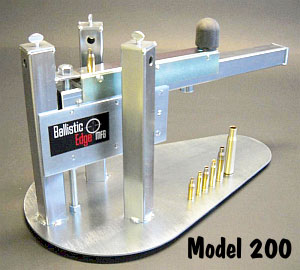
Forum member and long-range shooter Jerry Brandon has launched a new company, Ballistics Edge Mfg., which produces cartridge annealing machines for use by home reloaders. Brandon, a talented designer and fabricator, first tried annealing to maintain the quality of his own match brass. Brandon then built and tested a series of prototype annealing machines, working with a variety of brass sizes. Now Ballistics Edge Mfg. offers a full line of four annealing machines: the manually-operated Model 200 ($250), the motorized twin-torch Model 300 ($345), the motorized triple-torch Model 350 ($395), and the motorized Model 400 ($475), a beautifully-machined carousel design.
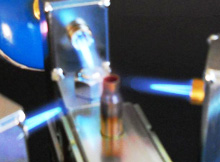
Brandon’s most versatile machine, and the one he recommends for annealing both normal- and magnum-sized cases, is the Model 350. Like the Model 300, the Model 350 features all-metal construction and motorized case transport. The Model 350 uses three torches rather than the Model 300’s two. The triple-torch system does a better job heating the large-diameter necks on .338, .416 and .50-caliber cases. The triple-torch design also ensures fast, uniform heating of the case-necks on smaller cases. The video below shows the Model 350 in action, annealing jumbo-sized .50 BMG cases.
For PPC, 6mmBR, and .308-sized cases, you can use the Model 200, the Model 300, or the Model 400. The Model 200 is a simple, one-at-a-time annealer that works remarkably well using a sliding arm. Simply slide the case into the flame, then slide it out after the required dwell time. For the average reloader, the Model 200 may be more than adequate. If, however, you plan to anneal hundreds of cases a week, you may want to consider the beautifully-machined Model 400 carousel, which will anneal 100 cases in less than 15 minutes. The Model 400 features both .308-size and magnum/ultra magnum-size holes to accept both .47X and .56X diameter cases. Just choose the correct size hole and adjust the torch height to match your case. The .75″-thick shell-plate top acts as a heat-sink to protect the lower case body. View the Model 400 carousel annealer in the video below.
Ballistics Edge Website Offers Good Technical Advice on Annealing
Anyone interested in learning about cartridge annealing should visit www.AnnealingMachines.com, Jerry Brandon’s website. There you’ll find a helpful, authoritative discussion of annealing, including the all-important factors of time and temperature. As Brandon observes, much MISinformation about annealing can be found. Brandon will set you straight. Read Brandon’s How to Anneal article and you can avoid making costly (and potentially dangerous) mistakes, whether you anneal manually or use an annealing machine. In the video below, Jerry Brandon reviews the features of Ballistics Edge annealing machines. He also provides some good, basic advice for shooters who are looking to try their hand at annealing for the first time.
Competitive shooters need to keep track of the weight of their rifle and gear. In many disciplines rifle weight is restricted, and when traveling by air overseas, every ounce counts. Hunters and varminters headed to far-off locations also need to know how much their equipment weighs. Airlines now impose costly penalties for overweight baggage.
Here’s a compact, handy scale that can help ensure your checked baggage doesn’t exceed limits. (You can use the scale to get a rough idea of your rifle weight, but to be 100% sure you “make weight” per match rules, use a quality calibrated scale, such as a postal scale rated to 40 pounds.) A scale like this is also handy when selecting spotting scopes, rests, hard cases etc., to take on a trip. This pocket scale is small enough that you can keep it in your range kit or bring it along on your travels.
Right now Amazon.com has the Travelon Luggage Scale on sale for $9.06 with FREE Shipping. This compact unit weighs items up to 75 pounds. Just place the hook around the item to be weighed, and lift with the metal handle at the top. The red dial marker stops in place at max weight, so you don’t have to watch the scale as you lift. Most purchasers have given this scale good reviews.
Brownells has added a new Professional Drill Jig to its collection of gunsmithing tools. The $194.99 jig, made by B Square, aligns hole-spacing for popular scope bases on most popular military bolt action receivers. According to Brownells, this jig: “aligns mount hole-spacing for Weaver, Redfield and Buehler bases on all Springfields, U.S. Enfields (not SMLE), Japs, Mausers, Remington 30s and similar bolt actions.” Brownells says this unit saves time and eliminates tedious measuring as it “automatically locates holes in reference to recoil shoulder, and aligns and spaces holes vertically on the centerline of the receiver.”
Brownells’ Drill Jig features all-metal construction. The jig bars, base block and top piece are gold-anodized aluminum while the bore arbor and “V” bushings are blued steel. For the $194.99 price, the Pro Drill Jig includes two bars (Mauser and Spgfld/Enf/Jap,), complete mounting assembly, and an interchangeable No. 31 drill bushing.
Editor’s Comment: In the past, we haven’t been particularly impressed with B Square consumer products, particularly B Square rails and rings, but with CNC machining these days, the Professional Jig should be a quality tool. Remember that Brownells offers a 100% Satisfaction Guarantee on everything it sells: “If you aren’t completely, 100% satisfied with any purchase you receive from Brownells, for any reason, at any time, return it for a full refund or exchange. No hassle, no problem.”
Timney Mfg. now sells triggers for left-hand Remington m700 rifles. There is both a standard lefty model (#502) and a safety-equipped lefty model (#511). The model #502 uses the existing safety and bolt stop in your gun, while the model #511 has an external safety on the left side of the trigger housing. Both these left-hand triggers require no gunsmithing, are fully-adjustable, and can be ordered with default pull weights ranging from 1.5 pounds to 4.0 pounds.
External Safety Trigger Based on Innovative 2006 Design
In 2006, Timney began producing a new drop-in trigger for the Remington 700 with external safety. This was a totally new design with a safety that blocks the trigger not the sear. For 2010 has adapted this trigger for left-hand Rem 700 rifles. If you don’t need an external safety, Timney also now offers a standard left-hand trigger. MSRP for either version is $124.95. The housings of both triggers are milled from solid billet. Other components are machined using state-of-the-art Electrical Discharge Machining (EDM) from high-grade solid steel. This allows Timney to maintain very precise tolerances on its triggers. For more info call toll-free 866-4TIMNEY, or visit www.timneytriggers.com
New optical technology from the Idaho National Laboratory could make a big improvement in non-telescopic iron sights. INL’s new “MicroSight” uses a Zone Plate design to focus light so that BOTH front sight-blade AND the target appear in sharp focus. This technology could be a major breakthrough for iron sights shooters, particularly older shooters whose eyes have difficulty focusing at multiple distances. The INL MicroSight’s wafer-thin optical element is only about 1/4″ in diameter, and it has been successfully adapted for match-type rear iris sight systems. Initial tests show the MicroSight can help iron sights users shoot better scores, with less eye fatigue. The technology could aid hunters and soldiers, too, either as a primary aiming device or as a lightweight backup for other types of sights.
By Mike Wall, INL Communications and Governmental Affairs
The human eye has trouble focusing on both a firearm’s front sight blade and the much more distant target at the same time. Idaho National Laboratory’s innovative gunsight technology, the MicroSight, helps the eye solve this problem. The MicroSight, a disc smaller than a dime, brings both the target and the iron sight into simultaneous focus, giving marksmen a better sight picture. The new sight has national-security applications, as it could improve safety and performance for American soldiers. Millions of target shooters and hunters should also benefit.
“The MicroSight gives you much of the performance you’d get out of a holographic or telescopic sight,” says INL engineer David Crandall, who developed the technology. “But it’s more reliable, much lighter-weight and much cheaper.” The alternating rings on zone plates bring faraway and nearby objects into focus simultaneously.
The Magic of Zone Plates — Concentric Rings Using Diffraction
Crandall is not an optics specialist. Most of his past work tended toward infrastructure engineering, like nuclear projects with INL’s Advanced Test Reactor. But Crandall is a highly accomplished target shooter — he’s a member of the U.S. national long-range rifle team — and he’s come up with several other shooting-related inventions. He patented a rifle-stabilizing shooting sling, and a small, powerful breaching shotgun that could help law-enforcement personnel storm buildings more effectively.
One day, Crandall was leafing through an optics textbook, and he stumbled across a section on “zone plates.” Zone plates are optical devices that resemble lenses. But whereas lenses focus light using refraction — essentially, changing the direction of light waves by changing their speed — zone plates use diffraction. Diffraction describes how waves bend, break up, spread out and interfere with each other as they encounter obstacles. The diffraction of sound waves, for example, explains how you can hear someone’s voice from around a corner.
Zone plates focus light via a set of concentric rings that alternate between transparent and opaque. The transparent sections let some light waves pass through unchanged, focusing objects that are far away (basically, at infinity). But light passing the edges of the opaque rings gets diffracted, which brings nearby objects into focus. The seemingly impossible result: sharp images of distant and near objects, simultaneously.
Zone plates aren’t new. Frenchman Augustin-Jean Fresnel worked out their underlying scientific principles in the early 1800s. [Editor’s NOTE: A.J. Fresnel also invented the Fresnel lenses used in light-houses and theatrical spotlights.] But it took Crandall, with his shooter’s eye, to recognize the potential zone plates held for improving gunsights. “Competitive shooters are always looking for an edge, for something better,” Crandall says. “You have to, when you’re going against the best in the world.”
Crandall took his idea to INL’s technology transfer division, which also saw the promise and agreed to fund his research. He eventually found his way to phased zone plates. Phased zone plates replace the opaque rings with transparent glass of varying thickness. This accomplishes the same goal — diffraction — but does so without losing as much light, yielding brighter images. After much tinkering, Crandall came up with the MicroSight. CLICK HERE for giant-sized photo of MicroSight element.
A Smaller, Cheaper, More Robust Sight
Without help from zone plates, the human eye cannot focus on two different planes at the same time. So shooters using only standard-issue iron sights see either a blurry target or a blurry sight. The MicroSight isn’t the only gunsight technology that can overcome this problem, of course. Telescopic sights magnify targets, bringing them into close, crisp focus. And holographic sights project a red dot onto an image of the target, showing clearly where the shot will land.
But telescopic and holographic sights have their drawbacks. For one thing, they tend to be bulky. Both types of sight can add one or two pounds to the weight of a rifle — not a trivial concern for hunters or soldiers who must lug their weapons for miles over rough terrain. Further, both are complex instruments with fragile components. They can break, especially if dropped or banged against a rock or tree. Red-dot sights require batteries, which can die. And neither one is cheap: most red-dot sights cost more than $100, and high-quality telescopic ones can run $1,000 or more.
MicroSight Should Be Versatile and Affordable
The MicroSight, on the other hand, is tiny — its zone plate is thin and only about 1/4″ in diameter — and relatively cheap. Crandall says the sight should cost significantly less than red-dot and telescopic sights when Apollo Optical Systems, which licensed the technology, takes it to market. The company is currently working with gunsight manufacturers to design and develop various MicroSight versions. In the future, some of these versions might add refractive power to the zone plate, achieving some level of target magnification. Crandall foresees other possible applications as well, such as in handguns and night-vision goggles. In any situation that requires taking the long and the short view at the same time, this new INL technology could provide a major advantage.
Article and graphics courtesy Idaho National Laboratory (INL), www.inl.gov.
Oehler Research, Inc. of Austin, Texas has announced that it has resumed production of the vaunted Oehler Model 35P Proof-Channel™ chronograph with printer. Company President Ken Oehler revealed to AccurateShooter.com that his company will produce “at least a couple hundred” model 35P chronographs in a “special run” this year. Production of the Model 43 remains suspended. The first new Model 35P units should ship “in late summer”. Oehler Research is taking orders right now, but Ken said: “we can’t start shipping until all the components are in inventory — end of July at the earliest.”
The latest Model 35P chronographs will employ exactly the same design and components as previous units — no changed features or parts. The Model 35P design has proven both highly accurate and reliable, and Ken explained that his team will make the new units “just the way they were before”. The new model 35Ps will ship in one configuration only, a complete system costing $575.00 (plus $20 UPS shipping). This includes: printer/base unit; three Skyscreen III detectors; four-foot rail; two folding stands; and a Plano (Doskocil) hard case. All the components fit into the hard case for storage and transport (see photo below):
The resumption of Model 35P production represents an effort to “test the waters”, to see if the company should re-enter the consumer shooting market, according to Ken Oehler. In the last few years, Oehler Research has focused on high-end military and industrial products. But Ken has brought in a new engineer, Gary Stafford, who is overseeing the Model 35P program. If all goes well, according to Ken, there may be other consumer products in the future and Stafford may “take over the reins” from Ken, who, at age 73, may shift to a “Senior Chairman” role in the company.
If you want to purchase a new Oehler Model 35P Chronograph, you should contact Oehler Research right away — Oehler has already logged 20+ orders. Order Online at www.Oehler-research.com. You can also email sales[at]oehler-research.com or phone (800) 531-5125, (512) 327-6900. According to Oehler’s sales sheet, you can reserve your unit with a Visa/MC and Oehler won’t bill until the product ships. Or, if you pre-pay via check or Money Order, Oehler will pay the shipping. Shipments will be prioritized according to the date orders are received.
Berger Bullets has just released its new .338-caliber “hybrid” bullet, Berger’s first-ever projectile larger than .30 caliber. The new bullet has a very high ballistic coefficient (BC): 0.891 under the G1 model, and 0.455 under the newer G7 standard for boat-tail bullets. That high BC should translate into exceptional long-range performance. According to Berger, the BC of the new Berger .338 bullet BC is roughly 14% better than the BCs of other .338-caliber 300gr offerings from Sierra and Lapua. This claim is supported by testing done on all three bullets and published in a detailed Bullet Comparison Report (PDF). The new .338 Hybrid bullets will be sold in 50-count and 250-count boxes. To order, call Berger’s Tech-Line, (714) 447-5458.
The key design feature of the new .338 bullet is its hybrid ogive, i.e. a shape that combines both tangent and secant geometry. A tangent ogive meets the bearing surface very smoothly, whereas a secant ogive has an abrupt juncture with the bearing surface. The figure below shows the geometric differences between a tangent and a secant ogive, as well as the strengths and weaknesses of each.
Practical Considerations — Load Length and Twist Rate
The superior ballistic performance of the 300gr Hybrid .338 is primarily due to the very long ogive and boat tail. However, that super-long bullet length can create some issues. Berger’s new .338 Hybrid bullets are so long that loaded rounds may not fit some magazines comfortably, unless you deep-seat the bullets, which cuts down on usable case capacity. If your loaded rounds with the new .338s are too long for your magazine, single-feeding is recommended. In addition, and this is IMPORTANT, to get optimal performance with the new bullets, you may want to extend the throat in your chamber. This can be done relatively easily by a competent gunsmith using a throating reamer. We caution, however, once the throat is pushed out, you can’t go back to a shorter throat without setting back the entire barrel.
The new .338 Hybrid bullets should stabilize well with a 1:10″ twist at the velocities achievable with popular .338 magnum cartridges. However, according to Bryan Litz, Berger’s Ballistician, at extreme long ranges (beyond one mile), as the .388 bullet goes trans-sonic, it may need more spin. As the bullet slows down into the trans-sonic range, extra stability is required — something you get by spinning the bullet faster. So, for those guys planning to shoot at one mile or beyond, Berger recommends a faster twist-rate. The faster twist provides more spin-stabilization at very long ranges. But for 1000-yard shooting, you don’t need to be concerned about trans-sonic stability. As Bryan explains: “So as long as you keep your shots under 1 mile, the 1:10″ twist is plenty adequate.”
Berger Bullets Video Update (Eric Stecker talks about the new .338 Hybrid and other matters.)
Sinclair International has just released its completely new Competition Shooting Rest BR. It’s a beefy unit, weighing over 30 pounds… and yes, it’s fully approved for both IBS and NBRSA benchrest competition at all distances. The new rest should start shipping in mid-May, 2010. The price is $599.00 including top bracket, but not the front sand-bag (both Edgewood and Protektor bags will fit).
Key features are: 1) Very low center of gravity for stability; 2) Smooth, precise windage control built in to the base-plate; 3) Ambi-dextrous design; and 4) Built-in carry handle on the front (target) side. The windage control, which employs twin tapered roller bearings for smoothness, is a clever design that provides nearly 48″ of windage movement at 100 yards. The oversized windage control knob is positioned near the rear (vertical) speed screw so you can easily and quickly control both the vertical and horizontal with the same hand. And you Southpaws, don’t worry… the post, center column, controls and windage adjustment disassemble and reassemble on the opposite side, for left-hand use.
The Sinclair Competition Rest’s components are “super-sized” compared to older Sinclair front pedestal designs. The new rest’s center column diameter is upsized to 1.95″ from 1.375″, the threaded post is increased to 1″ diameter from 3/4″, and the leg screws are now .5″ (up from .375″). The rear fluted speed screw is also oversized. The new Competition Rest also includes mounting holes for attachment of raised ammo caddies or a timer-holder. In addition, the Sinclair Competition Rest features a new, lockable fore-end stop assembly that adjusts for length, height, and cant (angle).


 For hunters and Tactical operators with big thirsts, here is the ultimate “Après-shoot” accessory. The new Tactical
 Forum member and long-range shooter Jerry Brandon has launched a new company,
 For PPC, 6mmBR, and .308-sized cases, you can use the Model 200, the Model 300, or the Model 400. The Model 200 is a simple, one-at-a-time annealer that works remarkably well using a sliding arm. Simply slide the case into the flame, then slide it out after the required dwell time. For the average reloader, the Model 200 may be more than adequate. If, however, you plan to anneal hundreds of cases a week, you may want to consider the beautifully-machined Model 400 carousel, which will anneal 100 cases in less than 15 minutes. The Model 400 features both .308-size and magnum/ultra magnum-size holes to accept both .47X and .56X diameter cases. Just choose the correct size hole and adjust the torch height to match your case. The .75″-thick shell-plate top acts as a heat-sink to protect the lower case body. View the Model 400 carousel annealer in the video below.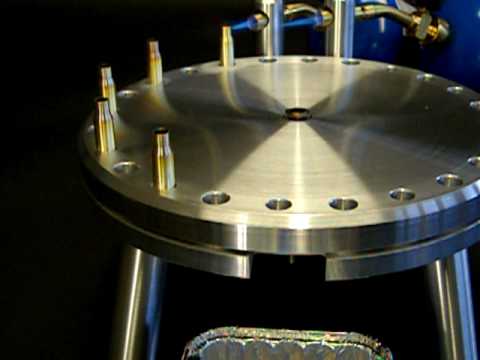



 New optical technology from the


