In May, we reported on the new MicroSight invented by engineer (and shooter) David Crandall of the Idaho National Laboratory (INL). The MicroSight keeps both near and far objects in sharp focus, simultaneously imaging two distinct focal planes. This break-through technology allows the shooter to see a sharp image of the target and a sharp image of his iron sights at the same time.
The MicroSight is not a lens per se. Rather it is a phased Zone Plate that focuses light beams through diffraction. Zone Plates, first studied by Frenchman Augustin-Jean Fresnel in the 1800s, focus light via a set of concentric rings that alternate between transparent and opaque. The transparent sections let some light waves pass through unchanged, focusing objects that are far away (basically, at infinity). But light passing the edges of the opaque rings gets diffracted, which brings nearby objects into focus. This produces a seemingly impossible result — sharp images of distant and near objects, simultaneously.
The MicroSight is not just a laboratory experiment. Prototype versions have been crafted and placed on test rifles. INL has licensed the technology to Apollo Optical Systems which is right now working with gunsight manufacturers to adapt the MicroSight design to a variety of products. In the future, some MicroSight-equipped products might add refractive power to the Zone Plate, allowing target magnification as well as focusing.
WATCH the VIDEO below to see the MicroSight in Use and to learn how it works…
Many of our readers use iPhones to run ballistics programs and to access travel maps and weather reports. We CAUTION readers who may be planning to purchase a new Apple iPhone 4 (Fourth Generation), first released on June 24th: Wait until the flaws are fixed.
You May Want to Hold Off on Purchasing a iPhone 4
We know many of you guys are anxious to get the latest iPhone 4… but we strongly advise you to wait a week or two at least. Or perhaps wait a few months until an improved version of the new iPhone is available. The reason for this advice is simple — the glass panels on the new iPhone are prone to cracking, and there is a serious reception problem on many of the latest generation of iPhones.
iPhone 4 Major Problems
We suggest readers WAIT before purchasing an iPhone 4, based on issues we observed ourselves, as well as thousands of reports that are flooding in. There are three main problems.
1. Many iPhone 4s have hardware-related reception problems causing dropped calls. This is apparently caused by hand interference with the antenna.
2. The iPhone 4’s front screen and back plate, which are composed of a new, ultra-hard Aluminosilicate glass, are very prone to cracking. We observed this first-hand.
3. Some iPhone 4 users are reporting yellow blotches and other abnormal screen discolorations. This is apparently a manufacturing defect.
Cracked Glass on Faceplate and Backplate
On June 24th, we went to the shooting range. One of our shooters, Katrina, had just acquired a brand new iPhone 4. She carried it in a protective belt holster. After a couple hours of shooting from a sitting position at the bench, she tried to make a call, only to find that the front glass screen had a full-width diagonal crack. This phone was never dropped, tossed, or abused in any way. While the screen needs to be replaced, Katrina’s iPhone is still able to make calls — the first one of which went to Apple customer support.
Many reports are surfacing about broken iPhone 4 glass. Unlike our experience with Katrina’s phone, most of the breakages appear to be on the back plate. You’ll find reports of the breakages in the Apple forums and on major tech websites.
Gizmodo.com reports: “Cases of broken iPhone 4’s backs are already appearing. This hasn’t changed from previous generations…. But the difference is that the iPhone 4 is all glass. If you drop any other phone, you have a 50% chance of breaking its screen. With the iPhone 4, the risk will always be there, no matter how it falls. It’s just more exposed to damage because of the material choice.” Another breakage report.
Reception and Dropped Call Problem
There is a widespread problem with iPhone 4s losing reception when held in the hand. The video below shows how just picking up the iPhone and holding it normally will cause loss of reception. The problem appears to be hand contact with the iPhone 4’s metal frame, which serves as the antenna.
An article in Gizmodo.com addresses the issue: “There’s no great fix for the iPhone 4 reception issues right now. We’re also pretty sure—and Apple confirms it—that touching the antenna does affect things—whether or not it has the final result of killing calls or speed of data connection.”
Rubber Bumper Partial Reception Fix?
Here is a further CNET video report confirming the reception issue with multiple iPhone 4 test units. The problem is more acute with some users than others, and CNET did suggest that installing a $30 rubber bumper may help with the problem. Tests by igear360.com show that bumper can raise iPhone 4 downloading speeds, but uploading speeds still suffer substantially. Click here for iPhone bumper tests.
You have to hand it to the Texans. Forum member Paul Scott (aka “FTRinTexas”), has created a sturdy double-gun case from a surplus Stinger Missile transport box. Measuring roughly 63″ x 11″ x 13″, the aluminum Stinger box is big enough to fit two, long-barreled match rifles side by side, stowed vertically, toaster-style. There’s even room inside for a spotting scope and other accessories. With a little effort (and some after-market foam), the Stinger box can be converted into a very practical (and rugged) gun case.
The converted Stinger box is also an attention-getter according to Paul: “Other guys at the range definitely do a double-take when you haul a missile case out of your truck! They’re kind of disappointed when I open the lid and they see there are only rifles inside.”
Advantages of Side-by-Side (Vertical) Rifle Cases
For wide-forearm rifles with big scopes, we have always liked the vertical storage (drop-in style) cases such as the Plano AirGlide. Vertical placement allows the gun’s weight to rest on the stock with no side-pressure applied to the scope turrets. We’ve asked Plano to make a double-gun case of a similar design, but that’s not going to happen any time soon.
There are companies that make large, metal-bodied safari cases that stow two rifles vertically, side-by-side. These cases are super-secure, but they are also very expensive. Cabela’s side-by-side Safari Case costs $399.00, and it will only hold rifles up to about 50″ overall length. Ziegel Engineering makes a beautiful two-rifle, top-loading Expedition case, but it costs $639.95, and is also limited to a 50″ rifle OAL.
The Stinger Solution — Inexpensive, Rugged Side-By-Side Storage
Paul Scott was clever to source a Stinger Box and transform it into a side-by-side double rifle case. With over five FEET (61.5″) of internal length, the box will secure guns with barrels up to 38″ with ease. And the Stinger box is wide enough to hold two F-Class guns side-by-side with plenty of clearance. Stinger boxes come with an O-ring seal, air relief valve, and handles on each end. Hasp locks are easily added, as are wheels (just slide an axle through the lower “bumper” flange on the box end.)
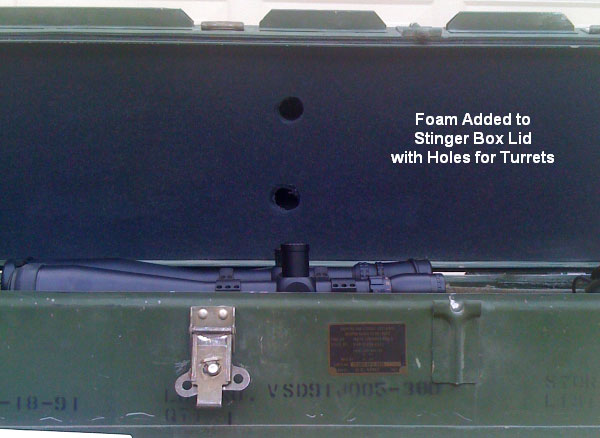
As received from Uncle Sam, a surplus Stinger storage box needs some modification to work as a double rifle case. Paul removed most of the internal foam padding from the lower section, and then used an electric knife to carve cradles to support the two rifles under the forearms and buttstocks. The original hard foam blocks in the Stinger box lid were replaced with closed cell foam like that used in Pelican cases. Paul found that the new foam in the lid would press down on the scopes’ elevation knobs, so he cut round holes in the top foam to provide additional turret clearance.
As you can see in the photos, Paul had enough room forward of the rifles to stow his spotting scope and disassembled spotting scope stand. Paul simply placed another layer of foam in the bottom of the box and then cut the foam to fit the equipment. Another foam layer can be placed over the spotting scope and stand to prevent slippage during shipment.
If you are interested in making your own double-gun case from a Stinger box, email PScott [at] pegasustexas.com . Paul has a few extra Stinger boxes he may be willing to sell for around $175 each. Each of these Stinger Missile containers cost Uncle Sam $2066.00 originally! The photo below shows the Stinger transport box before modification.
Here’s a handy product for our readers who collect military rifles or who shoot in the CMP’s Garand Matches. Second Star to the Right, a company based in Stonewall, Lousiana, offers vinyl mats printed with the breakdown/assembly instructions for the M1 Garand. These mats are faithful reproductions of the 1952 Army instruction diagram used to train GIs and armorers. There are two models: 1) 30″ x 26″ Deluxe heavy-weight version with grommets ($25.00); and 2) 19″ x 14″ “Collectors Edition” lighter-weight version ($17.00). You can either use the mat draped on your bench as a cleaning surface, or hang it on the wall for decoration.
In addition to its M1 Garand mats, Second Star plans to introduce mats for other firearms such as the M14, M1 Carbine, and M16. For more information call Second Star at (318) 560-2579. Second Star’s website is not yet active, but you can send email to: the2ndstar2010@yahoo.com .
The problem with most flashlights is that, when you really need them the most, you often find the batteries are discharged. A flashlight with dead batteries is useless in an emergency. The new LED Magna flashlight doesn’t need batteries at all. Inside the housing is a copper coil. By shaking the handle of the unit you cause a magnet to pass back and forth through the coil. This generates electricity which is stored in a capacitor. Just a few shakes will generate light.
The LED Magna Light costs just $4.68 plus shipping from www.techdeals.us. At that price you can afford to keep one of these lamps in each of your vehicles, plus one in your range kit or “bug-out” bag. Now we just wish somebody made kinetic-powered cell phones and GPS units. It seems we are always struggling with low batteries on those often-used electronic devices. And why hasn’t anybody put a solar panel on the back of the iPhone yet?
Imagine a riflescope that could sense target distance and shift from wide field-of-view/low magnification for closer shots to higher magnification for longer-range shots. Just think of the benefits for a hunter. He could just place his cross-hairs on a buck and the scope would automatically zoom to the optimal magnification. Does this sound like science fiction?
Well the Defense Advanced Research Projects Agency (DARPA) is betting millions of tax dollars that an auto-adjusting rifle scope will soon be science FACT. DARPA recently awarded Lockheed Martin a $3.93 contract to develop a “next generation” Dynamic Image Gunsight Optic, aka DInGO. The DInGO scope automatically calculates the range with a low power laser rangefinder, digitally zooms in on it and accounts for environmental conditions such as wind using sensors built into the scope. It then projects the bullet’s point-of-impact calculated from the embedded ballistics computer. DInGO is based on Lockheed Martin’s One Shot Advanced Sighting System, which utilizes similar technology to automatically transmit crosswind information to a sniper’s scope and move the crosshairs to show the corrected point of aim.
“Current scopes are optimized for a single target range, impacting soldiers’ effectiveness and survivability when engaging targets at different distances,” said Dan Schultz, vice president and general manager of Lockheed Martin’s Mission Systems & Sensors Ship & Aviation Systems business. “DInGO will solve this problem, significantly increasing soldiers’ ability to rapidly reconfigure optics for use from short to long ranges and improving marksmanship capabilities for all soldiers.”
While DInGo scope technology will first be implemented for the military on M-4 and M-16 rifles, eventually this automatic ranging/zooming system could be adapted to hunting rifles. Such a system would be great for game hunters. When the prey appears at close range, the scope would provide a relatively low magnification level for enhanced field of view. If the animal was much farther away, the scope would autmatically increase magnification to allow more precise aiming. Hopefully this will be one example of military technology “trickling down” to the general public for sporting use.
Other Scopes with Built-In Laser Rangefinders
Both Burris and Zeiss currently offer hunting scopes with integrated laser-rangefinders that calculate holdover, based on target distance. The Burris Eliminator even projects the calculated aiming (hold) point as a red dot on the vertical crosshair. Shown below is the view through the lens of the Burris Eliminator scope, with the red dot showing holding point. Just place the red dot on the center of the target and pull the trigger. However, neither the Burris nor Zeiss rangefinding scopes automatically adjust magnification/field of view. Zooming in or out must still be done manually. That’s where the DInGO system offers something radically new.
Kahr Arms has acquired firearms manufacturer, Magnum Research, Inc., of Minnesota. Magnum Research, founded in 1979, is best known for its super-sized big-bore Desert Eagle pistol, but it also sells a 1911-style pistol, compact “Baby” and “Micro” Desert Eagle carry pistols, BFR revolvers, and the Mountain Eagle™ MagnumLite® line of rifles. The Desert Eagle is a large-framed gas-operated semi-automatic pistol designed by Magnum Research in the USA, and manufactured primarily in Israel by IWI (Israel Weapon Industries, formerly Israel Military Industries, IMI). The Baby Eagle is based on the CZ75 design, updated by IWI.
Kahr Arms currently sells mostly striker-fired semi-automatic pistols, aimed primarily at the personal defense and concealed carry markets. The acquisition of Magnum Research gives Kahr a line of traditional hammer-fired pistols and revolvers. Now Kahr can also expand into the hunting and varminting markets with the Mountain Eagle series of rifles. These feature carbon-wrapped barrels fitted to “custom-tuned” Rem 700 actions in H-S Precision or Hogue stocks. The MSRP on Mountain Eagle rifles is $2173.00 — that’s expensive compared to a factory Remington, but the price is half what Christensen Arms charges for similar rifles with carbon-wrapped barrels. No doubt Kahr hopes to steal some of Christensen’s customers.
Here’s an item that should interest 3-Gun and Multi-Gun competitors using AR rifles. Magpul Industries has filed for a patent on a new “quad-stack” magazine that may hold as many as 60 rounds, yet feed through a normal AR15 mag well. (In Multi-Gun matches, ultra-high-capacity magazines can provide a competitive edge in high-round-count stages.) While Magpul is renowned for its innovative engineering, we wonder if this new mag design was inspired, at least in part, by the Russians. Earlier this year, the Izhmash OJSC factory in Russia revealed a quad-stack 60-round magazine for the new AK-200 rifle, successor to the AK-47.
An explanation of how Magpul’s new quad-stack AR magazine works is found on The Firearm Blog, which reports: “The design is quite straight forward. A central partition separates two dual staggered round stacks. Two springs are used, a lower stronger spring and a weaker top spring[.]”
In the frame below, click-drag on the right-side scroll bar to view numerous technical illustrations included in Magpul’s 12-page patent application. You can also navigate by clicking the page arrows (at bottom of frame) or by clicking “tile mode”. Use the plus/minus controls to zoom in or out.
DeLorme has come out with a new, handheld GPS that can send messages via satellite, using SPOT satellite technology. What’s the benefit? This allows a user to stay in touch with others (or reach emergency responders) even when out of cell phone range. With its texting ability, DeLorme’s new Earthmate PN-60w offers many of the benefits of a satellite phone, at a fraction of the cost.
The Earthmate PN-60w is the world’s first handheld GPS that enables Type & Send text messaging via satellite. With the PN-60w you can send a text message (with your location), from pretty much any spot on the globe. Having that capability can be a life-saver for a hunter or hiker stranded in the wilderness. Messages are created on the PN-60w’s internal keyboard, sent wirelessly to the separate SPOT communicator, then relayed via satellite to individual email addresses, cell phones, buddy lists, and/or geo-caching websites. In case of emergency, SOS messages can be sent directly to rescue services with the user’s GPS coordinates embedded.
As a stand-alone GPS, the Earthmate PN-60w has premium navigation features including a 32-channel GPS chipset, dual-core processor, 3-axis electronic compass, barometric altimeter, elevation profiles, and GPX file transfers. The Earthmate PN-60w comes with DeLorme Topo North America GPS maps and desktop software included, with topographic and street coverage of the U.S. and Canada. The unit can also display high-resolution aerial imagery, official USGS and Canada topo maps, NOAA nautical charts, and Navionics charts, (all extra cost). The text messaging, track progress, and emergency SOS/911 features are activated via separate fee-based SPOT subscriptions (not included in hardware price). MSRP for the PN-60w and SPOT Communicator bundle is $549.00, with product availability in July.
Recognizing the growing interest in bow-hunting, MidwayUSA is now offering a full line of archery equipment. MidwayUSA’s online store now carries everything an archer could need: compound bows, crossbows, quivers, arrows, shafts, bolts, broadheads, bow sights, releases, slings, bow cases, archery targets and more. In addition, for bow-hunters, MidwayUSA offers tree-stands, blinds, scent-blockers, plus hunting boots and hunting clothing. CLICK HERE to browse MidwayUSA’s selection of archery and bow-hunting products.


 In May, we reported on the new MicroSight invented by engineer (and shooter) David Crandall of the Idaho National Laboratory (INL). The MicroSight keeps both near and far objects in sharp focus, simultaneously imaging two distinct focal planes. This break-through technology allows the shooter to see a sharp image of the target and a sharp image of his iron sights at the same time.



 Cracked Glass on Faceplate and Backplate


 You have to hand it to the Texans. Forum member Paul Scott (aka “FTRinTexas”), has created a sturdy double-gun case from a surplus Stinger Missile transport box. Measuring roughly 63″ x 11″ x 13″, the aluminum Stinger box is big enough to fit two, long-barreled match rifles side by side, stowed vertically, toaster-style. There’s even room inside for a spotting scope and other accessories. With a little effort (and some after-market foam), the Stinger box can be converted into a very practical (and rugged) gun case.
 There are companies that make large, metal-bodied safari cases that stow two rifles vertically, side-by-side. These cases are super-secure, but they are also very expensive. Cabela’s side-by-side



 Well the Defense Advanced Research Projects Agency (DARPA) is betting millions of tax dollars that an auto-adjusting rifle scope will soon be science FACT. DARPA recently awarded Lockheed Martin a $3.93 contract to develop a “next generation” Dynamic Image Gunsight Optic, aka DInGO. The DInGO scope automatically calculates the range with a low power laser rangefinder, digitally zooms in on it and accounts for environmental conditions such as wind using sensors built into the scope. It then projects the bullet’s point-of-impact calculated from the embedded ballistics computer. DInGO is based on Lockheed Martin’s One Shot Advanced Sighting System, which utilizes similar technology to automatically transmit crosswind information to a sniper’s scope and move the crosshairs to show the corrected point of aim.


 Here’s an item that should interest 3-Gun and Multi-Gun competitors using AR rifles. Magpul Industries has filed for a patent on a new “quad-stack” magazine that may hold as many as 60 rounds, yet feed through a normal AR15 mag well. (In Multi-Gun matches, ultra-high-capacity magazines can provide a competitive edge in high-round-count stages.) While Magpul is renowned for its innovative engineering, we wonder if this new mag design was inspired, at least in part, by the Russians. Earlier this year, the
 DeLorme has come out with a new, handheld GPS that can send messages via satellite, using SPOT satellite technology. What’s the benefit? This allows a user to stay in touch with others (or reach emergency responders) even when out of cell phone range. With its texting ability, DeLorme’s new Earthmate PN-60w offers many of the benefits of a satellite phone, at a fraction of the cost.


