Pierce Engineering has just introduced its new Tactical Multi-flat action. This handsome design, crafted from chrome-moly steel, features a built-in 20-MOA rail and an integral recoil lug. The action was designed from the get-go to fit the Accuracy International chassis with no modification. With a 1/2″ flat on the bottom and 45° angled sides, the new Pierce Multi-flat short action drops right into the AI stock. Just bolt it in and shoot. The actions will cost $1295.00 and John Pierce is taking orders right now for delivery in two months.
John Pierce reports: “Our new Tactical Multi-flat action features a low-profile, 20-minute integral Picatinny rail and integral recoil lug. We made the action to drop into the Accuracy International modular stock utilizing AI’s magazines as well. Though this is a short action for .308 Win and similar-sized cartridges, the loading port is much longer than usual for better access and ejection. The current price is $1295.00, and that price includes a 30° coned bolt and/or spiral fluting if the customer desires those options.” John noted that the coned bolt option works well in Tac Comps: “I have a coned bolt on my own tactical rifle that I used at ASC. I found it picks up the rounds more smoothly from the magazine. At ASC, quite a few guys had feeding issues, but my action ran perfectly. The coned bolt works slick.” Actions will come finished with NIC CeraKote in customer’s choice of colors including: Matte Black, Titanium, OD, Sand, Brown, Gray, and Forest Green. (CLICK HERE for CeraKote color options).
Short Actions Will Be Followed By Long Actions Later This Year
Currently the new action will be available only in a short-action design. OAL is 8.050″, about the same as a Rem 700 short action if you include the thickness of the Rem’s recoil lug. The new actions will be made to order with a two-month lead time. After placing your order, you should get your new multi-flat action within about eight (8) weeks. Later this year, Pierce plans to release a larger Tactical Multi-flat action. This long action will work for cartridges such as the .30-06, .300 Win Mag, and 7mm Magnums.
For more information, or to place an order, call Pierce Engineering at (517) 321-5051, or visit www.PierceEngineeringltd.com.
For more than a century, makers of rifle stocks have used large, complicated mechanical duplicators to reproduce stock designs. These contraptions rely on mechanical linkages to follow the lines of a stock and reproduce the shape on a new blank. Now new 3D scanning technology and CNC milling systems may render the mechanical stock duplicator obsolete. Laser Design Inc. (LDI) has developed a system of scanning lasers that creates an ultra-precise 3D model of a gunstock. Digital CAD data from the scans is then used to program a CNC milling machine that produces exact duplicates of the original stock.
Keystone Sporting Arms, LLC, of Milton, PA, has already started producing rifle stocks modeled on designs derived from laser scans. Keystone, one of the nation’s biggest producers of gunstocks, turned to the laser-scanning technology after Keystone purchased another stock-maker. Keystone wanted to continue to produce the acquired company’s legacy models. However, there were no CAD models for those older stock designs. Keystone had already invested heavily in the machining equipment and needed to be able to quickly generate CAD data from scanning a master model of the stock.
Keystone owner Steve McNeal knew that 3D laser scanning was able to produce excellent results when reverse-engineering rifle stocks. When an object is hard to measure manually or with a touch probe due to its irregular surface contours, non-contact 3D laser scanning can produce accurate CAD data very quickly. The Keystone stock scans were done with a 7-axis Faro Platinum articulating arm fitted with an SLP-330 laser probe. LSI’s technical experts helped Keystone create crisp well-defined edges and corners in the data files — this is key to the reverse-engineering process. The scanning process is fast, and exporting directly to MasterCAM for milling is extremely efficient.
Amazingly, the scans from a single stock contained over 18 million data coordinates. This enormous amount of data was then exported to MasterCAM to create the CNC toolpaths. From start to finish, the project took only three hours for the scanning, data editing, and export to MasterCAM.
How Laser Scanning Works
Scanning free-form shapes and irregular surfaces, such as curved gun stocks, is an ideal application for a non-contact laser scanner. Because the scanning system projects a line of laser light onto surfaces while cameras continuously triangulate the changing distance and profile of the laser line as it sweeps along, the problem of missing data on an irregularly-shaped surface is minimal. The operator moves the laser line back and forth over the area until the complete surface is captured. The capture progress is continuously monitored by the operator on the computer screen. The system measures details and complex geometry so that the object can be exactly replicated digitally. Laser scanners measure articles quickly, picking up to 75,000 coordinate points per second.
Scanning a gun stock offers certain special challenges. Most of the gun stock had a smoothly finished surface which produces excellent scan data with very precise tolerances. However, the front end of the stock, which had a rough wood grain, needed sanding to yield more usable 3D data. A feature that was somewhat challenging to scan was a 1.5″ hole in the stock. To capture the sides and bottom of the hole the scan technician positioned the laser directly over the top of the hole so the laser could “see” the bottom, then at a 45-degree angle for the sidewalls.
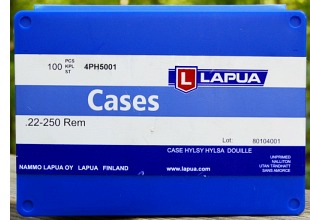
Lapua’s new 22-250 brass has finally started to arrive on dealers’ shelves. Forum member William P. (aka “Heath”) just got two boxes of the new brass. Both boxes have the same lot number. Heath was kind enough to sort the brass and report his findings.
Based on Heath’s 200-count sample, we can say this new brass is very, very consistent in weight. The total weight spread (delta) for 200 cases was just 1.4 grains! And the vast majority, 83%, were within 0.7 grains in weight (160.3 – 161.0). For the varminter, sorting may be superfluous. Once again, Lapua has produced a superb new product, and we love the new, blue plastic boxes.
FYI, you 6mm shooters should know that the Lapua 22-250 brass can be made into quality 6XC brass. And it’s even easier to create a 6-250 wildcat. In May, Robert Whitley explained how he created a tack-driving 6-250 Wildcat from the new Lapua 22-250 brass.
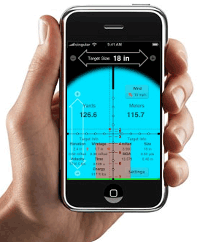
Many of our readers are now using smart-phones for ballistic calculations. Now there is a new App for the iPhone which makes mildot target ranging simple and easy. Mil-Dot Rangefinder 2.0 does all the math for you. Just input the size of the target, and the program calculates range instantly, in yards and meters. The standard edition costs just $1.99 while the “Pro” version is $9.99. We think that, if you’re going to really use this program in the field, it’s well worth paying ten bucks for the Pro version. The Pro edition gives you a full-featured ballistics calculator with windage/elevation corrections. That calculator alone is worth the extra money, and the Pro version offers many other features, which are listed below:
Target ranging (yards and meters)
US Army and USMC mil-dot reticles
Target Info display
Advanced ballistics calculator
Fast windspeed/direction adjustment
Range card (ballistics chart)
Point of impact indicator
Bullet drop compensator
Windage/elevation corrections
Time to target
Shot energy/velocity at target
Multiple Ballistic Profiles
This is a very powerful program. We suspect it will take most users a few days before they really understand all its functions and options. To see a more detailed demonstration of the Mil-Dot Rangefinder App, click on the YouTube video below. There’s no voice-over, so the video can be hard to follow. But at least the video showcases the flexibility of the program and the wide variety of functions it offers. Credit The Firearm Blog for spotlighting this useful App.
We recently had a chance to test the new Chimera Titanium Rings from TacticalRifles.net. The Chimera Rings are “ultra-premium” items designed to compete with the very best tactical rings on the market. As you’d expect, they’re expensive. The 30mm Chimera Rings retail for $224.00 per matched set, including Torx driver. Though these fat boys are beefy in size, offering 7.5 square inches of clamping area per set (way more than most rings), they are very light weight. A medium-height, 30mm Chimera ring weighs just 84 grams (2.96 ounces).
The Chimera rings are precision-machined to exacting tolerances. We had our Mark, our in-house machinist, check them out and he was very impressed: “These rings exhibit beautiful fit and finish and are extremely tough. The fit of the ring bases on a Picatinny rail is perfect. I liked the radius shapes given to most of the surfaces. The front and back faces of each ring are standard flat planes, and the ring caps have a flat disc in their centers, but the remainder of the cap and the sides of the bodies are gently curved. This design requires sophisticated machining processes to pull off, but it looks good. The larger-than-standard heads on the cap hardware, 8-32 X #25 Torx, are another departure that looks well thought out. One danger this increased head size would present if the fasteners were threading into typical 6061 aluminum bodies would be the potential to over-torque and strip the threads with the larger #25 Torx wrench. However, since the titanium bodies have approximately double the tensile strength of 6061 aluminum this is not a problem.”
Assymetrical Tensioning by Design
The Chimera Titanium Rings employ an assymetrical clamping design. This should allow the rings to provide stronger clamping force with less chance of ring distortion. Here’s how they work. After placing the scope in the lower halves of the rings, you screw down the top halves on one side only (opposite the bolt head that clamps to the Picatinny rail). After the three Torx screws are tightened fully on one side, so that the top Ring half butts firmly on the bottom half, there will still be a small gap on the opposite side of the ring (see photo). Don’t worry — that is by design. Final torque is applied to the side with the gap. With the final tensioning done on one side only, the scope is less prone to twist. Furthermore, the manufacturer claims this design puts less stress on the scope tube during mounting.
We did fit the Chimera rings to a Leupold LRT 8-25x50mm scope with 30mm tube. Fit was excellent with no high or low points. With the rings installed as instructed, with one side first clamped flush and the opposite side then torqued to spec, the scope was very secure. On removal the Chimera rings left no visible marks on the tube. I can’t say that it would be a waste of time to lap these rings, but on our Leupold scope the fit was perfect, and the “grip” was uniform over the entire clamping surface.
Tactical Precision System TSR™ Rings TSR™ rings made by Tactical Precision Systems (TPS) have a clamping design very similar to the Chimera Titanium Rings. After placing the scope in the TSR ring set, you clamp down one side (of the ring tops) until metal meets metal. This then leaves a gap of 0.020″ on the other side. The TSR Picatinny 30mm 7075 Aluminum Medium Rings cost $82 in aluminum or $94.00 in alloy steel. The TSR rings are narrower than the Chimeras, and have two Torx bolts per side, rather than the three on the Chimeras.
M3 Hinged Scope Rings from American Rifle Company
An even more radical clamping system is employed by the new, patent-pendingM3 Scope Rings from The American Rifle Company. The top section of the M3 rings is attached with a hinge on one side. After placing the scope in the bottom section of the M3 rings, you swing the upper ring half into place over the scope tube. Then the clamping is done with two inverted (head-down) machine screws that actually pull the hinged ring section downwards. This is designed to put less stress on the scope than conventional rings. The axis of the screws is tangential to the scope tube. Sophisticated finite element analysis (FEA) was used to develop the “over the top”, tangential-clamping ring design. According to the manufacturer, this design evenly distributes clamping forces over the tube and “eliminates the damaging effects of [scope] bending”. The manufacturer claims that, with its rings, “no significant stress concentrations are present on the scope tube”. American Rifle Co. backs up these claims with a series of 3D stress analyses published on its website.
Credit The Firearm Blog for reporting on the M3 ring design.
Disclosure: TacticalRifles.net loaned a pair of Chimera Titanium Rings for testing and evaluation.
The U.S. Army has begun shipping its new, improved 5.56×45 cartridge, the M855A1 Enhanced Performance Round, to U.S. troops in Afghanistan. The Army will procure over 200 million rounds of the new M855A1 ammo in the next 12-15 months, and soldiers in Afghanistan will begin using M855A1 ammo in the summer of 2010. The new round replaces the current M855 cartridge used by U.S. troops since the early 1980s.
The military sought to replace current M855 ammo because M855 has not performed adequately in the Afghan theater. Specific complaints include: 1) inability to effectively penetrate vehicle windshields; 2) poor long-range performance; and 3) failure to fragment even in short-range anti-personnel use. The Army’s Picatinny Arsenal claims that the new M855A1 has improved hard target capability, more consistent performance at all distances, improved accuracy, reduced muzzle flash, and higher velocity. M855A1 ammo is tailored for use in M4 carbines but should also give enhanced performance in M16s and M249s.
New Steel-Tip Bullet Design
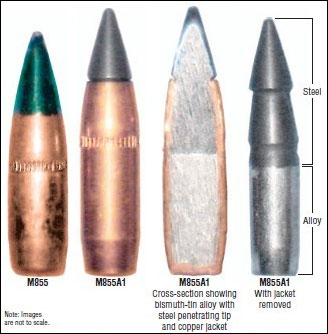
The 62-grain bullet for the new M855A1 ammo is a completely new design. While it may appear to have a plastic “ballistic tip”, that’s deceiving. The new bullet created for M855A1 ammo has a bismuth-tin alloy core with a steel “stacked-cone” penetrating tip. The photo at right shows the version from last year; the final production version may be slightly different (e.g. the final version tip is a different color). Apparently the latest bullet design is a winner. During testing, M855A1 ammo performed better than current 7.62mm ball ammunition against certain types of targets. According to Lt. Col. Jeffrey K. Woods, the program’s product manager, the new M855A1 ammo is “the best general purpose 5.56mm round ever produced. A true general purpose round, the M855A1 exceeds the performance of the current M855 against the many different types of targets likely to be encountered in combat.” The chart below illustrates how M855A1 ammo performs on hard targets compared to M855.
Over One Million Rounds Fired in Army Tests
Prior to initial production, the new M855A1 round underwent vigorous testing. Official qualification of the round consisted of a series of side-by-side tests with the current M855. Overall, the Army fired more than one million rounds to ensure the new cartridge met all expectations. The new M855A1 round is the “most thoroughly tested small caliber round ever fielded” according to Lt. Col. Woods. The new M855A1 is sometimes called “Green Ammo” because it uses a lead-free projectile. Woods said the M855A1’s bullet design shows how “greening” a previously hazardous material can also provide extremely beneficial performance improvements.
In May, we reported on the new MicroSight invented by engineer (and shooter) David Crandall of the Idaho National Laboratory (INL). The MicroSight keeps both near and far objects in sharp focus, simultaneously imaging two distinct focal planes. This break-through technology allows the shooter to see a sharp image of the target and a sharp image of his iron sights at the same time.
The MicroSight is not a lens per se. Rather it is a phased Zone Plate that focuses light beams through diffraction. Zone Plates, first studied by Frenchman Augustin-Jean Fresnel in the 1800s, focus light via a set of concentric rings that alternate between transparent and opaque. The transparent sections let some light waves pass through unchanged, focusing objects that are far away (basically, at infinity). But light passing the edges of the opaque rings gets diffracted, which brings nearby objects into focus. This produces a seemingly impossible result — sharp images of distant and near objects, simultaneously.
The MicroSight is not just a laboratory experiment. Prototype versions have been crafted and placed on test rifles. INL has licensed the technology to Apollo Optical Systems which is right now working with gunsight manufacturers to adapt the MicroSight design to a variety of products. In the future, some MicroSight-equipped products might add refractive power to the Zone Plate, allowing target magnification as well as focusing.
WATCH the VIDEO below to see the MicroSight in Use and to learn how it works…
Many of our readers use iPhones to run ballistics programs and to access travel maps and weather reports. We CAUTION readers who may be planning to purchase a new Apple iPhone 4 (Fourth Generation), first released on June 24th: Wait until the flaws are fixed.
You May Want to Hold Off on Purchasing a iPhone 4
We know many of you guys are anxious to get the latest iPhone 4… but we strongly advise you to wait a week or two at least. Or perhaps wait a few months until an improved version of the new iPhone is available. The reason for this advice is simple — the glass panels on the new iPhone are prone to cracking, and there is a serious reception problem on many of the latest generation of iPhones.
iPhone 4 Major Problems
We suggest readers WAIT before purchasing an iPhone 4, based on issues we observed ourselves, as well as thousands of reports that are flooding in. There are three main problems.
1. Many iPhone 4s have hardware-related reception problems causing dropped calls. This is apparently caused by hand interference with the antenna.
2. The iPhone 4’s front screen and back plate, which are composed of a new, ultra-hard Aluminosilicate glass, are very prone to cracking. We observed this first-hand.
3. Some iPhone 4 users are reporting yellow blotches and other abnormal screen discolorations. This is apparently a manufacturing defect.
Cracked Glass on Faceplate and Backplate
On June 24th, we went to the shooting range. One of our shooters, Katrina, had just acquired a brand new iPhone 4. She carried it in a protective belt holster. After a couple hours of shooting from a sitting position at the bench, she tried to make a call, only to find that the front glass screen had a full-width diagonal crack. This phone was never dropped, tossed, or abused in any way. While the screen needs to be replaced, Katrina’s iPhone is still able to make calls — the first one of which went to Apple customer support.
Many reports are surfacing about broken iPhone 4 glass. Unlike our experience with Katrina’s phone, most of the breakages appear to be on the back plate. You’ll find reports of the breakages in the Apple forums and on major tech websites.
Gizmodo.com reports: “Cases of broken iPhone 4’s backs are already appearing. This hasn’t changed from previous generations…. But the difference is that the iPhone 4 is all glass. If you drop any other phone, you have a 50% chance of breaking its screen. With the iPhone 4, the risk will always be there, no matter how it falls. It’s just more exposed to damage because of the material choice.” Another breakage report.
Reception and Dropped Call Problem
There is a widespread problem with iPhone 4s losing reception when held in the hand. The video below shows how just picking up the iPhone and holding it normally will cause loss of reception. The problem appears to be hand contact with the iPhone 4’s metal frame, which serves as the antenna.
An article in Gizmodo.com addresses the issue: “There’s no great fix for the iPhone 4 reception issues right now. We’re also pretty sure—and Apple confirms it—that touching the antenna does affect things—whether or not it has the final result of killing calls or speed of data connection.”
Rubber Bumper Partial Reception Fix?
Here is a further CNET video report confirming the reception issue with multiple iPhone 4 test units. The problem is more acute with some users than others, and CNET did suggest that installing a $30 rubber bumper may help with the problem. Tests by igear360.com show that bumper can raise iPhone 4 downloading speeds, but uploading speeds still suffer substantially. Click here for iPhone bumper tests.
You have to hand it to the Texans. Forum member Paul Scott (aka “FTRinTexas”), has created a sturdy double-gun case from a surplus Stinger Missile transport box. Measuring roughly 63″ x 11″ x 13″, the aluminum Stinger box is big enough to fit two, long-barreled match rifles side by side, stowed vertically, toaster-style. There’s even room inside for a spotting scope and other accessories. With a little effort (and some after-market foam), the Stinger box can be converted into a very practical (and rugged) gun case.
The converted Stinger box is also an attention-getter according to Paul: “Other guys at the range definitely do a double-take when you haul a missile case out of your truck! They’re kind of disappointed when I open the lid and they see there are only rifles inside.”
Advantages of Side-by-Side (Vertical) Rifle Cases
For wide-forearm rifles with big scopes, we have always liked the vertical storage (drop-in style) cases such as the Plano AirGlide. Vertical placement allows the gun’s weight to rest on the stock with no side-pressure applied to the scope turrets. We’ve asked Plano to make a double-gun case of a similar design, but that’s not going to happen any time soon.
There are companies that make large, metal-bodied safari cases that stow two rifles vertically, side-by-side. These cases are super-secure, but they are also very expensive. Cabela’s side-by-side Safari Case costs $399.00, and it will only hold rifles up to about 50″ overall length. Ziegel Engineering makes a beautiful two-rifle, top-loading Expedition case, but it costs $639.95, and is also limited to a 50″ rifle OAL.
The Stinger Solution — Inexpensive, Rugged Side-By-Side Storage
Paul Scott was clever to source a Stinger Box and transform it into a side-by-side double rifle case. With over five FEET (61.5″) of internal length, the box will secure guns with barrels up to 38″ with ease. And the Stinger box is wide enough to hold two F-Class guns side-by-side with plenty of clearance. Stinger boxes come with an O-ring seal, air relief valve, and handles on each end. Hasp locks are easily added, as are wheels (just slide an axle through the lower “bumper” flange on the box end.)
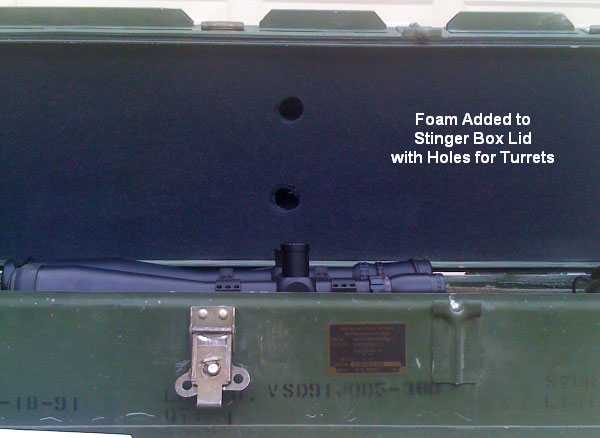
As received from Uncle Sam, a surplus Stinger storage box needs some modification to work as a double rifle case. Paul removed most of the internal foam padding from the lower section, and then used an electric knife to carve cradles to support the two rifles under the forearms and buttstocks. The original hard foam blocks in the Stinger box lid were replaced with closed cell foam like that used in Pelican cases. Paul found that the new foam in the lid would press down on the scopes’ elevation knobs, so he cut round holes in the top foam to provide additional turret clearance.
As you can see in the photos, Paul had enough room forward of the rifles to stow his spotting scope and disassembled spotting scope stand. Paul simply placed another layer of foam in the bottom of the box and then cut the foam to fit the equipment. Another foam layer can be placed over the spotting scope and stand to prevent slippage during shipment.
If you are interested in making your own double-gun case from a Stinger box, email PScott [at] pegasustexas.com . Paul has a few extra Stinger boxes he may be willing to sell for around $175 each. Each of these Stinger Missile containers cost Uncle Sam $2066.00 originally! The photo below shows the Stinger transport box before modification.
Here’s a handy product for our readers who collect military rifles or who shoot in the CMP’s Garand Matches. Second Star to the Right, a company based in Stonewall, Lousiana, offers vinyl mats printed with the breakdown/assembly instructions for the M1 Garand. These mats are faithful reproductions of the 1952 Army instruction diagram used to train GIs and armorers. There are two models: 1) 30″ x 26″ Deluxe heavy-weight version with grommets ($25.00); and 2) 19″ x 14″ “Collectors Edition” lighter-weight version ($17.00). You can either use the mat draped on your bench as a cleaning surface, or hang it on the wall for decoration.
In addition to its M1 Garand mats, Second Star plans to introduce mats for other firearms such as the M14, M1 Carbine, and M16. For more information call Second Star at (318) 560-2579. Second Star’s website is not yet active, but you can send email to: the2ndstar2010@yahoo.com .


 John Pierce reports: “Our new Tactical Multi-flat action features a low-profile, 20-minute integral Picatinny rail and integral recoil lug. We made the action to drop into the Accuracy International modular stock utilizing AI’s magazines as well. Though this is a short action for .308 Win and similar-sized cartridges, the loading port is much longer than usual for better access and ejection. The current price is $1295.00, and that price includes a 30° coned bolt and/or spiral fluting if the customer desires those options.” John noted that the coned bolt option works well in Tac Comps: “I have a coned bolt on my own tactical rifle that I used at ASC. I found it picks up the rounds more smoothly from the magazine. At ASC, quite a few guys had feeding issues, but my action ran perfectly. The coned bolt works slick.” Actions will come finished with NIC CeraKote in customer’s choice of colors including: Matte Black, Titanium, OD, Sand, Brown, Gray, and Forest Green. (CLICK HERE for CeraKote color options).
 For more than a century, makers of rifle stocks have used large, complicated mechanical duplicators to reproduce stock designs. These contraptions rely on mechanical linkages to follow the lines of a stock and reproduce the shape on a new blank. Now new 3D scanning technology and CNC milling systems may render the mechanical stock duplicator obsolete.


 Many of our readers are now using smart-phones for ballistic calculations. Now there is a new App for the iPhone which makes mildot target ranging simple and easy.
 We recently had a chance to test the new
  Assymetrical Tensioning by Design


 New Steel-Tip Bullet Design
 In May, we reported on the new


 Cracked Glass on Faceplate and Backplate

 You have to hand it to the Texans. Forum member Paul Scott (aka “FTRinTexas”), has created a sturdy double-gun case from a surplus Stinger Missile transport box. Measuring roughly 63″ x 11″ x 13″, the aluminum Stinger box is big enough to fit two, long-barreled match rifles side by side, stowed vertically, toaster-style. There’s even room inside for a spotting scope and other accessories. With a little effort (and some after-market foam), the Stinger box can be converted into a very practical (and rugged) gun case.
 There are companies that make large, metal-bodied safari cases that stow two rifles vertically, side-by-side. These cases are super-secure, but they are also very expensive. Cabela’s side-by-side