|
|
January 26th, 2009
In mid-2008, Sinclair Int’l released an all-new, super-wide bipod system for F-Class, Tactical, and Varmint shooters. Initially priced at $165.00, the Sinclair F-Class bipod was (then) a steal. The price is now up to $199.95, still a good deal in our opinion. And now you can get the bipod in either a silver (aluminum color) or matte black finish. On a tactical rifle, the low-gloss black looks great.

New Wider, More Versatile Design
Sinclair’s previous F-Class bipod was popular but shooters wanted a wider “wheelbase” and the ability to work with 3″-wide forearms. Sinclair’s new unit offers these features and much more. The new bipod is lower, lighter (36 oz.), and easier to mount than the previous model. The new unit attaches via a captured pin system that works fast and can’t get lost. After engaging the pin, two adjusting knobs then clamp the fore-arm onto a felt-lined bracket for a secure fit. The bipod will accommodate up to 3″-wide forearms (and even 3 3/8″ without canting adjustment).
Adjusts for Height and Cant Angle
The new Sinclair bipod features a large rotating lever that allows you to adjust rifle cant angle easily. Vertical height adjusts from 5.5″ to 10.25″, and the leg heights are independently adjustable — an important feature when shooting on uneven ground.
The folks at Sinclair did their homework. This is a completely redesigned system that offers an easily-adjustable, highly stable platform in the field. The unit is well-built, with all the adjustments you want and need. Given the quality of the design and materials, we think it reamains a good value, though the price has gone up since this “second generation” Sinclair F-Class bipod was introduced last year.
January 25th, 2009
Barry O. (aka “TheBlueEyedBear”) of Montana is a long-term Forum member and “friend of the site”. Barry owns some pretty spectacular rifles, all built with premium components. His latest ‘Pride and Joy’ is a mighty impressive piece of field artillery. This is one serious “big boomer” chambered in the 338 Snipe-Tac® cartridge (based on 408 CheyTac®). The rifle was built by Dave Viers of Black Diamond Rifles (Viersco.com). Viers tell us: “The 338 Snipe-Tac® was developed in 2001 for extreme long-range hunting and target applications. The parent case is the 408 CheyTac® necked down and shoulder improved to 35 degrees. H2O capacity is a whopping 165 grains! For velocity, 140 grains of Hodgdon BMG-50 powder propels a 300gr Sierra MatchKing bullet to a average speed of 3300fps. Accuracy is half-MOA or less.”

Barry successfully took elk with this rifle this season. The .338 Snipe-Tac certainly offers more than enough “knock-down power” for any North Americcan game. Barry explains: “Success must have come from the gun — it could not have been the ‘Nut behind the trigger’. My elk load this season was a Henson 265gr aluminum-tipped bullet pushed by 140+ grains of US-869 powder. Muzzle Velocity was 3496 fps (recorded by my PVM-21). Muzzle Energy approached the ‘Mack Truck’ mark. The bullet impact at 424 yards destroyed the off shoulder of my elk.”

Gun Specifications:
Action: Lawton 8000 Action with Jewell HVRST trigger.
Barrel: 32″ Lawton chrome-moly, 1:11″ barrel with Viersco Muzzle Brake.
Stock: Manners carbon Tactical Stock with custom camo paint by Dave Viers.

For more info, contact David Viers, Viersco Mfg., 58896 – 866 Road, Allen, NE 68710, phone: 402-635-2333 or 712-266-5083 (cell).
January 23rd, 2009
We recently talked with Dave Kiff of Pacific Tool & Gauge (PT&G). Dave told us he has a number of new time-saving tools for gunsmiths, plus new bottom metal and bolt components for owners of Remington rifles..
Specialized Gunsmithing Tools in Stock
At the show, dave noted that PT&G currently has a variety of specialized cutting tools in inventory. Dave says the big new is is “Gen 2 Reamer”. This unique $287.00 tool will true the receiver face AND the internal lug recesses simultaneously. That will save a gunsmith time and effort. Dave offers other specialized cutters including:
– Threaded Receiver Mandrel for external engraving, outside truing etc. — $189.00
– Oversize Thread Reamer — $189.00
– Diamond-coated tap for Rem 700 – $189.00

 New Rem 700 Upgrades New Rem 700 Upgrades
Dave Kiff has collaborated with parts designer Kevin Wyatt to introduce some exciting new hardware for precision tactical, match, and hunting rifles. The new PT&G/Wyatt products will include custom bottom metal for the Rem 700, and a Win m70 claw-extractor modification for the Remington 700.
Initially, the Rem 700 bottom metal will be crafted from aluminum (steel versions will be offered soon). The bottom metal will use Wyatt’s detachable box magazines. The bottom metal fits a standard Remington footprint (though minor modifications may have to be made to the receiver). Both aluminum and solid steel versions should be available by late spring for $205.00 with one magazine, and extra mags are $54.00.

The Claw Extractor mod for the Rem 700 is a robust design that avoids some of the problems associated with a SAKO-style extractor in a Rem bolt. The Claw Extractor allows a “normal” ejection angle so you won’t bounce your brass off the windage knob of the scope. No receiver alterations are required, and Wyatt is working to provide controlled feeding in the final production version. The new Claw Extractor product, according to Dave Kiff, should be available by the end of 2009. Installation will require a gunsmith — this is not a do-it-yourself mod.
January 21st, 2009
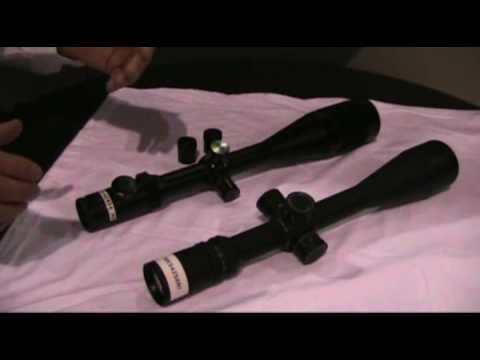
Nightforce Benchrest and NXS scopes are very popular among our readers. The Nightforce 12-42×56 BR model is the scope of choice for top F-Class and 1000-yard shooters. It offers sharp glass, big-time magnification, precision parallax control (via a rotating front objective), plus a wide choice of reticles. The NXS offers these same qualities, but it uses a side-parallax adjustment. Many shooters building their first long-range rifle ask: “Which should I get–the Nightforce BR model or the NXS?” Nightforce Sales Manager Kyle Brown helps answer that question in the video below. Kyle explains the major (and minor) differences between the BR and NXS scope lines. You’ll find this video very informative.
CLICK HERE to download Nightforce Optics 2009 Catalog (Large 5mb .pdf file).
New First Focal Plane 3.5-15×50 F1 Scope
The new NXS 3.5-15×50 F1 was created at the request of U.S. military and other professional sharpshooters. They wanted a rugged scope that offers a choice of elevation/windage click values, plus a ranging reticle in the First Focal Plane (FFP). A reticle located in the first focal plane remains in the exact same ratio to the target across the scope’s entire magnification range. The FFP design (designated by “F1″) is optimal for rangefinding purposes, since the reticle’s markings remain consistent relative to target size at all magnification settings. The 3.5-15×50 F1 scope will be offered with three click-value options: 1/4 MOA, 0.1 Mil Radians, or 1.0 MOA elevation + 0.5 MOA windage clicks.

CLICK HERE to download NXS 3.5-15×50 F1 Scope Spec Sheet (.pdf file).
HOT NEWS: If you like the NXS 3.5-15×50 F1, take note that a Nightforce 5.5-22×56 FFP NXS is coming in the fall of 2009. Plus Kyle told us that the Nightforce Compacts and First Focal Plane scopes now have their scope bodies (main tubes) crafted in Idaho. So, you’ll notice that they are now stamped “Made in USA”.
New Ballistic-Compensating Reticles Offered for 2009
Nightforce will offer a variety of NEW ballistic reticles that provide “hold-over” hashmarks corresponding to the trajectories of popular hunting rounds. With these new christmas-tree style reticles, hunters and varminters can rapidly adjust to different ranges without cranking-in elevation with the top turret. The reticles also include horizontal hash marks corresponding to calculated wind drift in mph (not MOA or mils). There are three basic options, one each for low, medium, and high velocity cartridges. In addition, Nightforce may offer Horus ballistic-compensating reticles, and possibly the Holland ART reticle, later in the spring of 2009.
 New Ring-Top Bubble Level and Level/ADI New Ring-Top Bubble Level and Level/ADI
Nightforce has introduced the Top of Ring Bubble Level, a low-profile level built directly into the top half of a scope ring. This fits in place of the upper half of a Nightforce Ring (e.g. Unimount, Direct Mount, and Nightforce Mil-Spec). Like other anti-cant devices, the NF bubble level helps the shooter avoid canting his rifle left or right, which can throw off the shot significantly at long ranges. The level also helps ensure your reticle is plumb when mounting the scope.
The Top of Ring Bubble Level is available in three versions: 1) Ring Level alone; 2) Ring level with integrated mount for the Nightforce ADI (Angle Degree Indicator); 3) Ring level with mount plus ADI unit (complete system). You’ll want the ADI if you often have to make shots at steep angles. Calibrated in degrees, the ADI instantly gives the shooter the up or down angle for the shot. Plug that number into a ballistics calculator (or angle drop chart) and you’ve got your corrected drop for the true range to the target.
We definitely recommend an ADI for hunting, and for competition disciplines where up/down angle shots are required. The ADI is simple, robust, and requires no batteries. Mounting the ADI directly to the scope ring is the slickest installation yet for this useful device. This mounting set-up was a collaboration between Shawn Carlock (Defensive Edge), Ward Brian (Sniper Tools ACI), and Nightforce.
For more info, contact Nightforce Optics, Inc., 1040 Hazen Lane, Orofino, ID 83544, tel (208) 476-9814, or visit NightforceOptics.com
January 20th, 2009
Tom Manners of Manners Composite Stocks had a wide selection of stocks on display at SHOT Show. The Manners stocks, with carbon-fiber layup, are extremely durable and stiff. The fit and finish is excellent, better than you’ll find with most fiberglass stocks. The designs work really well when shot from bipod, making the Manners T-Series stocks (T, T1, T2, T3, T4, GAT, T50) ideal for tactical use. Jason reports: “These are extremely strong stocks. I really like the T 2/3/4 stocks. The T2 is my favorite. It features a McMillan A5-style front with an A3-style rear.”

New Low-Profile ‘Fish Belly’ F-Class Stock
Jason was impressed with the new Manners F-Class stock. Tom says: “The shell is 100% carbon fiber with a molded-in action and barrel area. This design features a very long, stiff fore-end. From the back of the action to the tip of the fore-end the stock measures 27″ long which is around 7 1/2″ longer than our T4 stock.” The idea is to provide a “longer wheelbase” to better balance the long, 30-32″ barrels favored by many F-Class competitors. The front half of the fore-end is very thin (from top to bottom) to achieve a low profile on the bags. Much thought has gone into controlling fore-end flex. Manners’ design achieves greater vertical rigidity (less deflection under load) through an innovative “fish belly” design. The rounded undersection, like a canoe hull, strengthens the fore-end considerably.


Rimfire Stock for Tactical Cross-Training
Tom also had on display a new stock set up for the SAKO Quad switch-barrel rifle. Finished in “digital camo”, this stock has the “fit and feel” of Manners’ T-Series centerfire stocks. This lets you maintain the shooting position of your centerfire tactical stock when you switch to the SAKO Quad rimfire for low-cost training sessions.

January 20th, 2009
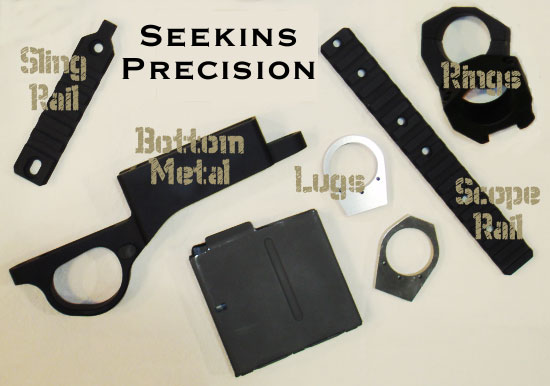
Seekins Precision produces a wide variety of expertly-machined products such as scope rings, picatinny rails, and sling rails. Seekins products are priced competitively, but give up nothing in quality to some more expensive brands.
At SHOT 2009, Glen Seekins unveiled some cool, new products, including a new AR15 lower with many unique features. The Seekins SP223 lower features flutes on the magwell front face for improved grip, plus an enlarged triggerguard allowing use with gloves. The new lower takes standard milspec mags as well as MagPul P-Mags. It should be available in April 2009, with a price of about $350. Glen tells us that a Seekins AR upper design will follow “down the road.”

Seekins also announced new Remington 700 bottom metal. The Seekins R700 bottom metal assembly is made from 7075-T6 Aluminum allow — very tough stuff. The R700 is currently offered for .223 Rem, .308 (and other standard short action rounds), and .338 Lapua. A WSM version will be available soon. This bottom metal works with 5-round magazines, but Seekins will be offering 10-round .223 and .308 mags in the summer.
January 19th, 2009
 Kelbly’s rolled out a remarkable new March benchrest scope at SHOT 2009: a completely new 36-55x52mm zoom, quite unlike anything on the market. Produced by Japan’s DEON Optical, the design was inspired, in part, by suggestions from ace shooter Lou Murdica. Lou looked at the current benchrest disciplines, from point-blank (100/200) BR, all the way to the 1000-yard game. He found that most benchresters (both short-range and long-range) rarely dialed their scopes below 30-power, and most wanted more magnification than their current scopes offered, for times when the conditions were good. Lou asked DEON’s designers if they could build a high-quality BR scope with about a two-times zoom ratio. But he also wanted the reticle to be super-stable, so it didn’t move at all when adjusting the magnification. Kelbly’s rolled out a remarkable new March benchrest scope at SHOT 2009: a completely new 36-55x52mm zoom, quite unlike anything on the market. Produced by Japan’s DEON Optical, the design was inspired, in part, by suggestions from ace shooter Lou Murdica. Lou looked at the current benchrest disciplines, from point-blank (100/200) BR, all the way to the 1000-yard game. He found that most benchresters (both short-range and long-range) rarely dialed their scopes below 30-power, and most wanted more magnification than their current scopes offered, for times when the conditions were good. Lou asked DEON’s designers if they could build a high-quality BR scope with about a two-times zoom ratio. But he also wanted the reticle to be super-stable, so it didn’t move at all when adjusting the magnification.
Six months later, DEON (March) sent Lou a prototype. It was very different that other scopes on the market because the zoom function is done in the eyepiece — similar to a spotting scope. In fact DEON dubbed the new scoped the “EP” zoom, with the “EP” referring to “eye piece”. Lou has tested the new March 36-55X and he says “The cross-hair absolutely doesn’t move when you zoom because everything is taking place behind the cross-hairs at the eyepiece. For a benchrest shooter this is a BIG deal — if you don’t like the mirage, you can change from 55 power to 36 power in the middle of your group, and know that point of impact will not change.” The other great feature of the scope is the near-constant eye relief — it changes only about 1/2″ from 36 power to full 55X magnification. Lou says, “you can zoom through the entire range and barely need to move your head at all.” Lou has worked with all the March BR scopes, from the early 40X through the lastest zooms. He feels that the new 36-55 may be the best yet for short-, medium-, and long-range benchrest shooters. As Lou explains: “It takes care of 100 to 1000-yard shooting with one scope. What more would you ever need?”


Click Here to download March 36-55×52 Spec Sheet.
Revolutionary March 1:10 Ratio Zooms Amaze Optics Experts
March pulled off a major coup at SHOT Show. The new March 1-10x35mm and 2.5-25x42mm zooms were the talk of the Show. This is the first time ANY major manufacturer has been able to achieve a 10 times zoom ratio. March’s booth was mobbed as engineers from other optics companies came to see how March “achieved the impossible”. And the optics guys had to fight past a line-up of military personnel — from the USA, Canada, Israel, and Germany. Lou Murdica was there and he reports: “Once word of these scopes hit the show’s Tactical area, March had more military and law enforcement people from the U.S. and other countries than you could imagine.”
 Apparently, the U.S. Military has been asking domestic manufacturers to perfect a 1-10X zoom for years, and the response was always: “It can’t be done.” Well, starting from a blank page, the engineers at Japans’ DEON Optical Design Corp. (makers of the March), figured it out. For the military this is a HUGE technical breakthrough because a 1-power optic is ideal for close quarters combat (or house-clearing) while 10-power is a good setting for long-range sniper work. The two 1:10 ratio zooms both feature 1/4 MOA clicks, illuminated plex or MTR2 reticles, 30mm tubes, and a huge elevation range: 180 MOA for the 1-10×35 and 100 MOA for the 2.5-25×42. Both these scopes are slated for June 2009 deliveries. The 1-10×35 scope is expected to sell for $1500.00 while the 2.4-25×42 will cost about $2400.00. Apparently, the U.S. Military has been asking domestic manufacturers to perfect a 1-10X zoom for years, and the response was always: “It can’t be done.” Well, starting from a blank page, the engineers at Japans’ DEON Optical Design Corp. (makers of the March), figured it out. For the military this is a HUGE technical breakthrough because a 1-power optic is ideal for close quarters combat (or house-clearing) while 10-power is a good setting for long-range sniper work. The two 1:10 ratio zooms both feature 1/4 MOA clicks, illuminated plex or MTR2 reticles, 30mm tubes, and a huge elevation range: 180 MOA for the 1-10×35 and 100 MOA for the 2.5-25×42. Both these scopes are slated for June 2009 deliveries. The 1-10×35 scope is expected to sell for $1500.00 while the 2.4-25×42 will cost about $2400.00.

We are told that David Tubb will be working on adapting a specialized long-range reticle for the 2.5-25×42. Representatives of the U.S. Navy SEALs showed great interest in the 2.5-25x42mm March. In addition to the two smaller tactical scopes, March displayed 5-32x52mm and 10-60x52mm tactical scopes. These feature 1/8-MOA clicks and an MTR1 reticle.
January 19th, 2009
RCBS makes a fine progressive press, the RCBS Pro 2000. This Editor owns one. I can tell you it is very solid, and the strip primer-feeding system has proven virtually fool-proof, something that can’t be said about some competitive progressive presses. I also believe the micrometer-equipped powder measure is superior to the Dillon alternative. Nonetheless, Dillon still dominates the progressive press market. One reason is that Dillon has long offered a reliable case-feeding system, and GSI International and Gaspari USA offer after-market bullet feeders for the Dillon 650 and 1050. Until now, with an RCBS Progressive, you needed to manually insert a bullet into each case. Well, at SHOT 2009, RCBS unveiled a new bullet-feeding system.
 |
 |
RCBS says its new automatic bullet-feeder will work with Dillon (blue) and Hornady (red) progressives as well as the RCBS 2000. The unit mounts to a sturdy vertical support, with a flexible tube that connects to the bullet-seating station. It looks well-designed, and during a demo by RCBS manager Kent Sakamoto, the bullet-feeding system worked flawlessly. Kent showed us the pistol-bullet feeder, but a second version for rifle bullets will be offered by mid-2009. The rifle-bullet feeder should be just the ticket for varminters who need to load large quantities of .223 Rem, 22-250, or .204 Ruger rounds. Sakamoto explained that the automatic bullet feeder can significantly boost your reloading output whether you have a blue, red, or green progressive press.
January 19th, 2009
 Every year, the high-end Spotting Scopes from the major optics-makers seem to get bigger, better, and, unfortunately, more expensive. Leica rolled out its new flagship spotting scope, a black-bodied 82mm Televid with APO glass. A smaller version with a 65mm front objective will also be available in Spring 2009. These babies are expensive — the 82mm (body only, no eyepiece), carries a $3,195.00 MSRP, while the 65mm (body only, no eyepiece) retails for $2,295.00. Every year, the high-end Spotting Scopes from the major optics-makers seem to get bigger, better, and, unfortunately, more expensive. Leica rolled out its new flagship spotting scope, a black-bodied 82mm Televid with APO glass. A smaller version with a 65mm front objective will also be available in Spring 2009. These babies are expensive — the 82mm (body only, no eyepiece), carries a $3,195.00 MSRP, while the 65mm (body only, no eyepiece) retails for $2,295.00.
What justifies the high price is Leica’s superb APO (apochromatic) glass. This is formulated to give enhanced light transmission with less chromatic aberration. Other manufacturers offer “ED”, “HD” or “LD” low-dispersion glass, but the Leica APO glass is probably about as good as it gets. (Both the new 65mm and the 82mm are offered at a lower price with HD flouride glass, with APO lenses an extra-cost upgrade.) Leica claims the optical performance of the new spotting scopes is significantly better than the preceding models. The High Definition (HD) versions use specialized glass in a newly designed lens arrangement for improved clarity and contrast.
Jason checked out the new 82mm Televid with angled body. It was fitted with a 25-50x Wide Angle eyepiece. Jason noted the eyepiece offered good eye relief, and the clarity and sharpness was outstanding. The scope is fairly compact (front to rear) for an 80mm-class optic. Is the 82mm APO Televid better than the Big Zeiss or Swarovski (or the new ED-glass Kowa)? Only field tests can reveal that. “You’d have to get the Leica 82mm in the field with a couple other premium spotters with low dispersion glass and see how they perform side by side.” The Leica Televid 82 and Televid 65 spotting scopes are both available with straight or angled eyepiece housing, with either HD or APO glass.

Leice also announced that, for 2009, it will offer HD (High Definition) lenses in its popular Geovid Laser-Range-Finding Binoculars. MSRP on the HD Geovids starts at $2395.00.
For more information, visit www.leica-camera.com.
January 18th, 2009
Anschütz, the legendary German arms-maker, harvested a ton of Gold Medals at the 2008 Beijing Olympics with its latest match rifles (both rimfire arms and air rifles/pistols). In addition to its state-of-the-art bullseye target rifles, Anschutz produces Biathlon rifles and hunting rifles. At SHOT Show 2009, company President Jochen Anschütz was on hand to show his company’s latest wares, including the designs that won gold in Beijing. Jason Baney met with Jochen and got this exclusive Video Interview:
CLICK HERE to watch full-width VIDEO in Higher Quality
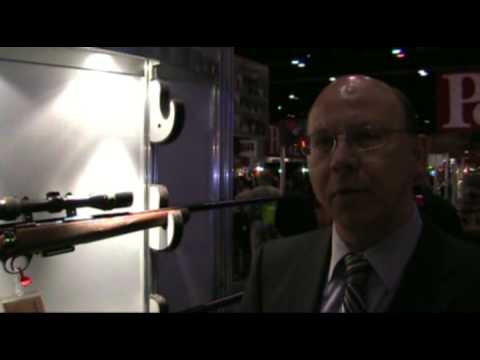
In the interview, Jochen noted that Anschütz has introduced a new Model 1770 hunting rifle, chambered in .223 Remington. This features a new six-lug action — the first all-new action design from Anschütz in 30 years. Below, Jochen holds the top-of-the-line Anschütz biathlon rifle. Designed for Olympic-caliber biathletes, this gun has a straight-pull Fortner action that can be cycled nearly as rapidly as a semi-auto.

High-Tech Aluminum-stocked Position Rifle
Among the Anschütz designs on display at Shot Show was the new Anschütz model 1913 position rifle with a gorgeous “1918 ALU Precise” brushed aluminum stock. It looked like it had been crafted in an aircraft plant.


|


