|
|
February 26th, 2009
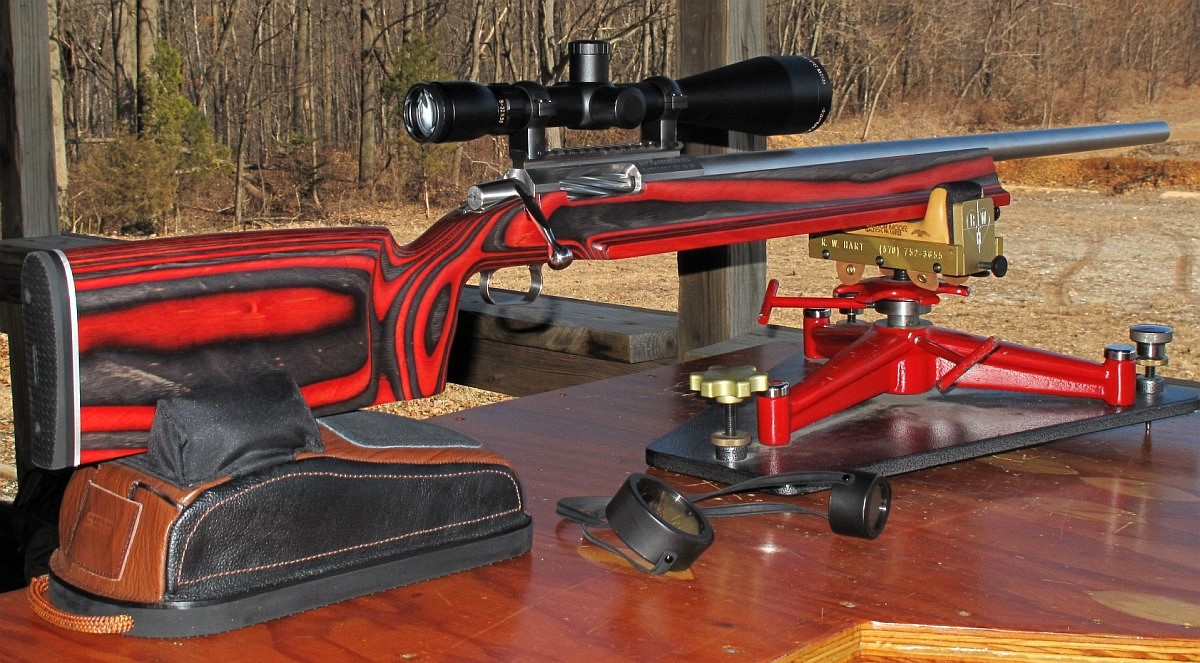
SEB coaxial front rests are impressively engineered and beautifully machined. If you like a joystick-style rest, you won’t go wrong with a SEB. This editor shoots off one. Though the current SEB rest is nearly ideal for short-range benchrest, shooters have asked for an upgraded version that can handle heavier rifles (such as 22-lb, F-class guns), and wider fore-ends (up to 6″). Sebastian Lambang, creator of SEB rests, has been listening, and he’s hard at work perfecting a new “magnum” model that will work with big, heavy guns. It is hoped that the new model SEB rest will be available in summer 2009, but it’s “too early to know for sure”.

2009 Update: New SEB Rest in Research & Development
Report by Ernie Bishop, USA Dealer for SEB Products
Seb’s goal is to make a new rest using an enhanced design (but it will still be a coaxial-type rest with double-sided functionality). It will have quicker elevation adjustment. It will also go lower and taller at the lowest & tallest setting (from about 4″ to 9″ tall, or more), and should accept rifle stocks up to 6″ wide. Here’s the good news — the price should be less expensive too. The new rest will still feature twin posts, with coarse elevation adjusted by rack & pinion. The center-to-center (“CTC”) between the posts is about 10″, to be able to accept rifle stocks up to 6″ wide. Like the current SEB rests, the new rest can be set up for either right-hand & left-hand shooters.
The new rest should suit a broader set of disciplines — it will work for short range BR, F-class, long-range benchrest shooting, and varmint shooting, too. Unfortunately, because of the specifications/requirements, Seb must remove the “pivotal base system” and make the base in “T” shape. The base can be disassembled for easily for more compact storage. By design, the new model rest can accept a “Balance Weight System” (BWS) better than the standard SEB rest, because the weight (which is optional) would not interfere with the front elevation screw, the fore-end stopper, or the base. This is the reason that the new base will have be built with a “T” shape.
The “BWS” is basically a counterweight, simply a chunk of stainless steel, attached on the side opposite side of the joystick. It’s an inexpensive, optional item, available in different weights. With the “BWS”, the SEB rests could accept rifles as heavy as 30 kgs (66 lbs.), or even more. This should be able to be accomplished without holding the joystick. If the weight is correctly matched to the weight of the rifle), I suspect that the rest top & “BWS” combination would remain stationary under hard recoil.
Hopefully the new rest will cost less than the current model rest. Seb is trying to keep the price under $700. This should be possible because of changes to the design and materials. It will retain the same standard of smoothness and quality that Seb is known for.
 Finally, Seb asks for your patience. He is still evaluating materials and is still experimenting to determine what will work best. Besides this, Seb is working on an updated front bag design as well. (There is also an improved fore-end stop in the works.) Once this new rest is ready, Seb will be shipping some to the States for testing. Personally, I can’t wait to see this new rest! Finally, Seb asks for your patience. He is still evaluating materials and is still experimenting to determine what will work best. Besides this, Seb is working on an updated front bag design as well. (There is also an improved fore-end stop in the works.) Once this new rest is ready, Seb will be shipping some to the States for testing. Personally, I can’t wait to see this new rest!
Ernie Bishop
306 West Flying Circle Drive
Gillette, WY 82716
(307) 257-7431
ernieemily [at] yahoo.com
|
For more information on SEB front rests visit www.sebcoax.com, or contact Ernie Bishop (address above). Ernie notes: “I have a shipment of 15 rests coming toward the beginning of March. Currently, I am out of stock, and have started a waiting list. The USA price for a SEB Rest (including one 2.25” OR 3” front bag ) is $725.00 plus shipping/handling. Please don’t get confused by the price that is listed on Seb’s website. That price is for customers in countries where there are no SEB dealers.“
February 26th, 2009
Here’s an handy and affordable product that everyone can use in their home workshop. When working with a vise you have to be careful not to mar or gouge the item you’re clamping. People will use cardboard, old carpet, even scrap leather as “padding”. All those options can work, but magnetic soft vise jaws are a simpler solution. These come in matching sets, sold for $12-$20.00 by a variety of vendors. Measuring 4-6″ long these have an upside-down L-shaped cross-section. The are formed from a semi-soft polyurethane that won’t scratch metal (or gouge wood). Simply mount the plastic pieces over the metal jaws of your vise. The soft jaws are held in place by magnets embedded in the backside of the plastic. If you wish, you can saw off the ends of the soft jaws for a better fit on smaller vises.
In todays’ report, we highlight two kinds of soft vise jaws, one with pre-formed channels and the other with flat edges. The first unit, made by Wilton, is bright yellow, with shaped channels to hold various items. Shown below, these soft jaws will hold Wood, Metal, Tubing, and more. The Wilton jaws cost $13.69 at TrueValue Hardware stores (item 606400).

For those who prefer polymer vise jaws with a flat edge (no channels), Graham Tool Co. makes a nice set of Soft Vise Jaws, priced at $19.95. Graham’s bright red vise jaws feature a flat contact surface with shallow, diamond-pattern serrations. The Graham soft jaws feature powerful rare-earth magnets, so they secure to your metal vise more securely than most other types of plastic jaws.

NOT for Barrel Removal/Installation
Soft vise jaws can hold a barrel for fine work, such as engraving. However, they are not designed to resist large torque loads. Soft jaws are NOT suitable for barrel removal and installation. For those tasks, use a dedicated barrel vise with the appropriate clamping insert.
February 21st, 2009
 Sinclair Int’l has released its latest catalog of products for precision shooters. As always, the Sinclair Catalog is packed with interesting gear, and this 2009-A catalog has a bunch of new products. Most notably, the catalog features a wide selection of Nightforce scopes, including the Benchrest models. Sinclair Int’l is now a stocking Nightforce dealer. The 12-42×56 BR model is Sinclair Product 72-1045, priced at $1359.00. Sinclair Int’l has released its latest catalog of products for precision shooters. As always, the Sinclair Catalog is packed with interesting gear, and this 2009-A catalog has a bunch of new products. Most notably, the catalog features a wide selection of Nightforce scopes, including the Benchrest models. Sinclair Int’l is now a stocking Nightforce dealer. The 12-42×56 BR model is Sinclair Product 72-1045, priced at $1359.00.
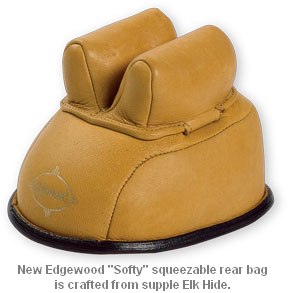
Among the many new items in Sinclair’s catalog are two new products from Edgewood, makers of sandbags and high-quality leather shooting products. The first Edgewood addition will make old-fashioned bag-squeezers rejoice. Edgewood’s new “Softy” is an extra-soft squeezable rear bag is made of heavy Elk Hide. The Softy’s base is extra thick, but still soft (not a hard donut like Edgewood’s otherbags). This bag is approximately 3-1/2” tall with medium height ears and a 3/16” ear spread. Sinclair comments: “If you prefer to squeeze the rear bag for minor sight adjustments instead of turning knobs on your front rest, this is the perfect rear bag for the job. The Softy’s taller, soft ears will accommodate just about any stock style.” The Softy, Item 04-7575, retails for $135.50.
The second Edgewood item we noticed was the new leather Stock Protector, item 04-7580. Yes, we know, a cheap, old towel can do the same job, but the $32.95 Edgewood product will stay in place better than a towel and it provides a better barrier against solvents that might harm your stock’s finish. This is a beautifully-made item, a shooting accessory for the “man who has everything”. Two 1/4” steel rods are sewn into the side edges of the stock protector to keep it in place on the stock. Made of a single piece of quality leather, the Edgewood Stock Protector is 9-1/2” wide and 12” long.

Sinclair Int’l Catalog Requests
Sinclair’s 2009-A catalog is free for the asking. CLICK HERE for a catalog request form. Fill it out and Sinclair will mail its latest catalog to you.
February 19th, 2009
After much anticipation, we finally rolled out our latest project gun, a Bat-actioned 6-6.5×47/6.5×47 Lapua switch-barrel benchrest rifle. Equipped with two (2) Bartlein 30″ 5R barrels, the gun was designed to compete in a variety of disciplines: F-Class, Varmint Matches (Silhouette + Paper), and 600- and 1000-yard Benchrest.


The gun was built to a 17-lb. weight limit, with the goal of achieving the maximum possible accuracy with this pair of cartridges. We chose two identical, 30″ Bartlein barrels so we could evaluate the relative performance of the 6.5×47 and its necked-down 6mm version, holding as many variables constant as possible. Both barrels were chambered by ace gunsmith Mark King with tight-tolerance, no-turn necks.
 . .
Sightron provided the SIII 8-32×56 30mm scope, shown mounted in Burris Signature Zee Rings.
The rifle, two years in the making, features top-of-the-line components. The action is a BAT multi-flat MB, with a +20MOA Weaver-style rail on top. As the action was originally intended to be used in an F-Class rifle, the loading port was enlarged at the BAT factory to load full-length .284 Winchester rounds.
 The stock design is unique. It started as a Bruce Baer MB Tooley style, but we added some custom design upgrades. The sides of the fore-end are square (like a McMillan edge), and the underside of the fore-end has been relieved in the middle, creating two “rails”. The rear flat, on the underside of the buttstock, is 1.25″ wide, with a channel cut in the middle (to reduce drag, and to ensure that the bag tracks in the ears rather than on the center stitching.) The stock design is unique. It started as a Bruce Baer MB Tooley style, but we added some custom design upgrades. The sides of the fore-end are square (like a McMillan edge), and the underside of the fore-end has been relieved in the middle, creating two “rails”. The rear flat, on the underside of the buttstock, is 1.25″ wide, with a channel cut in the middle (to reduce drag, and to ensure that the bag tracks in the ears rather than on the center stitching.)
The stock was expertly inletted, pillar-bedded, and finished by Alex Sitman of Master Class Stocks. Alex put much time and effort into ensuring that the geometry was square throughout, with straight, parallel tracking surfaces. The BAT MB action has an extended front section, to allow for additional bedding surface. The MB action employs a three-action screw design. Sitman installed pillars for all three action screws then carefully bedded the entire action. Alex, one of the best stock-workers in the world, did a great job on this rifle.

Rifle Will Provide Load Data for New Cartridge Guide
This rifle was originally conceived as a match-grade test bed for the 6.5×47 Lapua cartridge and its wildcat cousin the 6-6.5×47. Jason Baney will test different powders and bullets in the rifle, to develop reliable load data for an upcoming 6.5×47/6-6.5×47 Cartridge Guide. And yes, we will be trying H4350, Reloder 17, and the relatively new Hodgdon Hybrid 100V. Jason will test a variety of flat-base and boat-tail bullets in both 6mm and 6.5mm.
Pet Loads Wanted for 6-6.5×47 and 6.5×47 Cartridge Guide
While Jason will generate load data for our planned 6-6.5×47/6.5×47 Cartridge Guide, we recognize that one rifle (even with two barrels) can’t provide all the key info. Each gun has its powder/bullet preferences, so we want to offer a broad sampling of load data for the new Cartridge Guide. That’s where you, our readers, can help.
If you shoot the 6-6.5×47 or 6.5×47 Lapua, and have developed some really great loads, share them with us. We can then include more data in our planned load charts. Send your “pet loads” to mailbox@6mmBR.com. Be sure to include: Powder Brand, Charge Weight, Primer Type, Bullet Brand and weight, and the OAL or known seating depth. We also request that you list the type of action, barrel length, and contour. Chron data is also important. Include the tested Muzzle Velocity, Extreme Spread (ES), and Standard Deviation (SD) if possible. It’s helpful if you can provide a short summary of your load, such as “Great 600-yard accuracy, near max, works best with light neck tension, low ES/SD.”
February 18th, 2009
 Ace trigger-puller Joel Kendrick, a former IBS 600-yard Shooter of the Year, has been working on a MELONITE® nitrocarburizing process for surface-hardening barrels and other gun parts. The main advantage of Melonite barrel treatment is that it reduces friction in the bore and lessens bore surface wear, potentially extending barrel life. Melonite-treatment of a bore creates a new compound layer in the top 10-20 microns of the surface, creating a very hard, slick surface. Joel has found that this surface is so slick that carbon does not easily adhere, so the barrel is easier to keep clean. Real-world tests have shown that Melonite barrel treatment definitely reduces internal barrel friction. Joel notes that, after processing, barrels deliver 50 to 100 fps LESS velocity with the same load, a reliable indicator of reduced friction. (Likewise, you’ll get less velocity when switching from naked to moly-coated bullets.) Butch Lambert has tried some Melonite-treated barrels, and he reports: “I have had Joel Kendrick do three barrels for me in Melonite. I polished them first and the finish is like a deep polished black-bluing. One Krieger has 5000 rounds on it and it is shooting just as well as when new. It has been an incredible barrel. It has no throat erosion. It has developed a bunch of pinprick looking spots in the throat, but doesn’t seem to hurt anything. The finish is so hard you can’t thread it. I have not put one of the LV barrels on yet and the heavy is a great shooter and doesn’t have many rounds on it. My experience has been great, but a more extensive test is needed.” Ace trigger-puller Joel Kendrick, a former IBS 600-yard Shooter of the Year, has been working on a MELONITE® nitrocarburizing process for surface-hardening barrels and other gun parts. The main advantage of Melonite barrel treatment is that it reduces friction in the bore and lessens bore surface wear, potentially extending barrel life. Melonite-treatment of a bore creates a new compound layer in the top 10-20 microns of the surface, creating a very hard, slick surface. Joel has found that this surface is so slick that carbon does not easily adhere, so the barrel is easier to keep clean. Real-world tests have shown that Melonite barrel treatment definitely reduces internal barrel friction. Joel notes that, after processing, barrels deliver 50 to 100 fps LESS velocity with the same load, a reliable indicator of reduced friction. (Likewise, you’ll get less velocity when switching from naked to moly-coated bullets.) Butch Lambert has tried some Melonite-treated barrels, and he reports: “I have had Joel Kendrick do three barrels for me in Melonite. I polished them first and the finish is like a deep polished black-bluing. One Krieger has 5000 rounds on it and it is shooting just as well as when new. It has been an incredible barrel. It has no throat erosion. It has developed a bunch of pinprick looking spots in the throat, but doesn’t seem to hurt anything. The finish is so hard you can’t thread it. I have not put one of the LV barrels on yet and the heavy is a great shooter and doesn’t have many rounds on it. My experience has been great, but a more extensive test is needed.”
Salt-bath nitrocarburizing by Melonite process has been applied in a wide range of industries throughout the world for many decades. It is used to improve the wear resistance, the fatigue strength, and corrosion resistance of components made from steel, cast iron, and sintered iron materials. The Melonite process is used as an alternative to other surface engineering processes such as case hardening.

Joel tells us: “I have been experimenting with this Melonite process for the last five years. I have been testing nitrocarburized barrels on my F-class and Long Range equipment since 2005 with good results. What will it cost? Joel expects Melonite treatment will cost under $100.00 per barrel, but the final pricing structure hasn’t been set yet. There will be volume discounts for gunsmiths and manufacturers.
There are many potential applications of Melonite processing for shooters, Joel believes. In addition to barrels, bolts, actions, internal components, and even reloading equipment can be surface-hardened with the Melonite process. After processing, the surface compound layers formed consist of iron, nitrogen, carbon and oxygen. Due to its microstructure, the compound layer does not possess metallic properties. Depending on material used, the compound layer will have a Vickers hardness of about 800 to 1500 HV, and a layer depth of 10 to 20 micorons. That’s so hard that conventional reamers won’t work well on a Melonited surface, so the barrel must be chambered BEFORE Melonite processing.

Lower Friction, Less Throat Erosion, Longer Barrel Life
Joel believes there are many benefits to Melonite barrel processing. The barrels he has treated and tested have shown reduced fouling, less throat erosion, and extended useful barrel life. Melonite-treated Chrome-moly barrels will have improved corrosion resistance as well. But are there negatives? According to Joel, “with stainless barrels, Melonite processing may reduce corrosion resistance slightly. Also, the treatment process makes the surface so hard that re-chambering is not practical — so this is something you do to already-chambered barrels.”
What about accuracy? Joel says: “Melonite barrel treatment should have no effect, positive or negative, on accuracy… except to the extent that your barrel may retain its best accuracy longer since it won’t wear out as fast.”
To learn more about the Melonite nitrocarburizing process and its application to shooting products, contact Joel Kendrick, joelkndrck [at] aol.com, or call (704) 616-6442.
February 11th, 2009
Credit this find to ace British benchrest shooter Vince Bottomley, United Kingdom 1K record-holder and publisher of the excellent Precision Rifle website.
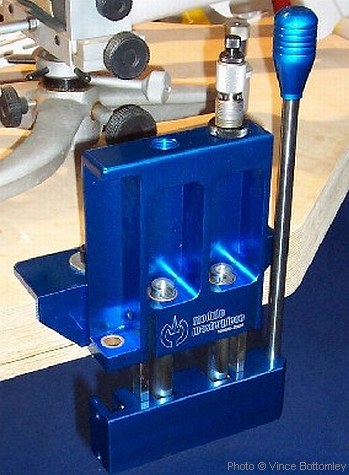
Vince writes: “This beautiful compact press is made by an Italian company, BCM Europearms, run by Vittorio Taveggia. Vittorio builds some superb rifles but he also has a very useful range of accessories for accuracy aficionados. I’m sure you’ll be interested in Vittorio’s loading press — this is offered in several configurations for normal dies, Wilson-style hand-dies, or both. The press is superbly made. Vittorio also crafts very nice Weaver-style rings and bases. Again they are beautifully-finished and very strong. Vittorio also makes stocks and actions. At present, there is no UK importer for the press, but there could be very soon. If you are at all interested in any of the products please drop me an e-mail at vinceb [at] 6ppc.fsnet.co.uk and I’ll pass your interest onto the ‘soon to be’ UK importer.” The top photo shows the original Modulo Masterpiece version, which had three stations. There are other versions, as seen in the photo below.

Editor’s note: We don’t know of a US importer, but you can contact Vittorio directly. Information for his company in Torino, Italy is found on the BCM Europearms website. Send email to: info [at] info@bcmeuropearms.it.
Photo © Vince Bottomley, used by permission
February 10th, 2009
 The ladies beat the gents at the 2009 Arizona Long-Range Championship at the Ben Avery Shooting Facility in Phoenix, AZ. Nancy Tompkins (photo left) triumphed over 50 other shooters to win the main 1K event with a spectacular 600-36X, followed by Michelle Gallagher (of Berger Bullets) who shot 598-28X. Trudie Fay was the top shooter in Palma (.308) class. Way to go ladies! In this event, competitors shot prone (with sling) at 1000 yards. There were 60 rounds for record over two days, with two “any sights” stages, and one “iron sights” stage; the second “iron sights” stage was cancelled due to a sudden and severe hail storm. The ladies beat the gents at the 2009 Arizona Long-Range Championship at the Ben Avery Shooting Facility in Phoenix, AZ. Nancy Tompkins (photo left) triumphed over 50 other shooters to win the main 1K event with a spectacular 600-36X, followed by Michelle Gallagher (of Berger Bullets) who shot 598-28X. Trudie Fay was the top shooter in Palma (.308) class. Way to go ladies! In this event, competitors shot prone (with sling) at 1000 yards. There were 60 rounds for record over two days, with two “any sights” stages, and one “iron sights” stage; the second “iron sights” stage was cancelled due to a sudden and severe hail storm.
Savage Tubegun Wows the Crowd at Ben Avery
Tubegun builder Gary Eliseo finished third overall with 596-27X. Gary’s performance shocked many fellow shooters … not because Gary doesn’t have the skills, but because he shot a 200-12x and a 199-6X on Day One with a Savage-actioned rifle. That’s right, Gary was shooting a prototype S1 Tubegun built with an out-of-the-box Savage Target Action with factory Accutrigger. Gary told us: “To be honest, like everybody else, I was amazed at how well that Savage shot. And I did no modifications or accurizing to the action whatsoever. All I did was lap the outside of the action to the S1 chassis for a better fit.”


German Salazar believes the Savage Tubegun is a very important development: “Here’s an affordable long-range prone rifle that can be assembled by the shooter with simple tools. Get a prefit barrel with barrel nut and you don’t even need a gunsmith. You save money, and just as importantly, you save time — no more year-long waits to get your rifle built.”
Plenty of 6mm Rifles on the Firing Line
While the match winner and runner-up were shooting 6.5-284s, the majority of the remaining Top 10 finishers were using a 6mm cartridge of some kind. Gary Eliseo finished third shooting a 6BR Improved (BRX), Randy Tesseidre finished fourth, also with a 6BRX, and German Salazar finished fifth shooting a 6XC and four of the next five finishers also shot 6mm cartridges. This may evidence a trend towards the smaller caliber over the 6.5mm. Why are we seeing more 6mm cartridges used at 1000 yards? According to German Salazar: “The answer is pretty simple — higher scores. Many (but certainly not all) shooters have found their scores increase when shooting 6mm cartridges, as opposed to the 6.5-284 or even the 7mms. The reasons are more consistent vertical and less recoil, and those two factors are related. With less recoil it’s easier to maintain the precise hold needed to shoot 10s and Xs throughout the match.” Third-place finisher Gary Eliseo also feels that some of the 6mm cartridges may be easier to tune than the 6.5-284. “I shoot the 6BRX”, Gary explained, “it’s an amazing little cartridge–easy to load for. With Berger VLDs seated into the lands it’s super-accurate and really holds tight elevation.”
More Match Results on Desert Sharpshooters Website
Complete Match Results are available on the Desert Sharpshooters website. The Top Three F-Class shooters (in order) were Jim Murphy, Larry Bartholome, and Jeff Cochran, while John Brewer was F-Class High Senior. The Palma match for .308 rifles, held on Friday, was tightly contested. Among the 48 Palma competitors in Friday’s match (not part of the championship aggregate), the top five finishers were Eddie Newman (445-26X), Gary Eliseo (444-25X), David Littlefield (444-21X), Trudie Fay (443-29X), and Steve Cunico (442-26X). Trudie was the High Women shooter while Steve was High Senior.
February 9th, 2009
 The latest editions of Remington’s product catalogs are now available online. You can download the entire 2009 catalog (a 19.5 mb file), or select particular product lines: rifle, shotgun, ammunition, accessories. The Rifle Catalog features all the latest Remington rifles, including the new Model 700 ‘Target Tactical’ model. This 11.75-lb gun boasts a Bell & Carlson composite stock with ergonomic grip and adjustable LOP and cheekpiece. The Target Tactical is offered in .308 Winchester only, with a 26″ hammer-forged 5R barrel with triangular profile. MSRP is $1972. The latest editions of Remington’s product catalogs are now available online. You can download the entire 2009 catalog (a 19.5 mb file), or select particular product lines: rifle, shotgun, ammunition, accessories. The Rifle Catalog features all the latest Remington rifles, including the new Model 700 ‘Target Tactical’ model. This 11.75-lb gun boasts a Bell & Carlson composite stock with ergonomic grip and adjustable LOP and cheekpiece. The Target Tactical is offered in .308 Winchester only, with a 26″ hammer-forged 5R barrel with triangular profile. MSRP is $1972.
Complete 2009 Catalog | 2009 Rifles Catalog

Ballistics Data for Dozens of Factory Loads
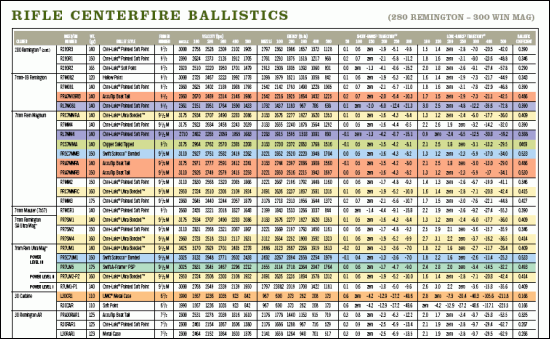
Remington also has a comprehensive Ballistics Data Sheet with ballistics information for all Remington loaded ammo — from 17 Fireball all the way up to the 45/70 Government. Even if you don’t use factory-loaded ammo, this is a very useful resource that allows you to quickly compare velocities, energy, wind drift, and drop among a wide variety of cartridges. Which shoots flatter… a .204 Ruger or a 22-250? Remington’s Ballistics Data Sheet provides a quick, reliable answer. Info is laid out in tables, with color coding for different bullet types.
CLICK HERE to download Ballistics INFO
February 9th, 2009
 HPS Target Rifles Ltd., Britain’s leading competition shooting supply vendor, offers a new sling design that should benefit smaller shooters or those whose rifles have shallow fore-ends. The HPS AKTIV Flex Sling, made of non-stretch, reinforced PVC webbing, is designed to overcome the problems of the sling fouling on the trigger guard or rubbing on the underside of the stock. The section of the sling that runs under the rifle is replaced with coated wire. The wire center section can be positioned directly under the stock to give maximum clearance. The front strap can be adjusted to the size of hand and to clear the wrist. The arm cuff can be adjusted in length for arm size and position, while sling length is controlled by a buckle that positions the ‘tail’ of the sling so that there is no fouling under the rifle. The HPS AKTIV Flex Sling comes in three colours: blue (shown), dark green and black. The price is U.S. $95.87, or 74.84 Euros. HPS Target Rifles Ltd., Britain’s leading competition shooting supply vendor, offers a new sling design that should benefit smaller shooters or those whose rifles have shallow fore-ends. The HPS AKTIV Flex Sling, made of non-stretch, reinforced PVC webbing, is designed to overcome the problems of the sling fouling on the trigger guard or rubbing on the underside of the stock. The section of the sling that runs under the rifle is replaced with coated wire. The wire center section can be positioned directly under the stock to give maximum clearance. The front strap can be adjusted to the size of hand and to clear the wrist. The arm cuff can be adjusted in length for arm size and position, while sling length is controlled by a buckle that positions the ‘tail’ of the sling so that there is no fouling under the rifle. The HPS AKTIV Flex Sling comes in three colours: blue (shown), dark green and black. The price is U.S. $95.87, or 74.84 Euros.


To view more products from HPS Target Rifles, including their innovative System Gemini Modular position stocks, visit www.HPT-TR.com, or click the link below to download the HPS catalog as a .pdf file.
CLICK HERE to Download 10 mb HPS Target Rifles Ltd. Catalog (10 meg .pdf file).
February 7th, 2009
Larry Crow of Competitive Edge Gunworks has developed a new action that allows the rear of the receiver to float. The front of the action features a large block that secures the action in the stock. Though similar in appearance, this is NOT a barrel block. The barrel snugs up to a shoulder inside the front block, much like a conventional action. Though the oversized block does the “heavy lifting” in terms of securing the action to the stock, there are two (2) action screws. One threads into the underside of the block while the second is placed further back where it attaches to the underside of the normal-diameter section of the receiver. This provides an extremely secure mount while allowing the rear of the action to float free above the stock.
Crow has tested the rifle with a variety of calibers including large magnums. Crow explains: “Our action mounts [with] an extended front lug and allows the rear of the action to float. When fired the barrel harmonics travels back through the action with the back of the action floated. There are no bedding issues which cause vertical stringing. The action is 4340 Rockwell to 42 with 1.228″ X 1.0625″ X 16 T.P.I. barrel shank. The standard action comes with a 20-MOA Picatinny rail. Our bolts are one-piece with M16-style extractor under right lug for 3 O’Clock ejection. Bolts are 4140 Rockwell 42 with R60 hard chrome finish. This [delivers] true bench rest accuracy in a tactical platform.” Shown below is the new action installed in a laminated wood stock and in a McCree modular metal stock (lower photo).


One-Piece Bolt for New Action
For the new action, Crow has also developed a new, super-strong, one-piece bolt. The handle is integral with the bolt. This should be stronger (and more durable) than a conventional bolt handle attached only with silver solder or a spot weld. Shown below are prototype examples of the new one-piece bolt. Production versions will be fluted. Note how the M16-style extractor is integrated into the recoil lug.

|