On 1/21/18, new World Records were set under ELR Central rules for verified, consecutive three-shot string without sighters. Competitors started from cold bore, no sighters or ranging shots allowed. That’s a tough standard. In fact the first 12 shooters failed to put three shots on target at 1500 yards before Paul Phillips took his turn. Paul, Lucky number 13, placed all three of his shots on the 36″ x 36″ plate, claiming a first-ever record. Later that afternoon, John Armstrong duplicated that feat, also putting three shots on target at 1500 with no sighters.
But the best performances of all came later. Nate Stallter, shooting a .375 CheyTac, nailed his three shots at over one mile — 1768 yards. But it gets better — Nate broke his own record later in the afternoon, going 3 for 3 at 2011 yards.
David Tubb posted: “Congratulations to my son-in-law, Nate. Today he won the ELR Central World Record competition. This competition allows two separate attempts (spaced four hours apart) and consists of three cold bore shots each time. He took 3 shots and had 3 hits at 1768 yards in the morning and then beat his own record in the afternoon with 3 shots and 3 hits at 2011 yards after the wind had become trickier.”
Stallter used the new Tubb Adaptive Target Rifle (Tubb Gun) with a Dynamic Targeting Reticle and Tubb T7T two-stage trigger. He was shooting the .375 Cheytac with a 364gr Warner flatline bullet that has a patent pending Nose Ring modification in a Schneider 1:7″ twist barrel. Three of the Tubb Rifles are shown below. Note the long barrels.
As we explained, this was a tough challenge. Competitors started with a cold bore, with no sighters alowed — that makes it especially tough.
Watch this video to hear the record-setting shooters describe their equipment — chambering, action, stock, barrel, bipod, and optics. No the video is not sideways! Nearly all this video is correct, horizontal orientation. Click triangle to start correct format.
None of the competitors had shot these kind of distances at this facility, the Front Sight Firearms Training Center in Pahrump, Nevada. And the “no sighters” rule really added to the difficulty — witness the fact that the first 12 shooters failed to put three consecutive hits on a square yard of steel at 1500. Here are the three record-setting shooters:
1. Paul Phillips, 1500 yards (first record) | 2. John Armstrong, 1500 yards (tied record)
Those who understand the challenge were impressed …
Andy McNeill observed: “I’ve shot targets further too, but I didn’t go 3 for 3 with no sighters. These hit cold bore and then two consecutive follow-up shots at specific target sizes. This is what a record should be. Not I hit a target at X distance once after slinging lead at it all day.”
Jacob Scobell liked the match format: “Love that this is intentional, consecutive impacts with a fixed size target and not just a statistical probability of hitting the broad side of a barn with unlimited shots. Excellent to see a standard being set.
Now will all of these other supposed ‘world record holders’ step up and enter this competition? Sure some guy who can impact upon demand beyond 4000 yards would cake walk this right? A registered event with multiple shooters means put up or shut up.”
The 2018 CMP competition rules are now approved and posted on the CMP website. The 2018 CMP Highpower Rifle and Pistol Competition Rules and the 2018 CMP Games Rifle and Pistol Competition Rules can be downloaded on the CMP Competition Rules Page.
Evolution of CMP Competition Rules
There are a number of important CMP Rule changes for 2018 that are spelled out below. CMP Competition Rules have undergone major changes in the last few years that were aimed at modernizing the CMP competition program and promoting greater participation in rifle and pistol target shooting. In 2015, rule changes expanded the types of pistols that can be used in EIC and National Match Service Pistol events and introduced the immediately popular CMP 22 Rimfire Pistol Distinguished program. The most significant 2016 change was the authorization for Service Rifle shooters to use optical sights with 4.5X max magnification. 2017 saw the introduction of a new classification system, rules for electronic targets and the addition of rules for “Alternative Rifles” and “Match Rifles”.
Important Rules Changes for 2018
The biggest change in the 2018 Rules is the introduction of a two-track system for conducting CMP-sanctioned Highpower Rifle Matches. Highpower Rifle events can now be conducted as either traditional “National Trophy Rifle Events” where there are no sighting shots and competitors start rapid-fire series from standing or as “CMP Cup Match Events” where sighting shots are allowed before each stage and competitors start rapid-fire series in position. All EIC Rifle Matches and Camp Perry National Trophy Matches will continue to be conducted according to National Trophy rules, with no sighters and rapid-fire starting from standing. The CMP Cup Matches, which are scheduled at the beginning of the 2018 CMP Highpower Rifle Matches at Camp Perry on 23-25 July, and the CMP Cup Matches, which are included in the 2018 CMP Travel Games programs, will be conducted under Cup Match rules with sighters and rapid-fire stages starting in position.
The rules for CMP As-Issued Military Rifle and Pistol events and Rimfire Sporter Matches remain unchanged in this regard. These events typically allow sighters at the beginning of each course of fire. Competitors start rapid-fire series from standing, but any competitors who are 70 or over or who have physical limitations that prevent them from readily standing and getting back into position are allowed to start rapid-fire series in position.
Otherwise the 2018 CMP Games Rifle and Pistol Rules, which include Rimfire Sporter Rifle Rules, have only minor changes from the 2017 edition.
National Records — Rules providing for the official recognition of National Records in open and junior categories in CMP-recognized events were added for 2018. The CMP is compiling its first list of official records and will post it on the CMP website as soon as it is ready. To be recognized as National Records, scores must be fired in the National Matches or in competitions conducted by the CMP staff such as CMP Travel Games or National Range Matches.
CMP Smallbore Matches Coming to Camp Perry
Traditional smallbore rifle championships are returning to Camp Perry in 2018 and rules for those events are being drafted now. The 2018 National Matches Calendar features six days of CMP Smallbore Rifle shooting on 17-22 July. There will be two days of smallbore position and four days of smallbore prone shooting, along with one full day of Rimfire Sporter Rifle competition on 22 July. Provisional CMP Smallbore Rifle Rules will be released in the next few weeks.
Electronic Targets — A new section has been added to the CMP Rulebooks to help explain and clarify the CMP’s Electronic Scoring Target Rules. See Rule 7.0 in the CMP Competition Highpower Rifle and Pistol Competition Rules or Rule 9.0 in the CMP Games Rifle and Pistol Competition Rules.
In our Shooters’ Forum, there was an discussion about a range that was threatened with closure because rifle over-shoots were hitting a farm building over two miles from the firing line. One reader was skeptical of this, asking “how’s that possible — were these guys aiming at the stars?” Actually, you may be surprised. It doesn’t take much up-angle on a rifle to have a bullet land miles down-range. That’s why it’s so important that hunters and target shooters always orient their barrels in a safe direction (and angle). Shooters may not realize how much a small tilt of the barrel (above horizontal) can alter a bullet’s trajectory.
How many degrees of muzzle elevation do you think it would take to hit a barn at 3000 yards? Ten Degrees? Twenty Degrees? Actually the answer is much less — for a typical hunting cartridge, five to seven degrees of up-angle on the rifle is enough to create a trajectory that will have your bullet impacting at 3000 yards — that’s 1.7 miles away!
Five degrees isn’t much at all. Look at the diagram above. The angle actually displayed for the up-tilted rifle is a true 5.07 degrees (above horizontal). Using JBM Ballistics, we calculated 5.07° as the angle that would produce a 3000-yard impact with a 185gr .30-caliber bullet launched at 2850 fps MV. That would be a moderate “book load” for a .300 Win Mag deer rifle.
Here’s how we derived the angle value. Using Litz-derived BCs for a 185gr Berger Hunting VLD launched at 2850 fps, the drop at 3000 yards is 304.1 MOA (Minutes of Angle), assuming a 100-yard zero. This was calculated using a G7 BC with the JBM Ballistics Program. There are 60 MOA for each 1 degree of Angle. Thus, 304.1 MOA equals 5.068 degrees. So, that means that if you tilt up your muzzle just slightly over five degrees, your 185gr bullet (2850 fps MV) will impact 3000 yards down-range.
Figuring Trajectories with Different Bullets and MVs
If the bullet travels slower, or if you shoot a bullet with a lower BC, the angle elevation required for a 3000-yard impact goes up, but the principle is the same. Let’s say you have a 168gr HPBT MatchKing launched at 2750 fps MV from a .308 Winchester. (That’s a typical tactical load.) With a 100-yard zero, the total drop is 440.1 MOA, or 7.335 degrees. That’s more up-tilt than our example above, but seven degrees is still not that much, when you consider how a rifle might be handled during a negligent discharge. Think about a hunter getting into position for a prone shot. If careless, he could easily touch off the trigger with a muzzle up-angle of 10 degrees or more. Even when shooting from the bench, there is the possibility of discharging a rifle before the gun is leveled, sending the shot over the berm and, potentially, thousands of yards down-range.
Hopefully this article has shown folks that a very small amount of barrel elevation can make a huge difference in your bullet’s trajectory, and where it eventually lands. Nobody wants to put holes in a distant neighbor’s house, or worse yet, have the shot cause injury. Let’s go back to our original example of a 185gr bullet with a MV of 2850 fps. According to JBM, this projectile will still be traveling 687 fps at 3000 yards, with 193.7 ft/lbs of retained energy at that distance. That’s more than enough energy to be deadly.
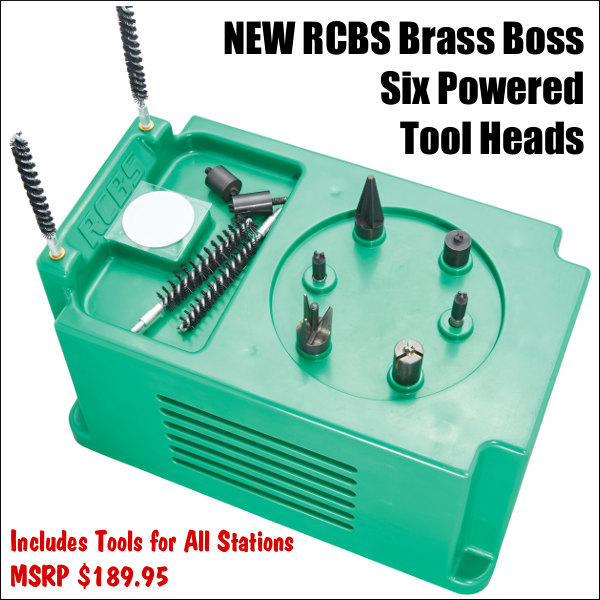
RCBS has announced the successor to the venerable RCBS Trim Mate. The New-for-2018 RCBS Brass Boss features six rotating stations that handle all your brass neck-brushing, chamfering, deburring, and pocket uniforming chores. The new Brass Boss includes tools for all six stations: inside VLD chamfering tool, outside deburring tool, primer pocket cleaners (small/large), military crimp removers (small/large), primer pocket uniformers (small/large), case neck brushes (four diameters), and a tub of dry case neck lubricant. MSRP for the Brass Boss, RCBS SKU 90390, is $189.95. We expect “street price” to be around $155.00.
This machine has two different rotation speeds for the toolheads. Four stations run at 350 rpm, while the two other stations run 57% faster, at 550 rpm. That give you a choice of spin speeds. You can work fast for tougher chores like military crimp removal, and slow down for inside-neck chamfering, which should be done carefully.
Larger and taller than the older RCBS Trim Mate, the new Brass Boss has one more station (six vs. five), plus a more powerful motor. This should make the Brass Boxx more competitive with the popular Lyman Case Prep Express.
Savage Arms will launch more than two dozen new products at the 2018 SHOT Show, January 23-26 at the Sands Expo Center in Las Vegas, Nevada. The big news is the AccuFit stock system for the Model 110 rifle line. “Our new AccuFit System is designed to allow shooters to quickly adjust comb height and length-of-pull for a customized fit. This results in more consistent, more comfortable shooting”, says Beth Shimanski, Savage Senior Marketing Manager. These new Savages also feature the Accustock internal chassis with bedding block (see second video below).
AccuFit Adjustment System
Accustock Embedded Chassis System
CLICK HERE for more videos showing new Savage Design and Engineering features.
More Chambering Options for Savage AR-Platform Rifles
Savage has added new chamberings for its MSR black rifle line-up. MSR 15 models will be newly offered in 224 Valkyrie, 22 Nosler, and 6.8 SPC. A 6mm Creedmoor version of the AR-10 platform MSR 10 Long Range has been added, and Savage will offer the hard-hitting .338 Federal chambering in the MSR Hunter rifle (along with 6.5 Creedmoor and .308 Win).
Savage 2018 New Product Highlights
Model 110 Storm with AccuFit: Features stainless steel action and barrel for adverse weather and conditions. Sixteen caliber and left-hand options.
Model 110 Long Range Hunter with AccuFit: Engineered for long-range shooting with a 26-inch barrel and muzzle brake. Nine caliber options, including 338 Lapua Magnum.
Model 110 Lightweight Storm: Easier to carry in field thanks to a lightweight stainless steel barrel and action. Length-of-pull is easily customized. Six caliber options.
AXIS II XP with New Stock: Popular package rifle with redesigned, ergonomic stock and Bushnell Banner 3-9×40 scope in full-size and compact models. Twenty caliber/configuration options.
MSR 15 Valkyrie: MSR 15 AR-type rifle chambered for the 224 Valkyrie. This new model features an adjustable gas block, furniture upgrades, and Elite Series Flat Dark Earth Cerakote finish.
MSR 15 Recon Long Range Precision: Equipped with alternate furniture options and chambered in all-new 224 Valkyrie, 22 Nosler, and 6.8 SPC.
MSR 10 Long Range in 6mm Creedmoor: AR-10 platform rifle design for long-range precision shooting. Chambered for the flat-shooting, modest-recoil 6mm Creedmoor cartridge.
MSR 10 Hunter in 338 Federal: Built specifically for hunters and chambered in the popular, hard-hitting .338 Federal.
B Series Compact and Left-hand: Extremely accurate bolt-action .22 LR, .22 WMR, and .17 HMR options. Now available in compact and left-hand models.
A Series Pro Varmint: Semi-automatic options in .22 LR, .22 WMR and .17 HMR, all with Boyd’s Pro Varmint stock and 22-inch fluted, heavy barrel.
All of these new rifles, as well as more bolt-action and semi-auto centerfire and rimfire rifles, will be on display at SHOT Show Booth No. 14551. Most will be set up so visitors can handle the rifle and work trigger and bolt. To learn more about the new Savage rifles and their features, visit www.SavageArms.com.
Savage MSR 10 Long Range (6mm Creedmoor, 6.5 Creedmoor, .308 Win)
Shooting ranges have gone upscale with the development of the “Guntry Club”. This new kind of recreational/social facility combines a shooting range with Country Club style amenities. Imagine a high-tech indoor range with “Pro Shop”, restaurant, and maybe outdoor shooting facilities as well. In the past five years, more and more of these deluxe “Guntry Clubs” have opened nationwide.
This week GunVenture TV takes a look at some of the country’s finest gun clubs. First, join Tom Gresham and RECOIL Magazine’s Iain Harrison at one of the original “Guntry Clubs” — the Scottsdale Gun Club. You’ll tour the exclusive Titanium lounge before heading to the range for some full-auto fun with Sig Sauer’s John Hollister. Then, Tom visits a very high-end facility in Centennial, Colorado. The upscale Centennial Gun Club features a retail store, range, training center, and lounge.
Finally, GunVenture visits the Talladega Super-Speedway, where Ryan Gresham takes a lap on the famous track before visiting at the CMP’s impressive new Talladega Marksmanship Park, which boasts state-of-the-art electronic targets.
Here’s a CBS News report on upscale “Guntry Clubs”, luxurious facilities that target younger, more affluent patrons. Chip Reid reports on a high-end gun club in Manassas, Virginia: “This is not your Grandfather’s shooting range. Elite Shooting Sports is 65000 Square feet of bright lights, polished wood, flat-screen TVs, and state of the art equipment”.
Doug Koenig will exchange the Smith & Wesson hat for one with the Ruger logo this season. The 18-time Bianchi Cup Winner has joined Team Ruger, and will shoot Ruger pistols and rifles in 2018.
Doug Koenig, one of the greatest pistol shooters of all time, has a new team. The long-time Team Smith & Wesson stalwart has joined newly-formed Team Ruger as its Team Captain. Doug will shoot Ruger 1911-style handguns and Ruger polymer pistols. Interestingly, Koenig will also field a Ruger Precision Rifle for some PRS-style events. Doug has actually done pretty well in the past shooting long guns. He won the 2015 NRA World Shooting Championship — a multi-day event featuring rifles and/or shotguns in most of the stages.
This is the first time Ruger has ever fielded a full-fledged pro team. It is an interesting development for Ruger, which has a product mix suitable for a variety of disciplines: Rimfire Challenge, Cowboy Action, IDPA/USPSA, Steel Challenge, and even PRS (Factory Class and Gas Gun Division).
Why is Koenig leaving Smith and Wesson? It’s mostly about being “on the same page”. Talking to Jim Shepherd of the Shooting Wire, Doug explained: “I’ve been with Smith & Wesson for a very long time — and I want to be really clear about this – they’ve always been good to me.” But, there had been changes at S&W in recent years: “We were going in different directions, and I’d already told them I wasn’t re-signing this year. And when I was approached by Ruger, they were interested in my thoughts on guns.” Read Shooting Wire Report.
Though best known as a pistolero, Koenig is a great long gun shooter as well. Doug won the 2016 NRA World Shooting Championship, beating a field of talented 3-Gun aces. Photo DougKoenig.com.
Doug was impressed with Ruger’s design staff. He said they have already incorporated upgrades he wanted: “When I talked with Ruger engineers, they asked me what I thought — instead of telling me what they were going to do. So, I told them what I would like to see in a Ruger competition pistol, and it seemed like they were really listening.” In fact, Ruger immediately made upgrades: “A few days after Christmas I got a pair of Ruger pistols with the exact changes I’d talked about already done to them. That is exciting”.
Doug Koenig’s List of Championships:
10-time World Champion
18-time Bianchi Cup winner
2016 NRA World Shooting Champion
More than 70 National Championships
6-time World Action Pistol Championship Winner
3-time World Speed Shooting Champion/Steel Challenge
Watch Doug Koenig’s Championship Season TV show on the Pursuit Channel: Wednesday 5:30 pm (Eastern); Friday 9:00 pm (Eastern); Saturday 1:30 am (Eastern) West Coast prime-time.
In the past few years, the 6.5 Creedmoor cartridge has become the leading cartridge for tactical/practical gun games. It offers excellent ballistics, moderate recoil, and good accuracy with a variety of powder and bullet combos. Along with the 6.5×47 Lapua, the 6.5 Creedmoor has demonstrated that a .264-Caliber mid-sized caliber is truly a jack of all trades — it can be accurate on paper, win PRS matches, and also harvest game during hunting season. If you own a 6.5 Creedmoor (or plan to get one) and hand-load your ammo, this post should provide a good start. Sierra Bullets now offers 6.5 Creedmoor Load Data for bullets from 120 to 142 grains — the most popular weight range for this chambering.
Sierra Bullets has released very complete load data for the popular 6.5 Creedmoor cartridge. This medium-sized cartridge has become one of the most popular chamberings for tactical and PRS shooters. The 6.5 Creedmoor combines excellent accuracy, good mag-feeding, good barrel life, moderate recoil, and reasonable component cost. That’s why this cartridge has caught on quickly.
The Springfield M1A is now available in 6.5 Creedmoor. For Gas Guns like this, be sure to full-length-size your brass after every firing, with adequate shoulder bump.
Developed in 2007 by Dennis DeMille and Dave Emary, the 6.5 Creedmoor is a shortened and improved 30 TC cartridge case that was inspired by the .308 Winchester design. This short action design was created to maximize case capacity and a wide range of loading lengths, while still fitting in standard short action magazines. With the correct twist barrel, the versatile 6.5 Creedmoor can take advantage of the wide range of bullet weights available in 6.5 mm (i.e. .264 caliber). Reloaders should keep in mind that the 6.5 Creedmoor works best with medium to medium-slow powders such as H4350, Varget, Win 760, and RE-17. The light recoil and adaptability of the efficient 6.5 Creedmoor cartridge has already proven itself in high power, precision rifle series and benchrest competitions. Couple that with respectable barrel life and its intrinsic accuracy potential and you have a recipe for success which should insure its legacy for decades to come.
Here are three tables from the Sierra Bullets Reloading Manual (5th Edition). IMPORTANT — This is just a sample!! Sierra has load data for many other 6.5mm bullet types, including FB, Spitzer, SBT, HPBT, and Tipped MK from 85 grains to 142 grains. To view ALL 6.5 Creedmoor DATA, CLICK HERE.
INDICATES MAXIMUM LOAD – USE CAUTION
LOADS LESS THAN MINIMUM CHARGES SHOWN ARE NOT RECOMMENDED.
INDICATES MAXIMUM LOAD – USE CAUTION
LOADS LESS THAN MINIMUM CHARGES SHOWN ARE NOT RECOMMENDED.
INDICATES MAXIMUM LOAD – USE CAUTION
LOADS LESS THAN MINIMUM CHARGES SHOWN ARE NOT RECOMMENDED.
AccurateShooter.com supports the candidacy of John Sigler for re-election to the NRA Board of Directors. A past President of the NRA, John is a competitive shooter and an active member of our Shooters’ Forum. John is a high-integrity individual who will capably represent the interest of serious shooters in the country. We’re behind John 100% and call for readers to vote for John Sigler when your NRA ballot arrives. NRA members eligible to vote for the Board of Directors should start receiving ballots around January 20, 2018 in their NRA magazines. John is the only current Director candidate nominated both by NRA Members (through petitions) AND by the NRA Nominating Committee
Lee Williams, writing on TheGunWriter.com stated: “There are a lot of good [NRA Board of Director] candidates and incumbents. There’s one GREAT one — John Sigler.
I’ve said this before — John does more for the Second Amendment in one week than most people do in an entire lifetime. He is the personification of an American Gun Owner and, in my humble opinion, he’s the best president NRA ever had.
He deserves to continue serving on NRA’s Board of Directors.”
John Sigler Key Background
Two-Term Past NRA President (59th)
Two-Term Past NRA 1st Vice President
Current Member of NRA Board of Directors and Executive Council
Endorsed by Eight Major Clubs and NRA State Associations
Competitive Shooter – Member 2017 U.S. F-Open Rifle Team
Current Vice-Chairman, NRA High Power Committee
Avid Hunter – Member Safari Club International
Retired Police Captain, now Practicing Law
U.S. Navy Veteran – 1967-1971
John has a 100% Attendance record as a current Director:
Key Objectives for John Sigler as NRA Board Member
— We must expand our fight to keep our ranges open and to open new ranges.
— NRA’s competitive shooting programs must be renewed, strengthened, revitalized.
— Our right to keep and bear arms must continue to be vigorously defended.
— NRA must redouble its efforts on behalf of hunting and conservation.
I was privileged to serve the NRA and our great nation for two terms as NRA’s Second Vice President, two terms as NRA’s First Vice President, and two terms as NRA’s 59th National President. — Capt. John C. Sigler (Ret.)
Statement by John Sigler
First, I would like to thank all of the NRA members who were instrumental in circulating and signing my most recent NRA Members’ Petition for re-election to the NRA Board of Directors. Because of your efforts, I was able to submit a total of 181 petition pages to the NRA Secretary containing 1,371 signatures of NRA members from 45 separate states, and to be successfully nominated by NRA Members’ Petition. Thank You!
Because of your efforts, I am only one of three candidates, all incumbent Directors, to be nominated by both the NRA Nominating Committee and by the Members through the petition process – Thank You!
Next, I would like to thank the Board of Directors of the Delaware State Sportsmen’s Association, Delaware’s official NRA state affiliate, for their continued support and their endorsement for re-election to the NRA Board of Directors. With DSSA’s endorsement, I have now been endorsed by a total of eight (8) major clubs and NRA State Associations, including the New York State Rifle & Pistol Association; the Firearms Coalition of Colorado; the Ohio Rifle & Pistol Association; the Ohio Gun Collectors Association; the Fifty Caliber Shooters Association; the Florida Sport Shooting Association; the North Carolina Rifle & Pistol Association; and of course, the Delaware State Sportsmen’s Association.
Finally, I want to thank all of the members of the NRA for all that you have done for me over the years to help me fight for our God-given right to keep and bear arms, at the polls, in Congress and the various legislatures, and in the courts. Without your continued help and support I could never have enjoyed the successes I have enjoyed during my 21+ years on the NRA Board, serving the NRA and all of the people of our great nation. Thank You!
NRA Board Member Attendance
I am proud of my 100% NRA Board Member Meeting Attendance record. Because of you, the members of NRA, in 1996 I became the first person from Delaware to ever be elected to the NRA Board. Because of you and your efforts, I was given the opportunity to work with and under NRA’s two greatest presidents, Marion Hammer and Charlton Heston, both of whom believed in me, trusted me, and gave me the opportunity to serve as the Chairman of NRA’s Finance Committee for 10 years and as the Chairman of NRA’s Law Enforcement Assistance Committee for the same 10 years.
Because of you, the valued members of NRA, I was also granted the opportunity to serve on the NRA’s High Power Rifle Committee as both Chairman and Vice-Chairman; the Competitions Rules & Programs Committee; as Vice-Chairman of the Clubs & Associations Committee, the Bylaws & Resolutions Committee, the Committee on Hearings, the Gun Collectors Committee, the Site Selection Committee, the Legislative Policy Committee and as Chairman of the Sub-Committee on State & Local Affairs, and on NRA’s Executive Committee. Additionally, because of you and your continued support, I have also had the privilege and pleasure of serving as a member of the NRA’s Executive Council and on the Board of the NRA Foundation and as a Whittington Center Trustee. Thank You!
And finally, because of you, I was privileged to serve NRA and our great nation for two terms as NRA’s Second Vice President, two terms as NRA’s First Vice President, and two terms as NRA’s 59th national President. Thanks to you, I was given the opportunity to create two new committees specifically designed to help and serve our veterans, the Committee on Military and Veterans Affairs and the Disabled Shooting Sports Committee.
In closing, I come to you, the voting members of NRA and respectfully ask for your vote. In doing so, I ask that you allow me the honor of continuing to represent you and the opportunity to continue the work I have been privileged to perform on your behalf since 1996. Thank you — John Sigler
You’d like to protect your hearing, and maybe you’re a little curious about how your rifle might shoot suppressed. So you’re thinking of buying a suppressor (aka “can”, “moderator”, “silencer”). You can’t just get one off the shelf at Walmart. Acquiring a suppressor requires filling out paperwork and paying a Federal $200 Tax Stamp. Plus there is typically a pretty long wait. However, the good news is that suppressor ownership is now legal in 42 of the 50 American states — that’s 84%! For most American adults, getting a suppressor is legal, provided pass the required background checks.
States Where Suppressor Ownership is Allowed
Currently, the following 42 states allow private ownership of suppressors: AL, AK, AZ, AR, CO, CT, FL, GA, ID, IN, IA, KS, KY, LA, ME, MD, MI, MN, MS, MO, MT, NE, NV, NH, NM, NC, ND, OH, OK, OR, PA, SC, SD, TN, TX, UT, VT, VA, WA, WV, WI, WY.
Note: Even if you live in one of the states listed, you should still verify that owning a suppressor is legal in your area. Some states may have municipal- or county-based restrictions.
States Where Suppressor Ownership is Prohibited
Unfortunately, there are still eight (8) States that forbid private ownership of suppressors. The eight No-Go States are: California, Delaware, Hawaii, Illinois, Massachusetts, New Jersey, New York, Rhode Island. In these eight states, private ownership of suppressors (aka “silencers”) is forbidden. Hopefully that a few of those eight hold-out states will change their laws in the months ahead.
Looking Inside a Suppressor in Action
Popular YouTube Channel Smarter Every Day recently released a cool video featuring rifle suppressors with see-through acrylic sleeves. The team filmed shots through the suppressors using ultra-high-speed (110,000 frame per second) cameras. When played back in super-slow-motion, you can see the flame propagate through the suppressor and the bullet move through each baffle before it exists the muzzle. Watch the results in the video below — it’s mesmerizing:
See Through Suppressor in Super Slow Motion (110,000 fps) — Click Arrow to Watch:
Suppressors, On Average, Reduce Noise Levels about 30 Decibels
In an article for Ammoland, gunwriter Sam Hoober says that you can expect about 30 decibels (dB) of noise reduction from the average suppressor: “Looking at a few different products, SilencerCo attests their suppressors reduce the sound pressure of a 9mm gunshot to anywhere from 125.7 dB to 131.5 dB, depending on the model. Advanced Armament Co, another popular supplier, attests a 23 dB to 33 dB reduction or down to 127 dB. Liberty Suppressors, another manufacturer, attests a reduction of 24 dB to 38 dB, depending on model and other factors. In short, we can presume something on the order of 30 dB of attenuation as an average.”
Using that 30 dB number you can quickly discern that you’ll still need hearing protection — good hearing protection — when shooting any suppressed firearm (even a .22 LR). “Spikes of 130 dB and more can result in permanent hearing damage instantly”. Source: NRA Blog.
Story idea by Boyd Allen. We welcome reader submissions.


 In our Shooters’ Forum, there was an discussion about a range that was threatened with closure because rifle over-shoots were hitting a farm building over two miles from the firing line. One reader was skeptical of this, asking “how’s that possible — were these guys aiming at the stars?” Actually, you may be surprised. It doesn’t take much up-angle on a rifle to have a bullet land miles down-range. That’s why it’s so important that hunters and target shooters always orient their barrels in a safe direction (and angle). Shooters may not realize how much a small tilt of the barrel (above horizontal) can alter a bullet’s trajectory.

 This machine has two different rotation speeds for the toolheads. Four stations run at 350 rpm, while the two other stations run 57% faster, at 550 rpm. That give you a choice of spin speeds. You can work fast for tougher chores like military crimp removal, and slow down for inside-neck chamfering, which should be done carefully.


 Developed in 2007 by Dennis DeMille and Dave Emary, the 6.5 Creedmoor is a shortened and improved 30 TC cartridge case that was inspired by the .308 Winchester design. This short action design was created to maximize case capacity and a wide range of loading lengths, while still fitting in standard short action magazines. With the correct twist barrel, the versatile 6.5 Creedmoor can take advantage of the wide range of bullet weights available in 6.5 mm (i.e. .264 caliber). Reloaders should keep in mind that the 6.5 Creedmoor works best with medium to medium-slow powders such as H4350, Varget, Win 760, and RE-17. The light recoil and adaptability of the efficient 6.5 Creedmoor cartridge has already proven itself in high power, precision rifle series and benchrest competitions. Couple that with respectable barrel life and its intrinsic accuracy potential and you have a recipe for success which should insure its legacy for decades to come.


