Ret. Army Lt. Col. Lones W. Wigger, Olympic shooter and international champion, passed away on the evening of December 14, 2017 at his home in Colorado Springs, Colorado of complications from pancreatic cancer. He was 80 years old. By many measures, Wigger could be called the best iron sights, position shooter in history. During his shooting career, Wigger won 111 medals and set or tied 29 world records in international competition, more than any other shooter in the world. He was on the USA Olympic Shooting Team in 1964, 1968, 1972, and 1980.
Kelly McMillan mourns Wigger: “My heart is broken. Sometimes something happens that though you may have been expecting it, when it happens the effect that it has on you is a complete surprise. I feel honored to have attended his [80th] Birthday Celebration in August and was extremely fortunate to have him on my radio show a little over a month ago. I am honored to have known him and to call him my friend… I miss him already.”
A Lifetime of Shooting Excellence
Originally from Fort Benton, Montana, Wigger won three Olympic medals in his career including Golds in 1964 and 1972. His resume also includes 24 World Championship Gold Medals and 29 World Records. The retired Lt. Col. also served his country in the U.S. Army with tours of duty in Vietnam in 1967 and 1971. Wigger was primed for Olympic success in 1980 but never got the chance due to the U.S. boycott.
Wigger is often regarded as the greatest competitive rifle shooter ever to have taken aim for the United States. He won more medals in international shooting competition (111) than any other shooting athlete in the world and is the only athlete to win medals in all three Olympic rifle shooting disciplines. Wigger is the only USA Shooting Team member ever elected to the U.S. Olympic Committee’s Hall of Fame.
Wigger was a USA Olympic shooting team member in 1964, 1968, 1972, and 1980. The 1964 effort resulted in a Gold Medal. He won the gold for the 3-position small-bore rifle. In 1972, Wigger won the Gold Medal for 3-position Free Rifle. Wigger also competed on five Pan American Games teams, where he won five Silver and 13 Gold medals. A retired Army Lt. Colonel, Wigger was a Vietnam Veteran who spent 25 years on active duty, retiring with the rank of Lt. Colonel. While in the Army, Wiggers also competed with the USAMU.
Wisdom from Wigger — The Psychology of Winning
by Lones Wigger, Olympic Medalist
It’s pretty complicated — this subject of dealing with pressure. I’m a precision shooter and have learned to excel in that discipline. You’ve got to learn to shoot the desired scores at home and in training. And once you’re capable of shooting the scores, you may not shoot the same way in the match because of the match pressure. As a result, it takes 3-4 years to learn how to shoot, and another 3-4 years to learn how to win — to deal with the match pressure. It takes several more years to learn how to do it when it counts.
To win, there are several things you have to learn how to do. You have to do it from within. You have to learn how to train just as if you were in a big competition. You work on every shot. You have got to learn to treat it just like a match — to get the maximum value out of every shot.
You have got to use the same technique in practice and in training. A lot of shooters have a problem because they change their technique from practice to the match. In competition, you work your ass off for every shot. You have to approach the training the same way.
A second way to combat pressure is to shoot in every competition you can get into so that you become accustomed to it.
Do Everything Possible to Prepare
The third technique is preparation. Before you are going to shoot in a big competition, train hard to do everything you can to raise your scores. So when you’re in the match, you know that you have done everything humanly possible to get ready for the competition. If you have self-doubt, you will not shoot well. You have to have the will to prepare to win.
When Gary Anderson was a kid, he couldn’t afford a gun or ammunition. He had read about the great Soviet shooters. With his single shot rifle, he would get into position, point that gun and dry fire for hours at a time in the three different positions. He had tremendous desire. He wanted to win and he did whatever he could to get there. When he finally got into competition, he shot fantastic scores from the beginning.
Visualize Winning to Train the Subconscious Mind
A little bit of psychology: You picture in your mind what you want to do. You have to say, OK, I’m going to the Olympics and perform well. Picture yourself shooting a great score and how good it feels. You are training your subconscious mind. Once you get it trained, it takes over. A coach taught me to visualize the outcome, and it worked. Eventually you train your subconscious and it believes you can win. At first I didn’t know about teaching the subconscious to take over, but now I do it all the time. And it certainly worked for me at the 1972 Olympics. What it really takes is training and doing the same thing in training as at a match. If you are “just shooting,” you are wasting your time.
This above text comes from an interview with Lones Wigger by Jock Elliot, part of a three-part series, The Fine Art of Not Cracking Under Pressure. CLICK HERE to READ FULL ARTICLE featuring other interviews with Brian Zins, Bruce Piatt, Carl Bernosky and Ernie Vande Zande.
Image Courtesy NSSF. This story is based on a recent NSSF Article.
‘Tis the season of gift-giving (and Christmas Day is nearly here). As hunters, shooters, collectors or just plain plinkers, it’s a natural instinct to want to share our enjoyment of firearms with others. What better way to do that than to make a gift of a firearm to a family member, close friend or relative?
The first thing to remember if you’re thinking about giving someone a gun is that … it’s a gun! You already know that ownership of a firearm brings with it some serious legal and ethical obligations that other consumer products don’t. So let’s look at some questions you may have about giving a firearm as a gift.
Image Courtesy NSSF
The first question you have to ask is whether the intended recipient can legally own the firearm where he or she lives. With more than 20,000 different gun laws on the books, even the kinds of firearms that law-abiding citizens can own vary from place to place. For example, juveniles (under age 18) generally speaking are precluded by law from possessing a handgun. Check out the Bureau of Alcohol, Tobacco, Firearms and Explosives (ATF) website for an overview of local laws and, whatever you do, don’t forget that you can never under any circumstances transfer a firearm to someone you know — or have reasonable cause to believe — legally can’t own one. That’s a federal felony, so be careful.
There’s no federal law that prohibits a gift of a firearm to a relative or friend who lives in your home state. Abramski v. United States, a recent Supreme Court decision involving a “straw purchase” of a firearm did not change the law regarding firearms as gifts. The following states (California, Colorado, Connecticut, Delaware, New York, Oregon, Rhode Island, Washington State) and the District of Columbia require you to transfer a firearm through a local firearms retailer so an instant background check will be performed to make sure the recipient is not legally prohibited from owning the gun. Maryland and Pennsylvania require a background check for private party transfer of a handgun. There are exceptions, so it’s important to check the law of your state or ask your local firearms retailer.
Consider a Gift Card Instead of Direct Gift
The ATF recommends that if you want to give someone a new firearm, rather than going to a gun store and buying the gun on your own, consider instead purchasing a gift certificate/card from your favorite gun retailer. Then give that gift card as the present. That way the recipient can choose the exact gun he or she wants, and there’s no question about who is “the actual buyer of the firearm,” which is a question any purchaser must certify on the Federal Form 4473 at the time of purchase. The Gift Card option avoids any “straw purchaser” issues.
Intra-Family Transfers and Antique Arms
What if you want to give “Old Betsy,” your favorite old deer rifle, to your son or daughter as a college graduation gift? Again, in most states, there’s no law that says you can’t, but some states require even intra-family transfers to go through a licensed dealer. Remember, you can never transfer a firearm directly to another person who is a resident of a different state. In that case, you must transfer the firearm through a licensed dealer in the state where the person receiving the gift resides. Using a gift certificate from a firearms retailer near where the recipient lives might be a good solution. Pre-1898 antique firearms are generally exempt from the dealer requirement. [But check with the laws in your jurisdiction]. Be safe and check with your dealer or local law enforcement before you hand over your prized possession.
Regulations on Firearms Shipping to Third Parties
When you intend to transfer a gun, there are important rules on interstate shipping*. Generally speaking, you can only ship a handgun by common carrier (but not U.S. Mail) and a long gun by U.S. Mail or common carrier to a federally licensed dealer, but not to a non-licensed individual. With all carriers, federal law requires you to declare that your package contains an unloaded firearm. To be safe, always consult your carrier in advance about its regulations for shipping firearms. Also check your state laws on transfers.
*Different rules may apply to shipping to parties IN-STATE or shipping firearms to yourself in temporary care of others. Always consult your own state laws, but here are some FAQs copied directly from the ATF.GOV website:
NOTE: Audio may auto-start when you click this graphic — turn down speakers at work
You should tune in to Kelly McMillan’s Taking Stock Internet Radio Show today, Friday, December 15, 2017. Two very smart and talented guys are featured on the show. Kelly’s first guest, Erik Cortina, is Captain of Team Lapua-Brux-Borden and one of American’s Top F-Class competitors. The second guest, Dan Dowling, is a respected name in the field of bolt-action rifle work, with his main focus being benchrest rifles and similar high-accuracy rifles. Today’s live show, and recorded archives, are hosted on the VoiceAmerica Sports Channel.
We have followed Erik’s career as he has risen to be one of the best F-Class and long-range shooters in the world. Texas State LR Champion (3 years in a row), Erik has placed Top 10 in the Berger SW Nationals, won a Bronze medal in World Championship with Rutland team (Team USA Red), placed 3rd in F-Class Nationals. Erik also has produced very informative shooting/reloading videos on his YouTube Channel. Erik tells us: “I am honored to be on Taking Stock with Kelly McMillan. As you all know, I enjoy passing on what I know so that other shooters can benefit from my experience. I received a lot of help from others, epecially Mike Downey and Mark Pharr, starting out, so I’m paying it forward. I also believe it’s a good way to grow the shooting sports.”
On today’s radio show, Erik added: “We will also discuss the importance of using quality equipment as it is the most reliable and gives me the best chance at winning. Another topic we will discuss is learning to win. I believe learning how to shoot is fairly easy, especially with all the info out there these days, but learning how to win, is the difference between a great shooter and a Champion.”
Erik Cortina shows one of his handsome F-Open Rifles at Berger SW Nationals.
You can also access previous episodes. Recent guests have included F-TR World Champion and King of 2 Miles Derek Rodgers, Multi-Time National High Power Champion Carl Bernosky, USA F-TR Team Captain Ray Gross, and GA Precision’s George Gardner.
About McMillan Fiberglass Stocks
Kelly McMillan is the president of McMillan Fiberglass Stocks (MFS). This company began in 1973 when Gale McMillan starting crafting benchrest stocks at home in his carport/garage. In 1975 MFS hired its first employee, Kelly McMillan. By 1979 Kelly was made a partner, and by 1984 Kelly was in charge of running the stock shop. Since that time MFS has continued to grow with innovation and design. Today McMillan Fiberglass Stocks has a 15,000 sq/ft facility and 65 employees.
The King of 2 Miles event, and other Extreme Long Range (ELR) competitions, have spurred great interest in ultra-long-range shooting. The challenge of making the “longest shot ever” can be compelling. Some shooters have recently claimed World Records for mind-blowingly extreme distances. But you can’t have meaningful records without uniform, accepted standards. If you take 100 shots to hit a target at 3 miles, is that really a record — or just dumb luck? And if you hit the target just once after trying for hours — it that really worth bragging about?
ELR Central, an organization founded by Bryan Litz and his Applied Ballistics Team, hopes to promulgate new standards under which an ELR World Record can be established. Multiple hits will be required, with a uniform 36″x 36″ target size. No longer will shooters be able to claim a world record if they hit a barn door with a single shot. Under ELR Central’s proposed standards, in order to set a World Record, the shooter must place three consecutive rounds on a 36″ target with no sighters. As Kelly McMillan notes: “Now THAT is a record people can aspire to break.” On Facebook, one wag asked: “You mean we can’t walk in a hit with 32 sighters and claim it?” To which Kelly replied: “Though that seems pretty common — NO!”
ELR Central explains: “ELR shooting is the pinnacle of small arms precision shooting and so it’s natural that record setting is a big part of ELR shooting. Historically, world records for ‘longest shots’ have not been formally defined. As of 2017, ELR Central has published a set of guidelines and standards by which official world records can be established.”
Coming Soon: ELR Record Competition in Nevada, 1/21/2018
To help establish its new standards for ELR World Records, ELR Central will host a competitive ELR World Record Event on January 21, 2018 at the Front Sight Firearms Training Facility near Pahrump, Nevada.
Next month, ELR Central will host its first-ever ELR World Record Event. ELR shooters can showcase their skills in an organized, 3 for 3, on-the-record competition. Targets will be placed from 1500 to 2500+ yards. Shooters will have 3 shots, starting from a cold bore to attempt a World Record. This event is open to the public, and free to spectators. Registration is $50 per shooter. Contact Kathy.Barnhart [at] appliedballisticsllc.com for more information.
Big Rigs prevail in the ELR game. Here is the massive barreled action for Paul Phillips’s latest ELR rifle, which boasts a 38″-long tube.
Heavy, high-BC bullets are best for ELR competition. Derek Rodgers won the 2017 K02M Event shooting a .375 Cheytac with 400gr Cutting Edge Bullets.
NOTE: The contest is OVER, so ignore information on the PDF about submitting targets — that’s from back in 2013.
Here’s a target for the holidays that can provide some fun at the range. This Christmas Tree Target was created by Sierra Bullets for a 2013 contest. This contest is now over, but you can still have fun with the target. This tree target is designed to be shot at 15 yards with pistol, or at 100 yards with rifle.
Santa’s Extra Accuracy Challenge
Start with the big circles, and then work your way down to the small circles (7,8,9,10) as you build your confidence. Shoot the gifts for bonus points.
For an extra challenge (with a real accurate rifle), try working your way back up to the top, aiming for the X-Marks in the circles and finishing with the small, inset star at the top. Try to hit each X-Mark and then put your final shot in the inner star. Have fun!
Are you feelin’ lucky? Well here’s your chance to win. For 12 Days in December (through the 22nd), Powder Valley is giving away a total of $15,000 worth of products from big name suppliers. That averages well over $1,000 worth of product prizes every day. This is top-of-the-line stuff, including Powder from Accurate, Alliant, Hodgdon/IMR, Ramshot, and Shooters’ World, Bullets from Berry’s, Nosler, Sierra, Speer, and Zero, Ammunition from Hornady, Nosler, and Zero, plus Reloading Hardware from Hornady. Each day there will be a new set of prizes. Today’s prizes (for December 13, 2017) are Zero Bullets and Zero Ammunition.
It’s easy to qualify to win one of the Daily Giveaway prize packages. Simply visit Powder Valley’s Facebook Page, and make a comment on the featured Daily Giveaway Post. You don’t have to fill out any forms, but you must have a Facebook account so you can comment. Each day the folks at Powder Valley will select winners from among the visitors who commented. In days ahead there can be multiple daily winners. And on Day 12 there will be very special prize give-aways including Powder Valley Gift certificates. NOTE: You can enter multiple times by commenting on multiple days, but sorry, if you win, you are no longer eligible.
Powder Valley Daily Giveaway — New Prizes Every Day
Powder Valley’s 12 Days of Christmas promo kicked off Monday, December 11th, 2017. To enter, you must visit the Powder Valley Facebook Page. Once there, scroll down to find the Giveaway of the Day. You need to comment on that post to be entered. Winners will be selected by lottery from those who comment. Each successive day, through December 22nd, there will be another product giveaway post.
To be entered in this Powder Valley Contest, you need to go to the Powder Valley Facebook Page and post a Facebook Comment for the Daily Prize story. NOTE: You MUST post your comment on Powder Valley’s Facebook Site, NOT HERE. And you need to comment each day to be entered in that particular day’s contest. To have repeat chances to win you need to comment on multiple days. Got it?
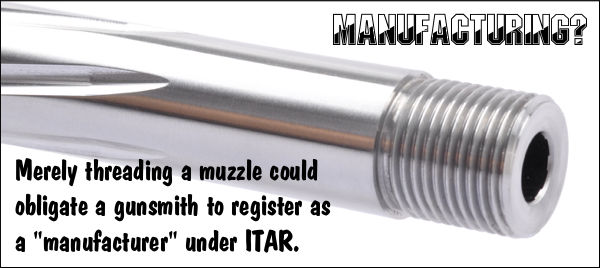
If you are a gunsmith, or do any machine works on firearms, you need to know about ITAR, the International Traffic in Arms Regulations which are enforced through the U.S. Department of State (DOS). ITAR applies to companies that create sophisticated weapons systems. However, under DOS interpretations in recent years, ITAR may also apply to persons and businesses that do simple, basic gunsmithing tasks. That could require filling out lots of paperwork, and paying the Fed’s hefty fees, starting at $2250 per year. A Guidance Statement issued by the DOS Directorate of Defense Trade Counsels (DDTC) in July, 2016 (under the Obama Administration) gave rise to serious concerns that DOS was going to require every gunsmith to register under ITAR, under threat of massive fines and penalties. READ About DDTC ITAR Guidance.
Thankfully, it appears that the Trump Administration is working to narrow the scope of ITAR so that it would NOT apply to basic gunsmithing activities, and not apply to common gun accessories that are not exported. IMPORTANT: Changes have NOT been made yet, but it appears the Feds are heading in the right direction, with the DOS willing to modify its definition of “manufacturing” so ITAR would not embrace basic gunsmithing tasks such as threading a muzzle.
The Gun Collective reports that: “The Directorate of Defense Trade Counsels (DDTC) is working on revising the ITAR regulations which will help the gun industry[.] Gunsmiths having to pay hefty fees, register and comply with ITAR may no longer be a problem if this goes through as planned. Fortunately, we don’t have to wait for Congress to take action, but rather an agency, which appears to be taking initiative to get it done. As always, time will tell, so be sure to keep your eye on the Federal Register….”
While nothing has happened yet, it appears that this administration is working to revise ITAR. For members of the firearms industry, this is a big deal and will be beneficial to all. There is no reason that a gunsmith should be required to register and comply with ITAR to simply thread a muzzle. It will also allow companies to more easily export their products around the world. (Source: The Gun Collective)
The Gun Collective further noted that: “The topic that will be of the most interest to us would be the definition of manufacturing[.] You may remember DDTC’s July 2016 letter, which issued “Guidance” as to who would have to register under ITAR [and suggested] that now gunsmiths would have to register as well. The definition of manufacturing is an important one to define and one that had broad ranging implications as the industries covered under ITAR are wide ranging, everything from the firearms industry to airplanes and missiles. The Guidance stated that ITAR registration was required for gunsmiths who machined or cut firearms, such as the threading of muzzles or muzzle brake installation which required machining. At a hefty $2,250 a year to register, ignoring all of the other things that go along with ITAR, it is easy to see why this would be problematic for most small businesses.”
Here is the key language in the DDTC’s “ITAR Registration Requirements – Consolidated Guidance” Ruling of 7/22/2016:
2. Registration Required – Manufacturing: In response to questions from persons engaged in the business of gunsmithing, DDTC has found in specific cases that ITAR registration is required because the following activities meet the ordinary, contemporary, common meaning of “manufacturing” and, therefore, constitute “manufacturing” for ITAR purposes:
a) Use of any special tooling or equipment upgrading in order to improve the capability of assembled or repaired firearms;
b) Modifications to a firearm that change round capacity;
c) The production of firearm parts (including, but not limited to, barrels, stocks, cylinders, breech mechanisms, triggers, silencers, or suppressors);
d) The systemized production of ammunition, including the automated loading or reloading of ammunition;
e) The machining or cutting of firearms, e.g., threading of muzzles or muzzle brake installation requiring machining, that results in an enhanced capability;
f) Rechambering firearms through machining, cutting, or drilling;
g) Chambering, cutting, or threading barrel blanks; and
There are tough times ahead for Remington. Fox News reports that: “Privately-held Remington Outdoor is now at risk of declaring bankruptcy after a collapse in sales and profits. Saddled with debt, the historic gun manufacturer is short on avenues for escape.” (LINK). Fox News adds:
“The rifle and shotgun manufacturer’s third-quarter sales plunged 41% as demand for firearms dried up. That led Remington to report adjusted earnings before interest, taxes, depreciation, and amortization that were 78% lower year over year. Over the first nine months of 2017, the company has produced a $60.5 million net loss, compared to a $19.1 million gain in the prior-year period.
And with its credit rating in the trash bin, the future is bleak for ‘America’s oldest gunmaker’. Today, debt on the company’s books has ballooned to almost $1 billion[.]”
Financial analysts report that Remington’s earnings decline will further harm the company’s already poor corporate credit rating. That means Remington must pay even higher interest rates to borrow money, further bleeding cash and decreasing profitability. This, in turn, accelerates the momentum towards filing bankruptcy. Fox explains: “With the firearms and ammunition manufacturer burning through cash as a result of falling sales, S&P expects it will undertake a restructuring within the next year.”
Other large American gun industry companies have seen their stock value drop dramatically this year. Vista Outdoor (Savage, RCBS, CCI etc.) is down 62% since December 9, 2016, while American Outdoor Brands (Smith & Wesson) has dropped 36%.
Remington Has a Storied History
Founded in 1816, Remington is the oldest continuously-operating gun manufacturer in the United States, and remains one of the USA’s oldest commercial enterprises. Even with its present difficulties, Remington still sells more sporting rifles and shotguns than any other American company. Remington has developed more cartridges than any other U.S. company. And it is the only American company that sells firearms AND ammunition under its own name.
The Remington enterprise was founded in 1816 by Eliphalet Remington in Ilion, New York, as E. Remington and Sons. In 2016 Remington celebrated 200 years of history. American Rifleman TV explored the history of Remington Arms Company in a TV special which focuses on many of the company’s most noted firearms. Here is a preview:
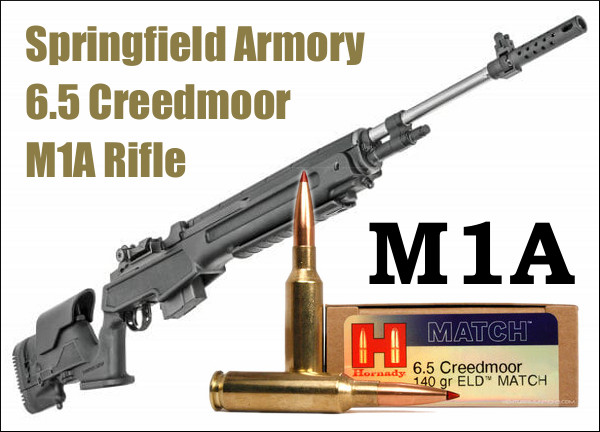
The 6.5 Creedmoor craze goes one step further. Soon you can buy a Springfield M1A chambered for this mid-sized cartridge popularized by PRS shooters. Both bolt-action and AR-platform rifles chambered for the 6.5 Creedmoor have been available for quite some time, but this is a new direction for the M1A, which has traditionally been chambered for the 7.62×51 NATO/.308 Winchester round. As chambered for the 6.5 Creedmoor, Springfield’s M1A should be easier on shooters’ shoulders. The 6.5 Creedmoor M1A has 28% less recoil than the .308 Winchester version.*
The new 6.5 Creedmoor M1A features a 22″ medium-contour, 1:8″-twist stainless barrel with factory muzzle brake. The rifle comes with iron sights: .062 post front sight and .0520 aperture rear sight adjustable for ½ MOA windage and 1 MOA elevation. Springfield ships the rifle with a 2-stage trigger tuned to 4.5 – 5 pounds. A Springfield Armory Optics mount is available to fit a magnified optic, but, to be honest, we haven’t been very impressed with that mount.
Two stock options are offered: a basic black polymer stock (not recommended — it’s weak and flexy) or a deluxe “precision” stock with adjustable cheekpiece and adjustable LOP. The deluxe precision stock, shown above, is much more rigid, and can be configured with front underside Picatinny rail (see video). Rifle Specs HERE.
With the basic polymer stock, the 6.5 Creedmoor weighs 11.4 pounds (unloaded) and has a $1985.00 MSRP. With the adjustable precision stock, the gun is a bit heavier and retails for $2045.00 in either matte black or Flat Dark Earth (FDE).
“Having a 6.5 Creedmoor caliber in the M1A lineup gives long-range shooters more choices with the precision and accuracy they require,” says Springfield Armory CEO Dennis Reese. “They can choose the round they prefer…”, i.e. .308 Win or the 6.5 Creedmoor. Excellent factory ammo is available for both chamberings.
Photo of 2009 M1A Match at Camp Perry. Shooter is Nick Till, 2007 Service Rifle Champion.
If you are looking for a robust semi-auto rifle that has an interesting legacy (the M1A was derived from the U.S. Military’s M14), this new M1A may suit your tastes. Every year at Camp Perry, Springfield Armory sponsors a very popular M1A match which attracts marksmen from around the country. We can’t say for sure that the 6.5 Creedmoor M1As will be allowed in M1A matches, but we would expect they will, though perhaps competing in a separate division.
The U.S. House of Representatives passed the Concealed Carry Reciprocity Act of 2017 (H.R. 38) in a 231-198 vote on Wednesday, December 6th. The legislation will next proceed to the U.S. Senate. If a joint version of the Bill is approved by both House and Senate, the new legislation would then go to the President for signature.
Story Based on Report by NRA-ILA.org
The National Rifle Association applauded House Members for passing the most far-reaching expansion of self-defense rights in modern American history. “This vote marks a watershed moment for Second Amendment rights,” said Chris W. Cox, executive director, National Rifle Association Institute for Legislative Action. “The Concealed Carry Reciprocity Act is the culmination of a 30-year movement recognizing the right of all law-abiding Americans to defend themselves, and their loved ones, including when they cross state lines.”
Next Stop — the U.S. Senate
“This bill ensures that all law-abiding citizens in our great country can protect themselves in the manner they see fit without accidentally running afoul of the law. We now call on the Senate to take up and pass this critical legislation,” Cox concluded.
H.R. 38 — What This Legislation Does and Does Not Do
The Concealed Carry Reciprocity Act of 2017 ensures that those Americans who can legally carry a concealed firearm in one state will legally be able to do so in every other state. It eliminates the confusing patchwork of state laws that have ensnared otherwise law-abiding gun owners.
While the bill allows recognition of concealed firearms permits from one state to the next (reciprocity), it does NOT create a federal licensing or registration system or establish national standards for concealed carry. Moreover, H.R. 38 will NOT override current state laws governing the time, place, and manner of carrying concealed weapons.
The bill also makes improvements to the National Instant Criminal Background Check System, NICS. This bill incentivizes states and government agencies to update the NICS with legitimate records of prohibited persons.
Summary of H.R. 38 — Concealed Carry Reciprocity Act of 2017
This bill amends the Federal criminal code to allow a qualified individual to carry a concealed handgun into or possess a concealed handgun in another state that allows individuals to carry concealed firearms. A qualified individual must: (1) be eligible to possess, transport, or receive a firearm under federal law; (2) carry a valid photo identification document; and (3) carry a valid concealed carry permit issued by, or be eligible to carry a concealed firearm in, his or her state of residence.
Additionally, the bill specifies that a qualified individual who lawfully carries or possesses a concealed handgun in another state: (1) is not subject to the federal prohibition on possessing a firearm in a school zone; and (2) may carry or possess the concealed handgun in Federally-owned lands that are open to the public.


 It’s pretty complicated — this subject of dealing with pressure. I’m a precision shooter and have learned to excel in that discipline. You’ve got to learn to shoot the desired scores at home and in training. And once you’re capable of shooting the scores, you may not shoot the same way in the match because of the match pressure. As a result, it takes 3-4 years to learn how to shoot, and another 3-4 years to learn how to win — to deal with the match pressure. It takes several more years to learn how to do it when it counts.

 The first question you have to ask is whether the intended recipient can legally own the firearm where he or she lives. With more than 20,000 different gun laws on the books, even the kinds of firearms that law-abiding citizens can own vary from place to place. For example, juveniles (under age 18) generally speaking are precluded by law from possessing a handgun. Check out the
  Consider a Gift Card Instead of Direct Gift




 Santa’s Extra Accuracy Challenge