At its upcoming Annual Meeting in Louisville, Kentucky, the National Rifle Association (NRA) will launch a new activities program for Millennials — young Americans in their 20s and early 30s. The new MRA (Millennial Rifle Activities) program will include a series of special events for Millennials held throughout the nation. These MRA “gatherings” will be unique among NRA competition disciplines. First, all participants in MRA events will receive a participation badge or trophy for showing up. Second, though shooting at targets will be encouraged, no actual gun-handling is required. Millennial participants can choose to watch instead. Finally, for those who do choose to shoot at MRA events, scoring will optional. Actual scores will be kept confidential, and there will be no published rankings. “At MRA events”, promises an NRA news release, “all participants will be winners.”
The NRA’s new MRA activities program targets “Millennials” — the young Americans raised on video games and the internet. If you’re not familiar with the term “Millennials”, this refers to Americans born between 1980 and 2000. They represent “the first generation that grew up with the internet and the first to have truly incorporated technology into their daily lives.” READ More.
Scoring Optional at Millennials Matches
Creating a competition program for Millennials has been challenging. With short attention spans, Millennials are easily distracted and they lack motivation to prepare or practice. Very self-absorbed, Millennials were raised on “instant gratification” and see themselves as entitled. These personality traits seem to run contrary to the focus, self-discipline, and mindset required for serious competition. Accordingly, the NRA has taken a whole new approach to MRA matches — scores won’t count and the focus will be on participation. Said one member of the NRA Competition Committee: “These were the kids who got ‘participation trophies’ for playing soccer. We are offering the same kinds of rewards. At our Millennial Matches you’ll be acknowledged just for showing up. Scoring will be optional. The emphasis is not on winning, but on participating.”
An NRA spokesman told us: “We’ve done a lot of research into the Millennial group. This demographic is very different than older generations. They expect to be rewarded for participation and they don’t want to be judged by objective standards, such as numeric scores. We’ve also learned that they like to do activities on the spur of the moment and without preparation. That’s why actual shooting will be optional at MRA events. We expect that many participants will arrive completely unprepared — without a gun or ammo. But they can still participate, and be acknowledged… and that’s what it’s all about. We want to get more Millennials involved, whether they actually shoot or not.”
NRA Millennials Outreach Follows Success of NRA Programs for Women
The NRA’s outreach programs have enabled the organization to grow its membership base successfully. For example, in recent years the NRA has significantly expanded the ranks of female members. The NRA now offers a wide variety of programs expressly for women, including self-defense training and women’s wilderness retreats. The NRA also maintains a media channel for women, NRAwomen.tv. This broadcast/web channel promotes women’s activities and recognizes top female shooters.
Millennials Create Unique Challenges for Match Directors
Dennis Santiago is a seasoned match director with decades of experience running NRA matches. He said that finding a formula for the new Millennials Match “gatherings” has been a challenge: “Designing a competitive course of fire for the new MRA Millennials discipline is not as easy as you would think. Millennials have short attention spans and it is difficult to draw them away from their digital devices. You have to come up with range commands that can attract their attention. We are thinking of sending commands via Twitter, or possibly streaming match instructions over Spotify.”
Dennis also noted that a shooting competition with “optional scoring” is something new and different for the NRA. “The concept of recording and reporting scores was hotly debated. Ultimately we decided to make scoring optional. We concluded that mandatory scoring would probably discourage participation by Millennials. To a generation that has been rewarded for simply showing up, we wanted to create a ‘safe space’ and a non-threatening environment for this new class of competitor.”
A new statute passed in California will bar state employees (as well as teachers, police personnel, and health care workers) from using a variety of firearms terms in official communications. California Assembly Bill 2243, authored by Assemblyman Tony Fulenzo (D. Los Angeles), defines over 30 gun-related words as “hate speech”. Under existing California law, any words/phrases defined as “hate speech” are proscribed (forbidden) in official publications, school textbooks, and all public-sector communications (including email). By effect of AB 2243 then, dozens of gun-related nouns, verbs, and adjectives will be banned, and “shall no longer be uttered or used in the State of California by any public agent or employee”.
Assemblyman Fulenzo said his intent in sponsoring AB 2243 was to alter public attitudes toward firearms, and in particular, to convince school children that firearms are bad. “We want to prevent young kids from perceiving firearms as ‘cool’ or ‘exciting’. The best way to do that is to bury the subject altogether. We need to dismantle the ‘gun culture’. That begins with banning the words themselves.”
Fulenzo said AB 2243 was inspired by existing bans on racist “hate speech”: “We don’t want children to read about guns or talk about guns. The first step, therefore, is to remove firearms-related words from textbooks, classroom presentations, and state documents. This is not something new. California has done the same thing with hateful words directed at minority groups. In California, by law, we have banned the use of the ‘N’ word (and other racist terms) in official state publications and school textbooks. Now we are just following that practice and banning the ‘G’ word (i.e. ‘gun’) and similar firearms-related hate speech”.
Ban on Gun Words in Arizona Next?
Meanwhile, in neighboring Arizona, anti-gun groups have called for the passage of similar legislation banning the use of firearms-related terminology.
Permitted Word Equivalencies for Banned Firearm Terms
When enacted into law, AB 2243 will ban more than 30 firearm-related words, including “gun”, “pistol”, “rifle”, “bullet” and other commonly-used words. Where it is necessary to reference a firearm, as in a police report, AB 2243 provides for substitute words or phrases. AB 2243 recognizes that, in some instances, it will be necessary to mention firearms-related facts in official documents. By using these officially-designated substitute words, firearms-related facts can be logged without resort to banned “hate speech”.
Gun = “Gunk”
Pistol = “Piddle”
Rifle = “Ripple”
Shoot = “Suit”
Bullet = “Mullet”
Cartridge = “Partridge”
How to Use CA-Approved Substitute Words:
Under AB 2243, if an official report requires description of a hate speech item, then the approved replacement words shall be used instead of the prohibited terms. For example, if a state-funded hospital treats a pistol wound, this shall be listed as a “piddle wound” in the medical report. Likewise the recovery of cartridges at a crime scene by police shall be recorded as a “partridge recovery” in the incident report.
New Law Does Not Restrict Speech by Non-Governmental Entities
This new law only applies to “public sector” entities (schools, police/sheriff agencies, hospitals/health clinics, state and municipal agencies). Private businesses, including newspapers and web sites, will still be allowed to use firearms-related words without the threat of prosecution. Likewise, private citizens will still be allowed to say “gun”, “pistol”, or “rifle” etc. in their own private communications. However internet posting of hate speech involving forbidden firearm words will be monitored by a new California State Agency. This new Agency, the California Office of Firearms Hate Speech (COFHS) will be funded by a new 5% sales tax on firearms ammunition and components.
Report based on story by Ashley Brugnone, CMP Writer
Registration for the 2016 National Trophy Pistol and Rifle Matches will open April 1, 2016. The National Matches will take place at Camp Perry, Ohio, six miles west of Port Clinton, during the months of July and August. Starting April 1st, you can register on the Civilian Marksmanship Program (CMP) website to claim your spot at this year’s event.
2016 National Match Schedule Includes Legacy Series
The 2016 Match Schedule will be different from the 2014-2015 National Matches, returning to the original schedule of years past. Events featured will include the John C. Garand, President’s Rifle, Hearst Doubles, Vintage Sniper, as well as a multitude of prestigious pistol events. New this year, the CMP will introduce its Legacy Series — an extra week with competitions featuring both vintage and modern military rifles. Each event has been named to honor the memories of important figures in marksmanship history, as well as to commemorate the spirit of past and present National Matches.
Shooting Clinics at Camp Perry This Summer
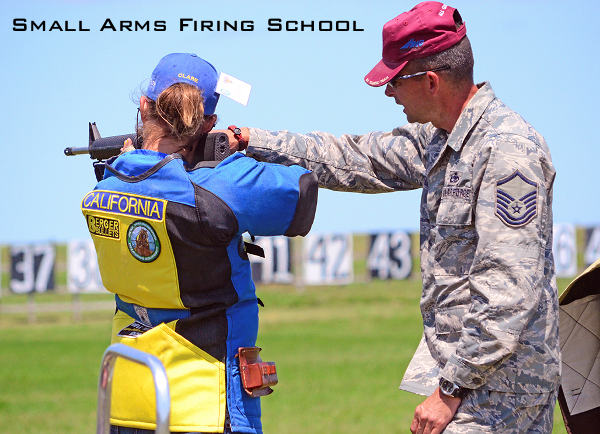
The Small Arms Firing School (SAFS) will also be held for rifle and pistol enthusiasts this summer. Participants will be taught firearms handling and competition skills by some of the top military shooters in the country. The SAFS courses have been a staple in the National Matches at Camp Perry since 1918. Many other clinics and learning opportunities, taught by qualified professionals, will also be available during the National Matches.
Spectators Are Welcome at the National Matches
Events are open to the public, and spectators are welcome to observe firing on the Camp Perry ranges at any time. Guests are encouraged to visit Camp Perry and watch the many events held during Match season. The photo below shows spectators watching Pistol events at the 1956 National Matches. That was quite a crowd…
The Civilian Marksmanship Program (CMP) is a federally chartered 501 (c) (3) non-profit corporation. It is dedicated to firearm safety and marksmanship training and to the promotion of marksmanship competition for citizens of the United States. For more information about the CMP and its programs, log onto www.TheCMP.org.
What’s a “wallet group”? It’s a singularly spectacular proof target that entitles its bearer to bragging rights. The wallet group may or may not have been shot in competition, and, by definition, it may not be repeatable. But it exists as incontrovertible proof that, at least once, the stars aligned, and the wind gods smiled on the shooter.
Five Shots in 0.178 MOA at 1000 Yards
A few years ago, Forum member and F-Class shooter Gary Wood was testing his 6.5-284 rifle at the 1000-yard range in Coalinga, California, getting ready for an upcoming long range match. In practice, Gary nailed a witnessed 1.859″ five-shot group, with four of the five shots well under an inch. Use this as proof to win those club-house arguments about whether it is possible to shoot “in the ones” at 1000 yards. Gary’s group worked out to 0.178 MOA!
Gary reports: “I was load testing with 5-shot groups. Each group was shot on a new F-Class center and pulled by Ret. Master Chief Jerry Pullens and spotted by an other long-range shooter. The second 5-shot load group looked really small … by our reckoning four out of five shots measured under an inch. I was amazed. What’s more, when I shot the group, the 4th shot blew the spindle out of the 3rd shot. My spotter saw that in his scope and Jerry Pullens told me about it afterwards”.
As measured with the OnTarget Software, using a scan of the target, Gary plotted the group size at 1.859″ total for five shots, or 0.178 MOA. Gary noted: “I had everyone sign the target which I saved and photographed.” Yes, Gary, this may be the wallet group to end all wallet groups. You should have that target framed.
Gary’s Load and 6.5-284 Rifle Specs
Gary was running a stout load of Hodgdon H4350 and CCI BR-2 primers, pushing moly-coated 142gr Sierra MKs, in Lapua 6.5-284 brass. The rifle features an F-Class, single-shot Surgeon action with a Bartlein 5R barrel chambered with a no-turn neck. Gary says “The barrel only has 70 rounds through it… yep, I think it will shoot.” Gary did all of the gunsmithing and barrel work himself.
Did Gary have any special reloading tricks? Apparently not: “Other than weighing the cases and the powder very carefully, there really were no magical reloading secrets used. The Sierra 142s were moly-coated straight from the box of 500, but they were not weighed or checked for bearing surface. The powder was dropped with a RCBS ChargeMaster then checked with an Acculab scale (to under a tenth). The Lapua cases were not neck-turned, but I did weight-sort them. The five cases for the small group weighed: 195.05, 195.03, 195.03, 195.03, 195.01.”
The Cactus Classic is a prestigious benchrest competition held every year in Phoenix, Arizona. On March 16-20, many of the nation’s top short-range benchresters came to Ben Avery to vie for glory and prizes. There were some impressive performances at this year’s Cactus Classic, hosted by the Arizona Benchrest Shooters. Top Gun was Larry Costa who won the Two-Gun Grand Aggregate as well as the Light Varmint (LV) 200-yard Agg. Lou Murdica (shown below) won the Heavy Varmint (HV) 200-yard Aggregate. At the shorter range, Larry Baggett won the Heavy Varmint 100-yard Aggregate and Gary Bristow won the Light Varmint 100-yard Agg. For full results, click the link below. To see hundreds of high-rez photos from the match, visit the Berger Bullets Flickr Photo Gallery.
Criterion Barrels Inc. (CBI) has a policy of rewarding excellence. As a way of supporting top shooters, Criterion will provide a new, free barrel to any shooter who sets or ties a national record when using a Criterion product. To explain, you get a new Criterion barrel for free if you set (or tie) a national shooting record using a Criterion barrel on your rifle.
Criterion Barrels hopes to increase awareness of its free barrel for record sectors program. Over the last few years a number of F-Class and vintage military competitors have benefited from this program, receiving a complimentary barrel of their choice after setting a new national record in their shooting discipline. Past record breaking shooters have included David Mark Honeycutt (with a 300-yard F-Class score of 600-50X), Samantha Huhtala (four records set in 600-yard F-TR competition), and Victor Betzold (M1 Carbine with a score of 375-6X).
Criterion may, in the future, create a rewards program for winners of national, regional, and local rifle matches. Potential earned rewards by match winners could include equipment sponsorships, barrel discounts, and free apparel items.
Set a Record with a Criterion Barrel? Then Give Criterion a Call…
If you or someone you know has set a pending national record with a Criterion barrel, have the shooter contact Criterion Barrels. Send email to contact[at]criterionbarrels.com or call (262) 628-8749.
Once the shooter’s information is verified and the record is confirmed by the governing body of their appropriate shooting discipline, the order will be processed and shipped to the new record-holder.
About Criterion Barrels, Inc.: Criterion Barrels, Inc. was founded in 1999 as a division of Krieger Barrels, Inc. in response to demands of rifle builders and firearms manufacturers for quality match grade barrels at a lower cost. Our company is now completely independent from Krieger Barrels, featuring a separate facility, personnel, and ownership.
Commentary by Dean Weingarten,Gun Watch
In an historic, but extremely short unanimous opinion, the United States Supreme Court has confirmed that the Second Amendment applies “to all instruments that constitute bearable arms,”. As this is an enormous class of nearly all weapons, the decision [could be] applied to knives and clubs, and nearly all firearms that have been sold in the United States. Nearly all types of firearms are more common than stun guns. From nbcnews.com:
“But in an unsigned opinion, the U.S. Supreme Court [on 3/21/2016] vacated that ruling. It said the Massachusetts court improperly found that Second Amendment protection applies only to weapons that were in common use at the time of the nation’s founding.”
Referring to its landmark 2008 D.C. v. Heller ruling on handguns in the home, the justices said the Second Amendment applies “to all instruments that constitute bearable arms,” even those not in existence at the time of the founding.
The unsigned opinion is very short[.] Alito writes a much longer and more forceful opinion in concurrence. It could, and should, have gone much further. None the less, it is an enormous win for Second Amendment supporters, and it extends far beyond stun guns and Massachusetts.
There is strong language in this opinion. If 200,000 stun guns in the U.S. are “common”, it is hard to believe that 5 million AR-15s and millions of other semi-automatic rifles are “unusual”.
The case lays to rest the idea that courts can simply say anything other than handguns are “uncommon” or “unusual” and are therefore exempt from Second Amendment protections. This case will be cited far into the future.
The full, unanimous decision, along with Justice Alito’s lengthy concurrence, is found via this LINK:
After the success of its recent winter Ballistics seminar in Michigan, Applied Ballistics has decided to take its show on the road, offering additional Ballistics seminars in three different states (Texas, Michigan, and North Carolina). These three seminars will cover a wide range of topics, with the primary focus on basic to advanced ballistics principles as applied to long-range shooting. Registration is now open for the three (3) upcoming Ballistics Seminars:
This video explains the subjects covered by Applied Ballistics Seminars:
Ballistician (and current F-TR National Mid-Range and Long-Range Champion) Bryan Litz will be the primary speaker at the spring, summer, and fall seminars. He will present material from his books and the Applied Ballistics Lab, and he will discuss his experience shooting in various disciplines. The seminar will feature structured presentations by Bryan and other noted speakers, but a great deal of time will be alloted for questions and discussion. By the end of the seminar, participants should have a much better understanding of how to apply ballistics in the real world to hit long-range targets. Along with Bryan, other respected experts will include:
Emil Praslick III – Head coach of the U.S. Palma team and retired head coach of the U.S. Army Marksmanship Unit. Emil will discuss tactics, strategy, and mindset for successful wind-reading.
Eric Stecker – Master Bulletsmith and President of Berger Bullets. Eric will be presenting on precision bullet making technology.
Nick Vitalbo – Owner of nVisti Tactical Innovations and chief engineer for Applied Ballistics. Nick will discuss the state of the art in laser rangefinders and wind reading devices.
Mitch Fitzpatrick – Applied Ballistics intern and owner of Lethal Precision Arms. Mitch specializes in Extended Long Range (ELR) cartridge selection and rifle design.
Ballistic Solvers – How they work, best practices, demos.
Weapon Employment Zone (WEZ) Analysis – How to determine and improve hit percentage.
Optics and Laser Technology – State of the Art.
The seminars costs $500.00. But consider this — each seminar participant will receive the entire library of Applied Ballistics books and DVDs, valued at $234.75, PLUS a free copy of Applied Ballistics Analytics software, valued at $200.00. So you will be getting nearly $435.00 worth of books, DVDs, and software. In addition, a DVD of the seminar will be mailed to each attendee after the seminar concludes.
Report by Johnny Fisher
The Civilian Marksmanship Program has just finished temporary installation of 15 traveling electronic Kongsberg Targets at the Oklahoma City Gun Club in Arcadia, OK. These high-tech targets will be employed during the Oklahoma CMP Games, slated for April 6-10, 2016. All the High Power rifle events during this year’s Oklahoma Games will be run exclusively on these electronic targets. Competitors will be scored electronically with match results being processed in real-time. Notably, this means High Power competitors will not have to do “pit duty” the entire week since manual target-pulling and shot-marking is no longer required.
The majority of shooting at the Oklahoma CMP Games will be fired at the 200-yard line for the Garand / Springfield / Vintage & Modern Military (GSMM) matches. However, the electronic targets have also been readied for use in the scheduled Excellence In Competition (EIC) and Vintage Sniper matches. Those events require additional firing from 300 yards and 600 yards.
Electronic Target Technology — How Kongsberg Targets Work
CMP Targets technician Bryan Parris explains what makes these targets so special: “These targets were designed by the experts at Kongsberg Targets exclusively for the CMP to fit the standard US target dimensions of 72″ square target backers. What shooters discern as the black of the aiming bull is actually black rubber sheeting that is the entire size of the backer. A layer of white corrugated plastic then covers this rubber with a center hole having been cut out to reveal the appropriate sized bull for that yard-line. All that is required as competitors move further back through the course is to change out the plastic cover to reveal a larger aiming black.”
This acoustically-scored target system uses four microphones to locate the bullet as it passes through the target. The microphone closest to the bullet traveling through the target actuates the remaining three to triangulate the exact shot location for the scoring system and simultaneously display the shot on the shooter’s monitor.
Behind the coroplast face and inside the foam insulation, the target is wrapped with rubber to form a type of chamber. This helps insulate the target’s four microphones stay insulated from extreme temperature changes and also helps keep out ambient noise. This chamber need only exist to the extent that it separates itself from the other targets. Parris states: “We’re building these targets to last a great long while. They are extremely durable and can have anywhere from 3000 to 5000 rounds fired through them before any maintenance is required whatsoever.”
The entire system can be powered via battery, generator, or combination of both. The target line communicates wirelessly with the firing line computer system for timing courses of fire and recording scores. And of course, there is virtual real-time communication with monitors set up on each firing point to display shot / group location and value.
When fully assembled, each target weighs about 200 pounds. They are a little cumbersome in their current form, but the CMP’s target technicians are “still working some things out [for] potential future travel games.”
Registration Still Open for Oklahoma CMP Games
The 2016 CMP Oklahoma Games will be held at the Oklahoma City Gun Club in Arcadia, OK from April 6 – 10, 2016. Registration is still available. For more information about these Kongsberg Electronic Targets, contact Bryan Parris of CMP Targets at (256) 835-8455 or bparris@thecmp.org.
4140, 4150, 316, 17-4, 6061, 7075-T6 — What is the significance of these numbers? No, they’re not winning lottery numbers. These are all designations for metals commonly used in firearm and barrel construction. 4140 and 4150 are carbon steels, with 4150 often used in mil-spec AR15 barrels. 316 and 17-4 are grades of stainless steel. 316 is “marine grade” stainless, while 17-4 has 17% chromium and 4% nickel. 17-4 is a harder steel used in barrels and receivers. 6061 and 7075-T6 are aluminum alloys. 6061 is “aircraft grade” aluminum, often used for rings and trigger guards, while 7075-T6 is a much stronger, heat-treated aluminum commonly used in AR15 uppers.
You can learn about all these metals (and more) in the online archives of RifleShooter magazine.
Written by Patrick Sweeney, RifleShooter’s Guide to Gun Metal summarizes the primary types of steel and aluminum used in gun and barrel construction. Sweeney explains the nomenclature used to define metal types, and he outlines the salient properties of various steel and aluminum alloys. This is a useful resource for anyone selecting components or building rifles. We recommend you print out the page, or at least bookmark it.
Metals by the Number
The number system for steel classification came from the auto industry. Sweeney explains: “The Society of Automotive Engineers uses a simple designating system, the four numbers you see bandied about in gun articles. Numbers such as 1060, 4140 or 5150 all designate how much of what [elements are] in them. The first number is what class—carbon, nickel, chromium, and so forth. The next three numbers [list other elements in the alloy]. 4140, also known as ordnance steel, was one of the early high-alloy steels. It has about 1 percent chromium, 0.25 percent molybdenum, 0.4 percent carbon, 1 percent manganese, around 0.2 percent silicon and no more than 0.035 percent phosphorus and no more than 0.04 percent sulphur. That leaves most of it, 94.25 percent, iron.”
Aluminum Alloys
Numbers are also used to differentiate different types of aluminum alloys. Sweeny writes: “Aluminum is used in firearms in two alloys: 7075 and 6061. 6061 is commonly referred to as ‘aircraft aluminum’ and has trace amounts of silicon, copper, manganese, molybdenum and zinc. 7075 is a much stronger alloy and has markedly larger amounts of copper, manganese, chromium and zinc.” 7075 Aluminum has significantly better corrosion resistance, and that’s why it is used for AR receivers. The “T6″ you often see appended to 7075 refers to a heat-treating process.
Aluminum (or “Aluminium” in the UK) is a chemical element in the boron group with symbol Al and atomic number 13. It is a silvery-white, soft, nonmagnetic, ductile metal. Aluminum is the third most abundant element, and the most abundant metal, in the Earth’s crust. (Wikipedia)
To learn more about the metals used in your firearms’ barrels, rings, receivers, and internal parts, read Sweeney’s article in RifleShooterMag.com. Taking the time to read the article from start to finish will expand your knowledge of metal properties and how metals are chosen by manufacturers and gunsmiths. CLICK to Read Guide to Gun Metal.
Story Tip by EdLongrange. We welcome reader submissions. Aluminum Alloy chart courtesy AluminiumDesign.net.


 The NRA’s new MRA activities program targets “Millennials” — the young Americans raised on video games and the internet. If you’re not familiar with the term “Millennials”, this refers to Americans born between 1980 and 2000. They represent “the first generation that grew up with the internet and the first to have truly incorporated technology into their daily lives.” READ More.


 Fulenzo said AB 2243 was inspired by existing bans on racist “hate speech”: “We don’t want children to read about guns or talk about guns. The first step, therefore, is to remove firearms-related words from textbooks, classroom presentations, and state documents. This is not something new. California has done the same thing with hateful words directed at minority groups. In California, by law, we have banned the use of the ‘N’ word (and other racist terms) in official state publications and school textbooks. Now we are just following that practice and banning the ‘G’ word (i.e. ‘gun’) and similar firearms-related hate speech”.



 Five Shots in 0.178 MOA at 1000 Yards




 The unsigned opinion is very short[.] Alito writes a much longer and more forceful opinion in concurrence. It could, and should, have gone much further. None the less, it is an enormous win for Second Amendment supporters, and it extends far beyond stun guns and Massachusetts.


