|
|
January 2nd, 2015
Nightforce is introducing two all-new First Focal Plane (F1™) scopes at SHOT Show 2015 in Las Vegas. With abundant elevation adjustment, these new F1 optics should be popular with long-range shooters. Nightforce will offer these F1 scopes with either MOA-based 1/4-minute clicks or a Mil-based 0.1 (one-tenth) Mil-Radian adjustments. Reticle choices are: MOAR™, Mil-R™, Horus H59, and TReMoR3.
Our readers will probably be most interested in the new ATACR™ 5-25x56mm F1™ riflescope. Nightforce tells us that “We have been bombarded with requests for this specific model. We wanted to design and pack this model with so many features that it would be the true heavyweight champion in the field.” With a beefy 34mm maintube, the new 5-25x56mm F1 boasts an impressive 30 MOA (or 12 Mil-Rads) of elevation per revolution, with 120 MOA (or 35 mils) of total elevation adjustment. That’s a lot. Tactical shooters should appreciate the yards/meters markings on the side parallax knob (yards for MOA scopes, meters for Milrad scopes). You can actually “dial the distance” with the marked parallax knob. That should speed up focus adjustments during target transitions. For low-light applications, the new 5-25x56mm F1’s DigIllum™ reticle illumination system provides precise brightness control.

Nightforce believes the 5-25x56mm F1 will be a hit with long-range and tactical marksmen, even though MSRP is a hefty $2900.00: “We anticipate that some of the weapon applications for this model will include long-range and ultra-long-range precision tactical rifles, unique long-range hunting rifles, and many of the purpose-built magnum AR platforms.”


New 4-16x42mm F1 Replaces current 3.5-15x50mm NXS F1
The ATACR™ 4-16x42mm F1 will replace the previous NXS 3.5-15x50mm Nightforce. Like the 5-25X F1, the new 4-16X F1 offers 30 MOA (or 12 Mil-Rads) per revolution of the elevation turret. This scope also features a new ZeroHold™ zero-stop which uses a simple press-button design. According to Nightforce, the low-profile ZeroHold offers a positive zero-stop that is “automatically re-indexed as you return to your zero”. As with the ATACR 5-25x56mm F1 model above, the ATACR 4-16x42mm F1 features DigIllum reticle illumination control. MSRP for the 4-16x42mm ATACR F1 is $2400.00.

December 30th, 2014
 Midsouth Shooters Supply is having a huge End-of-Year Sale. Hundreds of clearance items are marked down 40% (or more) through the end of 2014. For the next couple of days there are amazing deals to be had on ammo, optics, scope rings, gun cases, reloading dies, muzzle-loader rifles, cleaning supplies and much more. Below are some of the top deals we found this morning. (NOTE: This is just a tiny fraction of the hundreds of 40% OFF clearance items.) Remember, these deeply-discounted deals expire soon — you snooze, you lose. Midsouth Shooters Supply is having a huge End-of-Year Sale. Hundreds of clearance items are marked down 40% (or more) through the end of 2014. For the next couple of days there are amazing deals to be had on ammo, optics, scope rings, gun cases, reloading dies, muzzle-loader rifles, cleaning supplies and much more. Below are some of the top deals we found this morning. (NOTE: This is just a tiny fraction of the hundreds of 40% OFF clearance items.) Remember, these deeply-discounted deals expire soon — you snooze, you lose.
Go to Midsouth End-of-Year Clearance Sale.
Sample Sale Items (hundreds more products are 40% off):


December 14th, 2014
 With the price of some premium scopes approaching $3000.00 (and beyond), it’s more important than ever to provide extra protection for your expensive optics. ScopeCoat produces covers that shield scopes with a layer of neoprene rubber (wetsuit material) sandwiched between nylon. In addition to its basic covers, sold in a variety of sizes and colors, ScopeCoat has a line of heavy-duty 6mm products that provide added security. With the price of some premium scopes approaching $3000.00 (and beyond), it’s more important than ever to provide extra protection for your expensive optics. ScopeCoat produces covers that shield scopes with a layer of neoprene rubber (wetsuit material) sandwiched between nylon. In addition to its basic covers, sold in a variety of sizes and colors, ScopeCoat has a line of heavy-duty 6mm products that provide added security.
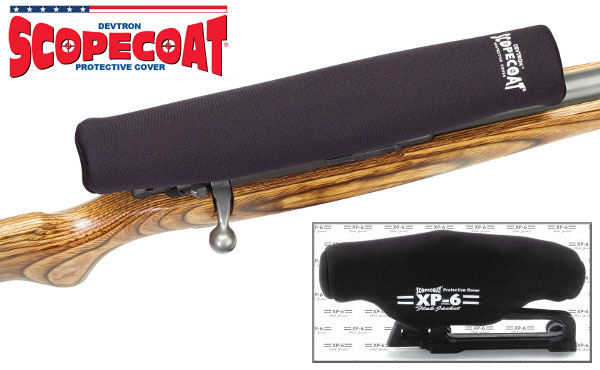
Triple-Thickness XP-6 Model for Added Protection
The XP-6 Flak Jacket™ is specifically designed for extra protection and special applications. The 6mm-thick layer of neoprene is three times thicker than the standard ScopeCoat. XP-6 Flak Jackets are designed for tall turrets, with sizes that accommodate either two or three adjustment knobs (for both side-focus and front-focus parallax models). To shield an expensive NightForce, March, or Schmidt & Bender scope, this a good choice. XP-6 covers come in black color only, and are available for both rifle-scopes and spotting scopes.
 The heavily padded XP-6 Flak Jacket is also offered in a Zippered version, shown at right. This is designed for removable optics that need protection when in storage. The full-length, zippered closure goes on quick-and-easy and provides more complete protection against dust, shock, and moisture. MSRP is $30.00. The heavily padded XP-6 Flak Jacket is also offered in a Zippered version, shown at right. This is designed for removable optics that need protection when in storage. The full-length, zippered closure goes on quick-and-easy and provides more complete protection against dust, shock, and moisture. MSRP is $30.00.
Special Covers for Binos and Red-Dots
ScopeCoat offers many specialized products, including oversize covers for spotting scopes, protective “Bino-Bibs” for binoculars, rangefinder covers, even sleeves for small pistol scopes and red-dot optics. There are also custom-designed covers for the popular Eotech and Trijicon tactical optics. Watch the Shooting USA video below to see some of ScopeCoat’s latest specialty covers.
December 12th, 2014
 If you’re thinking of spending thousands of dollars on a new rifle scope or spotting scope, do your homework first. You need to understand key design features, such as first focal plane vs. second focal plane, and turret click values. You should learn about light transmission, resolution, and other factors that distinguish a great optic from a not-so-great one. You also need to analyze your specific requirements before making a buying decision: How much magnification do you really need? Is illumination important? How much scope weight can you reasonably tolerate? If you’re thinking of spending thousands of dollars on a new rifle scope or spotting scope, do your homework first. You need to understand key design features, such as first focal plane vs. second focal plane, and turret click values. You should learn about light transmission, resolution, and other factors that distinguish a great optic from a not-so-great one. You also need to analyze your specific requirements before making a buying decision: How much magnification do you really need? Is illumination important? How much scope weight can you reasonably tolerate?
Sport Optics, a new book by Alan Hale, helps you answer all these important questions. Hale, former CEO of Celestron Optics, has more than 50 years of experience in the optics industry. His book, Sport Optics, is an up-to-date, comprehensive guide to Riflescopes, Spotting Scopes, and Binoculars. Hale surveys products from dozens of domestic and foreign manufacturers. Hale explains, in easy-to-understand terms, the technical jargon used by optics-makers. This helps buyers make informed decisions.
|
The new book is full of good, sound advice. Respected gun writer Chuck Hawks says: “Alan Hale has impeccable credentials in the optics industry. Sport Optics is written for the layman in a clear, understandable and interesting manner.” Bill Thompson, co-publisher of Bird Watcher’s Digest adds: “Alan Hale is one of the Zen masters of sport optics[.] He knows more about how optics work, how and where they are made, and how to put them to their highest possible use than most outdoor sport optics writers. Read this book before you make any optics purchase[.]”
FREE Book Preview at Amazon.com
The Sports Optics book is offered at Amazon.com for $21.95. To preview the book, go to the Amazon web page for Sports Optics, and click the cover photo that says “Look Inside”. This lets you see front and back covers, complete table of contents, and many sample pages (such as those shown below):
|
|
November 30th, 2014
Every rifle shooter should have access to a borescope. These devices reveal the condition of the inside of your barrel. Do you have a carbon ring problem? Is there jacket fouling near the muzzle? Are the edges of your lands worn away? All these common conditions can be revealed by a quality borescope.
UPDATE: MSRP will be under $300.00 and the unit should be available in March. Lyman told us: “We expect to have these available in March 2015. The price is expected to be $299.95. We will have this available for pre-order via our website in early 2015.”
And now new digital/optical technology makes the borescope easier than ever to use. For 2015, Lyman will introduce a new, affordable borescope that employs digital imaging (with a micro-camera). You no longer have to peer into an old-fashioned eyepiece. With the new Lyman borescope you can view the inside of your barrel via a small portable display screen. That’s handy. In addition, the borescope images can be displayed on your laptop or mobile device. Lyman provides a USB cable and software that allows you to view the borescope’s image output on your computer (plus you can record images for future reference). The unit fits bores .20 caliber and larger.

Sorry, we don’t have an exact price yet, but we’ve been told that this new product will be less expensive than current, conventional precision borescopes with glass-lens eyepieces. Here’s what Lyman says about it’s new product:
Lyman’s new Borescope provides active shooters with the means to carefully inspect the bores of their firearms for wear, throat erosion, tool marks, and other rifling or chamber damage, as well as for checking for fouling. The scope will fit 20 caliber and larger barrels and works with miniature camera technology. The display will show a clear image of the inside of the barrel and also allows you to take a photo of the bore. The image will storage on a standard SD card and can later be viewed on a computer or lap top. A separate cable (with USB connection) and CD are also available so that the Borescope rod can be connected directly to your computer or lap top. If you prefer to view only on your computer or lap-top, the Borescope rod is available separately (without the display unit) and plugs into the computer with a USB connection.
New product tip from EdLongrange. We welcome reader submissions.
November 30th, 2014
Last year, PrecisionRifleBlog.com published results from the most comprehensive field test of rangefinder binoculars ever conducted. The comparison test included virtually every product then available in the USA. If you are thinking about getting a set of binoculars with range-finding capability, you should definitely read this test. Here we summarize key findings of the test, but you’ll want to read the FULL STORY.
Six range-finding binocular optics (and two monocular rangefinders) were field-tested in a variety scenarios to see which had the best performance in terms of both optical clarity and ranging capabilities. The results are based on over 10,000 data points collected from the field over 3 months of testing. Cal Zant, author of PrecisionRifleBlog.com, published a series of posts with exhaustive details about his optical and ranging tests and results, but we’ll hit the highlights here.

|
VOICE FILE: Click Button to Hear Cal Zant TALK about Rangefinder Binocular Test |
Six of the models tested were binoculars, and the other two were monoculars. The Leupold monocular was included for reference, because many shooters have a 1,000-yard rangefinder similar to the RX-1000. The Vectronix Terrapin model was included as the control for ranging performance, because it is known to be an extremely accurate rangefinder (spoiler alert: it is). Cal provides a very detailed side-by-side spec comparison for these models in one of his posts.
Ranging Test Results
 Each model was used to range 500+ times in a variety of scenarios from 25 to over 30,000 yards. The tests showed these models had similar performance at close and mid-range targets, but at 600 yards their performance started to diverge … so that is where most of the testing was focused. Each model was used to range 500+ times in a variety of scenarios from 25 to over 30,000 yards. The tests showed these models had similar performance at close and mid-range targets, but at 600 yards their performance started to diverge … so that is where most of the testing was focused.
The chart below summarizes the ranging performance found on the test targets in ideal conditions, which was from a sturdy tripod, at sunset, with 10+ mile visibility. The exact target shape and surroundings varied, but the targets were all approximately 2 MOA wide, highly reflective, and perpendicular to the rangefinder. Specifics on target dimensions, view from the ranging position, and target surroundings are given in the detailed ranging performance results post.

Vectronix is the leader of the rangefinder world, and that was proved once again in these tests. The new Leica Geovid HD-B wasn’t far behind them, with accurate ranging beyond 1 mile. The Zeiss Victory RF also had surgical precision off a tripod, although it had a reduced range compared to the Vectronix and Leica. The Bushnell Fusion 1 Mile also proved to be able to range targets out to their claimed max range of 1,760 yards.
PrecisionRifleBlog.com also tested the ranging performance of each model in bright lighting conditions, and offhand as well. The data from those tests also contained a few surprises. To determine how accurate each model really was, Cal Zant carefully analyzed the results from each model when aimed at precisely positioned, “known distance” targets. To see how those tests turned out, or learn more details about specific models, GO TO full results.
Optical Test Results
 For the optics tests, Cal’s goal was to find an objective, data-driven approach to testing optical performance. What he came up with was placing eye exam charts from 600 to 1,400 yards with different size letters, and then recording what two different people could accurately read with each model. The data for each unit was summed into a single score so they could be ranked relative to how much detail the testers could make out. More specifics are provided regarding how the test was conducted and how scores were calculated in the optical performance results post. Here are the results from Cal’s data-driven approach: For the optics tests, Cal’s goal was to find an objective, data-driven approach to testing optical performance. What he came up with was placing eye exam charts from 600 to 1,400 yards with different size letters, and then recording what two different people could accurately read with each model. The data for each unit was summed into a single score so they could be ranked relative to how much detail the testers could make out. More specifics are provided regarding how the test was conducted and how scores were calculated in the optical performance results post. Here are the results from Cal’s data-driven approach:

The Leica Geovid HD-B edged out the other models for the top spot, with its completely new, Perger-Porro prism design. The original Leica Geovid HD, and Zeiss Victory RF also showed great optical clarity.
The Rest of the Story
Cal’s full series of posts is very informative. He’s done tons of analysis on the data, and summarizes it in several charts that provide a lot of insight. Cal is also in the process of publishing detailed reviews on each model, including notes he and the other testers compiled for each unit. They used them all — a lot, so they have a unique perspective on what’s good or bad about each. Find out more at the link below:
CLICK HERE to Read Full Article with More Info
November 20th, 2014
Nightforce makes great scopes — just ask the man who owns one. And Vortex offers scopes that offer exceptional “bang for the buck”. Here’s your chance to get a Nightforce NXS, or Vortex Viper PST scope at very low “close-out” prices from Bullets.com. The folks at Bullets.com tell us: “We are selling these at deals that are so low your viewers won’t be able to pass them up. We want this stock gone before the end of the year and have slashed prices to move it.” Here is a partial sample of the items on sale. NOTE: CLICK HERE to see the complete list of sale items, which include other lower-magnification Nightforce NXS scopes, as well as Vortex spotting scopes. Supplies are limited at these close-out prices.
Nightforce Scopes ON SALE (Partial sample)

Vortex Scopes ON SALE (Partial Sample)
 |

Online Shopping Tips
Before placing your order with Bullets.com, be sure you are 100% certain about the model you are ordering. Some scopes with the same magnification range come with a choice of either 50mm objective or 56mm objective. Likewise, there are various reticles offered for each basic model, and Nightforce offers 1/4 MOA clicks on some scopes, with 1/8 MOA clicks on others.
October 27th, 2014
Hey guys here’s a torture test video that’s really worth watching — you’ll be shocked and amazed (we guarantee it). In this video, Nightforce Exec Kyle Brown (with help from NF employee Sean Murphy), absolutely brutalizes a Nightforce NXS 5.5-22x56mm scope. He bangs it on a concrete bench-top, throws it 50 yards downrange, knocks it on a hardwood beam multiple times, and then heaves it back again. We kid you not. To our eternal surprise, the Nightforce scope survives all that abuse and shoots fine. What did Timex once say — “Takes a licking and keeps on ticking”?
You’ve got to watch this video — it was shot with five cameras and runs with no “time-outs”, cutaways, or video tricks. What you see is what you get. This is one tough NXS. Thank you Kyle Brown and crew for taking the time to prove the durability of Nightforce Optics products.
Nightforce Torture Test – Uncut – Full Length from Nightforce Optics


If you want to watch this video offline (or share it with your buddies in the future), here are links:
Share Video: http://vimeo.com/109698139
Download Standard Definition Video (640 x 480, 27 megabytes)
Download High Definition Video (1280 x 720, 86 megabytes)
October 14th, 2014
Here’s the deal of the month if you’re looking for a medium-magnification scope for hunting or gun games. The Vortex Razor HD 5-20x50mm Scope is now just $1349.00 at EuroOptic.com. These popular optics previously retailed for $1999.95. But EuroOptic purchased ALL the remaining inventory of these Vortex scopes and is blowing them out at below wholesale prices. With this special inventory reduction sale, you can save $650.00 on a very high-quality scope.

Vortex Razor HD 5-20x50mm Scope Buy Out Sale!
After buying ALL the remaining Vortex Razor HD inventory, EuroOptic is offering huge savings — $650 off the riflescopes shown above. Originally priced at $1999.95, these scopes are now being sold for just $1349.00! Supplies are limited. Call 570-368-3920 to order.
Sale tip by EdLongrange. We welcome reader submissions.
October 10th, 2014
Do you think your borescope is a state-of-the-art bore inspection device? Well think again. There is now something way more advanced than any optical borescope. A new laser-equipped scanning device can map the entire interior surface of a barrel bore. With this new technology you can now examine every land and every groove, millimeter by millimeter, from the chamber to the tip of the muzzle. The most minute flaw in a barrel can now be revealed.
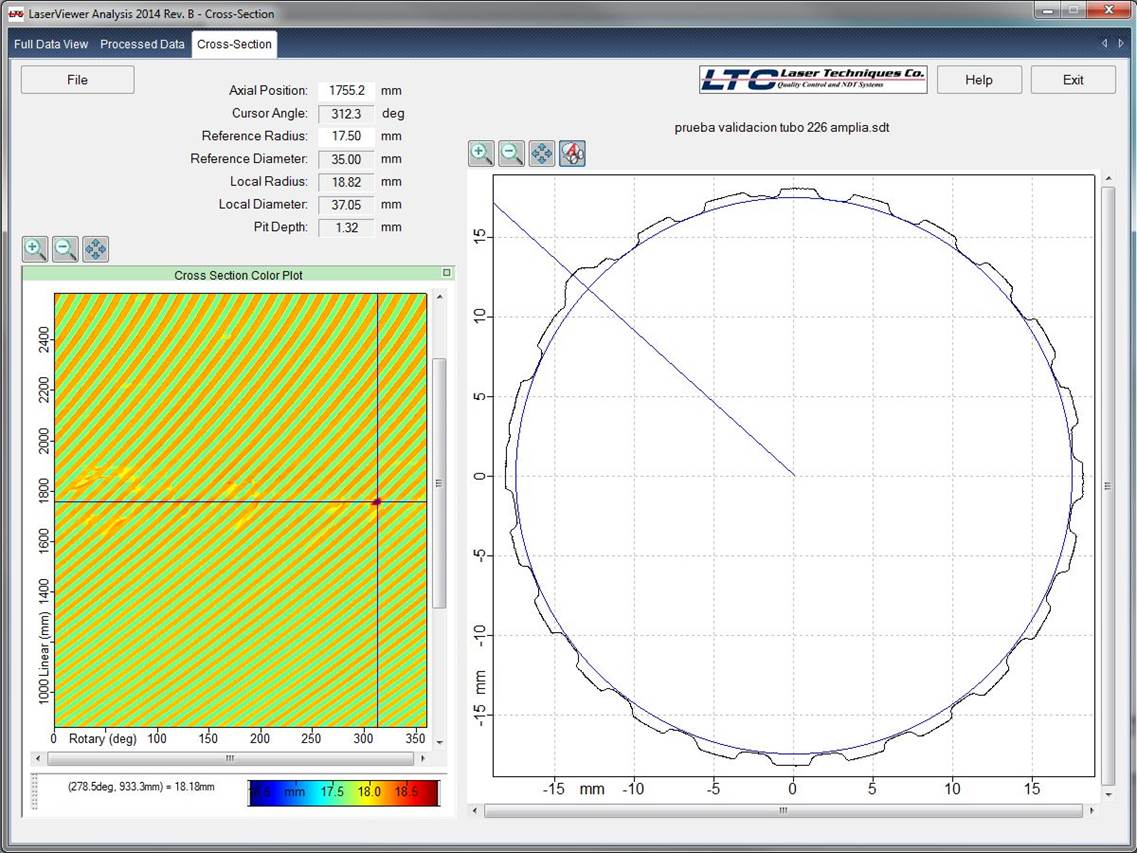
 The new device is called the BEMIS-SC™ (for Barrel Inspection Machine Small Caliber). Operated by Chesapeake Testing and Laser Techniques Company (LTC), BEMIS-SC performs non-destructive laser-based mapping of gun bores. The BEMIS-SC currently works with .22 caliber to .50 caliber (5.56 – 12.7 mm) barrels. The BEMIS captures thousands of highly accurate data points over the full length of a barrel. The inspection can be completed in mere minutes, with scan results displayed in graphical, tabular, and 3D visual formats. Here is a barrel cross-section, as scanned by the BEMIS-SC: The new device is called the BEMIS-SC™ (for Barrel Inspection Machine Small Caliber). Operated by Chesapeake Testing and Laser Techniques Company (LTC), BEMIS-SC performs non-destructive laser-based mapping of gun bores. The BEMIS-SC currently works with .22 caliber to .50 caliber (5.56 – 12.7 mm) barrels. The BEMIS captures thousands of highly accurate data points over the full length of a barrel. The inspection can be completed in mere minutes, with scan results displayed in graphical, tabular, and 3D visual formats. Here is a barrel cross-section, as scanned by the BEMIS-SC:
Click for Full-Screen Version

Until the 1980s, gun tube inspection had to be conducted by hand using a manual “star” gauge, a process that would take hours and provide minimal data. Electronic gauges were eventually developed along with the video bore scope, but these systems were still limited to very few, low-resolution data points. That has all changed with the BEMIS™, a huge leap forward in technology that is capable of rapidly capturing thousands of precise data points.
BEMIS-SC (Small Caliber) Barrel Inspection Machines

Chesapeake Testing commenced BEMIS-SC barrel inspection services in September 2014. Testing is performed in Chesapeake’s commercial barrel inspection laboratory, located in Belcamp, MD, minutes from the U.S. Army Aberdeen Proving Ground. While testing is currently limited to .22 to .50 caliber barrels, Chesapeake Testing will accommodate both smaller and larger calibers in the future.
“We have always focused on building our company around very unique technologies. BEMIS™ has changed the industry in regards to the inspection of weapon systems. We are excited to be an exclusive partner with LTC in this industry and look forward to contributing to the future of this technology,” says Jim Foulk, founder and president of Chesapeake Testing.
|