OpticsPlanet.com has a vast selection of riflescopes, spotting scopes, binoculars, red dot sights, and rangefinders. But OpticsPlanet sells much more than just optics. You’ll also find compasses, knives, flashlights, sunglasses, even hunting boots and outdoor clothing. And now you can get $35.00 off with any order of $300.00 or more. What’s more, OpticsPlanet provides FREE UPS Ground shipping to the contiguous 48 states on most orders over $29.95. To save on your OpticsPlanet.com order, use Coupon Code 69B8A7F during online check-out. (Some restrictions apply).
Steiner Binoculars Offer Good Value While you’re shopping Optics Planet, check out the Steiner Military Marine 8×30 Binoculars ($249.00) and 7×50 Marine Binoculars ($324.99). This Editor has used these binoculars on hunts and hikes, and they offer excellent performance for the price. Steiner binoculars, with their wide porro-prism design, may seem old-fashioned, but don’t let that put you off. At SHOT Show an executive of a competing optics maker told us: “The porro-prism offers great field of view and depth of field at 7-8X power. You can produce a better optic at a lower price with this porro-prism design. However, we don’t use the porro-prism in our binoculars because we think consumers prefer the narrow styling of roof prism [straight lens body] designs.”
If styling were not a controlling factor, you’d see more porro-prism binoculars. Experts says that porro-prism binoculars will produce a brighter image than roof-prism binoculars of the same magnification, objective size, and optical quality, because the roof-prism design employs silvered surfaces that reduce light transmission by 12% to 15%. Roof-prisms designs also require tighter alignment tolerances for their optical elements (collimation). This adds to their expense since the design requires the use of fixed elements that need to be set at a high degree of collimation at the factory.
Discount Code Tip from EdLongrange. We welcome reader submissions.
Leupold is now offering Custom Dial System (CDS®) elevation turrets in more models of VX-3 and VX-3L riflescopes. These CDS turrets have a dial calibrated for load ballistics supplied by the scope owner, with markings that correspond to range yardages. So, instead of dialing-in a specified number of clicks from a ballistics table, you simply dial to the indicated yardage (see demo at right). For example, to hit a target at 500 yards, you simply spin the dial to the “5” mark on the turret. You can order multiple dials, set up for different loads.
New VX-3 CDS models include the 4.5-14x40mm AO, 4.5-14x40mm Side Focus, and 4.5-14x50mm Side Focus. The new VX-3L CDS model is the 4.5-14x56mm Side Focus.
How the CDS™ System Works The CDS System works by laser-inscribing your scope’s elevation dial to match your load, velocity and conditions. Each CDS dial is custom-calibrated based on key ballistic factors: Caliber, Bullet Weight, Bullet Type, Ballistic Coefficient, Muzzle Velocity, Average Elevation, and Average Temperature.
With CDS turrets mounted on a VX-3/VX-3L scope, you can quickly get on target by dialing the elevation to different ranges with a custom adjustment matched to your rifle- and load-specific ballistics. Leupold CDS riflescopes comes with standard ¼-MOA click adjustment dials. VX-3 CDS models include a coupon redeemable for one FREE custom-engraved CDS dial. Additional dials may be purchased for $59.99 each. All you need to swap between dials is a small screw-driver to work a simple set-screw. One-Revolution stops are available for custom dials.
Pat Mundy, communications manager for Leupold & Stevens, Inc., explained, “When you purchase a CDS riflescope, contact us with your ballistic data and shipping information, then we’ll send you a dial custom built to match the caliber and load you are using. It’s as simple as that. There are no adjustment covers to lose and the CDS makes your VX-3 even more accurate and rugged.”
Excellent ballistics apps have been available for iPhones and Android phones for quite some time. Well, Windows-phone users can now join the party. Ballistica, a $5.99 software App for WP7-OS smartphones (ver. 7.5+), is now on the market. Ballistica has all the features you’d expect from a modern ballistics solver. To get a solution, first enter your bullet info, MV, and BC (either G1 or G7). Then input the target distance, up/down angle, temp, altitude, barometric pressure, wind speed and wind angle. The program will create a drop chart with values of your choosing (MOA clicks or Mils). Conveniently, you can save Ballistic Profiles for particular loads (bullet/velocity combinations). CLICK HERE for Ballistica USER MANUAL (PDF file).
The user interface for Ballistica is simple and straightforward, with five primary screens:
Projectile Page: Enter data on bullet of choice: Caliber, Weight, Sight Height, BC (G1 or G7). Conditions Page: Set ambient conditions such as altitude, humidity, and wind direction/velocity. Target Page: Set target distance, target speed, and up/down line of sight angle. Chart Page: Shows POI drop chart with distance intervals you select. Mil- or MOA-segmented clicks. Quick Shot Page: This provides a fast firing solution at one distance. You can change variables as conditions change.
Video Review of Ballistics for Windows Phones
If you have a Windows-OS smart phone, Ballistica is definitely worth checking out. A FREE trial version is available. The trial version lets you access most of the features, however, you won’t be able to save profiles. You can download Ballistica from the Windows Phone Marketplace. You’ll find a “Try for Free” link for the free version right below the purchase link. You can also download a FREE USER Manual for Ballistica. NOTE: Ballistica requires Windows Phone ver. 7.5 or higher.
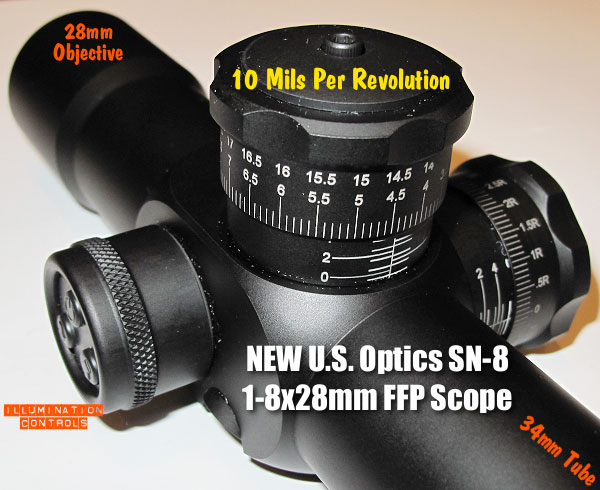
Background: Last year, when Leupold introduced its 1.1-8x24mm FFP Mark 8 CQBSS scope at a whopping $3,999.00 price, jaws dropped in the shooting world. Folks rightly wondered whether anyone (other than Uncle Sam) would pay four grand for a small, compact scope, even if it did offer a broad magnification range and other innovative features.
U.S. Optics SN-8 Is Thousands Cheaper than Mark 8
Well U.S. Optics has just undercut Leupold by a couple thousand dollars, providing a much more affordable 1-8X option for tactical shooters and 3-gunners. If you were thinking about the Mark 8, you better take a close look at the new 1-8x28mm SN-8 from U.S. Optics. From what we can see, the SN-8 performs on a par with the Mark 8, plus it features a true 1X magnification on the low end — which is best for fast, both-eyes-open target engagement. The new SN-8 is offered in two models. The 1-8x28mm SN-8 Standard version retails for $1945.00, while the higher-end version with Red Dot-equipped eyepiece runs $2445.00, still substantially under the cost of Leupold’s Mark 8. These new SN-8s should start shipping in June, 2012.
New “Slim-Line” Hunting Scopes from U.S. Optics
For 2012, U.S. Optics is bringing out a series of compact, light-weight “Slim-Line” hunting optics: 1.5-6X, 1-4X, and 3.2-17X. Though they offer a significant weight-savings over typical hunting scopes, these new Slim-Line hunting scopes are built for hard use, and U.S. Optics backs them with an impressive, transferrable, “full lifetime” warranty. Prices start at $1100.00 and the Slim-Line Hunting scopes should hit the market in late March or April, 2012. We like what U.S. Optics is doing with this “Slim-Line” scope series. For daylight deer and varmint hunting, many hunters are better served with a compact 1.5-6X variable, than with a large, bulky high-power scope with a relatively small field of view.
At SHOT Show, in addition to its all-new SN-8, U.S. Optics also showcased its innovative dual-focal-plane tactical scopes. Offered in 1-4X and 1.5-6X, these offer the best of both worlds. The FFP reticle allows consistent ranging at all magnifications, while the Second Focal Plane functionality allows more precise aiming, since reticle line thickness does not increase as the magnification goes up.
Show Report by Jason Baney
Nearly every major optics manufacturer showcased innovative new products at this year’s SHOT Show. And some of the scope-makers surprised us by venturing into new product areas. For example, Vortex came out with a nice, compact Laser Rangefinder, and Sightron released a 1-7×24 hunting/tactical scope. Here are new product highlights from Kahles, Meopta, Schmidt & Bender, Sightron, and Vortex.
Kahles
New Tactical Scope with Parallax Control On Elevation Turret
Kahles has brought out a beefy 34mm-tubed tactical scope with some smart features. The parallax adjustment on Kahles’s new 6-24x56mm scope is located at the base of the elevation turret — not on the side like an Nightforce NXS. It may seem odd to put the parallax control BELOW the elevation adjustment, but when you think about it — this is pretty clever. Locating the parallax below the elevation is very convenient — when you dial for longer range, you can quickly dial the new parallax without changing your hand position, or fiddling around for a second turret. Putting the parallax control on the central turret allows the illumination rheostat to be placed on the left side of the tube. This allows much more scope-mounting freedom — you don’t have a big illumination module positioned next to the rear ring, limiting how far forward you can position the scope.
Initially the Kahles 6-24×56 will be offered with just two (2) reticles. We would like to see a wider zoom range, but overall, this is a very well-thought-out scope. Kahles is also offering a 1-6 with nicely designed reticles.The 6-24×56 is expected to cost about $3000 while the 1-6 should be priced around $2700. Both scopes should be on dealers’s shelves by summer 2012.
Meopta
All-New 82mm Spotting Scope and iPhone Adapter
Meopta has totally redesigned its top-end spotting scope to keep up with current market trends. But we’re pleased that Meopta has maintained a more moderate price-point than most in this class of 80mm spotters. The new spotter has a 82mm objective, solid rubber armor and is available straight or angled. Two eyepiece options are offered: a 30-60X Wide-Angle and a 20-70X standard eyepiece. Meopta’s new 82mm spotter should be available in March 2012, priced at about $2200 for a complete spotter with eyepiece. Meopta has also introduced a handy adapter to allow iPhone users to take pictures through the spotter. This adapter retails for $50.00.
Schmidt & Bender
New PMIIs — at Higher Prices
Schmidt & Bender had a few new scopes on display, most notably, a redesigned (and still unavailable) 3-20×50 PMII as well as S&B’s 1-8x PMII. The most obvious difference on the revised 3-20 was the updated locking turret that is different, and much better than it was 2 years ago. Street price on the PMII scopes will be in the $3500-$4000 range depending on reticle choice. We also noted the very aggressive tactile fins on the magnification adjustment dial. Also shown was a prototype compact, tan 1.5-6x20mm straight tube dot scope. Based on S&B’s track record, this 1.5-6X might actually make it to North American dealers in 2014.
Sightron
New Compact 1-7X Variable
Sightron unveiled a new 1-7×24 scope, which should please hunters and 3-Gun shooters. The new 1-7×24 is only offered with one reticle currently; this appears similar to the Meopta 4C red dot reticle. The reticle features an illuminated red dot in the middle, with a thinner upper post and thicker left, right and bottom posts. The scope features 0.1 MRAD clicks and 5 mils per turn with covered low profile target turrets. We hope to see an improved reticle with holdover stadia for longer range shooting in the future. The 1-7×24 will retail for $799.00 and should be at dealers by the end of March, 2012.
Vortex
New Compact Rangefinder with Angle Correction
Vortex introduced a very cool little laser rangefinder at a nice price point. The Ranger 1000 is rated for 1000 yards, has a great feel, great size, pleasant red-cross aim point display, and unlike any other similar laser products out there, offers a LIFETIME warranty. Along with all these features, it also gives angle-corrected readings for shooting more accurately uphill and downhill. The Ranger 1000 is very easy to operate one-handed and has a nice rubber coating and removable pocket clip as well. Retail price will come in at $379 with availability in May 2012.
For months now, we’ve heard rumors of an all-new, high-magnification Nightforce scope, to be introduced in 2012. Unfortunately, Nightforce had no new “super-scope” on display at SHOT 2012, but Nightforce reps did indicate that “important announcements will be forthcoming in a few months”. Possibly we will see the new model(s) at the NRA Annual meeting, but that’s not definite. The only thing we can tell you — and this is NOT official — is that more magnification may be on tap on the high-end, giving Nightforce something to compete with the latest high-magnification competition scopes from other optics-makers.
We were pleased to see that Nightforce is offering an enhanced MOA-marked reticle with 1 MOA stadia (hash marks), and a center floating “X” that is 2 MOA high and 2 MOA wide. This new “MOAR” reticle should be a good choice for long-range shooters who prefer to hold off for windage corrections, rather than dial windage turrets. By comparison, the popular NP-R1 has 1 MOA marks on the elevation bar and 2 MOA marks on the windage bar. With the MOAR you get 1 MOA stadia (dividers) on the horizontal line as well. This should help shooters make more precise wind holds. NOTE: Initially the MOAR reticle will only be available for new NXS 3.5-15, 5.5-22, and 8-32X models (MOAR will NOT be offered in current Benchrest Models). ETA for the first MOAR-equipped NXS scopes is June, 2012.
In the video above, a Nightforce spokesman covers the function of the New Nightforce Velocity Reticle Calculator. This interactive program helps Nightforce scope owners select the particular velocity reticle (from a series of eight available) which best matches the ballistics of their particular rifle and load. Once you input the bullet velocity and BC data for your load, the calculator selects one of the eight velocity reticle options. This gives the scope owner a reticle with vertical hold-over points that closely match the actual trajectory of his ammunition.
Nightforce Adds Workers and Expands Production Facilities
In other Nightforce news, Nightforce Marketing Director Kyle Brown announced that Nightforce is beefing up its workforce and expanding its production facilities. With Nightforce scopes being in such high demand, there have been extended delivery times for some of the most popular Nightforce models. With more assemblers and a larger assembly plant, Nightforce hopes to keep up with growing demand for its products. We commend Nightforce for committing added resources to scope production. This will certainly benefit scope buyers by increasing “on-the-shelf” inventory at Nightforce stocking dealers.
Here’s a great offer for members of the Creedmoor Sports Internet Buyers’ Club. For the next three days, January 20-22 (Friday, Saturday, and Sunday), Creedmoor Sports will provide a FREE set of Simmons 10×25 ProSport Binoculars to any Buyers’ Cub members who order at least $150.00 worth of merchandise through Creedmoor’s online store.
Here’s how it works — Go to the Creedmoor Sports Home Page, and enter your email address. This signs you up for Creedmoor’s Internet Buyers’ Club. Then you should get an email with a Coupon Code entitling you to the FREE Binoculars when you place an online order of $150.00 or more. NOTE: Only registered Creedmoor Buyers’ Club members can use the coupon code for the FREE binoculars. Binocular offer valid January 20-22, 2012. Limit one per order. Not valid on previous purchases.
While we were somewhat disappointed that we didn’t see many all-new precision rifles at Media Day 2012, there were plenty of new riflescopes on display. Among the most impressive new optics were rugged new high-zoom-range, First Focal Plane (FFP) tactical scopes from Hensoldt (Carl Zeiss), Leupold and Trijicon. These new scopes all featured fat tubes, compact overall length, and abundant elevation travel. These lastest top-end FFP tactical scopes offer as much as 26-power in a form factor not much bigger than a “normal” 4-16X scope.
New 3.5-26x50mm Hensoldt Was Outstanding
Hensoldt showcased a very impressive, prototype 3.5-26x56mm FFP tactical scope. Though this scope offers a whopping 7.4X zoom range and 26-power on top, this new Hensold is relatively compact. The reticle in these prototype versions was a very useful (and simple) milradian-based reticle that we hope Hensoldt retains in the production versions. The Hensoldt boasted an impressive 36 Mils of total elevation travel in two (2) turns of the turret. The new Hensoldt still shares the same superior glass and compact size that puts these scopes at the top of their class. We tested a prototype mounted to an Accuracy International AX 338. Expect the production version to be the same size and cost approximately $4000.00.
As you can see in the video, the new Hensoldt coupled with the new Accuracy Int’l AX in 338 Lapua Magnum worked very effectively at 900 meters in some tricky winds. This combination made it fairly easy to break clay pigeons on the bank at 900 meters. Off camera this combination continued to show great accuracy and very effective design features.
New Leupold MK-8
Leupold showed off a brand new MK-8 3.5-25x56mm with a Horus reticle and a beefy main tube. Again, this featured a lot of elevation in one turn as well as a pinch-and-turn locking turrets. This is a big leap forward for Leupold and we feel this will be well-received in the tactical world. Along with the new MK8, we also sampled Leupold’s new MK6 3-18x50mm. This shared similar features as the 3.5-25, and was incredibly compact as well. We expect the MK8 to sell near $4000 and the MK6 to be substantially less, likely under $3000 according to company reps.
Trijicon made a departure from their standard fare and jumped into the tactical scope world with a beefy Front-Focal Plane 3-15x50mm. This featured a well-executed MOA-based reticle and turrets with 30 MOA per turn (a Milrad version offers 10 Mils per turn). The Trijicon showcased the “short and fat” appearance that seems to be the latest design trend in tactical scopes. But though the Trijicon had a fairly short OAL (for its zoom range), it was still quite heavy at 47 ounces. The glass in this prototype version was disappointing for a scope that will retail in the $4K range. Reps told us the production version glass would be much improved. (It had better be, if Trijicon hopes to play in this stratospheric price range.)
It was apparent at Media Day 2012 that scope companies have worked hard to provide more features and more performance in their high-end tactical scopes. Consequently, the latest generation of scopes offer some very interesting and useful innovations — wider zoom range, more compact size, more elevation travel per rotation, and “goof-proof” turret mechanisms. We can only hope that, with more competition in this market, prices may become more reasonable. $4000 is an awful lot of money to pay for a scope.
Bushnell Outdoor Products has expanded its “Bulletproof Guarantee” to include several lines of binoculars, riflescopes and spotting scopes and its entire line of hunting laser rangefinders. This now provides a “no-risk”, one-year, money-back guarantee for these Bushnell products.
Originally introduced with the Legend Ultra HD binocular product line in 2011, Bushnell’s “Bulletproof Guarantee” provides that if customers were not completely satisfied with the product, the company would buy it back, no questions asked, for up to one year from the original date of purchase.
For 2012, Bushnell’s Bulletproof Guarantee now covers the Elite, Excursion EX, Legacy WP, Legend Ultra HD and Trophy XLT families of binoculars; Elite, Legend Ultra HD and Trophy XLT families of riflescopes and spotting scopes; and all hunting laser rangefinders.
Additional Limited Lifetime Warranty on Many Products
In addition to the “Bulletproof Guarantee”, the majority of Bushnell sports optics products are covered by a Limited Lifetime Warranty. Bushnell guarantees those products to be free of defects in materials and workmanship for the lifetime of the original owner. Exceptions to this Limited Lifetime Warranty, mostly electronic products and red-dot type optics, are listed on the Bushnell Warranty Page.
To learn more about Bushnell Outdoor Products and its complete line of sports optics and outdoor technology, visit www.Bushnell.com or call 1-800-423-3537.
Zeiss Sports Optics has introduced a new “Duralyt” line of affordable hunting scopes — all made in Germany. The new 30mm CONQUEST Duralyt line-up has 1.2-5×36, 2-8×42 and 3-12×50 models. All three premium German-made Duralyt riflescopes are available with illuminated reticle #60 or non-illuminated reticle #6. The illuminated versions are great for low-light hunting, but they are much more costly. Illuminated model MSRPs run $200-$300 more than the unlit versions.
The CONQUEST Duralyt scopes are nitrogen-filled to remain waterproof and fog-proof. The illuminated reticle #60 features an extremely fine red dot in the center of the crosshairs. When turned off, the dot disappears and it looks identical to reticle #6). The daylight-visible illuminated reticle #60 was developed using fiber optic nanotechnology that produces the finest illuminated dot in its class –- covering just 0.3 inches at 100 yards on 12x magnification.
Duralyt prices, starting at $949.99 MSRP, are affordable when compared to other premium 30mm, European-made optics. Michael Jensen, President of Carl Zeiss Sports Optics, states: “The CONQUEST Duralyt represents the best value for a European-engineered riflescope. These riflescopes feature the mechanical precision that you expect from ZEISS, large fields of view, incredible daylight illumination and image quality that is absolutely outstanding for this class.”
Conquest Duralyt 1.2-5x36mm #60
wide field of view for dangerous game and tactical applications. $949.99 MSRP; $1,249.99 with illum.
Conquest Duralyt 2-8x42mm #6
Light, compact, best magnification choice for most hunting. $999.99 MSRP, $1299.99 with illum.
Conquest Duralyt 3-12x50mm, #60
50mm objec. for xlnt low light performance. $1049.99 MSRP; $1,349.99 with illum.


 While you’re shopping Optics Planet, check out the Steiner Military Marine 8×30 Binoculars ($249.00) and 7×50 Marine Binoculars ($324.99). This Editor has used these binoculars on hunts and hikes, and they offer excellent performance for the price. Steiner binoculars, with their wide porro-prism design, may seem old-fashioned, but don’t let that put you off. At SHOT Show an executive of a competing optics maker told us: “The porro-prism offers great field of view and depth of field at 7-8X power. You can produce a better optic at a lower price with this porro-prism design. However, we don’t use the porro-prism in our binoculars because we think consumers prefer the narrow styling of roof prism [straight lens body] designs.”

 With CDS turrets mounted on a VX-3/VX-3L scope, you can quickly get on target by dialing the elevation to different ranges with a custom adjustment matched to your rifle- and load-specific ballistics. Leupold CDS riflescopes comes with standard ¼-MOA click adjustment dials. VX-3 CDS models include a coupon redeemable for one FREE custom-engraved CDS dial. Additional dials may be purchased for $59.99 each. All you need to swap between dials is a small screw-driver to work a simple set-screw. One-Revolution stops are available for custom dials.
 Excellent ballistics apps have been available for iPhones and Android phones for quite some time. Well, Windows-phone users can now join the party.



 For months now, we’ve heard rumors of an all-new, high-magnification Nightforce scope, to be introduced in 2012. Unfortunately, Nightforce had no new “super-scope” on display at SHOT 2012, but Nightforce reps did indicate that “important announcements will be forthcoming in a few months”. Possibly we will see the new model(s) at the NRA Annual meeting, but that’s not definite. The only thing we can tell you — and this is NOT official — is that more magnification may be on tap on the high-end, giving Nightforce something to compete with the latest high-magnification competition scopes from other optics-makers.


 Trijicon made a departure from their standard fare and jumped into the tactical scope world with a beefy Front-Focal Plane 3-15x50mm. This featured a well-executed MOA-based reticle and turrets with 30 MOA per turn (a Milrad version offers 10 Mils per turn). The Trijicon showcased the “short and fat” appearance that seems to be the latest design trend in tactical scopes. But though the Trijicon had a fairly short OAL (for its zoom range), it was still quite heavy at 47 ounces. The glass in this prototype version was disappointing for a scope that will retail in the $4K range. Reps told us the production version glass would be much improved. (It had better be, if Trijicon hopes to play in this stratospheric price range.)


