Here’s a simple procedure that lets you get a solid zero for a hunting rifle in just four shots. Of course you probably want to fire a few more rounds to confirm your zero before you head off to your hunting grounds, but this will let you get on-target with a minimum amount of time and ammo expended. (This assumes your scope is securely mounted, and the bases are not drastically out of alignment.)
1. First, remove the bolt and boresight the rifle. Adjust the position of the rifle so that, looking through the bore, you can see the center of the target with your eyes. Secure the rifle in the rests to maintain its position as boresighted. Then, without moving the rifle, center the reticle. That should get you on paper. With the rifle solidly secured in front and rear rests or sandbags, aim at the center of a target placed at your zeroing distance (50 or 100 yards). Confirm there are no obstructions in the barrel! Then load and fire one shot. Then, return the gun to the exact position it was when you pulled the trigger, with the cross-hair centered on the target as before.
2. Locate, in the scope, where your first bullet landed on the target. Now, while you grip the rifle firmly so it doesn’t move, have a friend adjust the turrets on your scope. While you look through the scope, have your friend turn the windage and elevation turrets until the cross-hairs, as viewed through the scope, bisect the first bullet hole on the target. In other words, you use the turrets to move the center of the reticle to the actual position of shot number one. Dial the crosshairs to the hole — don’t move the rifle.
3. After you’ve adjusted the turrets, now re-aim the rifle so the cross-hairs are, once again, positioned on the target center. Keep the rifle firmly supported by your rest or sandbag. Take the second shot. You should find that the bullet now strikes in the center of the target.
4. Take a third shot with the cross-hairs aligned in the center of the target to confirm your zero. Make minor modifications to the windage and elevation as necessary.
5. Now shoot the rifle from a field rest (shooting sticks, bipod, or rucksack) as you would use when actually hunting. Confirm that your zero is unchanged. You may need to make slight adjustments. Some rifles, particularly those with flexy fore-arms, exhibit a different POI (point of impact) when fired from a bipod or ruck vs. a sandbag rest.
If you recently cleaned your rifle, you may want to fire two or three fouling shots before you start this procedure. But keep in mind that you want to duplicate the typical cold bore conditions that you’ll experience during the hunt. If you set your zero after three fouling shots, then make sure the bore is in a similar condition when you actually go out hunting.
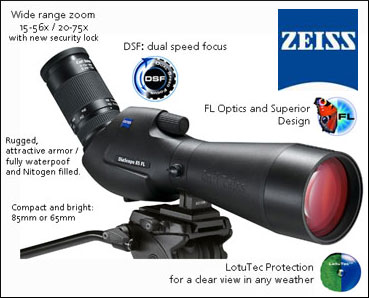
The new Zeiss Victory DiaScope 85mm spotting scope from Carl Zeiss has won Field & Stream magazine’s prestigious Best of the Best Award for 2010. This annual awards program recognizes the most innovative and best-designed products in the hunting industry. In the September issue of Field & Stream, the magazine’s reviewer wrote: “The DiaScope is superior in sharpness, focus, zoom and armored construction. When I tested for waterproofness, it floated. I could judge buck antelope miles away with it on a cloudy day. The cost can be made up in saved boot leather. – T.M.”
Zeiss 85mm Diascope Also Earned Outdoor Life and Hunting Magazine Honors
This marks the third major industry award for the ZEISS DiaScope this year. The 85mm DiaScope also won the 2010 Outdoor Life Editor’s Choice Award and Petersen’s Hunting magazine’s Editor’s Choice Award. The DiaScope is available in 65mm or 85mm models, straight or angled, and newly-designed eyepieces include the Vario D 20-75X, one of the most powerful and versatile eyepieces on the market today. All DiaScope eyepieces boast Zeiss’ LotuTec® water-repellant coating and a new bayonet locking system that securely locks the eyepieces yet still allows quick eyepiece changing.
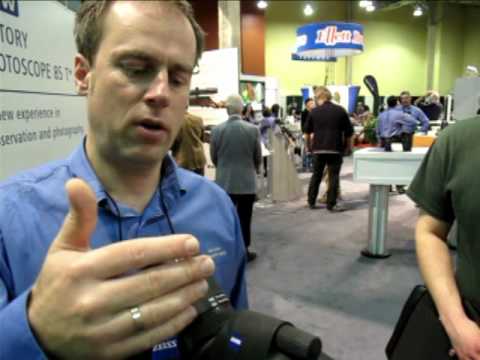
At the 2010 SHOT Show, this Editor had a chance to interview Stephan Albrecht, Project Engineer for the impressive new 85mm Diascope. In the video below, Stephan explains the important new features of the award-winning spotting scope, including the dual-speed focus system and the new, high-power 20-75X eyepiece.
Leupold’s Mark 4 Tactical Spotting Scope is now the standard Scout Sniper Observation Telescope (SSOT) of the U.S. Marine Corps, the first new spotting scope the Corps has used in decades. Leupold’s compact MK4 variable-power spotter replaces the fixed 20X M49 spotting scope fielded by the Marines since World War II. The Mark 4 Tactical spotter was also selected by the U.S. Army for use with its XM110 Semi-Auto Sniper System (SASS). This same Mark 4 spotting scope, with either Mil-dot or Horus reticles, is available for civilian purchase.
Only 12.4 inches long, the MK4 spotting scope is extremely compact for its magnification level. Though it weighs just 37 ounces, it boasts a rugged, armored magnesium body that is nitrogen charged and 100% waterproof. Other good features of the MK4 include generous eye relief, multi-coated lenses, and rubber fold-down eyecups. A front focal plane (FFP) reticle magnifies the reticle along with the image, so users can estimate range at any power setting using the Mil Dot or Tactical Milling Reticle. CLICK HERE for full MK4 Spotting Scope Specs.
Folded Light Path Design Yields High Power in Small Package
By “folding” the entering light in a ‘Z’-path, the Newtonian-reflector design achieves high magnification in a very compact optic that is easy to pack and carry. Leupold’s efficient Folded Light Path (FLP) lens and mirror optical system allow the Mark 4 to deliver the effective optical path of a scope twice its length. We have also found that, compared to conventional spotting scopes, the Leupold spotter is more stable in windy conditions because it has much less overhang and a smaller cross-section than conventional designs. The folded-path Newtonian design makes perfect sense for spotting scopes that need to be carried in the field. A similar folded-light-path design is used in the superb, $5000.00 Zeiss Optronics 20-60x72mm Tactical Spotting Scope.
Leupold Now Offers Horus Reticle Options in MK4 Spotting Scopes
While the Marines use the MK4 Spotting scope with a conventional Mil Dot reticle, Leupold now offers Horus H32 and H36 ranging reticles as options. The H32 has a mil line for target measurement and speed estimation, while the H36 features an inverted “L” in Inch Of Angle (IOA) for easy ranging. The Mil Dot reticle matches those found in military riflescopes, allowing a spotter to quickly range a target, while viewing the same sight picture as the shooter. The Horus H32 and H36 provide a more complex grid that allows range estimation, target speed calculation, and 2nd-shot-correction.
To learn about more about the sophisticated Horus reticles, visit HorusVision.com.
Leupold has launched a dedicated website to educate hunters and shooters about the Custom Dial System (CDS™) feature for VX-3® riflescopes. The innovative CDS system is darn clever. Basically what Leupold has done is create calibrated elevation knobs that allow hunters and varminters to simply dial the yardage to their targets, rather than input a specific number of clicks. For example, to shoot a buck at 300 yards, you simply rotate the elevation turret to “3” on the scale. CDS helps hunters and shooters get on target at any range, with any load, by matching their scopes to the ballistics of their ammunition.
Leupold’s CDS system is a user-friendly invention that can really simplify shooting at multiple yardages. The big single-digit Arabic numerals on the elevation dial correspond to 100-yard intervals, while the smaller numbers show 50-yard intervals. (Click values are otherwise 1/4-MOA.) No longer do you have to remember specific come-ups for particular distances. For the CDS system to work correctly however, your load’s ballistics must match a set of master loads that Leupold uses to calibrate the dial scales. Hunters using most common cartridges should find a calibrated load that matches their muzzle velocity and bullet BC. CDS turrets are available on these scopes: VX-3 3.5-10x40mm, VX-3 3.5-10x50mm, VX-3 4.5-14x40mm, VX-3L 3.5-10x50mm and VX-3L 4.5-14x50mm.
Free CDS Calibrated Dials with Purchase of VX-3 Scopes
Leupold’s CDS system is explained at www.leupold.com/VX-3CDS. Visitors to the VX-3 CDS webpage will find an educational video and graphics, an overview of how the system works and its advantages, and details on a special offer. With the purchase of any VX-3 CDS riflescope, shooters receive two customized, ballistically-matched adjustment dials ($100 retail value) at no extra cost. This offer ends December 31, 2010. Click the image below to learn more (turn down your speakers before clicking as a loud video will auto-play).
The new Zeiss Victory DiaScope 85mm T* FL spotting scope from Carl Zeiss has been named Editor’s Choice by Petersen’s Hunting magazine. The 2010 Spotting Scope Review, featured in the magazine’s September issue, compared spotting scopes from many manufacturers and the new ZEISS DiaScope, with its revolutionary Dual Speed Focus (DSF) system, came out on top. Petersen’s editors wrote: “The innovative Dual Speed Focus (DSF) system is something you almost have to try to believe. It automatically transfers from macro-adjustment to fine-tuning like no other scope. This is our pick of the litter, price be damned. $2,999.00.”
straight or angled bodies both boasting a rubber-armored exterior for protection. Eyepieces are available as variable 20-60x, 20-75x, or fixed 40x. A 65mm version of the new Diascope is also available, but we feel that, if you’re going to spend this kind of money ($3000.00 for 85mm with 20-60X eyepiece), you should go with the 85mm. The 20-75X eyepiece only delivers 15-56X when used with the smaller 65mm Diascope.
New DiaScope Wins Other Awards
The new Zeiss Victory DiaScope 85 T* FL Spotting Scope has earned two other prestigious awards. First the new 85mm DiaScope won the coveted Red Dot Design Award. “All products honored with the red dot design award had to impress an international jury. These products [must] demonstrate their quality in one of the toughest design competitions in the world,” says Professor Dr. Peter Zec, speaking on behalf of Design Zentrum Nordrhein Westfalen which issues the Red Dot Design Awards.
At the NRA Annual Meeting on May 14, the Zeiss 85mm DiaScope was named an “Editor’s Choice” by Outdoor Life Magazine. Outdoor Life’s editors praised its “optically superior [flourite] glass in a surprisingly lightweight chassis”. The ZEISS DiaScope won the low-light test, had a top resolution score and “the two-speed focus and wide-angle eyepiece sparkled”, according to the test team.
To compete with the vaunted Leica Geovids, Steiner Optik has released its new 10×50 porro-prism binoculars equipped with a built-in Laser Rangefinder. Steiner’s new model 398 10×50 LRF Military Rangefinder Binoculars feature a handy two-button interface and a powerful Class 1 laser rangefinder with claimed maximum ranging distance of 1,600 yards. That meets or beats the range of any other commercial laser rangefinder on the market. Beam divergence on the Steiner LRF binocular is impressively narrow. This allows ranging at very long distances. Steiner claims: “With sunshine and good visibility, the unit’s accuracy is within one yard at ranges up to 380 yards, within two yards to 763 yards, and within approximately 0.5% to 1,600 yards.”
Yes, There is a Mounting Slot for Tripods and Monopods
We were pleased to see that Steiner’s LRF binoculars incorporate a 1/4-20 tripod adapter mount. We think all “serious” laser rangefinders should have mounts for tripods and/or monopods. You simply can’t make use of the full ranging capability of these devices unless you can hold them rock steady when aiming at far-away objects. Steiner’s “easy-on” two-button control also helps you aim precisely. With some LRFs, such as the Swarovski LaserGuide, you must press down quite hard to activate the “on button”. This can upset your aim.
New LRF Binoculars are Built Tough Inside and Out
The new Steiner LRF binoculars are built to withstand tough use, even though, at 46 ounces, they are still fairly lightweight. The chassis is made with Makrolon®, a fiber-reinforced polycarbonate material that is very impact resistant. The exterior is fully armored with Nitrile Butadiene Rubber (NBR) for protection. The interior is pressurized with dry nitrogen fill and is waterproof to 16 feet. All alloy components are anodized, and external metal parts are enamel-finished to prevent corrosion.
Lowest Web Price is Under $2100.00
Though Steiner’s 10×50 LRF binos have “Military” in the product name, this unit can be purchased by the public. Current “street price” at most online optics dealers is $2,499.00. However a few dealers are now undercutting MAP pricing, so if you shop around, you may find the model 398 Steiner 10×50 Military LRF binoculars for under $2,100.00. DigitalFoto.com is listing the unit at $2079.48. For comparison, DigitalFoto.com sells the 8×56 Leica Geovid rangefinder binoculars for $2699.00.
Valdada 36X Scope, First Report: Benchrest shooter and noted gun writer James Mock recently tested Valdada’s new 36X Benchrest scope on his PPC. Valdada scopes are made by IOR (Industry Optic Romania) in Bucharest, Romania. James was impressed with the scope — and it certainly didn’t hurt his performance any. With the Valdada on top of his PPC, James nailed a 0.150″ three-shot group at 200 yards during testing earlier this week. Below you’ll find Mock’s first impressions of the Valdada 36X, along with photos of the scope mounted on his rifle. James — Thanks for sharing this!
NEW Valdada 36X Benchrest Scope by James Mock
Yesterday, I received one of Valdada’s new 36X BR scopes for testing. My initial tests proved that Valdada may have a winner. The scope has 7-layer coating on their German glass optics for a superb image. The 1/8th-minute clicks are positive and they repeat well. The reticle is a 1/8th MOA floating dot with 1 MOA hash marks for both windage and elevation. The scope has a very smooth worm gear parallax side adjustment that is marked in meters. Overall I am impressed with the initial testing. The suggested retail is around $1295.00, but I don’t know what the “street price” will be. Here are a couple pictures that show the scope mounted on My BAT-actioned rifle, currently fitted with a PPC barrel.
We recently had a chance to test the new Chimera Titanium Rings from TacticalRifles.net. The Chimera Rings are “ultra-premium” items designed to compete with the very best tactical rings on the market. As you’d expect, they’re expensive. The 30mm Chimera Rings retail for $224.00 per matched set, including Torx driver. Though these fat boys are beefy in size, offering 7.5 square inches of clamping area per set (way more than most rings), they are very light weight. A medium-height, 30mm Chimera ring weighs just 84 grams (2.96 ounces).
The Chimera rings are precision-machined to exacting tolerances. We had our Mark, our in-house machinist, check them out and he was very impressed: “These rings exhibit beautiful fit and finish and are extremely tough. The fit of the ring bases on a Picatinny rail is perfect. I liked the radius shapes given to most of the surfaces. The front and back faces of each ring are standard flat planes, and the ring caps have a flat disc in their centers, but the remainder of the cap and the sides of the bodies are gently curved. This design requires sophisticated machining processes to pull off, but it looks good. The larger-than-standard heads on the cap hardware, 8-32 X #25 Torx, are another departure that looks well thought out. One danger this increased head size would present if the fasteners were threading into typical 6061 aluminum bodies would be the potential to over-torque and strip the threads with the larger #25 Torx wrench. However, since the titanium bodies have approximately double the tensile strength of 6061 aluminum this is not a problem.”
Assymetrical Tensioning by Design
The Chimera Titanium Rings employ an assymetrical clamping design. This should allow the rings to provide stronger clamping force with less chance of ring distortion. Here’s how they work. After placing the scope in the lower halves of the rings, you screw down the top halves on one side only (opposite the bolt head that clamps to the Picatinny rail). After the three Torx screws are tightened fully on one side, so that the top Ring half butts firmly on the bottom half, there will still be a small gap on the opposite side of the ring (see photo). Don’t worry — that is by design. Final torque is applied to the side with the gap. With the final tensioning done on one side only, the scope is less prone to twist. Furthermore, the manufacturer claims this design puts less stress on the scope tube during mounting.
We did fit the Chimera rings to a Leupold LRT 8-25x50mm scope with 30mm tube. Fit was excellent with no high or low points. With the rings installed as instructed, with one side first clamped flush and the opposite side then torqued to spec, the scope was very secure. On removal the Chimera rings left no visible marks on the tube. I can’t say that it would be a waste of time to lap these rings, but on our Leupold scope the fit was perfect, and the “grip” was uniform over the entire clamping surface.
Tactical Precision System TSR™ Rings TSR™ rings made by Tactical Precision Systems (TPS) have a clamping design very similar to the Chimera Titanium Rings. After placing the scope in the TSR ring set, you clamp down one side (of the ring tops) until metal meets metal. This then leaves a gap of 0.020″ on the other side. The TSR Picatinny 30mm 7075 Aluminum Medium Rings cost $82 in aluminum or $94.00 in alloy steel. The TSR rings are narrower than the Chimeras, and have two Torx bolts per side, rather than the three on the Chimeras.
M3 Hinged Scope Rings from American Rifle Company
An even more radical clamping system is employed by the new, patent-pendingM3 Scope Rings from The American Rifle Company. The top section of the M3 rings is attached with a hinge on one side. After placing the scope in the bottom section of the M3 rings, you swing the upper ring half into place over the scope tube. Then the clamping is done with two inverted (head-down) machine screws that actually pull the hinged ring section downwards. This is designed to put less stress on the scope than conventional rings. The axis of the screws is tangential to the scope tube. Sophisticated finite element analysis (FEA) was used to develop the “over the top”, tangential-clamping ring design. According to the manufacturer, this design evenly distributes clamping forces over the tube and “eliminates the damaging effects of [scope] bending”. The manufacturer claims that, with its rings, “no significant stress concentrations are present on the scope tube”. American Rifle Co. backs up these claims with a series of 3D stress analyses published on its website.
Credit The Firearm Blog for reporting on the M3 ring design.
Disclosure: TacticalRifles.net loaned a pair of Chimera Titanium Rings for testing and evaluation.
In May, we reported on the new MicroSight invented by engineer (and shooter) David Crandall of the Idaho National Laboratory (INL). The MicroSight keeps both near and far objects in sharp focus, simultaneously imaging two distinct focal planes. This break-through technology allows the shooter to see a sharp image of the target and a sharp image of his iron sights at the same time.
The MicroSight is not a lens per se. Rather it is a phased Zone Plate that focuses light beams through diffraction. Zone Plates, first studied by Frenchman Augustin-Jean Fresnel in the 1800s, focus light via a set of concentric rings that alternate between transparent and opaque. The transparent sections let some light waves pass through unchanged, focusing objects that are far away (basically, at infinity). But light passing the edges of the opaque rings gets diffracted, which brings nearby objects into focus. This produces a seemingly impossible result — sharp images of distant and near objects, simultaneously.
The MicroSight is not just a laboratory experiment. Prototype versions have been crafted and placed on test rifles. INL has licensed the technology to Apollo Optical Systems which is right now working with gunsight manufacturers to adapt the MicroSight design to a variety of products. In the future, some MicroSight-equipped products might add refractive power to the Zone Plate, allowing target magnification as well as focusing.
WATCH the VIDEO below to see the MicroSight in Use and to learn how it works…
At SHOT Show in January, Nightforce revealed a new Hi-Speed option for its NXS scope line-up. This nearly doubles the MOA range for each turn of the elevation knob, giving a full 20 MOA of elevation for a single rotation. For most long-range calibers that means you can hit targets from 50 yards out past 700 yards all within a single turret rotation. That makes it far less easy to get confused with your long-range zeros.
We’ve been waiting for the “Hi-Speed” option to arrive. Well the wait is almost over — Nightforce Optics has begun taking orders for the new “Hi-Speed” ZeroStop feature for the following 5 models:
The above scope models (with hi-speed turret) will be offered with either 1/4-MOA adjustments and 20 MOA per rotation, or 1/10th Mil-Radian adjustments and 10 Mil-Radians per rotation.
Nightforce reports it “will begin shipping these new featured models -– in limited numbers –- by mid to late July, 2010. There will be a 3% price increase per respective model (excluding the NXS1550 F1).”


 Leupold’s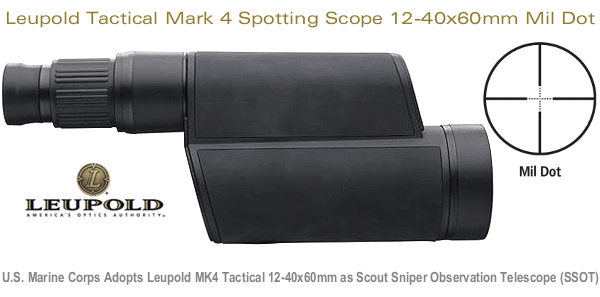


 Leupold’s CDS system is a user-friendly invention that can really simplify shooting at multiple yardages. The big single-digit Arabic numerals on the elevation dial correspond to 100-yard intervals, while the smaller numbers show 50-yard intervals. (Click values are otherwise 1/4-MOA.) No longer do you have to remember specific come-ups for particular distances. For the CDS system to work correctly however, your load’s ballistics must match a set of master loads that Leupold uses to calibrate the dial scales. Hunters using most common cartridges should find a calibrated load that matches their muzzle velocity and bullet BC. CDS turrets are available on these scopes: VX-3 3.5-10x40mm, VX-3 3.5-10x50mm, VX-3 4.5-14x40mm, VX-3L 3.5-10x50mm and VX-3L 4.5-14x50mm.
 New DiaScope Wins Other Awards

 Valdada 36X Scope, First Report: Benchrest shooter and noted gun writer James Mock recently tested Valdada’s new 36X Benchrest scope on his PPC. Valdada scopes are made by IOR (Industry Optic Romania) in Bucharest, Romania. James was impressed with the scope — and it certainly didn’t hurt his performance any. With the Valdada on top of his PPC, James nailed a 0.150″ three-shot group at 200 yards during testing earlier this week. Below you’ll find Mock’s first impressions of the Valdada 36X, along with photos of the scope mounted on his rifle. James — Thanks for sharing this!
 NEW Valdada 36X Benchrest Scope
 We recently had a chance to test the new
  Assymetrical Tensioning by Design


 In May, we reported on the new


 At SHOT Show in January, Nightforce revealed a new


