|
|
February 13th, 2011
Bench-Source, founded by David Dorris, President of Vertex Mfg. Corp., and benchrest shooter Darrell Jones, is now producing precision scope-mounting bases for the Savage round-top Target Action. CNC-machined to exact tolerances from 7075-T6 aircraft aluminum, these bases are extremely light (under two ounces) yet strong. Both Picatinny-style bases and Davidson dovetail bases are offered with either zero taper (flat) or with +20 MOA of built-in elevation. Bench-Source rails also feature precision-cut reliefs to match the loading ports on the Savage Target Actions.

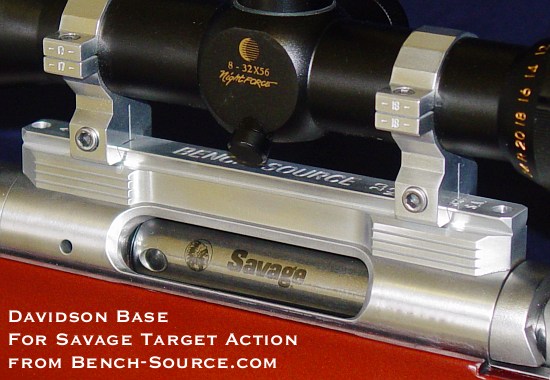
The Picatinny (Weaver) base costs $84.95 (either flat or +20 MOA) while the Davidson dovetail base is just $69.95 (either flat or +20 MOA). This is a good price considering the quality of the materials and machining. (The 7075-T6 aircraft grade aluminum is three times as expensive as the aluminum alloy used by some other rail-makers.) Either style base is available with either a “luster” or polished finish. The price includes a Torx wrench and mounting screws.
 
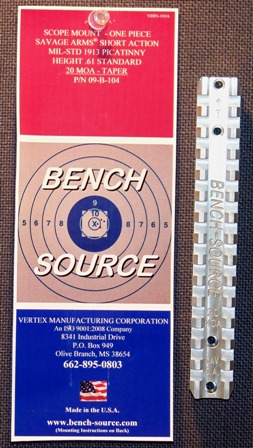 Technical Specifications Technical Specifications
The Picatinny M1913-A Mounting Rail features 14 symmetrically spaced cross-slots. The base is long enough to mount any popular scope. The Picatinny base is approximately .610″ tall. Parallelism deviates less than .002″ between the dovetail clamping area and top of the receiver after mounting. The screws used are #6-48 x 3/8″ long and holes are drilled and counter-bored to the correct depths. This ensures that users will not damage their barrel threads or encounter interference with the locking lugs when closing the bolt.
The Davidson 1/2″ x 60º Mounting Rail dovetail is parallel over its entire length. The rail is held to very tight tolerances to minimize windage correction (at different ring positions). The Davidson rail should self-center on your action when installed per the included instructions. Both ends of the mount are chamfered slightly on a 30° angle to let the sharp corners of the mating rings align themselves without binding. The 60º dovetails are machined +/- .001″ and measured over two optimum-diameter pins to minimize over-clamping of your rings.
For more information, visit Bench-Source.com or phone: (662) 895-0803.
February 10th, 2011
Vortex is an up-and-coming optics maker that has made great strides in recent years. Vortex scopes, spotting scopes and binoculars offer excellent value for the dollar. This year, at SHOT Show, Vortex unveiled its new Viper HS series of scopes, with 30mm tubes and 4X magnification ranges. We checked out the new Viper HS 4-16×50 LR (Long Range) model. This features an exposed elevation turret with Vortex’s CRS zero stop. The 4-16 Viper HS offers 75 MOA of elevation travel (24 MOA per revolution).

 Order Custom-Calibrated Elevation Turret Caps Order Custom-Calibrated Elevation Turret Caps
One thing we really liked about the new Viper series of scopes is the availability of custom elevation turret caps. For about $100.00, Vortex will craft a elevation turret cap with range markings custom-calibrated for the ballistics of your load in your rifle. As explained in the video below, you can go to the Vortex website, and input your MV, bullet BC, altitude and other load variables. Then, using the custom elevation turret cap, simply dial in your target range, and hold ‘dead on’.

New Viper HS 1-4x24mm with TMCQ Reticle
The growing popularity of multi-gun competition has spurred interest in compact, zoom scopes that can switch from a wide-angle, zero magnification view for close work to four- or five-power magnification for long-range stages. Vortex Optics has developed a new scope that should work well for 3-Gun carbines, as well as dangerous game hunting rifles. The Viper HS 1-4x24mm with the TMCQ (Tactical Milling Close Quarter) reticle features a 30mm main tube and built-in illumination with 10 intensity levels with an off position between each setting.

February 7th, 2011
Leupold’s Mark 4 riflescopes are highly respected for their quality of glass, user-friendly tactile turrets, and durability backed up by Leupold’s lifetime warranty. These scopes are favored by police and military shooters. Because of their popularity, Mark 4 scopes are in high demand and retailers maintain pretty high prices. We’ve worked with one of our sponsors to create a very attractive special discount on Mark 4 6.5-20x50mm LR/T M1 scopes, just for our readers.
Leupold 6.5-20x50mm Mark 4 with Leupold Tactical Rings for just $1375.99
Our sponsor DogHouse Outdoors has created a special package with a Leupold Mark 4 LR/T 6.5-20x50mm scope, plus Leupold tactical 30mm rings at a super-low price. These rings have an MSRP of $224.00. Through this special offer for AccurateShooter.com readers, you can get the Mark 4 scope, plus genuine Leupold Mark 4 30mm rings (either aluminum or steel), for just $1375.99. And shipping is FREE! Go ahead and comparison shop and you’ll see what a good value this is.

Choose either a mildot reticle or Leupold’s TMR® (Tactical Milling Reticle). Most tactical shooters seem to prefer the TMR, which has fine hash marks. However, in low light, some shooters say the older Mildot Reticle is easier to see.
This is a limited-time offer. DogHouse Outdoors plans to offer this $1375.99 pricing for the next three weeks, through the end of February, 2011. If you have been looking for a high-quality Leupold tactical scope, you should definitely check out this offer.

CLICK HERE for Leupold 6.5-20x50mm LR/T with Rings Package
First Focal Plane, Mil-Mil Version Also Offered
Because most shooters actually are better served with a second focal plane reticle, and the vast majority of American shooters prefer MOA adjustments, the Mark 4 $1375.99 LR/T package scopes come with 1/4-MOA windage and elevation clicks with a second focal plane reticle. However, for those shooters who need a First Focal Plane (FFP) Reticle (for ranging at all magnifications), and mil-based clicks, DogHouse Outdoors is also offering a Mark 4, ER/T M5 6.5-20x50mm package. This features a FFP reticle, and turrets with 1/10 milrad clicks. The price, including Leupold Mark IV 30mm rings, is $1,775.99. That’s 24% off the normal list price (with the $224 rings). Again, this offer is limited in time. Get your orders in before 2/28/2011.

February 7th, 2011
When conditions are absolutely perfect, you can see 6mm bullet holes (in the white) at 600 yards with a premium spotting scope (with at least 45x magnification). But add some haze and mirage into the mix and all bets are off. This weekend, we tested three top-of-the-line “big name” spotting scopes. All three had at least 60X magnification, all had HD glass, and the average price of the three units was over $2500.00 with eyepiece. Even with all those pricey, state-of-the-art optics, on Saturday we couldn’t see bullet holes at 400 yards because of thick mirage and dust in the air.
Quality Target Cams Can Provide Reliable Viewing from 50 yards to 1000+ yards
What can you do if you want to practice at long ranges, and see your bullet impacts — reliably, every time? There are electronic target systems that plot shot locations with sonic sensors or accelerometers, but these are large, complex, semi-permanent installations costing many thousands of dollars. For most shooters, the only practical, field-deployable solution is a quality, wireless target cam system. You can source the necessary components — video camera, transceivers, antennas, batteries, display screen — or you can purchase a turn-key system. There are a handful of target cam systems now marketed for shooters. We’ve tried a couple that did not perform as claimed. But one system that we can endorse without reservation is the Target Cam System from Pro Security Warehouse (PSW). We purchased PSW’s Long-Range Wireless Target Observation System and have tested it outdoors extensively. With a well-illuminated target, this system will reliably display even .22 caliber bullet holes in the black, at distances out to 1000 yards. In order to see bullet holes in the black you may have to increase the contrast or adjust the brightness — but that’s a simple matter of clicking a couple control buttons. During daylight hours, we could easily see all bullet holes, with the camera displaying an area about two feet by two feet square. When shooting at night, you need to illuminate the target with lights.

 PSW Wireless Video Viewing System Components PSW Wireless Video Viewing System Components
The PSW Target Cam System costs $1499.00 but that includes everything you need, even tripod and batteries. The target image is captured by a high-resolution, auto-focus color camera with 22X max magnification and motorized zoom. This can be set as far as 30 feet from the target, but we got the best results with the camera positioned about 10 feet from the target, on one side of the target frame. The camera connects to a digital wireless multi-channel transceiver (with high-gain antenna) clamped to the same tripod that holds the camera. A sealed, rechargeable 12V gel cell battery will run the camera for a full day’s worth of shooting.
Pro Security Warehouse Target Cam System Brochure (PDF).
For the shooter’s station, PSW provides a compact transceiver (the size of a smart-phone), plus a rugged color monitor in a padded carry pack. These are likewise powered by a rechargeable 12V battery. Initially, we suspected the 5.6″ monitor was a little on the small size, but it proved more than adequate in use. With the monitor positioned a couple feet from your rifle (either on the bench or on the ground when shooting prone), you can easily see scoring rings, score numbers, and, of course, bullet holes. You may want to fiddle with the color and contrast controls to create the best definition for viewing bullet holes in the black. The resolution is good enough that we could easily make out “doubles” where two 6mm shots landed virtually on top of one another.

One smart feature is that the target display is set for a short time delay. This allows you to turn your head from sights or scope to the display screen and see the bullet hole “arrive” on paper a few seconds after the actual hit. Being able to actually see the bullet hole appear on the target helps you quickly locate the latest shot even if there is a cluster of bullet holes close together. That’s smart engineering.
The PSW system works really well. We have no negatives to report — everything performed as advertised. Are there any improvements/enhancements we would like? Yes — it would be nice if the receiver could output to a laptop computer, so you’d have the option of a larger display screen and so you could capture video of shot strings. We would like PSW to offer an optional, small solar panel that could trickle-charge the unit during use. Lastly, we would like to see PSW offer a lower-cost system that could be used with a user-supplied video camera. We know many shooters already own small video cameras, and this could reduce the overall “buy-in” cost of the system.
Certainly, $1499.00 for the complete PSW system is not cheap. However, when you consider that the PSW wireless viewing system reliably displays bullet holes at long range in all daylight viewing conditions — something not even a $3500.00 spotting scope can do — the system is worth the money for shooters who practice at long ranges. Interestingly, all four testers who looked through the top-end spotting scopes agreed that they would rather have this $1500.00 target cam AND a $1000.00 spotting scope rather than a $2500.00+ spotting scope alone. To learn more about the PSW Target Cam system visit www.ProSecurityWarehouse.com or call (407) 447-1637.
February 5th, 2011
Experienced tactical shooters will tell you that a first focal plane (FFP), mil-mil scope is the smart way to go — if you need to range targets at unknown distances. This gives you mil dots for measuring the size of a target, a reticle that can range at all power settings, plus 1/10th mil-radian turret clicks for compatibility. There are a lot of “tactical” scopes marketed these days, many of which are just medium-power target scopes with bulky turrets. The top-end tactical scopes do offer the right combination of features, but you can easily spend $2000.00 or even $3000.00 on a good FFP mil-mil optic.
Save Hundreds on 30mm, Mil-Mil Illuminated Bushnell Tactical Scopes
With its Elite 4200 series of tactical scopes, Bushnell has created a truly affordable series of quality 30mm-tube, mil-mil optics. The FFP Elite 4200s rival some tactical scopes costing twice as much (honest). And right now you can save even more. Through the end of February 2011, MidwayUSA is offering huge discounts on the Bushnell 4200 FFP 3-12x44mm and 6-24x50mm tactical scopes. Both these scopes feature FFP mildot reticles, 30mm tubes, 1/10th mil adjustments, and illumination. And the prices are amazing. The 3-12X is marked down from $849.99 to $594.99, a $255.00 savings. The 6-24X price has been slashed from $999.99 to $699.99, a $300.00 savings.

Go ahead and comparison-shop the price. We think you’ll find these deals hard to beat. And this scope comes with all the right features out of the box. Here’s what one 3-12x44mm owner says: “This is the best scope [value] on the market right now that offers mil/mil, good glass, tactical turrets, [and] rugged reliability. [T]his scope has optics as good as my Vari-X-III 4.5-114x50mm and is mil/mil and more rugged! Great scope!”
Midway’s prices are good through 2/28/2011. If you need a good tactical scope for under $700.00 these Elites will do the job. And for those who want a solid hunting scope with good glass, MidwayUSA is also discounting the Bushnell Elite 4200 2.5-10X50mm scope with illuminated T-Dot Reticle. The rugged 2.5-10X features 1/4-MOA clicks, and is now just $405.99 on sale, marked down from $579.99.

Note: As Bushnell’s Elite 4200 series scopes have somewhat limited elevation range compared to the high-dollar tactical scopes, we recommend mounting these optics on a +10 or +20 MOA rail.
Free Rain Suit with Purchase of Any Bushnell Elite Riflescope
As an added incentive, Bushnell is offering a FREE two-piece olive drab rainsuit to all purchasers of Elite riflescopes. To get your rain suit, just send in the product UPC code, a copy of the sales receipt, and $15.00 to cover shipping and handling. This offer is good through 12/31/2011.
CLICK HERE for free Rain Suit Offer

Story Sourced by Edlongrange. Disclosure: MidwayUSA advertises with this website.
February 4th, 2011
Great deals on Swarovski and Zeiss Demo riflescopes are available right now through Cameraland. These are mostly demo items used in trade shows. You can save up to $500.00 on some of these items from Zeiss and Swarovski. Cameraland explains: “As all of these items are limited quantities we have not posted all of them on our web site so please feel free to call Doug or Neil at (212) 753-5128 to place an order.” Supplies are limited. These prices only apply to special demo inventory in stock — when they’re gone, they’re gone. All orders over $100.00 include Fed Ex ground shipping to a street address in the USA. Editor’s NOTE: There is not enough room to list all the sales items. Other, lower-power demo riflescopes, spotting scopes, and binoculars are also on sale. Call for more info.

Zeiss
Conquest 3.5-10x50mm Riflescope:
#20 Z-Plex Reticle – $629.99, reduced from $749.99
#71/#72 Rapid Z-600 or Z-800 Reticle $649.99, reduced from $824.99
Conquest 4.5-14×44 Riflescope:
#72/#73 Rapid Z-800 or Z-1000 Reticle – $699.99, reduced from $874.99
#43 Mildot Reticle, Target Turret- $749.99, reduced from $949.99
Conquest 4.5-14x50mm Riflescope:
#72/#73 Rapid Z-800 or Z-1000 Reticle – $769.99, reduced from $924.99
#43 Mildot Reticle, Target Turret- $749.99, reduced from $949.99
 Conquest 6.5-20x50mm Target Turret Riflescope: Conquest 6.5-20x50mm Target Turret Riflescope:
#20 Z-Plex – $759.99, reduced from $999.99
#4 – $759.99, reduced from $999.99
#43 Mildot – $799.99, reduced from $1049.99
#73 Rapid Z-1000 – $869.99, reduced from $1074.99
#75 Rapid Z-Varmint – $869.99, reduced from $1074.99
#521777-9920 Diavari 4-16×50 T* FL Riflescope 2nd IP 30mm tube, with #20 Z-Plex Reticle, Hunting ASV only $1999.99, reduced from $2499.99
Swarovski
All of these riflescopes are in as new condition and come complete same as a new one, in their original box/packaging.
#59027 Z3 4-12×50 BRX Riflescope only $799.99. This scope is normally $1299.00. It is on Anniversary Sale promotion right now @ $999.00.
#59212 Z6 1.7-10×42 4 Riflescope only $1349.99 This scope is normally $1899.00. It is on Anniversary Sale promotion right now @ $1699.00.
#59613 Z6 3-18×50 4A Riflescope only $1549.99 This scope is normally $2229.00. It is on Anniversary Sale promotion right now @ $1999.00.
#59617 Z6 3-18×50 BR Riflescope only $1599.99 This scope is normally $2299.00. It is on Anniversary Sale promotion right now @ $2069.00.
#59887 Z5 5-25×52 BRX Riflescope only $1299.99 reduced from $1639.00.
SPECIAL: AT 80 HD Spotting Scope #49214 with 20-60x Zoom Eyepiece only $1399.99 (Display Item from Dealer that sold off inventory.)
Story Sourced by Edlongrange.
February 2nd, 2011
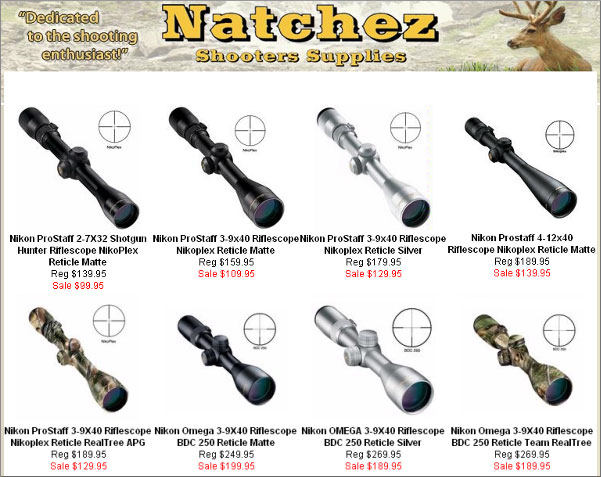
If you need a good, basic, reliable 3-9X40 hunting scope, Natchez Shooting Supplies is offering great deals right now on Nikon ProStaff and Omega riflescopes. You can select among a variety of reticles, including medium plex (NikoPlex) and bullet-drop compensation (BDC). Sale scopes are offered in Matte Black, Silver, or Real-Tree Camo finishes. While discounts vary, prices on many of these scopes have been slashed 30% below normal levels. For example the Nikon ProStaff 3-9×40 Matte is now just $109.95, marked down from $159.95, a 31% savings. Nikon binoculars are also on sale.
CLICK HERE for Natchez NIKON Optics Sale
Story Sourced by Edlongrange.
January 28th, 2011
Schmidt & Bender has a very impressive new tactical scope in the PMII (Police and Marksman) line, the 3-20x50mm PM II/LP/MTC/LT. A first-focal-plane design, the new 3-20X PMII features very bright glass, and a double-turn, locking elevation turret. The scope can be ordered with a variety of reticles, and either 1/4-MOA clicks or one-tenth milrad clicks, with MTC turrets.
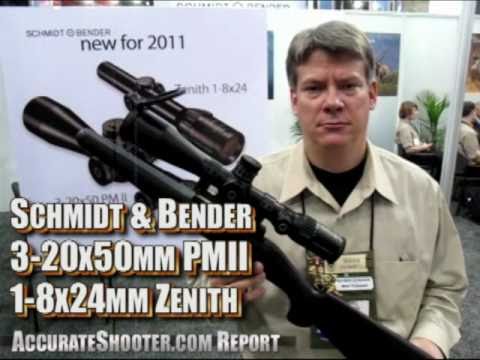
First delivered in late 2010, this unit has already drawn praise from the tactical community. JR, posting on SnipersHide.com Forum, declared: “I had the opportunity yesterday while at the Modern Day Marine show in Quantico to take a look at the new 3-20×50 PM II and to say that it impressed would be an understatement. The overall size was right between the 3-12 and the 4-16 and the 50mm objective is perfectly proportioned to this optic. Locking MTC turrets are very user friendly and it’s nice to have the option to leave them in the unlocked position when needed. Having a parallax range of 25 metres to infinity can also be very beneficial in many circumstances. Overall I was very impressed with the newest PM II … this scope will most definitely be sitting on one of my rifles before the year is over.” Another observer, writing in the Optics Talk Forum states: “If money is no object, consider the Hensoldt. But I think the scope that will be hardest to beat in the high-end tactical market will be the Schmidt & Bender 3-20.” That’s probably an intelligent call. However, at $3100.00+ per unit, we wonder how many shooters can actually afford the new 3-20x50mm PMII.


New Illuminated 1-8×24 Hunting and Multi-Gun Scope
At about $1899.00, Schmidt & Bender’s new 1-8x24mm Zenith scope is considerably less expensive. This scope is designed for short to medium-range tactical use, multi-gun competition, and hunting. One nice feature is that the scope has a “pure 1-power” setting that is 100% parallax-free. There will also be an illuminated version offered for $2149.00 US.

January 26th, 2011
Alan Orr of Sightron unveiled some impressive products at the 2011 SHOT Show. The first is a fully upgraded Sightron SIII 10-50X60mm LR scope. When first introduced in 2010, Sightron’s 10-50X scope became an immediate “hit” with AccurateShooter.com readers. The 10-50X offered seriously powerful magnification with reasonable weight — all in an affordable package. With “street price” under $1000.00, the Sightron 10-50X was much less expensive than rival “big-name” scopes with comparable magnification. As first released, Sightron’s 10-50X scope was a smart choice for F-Classers and long-range benchresters. For 2011, the 10-50X scope has been made even better, yet the price has stayed pretty much the same. That’s the kind of progress we like.
As upgraded, Sightron’s 10-50x60mm scope has new target turrets, a new reticle option (hash marks with center dot-in-circle), and dual-color, selectable illumination. At around $995.00, this scope is in a class by itself. Looking at the offerings of other scope-makers, you’d have to pay hundreds more to get a comparable 50-power riflescope with reliable tracking and good glass. Yes the Schmidt & Bender 12-50X scope is better, but the S&B costs three times as much as the Sightron. The Sightron 10-50X’s price to performance ratio makes it a very attractive choice for F-Class and long-range Benchrest.
 Exclusive ‘Sneak Preview’ of Exclusive ‘Sneak Preview’ of
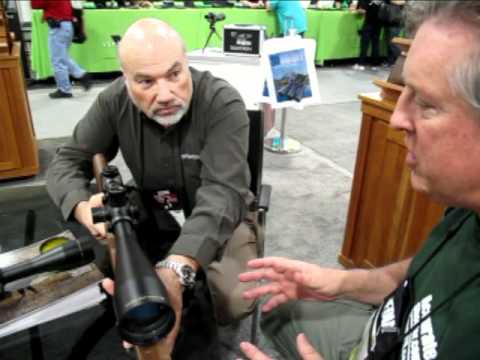
New 1-7X Sightron ‘Tactical Hunter’
After showing us the updated 10-50X scope, Sightron’s Alan Orr gave us an exclusive look at Sightron’s prototype 1-7X Tactical/hunting scope. This all-new scope offers wide field of view, selectable illumination and choice of 1/3 MOA or Centimeter clicks. This versatile, illuminated riflescope can be used for everything from tactical matches to big-game safaris. We definitely expect to see this compact 1-7X illuminated optic on many multi-gun rigs in the months ahead. The “street price” for the new 1-7X is expected to be right around $950.00. Expect the first units to ship in 120 to 150 days (i.e. at the start of summer).
January 25th, 2011
New March 3-24x42mm FFP Tactical Scope
Every year, a visit to the Kelbly’s booth is one of the highlights of our SHOT Show experience. This year, Jim Kelbly showed off an impressive new First-Focal-Plane 3-24x42mm March Tactical Scope. We were impressed with this new scope. It offers a wide range of magnification in a compact design. As first glance you think you’re looking at a 4-12X optic, not a scope with 24-power on tap. The scope is intelligently laid out — with mil clicks to match the mil reticle. Notably, the elevation turret delivers a full TEN mils per revolution. That is the same as Nightforce’s “high-speed” mil turret, and the ten mils of “up” should get you all the way to 1000 yards with most popular cartridges. If you’re a tactical shooter looking for a mil-mil scope you should check out the new 3-24X March. We think it is very competitive with anything out there, and it is a lot more compact than many scopes in the 20-24X power range.

Kelbly’s Also Builds Complete Rifles
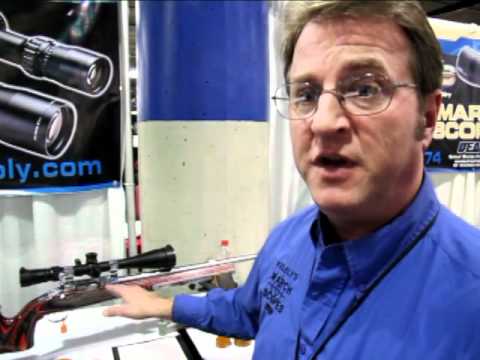
Along with March scopes and Kelbly/Stolle Actions, the Kelbly booth had a stunning F-Class rifle on display, with a 10-60X March scope on top. This red and black beauty belongs to Jim’s son, Ian Kelbly. It features a polished Stolle Panda F-Class action, pillar bedded to a Precision Rifle & Tool laminated F-Class stock. This was the stock design Charles Ballard used to win back-to-back U.S. F-Class Championships. Jim noted that Kelbly’s continues to offer a full range of gunsmithing services, from barrel chambering to building complete rifles — with your choice of Kelbly stocks or third-party stocks.


|


