|
|
January 24th, 2011
The big news at the Nightforce Optics booth this year involved Nightforce’s “High-Speed” turret design. First introduced on select models in 2010, now the “high-speed” turrets will be installed as standard equipment on Nightforce’s full line of NXS riflescopes (except compacts). The “High-Speed” turrets basically double the amount of elevation (or windage) travel you get with one full revolution of the turret. Previously, a Nightforce elevation turret delivered 10 MOA of elevation adjustment with one 360° turret rotation. Now, with the “High-Speed” turrets, Nightforce scopes will yield twenty (20) MOA of elevation travel with one full revolution. The “High-Speed” windage knobs will now give 10 MOA of travel in each direction. For mil-based turrets, the amount of elevation travel (per revolution) has been increased from 5 mils (per 360° spin) to 10 mils.
The doubling of adjustment travel (per revolution) really is an important upgrade that should make Nightforce scopes more user-friendly and fool-proof. For most popular cartridges, you should be able to go from 100 to 1000 yards within one 360° spin of the elevation turret. This means you no longer have to worry about which revolution you’re on. There are highly visible index numbers on the turret, so you should be able to just dial an index number (e.g. 9, 12, 18) to zero at any distance from 100 to 1000.
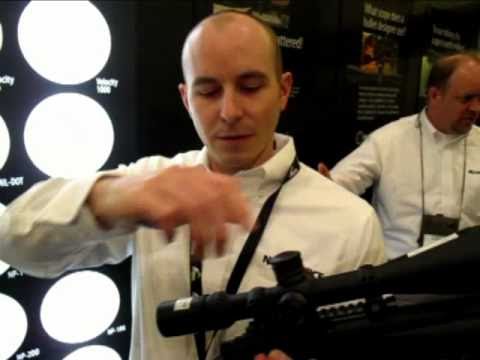
New Velocity 600 and Velocity 1000 Ballistic Compensating Reticles
Nightforce will also introduce two new “Velocity” reticles in the summer of 2011, one for 600 yards max, and the other for 1000 yards max range. These will initially be available for the 3.5-15X and 5.5-22X scopes only. Both NF “Velocity” reticles are basically Bullet Drop Compensating reticles that provide hold-over lines for particular yardages. But, you might ask, “How does Nightforce know the ballistic drops for my particular cartridge?” Here’s how it works — the customer sends in his bullet type, bullet BC, and muzzle velocity. Then Nightforce picks one of five (5) calibrated “Velocity” reticles, selecting the hold-over reticle design that most closely matches the actual trajectory of your loads. For most hunters using a common cartridge, one of the five Nightforce “Velocity” reticles should provide a good fit to your load’s ballistics. This isn’t revolutionary — Burris, Leupold, and Zeiss all offer something similar, but it’s good to see Nightforce add this reticle option to its lineup.

January 21st, 2011
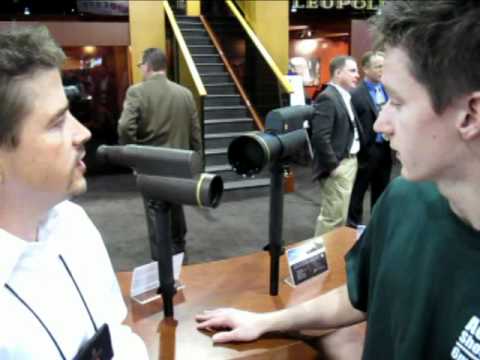
Yes, bigger is better. Leupold has upgraded its popular “folded-light-path” compact spotting scope, by adding an HD-glass, 80mm front objective and boosting the magnification up to 60-power. That will give this NEW scope better low-light performance and higher magnification while retaining a usable exit pupil (if you increase magnification without increasing the front lens diameter, the exit pupil shrinks). The unit costs $1800, not bad considering the price of other 80mm spotters, and the Leupold is much easier to carry, given its compact design.
Bigger Objective, Better HD Glass, More Useful Magnification Range
We’ve always liked the Leupold compact spotter because it is light weight and it’s Newtonian (folded light path) design makes it much more compact than most spotters of comparable magnification. The U.S. Military currently uses the Mark 4 “tactical” version of the Leupold 12-40x60mm spotter. However, we felt that the glass in the 12-40 spotter was not on a par with the latest generation HD spotters from Kowa, Zeiss, and Leica, or even Nikon and Pentax for that matter. Leupold has taken a huge step forward by gracing its new spotter with a big, HD (low dispersion) front objective. This should give the scope better perceived sharpness with much less color fringing (chromatic aberration) when viewing targets at long range. Upsizing the objective to 80mm makes the scope brighter, improving low-light performance. That’s important, particularly for tactical guys and hunters. The bigger objective also allows Leupold to increase magnification all the way from 40X to 60X. Do you always want a 60-power view? No, but it is great have 50% more magnification on tap when you need it.

60X is a Good Thing for Target Shooters
Most 40-power spotting scopes struggle to resolve 6mm and 6.5mm bullet holes at 600 yards. With HD glass and 60X magnification, you’ll have a much better chance to see small bullet holes at long range (though you’ll also need good viewing conditions). That’s a huge advantage for the long-range target shooter. Overall, we were very pleased that Leupold engineered this much-enhanced 80mm spotter. We predict it will be a big hit with anyone who needs serious magnification in an easy-to-carry optic.
January 20th, 2011
A riflescope that zooms in and out with the push of a remote button may seem like technological overkill. But think about it — most common point and shoot cameras these days offer power zoom and auto-focus. Modern binoculars have image stabilization and other high-tech features. There’s no reason a riflescope shouldn’t benefit from useful technologies we’ve already adapted to other optical products.
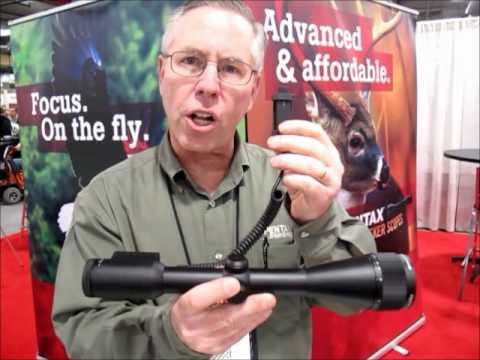
Pentax Marketing Demo — Ultimate Zoom

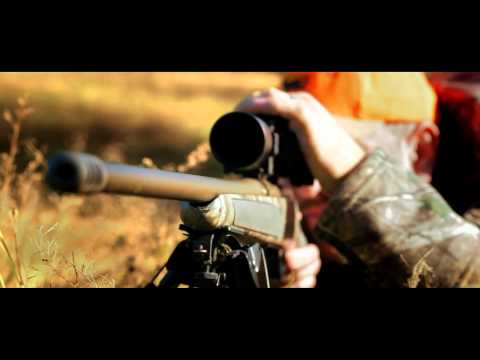
The new Pentax “Ultimate Zoom” scope got little press when it was launched in mid-2010. But we think it may be a true trend-setter. The big advantage for a varmint hunter is that you can keep your eye on the target. You don’t have to raise your head up or move your hand away from your firing position (see video above). With this scope you can zoom from 3X to 15X without changing your grip on the rifle or moving your head away from the scope. In the field, the batteries can last many months. The Pentax Ultimate Zoom typically retails for about $349.00 street price. However, Amazon.com currently offers the Ultimate Zoom for just $199.99 — a very good deal. In the video below you’ll see a product demo from SHOT Show.
January 18th, 2011
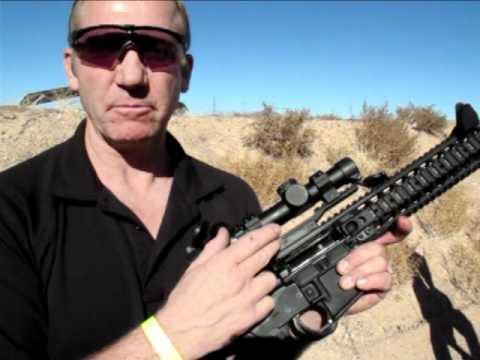
 During Media Day we kept our eyes out for new multi-gun gear, since 3-Gun Competition is becoming so popular. At the Surefire booth we ran into 3-Gun Ace Barry Dueck (pronouned “Duke”). Barry demonstrated the side-mounted iron sights he produces for AR-type carbines (actually these sights can work on any rifle that has suitable rails). During Media Day we kept our eyes out for new multi-gun gear, since 3-Gun Competition is becoming so popular. At the Surefire booth we ran into 3-Gun Ace Barry Dueck (pronouned “Duke”). Barry demonstrated the side-mounted iron sights he produces for AR-type carbines (actually these sights can work on any rifle that has suitable rails).
Running a combination of a magnified, 1-5X Leupold on top with iron sight mouted at a 45-degree angle on the sides, Dueck can rapidly transition from optics to irons. The top scope works great for longer shots, but Dueck finds he can engage close targets more quickly (and accurately) with the iron sights. While some other 3-gunners run a magnified optic on top and a red dot sight on the side, the use of two (2) glass optics puts a 3-gun competitor in a different division. Dueck’s Rapid Transition Sight (RTS) System, allows him to compete in the single-optics classes. The side-mounted irons are also more foolproof than any electronic sight, as Dueck explains in the video below.
January 15th, 2011
Zeiss has just introduced its latest spotting scope, the Dialyt 18-45x65mm Compact Field Spotter. We like the design and we think there’s a place in the spotting scope market for a simple straight-tube spotter with razor-sharp, ultra-premium glass. High-end spotting scopes have become increasingly large and heavy over the years as the optics-makers have chased ever-greater levels of brightness and magnification. But a hunter or tactical shooter doesn’t want to hump 8 pounds of glass up and down mountains. The Dialyt (“Die-Ah-Lite”) weighs a mere 2.6 lbs. (1.2 kg) and is just 15.5 inches long.

Easy to Use, Easy to Carry
The Dialyt is easy to use — twist the eyepiece to zoom and rotate the front objective to focus. Originally designed for European Alpine hunters, the new rubber-armored ZEISS Dialyt 18-45×65 Field Spotter is built tough for field use. This should appeal to hunters and tactical shooters. And unlike older-style draw-tube scopes, the straight-tube Dialyt is dustproof and fully waterproof (rated to 400 mbar).
About the size of a thermos bottle, the 2.6-pound Dialyt 18-45×65 fits easily into a backpack and, if necessary, can be rested on a pack for stabilization at higher magnification. This spotter also has threads for a tripod or monopod.
The Dialyt 18-45×65’s variable eyepiece provides a wide field of view at low magnification and plenty of magnification up top. This compact spotter also features multilayer coatings and high light transmission for good performance at dawn and dusk — something important for hunters.

January 14th, 2011
The new Micro-Sight was developed by scientists at Idaho National Laboratory (INL). This revolutionary optical insert for iron sights allows you to see BOTH the target and your front sight in sharp focus. The Micro-Sight employs Phased Zone Plate technology to improve focus of both close and distant objects.

 Creedmoor Sports Now Selling Production Micro-Sight Creedmoor Sports Now Selling Production Micro-Sight
This summer we reported that the Micro-Sight was in development. Now Creedmoor Sports has the first-ever production Micro-Sight, a special hood for AR and service rifle rear sights. The Micro-Sight hood sold by Creedmoor replaces a standard AR-15 hood (1/4-32 threads) as found in most NM AR-15 rear sights. The Micro-Sight element is positioned in the center of the hood, where it is shielded from moisture and impacts. Licensed by INL, the new Micro-Sight for ARs will be followed in the spring by inserts for popular rear match sights. The new SR Micro-Sight insert for ARs, item MS-1, costs $139.95. Order soon — Creedmoor has sold nearly 100 sights in just two days! Click HERE or call 800-273-3366 to order.

The Micro-Sight really works, and it makes a huge difference, particular for “older eyes” that have trouble focusing on both the target and the front sight. For the first time you’ll have a sight picture where the front sight and the target are both in focus. Creedmoor’s Dennis DeMille, a former National Service Rifle Champion, tells us: “This is one of the most game-changing products to come out in years!”
WATCH the VIDEO below to see the Micro-Sight in Use and to learn how it works…

Disclosure: Creedmoor Sports Advertises with AccurateShooter.com
January 11th, 2011
Every serious shooter should have some kind of anti-cant device fitted to his or her rifle. When you tilt your rifle to one side or the other, even a little bit, this will alter your point of impact. Unless the direction and angle of tilt (or cant) is exactly the same for each shot, canting your rifle will open up your groups. READ MORE about rifle canting.

New Anti-Cant System from Flatline Ops
Flatline Ops has developed a smart, scope-mounted leveling device with a fold-out bubble level. Flatline’s Accu/Level™, crafted from black-anodized 6061-T6 aluminum, clamps around the scope tube. Models are available for all common tube sizes: 1″, 30mm, and 34mm. There is also a Leupold MKIV version which clamps to the scope rail so it functions as a scope ring as well as a leveling device. All Accu/Level™ models can be fitted with an optional vertical Strong Arm™ accessory. The 6061-T6 aluminum Strong Arm has a dovetail for mounting an Angle-Degree-Indicator (ADI), which allows the shooter to make quick “true range” corrections for up-angle and down-angle shots. An Angle-Cosine-Indicator (ACI) also fits the dovetail.
As a combined unit, the Accu/Level™ (fitted with Strong Arm and ADI) is a great set-up for the tactical shooter or long-range hunter. The bubble level kicks out to the left for easy visibility (see Video above). The ADI is held in plain view on the left, under the bubble level. Of course the whole system can be reversed for left-handed shooters. On LongRangeHunting.com, Jim See explains how the Accu/Level works in the field and how he employed the ACI during a hunt. CLICK HERE for Accu/Level™ Field Test.
Good System — But Not Inexpensive
We like the combined Level + ADI system that Flatline Ops has developed. It is sturdy and well-designed. Our only concern is cost. The 30mm Accu/Level™ costs $139.99 and the Strong Arm (for ADI mounting) is $58.99. So you’ve got two hundred bucks invested before adding the $110.00 ADI. The whole set-up runs about $310.00. That’s a significant chunk of change that could be invested in your scope instead.
More Affordable Anti-Cant Alternatives
If you don’t need to make angled shots, you can get a simple rail-mounted B-Square bubble level from Brownell’s for $14.95. Mounting Solutions Plus offers a $29.95 tube-mounted anti-cant device with bubble level on top. If you prefer the bubble level on the side (for easier viewing) U.S. Optics makes a sturdy, rail-mount bubble level for $76.00. A hinged version, with inward-folding level, is $95.00.

January 10th, 2011
 Starrett, maker of precision measuring tools, has released a very cool digital magnifier. The Starrett KineScope can be hooked up to your laptop or home computer to provide close-up views of gun parts, tool edges, bullet tips, sear surfaces — any small object you want to see in great detail. The KineScope offers 40x to 140x magnification, adjustable with a simple slider on the device. The KineScope connects to your computer’s USB port and VLink imaging software is included. Output resolution is 640×480 pixels. Starrett, maker of precision measuring tools, has released a very cool digital magnifier. The Starrett KineScope can be hooked up to your laptop or home computer to provide close-up views of gun parts, tool edges, bullet tips, sear surfaces — any small object you want to see in great detail. The KineScope offers 40x to 140x magnification, adjustable with a simple slider on the device. The KineScope connects to your computer’s USB port and VLink imaging software is included. Output resolution is 640×480 pixels.
The KineScope is basically a miniature digital video camera, with precision optics and built-in LED lighting. To use, simply place the KineScope over the object and view the image on your computer monitor. You can capture still images, video, even time-lapse sequences. The video below show how you can easily take precise measurements (including circular diameters). You can also draw lines or annotate the captured images with labels or time stamps. LINK: Kinescope Product Brochure (PDF).

KineScope for Measuring Benchrest Group Sizes?
With the ability to measure circles, the KineScope could be the ultimate group-size measuring instrument. Will benchrest scorers use such a device some day? It certainly would be more precise than the plastic scoring templates commonly used today. With 140X magnification on tap, the KineScope gives scorers the ability to measure shot holes with extreme precision. However, that precision doesn’t come cheap. Starrett’s KineScope retails for a whopping $831.25. (Source: Manson Tool & Supply.)
Credit Research Assistant Edlongrange for finding the Starrett KineScope.
January 4th, 2011
 Didn’t get ALL the gear you wanted for Christmas? WebyShops.com, an online optics vendor, is sponsoring a special sweepstakes with over $1000.00 in prizes. Entry into the contest is FREE — no purchase is necessary. The Grand Prize Winner will be awarded a $1000.00 shopping spree from Webyshops.com. Additionally, one in ten entrants will win one of these four prizes: Didn’t get ALL the gear you wanted for Christmas? WebyShops.com, an online optics vendor, is sponsoring a special sweepstakes with over $1000.00 in prizes. Entry into the contest is FREE — no purchase is necessary. The Grand Prize Winner will be awarded a $1000.00 shopping spree from Webyshops.com. Additionally, one in ten entrants will win one of these four prizes:
1) Scopecoat Neoprene Cover
2) Laser Boresight
3) Accuscope Sighting Chart
4) Surefire CR123 3V Battery 12 Pack
How to Enter Contest
It’s simple to enter the contest. No purchase is required, but you will be asked for your name and email address. (If you prefer NOT to provide an email, just stop here — that’s a contest entry requirement.)
- Go to WebyShops’ Facebook Page: www.FaceBook.com/Webyshops
- Click the “LIKE” button at the top center of the page.
- After the new page loads, Click ENTER at the bottom of the picture.
- Complete the entry fields (name, email, hobby preference) and click ENTER.
The contest ends January 30th. The Grand Prize winner will be notified by email and his/her name will be posted on Webyshops’ Facebook Page on January 31, 2011. Additionally, one out of every 10 entrants will win a free gift. For more info, visit WebyShops.com, or call (800) 851-9321.
December 22nd, 2010
 If you’ve been shopping for Burris riflescopes or binoculars, visit SWFA.com. Texas-based SWFA is running a special liquidation sale on Burris optics with some items marked way down “below distributor cost”. Supplies are limited. Here are some examples of the savings: If you’ve been shopping for Burris riflescopes or binoculars, visit SWFA.com. Texas-based SWFA is running a special liquidation sale on Burris optics with some items marked way down “below distributor cost”. Supplies are limited. Here are some examples of the savings:
Burris 3-12x50mm Xtreme Tactical XTR 30mm SideFocus with Mildot Reticle.
Price: $599.99, regularly $789.95. Stock #201914.
Burris 3-12x50mm 30mm Euro Diamond with Ballistic Plex Reticle.
Price: $349.95, regularly $619.95. Stock #200916.
Burris 6.5-20x50mm Fullfield II, Adj. Objective Front with Fine Plex Reticle.
Price: $249.95, regularly $419.95. Stock #200191.
Burris 3-9x40mm Fullfield II with Electro-Dot/Duplex Reticle.
Price: $199.95, regularly $329.95. Stock #200156.
Burris 8x56mm Signature Select Binoculars, multi-coated lenses, black body.
Price: $199.95, regularly $524.95. Stock #300284.
Below you can see a small sample of the many items on sale (CLICK HERE for full list). Visit SWFA.com or call (972) 726-7348. SWFA offers a price guarantee and SWFA claims it “will beat any price”.

|


