Here’s a chance to save hundreds on a popular Leupold hunting, tactical, or target scope. Now through 12/31/2010, MidwayUSA has marked down a limited quantity of Leupold riflescopes which either have a small exterior blemish, or are otherwise on close-out. If you need a medium-power hunting scope there are some great deals to be had. CLICK HERE to Visit Closeout and Factory Blem Sale Page.
Here are some specific products on sale. Remember quantities are limited. You snooze, you lose.
When choosing a riflescope, picking the right reticle is vital. Even the highest-quality scope can be disappointing in the field if you don’t select the best reticle for your intended application — whether hunting, tactical, or target use.
Online retailer Webyshops.com has made the process of reticle selection much easier by providing Reticle Selector Tables for popular riflescope brands and models.
The folks at WebyShops tell us that customers often have trouble picking the right combination of reticle type, magnification option and scope finish: “Typically, customers have already narrowed down the brand and often the model, but they want to know all their reticle and finish options for the scope”. To make the process easier, WebyShops now offers Reticle Tables for many of the most popular riflescope brands and models. To access the tables, log on to the WebyShops site and select a scope brand. When you see a gray button like the one below, just click on it to see a list of reticle and finish options.
Shown below is a sample table for Nikon Monarch scopes. The table provides all available choices for this brand and model, classified by reticle type, magnification, and exterior finish.
WebyShops currently offers Reticle Selector Tables for the following scope brands and models. More tables will be added in the future. Click the links below to access Reticle Tables for particular scope brands and models:
March scopes (built by Japan’s Deon Optical) have become extremely popular with short-range benchrest competitors, and we are seeing an increasing number of 600-yard and 1000-yard shooters upgrade to March scopes. The March product line offers high magnification (up to 60X power), a wide choice of reticles, and extremely bright, sharp lenses.
March has also quickly acquired a reputation for reliable tracking and shot-to-shot consistency. In the unforgiving short-range benchrest game, if your reticle shifts just a tiny amount from shot to shot, that can open up your group and drop you from a top place to “also-ran” status. Top short-range shooters have praised the March for its ability to “stay put” with no reticle movement, shot after shot.
New Website with All the New Scopes (with Specs)
In the USA, March scopes are sold by Kelby’s Inc., which has a page dedicated to March products on the www.Kelbly.com website. If you need MORE Information about the March scopes, there is now a new March Website, with more models, more photos, more data, and more reticle diagrams. You’ll find the latest Benchrest models on the new March website, including the popular 36-55x52mm Benchrest EP Zoom Scope, the 10-60×52 Zoom, and the 40X, 50X, and 60X fixed-power BR scopes. In addition, the website features March’s new hunting and tactical series of optics, including the 1-10×24, 2.5-25×42 scopes which boast a revolutionary ten times Magnification Ratio.
Here’s another promo that can save you money on your holiday shopping. When ordering goods through Gander Mountain’s online store, use Coupon Code GME1205 during check-out. That code gets you $20 off a $100+ order (20% savings), $50 off a $300+ order (16.6% savings), or an impressive $100 off a $750 order (13.3% savings). This promo is good through December 11, 2010.
How to Beat MAP Pricing on Optics
Note that many premium scopes, binoculars, and rangefinders are governed by “MAP” (Minimum Advertised Price) rules imposed by the manufacturers. That means the list price is going to be the same at all authorized dealers, even the “super-discounters”. However, if you can use a “generic” discount code to get $50 off or $100 on an order that includes MAP-priced items, you’ll come out way ahead. MAP agreements prevent any seller from displaying specific items below a certain price point. But your coupon code effectively allows you to purchase below MAP price.
With the price of some premium scopes approaching $3000.00 (and beyond), it’s more important than ever to provide extra protection for your expensive optics. ScopeCoat produces covers that shield scopes with a layer of neoprene rubber (wetsuit material) sandwiched between nylon. In addition to its basic covers, sold in a variety of sizes and colors, ScopeCoat has a line of heavy-duty 6mm products that provide added security.
Triple-Thickness XP-6 Model for Added Protection
The XP-6 Flak Jacket™ is specifically designed for extra protection and special applications. The 6mm-thick layer of neoprene is three times thicker than the standard ScopeCoat. XP-6 Flak Jackets are designed for tall turrets, with sizes that accommodate either two or three adjustment knobs (for both side-focus and front-focus parallax models). To shield an expensive NightForce, March, or Schmidt & Bender scope, this a good choice. XP-6 covers come in black color only, and are available for both rifle-scopes and spotting scopes.
The heavily padded XP-6 Flak Jacket is also offered in a Zippered version, shown at right. This is designed for removable optics that need protection when in storage. The full-length, zippered closure goes on quick-and-easy and provides more complete protection against dust, shock, and moisture. MSRP is $30.00.
Special Covers for Binos and Red-Dots
ScopeCoat offers many specialized products, including oversize covers for spotting scopes, protective “Bino-Bibs” for binoculars, rangefinder covers, even sleeves for small pistol scopes and red-dot optics. There are also custom-designed covers for the popular Eotech and Trijicon tactical optics. Watch the Shooting USA video below to see some of ScopeCoat’s latest specialty covers.
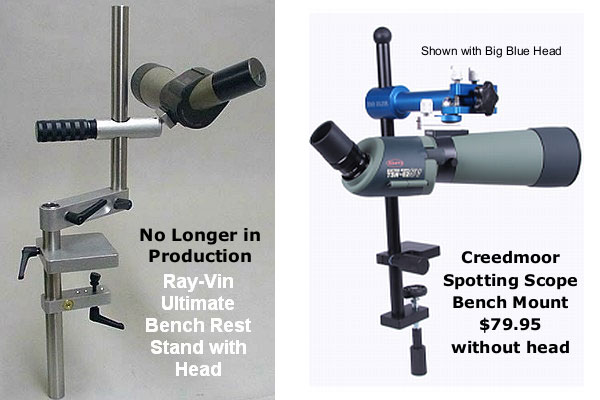
We’re often asked: “What’s the best way to set up a spotting scope for shooting from a bench?” Some guys have spotting scopes set on big full-size tripods positioned to the side of the bench. That will work, but it normally requires you to move way out of position to look through your scope. Also, if you place the tripod as close to the bench as possible, one of the tripod legs will extend down close to your foot. It is all too easy to jostle the tripod with your foot or knee and move the scope off your target. We’ve also seen folks with spotting scopes mounted on compact camera tripods set directly on the bench. Again, this is not a very good solution. These small tripods position the spotting scope too high. Small camera tripods are also really too light and flimsy to hold a big, heavy spotter, with a 65mm or larger front objective. You really need a better set-up. You want to mount the spotting scope so, when you are in shooting positino, the eyepiece is close to your head — allowing easy viewing without moving your whole body away from the rifle.
Scope Stands for Bench Use
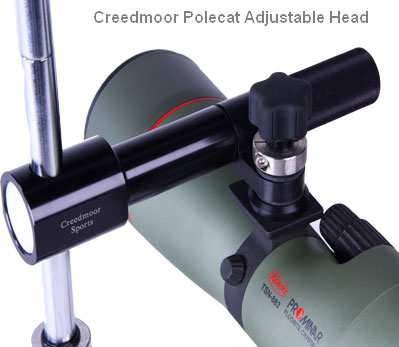
The best system for mounting a spotting scope to a bench was the Ray-Vin Ultimate Benchrest Stand. This clamped securely to the side of the bench and was a very high-quality piece of gear. Unfortunately, Ray Brandes of Ray-Vin has retired and his clamping benchrest scope stand is currently out of production. If you can find one for sale second-hand — snag it. If you can’t locate a Ray-Vin clamping stand, don’t despair, Creedmoor Sports has come out with a clamping-type Spotting Scope Bench-mount that is only $79.95 without head. This features 1″-diam vertical shaft so it can be used with most scope-holding heads that can adapt to a 1″ tube, such as a Ray-Vin head, Big Blue head, or Creedmoor’s new Polecat head. The clamp mount secures the rig anywhere you want along the side of the bench. You can easily adjust the scope height and fore/aft position relative to the shooter. The Ray-Vin head, now sold by Creedmoor, features a twist handle with a ball joint on the end. This then lets you set the scope (and angled eyepiece) to any angle you want. It’s a very slick system.
The Creedmoor Bench-mount is currently back-ordered, but Creedmoor expects to receive product before the end of the year. The Polecat head is available now for $139.95. Creedmoor, which has taken over production of the Ray-Vin scope stand head, is taking orders for the Ray-Vin head currently. No release date is offered. However, there should be some 1″ Ray-Vin heads on the used market.
Here’s a sweet deal if you are looking for a premium hunting scope with great glass, extended eye relief, and a handy +4/-3 diopter. Leica Sport Optics just announced a Trade-Up Program for its 2.5-10x42mm and 3.5-14x42mm ER riflescopes. From now through January 31st, 2011, Leica will knock $500 off the price of a brand new Leica ER scope when you trade-in any “functional” scope. Yes, under Leica’s rules, your trade-in could be a $20.00 Leapers. That’s like trading-in a used Yugo and getting twenty grand off the price of a new Mercedes.
There is no brand or price limit on the trade-in. Leica will accept any brand, make or model of trade-in scope, so long as it is “functional” and a “clear image and reticle [is] visible through the scope.”
Leica is offering $500 trade-ins on its impressive 2.5-10×42 and 3.5-14×42 ER scopes. You can choose among five different second-focal-plane reticles, and three turret options. These scopes feature 1/4 MOA clicks, 30mm tubes, and AquaDura-coated high-light-transmission lenses. Typical retail prices on these products range from $1799 to $2139. With the $500 trade-in, you can get into a premium Leica hunting scope for about $1299.00.
Use a $20.00 Scope for Your Trade-In
The smart way to take advantage of Leica’s offer is to trade-in the cheapest functional scope you can find. You can buy used off eBay but you could get a busted scope that won’t qualify. We suggest you purchase a new $20.00-$25.00 scope and use that for the trade-in.
You can buy the Leapers Golden Image 4X32 Mil-Dot Scope for just $19.95 at DPHArms.com. Texas-based CDNN Investments also has scopes for under $30.00, including a 4×32 Simmons for $19.99. Drop an easy $20 on some cheap Chinese glass, and walk away with a life-time guaranteed Leica for $500.00 under the regular price. That’s smart shopping.
Our latest Forum sponsor, DoghouseOutdoors.com, is a new online retailer specializing in fine optics. Based in Salt Lake City, Utah, Doghouse has a modern, easy-to-navigate website with a wide selection of products, all illustrated with high-quality photos.
Current Mfg. Rebates in Doghouse’s Rebate Central
On DoghouseOutdoors.com you’ll find a very cool feature: Rebate Central. Here manufacturers’ current optics rebates are all collected in one place. This helps buyers take advantage of all available money-saving promotions on rifle scopes, binoculars, rangefinders and other products.
Here’s the way it works: DoghouseOutdoors.com searches out all applicable rebates and then highlights them on the DogHouse home page in the “Rebate Central” area. As you move from one featured rebate to the next, if you find a rebate that suits you, just click on the rebate notice and you’ll be taken to the relevant products. Each product listing contains high-resolution photos along with a detailed description.
FREE Shipping on Rebated Products
As an added incentive for AccurateShooter.com readers, DoghouseOutdoors.com will provide free shipping on all rebate-qualified products. This currently includes products from Burris, Bushnell, Eotech, Leupold, and Sightron. (Shipping policy subject to change.)
Zeiss Instant Rebates
In related news, Zeiss just announced a Winter Specials Promotion providing instant rebates on Zeiss scopes and binoculars. If you purchase a set of Victory RF Binoculars between November 15, 2010 and January 31, 2011 you get a $200 instant rebate at check out. You can also get a $100 instant rebate if you purchase any other Zeiss Victory FL Binoculars or Zeiss Victory riflescope (except DiaRange LRF scope).
Field Days Mail-In Rebate
Also, under the Zeiss Field Days Promo (which continues through December 31, 2010), you can get a $100 mail-in rebate with the purchase of a ZeissVictory 8×26 T* PRF Laser Rangefinder or any of the Victory Compact Binoculars. We have field-tested the Zeiss 8×26 T* PRF Rangefinder and we recommend it highly. It is easy to hold and aim, optics are sharp and bright, and ranging performance is excellent.
Elcan ushers in the age of digitally-enhanced scopes with its amazing Digital Hunter. It’s about time digital features were added to consumer rifle scopes. In many respects a $150.00 point and shoot camera is much more sophisticated than a $2600.00 Schmidt & Bender. Adding a digital image sensor and digital “crosshairs” to a telescopic lens system unlocks an amazing realm of possibilities. First, you can eliminate moving parts, including the reticle itself, avoiding the possibility of reticle movement that could alter your zero. With digital crosshairs “informed” by a ballistics calculator, the reticle’s aimpoint can automatically display the correct hold-over at any target distance. For low-light shooting, you can boost the brightness and contrast of the image. You can even hook up the scope to a remote monitor so an instructor or spotter can see exactly what the shooter is seeing. Last but not least, everything viewed through the scope can be digitally recorded for later playback and analysis. This way a hunter can record, for posterity, the moment he bagged a trophy buck. Or, a military sniper can record a complete target engagement, for later review by his commander and fellow marksmen.
The $1199.00 Elcan Digital Hunter offers a 2.5-16.5X digital zoom, four field-selectable reticles, and built-in video capture. Reticles can be changed ‘on the fly’ and you can output the video to an external monitor, or simply pop out the SD flash memory card to play back video files on your computer.
Electronic Zoom with No Moving Parts
There are no moving parts in the Digital Hunter except for the diopter adjustment. Magnification is accomplished electronically, and the aiming point does not change at all during magnification. The electronic magnification is parallax-free and the exit pupil remains constant, allowing easy target acquisition, even at high power. Elcan claims that resolution does not change significantly from wide field of view to narrow field of view.
Electronic Ballistic Compensation
One of the most useful features of the Digital Hunter is electronic ballistic compensation. Here’s how that works. The scope has a USB port to connect with a computer. Using Elcan-provided PC ballistics software, you input Bullet BC, Muzzle Velocity, and even wind speed and angle. The scope’s processor automatically calculates drift and drop for various distances and then positions the digital aim point for the correct holdover, based on the target distance you select. All the critical calculations are handled automatically. Watch the video below to see how this all works.
Day-Night Digital Hunter In addition to the standard Elcan Digital Hunter, Elcan offers a version for low-light shooting. The Day/Night Digital Hunter, priced at $1399.00, can be combined with IR (infrared) “flash-lights” to provide full night-hunting capability. Low Light mode displays all the available visible light and the near infrared light (that can be “seen” by the scope’s image sensor, but not by the human eye). Utilizing the near infrared means more light energy is available to the scope for better, brighter imaging. After dark, active night vision enables covert surveillance and varmint hunting (where legal). The effective range of the active night vision depends on the power of the IR Flashlight(s).
Remote Viewing Capability Helps Disabled Shooters
When the Elcan Digital Hunter was first introduced a couple years ago, Outdoors writer Ray Sasser of the Dallas Morning News field-tested it with Ray Mauldin, Elcan Products Manager. Sasser wrote: “There’s a new rifle scope technology on the horizon, a spin-off from military developments made by the Raytheon Company [parent company of Elcan]. The software calculated bullet drop… and the information was stored in a computer chip inside the scope. The only two drawbacks I could find were price and weight. The digital scope weighs 26 ounces, nearly seven ounces heavier than Leupold’s LPS 3.5-14x50mm, my personal favorite traditional scope. Mauldin said physically challenged hunters are particularly excited about the Digital Hunter. It can be used with a video monitoring screen so the rifle can be sighted without your eye to the scope. That’s a huge advantage for a quadriplegic, one-armed or no-armed shooter.”
Digital Enhancements for Target Scopes?
Traditionalists may scoff at digital scope technology, thinking that something like the digital Elcan could never be used in a match because it is too big and heavy. But consider this — all you really need on top of the rifle is the lens system with light sensor. All the other controls and the display could be moved off the rifle and built into a benchtop display/control/processing unit (which could be wireless). In fact, the control functions and display could even performed by an iPod or smartphone. With the iPod you could select the reticle, input ballistics data (Velocity, Bullet BC, Wind direction), and select the magnification level. (Fitting longer focal-length lenses would allow higher magnification than the Digital Hunters’ 2.5-16.5X.) And with a finger-tap on the screen you can record the entire match you are shooting. When mass-produced, such a unit could be sold for considerably less than the $1199.00 price of the Elcan Digital Hunter, as the iPod does the processing and replaces most of the hardware.
If you’re looking for a good, moderately-priced variable scope for multi-gun competition, consider the new Burris Optics Fullfield Tac 30. MidwayUSA, the exclusive vendor of this scope, just knocked $40.00 off the price, through the end of November, 2010. Introduced at $339.99, the scope is now $299.99 on sale. The Tac 30 features 1X to 4X adjustable magnification, 30mm 6061T6 main tube, and 24mm objective. Here’s the cool part, an illuminated Ballistic CQ reticle provides hold-over points for the longer stages (ballistics calculated for a .223 Rem AR shooting a 62-grainer). Sean Doke, MidwayUSA’s Optics Manager noted: “The new Burris Fullfield TAC30 allows for rapid engagement of close quarters targets while also providing holdover points out to 600 yards.”
The scope is offered in two colors: Matte Black and Dark Earth. TAC30s are covered by the Burris Forever Warranty: “If [this product] is ever found to have defects in materials or workmanship, Burris will, at our option, repair or replace it at no charge, even if you are not the original owner.”


 When choosing a riflescope, picking the right reticle is vital. Even the highest-quality scope can be disappointing in the field if you don’t select the best reticle for your intended application — whether hunting, tactical, or target use.


 With the price of some premium scopes approaching $3000.00 (and beyond), it’s more important than ever to provide extra protection for your expensive optics.
  The heavily padded XP-6 Flak Jacket is also offered in a Zippered version, shown at right. This is designed for removable optics that need protection when in storage. The full-length, zippered closure goes on quick-and-easy and provides more complete protection against dust, shock, and moisture. MSRP is $30.00.

 Use a $20.00 Scope for Your Trade-In

 Zeiss Instant Rebates



 In addition to the standard Elcan Digital Hunter, Elcan offers a version for low-light shooting. The


