Gear Reviewby Germán A. Salazar, Contributing Editor
All of us have at one time or another struggled with glare in the front sight at certain ranges and certain times of year. There are a lot of ways to deal with glare, shade tubes being the most commonly seen. I prefer to avoid any type of extension on the front or rear sight, especially anything that hangs past the muzzle where the muzzle blast can cause damage and in any event, I haven’t found those tubes to be very effective. However, the need to do something about the glare at our south-facing range at the Phoenix Rod & Gun Club has become essential for me. At this time of year, the sun is directly in front at this range and I really struggle to get a clear sight picture.
The photo above, taken on 10/16/2010 clearly illustrates the problem at PRGC as the early morning sun is from the left and front. Note the backlit flag and the direction of the shadows. As the sun continues to rise, it aligns itself right down the range towards the shooters. Apart from the glare, the bull is hard to see on the targets once they’re up because the light is coming from behind the target, not from the front. A very challenging set of light conditions which will worsen from now through February as the sun stays lower in the sky month by month.
Anti-Glare Filters from Art Neergaard
I recently spoke to Art Neergaard about this problem. Art manufactures a number of innovative products for rifle sights through his company ShootingSight LLC and he had an idea for me. The idea was simple in concept, a “donut” filter for the front sight with a hole in the middle so as not to darken the already dim bull and yet, it would cut the glare that otherwise enters the front sight. The picture at left shows the filter mounted on the sight. When you’re looking through the sights, there isn’t the large gap around the aperture, it’s actually a very close match. Sticking the camera right into the sight obviously changes the perspective a bit.
I wanted to evaluate the Centra Goliath 30mm sight on my new Palma tubegun. Since Art intended to make the filters for the 30mm size, this was a good time to begin that evaluation as well. My last match score with this rifle, five weeks ago before the light got bad, was a 600-42X, since then, I’ve had a couple of poor matches with other rifles as the light and glare have really troubled me. With the 600-42 as a “good condition baseline” with this rifle I was eager to see how the filters would work.
Art sent me a few items: two filters (one gray, one orange), and one filter-holder for them, as well as a fixed aperture cut in the same material as the filters, with a beveled edge like the ones available for many years for smaller sights. The filters are interchangeable in the holder and can be changed in a minute or so. The aperture, however, is fixed as the hole is drilled in a lathe after mounting the disc in the holder — this ensures perfect concentricity for the aperture.
Gray Filter Preferred
Arriving at the range, I mounted the high-contrast orange filter first and looked through it. Frankly, although it cut glare well, I hate the look of an orange world! A quick change of filter and another look through the sights showed a good, glare-free and natural-looking sight picture with the gray filter. At right is a photo that shows the relative glare-cutting effect of the gray filter.
Scores Improved with Anti-Glare Filtration
Shooting a good mid-range .308 load with Winchester brass, Federal primers, IMR 4064 (manufactured in 1960, just like me) and moly-coated Sierra 190 gr. bullets, the rifle showed it’s good breeding giving me a 200-12X, 200-15X and 200-14X for a 600-41X, my 22nd score of 600! Well, quite a dramatic improvement over the last couple of weeks when I struggled to shoot 590, and back to the score I shot five weeks ago when the light was still good. Hooray! So yes, I’m very satisfied with the concept of the filter with a hole in it. All the extraneous glare that was hurting my sight picture was gone and the bull remained unimpaired. Not that the bull was too good to begin with as all I can see is a fuzzy gray blob out there, but keeping the center unfiltered was better than some solid filters I’ve tried in the past.
Clear Rain Filters for Front Sights
Art plans to make clear donut filters to use as rain shields for shooters with a front lens in their sight. That would keep raindrops off the lens — especially the middle of the lens where a drop could destroy the shooter’s ability to see the bull properly.
Filter Works with Fixed & Variable Apertures
Although I intended to try the fixed aperture also, I ended up shooting the entire match with the filter and the Centra variable aperture. I’ll try to use the fixed aperture (photo at left) next week. The value of a fixed aperture shouldn’t be underestimated. It provides a lower cost way to use a 30mm sight, an important consideration given the current $175 price of the adjustable aperture. Perhaps just as important, the fixed aperture is something that should be in every high-end shooter’s kit in case of failure of the adjustable, which has been known to happen. If I were traveling across the country or around the world to a match, you can be sure there would be a set of fixed apertures of various sizes in my kit to back up the adjustable iris.
Art Neergaard
ShootingSight LLC www.ShootingSight.com
eMail: shootingsight@nuvox.net
Phone: 513-702-4879
MidwayUSA has teamed up with Burris Optics to produce a new scope that should be ideal for Multi-Gun competition. The new Burris Fullfield TAC30, sold exclusively thorugh MidwayUSA, features 1X to 4X adjustable magnification and a 24mm objective. The illuminated Ballistic CQ reticle provides hold-over points for the longer stages. The scope body is sealed and nitrogen-purged. Sean Doke, MidwayUSA’s Optics Manager noted: “We listened to our Customers and partnered with Burris to create a unique scope that met our customers’ requirements. The new Burris Fullfield TAC30 allows for rapid engagement of close quarters targets while also providing holdover points out to 600 yards.”
The scope, finished in Burris’s popular Dark Earth Color, is constructed with quality, multi-coated lenses. The new TAC30 retails at MidwayUSA for $339.99, and is covered by the Burris Forever Warranty which states: “If [this product] is ever found to have defects in materials or workmanship, Burris will, at our option, repair or replace it at no charge, even if you are not the original owner.”
Stephen Ivey has engineered a set of gimbaled scope rings allowing up to 150 Minutes of Angle (MOA) of elevation. These rings have precision hinge pins front and rear allowing the entire scope to be tilted by a micrometer-controlled cam in the rear. This allows the scope to tilt upwards (in the rear) with the front ring as the axis while both rings remain parallel to prevent scope binding. The rear ring tilts to match the front while a cam pushes it up. Ivey also makes tilting +150 MOA Picatinny riser rails.
Ivey offers two scope-mounting products. First is the RT-150 Ring set (above). This has two, polished 30mm or 34mm 6061-T6 aluminum rings with bases to fit a Picatinny profile or mil-spec 1913 rail with standard 5mm cross slots at 10mm spacing. (Weaver installation requires extra cross-slots to be cut.) Total elevation is +150 MOA. The micrometer adjuster is graduated in true 1 MOA intervals, with 5 MOA of elevation change per rotation. This product costs $525.00 and requires at least 5-1/2″ length mounting base.
The newest product is the MSRR-150MOA Riser Rail, a pivoting 5.75″-long Picatinny-style rail that accepts Weaver-style clamping scope rings. This Adjusts from Zero to +150 MOA and raises the scope 1.45″ from the top of the action. The extra height provides clearance for large objectives when the unit is tilted for a full +150 MOA elevation. Cross slots are 5mm wide at 10mm (.394″) spacing. The $525.00 riser rail is made of 6061 T6 Aluminum hard-anodized black. Clamps are heat-treated steel. The micrometer thimble is marked for 1 MOA gradations, and provides 20 MOA per revolution.
The Ivey products are expensive, to be sure, but they are beautifully machined, and they offer unique capabilities for ultra-long-range shooters. With the +150 MOA units you have enough elevation to shoot at 2000+ yards! We like the idea of using the micrometer to dial within 1 MOA and then just using the scope turrets for fine-tuning. To learn more, visit the Ivey Shooting website, or call Stephen Ivey at (615) 896-9366, or email him at sales [at] iveyshooting.com .
Swarovski makes fantastic hunting scopes. They feature extremely high-quality glass, that is bright and razor-sharp. Excellent light transmission ensures good performance at dawn and dusk. Right now, through the end of October, MidwayUSA has clearance-sale pricing on two Swarovski medium-range zooms suitable for varminting or long-range hunting.
The Swarovski PH 4-16x50mm (30mm) with Ballistic Reticle (item #676135) is marked down from $1,849.00 to $1,399.00, a $450.00 savings. The higher power Swarovski AV 6-18x50mm with Ballistic Reticle and 1″ main tube (item #220145) is $929.00 on sale, reduced from $1229.00. Whenever you can get a mid-range zoom Swaro for under a grand, it’s a pretty good deal. Both these scopes feature diopter-type eyepieces offering ample focus correction. That’s a big plus if you normally need glasses but don’t have prescription shooting glasses.
Both scopes are covered by Swarovski’s 30-year warranty. The AV 6-18x50mm is less expensive, but the PH model should provide enhanced lowlight performance.
IMPORTANT: both these scopes have metric, non-standard click-values. The PH 4-16x50mm moves 0.5 cm per click at 100 meters (about .18″ at 100 yards), while the AV 6-18x50mm moves 1.0 cm at 100 meters (about .36″ per click at 100 yards). Make sure you can live with metric clicks before purchasing either scope.
Our readers were very interested in the recent announcement that Remington Arms was selected to build the new M24E1 Sniper Weapon System, the successor to the venerable M24 Sniper Rifle used by the U.S. Army for many years.
New Leupold Scope for M24E1
A key component of the M24E1 system is the new Leupold Mark 4 6.5-20x50mm Extended Range/Tactical (ER/T) M5 riflescope (34mm locking version). This scope features First Focal Plane (FFP) Horus ranging reticles (H27 or H58), side parallax adjustment, and a beefy 34mm maintube.
Other key features of the new ER/T include M5 windage and elevation adjustment dials with audible, tactile 1/10 (0.1) milrad clicks to match the mil-based Horus reticles. An elevation zero-stop helps prevent under-rotation in high-stress situations. The eyepiece offers long eye relief and it employs a “lockable” fast-focus design to ensure that the reticle remains in sharp focus. The scope has an auto-locking elevation adjustment.
With either a Horus H27 or H58 reticle in the front focal plane, the scope can accurately range at all magnification settings (the reticle magnifies with the image). The 34mm maintube allows for ample windage and elevation adjustment — a full 100 MOA of elevation and 100 MOA of windage adjustment.
The Mark 4 6.5-20x50mm ER/T M5 Locking Adjustment riflescope is waterproof, fog proof and shock proof. With its M5 Locking Adjustment, the scope’s platform is unique in the Mark 4 ER/T line. It is controlled under International Traffic in Arms Regulations (ITAR) and limited to domestic and international government sales only.
Here’s a simple procedure that lets you get a solid zero for a hunting rifle in just four shots. Of course you probably want to fire a few more rounds to confirm your zero before you head off to your hunting grounds, but this will let you get on-target with a minimum amount of time and ammo expended. (This assumes your scope is securely mounted, and the bases are not drastically out of alignment.)
1. First, remove the bolt and boresight the rifle. Adjust the position of the rifle so that, looking through the bore, you can see the center of the target with your eyes. Secure the rifle in the rests to maintain its position as boresighted. Then, without moving the rifle, center the reticle. That should get you on paper. With the rifle solidly secured in front and rear rests or sandbags, aim at the center of a target placed at your zeroing distance (50 or 100 yards). Confirm there are no obstructions in the barrel! Then load and fire one shot. Then, return the gun to the exact position it was when you pulled the trigger, with the cross-hair centered on the target as before.
2. Locate, in the scope, where your first bullet landed on the target. Now, while you grip the rifle firmly so it doesn’t move, have a friend adjust the turrets on your scope. While you look through the scope, have your friend turn the windage and elevation turrets until the cross-hairs, as viewed through the scope, bisect the first bullet hole on the target. In other words, you use the turrets to move the center of the reticle to the actual position of shot number one. Dial the crosshairs to the hole — don’t move the rifle.
3. After you’ve adjusted the turrets, now re-aim the rifle so the cross-hairs are, once again, positioned on the target center. Keep the rifle firmly supported by your rest or sandbag. Take the second shot. You should find that the bullet now strikes in the center of the target.
4. Take a third shot with the cross-hairs aligned in the center of the target to confirm your zero. Make minor modifications to the windage and elevation as necessary.
5. Now shoot the rifle from a field rest (shooting sticks, bipod, or rucksack) as you would use when actually hunting. Confirm that your zero is unchanged. You may need to make slight adjustments. Some rifles, particularly those with flexy fore-arms, exhibit a different POI (point of impact) when fired from a bipod or ruck vs. a sandbag rest.
If you recently cleaned your rifle, you may want to fire two or three fouling shots before you start this procedure. But keep in mind that you want to duplicate the typical cold bore conditions that you’ll experience during the hunt. If you set your zero after three fouling shots, then make sure the bore is in a similar condition when you actually go out hunting.
The new Zeiss Victory DiaScope 85mm spotting scope from Carl Zeiss has won Field & Stream magazine’s prestigious Best of the Best Award for 2010. This annual awards program recognizes the most innovative and best-designed products in the hunting industry. In the September issue of Field & Stream, the magazine’s reviewer wrote: “The DiaScope is superior in sharpness, focus, zoom and armored construction. When I tested for waterproofness, it floated. I could judge buck antelope miles away with it on a cloudy day. The cost can be made up in saved boot leather. – T.M.”
Zeiss 85mm Diascope Also Earned Outdoor Life and Hunting Magazine Honors
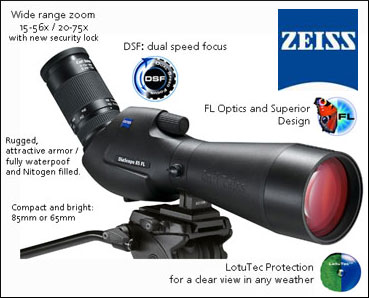
This marks the third major industry award for the ZEISS DiaScope this year. The 85mm DiaScope also won the 2010 Outdoor Life Editor’s Choice Award and Petersen’s Hunting magazine’s Editor’s Choice Award. The DiaScope is available in 65mm or 85mm models, straight or angled, and newly-designed eyepieces include the Vario D 20-75X, one of the most powerful and versatile eyepieces on the market today. All DiaScope eyepieces boast Zeiss’ LotuTec® water-repellant coating and a new bayonet locking system that securely locks the eyepieces yet still allows quick eyepiece changing.
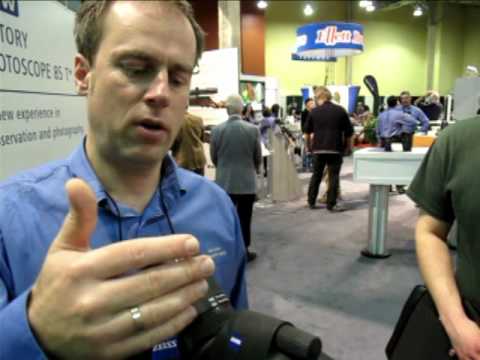
At the 2010 SHOT Show, this Editor had a chance to interview Stephan Albrecht, Project Engineer for the impressive new 85mm Diascope. In the video below, Stephan explains the important new features of the award-winning spotting scope, including the dual-speed focus system and the new, high-power 20-75X eyepiece.
Leupold’s Mark 4 Tactical Spotting Scope is now the standard Scout Sniper Observation Telescope (SSOT) of the U.S. Marine Corps, the first new spotting scope the Corps has used in decades. Leupold’s compact MK4 variable-power spotter replaces the fixed 20X M49 spotting scope fielded by the Marines since World War II. The Mark 4 Tactical spotter was also selected by the U.S. Army for use with its XM110 Semi-Auto Sniper System (SASS). This same Mark 4 spotting scope, with either Mil-dot or Horus reticles, is available for civilian purchase.
Only 12.4 inches long, the MK4 spotting scope is extremely compact for its magnification level. Though it weighs just 37 ounces, it boasts a rugged, armored magnesium body that is nitrogen charged and 100% waterproof. Other good features of the MK4 include generous eye relief, multi-coated lenses, and rubber fold-down eyecups. A front focal plane (FFP) reticle magnifies the reticle along with the image, so users can estimate range at any power setting using the Mil Dot or Tactical Milling Reticle. CLICK HERE for full MK4 Spotting Scope Specs.
Folded Light Path Design Yields High Power in Small Package
By “folding” the entering light in a ‘Z’-path, the Newtonian-reflector design achieves high magnification in a very compact optic that is easy to pack and carry. Leupold’s efficient Folded Light Path (FLP) lens and mirror optical system allow the Mark 4 to deliver the effective optical path of a scope twice its length. We have also found that, compared to conventional spotting scopes, the Leupold spotter is more stable in windy conditions because it has much less overhang and a smaller cross-section than conventional designs. The folded-path Newtonian design makes perfect sense for spotting scopes that need to be carried in the field. A similar folded-light-path design is used in the superb, $5000.00 Zeiss Optronics 20-60x72mm Tactical Spotting Scope.
Leupold Now Offers Horus Reticle Options in MK4 Spotting Scopes
While the Marines use the MK4 Spotting scope with a conventional Mil Dot reticle, Leupold now offers Horus H32 and H36 ranging reticles as options. The H32 has a mil line for target measurement and speed estimation, while the H36 features an inverted “L” in Inch Of Angle (IOA) for easy ranging. The Mil Dot reticle matches those found in military riflescopes, allowing a spotter to quickly range a target, while viewing the same sight picture as the shooter. The Horus H32 and H36 provide a more complex grid that allows range estimation, target speed calculation, and 2nd-shot-correction.
To learn about more about the sophisticated Horus reticles, visit HorusVision.com.
Leupold has launched a dedicated website to educate hunters and shooters about the Custom Dial System (CDS™) feature for VX-3® riflescopes. The innovative CDS system is darn clever. Basically what Leupold has done is create calibrated elevation knobs that allow hunters and varminters to simply dial the yardage to their targets, rather than input a specific number of clicks. For example, to shoot a buck at 300 yards, you simply rotate the elevation turret to “3” on the scale. CDS helps hunters and shooters get on target at any range, with any load, by matching their scopes to the ballistics of their ammunition.
Leupold’s CDS system is a user-friendly invention that can really simplify shooting at multiple yardages. The big single-digit Arabic numerals on the elevation dial correspond to 100-yard intervals, while the smaller numbers show 50-yard intervals. (Click values are otherwise 1/4-MOA.) No longer do you have to remember specific come-ups for particular distances. For the CDS system to work correctly however, your load’s ballistics must match a set of master loads that Leupold uses to calibrate the dial scales. Hunters using most common cartridges should find a calibrated load that matches their muzzle velocity and bullet BC. CDS turrets are available on these scopes: VX-3 3.5-10x40mm, VX-3 3.5-10x50mm, VX-3 4.5-14x40mm, VX-3L 3.5-10x50mm and VX-3L 4.5-14x50mm.
Free CDS Calibrated Dials with Purchase of VX-3 Scopes
Leupold’s CDS system is explained at www.leupold.com/VX-3CDS. Visitors to the VX-3 CDS webpage will find an educational video and graphics, an overview of how the system works and its advantages, and details on a special offer. With the purchase of any VX-3 CDS riflescope, shooters receive two customized, ballistically-matched adjustment dials ($100 retail value) at no extra cost. This offer ends December 31, 2010. Click the image below to learn more (turn down your speakers before clicking as a loud video will auto-play).
The new Zeiss Victory DiaScope 85mm T* FL spotting scope from Carl Zeiss has been named Editor’s Choice by Petersen’s Hunting magazine. The 2010 Spotting Scope Review, featured in the magazine’s September issue, compared spotting scopes from many manufacturers and the new ZEISS DiaScope, with its revolutionary Dual Speed Focus (DSF) system, came out on top. Petersen’s editors wrote: “The innovative Dual Speed Focus (DSF) system is something you almost have to try to believe. It automatically transfers from macro-adjustment to fine-tuning like no other scope. This is our pick of the litter, price be damned. $2,999.00.”
straight or angled bodies both boasting a rubber-armored exterior for protection. Eyepieces are available as variable 20-60x, 20-75x, or fixed 40x. A 65mm version of the new Diascope is also available, but we feel that, if you’re going to spend this kind of money ($3000.00 for 85mm with 20-60X eyepiece), you should go with the 85mm. The 20-75X eyepiece only delivers 15-56X when used with the smaller 65mm Diascope.
New DiaScope Wins Other Awards
The new Zeiss Victory DiaScope 85 T* FL Spotting Scope has earned two other prestigious awards. First the new 85mm DiaScope won the coveted Red Dot Design Award. “All products honored with the red dot design award had to impress an international jury. These products [must] demonstrate their quality in one of the toughest design competitions in the world,” says Professor Dr. Peter Zec, speaking on behalf of Design Zentrum Nordrhein Westfalen which issues the Red Dot Design Awards.
At the NRA Annual Meeting on May 14, the Zeiss 85mm DiaScope was named an “Editor’s Choice” by Outdoor Life Magazine. Outdoor Life’s editors praised its “optically superior [flourite] glass in a surprisingly lightweight chassis”. The ZEISS DiaScope won the low-light test, had a top resolution score and “the two-speed focus and wide-angle eyepiece sparkled”, according to the test team.


 Anti-Glare Filters from Art Neergaard
 Gray Filter Preferred
 Filter Works with Fixed & Variable Apertures


 New Leupold Scope for M24E1
 With either a Horus H27 or H58 reticle in the front focal plane, the scope can accurately range at all magnification settings (the reticle magnifies with the image). The 34mm maintube allows for ample windage and elevation adjustment — a full 100 MOA of elevation and 100 MOA of windage adjustment.

 Leupold’s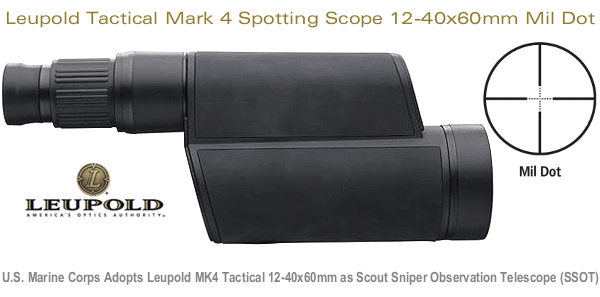


 Leupold’s CDS system is a user-friendly invention that can really simplify shooting at multiple yardages. The big single-digit Arabic numerals on the elevation dial correspond to 100-yard intervals, while the smaller numbers show 50-yard intervals. (Click values are otherwise 1/4-MOA.) No longer do you have to remember specific come-ups for particular distances. For the CDS system to work correctly however, your load’s ballistics must match a set of master loads that Leupold uses to calibrate the dial scales. Hunters using most common cartridges should find a calibrated load that matches their muzzle velocity and bullet BC. CDS turrets are available on these scopes: VX-3 3.5-10x40mm, VX-3 3.5-10x50mm, VX-3 4.5-14x40mm, VX-3L 3.5-10x50mm and VX-3L 4.5-14x50mm.
 New DiaScope Wins Other Awards


