|
|
August 4th, 2010
To compete with the vaunted Leica Geovids, Steiner Optik has released its new 10×50 porro-prism binoculars equipped with a built-in Laser Rangefinder. Steiner’s new model 398 10×50 LRF Military Rangefinder Binoculars feature a handy two-button interface and a powerful Class 1 laser rangefinder with claimed maximum ranging distance of 1,600 yards. That meets or beats the range of any other commercial laser rangefinder on the market. Beam divergence on the Steiner LRF binocular is impressively narrow. This allows ranging at very long distances. Steiner claims: “With sunshine and good visibility, the unit’s accuracy is within one yard at ranges up to 380 yards, within two yards to 763 yards, and within approximately 0.5% to 1,600 yards.”

Yes, There is a Mounting Slot for Tripods and Monopods
We were pleased to see that Steiner’s LRF binoculars incorporate a 1/4-20 tripod adapter mount. We think all “serious” laser rangefinders should have mounts for tripods and/or monopods. You simply can’t make use of the full ranging capability of these devices unless you can hold them rock steady when aiming at far-away objects. Steiner’s “easy-on” two-button control also helps you aim precisely. With some LRFs, such as the Swarovski LaserGuide, you must press down quite hard to activate the “on button”. This can upset your aim.

New LRF Binoculars are Built Tough Inside and Out
The new Steiner LRF binoculars are built to withstand tough use, even though, at 46 ounces, they are still fairly lightweight. The chassis is made with Makrolon®, a fiber-reinforced polycarbonate material that is very impact resistant. The exterior is fully armored with Nitrile Butadiene Rubber (NBR) for protection. The interior is pressurized with dry nitrogen fill and is waterproof to 16 feet. All alloy components are anodized, and external metal parts are enamel-finished to prevent corrosion.
Lowest Web Price is Under $2100.00
Though Steiner’s 10×50 LRF binos have “Military” in the product name, this unit can be purchased by the public. Current “street price” at most online optics dealers is $2,499.00. However a few dealers are now undercutting MAP pricing, so if you shop around, you may find the model 398 Steiner 10×50 Military LRF binoculars for under $2,100.00. DigitalFoto.com is listing the unit at $2079.48. For comparison, DigitalFoto.com sells the 8×56 Leica Geovid rangefinder binoculars for $2699.00.
July 30th, 2010
 Valdada 36X Scope, First Report: Benchrest shooter and noted gun writer James Mock recently tested Valdada’s new 36X Benchrest scope on his PPC. Valdada scopes are made by IOR (Industry Optic Romania) in Bucharest, Romania. James was impressed with the scope — and it certainly didn’t hurt his performance any. With the Valdada on top of his PPC, James nailed a 0.150″ three-shot group at 200 yards during testing earlier this week. Below you’ll find Mock’s first impressions of the Valdada 36X, along with photos of the scope mounted on his rifle. James — Thanks for sharing this! Valdada 36X Scope, First Report: Benchrest shooter and noted gun writer James Mock recently tested Valdada’s new 36X Benchrest scope on his PPC. Valdada scopes are made by IOR (Industry Optic Romania) in Bucharest, Romania. James was impressed with the scope — and it certainly didn’t hurt his performance any. With the Valdada on top of his PPC, James nailed a 0.150″ three-shot group at 200 yards during testing earlier this week. Below you’ll find Mock’s first impressions of the Valdada 36X, along with photos of the scope mounted on his rifle. James — Thanks for sharing this!
 NEW Valdada 36X Benchrest Scope NEW Valdada 36X Benchrest Scope
by James Mock
Yesterday, I received one of Valdada’s new 36X BR scopes for testing. My initial tests proved that Valdada may have a winner. The scope has 7-layer coating on their German glass optics for a superb image. The 1/8th-minute clicks are positive and they repeat well. The reticle is a 1/8th MOA floating dot with 1 MOA hash marks for both windage and elevation. The scope has a very smooth worm gear parallax side adjustment that is marked in meters. Overall I am impressed with the initial testing. The suggested retail is around $1295.00, but I don’t know what the “street price” will be. Here are a couple pictures that show the scope mounted on My BAT-actioned rifle, currently fitted with a PPC barrel.

June 29th, 2010
 We recently had a chance to test the new Chimera Titanium Rings from TacticalRifles.net. The Chimera Rings are “ultra-premium” items designed to compete with the very best tactical rings on the market. As you’d expect, they’re expensive. The 30mm Chimera Rings retail for $224.00 per matched set, including Torx driver. Though these fat boys are beefy in size, offering 7.5 square inches of clamping area per set (way more than most rings), they are very light weight. A medium-height, 30mm Chimera ring weighs just 84 grams (2.96 ounces). We recently had a chance to test the new Chimera Titanium Rings from TacticalRifles.net. The Chimera Rings are “ultra-premium” items designed to compete with the very best tactical rings on the market. As you’d expect, they’re expensive. The 30mm Chimera Rings retail for $224.00 per matched set, including Torx driver. Though these fat boys are beefy in size, offering 7.5 square inches of clamping area per set (way more than most rings), they are very light weight. A medium-height, 30mm Chimera ring weighs just 84 grams (2.96 ounces).
The Chimera rings are precision-machined to exacting tolerances. We had our Mark, our in-house machinist, check them out and he was very impressed: “These rings exhibit beautiful fit and finish and are extremely tough. The fit of the ring bases on a Picatinny rail is perfect. I liked the radius shapes given to most of the surfaces. The front and back faces of each ring are standard flat planes, and the ring caps have a flat disc in their centers, but the remainder of the cap and the sides of the bodies are gently curved. This design requires sophisticated machining processes to pull off, but it looks good. The larger-than-standard heads on the cap hardware, 8-32 X #25 Torx, are another departure that looks well thought out. One danger this increased head size would present if the fasteners were threading into typical 6061 aluminum bodies would be the potential to over-torque and strip the threads with the larger #25 Torx wrench. However, since the titanium bodies have approximately double the tensile strength of 6061 aluminum this is not a problem.”
 Assymetrical Tensioning by Design Assymetrical Tensioning by Design
The Chimera Titanium Rings employ an assymetrical clamping design. This should allow the rings to provide stronger clamping force with less chance of ring distortion. Here’s how they work. After placing the scope in the lower halves of the rings, you screw down the top halves on one side only (opposite the bolt head that clamps to the Picatinny rail). After the three Torx screws are tightened fully on one side, so that the top Ring half butts firmly on the bottom half, there will still be a small gap on the opposite side of the ring (see photo). Don’t worry — that is by design. Final torque is applied to the side with the gap. With the final tensioning done on one side only, the scope is less prone to twist. Furthermore, the manufacturer claims this design puts less stress on the scope tube during mounting.

We did fit the Chimera rings to a Leupold LRT 8-25x50mm scope with 30mm tube. Fit was excellent with no high or low points. With the rings installed as instructed, with one side first clamped flush and the opposite side then torqued to spec, the scope was very secure. On removal the Chimera rings left no visible marks on the tube. I can’t say that it would be a waste of time to lap these rings, but on our Leupold scope the fit was perfect, and the “grip” was uniform over the entire clamping surface.

Tactical Precision System TSR™ Rings
TSR™ rings made by Tactical Precision Systems (TPS) have a clamping design very similar to the Chimera Titanium Rings. After placing the scope in the TSR ring set, you clamp down one side (of the ring tops) until metal meets metal. This then leaves a gap of 0.020″ on the other side. The TSR Picatinny 30mm 7075 Aluminum Medium Rings cost $82 in aluminum or $94.00 in alloy steel. The TSR rings are narrower than the Chimeras, and have two Torx bolts per side, rather than the three on the Chimeras.

M3 Hinged Scope Rings from American Rifle Company
An even more radical clamping system is employed by the new, patent-pending M3 Scope Rings from The American Rifle Company. The top section of the M3 rings is attached with a hinge on one side. After placing the scope in the bottom section of the M3 rings, you swing the upper ring half into place over the scope tube. Then the clamping is done with two inverted (head-down) machine screws that actually pull the hinged ring section downwards. This is designed to put less stress on the scope than conventional rings. The axis of the screws is tangential to the scope tube. Sophisticated finite element analysis (FEA) was used to develop the “over the top”, tangential-clamping ring design. According to the manufacturer, this design evenly distributes clamping forces over the tube and “eliminates the damaging effects of [scope] bending”. The manufacturer claims that, with its rings, “no significant stress concentrations are present on the scope tube”. American Rifle Co. backs up these claims with a series of 3D stress analyses published on its website.

Credit The Firearm Blog for reporting on the M3 ring design.
Disclosure: TacticalRifles.net loaned a pair of Chimera Titanium Rings for testing and evaluation.
June 28th, 2010
 In May, we reported on the new MicroSight invented by engineer (and shooter) David Crandall of the Idaho National Laboratory (INL). The MicroSight keeps both near and far objects in sharp focus, simultaneously imaging two distinct focal planes. This break-through technology allows the shooter to see a sharp image of the target and a sharp image of his iron sights at the same time. In May, we reported on the new MicroSight invented by engineer (and shooter) David Crandall of the Idaho National Laboratory (INL). The MicroSight keeps both near and far objects in sharp focus, simultaneously imaging two distinct focal planes. This break-through technology allows the shooter to see a sharp image of the target and a sharp image of his iron sights at the same time.
The MicroSight is not a lens per se. Rather it is a phased Zone Plate that focuses light beams through diffraction. Zone Plates, first studied by Frenchman Augustin-Jean Fresnel in the 1800s, focus light via a set of concentric rings that alternate between transparent and opaque. The transparent sections let some light waves pass through unchanged, focusing objects that are far away (basically, at infinity). But light passing the edges of the opaque rings gets diffracted, which brings nearby objects into focus. This produces a seemingly impossible result — sharp images of distant and near objects, simultaneously.

The MicroSight is not just a laboratory experiment. Prototype versions have been crafted and placed on test rifles. INL has licensed the technology to Apollo Optical Systems which is right now working with gunsight manufacturers to adapt the MicroSight design to a variety of products. In the future, some MicroSight-equipped products might add refractive power to the Zone Plate, allowing target magnification as well as focusing.
WATCH the VIDEO below to see the MicroSight in Use and to learn how it works…


June 28th, 2010
 At SHOT Show in January, Nightforce revealed a new Hi-Speed option for its NXS scope line-up. This nearly doubles the MOA range for each turn of the elevation knob, giving a full 20 MOA of elevation for a single rotation. For most long-range calibers that means you can hit targets from 50 yards out past 700 yards all within a single turret rotation. That makes it far less easy to get confused with your long-range zeros. At SHOT Show in January, Nightforce revealed a new Hi-Speed option for its NXS scope line-up. This nearly doubles the MOA range for each turn of the elevation knob, giving a full 20 MOA of elevation for a single rotation. For most long-range calibers that means you can hit targets from 50 yards out past 700 yards all within a single turret rotation. That makes it far less easy to get confused with your long-range zeros.
We’ve been waiting for the “Hi-Speed” option to arrive. Well the wait is almost over — Nightforce Optics has begun taking orders for the new “Hi-Speed” ZeroStop feature for the following 5 models:
NXS 3.5-15x50mm
NXS 3.5-15x56mm
NXS 5.5-22x50mm
NXS 5.5-22x56mm
NXS 3.5-15x50mm F1 (First focal plane reticle)
The above scope models (with hi-speed turret) will be offered with either 1/4-MOA adjustments and 20 MOA per rotation, or 1/10th Mil-Radian adjustments and 10 Mil-Radians per rotation.
Nightforce reports it “will begin shipping these new featured models -– in limited numbers –- by mid to late July, 2010. There will be a 3% price increase per respective model (excluding the NXS1550 F1).”
June 25th, 2010
 MidwayUSA is running a sale right now on Burris Signature and Signature Zee scope Rings and Pos-Align inserts. The Burris Signature Rings feature polymer inserts that fit between the scope tube and the ring itself. This protects the scope finish and also allows the scope tube to self-align within the rings. By using offset inserts with different thicknesses, you can keep your scope centered in its range of travel. You can also use the offset inserts to pre-load elevation into your scope, thus avoiding the need to purchase an expensive angled base for shooting at long ranges. MidwayUSA is running a sale right now on Burris Signature and Signature Zee scope Rings and Pos-Align inserts. The Burris Signature Rings feature polymer inserts that fit between the scope tube and the ring itself. This protects the scope finish and also allows the scope tube to self-align within the rings. By using offset inserts with different thicknesses, you can keep your scope centered in its range of travel. You can also use the offset inserts to pre-load elevation into your scope, thus avoiding the need to purchase an expensive angled base for shooting at long ranges.
As examples of the current savings, Burris 1″ Signature Zee Weaver-Style Rings High Rings are marked down from $36.99 to $32.99. A set of Burris 1″ Pos-Align Offset Inserts (.005, .010 and .020) is now just $10.99, marked down from $14.99.
June 24th, 2010
AccurateShooter.com has a new sponsor, Webyshops.com, which sells a full range of sporting optics for hunters, varminters, and competition shooters. To kick off WebyShops’ participation with our website, Mike Orlov, who runs Webyshops, has agreed to provide some EXCLUSIVE specials for AccurateShooter.com readers. These specials, just for our readers, are a full $50 below the normal low price. The Super-Sale items are limited quantity, first come, first serve, and subject to availability. When they’re gone, they’re gone. Go ahead and comparison-shop first. We think you’ll find these exclusive specials are hard to beat. For example, the Eotech 516 sells for $456.56 at Amazon.com, and $479.99 at Cabelas.com.
IMPORTANT: To qualify for these special prices, use Coupon Code ACCSHOOTER when you check out with your online order. For phone orders, call (800) 851-9329, ask for MIKE, and say you are an AccurateShooter.com reader.
June 15th, 2010
Bushnell Inc. and Leupold & Stevens have settled their respective lawsuits relating to the Leupold True Ballistic Range® (TBR) technology, and the Bushnell Angle Range Compensation (ARC) technology. So ends the legal battle of competing angle-compensation indication systems. In February, Leupold & Stevens sued Burris, Bushnell, and Zeiss for patent infringement in federal court for the District of Oregon. Then, in a separate action in the District of Kansas, Bushnell sued Leupold & Stevens for patent infringement. This week, after months of negotiations, the two companies dismissed their claims against each other, the two sides having reached an amicable settlement. The terms of the settlement were not disclosed, but neither company will be required to discontinue selling any of its products.

“We are pleased with the settlement, because it allows our customers to go on using and enjoying Bushnell laser rangefinders with our patented ARC technology, and we can focus our resources and energy on further developing and marketing new and innovative products,” said Phil Gyori, Executive Vice President of Marketing at Bushnell.
Previously, in March, Leupold removed Carl Zeiss Optical from Leupold’s patent suit. Though originally named as a defendant, Zeiss was dismissed from the suit because its products do NOT incorporate an inclinometer to compensate for angled shots. The inclinometer is a key element of Leupold’s patent.
June 11th, 2010
Imagine a riflescope that could sense target distance and shift from wide field-of-view/low magnification for closer shots to higher magnification for longer-range shots. Just think of the benefits for a hunter. He could just place his cross-hairs on a buck and the scope would automatically zoom to the optimal magnification. Does this sound like science fiction?
 Well the Defense Advanced Research Projects Agency (DARPA) is betting millions of tax dollars that an auto-adjusting rifle scope will soon be science FACT. DARPA recently awarded Lockheed Martin a $3.93 contract to develop a “next generation” Dynamic Image Gunsight Optic, aka DInGO. The DInGO scope automatically calculates the range with a low power laser rangefinder, digitally zooms in on it and accounts for environmental conditions such as wind using sensors built into the scope. It then projects the bullet’s point-of-impact calculated from the embedded ballistics computer. DInGO is based on Lockheed Martin’s One Shot Advanced Sighting System, which utilizes similar technology to automatically transmit crosswind information to a sniper’s scope and move the crosshairs to show the corrected point of aim. Well the Defense Advanced Research Projects Agency (DARPA) is betting millions of tax dollars that an auto-adjusting rifle scope will soon be science FACT. DARPA recently awarded Lockheed Martin a $3.93 contract to develop a “next generation” Dynamic Image Gunsight Optic, aka DInGO. The DInGO scope automatically calculates the range with a low power laser rangefinder, digitally zooms in on it and accounts for environmental conditions such as wind using sensors built into the scope. It then projects the bullet’s point-of-impact calculated from the embedded ballistics computer. DInGO is based on Lockheed Martin’s One Shot Advanced Sighting System, which utilizes similar technology to automatically transmit crosswind information to a sniper’s scope and move the crosshairs to show the corrected point of aim.
“Current scopes are optimized for a single target range, impacting soldiers’ effectiveness and survivability when engaging targets at different distances,” said Dan Schultz, vice president and general manager of Lockheed Martin’s Mission Systems & Sensors Ship & Aviation Systems business. “DInGO will solve this problem, significantly increasing soldiers’ ability to rapidly reconfigure optics for use from short to long ranges and improving marksmanship capabilities for all soldiers.”
While DInGo scope technology will first be implemented for the military on M-4 and M-16 rifles, eventually this automatic ranging/zooming system could be adapted to hunting rifles. Such a system would be great for game hunters. When the prey appears at close range, the scope would provide a relatively low magnification level for enhanced field of view. If the animal was much farther away, the scope would autmatically increase magnification to allow more precise aiming. Hopefully this will be one example of military technology “trickling down” to the general public for sporting use.
Other Scopes with Built-In Laser Rangefinders
Both Burris and Zeiss currently offer hunting scopes with integrated laser-rangefinders that calculate holdover, based on target distance. The Burris Eliminator even projects the calculated aiming (hold) point as a red dot on the vertical crosshair. Shown below is the view through the lens of the Burris Eliminator scope, with the red dot showing holding point. Just place the red dot on the center of the target and pull the trigger. However, neither the Burris nor Zeiss rangefinding scopes automatically adjust magnification/field of view. Zooming in or out must still be done manually. That’s where the DInGO system offers something radically new.

June 6th, 2010
The new Zeiss Victory DiaScope 85 T* FL Spotting Scope has earned two prestigious awards. First the new 85mm DiaScope won the coveted Red Dot Design Award. “All products honored with the red dot design award had to impress an international jury. These products [must] demonstrate their quality in one of the toughest design competitions in the world,” says Professor Dr. Peter Zec, speaking on behalf of Design Zentrum Nordrhein Westfalen which issues the Red Dot Design Awards.
 Outdoor Life Magazine. Outdoor Life’s editors praised its “optically superior [flourite] glass in a surprisingly lightweight chassis”. The ZEISS DiaScope won the low-light test, had a top resolution score and “the two-speed focus and wide-angle eyepiece sparkled”, according to the test team. Outdoor Life Magazine. Outdoor Life’s editors praised its “optically superior [flourite] glass in a surprisingly lightweight chassis”. The ZEISS DiaScope won the low-light test, had a top resolution score and “the two-speed focus and wide-angle eyepiece sparkled”, according to the test team.
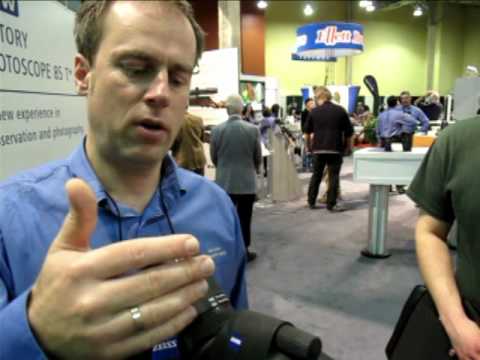
We checked out the new 85mm DiaScope at SHOT Show and reviewed its new features with Zeiss project engineer Stephan Albrecht. Make no mistake about it. This is an outstanding spotting scope. We loved the dual-rate focus system. You can do the gross focus really fast, but still achieve the ultra-precise focus needed to resolve bullet holes at long ranges. We were very impressed with the new higher-magnification 20-75X zoom eyepiece. This is one of the best variable-power eyepieces ever made, and long-range shooters can definitely use the extra magnification (75x vs. 60x). Overall the Zeiss system is surprisingly compact, yet it offers excellent low-light performance, plus higher magnification than most other spotting scopes in the 80mm category.
The new 85mm Diascope is available in straight or angled bodies both boasting a rubber-armored exterior for protection. Eyepieces are available as variable 20-60x, 20-75x, or fixed 40x. A 65mm version of the new Diascope is also available, but we feel that, if you’re going to spend this kind of money ($3000.00 for 85mm with 20-60X eyepiece), you should go with the 85mm. The 20-75X eyepiece only delivers 15-56X when used with the smaller 65mm Diascope.
|


