|
|
June 25th, 2010
 MidwayUSA is running a sale right now on Burris Signature and Signature Zee scope Rings and Pos-Align inserts. The Burris Signature Rings feature polymer inserts that fit between the scope tube and the ring itself. This protects the scope finish and also allows the scope tube to self-align within the rings. By using offset inserts with different thicknesses, you can keep your scope centered in its range of travel. You can also use the offset inserts to pre-load elevation into your scope, thus avoiding the need to purchase an expensive angled base for shooting at long ranges. MidwayUSA is running a sale right now on Burris Signature and Signature Zee scope Rings and Pos-Align inserts. The Burris Signature Rings feature polymer inserts that fit between the scope tube and the ring itself. This protects the scope finish and also allows the scope tube to self-align within the rings. By using offset inserts with different thicknesses, you can keep your scope centered in its range of travel. You can also use the offset inserts to pre-load elevation into your scope, thus avoiding the need to purchase an expensive angled base for shooting at long ranges.
As examples of the current savings, Burris 1″ Signature Zee Weaver-Style Rings High Rings are marked down from $36.99 to $32.99. A set of Burris 1″ Pos-Align Offset Inserts (.005, .010 and .020) is now just $10.99, marked down from $14.99.
June 24th, 2010
AccurateShooter.com has a new sponsor, Webyshops.com, which sells a full range of sporting optics for hunters, varminters, and competition shooters. To kick off WebyShops’ participation with our website, Mike Orlov, who runs Webyshops, has agreed to provide some EXCLUSIVE specials for AccurateShooter.com readers. These specials, just for our readers, are a full $50 below the normal low price. The Super-Sale items are limited quantity, first come, first serve, and subject to availability. When they’re gone, they’re gone. Go ahead and comparison-shop first. We think you’ll find these exclusive specials are hard to beat. For example, the Eotech 516 sells for $456.56 at Amazon.com, and $479.99 at Cabelas.com.
IMPORTANT: To qualify for these special prices, use Coupon Code ACCSHOOTER when you check out with your online order. For phone orders, call (800) 851-9329, ask for MIKE, and say you are an AccurateShooter.com reader.
June 15th, 2010
Bushnell Inc. and Leupold & Stevens have settled their respective lawsuits relating to the Leupold True Ballistic Range® (TBR) technology, and the Bushnell Angle Range Compensation (ARC) technology. So ends the legal battle of competing angle-compensation indication systems. In February, Leupold & Stevens sued Burris, Bushnell, and Zeiss for patent infringement in federal court for the District of Oregon. Then, in a separate action in the District of Kansas, Bushnell sued Leupold & Stevens for patent infringement. This week, after months of negotiations, the two companies dismissed their claims against each other, the two sides having reached an amicable settlement. The terms of the settlement were not disclosed, but neither company will be required to discontinue selling any of its products.

“We are pleased with the settlement, because it allows our customers to go on using and enjoying Bushnell laser rangefinders with our patented ARC technology, and we can focus our resources and energy on further developing and marketing new and innovative products,” said Phil Gyori, Executive Vice President of Marketing at Bushnell.
Previously, in March, Leupold removed Carl Zeiss Optical from Leupold’s patent suit. Though originally named as a defendant, Zeiss was dismissed from the suit because its products do NOT incorporate an inclinometer to compensate for angled shots. The inclinometer is a key element of Leupold’s patent.
June 11th, 2010
Imagine a riflescope that could sense target distance and shift from wide field-of-view/low magnification for closer shots to higher magnification for longer-range shots. Just think of the benefits for a hunter. He could just place his cross-hairs on a buck and the scope would automatically zoom to the optimal magnification. Does this sound like science fiction?
 Well the Defense Advanced Research Projects Agency (DARPA) is betting millions of tax dollars that an auto-adjusting rifle scope will soon be science FACT. DARPA recently awarded Lockheed Martin a $3.93 contract to develop a “next generation” Dynamic Image Gunsight Optic, aka DInGO. The DInGO scope automatically calculates the range with a low power laser rangefinder, digitally zooms in on it and accounts for environmental conditions such as wind using sensors built into the scope. It then projects the bullet’s point-of-impact calculated from the embedded ballistics computer. DInGO is based on Lockheed Martin’s One Shot Advanced Sighting System, which utilizes similar technology to automatically transmit crosswind information to a sniper’s scope and move the crosshairs to show the corrected point of aim. Well the Defense Advanced Research Projects Agency (DARPA) is betting millions of tax dollars that an auto-adjusting rifle scope will soon be science FACT. DARPA recently awarded Lockheed Martin a $3.93 contract to develop a “next generation” Dynamic Image Gunsight Optic, aka DInGO. The DInGO scope automatically calculates the range with a low power laser rangefinder, digitally zooms in on it and accounts for environmental conditions such as wind using sensors built into the scope. It then projects the bullet’s point-of-impact calculated from the embedded ballistics computer. DInGO is based on Lockheed Martin’s One Shot Advanced Sighting System, which utilizes similar technology to automatically transmit crosswind information to a sniper’s scope and move the crosshairs to show the corrected point of aim.
“Current scopes are optimized for a single target range, impacting soldiers’ effectiveness and survivability when engaging targets at different distances,” said Dan Schultz, vice president and general manager of Lockheed Martin’s Mission Systems & Sensors Ship & Aviation Systems business. “DInGO will solve this problem, significantly increasing soldiers’ ability to rapidly reconfigure optics for use from short to long ranges and improving marksmanship capabilities for all soldiers.”
While DInGo scope technology will first be implemented for the military on M-4 and M-16 rifles, eventually this automatic ranging/zooming system could be adapted to hunting rifles. Such a system would be great for game hunters. When the prey appears at close range, the scope would provide a relatively low magnification level for enhanced field of view. If the animal was much farther away, the scope would autmatically increase magnification to allow more precise aiming. Hopefully this will be one example of military technology “trickling down” to the general public for sporting use.
Other Scopes with Built-In Laser Rangefinders
Both Burris and Zeiss currently offer hunting scopes with integrated laser-rangefinders that calculate holdover, based on target distance. The Burris Eliminator even projects the calculated aiming (hold) point as a red dot on the vertical crosshair. Shown below is the view through the lens of the Burris Eliminator scope, with the red dot showing holding point. Just place the red dot on the center of the target and pull the trigger. However, neither the Burris nor Zeiss rangefinding scopes automatically adjust magnification/field of view. Zooming in or out must still be done manually. That’s where the DInGO system offers something radically new.

June 6th, 2010
The new Zeiss Victory DiaScope 85 T* FL Spotting Scope has earned two prestigious awards. First the new 85mm DiaScope won the coveted Red Dot Design Award. “All products honored with the red dot design award had to impress an international jury. These products [must] demonstrate their quality in one of the toughest design competitions in the world,” says Professor Dr. Peter Zec, speaking on behalf of Design Zentrum Nordrhein Westfalen which issues the Red Dot Design Awards.
 Outdoor Life Magazine. Outdoor Life’s editors praised its “optically superior [flourite] glass in a surprisingly lightweight chassis”. The ZEISS DiaScope won the low-light test, had a top resolution score and “the two-speed focus and wide-angle eyepiece sparkled”, according to the test team. Outdoor Life Magazine. Outdoor Life’s editors praised its “optically superior [flourite] glass in a surprisingly lightweight chassis”. The ZEISS DiaScope won the low-light test, had a top resolution score and “the two-speed focus and wide-angle eyepiece sparkled”, according to the test team.
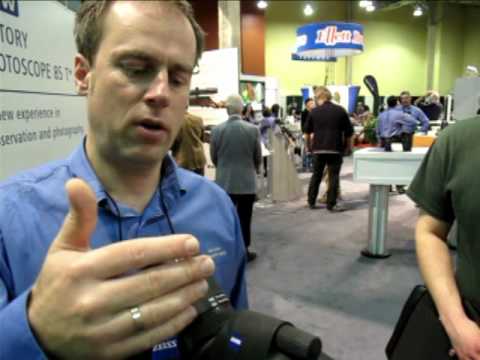
We checked out the new 85mm DiaScope at SHOT Show and reviewed its new features with Zeiss project engineer Stephan Albrecht. Make no mistake about it. This is an outstanding spotting scope. We loved the dual-rate focus system. You can do the gross focus really fast, but still achieve the ultra-precise focus needed to resolve bullet holes at long ranges. We were very impressed with the new higher-magnification 20-75X zoom eyepiece. This is one of the best variable-power eyepieces ever made, and long-range shooters can definitely use the extra magnification (75x vs. 60x). Overall the Zeiss system is surprisingly compact, yet it offers excellent low-light performance, plus higher magnification than most other spotting scopes in the 80mm category.
The new 85mm Diascope is available in straight or angled bodies both boasting a rubber-armored exterior for protection. Eyepieces are available as variable 20-60x, 20-75x, or fixed 40x. A 65mm version of the new Diascope is also available, but we feel that, if you’re going to spend this kind of money ($3000.00 for 85mm with 20-60X eyepiece), you should go with the 85mm. The 20-75X eyepiece only delivers 15-56X when used with the smaller 65mm Diascope.
June 3rd, 2010
Carl Zeiss Sports Optics has renewed its “Zeiss Field Days” promotion for 2010. Zeiss now offers substantial rebates on scopes, binoculars, and laser rangefinders.

$100 Rebate on Zeiss Victory 8×26 PRF Rangefinder
Earlier this year we comparison-tested a variety of Laser Rangefinders. Among the units tested, we felt that the overall best value, considering price, was the Zeiss Victory 8×26. While larger and heavier than the Leica CRF1200, it was easier to hold and aim, and it costs much less than the Swarovski Laser Guide. The Zeiss Victory is an outstanding unit and now it is even cheaper. From June 1 – December 31, 2010, Zeiss is providing a $100.00 mail-in rebate on the award-winning Victory 8×26 T* PRF Laser Rangefinder. (There is also a $100.00 rebate for the Victory Compact Binoculars.)

$150.00 Rebate on Zeiss Riflescopes with Rapid-Z® Varmint Reticle
From June 1 – September 30, 2010, Carl Zeiss is offering a $150 mail-in rebate for customers purchasing Zeiss Victory Diavari 6-24X or Zeiss Conquest 6-20X Riflescopes with the Rapid-Z® Varmint reticle. The Zeiss Rapid-Z® Varmint Reticle provides multiple, labeled hold-over points so you quickly move from one target distance to another without dialing scope elevation.

According to Erik Schumacher, president of Carl Zeiss Sports Optics: “This is our way of saying ‘thank you’ to our many loyal customers…. Given the challenging economic times, these reduced prices and rebate promotions should help many more to afford the best optics possible.”
Rebate Rules
All rebate request forms must be completed and postmarked 30 days from the date of purchase. Payment will be made by Carl Zeiss Visa Prepaid Cards. CLICK THIS LINK for more info about the Zeiss Field Days Promotion. Click the links below for PDF Rebate Forms.
Victory PRF Rangefinder Rebate Form PDF | Victory/Conquest Riflescope Rebate Form PDF
May 30th, 2010
 Need a rifle-scope, laser rangefinder, or spotting Scope? Here are some special promotions for this Memorial Day weekend. The Optic Zone is offering 7% off all online purchases of optics through 6/1/2010. Optics Planet is offering Free Shipping plus $10.00 off orders over $100. Cabela’s has free shipping on optics through 6/4/2010. Need a rifle-scope, laser rangefinder, or spotting Scope? Here are some special promotions for this Memorial Day weekend. The Optic Zone is offering 7% off all online purchases of optics through 6/1/2010. Optics Planet is offering Free Shipping plus $10.00 off orders over $100. Cabela’s has free shipping on optics through 6/4/2010.
Cabelas.com — Free Shipping on Optics
Cabela’s is offering free shipping on all optics. Enter promotion code 5XVIEW during checkout. This deal is valid through June 4, 2010 and is good on Standard Express shipping to U.S. Deliverable Addresses ONLY.
Optics Planet — $10 Off and Free Shipping
Optics Planet is offering FREE shipping on many items, plus $10.00 off any purchases over $100.00. To get the discount, use coupon code “HEROES” (without quote marks) at checkout.
The Optic Zone — 7% Off and Free Shipping on Items over $300
Here’s the best deal of all. Now through 6/1/2010, you can get 7% off online purchases with The Optic Zone. Use coupon code “FP07-79557″ during check-out through The Optic Zone’s secure web-store. Note: this applies to online purchases only. Also, The Optic Zone regularly offers FREE UPS ground shipping on all orders over $300.00.
May 24th, 2010
MidwayUSA has released a new 3-10x40mm MIL/MIL Tactical Grand Slam scope, made exclusively for MidwayUSA by Weaver. The scope features 1/10 mil radian (MIL) clicks, with a claimed 56 MOA (16.5 MIL) of BOTH windage and elevation adjustment. On sale through May 31, 2010 for just $299.00, the scope is regularly priced at $399.00. Even at the $400.00 mark, the scope is one of the most affordable optics combining a mildot reticle with mil-based clicks — a smarter system than what you find on so-called “tactical” scopes combining mildot reticles with 1/4-MOA clicks.
With the MIL/MIL arrangement you can directly translate what you see in the scope to click values. For example, with a MIL/MIL scope, a shot 1.5 mils low would require an elevation turret adjustment of 1.5 mils (15 clicks). This eliminates MOA conversions and allows the shooter to make adjustments quickly without having to do any math.

This tactical scope features Weaver’s Micro-trac® adjustment system, resettable 1/10 mil radian (MIL) windage and elevation turrets and a Mil-dot reticle. The scope has a one-piece tube and is claimed to be waterproof, fogproof and shockproof. The new Grand Slam 3-10X boasts a fast-focus eyepiece adjustment, and Weaver claims the multi-coated, Japanese-made lenses afford 94% light transmission. That’s a pretty tall claim regarding light transmission; if it’s true, then this scope should have very good low-light performance. We suspect the true average light transmission (across all visible wavelengths) is quite a bit lower. 94% transmission would put the new scope on a par with premium optics costing $1200.00 or more — which is unlikely. As noted above, the new 3-10x40mm scope is on sale for $299.00 for the rest of May, 2010. The scope is covered by Weaver’s Lifetime Warranty.
May 11th, 2010
 New optical technology from the Idaho National Laboratory could make a big improvement in non-telescopic iron sights. INL’s new “MicroSight” uses a Zone Plate design to focus light so that BOTH front sight-blade AND the target appear in sharp focus. This technology could be a major breakthrough for iron sights shooters, particularly older shooters whose eyes have difficulty focusing at multiple distances. The INL MicroSight’s wafer-thin optical element is only about 1/4″ in diameter, and it has been successfully adapted for match-type rear iris sight systems. Initial tests show the MicroSight can help iron sights users shoot better scores, with less eye fatigue. The technology could aid hunters and soldiers, too, either as a primary aiming device or as a lightweight backup for other types of sights. New optical technology from the Idaho National Laboratory could make a big improvement in non-telescopic iron sights. INL’s new “MicroSight” uses a Zone Plate design to focus light so that BOTH front sight-blade AND the target appear in sharp focus. This technology could be a major breakthrough for iron sights shooters, particularly older shooters whose eyes have difficulty focusing at multiple distances. The INL MicroSight’s wafer-thin optical element is only about 1/4″ in diameter, and it has been successfully adapted for match-type rear iris sight systems. Initial tests show the MicroSight can help iron sights users shoot better scores, with less eye fatigue. The technology could aid hunters and soldiers, too, either as a primary aiming device or as a lightweight backup for other types of sights.
By Mike Wall, INL Communications and Governmental Affairs
The human eye has trouble focusing on both a firearm’s front sight blade and the much more distant target at the same time. Idaho National Laboratory’s innovative gunsight technology, the MicroSight, helps the eye solve this problem. The MicroSight, a disc smaller than a dime, brings both the target and the iron sight into simultaneous focus, giving marksmen a better sight picture. The new sight has national-security applications, as it could improve safety and performance for American soldiers. Millions of target shooters and hunters should also benefit.

“The MicroSight gives you much of the performance you’d get out of a holographic or telescopic sight,” says INL engineer David Crandall, who developed the technology. “But it’s more reliable, much lighter-weight and much cheaper.” The alternating rings on zone plates bring faraway and nearby objects into focus simultaneously.
The Magic of Zone Plates — Concentric Rings Using Diffraction
Crandall is not an optics specialist. Most of his past work tended toward infrastructure engineering, like nuclear projects with INL’s Advanced Test Reactor. But Crandall is a highly accomplished target shooter — he’s a member of the U.S. national long-range rifle team — and he’s come up with several other shooting-related inventions. He patented a rifle-stabilizing shooting sling, and a small, powerful breaching shotgun that could help law-enforcement personnel storm buildings more effectively.

One day, Crandall was leafing through an optics textbook, and he stumbled across a section on “zone plates.” Zone plates are optical devices that resemble lenses. But whereas lenses focus light using refraction — essentially, changing the direction of light waves by changing their speed — zone plates use diffraction. Diffraction describes how waves bend, break up, spread out and interfere with each other as they encounter obstacles. The diffraction of sound waves, for example, explains how you can hear someone’s voice from around a corner.
Zone plates focus light via a set of concentric rings that alternate between transparent and opaque. The transparent sections let some light waves pass through unchanged, focusing objects that are far away (basically, at infinity). But light passing the edges of the opaque rings gets diffracted, which brings nearby objects into focus. The seemingly impossible result: sharp images of distant and near objects, simultaneously.

Zone plates aren’t new. Frenchman Augustin-Jean Fresnel worked out their underlying scientific principles in the early 1800s. [Editor’s NOTE: A.J. Fresnel also invented the Fresnel lenses used in light-houses and theatrical spotlights.] But it took Crandall, with his shooter’s eye, to recognize the potential zone plates held for improving gunsights. “Competitive shooters are always looking for an edge, for something better,” Crandall says. “You have to, when you’re going against the best in the world.”
Crandall took his idea to INL’s technology transfer division, which also saw the promise and agreed to fund his research. He eventually found his way to phased zone plates. Phased zone plates replace the opaque rings with transparent glass of varying thickness. This accomplishes the same goal — diffraction — but does so without losing as much light, yielding brighter images. After much tinkering, Crandall came up with the MicroSight. CLICK HERE for giant-sized photo of MicroSight element.
A Smaller, Cheaper, More Robust Sight
Without help from zone plates, the human eye cannot focus on two different planes at the same time. So shooters using only standard-issue iron sights see either a blurry target or a blurry sight. The MicroSight isn’t the only gunsight technology that can overcome this problem, of course. Telescopic sights magnify targets, bringing them into close, crisp focus. And holographic sights project a red dot onto an image of the target, showing clearly where the shot will land.
But telescopic and holographic sights have their drawbacks. For one thing, they tend to be bulky. Both types of sight can add one or two pounds to the weight of a rifle — not a trivial concern for hunters or soldiers who must lug their weapons for miles over rough terrain. Further, both are complex instruments with fragile components. They can break, especially if dropped or banged against a rock or tree. Red-dot sights require batteries, which can die. And neither one is cheap: most red-dot sights cost more than $100, and high-quality telescopic ones can run $1,000 or more.
 MicroSight Should Be Versatile and Affordable MicroSight Should Be Versatile and Affordable
The MicroSight, on the other hand, is tiny — its zone plate is thin and only about 1/4″ in diameter — and relatively cheap. Crandall says the sight should cost significantly less than red-dot and telescopic sights when Apollo Optical Systems, which licensed the technology, takes it to market. The company is currently working with gunsight manufacturers to design and develop various MicroSight versions. In the future, some of these versions might add refractive power to the zone plate, achieving some level of target magnification. Crandall foresees other possible applications as well, such as in handguns and night-vision goggles. In any situation that requires taking the long and the short view at the same time, this new INL technology could provide a major advantage.
Article and graphics courtesy Idaho National Laboratory (INL), www.inl.gov.
March 25th, 2010
 Leupold & Stevens, Inc. has dropped its lawsuit against Carl Zeiss Optical, Inc. for patent infringement. The lawsuit originally alleged that Zeiss, Burris, and Bushnell infringed Leupold & Stevens’ patent for True Ballistic Range (TBR®) technology. With Zeiss out, the action will proceed against Burris and Bushnell only. Leupold & Stevens, Inc. has dropped its lawsuit against Carl Zeiss Optical, Inc. for patent infringement. The lawsuit originally alleged that Zeiss, Burris, and Bushnell infringed Leupold & Stevens’ patent for True Ballistic Range (TBR®) technology. With Zeiss out, the action will proceed against Burris and Bushnell only.
While Zeiss products do allow users to input ballistic groups and display holdover values at specific yardages, it has been determined that they do not incorporate an inclinometer to compensate for uphill/downhill shot angles. Therefore, they do not infringe on US Patent Number 7,654,029 owned by Leupold & Stevens, Inc.
Bushnell Sues Leupold Claiming Infringement of ARC Patents
Leupold’s patent infringement suit will continue against Bushnell and Burris. But Bushnell Inc. has its own patent infringement action against Leupold & Stevens. In February, Bushnell filed suit alleging that Leupold infringed on Bushnell’s U.S. patents for Angle Range Compensation (ARC) and Rain Mode laser-rangefinder technology. Bushnell’s ARC and Leupold’s True Ballistic Range (TBR) are competing technologies. The courts will have to resolve whether both ARC and TBR patents can co-exist.
|


