|
|
February 14th, 2009
The editors of the NRA’s American Hunter magazine recently tested 10 brands of shooting glasses, determining how well the eyewear could shield users from shotgun birdshot. Eyewear samples were tested at 25, 15, 10, 8, and 5 yards, using #8 shot. One ANSI Z87.1-certified polycarbonate sample was then repeat-tested with #6 shot, #4 shot, #2 steel and buckshot. Read Full Test Report.
 The tests provided some very important conclusions: The tests provided some very important conclusions:
1. The glasses marked Z87.1+ (“plus” is a high-impact rating) performed the best. Overall, Z87.1-rated polycarbonate lenses provided excellent protection from birdshot at 10-15 yards and beyond. Some Z87.1+ eyewear even blocked birdshot at 8 yards.
2. You can’t necessarily rely on price as an indicator of quality. The $12 Bollé VX and the $5.95 Pyramex Rendezvous both worked better than some much more expensive brands. The $5.95 Pyramex, in fact, was one of only three products that stood up to the #8 birdshot at 8 yards. The Pyramex does carry a Z87.1+ rating.
3. Avoid no-name, un-rated plastic eyewear. American Hunter Editor Jeff Johnston writes: “It’s a mistake to assume that any plastic-lens sunglasses off the rack at the local 7-11 are made of polycarbonate and therefore are effective as shooting glasses—cheap plastics are not polycarbonates; in fact, wearing them could be worse than wearing nothing, as they can introduce sharp shards of plastic to your eyes in addition to the projectile(s) that caused them to break.”
To learn more about safety standards for shooting glasses, read our comprehensive Guide to Eye Protection for Shooters.
February 6th, 2009
For someone looking for a lightweight, compact, under-$400 spotting scope, we’ve been impressed by the Bushnell Elite 15-45x60mm. This straight-view spotter employs a roof-prism design to achieve high magnification with a short footprint. It is rubber-armored for durability.

The Elite® 15-45x60mm is just 12.2 inches long and weighs a mere 26.5 ounces. Fogproof, waterproof, and shockproof, the Elite series of spotting scopes (there is also a 20-60x70mm version), also feature Bushnell’s patented Rainguard® lens coating. Field tests have shown that the hydrophobic Rainguard coating really works — condensation from rain, fog or snow forms in much smaller droplets than with standard coatings.
The U.S. military apparently agrees that the 15-35x60mm Elite is a lot of scope for the money. Bushnell Outdoor Products was recently awarded a contract for a special military version of the Elite® 15-45x60mm spotting scopes. The spotting scopes will be used by multi-national forces around the world. Bushnell started shipping the units in late 2008.

Government buyers were impressed by the performance of the Elite 15-45 in a small, affordable package. The Elite 15-45x60mm is a compact unit that is easy to carry and quickly set up. Bushnell will make some modifications to the spotting scopes to meet military specifications. For more info, visit www.bushnell.com or call 800-423-3537 for consumer inquiries.
No Substitute For Higher Power and Bigger Objectives
We recently field-tested two premium spotting scopes (Pentax 100mm and Swarovski 80mm), to determine if they could resolve 6mm bullet holes at 600 yards. They both did. In good viewing conditions, a premium spotter can resolve 6mm holes at very long ranges, but you’ll want at least 55x power (and more is better — 80x is not too much in ideal viewing conditions). Our test scopes had 100mm and 80mm objectives. Don’t expect this compact Bushnell 15-45x60mm to perform on a par with a $2000.00 spotting scope with more magnification and bigger lenses.
January 22nd, 2009
 In our SHOT Show reports, we’ve provided in-depth coverage of notable new optics from March (DEON), Leica, Nightforce, Schmidt & Bender, and Zeiss. To learn more about new riflescopes, spotting scopes, rangefinders, and binoculars from other manufacturers, you can download the January 16th (Friday) edition of the SHOT Daily. In our SHOT Show reports, we’ve provided in-depth coverage of notable new optics from March (DEON), Leica, Nightforce, Schmidt & Bender, and Zeiss. To learn more about new riflescopes, spotting scopes, rangefinders, and binoculars from other manufacturers, you can download the January 16th (Friday) edition of the SHOT Daily.
Just posted online, this NSSF e-zine dedicates five pages to new products from all the well-known optics manufacturers, including Bushnell, Burris, Leupold, Nikon, Pentax, and Swarovski. Plus, on page 64 of the Jan. 16th SHOT Daily, there is an in-depth feature on Nikon’s new hunting scopes, including the Predator Hunter with BDC reticle, and the low-magnification (1.1-4×24) 30mm African Series scopes, designed for dangerous game. The Predator Hunter bullet-drop-compensating (BDC) reticle has a center circle that subtends a coyote’s vital area at 100 yards, for quick sighting and target acquisition. Nikon’s new scopes, “are an example of an increase in specificity of hunting and shooting products,” according to SHOT Daily.
CLICK HERE to Download 1/16 SHOT Daily with OPTICS REPORT (.pdf file).

January 21st, 2009
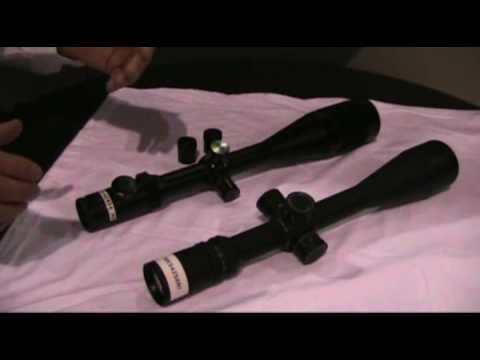
Nightforce Benchrest and NXS scopes are very popular among our readers. The Nightforce 12-42×56 BR model is the scope of choice for top F-Class and 1000-yard shooters. It offers sharp glass, big-time magnification, precision parallax control (via a rotating front objective), plus a wide choice of reticles. The NXS offers these same qualities, but it uses a side-parallax adjustment. Many shooters building their first long-range rifle ask: “Which should I get–the Nightforce BR model or the NXS?” Nightforce Sales Manager Kyle Brown helps answer that question in the video below. Kyle explains the major (and minor) differences between the BR and NXS scope lines. You’ll find this video very informative.
CLICK HERE to download Nightforce Optics 2009 Catalog (Large 5mb .pdf file).
New First Focal Plane 3.5-15×50 F1 Scope
The new NXS 3.5-15×50 F1 was created at the request of U.S. military and other professional sharpshooters. They wanted a rugged scope that offers a choice of elevation/windage click values, plus a ranging reticle in the First Focal Plane (FFP). A reticle located in the first focal plane remains in the exact same ratio to the target across the scope’s entire magnification range. The FFP design (designated by “F1″) is optimal for rangefinding purposes, since the reticle’s markings remain consistent relative to target size at all magnification settings. The 3.5-15×50 F1 scope will be offered with three click-value options: 1/4 MOA, 0.1 Mil Radians, or 1.0 MOA elevation + 0.5 MOA windage clicks.

CLICK HERE to download NXS 3.5-15×50 F1 Scope Spec Sheet (.pdf file).
HOT NEWS: If you like the NXS 3.5-15×50 F1, take note that a Nightforce 5.5-22×56 FFP NXS is coming in the fall of 2009. Plus Kyle told us that the Nightforce Compacts and First Focal Plane scopes now have their scope bodies (main tubes) crafted in Idaho. So, you’ll notice that they are now stamped “Made in USA”.
New Ballistic-Compensating Reticles Offered for 2009
Nightforce will offer a variety of NEW ballistic reticles that provide “hold-over” hashmarks corresponding to the trajectories of popular hunting rounds. With these new christmas-tree style reticles, hunters and varminters can rapidly adjust to different ranges without cranking-in elevation with the top turret. The reticles also include horizontal hash marks corresponding to calculated wind drift in mph (not MOA or mils). There are three basic options, one each for low, medium, and high velocity cartridges. In addition, Nightforce may offer Horus ballistic-compensating reticles, and possibly the Holland ART reticle, later in the spring of 2009.
 New Ring-Top Bubble Level and Level/ADI New Ring-Top Bubble Level and Level/ADI
Nightforce has introduced the Top of Ring Bubble Level, a low-profile level built directly into the top half of a scope ring. This fits in place of the upper half of a Nightforce Ring (e.g. Unimount, Direct Mount, and Nightforce Mil-Spec). Like other anti-cant devices, the NF bubble level helps the shooter avoid canting his rifle left or right, which can throw off the shot significantly at long ranges. The level also helps ensure your reticle is plumb when mounting the scope.
The Top of Ring Bubble Level is available in three versions: 1) Ring Level alone; 2) Ring level with integrated mount for the Nightforce ADI (Angle Degree Indicator); 3) Ring level with mount plus ADI unit (complete system). You’ll want the ADI if you often have to make shots at steep angles. Calibrated in degrees, the ADI instantly gives the shooter the up or down angle for the shot. Plug that number into a ballistics calculator (or angle drop chart) and you’ve got your corrected drop for the true range to the target.
We definitely recommend an ADI for hunting, and for competition disciplines where up/down angle shots are required. The ADI is simple, robust, and requires no batteries. Mounting the ADI directly to the scope ring is the slickest installation yet for this useful device. This mounting set-up was a collaboration between Shawn Carlock (Defensive Edge), Ward Brian (Sniper Tools ACI), and Nightforce.
For more info, contact Nightforce Optics, Inc., 1040 Hazen Lane, Orofino, ID 83544, tel (208) 476-9814, or visit NightforceOptics.com
January 19th, 2009
 Kelbly’s rolled out a remarkable new March benchrest scope at SHOT 2009: a completely new 36-55x52mm zoom, quite unlike anything on the market. Produced by Japan’s DEON Optical, the design was inspired, in part, by suggestions from ace shooter Lou Murdica. Lou looked at the current benchrest disciplines, from point-blank (100/200) BR, all the way to the 1000-yard game. He found that most benchresters (both short-range and long-range) rarely dialed their scopes below 30-power, and most wanted more magnification than their current scopes offered, for times when the conditions were good. Lou asked DEON’s designers if they could build a high-quality BR scope with about a two-times zoom ratio. But he also wanted the reticle to be super-stable, so it didn’t move at all when adjusting the magnification. Kelbly’s rolled out a remarkable new March benchrest scope at SHOT 2009: a completely new 36-55x52mm zoom, quite unlike anything on the market. Produced by Japan’s DEON Optical, the design was inspired, in part, by suggestions from ace shooter Lou Murdica. Lou looked at the current benchrest disciplines, from point-blank (100/200) BR, all the way to the 1000-yard game. He found that most benchresters (both short-range and long-range) rarely dialed their scopes below 30-power, and most wanted more magnification than their current scopes offered, for times when the conditions were good. Lou asked DEON’s designers if they could build a high-quality BR scope with about a two-times zoom ratio. But he also wanted the reticle to be super-stable, so it didn’t move at all when adjusting the magnification.
Six months later, DEON (March) sent Lou a prototype. It was very different that other scopes on the market because the zoom function is done in the eyepiece — similar to a spotting scope. In fact DEON dubbed the new scoped the “EP” zoom, with the “EP” referring to “eye piece”. Lou has tested the new March 36-55X and he says “The cross-hair absolutely doesn’t move when you zoom because everything is taking place behind the cross-hairs at the eyepiece. For a benchrest shooter this is a BIG deal — if you don’t like the mirage, you can change from 55 power to 36 power in the middle of your group, and know that point of impact will not change.” The other great feature of the scope is the near-constant eye relief — it changes only about 1/2″ from 36 power to full 55X magnification. Lou says, “you can zoom through the entire range and barely need to move your head at all.” Lou has worked with all the March BR scopes, from the early 40X through the lastest zooms. He feels that the new 36-55 may be the best yet for short-, medium-, and long-range benchrest shooters. As Lou explains: “It takes care of 100 to 1000-yard shooting with one scope. What more would you ever need?”


Click Here to download March 36-55×52 Spec Sheet.
Revolutionary March 1:10 Ratio Zooms Amaze Optics Experts
March pulled off a major coup at SHOT Show. The new March 1-10x35mm and 2.5-25x42mm zooms were the talk of the Show. This is the first time ANY major manufacturer has been able to achieve a 10 times zoom ratio. March’s booth was mobbed as engineers from other optics companies came to see how March “achieved the impossible”. And the optics guys had to fight past a line-up of military personnel — from the USA, Canada, Israel, and Germany. Lou Murdica was there and he reports: “Once word of these scopes hit the show’s Tactical area, March had more military and law enforcement people from the U.S. and other countries than you could imagine.”
 Apparently, the U.S. Military has been asking domestic manufacturers to perfect a 1-10X zoom for years, and the response was always: “It can’t be done.” Well, starting from a blank page, the engineers at Japans’ DEON Optical Design Corp. (makers of the March), figured it out. For the military this is a HUGE technical breakthrough because a 1-power optic is ideal for close quarters combat (or house-clearing) while 10-power is a good setting for long-range sniper work. The two 1:10 ratio zooms both feature 1/4 MOA clicks, illuminated plex or MTR2 reticles, 30mm tubes, and a huge elevation range: 180 MOA for the 1-10×35 and 100 MOA for the 2.5-25×42. Both these scopes are slated for June 2009 deliveries. The 1-10×35 scope is expected to sell for $1500.00 while the 2.4-25×42 will cost about $2400.00. Apparently, the U.S. Military has been asking domestic manufacturers to perfect a 1-10X zoom for years, and the response was always: “It can’t be done.” Well, starting from a blank page, the engineers at Japans’ DEON Optical Design Corp. (makers of the March), figured it out. For the military this is a HUGE technical breakthrough because a 1-power optic is ideal for close quarters combat (or house-clearing) while 10-power is a good setting for long-range sniper work. The two 1:10 ratio zooms both feature 1/4 MOA clicks, illuminated plex or MTR2 reticles, 30mm tubes, and a huge elevation range: 180 MOA for the 1-10×35 and 100 MOA for the 2.5-25×42. Both these scopes are slated for June 2009 deliveries. The 1-10×35 scope is expected to sell for $1500.00 while the 2.4-25×42 will cost about $2400.00.

We are told that David Tubb will be working on adapting a specialized long-range reticle for the 2.5-25×42. Representatives of the U.S. Navy SEALs showed great interest in the 2.5-25x42mm March. In addition to the two smaller tactical scopes, March displayed 5-32x52mm and 10-60x52mm tactical scopes. These feature 1/8-MOA clicks and an MTR1 reticle.
January 19th, 2009
 Every year, the high-end Spotting Scopes from the major optics-makers seem to get bigger, better, and, unfortunately, more expensive. Leica rolled out its new flagship spotting scope, a black-bodied 82mm Televid with APO glass. A smaller version with a 65mm front objective will also be available in Spring 2009. These babies are expensive — the 82mm (body only, no eyepiece), carries a $3,195.00 MSRP, while the 65mm (body only, no eyepiece) retails for $2,295.00. Every year, the high-end Spotting Scopes from the major optics-makers seem to get bigger, better, and, unfortunately, more expensive. Leica rolled out its new flagship spotting scope, a black-bodied 82mm Televid with APO glass. A smaller version with a 65mm front objective will also be available in Spring 2009. These babies are expensive — the 82mm (body only, no eyepiece), carries a $3,195.00 MSRP, while the 65mm (body only, no eyepiece) retails for $2,295.00.
What justifies the high price is Leica’s superb APO (apochromatic) glass. This is formulated to give enhanced light transmission with less chromatic aberration. Other manufacturers offer “ED”, “HD” or “LD” low-dispersion glass, but the Leica APO glass is probably about as good as it gets. (Both the new 65mm and the 82mm are offered at a lower price with HD flouride glass, with APO lenses an extra-cost upgrade.) Leica claims the optical performance of the new spotting scopes is significantly better than the preceding models. The High Definition (HD) versions use specialized glass in a newly designed lens arrangement for improved clarity and contrast.
Jason checked out the new 82mm Televid with angled body. It was fitted with a 25-50x Wide Angle eyepiece. Jason noted the eyepiece offered good eye relief, and the clarity and sharpness was outstanding. The scope is fairly compact (front to rear) for an 80mm-class optic. Is the 82mm APO Televid better than the Big Zeiss or Swarovski (or the new ED-glass Kowa)? Only field tests can reveal that. “You’d have to get the Leica 82mm in the field with a couple other premium spotters with low dispersion glass and see how they perform side by side.” The Leica Televid 82 and Televid 65 spotting scopes are both available with straight or angled eyepiece housing, with either HD or APO glass.

Leice also announced that, for 2009, it will offer HD (High Definition) lenses in its popular Geovid Laser-Range-Finding Binoculars. MSRP on the HD Geovids starts at $2395.00.
For more information, visit www.leica-camera.com.
January 17th, 2009
Our readers have been waiting a long time for Schmidt & Bender to bring its new high-magnification 12.5-50×56 PMII scope to American shores. We first wrote about this scope in April 2007. In February 2008, we published a follow-up report on the example we saw at the 2008 SHOT Show. For nearly two years now, American shooters have been asking us: “When can I get one?” Well, save your pennies. The scopes are slated to arrive in June, 2009 … provided S&B can deliver on its promises.
S&B Says the 12-50×56 Will Arrive in June
The scope will be available in the USA in limited quantities in summer 2009, hopefully in June. There are two (2) models. The black PMII version has a 34mm main tube and either 1/8 or 1/4 MOA clicks. Both normal and rapid two-turn counter-clockwise (CCW) turrets are offered on the PMII. The silver Field Target model comes with a 30mm main tube, and parallax that works down to 7 meters. Both scopes are priced at US $2849.00.


For more information, contact Mark Cromwell, Schmidt & Bender’s USA Manager, at 800-468-3450.

January 8th, 2009
Nightforce has unveiled its new NXS 2.5-10x32mm compact scope. Made in the USA, this scope was created to answer the requests of hunters for greater low-light capability in a compact, lightweight optic. The NXS 2.5-10×32 measures 12″ long and weighs just 19 ounces. The new NXS 2.5-10×32 has a larger exit pupil than the 2.5-10×24 NXS. This improves light transmission and allows faster target acquisition. Both compact scopes are bright and rugged. In fact, Nightforce compact NXS scopes were originally created for the U.S. Special Forces for use with night-vision devices.

Shown with optional ZeroStop and windage limiter turrets.
 Multiple Choices for Elevation/Windage Click Values Multiple Choices for Elevation/Windage Click Values
The NXS 2.5-10×32 is available with fully enclosed hunting-style turrets with 1/4-MOA clicks, or exposed target-style turrets with either 1/4-MOA clicks, 0.1 Mil-Rad clicks, or 1.0 MOA elevation + .5 MOA windage adjustments. The target-style turrets include the Nightforce ZeroStop control. This allows quick return to zero regardless of previous elevation adjustments.
New Ballistic Reticles for Compact NXS Scopes
Three new ballistic reticles are also being offered with Nightforce 2.5-10×32 and 2.5-10×24 NXS Compacts. Designed for hunting to 600 yards, the family of reticles are based upon a common NP-1 design, but with three different configurations for high, medium, and low-velocity cartridges respectively. Among the three reticles, you’ll find one that adapts well to most common hunting cartridges.
The ballistic reticles are designed to be sighted-in at 200 yards. Elevation lines are marked in 50-yard intervals to 600 yards, including a 100-yard mark.This gives you the ability to quickly hold-over in known intervals, so you can engage targets at multiple distances without cranking your scope knobs. With the new reticles, windage compensation is also marked in 5 and 10 MPH increments–so you can quickly respond to wind changes by shifting to a hash mark left or right of center. Nightforce claims that this “smart reticle” system has been proven to be up to twice as fast as traditional rangefinding reticles.
For more info, contact Nightforce Optics in Idaho, (208) 476-9814, or visit Nightforceoptics.com. At the 2009 SHOT Show, Nightforce has booth #9381.
December 24th, 2008
We’ve looked through many different types of spotting scopes. Initially we thought angled was the only way to go. This lets a shooter mount the spotting scope at his side and easily glance through the lens with the scope body rotated 30 to 90°. However, at matches where you spot for a partner, the straight scopes seem to work better. You don’t have to bend your neck down or remove your hat and your “free” eye can scan downrange for wind changes. When spotting for your partner (while seated or standing), a tripod-mounted straight scope was definitely the most “user-friendly” set-up.
Straight (in-line) Spotting Scope
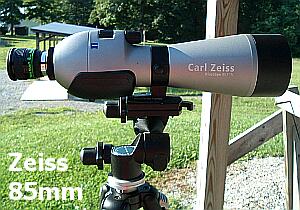
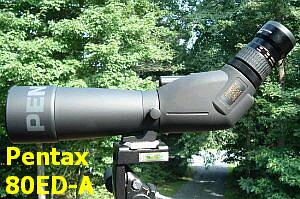
Danny Reever, author of our Spotting Scope Review, tell us: “Straight vs. angled? Man, that’s a tough call! Having used both personally for over a year I’d have to say this: I feel the straight gives you a clearer, sharper image. One less mirror to contend with. If you have a dealer that can give you a side-by-side look at a couple of hundred yards the difference is apparent. That’s one reason Chip Allen chose the straight Zeiss over the angled. On the other hand the angled gives you more options in the way of setup which can be a bonus between cramped benches, when you’re spotting for yourself. I don’t shoot prone, but I think the angled would be the way to go for a solo prone shooter, again more setup options. Another benefit of the angled is that you can keep the tripod lower, a plus on a windy day. The 100MM scopes like the Pentax and Optolyth do not offer an angled body option — maybe there are some engineering issues, or perhaps that’s just to control costs.”
Angled Spotting Scope
Scope Stands for Bench Use
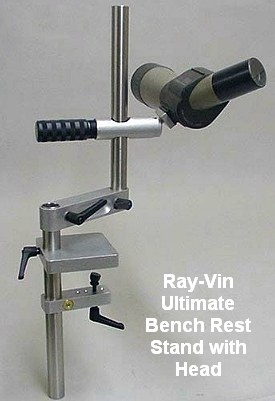
It you plan to use an angled spotting scope on the bench, Ray-Vin has a great clamping system that allows you to position the eyepiece exactly where you want it. The clamp mount Ray-Vin Benchrest Scope Stand allows you to easily adjust the scope height and horizontal position relative to the shooter. A twist handle with a ball joint on the end then lets you set the scope (and angled eyepiece) to any angle you want. It’s a very slick system. At $199.00 for the complete system (not including scope) shown below left, it’s not inexpensive. However, if you already own a Ray-Vin scope head with ball joint, the Benchrest Clamp is just $119.00. Another option for bench use is the Ray-Vin C-2004 “Tactical Tripod” (photo below right). This low-profile, $199.00 unit can be used on the bench or on the ground. Note: the Tactical Tripod uses a 3/4″-diam. vertical shaft, while the Benchrest Scope Stand has a 1″-diam. vertical shaft. Accordingly, the scope heads are not interchangeable between the two units.
December 16th, 2008
We recently shopped the web to find a new pair of protective shooting glasses. Expecting to pay $20 or more per pair, we were surprised to find high-quality UVEX safety glasses for under $9.00! Available from CooperSafety.com, UVEX glasses feature wrap-around lenses and comfortable padded temples and nose bridges. The UVEX line of safety eyewear passes ANSI Z87+ and CSA Z94.3 standards and meets the MIL VO ballistic test for impact protection. UVEX offers a lifetime frame guarantee–something you won’t get with many $100.00 sunglasses. Among the UVEX product line, we liked the UVEX Skyper ($7.80) with its extended side-shields, the UVEX Genesis ($7.75 -$9.92), and the lightweight UVEX XC ($9.07-$10.55). All three come in a variety of lens shades, and replacement lenses are available for under $5.00 per set.

For more information on protective eyewear, read our comprehensive Guide to Shooting Glasses. It explains the various safety standards which apply and gives the pros and cons of the various preferred lens materials: Polycarbonate, Trivex, and SR-91.
CLICK HERE to learn more ….
EDITORIAL — Zero Tolerance Needed on Protective Eyewear
I’ve noticed a disturbing percentage of shooters, novice and expert alike, who fail to wear proper eye protection when shooting from the bench. You’ve probably seen this yourself — experienced shooters who’ll grudgingly wear protective glasses in a match (only because they are required), but who won’t wear glasses while practicing. Or, you may have noticed young shooters who shun protective eyewear because they think safety glasses “look dorky”.
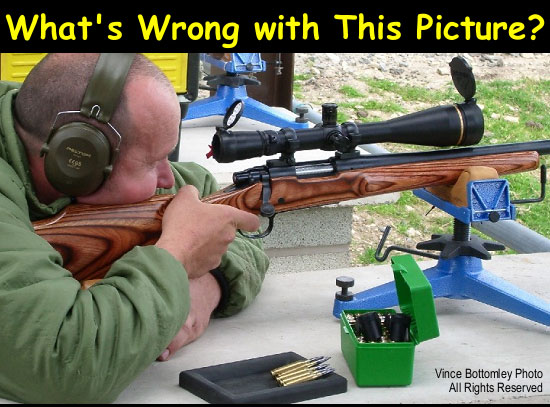
To be honest, guys, I think we need to exercise “ZERO Tolerance” when it comes to eye safety. “Mandatory eye protection” rules need to be enforced… no safety glasses = no shooting, period. Rangemasters must INSIST that ALL shooters on the line wear protective glasses. And when you’re out practicing on your own, wear your safety glasses… always… no matter whether you’re shooting centerfire, rimfire, or even air rifles. One little shard of brass or a popped primer and you could be blinded. Your eyesight is precious. Take care of it!
|


