Leupold has released a new ultra-compact laser rangefinder, the RX-1000. This thing is tiny — not much larger than a pack of cigarettes. The pocket-sized RX-1000 measures 3.8 inches long and weighs just 7.8 ounces. The “street price” for the basic RX-1000 unit is about $350.00 while the TBR® model with built-in ballistics compensation runs about $400.00 (OpticsPlanet.com prices). Both the RX-1000 and RX-1000 TBR units feature an aluminum frame, inside a weatherproof, matte-black, rubber-armored exterior. The RX-1000 TBR is also available in Mossy Oak® camouflage.
Beyond the reduction in size and weight, the notable feature of the RX-1000 is an improved optic with better light transmission. Leupold claims the RX-1000’s 80% light transmission is superior to most other rangefinders. In addition, the RX-1000 features a RED OLED read-out. In low light conditions, the OLED is definitely easier to view that conventional LCD displays.
Leupold claims the RX-1000 has a maximum effective range of 1,000 yards (914.4 meters) on reflective targets. Based on the performance of other Leupold rangefinders, we expect this claim is grossly optimistic and you shouldn’t count on reliable ranging much past 700 yards.
One feature we like about the new RX-1000 are the selectable reticles: a small “Plus Point” crosshair for ranging small targets, a larger outer crosshair, or a combination of the two. This is a feature we’d like to see added to premium rangefinders like the Swarovski laser guide. Choosing a tight reticle lets you aim the device more precisely, which reduces the chance of errant laser returns.
We think it’s wise to pay the money for the TBR model which automatically calculates the shot angle and provides the actual Ballistic Range rather than the straight-line distance to the target. This can be very helpful for hunters shooting at extreme up or down angles in mountainous country. To learn more about the RX-1000, check out Jeff Quinn’s Gunblast.com Review, visit www.leupold.com, or call 1-800-LEUPOLD.
The Sightron 6-24×50mm Mildot is the latest in Sightron’s SIII line-up of side-focus, 30mm riflescopes. This follows the hot-selling 8-32×56mm SIII, which we reviewed last fall. While our 6-24x50mm test sample has a Mildot reticle, Sightron’s new 6-24x50mm scope is also offered with a fine cross-hair (FCH) with target dot reticle. Both Mildot and FCH versions are 14.96″ overall with a near-constant 3.6-3.8 inches of eye relief. Clicks are 1/4 MOA (15 MOA per revolution), and total elevation (and windage) adjustment is listed as 100 MOA (50 MOA on either side of center). That’s a class-leading amount of elevation, which should make the new 6-24×50mm popular with long-range shooters.
Shown above is the Sightron 6-24×50mm Mildot, flanked by a Leupold 8-25×50mm LRT and the Sightron 8-32×56mm. The controls on the 6-24 Sightron are identical to those of its big brother, but it is shorter, with a smaller objective. The shorter length and 50mm front objective allow a 2.8 ounce weight savings over the larger model (21.9 oz. vs. 24.7 oz.).
Sightron 6-24x50mm Quick Review
Assistant Editor Jason Baney has been evaluating the optical qualities of the new Sightron 6-24 Mildot scope. Jason also had a chance to test the scope’s real-world performance in a tactical match. Here is Jason’s report:
“When the new 6-24x50mm mil-dot Sightron SIII arrived, it looked like the little brother of the Sightron 8-32x56mm. Controls and “styling” are similar. This family relationship was made clear as my review of its performance progressed. It shared the same ergonomics, same superior glass, and same unbeatable tracking.
I had a Leupold 8.5-25x50mm LRT for comparison purposes. The Leupold, which is actually 24.3x at max power, is a popular scope with a good reputation for clarity and sharpness. However, the new 6-24x50mm Sightron seemed better in many respects than the Leupold LRT. The Sightron’s glass appeared superior, giving better color rendition, a brighter field of view, and better contrast.
Also, with the Sightron, there was no noticeable parallax lash in the side-focus system. There was no need to start the side-focus at a travel stop every time. You could simply dial the side parallax adjustment and get the observed target in sharp focus with minimal parallax. This has been a problem with some Leupolds (i.e. you can’t get minimal parallax and best focus at the same time.) While observing bullet holes in different colored targets at 300 yards, the Sightron also appeared to show slightly better resolution than the Leupold and therefore better ability to locate individual bullet holes in the paper.”
Field Testing at the Allegheny Sniper Challenge (ASC)
In any competition riflescope, precise, repeatable tracking is absolutely vital. When you crank-in elevation and/or windage you want the reticle to move the exact value you dialed. Then you want the scope to repeat exactly when you return to the original zero. To test the Sightron’s tracking, Jason did more than a simple range test. He tested the scope’s tracking in the “real world”, during a two-day tactical comp.
Jason reports: “The 6-24 was thrown into action right away at the Allegheny Sniper Challenge (ASC) in Seneca Rocks, WV in August 2008. This was a team match that I shot with my father. ASC entails interesting weather, and even more interesting shots. In a matter of two days, over 100 shots are expended and a scope’s adjustments are REALLY put to the test. Maintaining zero is very important, because there are no sighters to check your zero. Shots range from less than 100 yards to nearly 1200 yards, and in the end, everyone has clicked their scope up-and-down 40 times or more. This means 40+ up/down repetitions on the elevation knob. This is as tough a test of a scope’s tracking ability as you’ll find.”
Great Tracking Ability, Excellent Value
So how did the Sightron’s tracking rate? The new Sightron 6-24×50 returned from ASC with the EXACT same 100-yard zero as when it started. This scope maintained its zero as well or better than any other scope out there, including those costing $3000.00+. The scope’s great elevation range was also much appreciated. Jason reports: “With 100+ MOA of elevation available and a 20 MOA base on the rifle, I had enough ‘up’ to shoot all the way out to 1200 yards with no problem.”
In Jason’s opinion this scope will be very hard if not impossible to beat in its price range in many aspects. The new Sightron 6-24 certainly rivals the overall optical quality of the Sightron 8-32×56, and that’s saying a lot. But since it is a Mildot scope there is another level of scrutiny needed. This scope is not a purpose-built tactical scope, but it represents a good base on which to build if Sightron offers enhancements in the future. If a shooter wishes only to use the mil-dots for holdover, he will be well served, but a Front Focal Plane (FFP) reticle would be more useful for serious tactical work. An illuminated reticle would also be welcome, and Jason would like to see a different reticle design with half-mil markings.
Also, some tactical shooters would prefer to have mil-based click values, rather than 1/4 MOA clicks. In raising these points, we need to stress that the $800.00 Sightron 6-24x50mm Mildot is affordable and works well as a general-purpose scope with reticle marks that allow hold-overs. This scope was not designed to compete with a $2700.00 Schmidt & Bender PMII. Jason explains: “I just want the serious tactical guys to understand that the Sightron won’t give you all the features of a dedicated FFP mildot optic with mil-based clicks. However, at about $800.00 average retail, the Sightron 6-24x50mm costs less than a third of what you’ll pay for high-end tactical scopes from S&B or U.S. Optics.”
Right now, Midsouth Shooters Supply has some great deals on refurbished Nikon hunting scopes. If you’re looking for a bargain price on a medium-magnification-range zoom riflescope, CLICK HERE. Remaining inventories are low for many models, so you should act quickly. Here are some of the current offers:
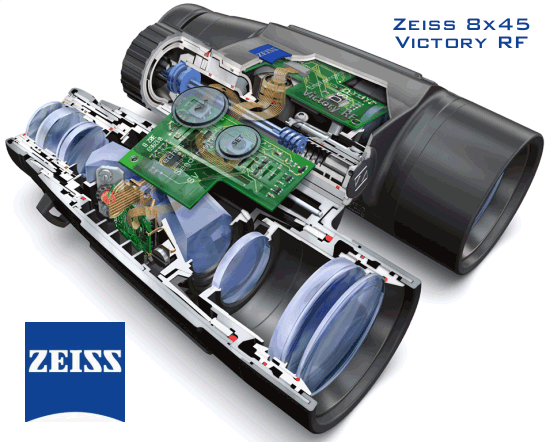
At SHOT Show 2009, we were impressed with the new Zeiss Victory laser rangefinder (LRF), listing it as one of the highlights of the 2009 Show.
A companion product line, the Zeiss Victory range-finding binoculars, have won a series of prestigious awards. Introduced in early 2008, the Zeiss Victory RF was named a “Leading Edge: The Best of What’s Next” product by National Geographic Adventure magazine, which wrote: “Zoom in on an object through the Zeiss Victory 8×45 rangefinding binoculars and a crisp LED display will give you its exact distance — as if you had Million Dollar Man eyesight. Traditional high-end Zeiss lenses and workmanship and a waterproof body complete this first-of-its-kind package.”
The Victory RF, claimed to be the world’s first premium binoculars with digital laser rangefinder, LED Display AND Ballistic Information System (BIS), also won the prestigious Red Dot Design Award in addition to the Chicago Athenaeum: GOOD DESIGN™ Award. Both are international awards that recognize the best design innovations of the year.
Zeiss Victory RF Binoculars Features:
• Ranges from 10 yards to 1,300 yards.
• Integrated design — Victory RF binoculars are the world’s first binoculars with a hinge bridge that do not require a separate laser emitter.
• Tightly focused Beam — The laser beam used in the Victory RFs is narrow with minimal beam divergence, so you can range small targets even at long distances.
• Accurate “One-Touch” rangefinding for a steadier image.
• Ballistic Information System (BIS) that automatically calculates required aiming hold-over at the ranged distance.
Great Performance, but Extremely Expensive
What’s the downside of the Zeiss Victory RF binoculars? They cost a fortune. The Zeiss Victory 8×45 version retails for about $2900.00, while the 10×45 model runs about $3,000. That makes the Zeiss Victory RF Binoculars MORE Expensive than the Leica 8×56 Geovids which have a much larger objective, providing better low-light performance (and a larger exit pupil). And, you can get the smaller 8×42 BRF Geovids for $2245 at Adorama.com and other large online vendors.
Are the 8×45 Zeiss Victory RFs worth $750 more than the 8×42 Leica Geovids? You’ll really have to make that decision for yourself. The Geovids are a known quantity, having proven themselves in the field over many years. The Zeiss Victory RF offers more sophisticated software (with the BIS), and we think the Victory is more secure and comfortable to hold.
Here’s a good deal if you’re looking for reliable, fixed-focal length optic for benchrest competition. MidwayUSA has knocked $43.79 off the price of Sightron SII 36x42mm BRD target scopes — they are now on sale for just $369.99. These same scopes sell elsewhere for up to $450.00. We’ve used this scope model on rimfire and centerfire benchrest rifles from 50 yards to 600 yards, and it worked well. The 1/8-MOA clicks were repeatable and the front-parallax adjustment worked “as advertised”.
Newer Model Available
The scope that is on sale is the SII model that has been available for quite some time. Be aware that Sightron recently introduced an updated “Big Sky” version of its 36-power target scope. This is officially the SIIB 36×42 BRD. This newer SIIB version is slightly longer than the earlier model, and the new model has a bit more eye relief. The main difference is that the earlier model has more elevation adjustment — 50 MOA vs. 40 MOA.
Forum regular Aaron H. (aka “6BR”) has been having great success in the California varmint fields with “Orange Crush”, his super-accurate 6BR rifle. Aaron recently posted his experiences with various laser rangefinder (LRF) types, and field binoculars. While there’s plenty of information available on LRFs, including our own Laser Rangefinder Comparison, it’s harder to find good info on binoculars from the perspective of a varmint hunter. Aaron looked at a variety of premium binoculars, and ended up choosing the 15×45 Zeiss Conquest, after careful consideration.
Choosing the Right Binoculars for Long-Range Varmint Hunting
Aaron writes: “[It] was a hard undertaking to pick the right pair. I decided I wanted a high magnification pair of binos in the 10x to 15x range. I narrowed my choices down to Zeiss, Swarovski, Leica, or Nikon. I was sure I was going to buy the Swarovskis when I started comparison shopping. However, I was wrong… I ended up getting a pair of the Zeiss 15×45 Conquests.”
Aaron reports: “The clarity of the Zeiss binos is awesome. I am glad I took the time to look through each and every pair before I bought. I was also impressed with the Nikon Monarch ATB; for the price, they are impressive. The Swarovskis were awesome too. However, through my eyes, the Zeiss clarity was better.”
The Zeiss 15×45 Binoculars are fairly expensive. At most places they go for about $1100.00 (see chart below), but you can find some better deals. Aaron tells us: “I had to sell other firearms to be able to afford the Zeiss binos and a Swaro 8×30 LRF. If you decide to shoot varmints, at long range, you’ll find out very quickly how important it is to have quality optics. When you spend a bunch of time looking through binoculars, it can become very hard on the eyes. So the better quality binoculars you have, the more comfortable you’ll be during your varmint hunt. I learned the hard way during the beginning years of long range varminting, and I realized how important it is to have quality optics.”
Nikon Monarch ATB Offers Great Performance for the Price
Aaron was impressed with the Nikon ATBs, given their low cost. But Aaron cautions: “It’s very important to go look through the binos before you buy a pair. Had the Zeiss 15×45 Conquests not been so remarkably clear, I probably would have bought a pair of the Nikon Monarch ATBs. If you need a pair of binoculars and you can’t afford the higher end binoculars, I would highly recommend the Nikon Monarch ATBs, offered in both 10-power and 12-power. I would have to say, and I am not making this up, they were close to the clarity of the higher-end binos. I also looked through a pair of the Leupold Golden Ring binos. They are nice, however, I felt the clarity of Nikons were much better and the price was much cheaper.” [Editor: The Nikon 10x42mm and 12x42mm Monarch ATBs retail for about $290.00 and $330.00 respectively at discount vendors such as B&H Photo.]
Aaron added: “One more thing, I am stating my own opinion on what I think works best for me. Another brand of optics might work better for someone else. I don’t want to offend anybody or imply that other brands are bad, I just wanted to give my experience with what I use and have had success with.”
Tips for Holding Binoculars Steady
Nate Haler, another Forum member, offered this advice about high-magnification binoculars: “Unless you are using a tripod or other mechanical support for a binocular, 15x magnification is too much. Image tremble will be much more problematic when trying to hand-hold a binocular of such high magnification. Furthermore, the exit pupil (i.e. the little circle of light transmitted to the ocular lens) will be only 3mm in a 15×45 binocular, which means 15x magnification and a 45mm objective lens. Exit pupil enables you to see the image better or worse in low light. 7mm exit pupil is about as big as a healthy human eye in a young adult can dilate. Smaller than that, and the image is dimmer.”
Editor’s Comment: Nate makes some very good points, but we would add that you can rest your binoculars on a pack or sandbag, or use an inexpensive tripod or bracket to hold the binoculars steady. Zeiss also makes a 12-power version of the binoculars Aaron favored. This editor has used 12x binoculars in the field without difficulty, but you definitely have to learn to “hold steady”. One technological solution is built-in image stabilization. Canon has a series of image-stabilized binoculars (8x, 10x, 12x, 15x, and 18x), and they work very well. The 15×50 is shown below. Regarding the 3mm exit pupil, yes a bigger exit pupil is better in low light, but 3mm should be adequate for daytime hunting. Keep in mind that a shooter using a 25-power riflescope will be looking through an exit pupil that’s 2mm or smaller.
Geovid All-in-One Option (Rangefinding Binoculars)
The Leica Geovid binoculars are another option for hunters. These combine great glass with a built-in Laser Rangefinder. That way you only need one optic for both game spotting and rangefinding. Aaron considered the Geovid option, but it didn’t offer any money savings compared to purchasing binoculars and LRF separately. Additionally, he felt that his Swaro 8×30 rangefinder out-performed the LRF in the Geovids. “The Leica Geovids are excellent. They are just so darn expensive. I think they start around $2600 for the 8×42 and go up to $3300 for the 15×56 pair. I would still choose the Swaro 8×30 LRF over the Geovids. Why? Because the Swaro out-ranges the Geovids by 300 yards and the Swaro is $1600 cheaper. That leaves a lot of cash left over for good binoculars.”
We often hear the question: “What is THE best spotting scope for viewing objects at ultra-long distances”. That’s not a trick question… but maybe there’s a trick answer. The best optic for ultra-long range may not be ONE spotting scope, but rather TWO scopes working in tandem. Military observers and artillery spotters have long used massive binoculars for long-range observation. Texas-based SWFA, one of the nation’s most successful optics vendors, now offers a dual-scope BIGEYES™ system that offers certain viewing properties no single scope can match. Employing two (2) premium 80mm-objective Swarovski spotting scopes with high-definition (HD) glass, the BIGEYES system promises better depth perception and enhanced perceived brightness compared to a single scope. Many people also find that extended viewing through a dual-lens system is less fatiguing than looking through one lens, but that is more about human factors than internal optic quality.
That’s Five Grand Worth of Swarovski Glass
The BIGEYES do work remarkably well. You’ll see these mounted on heavy tripods at long-range matches such as Williamsport. But BIGEYES are not for shooters and hunters on a tight budget. This twin-Swaro set-up is very expensive. SWFA offers two models. The STS80HD20XBE, with 20-power eyepieces, costs $4,929.95. The companion STS80HDZOOM with 20-60X zoom eyepieces (lower photo) runs a whopping $5,129.95. You can also purchase other eyepieces at different magnification, but remember, if you change eyepieces you need to purchase a pair — one for each scope.
Optical Advantages for Hunters
Even if we presume that two scopes are better than one, can a $5K investment in glass be justified? SWFA claims that: “BIGEYES™ allow you to view distant objects in great detail with the equivalent of a 20-60×80 tripod mounted binocular. Porro prism design provides the optimum focal length required to maximize the performance of the 80mm HD (high definition) objectives. BIGEYES offer superior field of view combined with amazing depth perception that no conventional binocular can match. BIGEYES allow you to hunt from a fixed location, providing you the ability to glass animals literally miles a way. You can scout and judge animals with out disrupting their patterns.”
This Editor doubts he could ever afford a set of BIGEYES. But it’s nice to know such a system, complete with mount, is available for those who have the financial resources. For more information, visit SWFA at www.RifleScopes.com.
Readers often ask “What’s the difference between a Weaver scope rail and a Picatinny Rail?” The answer is not as simple as it seems. The dimensions of a Picatinny Rail should be consistent (from one rail-maker to another), since there IS a government spec. Conversely, there is some variance in “Weaver-style” rails. The width of the groove is the most important difference between Picatinny Rails and weaver rails. “Mil-spec” Picatinny rails will have a grove width of 0.206″ while Weaver rails typically have a narrower, 0.180″ groove width.
Brownell’s has a helpful GunTech Article that discusses the Picatinny Rail vs. Weaver Rail. That article explains:
“What are the differences between the ‘Picatinny’ and the ‘Weaver’ systems? The profile of the two systems is virtually identical. Depending on the quality of the machining done by the manufacturer, the two systems should be indistinguishable from the profile. The key difference lies in the placement of the recoil grooves and with width of the grooves. MIL-STD-1913 (Picatinny) grooves are .206″ wide and have a center-to-center width of .394”. The placement of these grooves has to be consistent in order for it to be a true ‘Picatinny’MIL-STD system. Weaver systems have a .180” width of recoil groove and are not necessarily consistent in a center-to-center measurement from one groove to the next.
In many instances, a Weaver system has a specific application that it is machined for, so interchangeability is not necessarily an issue. A MIL-STD-1913 system must adhere to the specifications listed above in order for it to be considered MIL-STD, since the military desires uniformity in the recoil grooves to allow for different systems to be mounted on the weapon with no concern for compatibility.
Now, what does this mean to you? Boiled down, it means that accessories designed for a Weaver system will, in most cases, fit on a ‘Picatinny’ system. The reverse, however, is probably not the case. Due to the larger recoil groove, ‘Picatinny’ accessories will not fit a Weaver system. There are, of course, exceptions to every rule, but for a good rule-of-thumb, [full-width] ‘Picatinny’ won’t fit Weaver, but Weaver will fit ‘Picatinny’.”
Throughout 2009, Sightron is offering purchasers a $50.00 rebate on Sightron SII Big Sky™ riflescopes. To qualify, just purchase any Sightron SII Big Sky™ Series riflescope before December 31, 2009. These scopes feature the ExacTrack™ windage and elevation system, a Broadband lens coating process, one-piece main tubes, and Sigtron’s Lifetime Warranty.
The Fine Print
This offer is valied in the USA only. Purchase of an SII Big Sky™ scope must be made between January 1, 2009 and December 31, 2009. To qualify for the rebate, purchaser must submit Sightron coupon with original sales receipt, warranty card and UPC sticker by March 31st 2010. Rebate offer cannot be combined with any other discounts or offers.
Unfortunately, we still see too many scopes sold to the public with canted reticles. The problem of canted reticles is a serious issue that some manufacturers (both domestic and foreign) have failed to address. (Note: here we are talking about an INTERNAL scope assembly problem that results in reticles being off-axis relative to the turrets. Don’t confuse this with the canting which occurs if you don’t level your rifle. A canted reticle is a scope production defect requiring factory repair.)
One degree of scope reticle cant is noticeable. Three degrees is “slap in the face” obvious and, frankly, pretty unpleasant to work with. Unfortunately, three degrees happens to be one major domestic scope-maker’s production tolerance. And sure enough, you can find this company’s scopes in retail outlets with the reticles located a full three degrees off-axis.
We believe that badly canted reticles are unacceptable in a high-dollar scope, one costing more than $450.00. Optics-makers — it’s high time to improve your quality control.
Three degrees may not sound like much–after all it is less than 1% of a 360-degree circle. Nonetheless, as the diagrams show, three degrees of cant is VERY noticeable in a scope. In fact, most people will be bothered by a reticle that is just one degree off-axis. Canted reticles are not just annoying to look at, but off-axis reticles cause a number of problems with sighting and accuracy. For example, if you set up your rifle so the vertical cross-hair is straight up and down, your turrets will be slightly tilted. This means that when you click elevation you will change windage slightly, and vice-versa. If, on the other hand, you cant (or tilt) the whole rifle to make the turrets square, this throws off the bullet trajectory–causing bullet impact that is low and displaced horizontally*.
Now, all manufacturers can have a production flaw now and then. Yet we’ve never heard a complaint about canted reticles in Nightforce, U.S. Optics, or Schmidt & Bender scopes. So, it IS possible for the better manufacturers to get it right. Our point here is that it is time for the major scope-makers to address this problem and improve their quality control. That will happen sooner if consumers pay greater attention to reticle alignment during the purchasing process. If you have a scope with a canted reticle, send it back to the maker and ask for the problem to be fixed. If enough shooters do that, we expect the scope-makers will take notice and improve their products.
*CLICK HERE to read a very thorough technical article that explains the effect of rifle canting on bullet trajectory. CLICK HERE to see targets shot with canted rifles showing bullet displacement. The diagram below shows how this occurs.


 I had a Leupold 8.5-25x50mm LRT for comparison purposes. The Leupold, which is actually 24.3x at max power, is a popular scope with a good reputation for clarity and sharpness. However, the new 6-24x50mm Sightron seemed better in many respects than the Leupold LRT. The Sightron’s glass appeared superior, giving better color rendition, a brighter field of view, and better contrast.



 Here’s a good deal if you’re looking for reliable, fixed-focal length optic for benchrest competition.


