|
|
June 3rd, 2009
Leica is famous for its rangefinders, spotting scopes, and binoculars (and of course cameras). Now Leica is moving into the riflescope market. Leica has announced two new “ER” scopes for hunters. Initially, Leica will offer 2.5-10×42 and the 3.5-14×42 models. Both have 30mm maintubes, quarter-MOA clicks, and AquaDura lens coatings. Notably, both scopes have a long (10 cm/3.9″) eye relief. This extended eye relief allows the scopes to be mounted well forward so a shooter need not worry about recoil, even when shooting large magnum calibers.

SWFA has followed the development of the new Leica ER scopes. SWFA believes the Leica ERs will be some of the finest hunting scopes on the market, good enough to rival the Swarovski Z6, and Zeiss Victory series. Leica will offer five reticles, shown below. In addition, you can order the ER scopes with a neutral fast reticle adjustment (ASV), that adjusts the the impact point to different distances. Leica plans to start shipping its new ER scopes in October 2009. SWFA is listing the 2.5-10×42 at $1899.00 and the 3.5-14×42 at $1999.00, but those prices are subject to change.

May 30th, 2009
 At long range, small bullet holes are much easier to see in the white than in the black. When you’re practicing at long range on high power targets, one way to enhance your ability to see your bullet holes is to print a “negative” version of the regulation bullseye target. Forum member Watercam has a new Pentax PF-80ED. With the Pentax he can see 6mm bullet holes in the white at 600 yards, but holes in the black are only visible out to 400 yards or so. Accordingly, Watercam uses a modified “reversed” black-to-white target for 600-yard practice. Watercam writes: At long range, small bullet holes are much easier to see in the white than in the black. When you’re practicing at long range on high power targets, one way to enhance your ability to see your bullet holes is to print a “negative” version of the regulation bullseye target. Forum member Watercam has a new Pentax PF-80ED. With the Pentax he can see 6mm bullet holes in the white at 600 yards, but holes in the black are only visible out to 400 yards or so. Accordingly, Watercam uses a modified “reversed” black-to-white target for 600-yard practice. Watercam writes:
“I just received my Pentax PF-80ED-A angled spotting scope the other day and it is awesome. Great quality. I traded a straight Kowa 77mm fluorite for it through SWFA.com. Eye relief with the Pentax 10-60 power zoom is 18-22mm (much more than the Kowa zoom), so I can use glasses with no problem. The view through the Pentax is very sharp and contrasty with great color.
With my 6mm and limited mirage I’m seeing defined, 6mm holes in the white out to 600. In the black, I can see bullets holes at about 400 with my eyes. I am printing reverse-color targets for training without a pit partner at the 600-yard line.”

If you’re not concerned with official scoring rings, you can use an all-white target with a bright, fluorescent target dot in the middle. A 2″- or 3″-diameter stick-on target dot is highly visible at 600 yards. Birchwood Casey Target Spots® assortment #33928-TSA offers neon orange target dots in 1″, 2″, and 3″ diameters.

May 19th, 2009
Sightron optics, particularly the new SIII 30mm series scopes, have been very popular with our readers. We recently tested the SIII 6-24×50 mildot scope and found that it offered outstanding clarity, sharpness, and tracking. A leader in its price class, the SIII 6-24×50 rivals some scopes costing hundreds of dollars more.

Three 6-24 Sightron Scope Models Now Offered
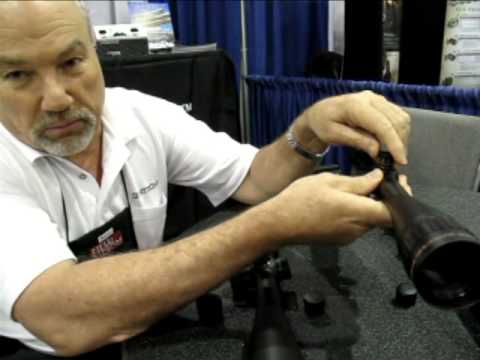
With the introduction of the SIII 30mm 6-24×50 Sightron, Sightron now offers THREE 6-24 power zoom rifle-scopes. This has created some confusion among buyers. Readers often ask us: “What is the difference between the SII 6-24, the Big Sky 6-24, and the new SIII 6-24?” At the NRA Annual meeting in Phoenix, AZ, we meet with Alan Orr, Sightron Product Manager. In the video below, Alan was kind enough to explain the differences among the three Sightron 6-24s. You’ll note that the three scopes offer different amounts of total windage and elevation travel, plus the amount of elevation per rotation is different. Also, the older SII 6-24 runs about $400.00, while the new SIII 30mm 6-24×56 sells for about $825.00. Watch the Sightron Video to learn more.
May 16th, 2009
Meopta is not a well-known name in the North American market, but we predict that may change in the near future. Meopta, a leading optics maker in the Czech Republic, makes optical components for many of the most respected “big name” companies in the business. With Meopta’s introduction of its 75mm APO (apochromatic) spotting scope, Meopta has served notice that it can build a scope that rivals far more expensive optics. We tried one out at the NRA meeting in Phoenix, and we’re very impressed from what we could see. The image is very sharp. Eye relief with a 20-60 zoom eyepiece is good. We liked the large full-diameter focus ring in the center of the scope body. Swarovski uses a similar central focus ring on its ATS line of scopes, and we’ve always found this to be a user-friendly design.


The Meopta 75mm APO spotting scope retails for up to $1449.00 at various online optics and camera houses. However, at the NRA Convention, Alex Roy of EuroOptic.com offered a spectacular offer to AccurateShooter.com readers. For a limited time, while supplies last, EuroOptic.com will sell the Meopta 75mm APO complete with 20-60X zoom eyepiece for just $1175.00, including a free compact tripod. That’s a true bargain. This is a very nice spotting scope that compares well to other European and Japanese spotting scopes costing much, much more. From what we can tell, the Meopta is also the most economical option for folks seeking a 72mm+ objective and APO glass. Watch the video below for more details of this special offer. NOTE: The offer is limited to stock in hand. (Don’t complain to us if you procrastinate and miss out on this bargain.)

May 7th, 2009
 Last year, the Cornell Ornithology Lab conducted ScopeQuest 2008, a detailed comparison test of 36 spotting scopes. Optics (ranging in price from $220.00 to $4500.00) were viewed side-by-side and rated according to sharpness, color fidelity, edge-to-edge focus, brightness, distortion, and general optical quality. The testing team also considered ease of handling/focus, and eye relief (scopes with longer eye relief are better for eyeglass wearers). Two of the finest spotting scopes AccurateShooter.com has used, the Zeiss Diascope 85 T FL, and the Swarovski APS 80 HD, performed very well as expected, and ended up near the top of the list. The TeleVue-85 APO, a very large refractor, received the highest ratings for image quality (both at 20X and 60X), but lost points for easy of use and general “feel”. The overall winner among the 36 spotting scopes tested was the Kowa TSN-883 Prominar, a new-generation spotter with a huge 88mm objective, dual focusing knobs, and spectacular flourite glass. The results of Cornell’s spotting scope test are found on the LivingBird.org website. Click the link below for a charrt ranking all 36 scopes according to their overall ratings. Last year, the Cornell Ornithology Lab conducted ScopeQuest 2008, a detailed comparison test of 36 spotting scopes. Optics (ranging in price from $220.00 to $4500.00) were viewed side-by-side and rated according to sharpness, color fidelity, edge-to-edge focus, brightness, distortion, and general optical quality. The testing team also considered ease of handling/focus, and eye relief (scopes with longer eye relief are better for eyeglass wearers). Two of the finest spotting scopes AccurateShooter.com has used, the Zeiss Diascope 85 T FL, and the Swarovski APS 80 HD, performed very well as expected, and ended up near the top of the list. The TeleVue-85 APO, a very large refractor, received the highest ratings for image quality (both at 20X and 60X), but lost points for easy of use and general “feel”. The overall winner among the 36 spotting scopes tested was the Kowa TSN-883 Prominar, a new-generation spotter with a huge 88mm objective, dual focusing knobs, and spectacular flourite glass. The results of Cornell’s spotting scope test are found on the LivingBird.org website. Click the link below for a charrt ranking all 36 scopes according to their overall ratings.
CLICK HERE for Spotting Scope Test Summary (.pdf file)

CLICK HERE for large photo of Kowa TSN-883 on Tripod.
Ken Rosenberg, summarizing the findings of Cornell’s ScopeQuest testers, named the Kowa TSN-883 the big winner. Rosenberg writes: “Fifteen models competed in the most expensive category, including 12 conventional zoom scopes and three astronomy “cross-overs”[.] Among the conventional scopes, the surprising (to us) and virtually unanimous top-of-the-line ranking went to the Kowa TSN-883 Prominar. In side-by-side comparisons with Swarovski, Leica, Zeiss, and Nikon, both Kowa scopes provided a slightly, but noticeably, brighter and crisper image at 60x than any other scope. The three-dimensional detail visible … with these scopes, even in dim light, is simply phenomenal.”
 Rosenberg also gave high praise to the Swarovski ATS 65 HD, noting that it was much lighter and compact than the Kowa 883, while offering nearly the image quality. Rosenberg concludes: “For birders willing to take the plunge for the very best optics at whatever cost, the top choices, in my view, are either the Kowa 883/884 or 773/774 or the Swarovski HD 80mm or 65mm scopes. Any of these top scopes will give you years of pure birding pleasure. Although the larger Kowa offers the brightest, sharpest image available from a conventional zoom scope under the toughest birding conditions, the small Swarovski still delivers the best image per ounce of any scope.” Rosenberg also gave high praise to the Swarovski ATS 65 HD, noting that it was much lighter and compact than the Kowa 883, while offering nearly the image quality. Rosenberg concludes: “For birders willing to take the plunge for the very best optics at whatever cost, the top choices, in my view, are either the Kowa 883/884 or 773/774 or the Swarovski HD 80mm or 65mm scopes. Any of these top scopes will give you years of pure birding pleasure. Although the larger Kowa offers the brightest, sharpest image available from a conventional zoom scope under the toughest birding conditions, the small Swarovski still delivers the best image per ounce of any scope.”
More Products Worth Considering
The Cornell Test did NOT include some premium spotting scopes, including Pentax’s top-of-the-line PF-100ED, or the new Leica 82mm Televid APO HD. The big Leica APO is considered by many experts to be the new benchmark for spotting scope quality. However, it is enormously expensive. The 82mm Leica APO HD retails for $3200 for the body only. That’s nearly $900 more than the Kowa TSN-883 Prominar body only.

May 4th, 2009
 Weaver is the latest company to introduce a new series of Japanese-made optics with a high (5:1) zoom ratio. The new Super Slam series includes 2-10×50, 3-15×50, and 5-20×50 riflescopes, all offered with 1″-diameter main tubes and four (4) reticle options: Dual-X (med. duplex), Fine Crosshair (with dot), Illuminated Duplex, and Weaver’s proprietary EBX™ ballistic reticle. According to Tom Knudtson, Weaver Product Line Manager. “This new EBX reticle allows for accurate bullet trajectory compensation for long-range shots and is a perfect compliment to our 3-point erector system with improved spring design.” Among the new 1″-tubed Super Slams, we think our readers will be most interested in the 6-20x50mm. This 27.5 oz. scope features side-focus parallax control, extra-hard lens coatings, and “pull-up” turrets (no caps to lose). The 6-20×50 has 1/8-MOA clicks and 3 finishes are offered: Matte Black, Gloss Black, and Silver. Weaver is the latest company to introduce a new series of Japanese-made optics with a high (5:1) zoom ratio. The new Super Slam series includes 2-10×50, 3-15×50, and 5-20×50 riflescopes, all offered with 1″-diameter main tubes and four (4) reticle options: Dual-X (med. duplex), Fine Crosshair (with dot), Illuminated Duplex, and Weaver’s proprietary EBX™ ballistic reticle. According to Tom Knudtson, Weaver Product Line Manager. “This new EBX reticle allows for accurate bullet trajectory compensation for long-range shots and is a perfect compliment to our 3-point erector system with improved spring design.” Among the new 1″-tubed Super Slams, we think our readers will be most interested in the 6-20x50mm. This 27.5 oz. scope features side-focus parallax control, extra-hard lens coatings, and “pull-up” turrets (no caps to lose). The 6-20×50 has 1/8-MOA clicks and 3 finishes are offered: Matte Black, Gloss Black, and Silver.

Tactical Super Slams Have Front Focal Plane (FFP) Reticles
There are two new Japanese-made Super Slam Tactical Models, the 3-15×50 (#800362), and the 4-20×50 (#800360). Both scopes feature 30mm main tubes, large fixed turret knobs (no caps), and a mil-dot reticle. Notably, both Tactical models have the reticle in the front (first) focal plane. This means the size of the reticle (and the mildots) remain the same (relative to the object viewed) at all magnification levels. That is an important feature for shooters using the mil-dots for ranging. FFP design is logical for a true “tactical” scope, and Weaver was wise to incorporate FFP into the Super Slam Tactical scopes. Weaver claims these Tactical scopes are waterproof, fogproof, and shockproof.
April 29th, 2009
 Shooting Sports USA is the NRA’s dedicated journal for competition shooters of all disciplines. Shooting Sports USA offers feature stories, news briefs, and a comprehensive schedule of events, organized by discipline. You can now read the latest May 2009 issue in digital format on the web–at no cost. In fact, online subscriptions are free. You can sign up to receive a reminder in your inbox every time a new issue is available. Shooting Sports USA is the NRA’s dedicated journal for competition shooters of all disciplines. Shooting Sports USA offers feature stories, news briefs, and a comprehensive schedule of events, organized by discipline. You can now read the latest May 2009 issue in digital format on the web–at no cost. In fact, online subscriptions are free. You can sign up to receive a reminder in your inbox every time a new issue is available.
This month’s cover story, “Winning Vision: A Guide for the Eye Care Professional,” is a must-read. It’s written by Dr. Norman H. Wong, O.D., a professional eye doctor and competitive shooter.
 The article is written to help shooters and eye doctors find the best solutions for vision problems. We know many shooters, particularly as they hit “middle age” and beyond, experience a variety of vision issues. However, it’s common for shooters to ignore their eye problems, at the same time spending buckets of money on expensive optics. Pay attention to what Dr. Wong writes and you can benefit. Remember that the last element in the sighting system is the human eye — and no scope, no matter how sophisticated, can overcome serious failings in a shooters’ vision that remain uncorrected. The article is written to help shooters and eye doctors find the best solutions for vision problems. We know many shooters, particularly as they hit “middle age” and beyond, experience a variety of vision issues. However, it’s common for shooters to ignore their eye problems, at the same time spending buckets of money on expensive optics. Pay attention to what Dr. Wong writes and you can benefit. Remember that the last element in the sighting system is the human eye — and no scope, no matter how sophisticated, can overcome serious failings in a shooters’ vision that remain uncorrected.
CLICK HERE for an archive of 24 more vision-related articles by Dr. Wong. Forum Member Jim Hardy comments: “[The] 24 articles by Dr. Norman Wong address many of the ocular issues confronting the competitive shooter. I downloaded all 55 pages and consider it mandatory reading for anyone associated with the shooting sports, whether you shoot iron sights or scope — handgun or rifle. The information is absolutely invaluable.
If you are not seeing your best, you cannot shoot your best. If you don’t know the questions to ask your eye professional, you are not likely to get the answers your need — starting with the selection of your eye care professional. The Rx that works for reading, work, and driving may not be close to what you need on the range. These articles will give you the basic education you need to address the vision issues in your shooting game.”

This item is provided courtesy the NRA Blog.
April 26th, 2009
 If you’re looking for a 1″-diameter scope for hunting, varminting, or general paper-punching, Zeiss makes some of the best available. The less expensive Conquest line of riflescopes have impressed us with their very clear, sharp glass, and excellent controls. Unfortunately, Zeiss Conquest prices have climbed in recent years. For example, the excellent Conquest 6-20x50mm retails for nearly $200 more than it did originally. If you’re looking for a 1″-diameter scope for hunting, varminting, or general paper-punching, Zeiss makes some of the best available. The less expensive Conquest line of riflescopes have impressed us with their very clear, sharp glass, and excellent controls. Unfortunately, Zeiss Conquest prices have climbed in recent years. For example, the excellent Conquest 6-20x50mm retails for nearly $200 more than it did originally.
You can’t go back in time, but MidwayUSA is offering refurbished Zeiss Conquest scopes at big savings off regular prices. These scopes all feature etched reticles and rugged 1-piece main body tubes. Here are some of the deals currently offered on Zeiss “Certified Refurbished” scopes (with full factory warranties):
Zeiss MC Conquest 3-9x50mm, Matte, Z-Plex Reticle
Product #: 151785 | Price: $479.99 Sale ($120.00 off retail)
Zeiss MC Conquest 3.5-10x50mm, Matte, Rapid Z-600 Reticle
Product #: 714963 | Price: $659.99 Sale ($165.00 off retail)
Zeiss MC Conquest 4.5-14x44mm Side Focus, Matte, Z-Plex Reticle
Product #: 993333 | Price $639.99 Sale ($160.00 off retail)
Zeiss MC Conquest 6.5-20x50mm, Matte, Side Focus, Target Turrets, Z-Plex Reticle
Product #: 145597 | Price: $799.99 Sale ($200.00 off retail)

NOTE: Certified Refurbished Zeiss MC Conquest Rifle Scopes may have ring marks or small scratches on the body, but none of these slight blemishes will affect the function of the scope. Zeiss Conquest Rifle Scopes are covered by the Zeiss Limited Lifetime Warranty. Quantities are extremely limited.
April 17th, 2009
Forum member Jacob spotted this simple, but effective set of scope ring inserts on the Brownells’ Website. With these inserts, you can use a scope with 1″-diameter main tube in 30mm rings. Non-marring, matte black Delrin sleeves surround the scope tube so it can fit larger-diameter rings. Each sleeve comes in two parts for easy installation around your scope tube. This way you can use the same 30mm rings for all your scopes. Ring Reducers are sold as front/rear kits. Cost is just $19.99 for the 1″ to 30mm converters, item 084-000-091. There are also sets that reduce 30mm rings to 25mm, and 1″ rings to 3/4″ or 7/8″.

Note: These Brownells units simply function as plastic bushings. Unlike Burris Signature Ring inserts, they do not allow you to “pre-load” windage or elevation. If your rings are misaligned, the Brownells Ring Reducers won’t correct that problem.
April 13th, 2009
Kowa spotting scopes are highly regarded, particularly among High Power and long-range prone shooters. You’ll always find many Kowas on the firing line at High Power matches. Many shooters get their Kowas from retired Marine Msgt. Jim Owens, who offers excellent prices on his JarHeadTop.com website.

Kowa is replacing the venerable TSN-821M spotting scope with the newly redesigned TSN-82SV, which will be more compact with upgraded optics. The new TSN-82SV weighs 52.5 ounces, and is just 15.1″ long. The 82SV is waterproof and nitrogen-filled to to help eliminate lens fogging.
The 82SV has a 45-degree angled eyepiece (puchased separately). Four optional eyepieces are offered: TE-9Z, TE-14WD, TE-9WD, and TE-17HD. Specifications are listed in the chart below. Prone shooters will probably prefer the 27x TE-17HD long-eye-relief (LER) eyepiece. It offers a 2.0˚ real field of view (105 feet at 1000 yards), with about 1.25″ of eye relief.

The MSRP for the new TSN-82SV is $805.00 (body only), while the “street price” is currently about $650.00 without eyepiece. See: Eagle Optics, $645. By contrast, Kowa’s larger TSN 881 88mm spotter runs $999.00 without eyepiece.
|


