Each Wednesday, the U.S. Army Marksmanship Unit (USAMU) publishes a reloading “how-to” article on the USAMU Facebook page. In this article, the USAMU’s reloading gurus address a question frequently asked by prospective handloaders: “Should I buy a single-stage press, or a progressive?” The USAMU says the best answer is Solomon-esque in both its wisdom and simplicity: “Get BOTH!” However, there is definitely more to the issue, as the USAMU explains below.
Progressive Press Safety Considerationsby USAMU Staff
Many are the beginning handloaders who have asked a friend about their “setting up” a progressive press for them. The idea is that the newbie could then just feed in components and crank out buckets of practice ammo without needing to really learn much about handloading. Tempting though this might be, that’s simply not how it works. Such an approach might be ok if there were never a malfunction with either press or operator, but that’s unrealistic. Our hypothetical newbie would then lack the knowledge to problem-solve most situations.
Worse yet, several different handloading operations would be occurring at different stations on the progressive press at the same time. It takes an experienced operator to keep track of, and truly understand the significance of, all those potential mini-problems. Loading without this experience is a recipe for potential disaster – such as a double powder charge (especially with pistol cartridges) dropped while the loader was attending to some other function, etc. Progressives are an animal unto themselves, and while they offer many benefits, they do take some getting used to – even by experienced handloaders!
ILLUSTRATIVE HORROR STORY
Here, enter a 40-year veteran handloader who decided to jump onto the progressive bandwagon late in his career, having used only single-stage presses all his life. A High Master NRA High Power Rifle competitor, he had no background in competitive pistol shooting, where historically most progressive presses are found.
Experienced Action Pistol shooters have typically encountered multiple episodes in which shooters “skipped” a powder charge for some reason, leading to a squib round and a bullet possibly lodged in the bore. Thus, at matches, it’s reflexive for them to yell “STOP!” in unison if they see a shooter get a “click” vs. a “bang”, and rack the slide to keep firing. This writer has personally seen several pistols saved in just such scenarios over the years.
Click No Bang — What NOT to Do
Our High Master set up a popular progressive press and began turning out .223 Rem 100-yard practice ammo with abandon. He was using a moly-coated 52gr match bullet and an economical, fast-burning surplus powder that gave great accuracy. Once on the range, he began practicing strings of rapid-fire. All was well, until he heard “Click!” rather than “Boom”.
Lacking the above experience or onlookers to halt him, he reflexively operated the charging handle on his expensive, custom NM AR15 Service Rifle, and the next trigger squeeze reportedly registered on seismographs over at least a three-state radius. He sat, uninjured but bewildered, until the hail of expensive bits and pieces quit raining down around him.
When the smoke cleared, he immediately cursed the horrid, evil, demonically-possessed progressive press for this, his first-ever reloading mishap. His $1400 NM upper was ruined, but thankfully, his $800 pre-ban lower… and he had escaped injury.
This tale is told not to discourage the use of progressive presses, but to emphasize the need to EASILY and IMMEDIATELY KNOW what is happening with the press at each station, every time the handle is cranked. Not to do so is, as they say, “bad ju-ju.”
It illustrates why we at the USAMU Handloading Shop agree in recommending that new handloaders should begin with a single-stage press. Once one thoroughly learns the steps in each phase of handloading by repeated experience, then one will be qualified to move on to a progressive press.
The single-stage press will REMAIN virtually indispensable for one’s entire handloading career, even after having purchased a progressive press (or two). There are endless small projects that are best handled on a single-stage press, and a poll of USAMU’s Handloading staff reveals that not one would willingly be without his single-stage press, despite owning at least one progressive.
High-BC MatchKings Tipped at Factory
Sierra recently released a new-for-2018, 95-grain .224 projectile, Sierra product #1396, with a claimed G1 BC of 0.600 — mighty impressive for a .22-caliber bullet. Next up is the new 6.5mm (.264 caliber) 150-grainer with an 0.713 G1 BC. This could be a game-changer for the 6.5-284 and new 6.5 PRC short magnum. There are also two new .308-caliber MatchKings, a 200-grainer with 0.715 G1 BC, and a new 230-grainer with a stunning 0.800 G1 BC. Many of these New Generation MatchKings now come “tipped” from the factory for more uniform BC.
One of the most important aspects of precision reloading is setting the shoulder bump during the full-length (FL) sizing process. You want the amount of “bump” to be precise and identical for every loaded round. However, when you switch brands of brass you may need to change the die position to get the desired bump and case body sizing. And even with the same brand of brass, you may find that you need to adjust your FL die as the number of brass load cycles increases. Brass that has been fired many times will behave differently than new or near-new brass.
Also, even with the same cartridge type, brass loaded for a semi-auto rifle may need more bump than brass fired in a bolt gun. For example, with .223 Rem ammo, you’ll normally want to push the shoulder back farther if the ammo will be shot in a AR15 as opposed to a bolt-action rig.
So how do you make all these needed adjustments for your full-length dies? You can move a conventional locking ring up and down, but that can be a tedious, trial-and-error process. Some guys use shims in one-thousandth intervals, but that still requires taking your dies in and out of the press. Well there is a better way now…
PMA Tool Micro-Die Adjuster
Wouldn’t it be great if you could precisely adjust your FL die up and down in half-thousandth increments, with a simple indexed click. That is now possible with products offered by PMA Tool and Whidden Gunworks. PMA Tool offers a Micro-Die Adjuster that replaces your existing lock ring and can be used with nearly any 7/8-14 full length sizing die. The engraved marks correspond to approximately .001″ of shoulder bump adjustment. Splitting the engraved marks is therefore approximately equal to .0005″ (half a thousandth). Users love this product, saying it adds precision and saves time.
Whidden Click-Adjustable FL Sizing Die System
Whidden Gunworks offers a complete click-adjustable FL sizer die with a special, indexed ring. With Whidden’s patent-pending Click Adjustable Sizer Die system, the die and lock ring work together to allow rapid, precise bump adjustments. One click changes the bump .001″. It’s simple and fast. Included with the Click Adjustable Sizer Die is a shoulder bump gauge. John Whidden (in video below) explains:
“There has become a need for an easier way to adjust the sizer die properly. Until now there have been few options other than trial and error to get the shoulder setback correct. Anyone who has done this can attest that it’s a slow and imprecise job! Our die and lock ring work together to give the user a clicking feel to the adjustment. Each click moves the shoulder bump .001” so you can easily find the exact shoulder bump that you desire.” — John Whidden
Conventional brass jags work great — except for one thing. They can react to solvents, leaving a blue “false positive” on patches. In recent years, jag-makers have experimented with many different materials in an effort to cure the solvent-reaction problem. Today we have polymer jags, nickel-plated jags, and stainless steel jags. And the latest innovation is the aluminum jag from Dewey.
J. Dewey Mfg. offers a series of “Copper Eliminator” jags and brush adapters made from aircraft-grade aluminum with the same hardness as brass. Dewey claims that its aluminum jags will not become embedded with grit or particles that could harm your bore. At the same time, Dewey’s aluminum jags will not react to ammoniated bore solvents that can turn patches blue green when used with brass jags. Dewey aluminum jags are offered with either male OR female 8/32 threads. The $5.25 aluminum jags and $3.70 brush adapters are offered in a wide variety of calibers. You can order from Dewey Mfg. or Sinclair Int’l.
Story Tip from Boyd Allen. We welcome submissions from our readers.
At the request of our readers, we provide select “Deals of the Week”. Every Monday morning we offer our Best Bargain selections. Here are some of the best deals on firearms, hardware, reloading components, optics, and shooting accessories. Be aware that sale prices are subject to change, and once clearance inventory is sold, it’s gone for good. You snooze you lose.
1. Midsouth — Major Brand Blem Tipped Bullets — Up to 45% Off
Midsouth is now offering big savings on major-brand blem bullets. These are overruns, cosmetically blemished jackets or tip discolorations, or factory second bullets from a major bullet manufacturer (Midsouth isn’t allowed to name the company). NOTE: Some projectile tips are misshapen, other packages may contain bullets which vary by grain weight. No matter what, you’re getting tipped hunting, or tipped match bulk bullets at huge savings. Many options in .243 (6mm), .257, .264 (6.5mm), .277, .284 (7mm), .308, and .338 calibers.
2. Brownells — Thompson Center T/CR22 — $249.99 With Rebate
Thompson Center’s new T/CR22 rimfire can use most Ruger 10/22 accessories including 10/22 mags. But it has some distinct advantages over the Ruger. The stock is a quality MagPul composite design. The barrel is button-rifled with a threaded muzzle. The bolt holds open after the last shot. This gun comes complete with front and rear iron sights as well as a Picatinny rail on the action. NRA reviewers praised this gun saying: “Thompson Center has taken the aftermarket parts you’re going to pay extra for [on a Ruger 10/22] and made them standard on the T/CR22, saving you some cash[.]” Right now the T/CR22 is on sale for $299.99 at Brownells with a $50 manufacturer REBATE, for a $249.99 cost after rebate. But it gets better — use CODE “N8Y” during checkout to save another $20 and get free shipping. Then your actual cost for the rifle (after discount and rebate), is $229.99 plus $10.00 FFL Processing fee.
3. Brownells — ATI GSG .22 LR FireFly Pistol (P226 Style)
If you like SIG Sauer P-series pistols, you’ll love this GSG .22 LR rimfire. It faithfully copies the lines and ergonomics of the classic P226 9mm handgun. Make by GSG in Germany, the ATI Firefly features a 4″ barrel, alloy frame, and steel slide. A simple blowback operating system provides reliable cycling with included 10-round magazine. The Firefly is on sale now at Brownells for just $179.99, marked down from $249.99. That’s a great price for a nice little rimfire that is offered in three finishes: Matte Black, Tan, and Dark Green. Weight: 1.53 pounds.
4. VihtaVuori — $5.00 Per Pound Rebate on Vihtavuori Powders
The 2018 VihtaVuori Rebate Program is under way. For a limited time, earn $5.00 back per bottle when you purchase VihtaVuori powders. Act soon as this offer expires on October 15, 2018. Be sure to keep your receipts and note the labels. The Rebate application MUST include proof of purchase showing retailer name and date of purchase. And the Rebate Form MUST include the serial number for each VihtaVuori bottle purchased.
VV Rebate Start Date: 8/15/2018
VV Rebate End Date: 10/15/2018
Postmarked By Date: 11/30/2018
Minimum Purchase: One 1-pound bottle
Maximum Purchase: Twelve 1-pound bottles
Maximum REBATE is $60.00
5. Natchez — Big Savings on Nikon Optics (Scopes, LRFs, Binocs)
Need a scope or LRF for hunting season? Here’s a chance to save hundreds on a quality Nikon optic. Natchez Shooters Supply is offering exclusive deals on both new and refurbished Nikon riflescopes, rangefinders, and binoculars including camo finish hunting scopes for hunters. There are some truly excellent bargains, plus you can get $5 Flat Rate Shipping with Code 180910 (through 9/12/18). Here are some of the best deals on Nikon scopes at Natchez right now:
Burris Scopes Also on Sale
Natchez also has many Burris scopes up to 60% OFF. For example the Burris XTR II 1-5x24mm riflescope is marked down from $799.00 to $459.99, a $339 savings!
6. Mossberg — 20% Off All Products in Mossberg Store this Week
Mossberg just announced a major fall season sale. Virtually everything in Mossberg’s online store is now 20% Off with CODE “FALL 20″. This includes stocks, barrels, triggers, sights, heat shields, magazines, apparel, range bags, gun cases, and much more. This is a great way to acquire quality accessories at bargain prices. This promotion runs through 10/11/2018. Mossberg Sale tip from EdLongrange.
NOTE: This sale does not apply to complete Mossberg rifles or shotguns. Those must be purchased through retail FFL dealers.
7. Stocky’s — LR Stocks with Aluminum Bedding Block, $179.99
Here’s a good deal on a versatile Stocky’s Long Range Stock with aluminum V-block bedding system. For just $179.99, order this for Rem/Rem Clone long actions or short actions, with either narrow or wide (varmint/tactical) barrel channel. This would be a good choice for a varmint rifle. This is also offered with handsome hydrographic or web-pattern baked-on textured finishes for $199.99.
8. Brownells — RCBS Rock Chucker Supreme Press, $130.99
The RCBS Rock Chucker Supreme Press is a classic single-stage press that will handle all hand-loading sizing and seating chores. There’s plenty of leverage to full-length size big cases. The rigidity of this cast-iron press also allows precise, repeatable bullet seating. While we prefer to prime as a separate operation, you CAN prime your cases with the Rock Chucker. Right now this press is on sale at Brownells for $140.99. However, with CODE “NBM” you save $10 and get FREE Shipping. That way your net cost is $130.99 delivered. This same press sells elsewhere for up to $165.00.
9. Amazon — 12″x12″ Splatter Grid Targets, 10 for $9.99
This 12″x12″ Splatterburst Target combines splatter shot marking with a grid background, with five aiming points. The bright neon shot circles make it easy to see your shots. And the handy grid lets you quickly estimate your group size. Get a 10-pack for $9.99, or a 25-pack for $17.99 (better deal). This particular target has earned rave reviews — 87% of verified buyers gave this a FIVE-Star rating. One example: “Excellent quality and durability. The adhesive is really strong. High contrast makes down range targeting easy and the splatter contrast is [great].”
Photo 1: Three Near-Equal-Weight 7mm Bullets with Different Shapes
TECH TIP: Bullets of the same weight (and caliber) can generate very different pressure levels due to variances in Bearing Surface Length (BSL).
Bullet 1 (L-R), the RN/FB, has a very slight taper and only reaches its full diameter (0.284″) very near the cannelure. This taper is often seen on similar bullets — it helps reduce pressures with good accuracy. The calculated BSL of Bullet 1 was ~0.324″. The BSL of Bullet 2, in the center, was ~0.430”, and Bullet 3’s was ~ 0.463″. Obviously, bullets can be visually deceiving as to BSL!
This article from the USAMU covers an important safety issue — why you should never assume that a “book” load for a particular bullet will be safe with an equal-weight bullet of different shape/design. The shape and bearing surface of the bullet will affect the pressure generated inside the barrel. This is part of the USAMU’s Handloading Hump Day series, published on the USAMU Facebook page.
Beginning Handloading, Part 13:
Extrapolating Beyond Your Data, or … “I Don’t Know, What I Don’t Know!”
We continue our Handloading Safety theme, focusing on not inadvertently exceeding the boundaries of known, safe data. Bullet manufacturers’ loading manuals often display three, four, or more similar-weight bullets grouped together with one set of load recipes. The manufacturer has tested these bullets and developed safe data for that group. However, seeing data in this format can tempt loaders — especially new ones — to think that ALL bullets of a given weight and caliber can interchangeably use the same load data. Actually, not so much.
The researchers ensure their data is safe with the bullet yielding the highest pressure. Thus, all others in that group should produce equal or less pressure, and they are safe using this data.
However, bullet designs include many variables such as different bearing surface lengths, hardness, and even slight variations in diameter. These can occasionally range up to 0.001″ by design. Thus, choosing untested bullets of the same weight and caliber, and using them with data not developed for them can yield excess pressures.
This is only one of the countless reasons not to begin at or very near the highest pressure loads during load development. Always begin at the starting load and look for pressure signs as one increases powder charges.
Bullet bearing surface length (BSL) is often overlooked when considering maximum safe powder charges and pressures. In photo 1 (at top), note the differences in the bullets’ appearance. All three are 7mm, and their maximum weight difference is just five grains. Yet, the traditional round nose, flat base design on the left appears to have much more BSL than the sleeker match bullets. All things being equal, based on appearance, the RN/FB bullet seems likely to reach maximum pressure with significantly less powder than the other two designs.
Bearing Surface Measurement Considerations
Some might be tempted to use a bullet ogive comparator (or two) to measure bullets’ true BSL for comparison’s sake. Unfortunately, comparators don’t typically measure maximum bullet diameter and this approach can be deceiving.
Photo 2: The Perils of Measuring Bearing Surface Length with Comparators
In Photo 2, two 7mm comparators have been installed on a dial caliper in an attempt to measure BSL. Using this approach, the BSLs differed sharply from the original [measurements]. The comparator-measured Bullet 1 BSL was 0.694” vs. 0.324” (original), Bullet 2 was 0.601” (comparator) vs. 0.430” (original), and Bullet 3 (shown in Photo 2) was 0.602” (comparator) vs. 0.463” (original). [Editor’s comment — Note the very large difference for Bullet 1, masking the fact that the true full diameter on this bullet starts very far back.]
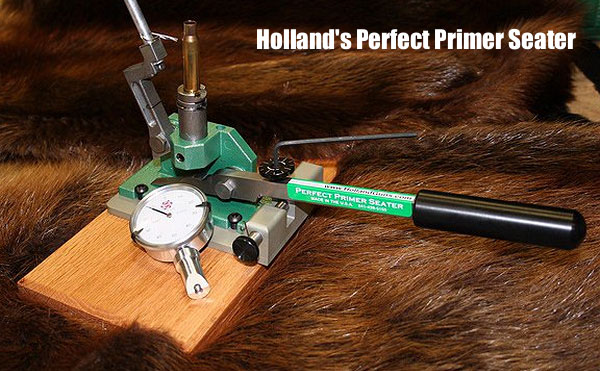
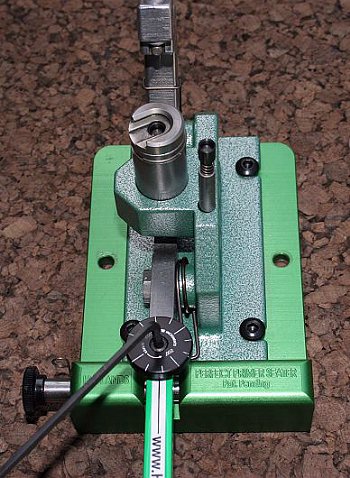
Gunsmith Darrell Holland sells a priming tool that upgrades the RCBS Auto Bench Priming Tool with key features — including primer seating depth control. If your hand starts to hurt after priming dozens of cases with a hand-held, squeeze-type priming tool, you may want to consider Holland’s invention, which he calls the “Perfect Primer Seater” (PPS).
Holland basically has modified the RCBS lever, adding a precise crush control and a means of measuring depth with a gauge. He claims this gives “an EXACT primer seating depth based on primer pocket depth and primer thickness”. With Holland’s PPS, primer seating depth is controlled with a rotating wheel that limits lever travel in precise gradations. You can buy the complete priming system for $215.00, or, if you already own the RCBS Auto Prime tool, you can purchase an adapter kit (with base, arm, adjuster, and gauge etc.) for $120.00. To order, visit Hollandguns.com. Click on “Reloading Equipment”, and look for the Perfect Primer Seater. Scroll down to the bottom of the page to add items to the shopping cart.
User Review by Tommy Todd
Sierra Bullets’ Chief Ballistician Tommy Todd acquired the Holland Perfect Primer Seater, and gave it a positive review. Todd writes: “This cartridge case priming system allows you to measure the primer pocket depth and adjust the seating tool to match the primer seating depth for a contact fit with a measured lot of primers to the cases you are working with. Mr. Darrell Holland has taken a standard RCBS automatic bench-mounted priming tool and modified it to a new level of precision. The modifications allow you to measure the primer pocket depth, primer height, and with the addition of an adjustable stop on the priming tool achieve precision primer seating, rather than how the primer ‘feels'[.]
If you are already utilizing the RCBS priming tool, Mr. Holland offers an adapter kit to upgrade your equipment. If you are looking for a new priming unit, I suggest giving this product a try. Increasing consistency when seating primers should result in smaller groups[.]”
Western Powders (which sells Accurate, Ramshot, and Norma powders) has published an article on case inspection and preparation. There are many tips in this article that can be useful to precision hand-loaders. For example, every time you open a new box of cartridge brass (particularly from domestic makers), you should inspect each case for flaws.
TIP ONE: Visual Inspection — Finding Flaws
Cases are mass-produced items and malformed ones are relatively common. Inspect each case carefully looking for obvious defects. A bench-mounted magnifying glass with light is a real help for the over-40 crowd. The main defects will be cracks in the neck or case body, crushed shoulders or deep creases in the neck. Next check the primer pocket. It is also fairly common to find flash holes that are damaged or, more rarely, not concentric to the primer pocket.
Imperfections like small dings in the case body, or necks that are not completely symmetrical do not have to be eliminated at this step. Damage of this sort is usually from loose packaging and usually has not seriously damaged the brass. [Running an expander mandrel in the neck] and fire-forming will iron out these largely cosmetic issues.
The Western Powder article also talks about primer pocket uniforming. We do NOT normally uniform the pockets for Lapua or RWS brass from the start. However, pocket uniforming can be beneficial with some other brands of brass, including Lake City, Remington, and Winchester. If you shoot milsurp brass, set time aside for pocket uniforming.
TIP TWO: Primer Pocket Uniforming Like flash holes, primer pockets are mass-produced and prone to small dimensional changes. A uniforming tool is used to make the depth of each primer pocket consistent. In turn this allows similar firing pin strike depths on the primer which creates more consistent ignition characteristics.
A good uniforming tool should have a shoulder, or another positive stop, that sets the cutter’s depth. Its use is pretty straightforward. The cutter is inserted into the pocket and turned clockwise several times until the stop in flush with the case head and no more brass is removed from the juncture of the pocket’s base and sidewall. This a job best done by hand. You will feel when the cutting is finished by a change in how smoothly the cutter turns in the pocket. Very little material is actually removed; usually just enough to square the radius at the bottom of the pocket.
We are often asked “Can I get more velocity by switching primer types?” The answer is “maybe”. The important thing to know is that changing primer types can alter your load’s performance in many ways — velocity average, velocity variance (ES/SD), accuracy, and pressure. Because there are so many variables involved you can’t really predict whether one primer type is going to be better or worse than another. This will depend on your cartridge, your powder, your barrel, and even the mechanics of your firing pin system.
Interestingly, however, a shooter on another forum did a test with his .308 Win semi-auto. Using Hodgdon Varget powder and Sierra 155gr Palma MatchKing (item 2156) bullets, he found that Wolf Large Rifle primers gave slightly higher velocities than did CCI-BR2s. Interestingly, the amount of extra speed (provided by the Wolfs) increased as charge weight went up, though the middle value had the largest speed variance. The shooter observed: “The Wolf primers seemed to be obviously hotter and they had about the same or possibly better ES average.” See table:
Varget .308 load
45.5 grains
46.0 grains
46.5 grains
CCI BR2 Primers
2751 fps
2761 fps
2783 fps
Wolf LR Primers
2757 fps
2780 fps
2798 fps
Speed Delta
6 fps
19 fps
15 fps
You can’t extrapolate too much from the table above. This describes just one gun, one powder, and one bullet. Your Mileage May Vary (YMMV) as they say. However, this illustration does show that by substituting one component you may see significant changes. Provided it can be repeated in multiple chrono runs, an increase of 19 fps (with the 46.0 grain powder load) is meaningful. An extra 20 fps or so may yield a more optimal accuracy node or “sweet spot” that produces better groups. (Though faster is certainly NOT always better for accuracy — you have to test to find out.)
WARNING: When switching primers, you should exercise caution. More speed may be attractive, but you have to consider that the “speedier” primer choice may also produce more pressure. Therefore, you must carefully monitor pressure signs whenever changing ANY component in a load. Glen Zediker recommends decreasing your load ONE FULL GRAIN when changing to a different primer type, one that you haven’t used before.
Western Powders has released its NEW Handloading Guide, Edition 7.0. This $2.99 print resource contains the latest load data for Western’s propellants including Accurate, Ramshot, and Blackhorn powders. Edition 7.0 features the most current data available for Ramshot and Accurate powders, including popular LT30 and LT32, and new Accurate TCM, Accurate 11FS and Ramshot LRT propellants. This latest load guide also has load data for the new 224 Valkyrie, 300 Norma, and 30 Nosler cartridges. Along with reloading recipes, this resource features helpful articles on handloading methods and rifle maintenance/cleaning with X-Treme products.
In the new Handloading Guide 7.0 , you’ll find load data for over 100 rifle cartridges. The cartridge listings are up to date — you’ll find the popular new mid-sized competition cartridges, such as the 6.5 Creedmoor and 6.5×47 Lapua, along with many popular wildcat varmint cartridges, such as the 20 Vartarg, 20 Tactical, and 20 BR. Benchresters will also find recipes for the new LT 30 and LT 32 powders which have proven very accurate in the 30BR and 6PPC respectively.
Download FREE Version 6.0 Guide:
If you can live without the very latest info, you can still get Version 6.0 of Western’s Reloading Guide for FREE. That’s right Version 6.0 is a FREE downloadable PDF. This FREE Reloading & Load Data Guide (Edition 6.0) contains thousands of recipes for handgun and rifle cartridges (plus shotshell and muzzle-loading info).










 User Review by Tommy Todd

 Like flash holes, primer pockets are mass-produced and prone to small dimensional changes. A uniforming tool is used to make the depth of each primer pocket consistent. In turn this allows similar firing pin strike depths on the primer which creates more consistent ignition characteristics.


