One of the most commonly-asked questions on our Shooters Forum is “what diameter bushing should I use with my neck-sizing die?” While we recommend that users obtain at least two bushings, you still have to know where to start. For hunting ammo and gas guns, we still recommend choosing a bushing that is 2 or 3 thousandths smaller than the neck diameter of a loaded round. However, in a bolt-action benchrest gun, you may well get superior accuracy with less neck tension. A while back Larry Isenhour set a spectacular 50-5X, 600-yard IBS record using very light tension — Larry employed a .268″ bushing for a .2695″ loaded round.
How to Select the Right Neck Bushing for your Cartridge Brass:
A while back, we discussed neck bushings during a visit to the Redding Reloading booth at the NRA Annual Meeting. In the video above, Patrick Ryan of Redding explains how to measure your cartridge brass and select the proper bushing diameter. Please note that Redding has changed its recommendations for benchrest neck sizing in recent years. Redding now recommends that benchresters start with a bushing that yields slightly less grip on the bullet.
The most eye-catching display at SHOT Show 2018 was a 3D Hologram animation of the new SAR 9 pistol. Showing the pistol assembling itself in mid-air, the hologram was mesmerizing.
So many products — so little time. We saw some very interesting new products including new Berger Ammunition on our second day at SHOT Show. There were many interesting tools on displays as well as cool new rifles for hunters, varminters, long-range shooters, and tactical marksmen. We also met some old friends on Day Two, including the legend himself — Jerry Miculek.
To give you a feel for SHOT Show, here’s a nice teaser video filmed last year. This shows both Media Day and the events inside the Sands Convention Center. Though this is a year old, we definitely recommend it. Plus is has a LOT of pretty ladies. You won’t be disappointed — honest.
This Video is from 2017, But You Should Definitely Watch It — Lots of Pretty Ladies!
NEW — Berger Branded Ammunition in Lapua Brass
Berger Bullets + Lapua Brass in factory-loaded ammo. You asked for it. Now it’s here. The new line of Berger Ammunition was unveiled at SHOT Show this week at the Capstone Precision Group booth. Berger, Lapua, Vihtavuori, and SK Ammo are now all owned by Nammo Lapua, so we can have these great American-made bullets packaged with superior, European-made Lapua brass*. This is an exciting development. There will be three (3) lines of Berger Ammunition: Match Grade Target, Match Grade Hunting, and Match Grade Tactical. We’ll have a full report with field tests this spring.
NEW and IMPROVED — Lyman Higher Rez Borecam
Better. Sharper. Higher Resolution. The new, upgraded Lyman Borecam® Digital Borescope is a serious candidate for best gunroom tool of the year. We really liked the original Borecam and recommended it highly. But now the new version is a LOT better. Now offering 300k resolution, you can really see finer details inside your bore. Trust us — the difference is VERY Noticeable. We could see very fine detail as never before. We like the fact that the lens wand is marked like a ruler so you can see your insertion depth and the handle has an indexing mark so you can keep track of your rotation. Great product. NOTE: The 300K means the camera delivers 300,000 pixels, i.e. 0.3 megapixel. For a square this is about 550×550. For a standard aspect ratio, this is similar to 640×480 resolution.
NEW — Walther KK500 .22 LR 3P Competition Rifle
Walther unveiled a handsome new smallbore (.22 LR) competition rifle, the KK500. This is more compact, with a shorter length of pull, so it’s a great choice for smaller-framed competitors — women and junior. The new Walther KK500 position rifle features bold red/gray laminated grip and fore-end block, plus an eye-catching red bolt handle. Very nice rimfire rifle for serious 3P smallbore shooters.
NEW — RCBS 6-Station Brass Boss
We tried out the new Brass Boss from RCBS. This new machine features SIX (6) powered tool heads, plus brushes. Four of the tool heads run at variable speeds up to 350 rpm. Two other high-speed tool heads run up to 550 RPM. There is a convenient speed control knob on the side of the unit. This is a great feature — you can run at high RPM for hard jobs like removing military primer crimps, and then slow way down to do more precise tasks such as inside chamfering. We like the Brass Boss. It is a definite upgrade over the previous RCBS Trim-Mate. The new Brass Boss includes tools for all six stations: inside VLD chamfering tool, outside deburring tool, primer pocket cleaners (small/large), military crimp removers (small/large), primer pocket uniformers (small/large), case neck brushes (four diameters), and a tub of dry case neck lubricant. MSRP for the Brass Boss is $189.95. We expect “street price” to be around $155.00.
COOL — World’s Biggest Cutaway Cartridge?
At the Vista Outdoor booth, we saw a 4-foot tall replica rifle cartridge. This was a real eye-catcher. Many folks looking at the giant-sized mock cartridge had never seen a 3-D cutaway like this showing the construction of the primer along with the core and jacket of the bullet. Note to Vista Outdoor — Please send one of these jumbo cutaways for our AccurateShooter.com “Man-Cave”.
WILD — $18,000 Janz Plasma Finish Revolver
Holy Mother of Mercy. This stunning Janz pistol costs $18,000. You can buy an entry-level Honda Civic for that! But does that Honda have a rainbow-colored Plasma finish like the Janz? And can the Civic swap barrel and cylinder assemblies to shoot multiple calibers? These top-of-the line Janz wheelguns are crafted in Germany in very small numbers. Just remember, beauty doesn’t come cheap.
NEW — Leica HD-B 3000 Geovid Rangefinder Binoculars
When we looked through the new HD-B 3000 Leica Geovids we were stunned. Superb clarity and sharpness. And the laser ranging was instantaneous — amazingly fast. The new Geovid HD-B 3000 delivers linear distance determination up to 3,000 yards (2,750 meters). This combo binocular/LRF has an ABC® ballistic brain inside which can output holdover, click adjustment, and equivalent horizontal range (EHR). Barometric pressure, temperature and angle are also included in the measurements. Impressive.
FUN — Selfie Time with Jerry Miculek — The Man, the Legend
Where else but SHOT Show in Las Vegas can you get a selfie with the world’s greatest revolver shooter, the legendary Jerry Miculek. Jerry was signing autographs at the Hornady booth. Of course Jerry’s not just a wheelgun ace. He has been a top 3-Gun competitor and, at last year’s 2017 Industry Day at the Range, Jerry set a world rifle speed record shooting a S&W M&P15.
NEW — Lyman Brass Smith C-Frame Press
Lyman has three new cast-iron presses on display: an O-Frame Single Stage, and 8-station Turret, and this compact Brass Smith C-Frame Ideal open front press. We liked them all but we think this new C-Frame press is an exceptional value. With beefy cast-iron construction, it is much stiffer than other presses in this category. The compound linkage is smooth. The base is big enough to provide good stability. For someone looking for a second press, or a smaller press to take to the range, the new Lyman may be the right solution. Thumbs up.
WEIRD — Virtual Reality Self-Defense Simulator
At the NRA Booth, CarryGuard, the NRA’s insurance program, had a half-dozen high-tech Virtual Reality simulators. Visitors could put on a pair of VR goggles, and then experience a variety of threat scenarios. This helps gun owners recognize true threats and respond in a proper manner. We like the cool Virtual Reality technology, but it still seemed weird to see grown men wearing goofy VR headgear and waving their arms around like circus clowns.
BAD ASS — Victrix Heavy Metal Tactical Rifles
Victrix is an Italian rifle-maker that shows that has proven that the USA doesn’t have a monopoly on seriously “Bad Ass” weaponry. We saw a trio of Victrix Minerva Tactical rifles that look tough enough to survive the Zombie Apocalypse with ease. The Minerva’s beefy carry handle under the fore-end is an interesting feature — something similar might come in handy for big ELR rigs.
SMART — Burris Spotting Scope with Accessory Red Dot
Can you see an extra feature fitted to this Burris Signature HD Spotting Scope. Yep, that’s a Burris Red Dot Sight on the left side near the eyepiece. Smart idea — this helps you align the spotter quickly, particularly in low-light situations. After seeing this rig, we’re wondering how we might attach a red dot to our older spotting scopes. Hats off to Burris for this clever optics upgrade.
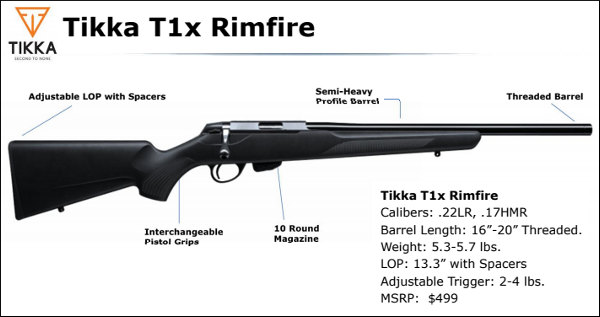
NEW and TEMPTING — Tikka T1x Rifle in .17 HMR
When we first revealed the impressive new Tikka T1x rimfire rifle in .22 LR, some readers said: “Well the .22 LR version is nice but will it be available in .17 HMR? That’s what I really want”. Well ladies and gentlemen, Tikka WILL sell a 17 HMR version of the T1x (see above). We saw this on display at SHOT Show and smiled. This gun has a very nice trigger, smooth running bolt, and the magazine is easy to seat (unlike some other recent rimfire rigs). Fitted with a nice 3-18X scope and bipod, this could be a great carry-around varmint rifle. We hope to test one this spring.
* NOTE: With some cartridge types for which Lapua brass is not currently made, other brands of brass may be used. However, most Berger Ammunition will feature Lapua brass.
There is an excellent article about primers on the Shooting Times website. We strongly recommend you read Mysteries And Misconceptions Of The All-Important Primer, written by Allan Jones. Mr. Jones is a bona fide expert — he served as the manager of technical publications for CCI Ammunition and Speer Bullets and Jones authored three editions of the Speer Reloading Manual.
This authoritative Shooting Times article explains the fine points of primer design and construction. Jones also reveals some little-known facts about primers and he corrects common misconceptions. Here are some highlights from the article:
Size Matters
Useful Trivia — even though Small Rifle and Small Pistol primer pockets share the same depth specification, Large Rifle and Large Pistol primers do not. The standard pocket for a Large Pistol primer is somewhat shallower than its Large Rifle counterpart, specifically, 0.008 to 0.009 inch less.
Magnum Primers
There are two ways to make a Magnum primer — either use more of the standard chemical mix to provide a longer-burning flame or change the mix to one with more aggressive burn characteristics. Prior to 1989, CCI used the first option in Magnum Rifle primers. After that, we switched to a mix optimized for spherical propellants that produced a 24% increase in flame temperature and a 16% boost in gas volume.
Foiled Again
Most component primers have a little disk of paper between the anvil and the priming mix. It is called “foil paper” not because it’s made of foil but because it replaces the true metal foil used to seal early percussion caps. The reason this little disk exists is strictly a manufacturing convenience. Wet primer pellets are smaller than the inside diameter of the cup when inserted and must be compacted to achieve their proper diameter and height. Without the foil paper, the wet mix would stick to the compaction pins and jam up the assembly process.
Hey guys, you’ll probably want to download this new Powder Burn Rate Chart issued by Hodgdon/IMR. This recently-released table includes the latest IMR powders including the Enduron series (IMR 4166, 4451, 4955, 7977), shown in green below. Please note, the chart is not limited to Hodgdon and IMR propellants. It also includes popular powders from Accurate, Alliant, Norma, Ramshot (Western), Vihtavuori, and Winchester.
This chart provides useful information for all hand-loaders. When doing load development, and testing one powder versus another, it’s generally wise to choose propellants that share the same relative burn rate, as least for starters.
NOTE: Hodgdon powders are shown in blue, IMR standard powders are shown in yellow, IMR Enduron powders are shown in green, and Winchester powder are shown in red. DOWNLOAD Chart HERE.
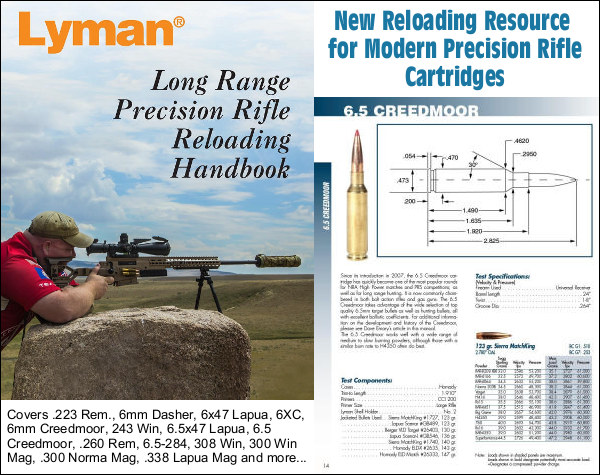
Lyman Products is offering a new reloading resource, the Lyman “Long Range Precision Rifle Reloading Handbook”. With the growing interest in Precision Rifle Series (PRS) events and Extended Long Range matches, Lyman saw the need for an up-to-date, reliable print resource for precision long range competitors. Lyman says this is “The first-ever reloading manual specifically written for the growing sport of precision long range shooting.”
Lyman’s new book covers the most popular cartridge types, and the premium components used by top shooters. The book covers the vast majority of popular cartridge types used in long range precision shooting. You’ll find .223 Rem, 6mm Dasher, 6×47 Lapua, 6XC, 6mm Creedmoor, .243 Win, 6.5×47 Lapua, 6.5 Creedmoor, .260 Rem., 6.5-284 Norma, .308 Win, .300 Win Mag, .300 Norma Mag, .338 Lapua Mag and more. The data section includes Berger and Lapua target bullets, as well as Sierra MatchKings and Hornady ELDs. A wide range of propellants from Accurate, Alliant, Hodgdon, IMR, Norma, VihtaVuori, Ramshot, and Winchester are reviewed.
Lyman Handbook Includes Articles by Leading Experts and Top PRS Shooters
The new handbook also includes articles by top PRS shooters and industry experts. Articles such as “PRS How-To” and “Rifle Systems for PRS” by Matt Gervais provide expert info and tips and techniques to start competing. An authoritative article by Hornady’s Dave Emary, “The History and Design of the 6.5 and 6mm Creedmoor” explains why these cartridges have become so popular for PRS and other applications. Emary’s “Reloading Considerations for Long Range Ammunition” is also highly recommended for both novice and experienced hand-loaders.
“As the leader in reloading data, we saw a need for an accurate and reliable source of reloading data for these precision, long-range loads,” said Trevor Mullen, Lyman’s Global Marketing VP. “Our process of compiling a new reloading handbook … is to work with the best in their field — reloaders, the manufacturers of ammunition and rifles, participants in the PRS sport, and our own staff of highly-skilled, highly knowledgeable test shooters. This new handbook [will help] those looking for that edge in PRS competitions.”
The “Long Range Precision Rifle Reloading Handbook”, priced at $16.98, will be available soon from online retailers. Within a short time you can also purchase the book from the Lyman web store. (It is not yet in stock).
SHOT SHOW Edition: For this week, we are doing something a bit different. Rather than showcasing discounted Deals of the Week, for this Monday, we’re featuring new-for-2018 products that will be on display at SHOT Show in Las Vegas. We have selected new products that, we believe, offer excellent inherent value even without special discounts. You may not be able to purchase all these items right away, but expect them at major vendors by early spring.
1. Lapua .300 Norma Magnum and .338 Norma Magnum Brass
A recent development based on the .338 Norma Magnum necked down to .30 caliber, the .300 Norma Magnum was adopted as the U.S. Military’s Advanced Sniper Cartridge “for extra long ranges beyond 1500 meters”. In addition to its military duties, the 300 Norma is sure to find favor with Long Range competitive shooters and hunters. We are excited to see this impressive new offering added to Lapua’s line of outstanding cartridge brass. Along with the .300 Norma, Lapua will also produce the .338 Norma Magnum parent cartridge. That .338 NM was developed by J. Sloan and D. Kiff as a long-range sporting cartridge, based on the .416 Rigby case. Norma adopted and standardized the .338 Norma Magnum through CIP certification in 2010.
2. New T1x Rimfire Rifle from Tikka
Tikka is introducing a new Rimfire rifle, the Tikka T1x. It features a medium-contour 20″ barrel with threaded muzzle, 10-round detachable magazine, and a smooth bolt throw. This will be offered in Both .22 LR and .17 HMR. The rifle boasts the feel and balance of Tikka’s centerfire line, so this can serve as a nice small-bore option for fans of Tikka hunting rifles. MSRP for the T1X is $499.00. There has been considerable shooter interest in this new Tikka which should provide competition to the CZ line of European rimfire rifles. The pricing is more than a Ruger or Savage, but much less than an Anschutz.
3. New Savage 110 Models with Adjustable Stocks
For 2018, Savage’s model 110 line-up boasts higher-quality, user-adjustable stocks. The all-new AccuFit system allows shooters to customize length of pull and comb height. The new AccuStock features a rigid chassis embedded in the stock. Savage has a full line of revamped 110s with these enhanced stocks. For example, the Savage 110 Long Range Hunter shown here features a 26″ barrel with brake, and is offered in six calibers: 6.5 Creedmoor, .260 Rem, .308 Win, 300 WSM, and .338 Federal.
4. Starline 6mm and 6.5mm Creedmoor Rifle Brass, $50/100
Starline Brass has recently added the 6.5/6mm family of cartridges to the company’s growing line of rifle cases. Starline is now producing 6.5 Creedmoor in both Large Primer pocket and Small Primer pocket versions. It also offers 6mm Creedmoor, and 6.5 Grendel. This brass will be pretty affordable, starting out at $125 for 250 cases (that works out to just $50 per hundred). Starline already sells other popular rifle brass, including .223 Rem, .243 Win, .260 Rem, and .308 Win. While this Starline brass won’t rival Lapua Brass, it may be suitable for tactical competitors who must run stages where it is impractical to recover your brass.
Lyman is releasing a beefy All-American Turret Press with eight (8) stations. That’s one more than the Redding T-7 Turret Press, and two more stations than the six-station RCBS Turret Press. With the Lyman’s EIGHT stations you can hold sizing AND seating dies for four different rifle cartridges. With eight stations available — there are countless options. Rigidity is very important with a turret press — if you have too much “give” of flex with the turret head you may get inconsistent results when bumping shoulders using full-length dies. With a heavy cast-iron frame and turret head, Lyman says its new Turret Press is “the most rugged” on the market. We like the front-mount priming system which can easily be operated with your free hand, whether you mount the press arm on the left or the right. You can purchase this press for $199.99 from MidwayUSA.
6. Ruger — Ruger Precision Rimfire, $399.99
The Ruger Precision Rimfire .22 LR rifle is so new that few vendors have them yet. But you CAN pre-order one now for $399.99 from Sportsmans Outdoor Superstore (MSRP: $529.00). For PRS shooters and Ruger Precision Rifle owners, this may be an ideal rimfire cross-trainer, with ergonomics and balance like their centerfire rig. This PRS-style .22 LR rig has some very interesting features, including adjustable bolt throw that lets shooters change from a rimfire 1.5″ bolt throw to a short-action centerfire 3″ bolt throw, reducing the chance of short-stroking your bolt in competition. The Ruger Marksman trigger adjusts from 2.25 to 5.0 pounds.
7. Vortex — New Affordable Viper HD Spotting Scopes
High-end performance at a mid-range price — the new-for-2018 Vortex Viper® HD Spotting Scopes offer impressive clarity, resolution, and color fidelity at an affordable price. The new 20-60x85mm model has a $1099.99 MSRP. That’s half the price of some other top-quality spotting scopes. The 15-45x65mm models have an $849.99 MSRP. These spotters feature HD lenses and helical-style focus. For conventience, the attachment collar allows the entire spotter to rotate. Designed for durability, the Viper HD spotter is has rubber armor, and exterior lenses are protected by ArmorTek — an ultra-hard, scratch-resistant compound that repels oil, dirt, and fingerprints. Both sizes are offered in straight and angled versions. And like all Vortex products, the Viper HD Spotting Scopes are covered by a lifetime, unconditional, no-fault, transferable, VIP Warranty.
8. MTM Cleaning Rod Case, $25.00 Street Price
Here’s a cool new product that will make it easier to stow and/or transport your precious cleaning rods. Sure you can tuck a single rod in a gun case, but what if you want to carry a variety of rods to the range? This case holds up to four (4) rods securely, and keeps solvent residues off your fine firearms. MTM’s new Gun Cleaning Rod Case is capable of storing four rifle or shotgun cleaning rods up to 47″ long. Each rod is held in an individual slot and there are foam inserts on either end, making transportation secure and rattle-free. You don’t have to worry about the rods banging into each other. We like the fact that MTM has cleverly included multi-sized “corrals” to hold patches from large to small. Plus there is plenty of room to hold jags and brushes.
9. Mossberg MVP Precision in 6.5 Creedmoor and .308 Win
The Mossberg MVP Precision looks good. It has all-new chassis with a longer fore-end up front and a fully-adjustable LUTH-AR MBA-3 stock in the back. Every rifle comes with an LBA trigger, and 20″ or 24″ threaded and free-floated medium bull barrels are standard. The action features an oversize bolt handle with a Picatinny rail on top. Available chamberings include the 6.5 Creedmoor (no surprise) and 7.62×51 (.308 Win). Mossberg will also offer combo packages fitted with Vortex Viper HS-T riflescope. Mossberg has not announced an MSRP for the new MVP Precision. However, we expect this new rifle to have a street price around $1300.00, competitive with the Ruger Precision Rifle.
ScopeSlicker NX is a weather-resistant scope cover that includes two built-in lens cloths. This smartly-designed socpe protector features two retaining bands that keep it on the scope, while providing quick access by flipping each end up to view through the scope. ScopeSlicker NX is made from premium neoprene for abrasion and impact protection. The slim-fitting neoprene cover is available in a variety of hi-resolution patterns, and fits a wide range of common scope sizes.
When you make a reloading mistake, you may need to “pull down” assembled ammo. The embedded UltimateReloader.com video demonstrates how to use the Hornady Cam-Lock bullet pulling system.
When Reloading Goes Bad — The Danger of Over-Charging
Our friend Gavin Gear of UltimateReloader.com was recently reloading some 9mm pistol ammo with his Hornady progressive press. As part of his reloading procedure, he visually checks the cases — and he noticed that the charges seemed high. Sure enough, his most recently-produced rounds were about two grains over spec. He diagnosed the issue: “I was using a powder measure without a baffle. What happened was, over the course of the loading session, things settled in, and the charge level increased.”
Not knowing just when his powder measure started delivering too much powder, Gavin decided, for safety’s sake, to pull down all the ammo he had just reloaded. Yes that’s time-consuming, but it’s better than the alternative — having a dangerous Kaboom while shooting. With fast-burning pistol powders, a two-grain over-charge could cause a blown case, damaged firearm, and/or serious injury.
Watch Cam-Lock Bullet Puller Used to Remove Bullets from Loaded Ammo:
Use of Bullet Puller starts 4:00 minutes into video.
Gavin says it is vitally important to perform safety checks during the reloading process: “You’ve got to do it — check every single round to make sure there IS powder, and that there’s not too MUCH powder. Double, Triple, Quadruple check your components… and your powder charges. You can’t be too careful.”
To pull down a loaded round, first place the cartridge in the shellholder on your press ram. Then raise the round up into the bullet puller device installed where a die would go. The Hornady Cam-lock bullet puller works by clamping the bullet in a collet when you flip down the red-coated lever. Then, with the case held by the rim in the shell-holder, the bullet exits the cartridge as the press ram is lowered. It takes time, but it’s pretty fool-proof once you get the hang of it. This entire process is illustrated in Gavin’s video, starting near the four-minute mark.
The Hornady Cam Lock Bullet Puller has four (4) key components: 1. Cam-Lock die body; 2. Cam-Lock lever; 3. Stem; and 4. Collet (Caliber-specific).
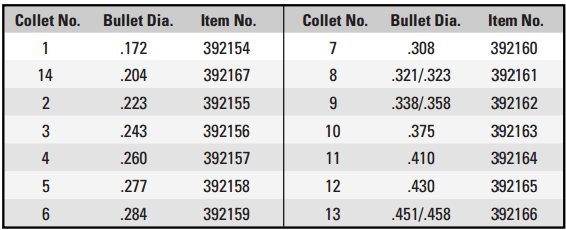
NOTE: In order to use this tool, you’ll need the appropriate collet for each diameter range of bullets you intend to pull. For example use collet #3 for 6mm, collect #6 for 7mm, and collet #7 for .308 Caliber.
If you want smoother bullet seating, inside neck lube can help. Forum member Ackleyman II likes to add a little Mica powder inside his case necks before seating bullets. This is easily done with the Forster three-brush neck lube kit. Ackleyman tells us: “Many loads that I have will not shoot well with a dry neck compared to a neck that is cleaned and lubed with this [Forster Dry Lubricator] — the best $15 you have ever spent.”
The Forster Case Neck Lubricator features three brushes attached to a tough, impact-resistant case with holes for bench mounting. The brushes accommodate all calibers from 22 to 35 caliber. The kit includes enough “motor mica” to process 2000 to 3000 cases and has a cover to keep dust and grit from contaminating the mica. By moving the case neck up and down on the correct mica-covered brush, the neck can be cleaned and lubricated at the same time.
Function: Lubricate case necks for easier resizing
Contents: Kit with base, lid, and three nylon brushes
Lubricant: Includes 1/10 oz. of Motor Mica, enough to process 2000-3000 cases
To err is human… Sooner or later you’ll probably get a case stuck in a die. This “fix-it” article, which originally appeared in the Western Powders Blog, explains the procedure for removing a firmly stuck cartridge case using an RCBS kit. This isn’t rocket science, but you do want to follow the directions carefully, step-by-step. Visit the Western Powders Blog for other helpful Tech Tips.
Curing the Stuck Case Blues
Sticking a case in the sizer die is a rite of passage for the beginning handloader. If you haven’t done it yet, that’s great, but it probably will eventually happen. When it does, fixing the problem requires a bit of ingenuity or a nice little kit like the one we got from RCBS.
The first step is to clear the de-capping pin from the flash hole. Just unscrew the de-capping assembly to move it as far as possible from the primer pocket and flash hole (photo at right). Don’t try to pull it all the way out. It won’t come. Just unscrew it and open as much space as possible inside the case.
Place the die upside down in the padded jaws of a vise and clamp it firmly into place. Using the supplied #7 bit, drill through the primer pocket. Be careful not to go too deeply inside the cartridge once the hole has opened up. It is important to be aware that the de-capping pin and expander ball are still in there and can be damaged by the bit.
Drill and Tap the Stuck Case
Once the cartridge head has been drilled, a ¼ – 20 is tap is used to cut threads into the pocket. Brass is relatively soft compared to a hardened tap, so no lube is needed for the tapping process. RCBS says that a drill can be used for this step, but it seems like a bit of overkill in a project of this nature. A wrench (photo above right) makes short work of the project.
RCBS supplies a part they call the “Stuck Case Remover Body” for the next step. If you are a do-it-yourselfer and have the bit and tap, this piece is easily replicated by a length of electrical conduit of the proper diameter and some washers. In either case, this tool provides a standoff for the screw that will do the actual pulling.
With an Allen Wrench, Finish the Job
Run the screw through the standoff and into the tapped case head. With a wrench, tighten the screw which hopefully pulls the case free. Once the case is free, clamp the case in a vice and pull it free of the de-capping pin. There is tension here because the sizing ball is oversized to the neck dimension as part of the sizing process. It doesn’t take much force, but be aware there is still this last little hurdle to clear before you get back to loading. Don’t feel bad, everyone does this. Just use more lube next time!
Article find by EdLongrange. We welcome reader submissions.
Lyman is introducing three new Brass Smith series reloading presses for 2018. Here we focus on the two full-size Brass Smith presses, the O-Frame Victory Single Stage and the new 8-Station All-American Turret Press. Both these sturdy presses feature an innovative “straight line” priming system with shielded primer tube.
New Cast-Iron Victory O-Frame Single-Stage Press
Lyman’s new Victory™ Press is built on a heavy duty cast iron “O” frame with 1-inch diameter ram and compound linkage. It looks strong and Lyman claims the “Victory Press is one of the most rugged and rigid available on the market.” The Victory Press features a simple, reliable straight-line primer feed. It’s easy to prime a case — simply push the priming arm forward to position a primer beneath the shell holder. As an added safety feature, the primer feed comes with a heavy steel shield surrounding the primer tube. The large 5-inch frame opening can take long magnum cases. MSRP is $199.45. We expect initial “street price” to be around $160.00, less expensive than an RCBS RockChucker, but more pricey than a Lee Classic Cast Press.
“It has been a while since Lyman Products introduced new presses, for the very simple reason that our presses are built to be so durable that they actually end up being handed down in families”, explained Trevor Mullen, Lyman’s VP of Marketing and Business Development. “But for 2018, we decided we needed to add certain features that make these new presses even better than their former models.”
New Cast-Iron 8-Station All-American Turret Press
Along with its new Victory Single-Stage Press, Lyman is releasing a beefy All-American Turret Press with eight (8) stations. That’s one more than the Redding T-7 Turret Press, and two more stations than the six-station RCBS Turret Press. With the Lyman’s EIGHT stations you can hold sizing AND seating dies for four different rifle cartridges. Or, if you seat bullets with an arbor press, you could have sizers for six cartridges, plus a dedicated decapping die and a factory crimp die. With eight stations available — there are countless options.
Rigidity is very important with a turret press — if you have too much “give” of flex with the turret head you may get inconsistent results when bumping shoulders using full-length dies. With a heavy cast-iron frame and turret head, Lyman says its new Turret Press is “the most rugged” on the market. We like the front-mount priming system which can easily be operated with your free hand, whether you mount the press arm on the left or the right. MSRP is $249.95. We expect “street price” to be around $220.00, quite a bit less than the six-station RCBS Turret Press.










 Sticking a case in the sizer die is a rite of passage for the beginning handloader. If you haven’t done it yet, that’s great, but it probably will eventually happen. When it does, fixing the problem requires a bit of ingenuity or a nice little kit like the one we got from RCBS.


