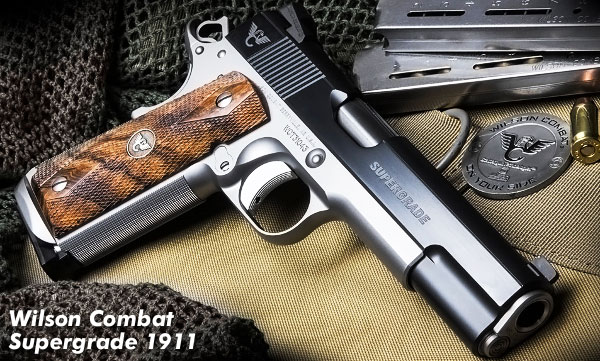
Do you shoot a .45 ACP? We love this short, fat cartridge because it is inherently accurate, it makes big, easy-to-see holes in paper, and because it it works so well in the classic 1911 series of pistols. It is hard to beat a good, tuned model 1911 when it comes to trigger pull/reset and natural pointing ability.
Once you get the hang of it, 1911-type pistols are also easy to field strip for cleaning. Here is a video showing how to disassemble and reassemble your model 1911:
Model 1911 Field Stripping and Reassembly
.45 ACP Ammunition Loading Guide
If you “roll your own” .45 ACP cartridges, there are many good powder choices. Our favorites are Vihtavuori N320, AA No. 5, and Hodgdon TiteGroup, but there are many other good choices. You’ll find these three recommended powders (plus seven others) in this .45 ACP Reloading Guide from Nosler:
Christmas is coming soon. Books have always been popular holiday gifts. If you haven’t completed your holiday shopping, here are some recommended titles that should please the serious shooters and firearms enthusiasts on your shopping list. For shooting clubs, books also make great end-of-season member awards. Most of us would rather have a useful book than one more piece of wood to toss in a box in the closet.
Here Are TEN BOOKS Recommended for Serious Shooters:
Glen Zediker’s latest book, Top-Grade Ammo, is a great resource for all hand-loaders — beginners through advanced. This 314-page guide covers every aspect of the reloading process — component sorting, priming, sizing, bullet seating and more. With 430 photos, Top-Grade Ammo is a richly-illustrated, step-by-step guide to producing high-quality handloads. Unlike many reloading books, Top-Grade Ammo is current and up-to-date, so it covers modern practices and the latest precision reloading tools. While Zediker focuses on producing match-grade ammo for competition, this book will also help novice reloaders on a budget. This book features a special “lay-flat” binding so it’s easy to use as a benchtop reference. To view Chapter List and sample pages visit ZedikerPublishing.com.
If you’re a serious long-range shooter, consider adding this book to your library. Relying on extensive ballistics testing, Modern Advancements contains some fascinating research results, including the effects of twist rate on muzzle velocity, BC, and precision. Other sections detail the evolution of modern rifle, bullet, and optics designs. And there is an important comparison test of chronographs. Laser rangefinders and wind measurement devices are explained in detail by contributing author Nick Vitalbo. This book is a valuable resource for anyone who wants to understand the current “state of the art” in today’s shooting world. There is a ton of “hard science” in this book — not just opinions.
Thinking of getting started in the Practical/Tactical shooting game? Looking for ways to be more stable when shooting from unconventional positions? Then you may want to read Marcus Blanchard’s Practical Shooter’s Guide (A How-To Approach for Unconventional Firing Positions and Training). Unlike almost every “how to shoot” book on the market, Blanchard’s work focuses on the shooting skills and positions you need to succeed in PRS matches and similar tactical competitions. Blanchard provides clear advice on shooting from barricades, from roof-tops, from steep angles. Blanchard says you need to train for these types of challenges: “I believe the largest factor in the improvement of the average shooter isn’t necessarily the gear; it’s the way the shooter approaches obstacles and how they properly train for them.”
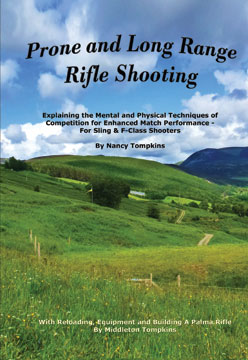
Nancy Tompkins is one of the greatest long-range shooters in American history. She has won five National Long-range Championships. Tompkins’ treatise is a must-read for serious Palma, F-Class, and High Power shooters. The revised Second edition includes F-Class equipment and techniques, and newly updated information. Color pictures. Topics include Mental & Physical training, Reading Wind & Mirage Shooting Fundamentals, International Competition, and Loading for Long Range. Nancy Tompkins is a 4-time winner of the National Long Range Championships, and has won countless other major events. Nancy has been on six Palma Teams (as both a shooter and a coach).
Ryan Cleckner is noted for his ability to explain complex topics in an easy-to-comprehend manner. Now Cleckner has authored a book, the Long Range Shooting Handbook, which expands on the topics covered in Cleckner’s popular NSSF video series. The Long Range Shooting Handbook is divided into three main categories: What It Is/How It Works, Fundamentals, and How to Use It. “What It Is/How It Works” covers equipment, terminology, and basic principles. “Fundamentals” covers the theory of long range shooting. “How to Use It” gives practical advice on implementing what you’ve learned, so you can progress as a skilled, long range shooter. You can view Sample Chapters from Ryan’s Book on Amazon.com.
Tony Boyer, the most successful shooter in the history of short-range benchrest competition, shares many of his match-winning tips in this 323-page book. The book covers all aspect of the benchrest discipline: loading, windflags, rest set-up, addressing the rifle, and match strategies. This is a high-quality publication, filled with valuable insights. Every serious benchrest shooter should read Tony’s book. Boyer has dominated registered benchrest in a fashion that will never be duplicated, having amassed 142 U.S. Benchrest Hall of Fame points. The next closest shooter, Allie Euber, has 47 Hall of Fame points. This handsome, full-color book is 323 pages long, with color photos or color illustrations on nearly every page.
This book should be on the shelf of every short-range benchrest shooter. (Shooters in other disciplines will find the book helpful as well.) Butch Lambert says Mike’s book is “far and away the best Benchrest book written. Very comprehensive, it touches on every aspect of our game.” Mike’s 368-page book is dedicated to getting the most from modern rifle accuracy equipment with an emphasis on shooting 100-200-300 yard group benchrest tournaments. This book covers the most popular hardware plus new equipment offerings are covered, including external mount scopes, actions, triggers, stocks, wind flags, and more. Also covered are rifle handling techniques, note taking, tuning, bullet selection, goals, and match strategies. Mike provides many tips that will help active competitors update their own competitive program.
This book by 11-time National High Power Champion David Tubb focuses on position shooting and High Power disciplines. Section One covers fundamentals: position points, natural point of aim, breathing, triggering mechanics and follow-through, sling selection and use, getting started, getting better, avoiding obstacles. Section Two covers mechanics of offhand, sitting, and prone positions. Section Three covers shooting skills, including wind reading and mental preparation. Section Four covers the technical side of shooting, with extensive disuctions of rifle design, load development, reloading barrel maintenance, and rifle fitting. We consider this book a “must-read” for any sling shooter, and there is plenty of good advice for F-Class shooters too.
Bullseye Mind (Mental Toughness for Sport Shooting) by Dr. Raymond Prior, $14.00 (Softcover).
Having a Bullseye Mind means thinking in ways that create confidence and consistency, even under pressure. A “must-read” for competitive shooters, Bullseye Mind is a mental training book written specifically for the shooting sports. The book is well-organized, with handy highlighted lists and key “talking points”. Each chapter concludes with examples from a world-class shooters such as: Matt Emmons, 2004 Olympic Gold Medalist; Vincent Hancock, 2-time Olympic Gold Medalist; Jamie Corkish, 2012 Olympic Gold Medalist; Petra Zublasing, 2014 World Champion/ISSF Shooter of the Year; and Nicco Campriani, 2012 Olympic Gold Medalist, 2010 World Champion. This book has earned rave reviews from competitive shooters who found it really helped their “Mental Game”. One recent purchaser states: “This book is as though you had a coach in your back pocket…”
Cartridges of the World (15th Edition, 2016), belongs in every serious gun guy’s library. This massive 680-page reference contains illustrations and basic load data for over 1500 cartridges. If you load for a wide variety of cartridges, or are a cartridge collector, this book is a “must-have” resource. The latest edition includes 50 new cartridges and boasts 1500+ photos. The 15th Edition of Cartridges of the World includes cartridge specs, plus tech articles on Cartridge identification, SAAMI guidelines, wildcatting, and new cartridge design trends. In scope and level of detail, Cartridges of the World is the most complete cartridge reference guide in print. Cartridges of the World now includes a 64-page full-color section with feature articles.
This article, which originally appeared in the Sierra Bullets Blog, provides a new terminology that helps describe the geometry of bullets. Once you understand the meaning of “Caliber(s) of Ogive”, you can quickly evaluate potential bullet performance by comparing listed Caliber of Ogive numeric values.
by Mark Walker, Sierra Bullets New Product Development Manager
During one of our recent product releases, we listed the “caliber of ogive” of the bullet in the product description. While some understood what that number meant, it appears that some are not aware of what the number is and why it is important. In a nutshell, the “caliber of ogive” number will tell you how sleek the front end of the bullet is. The higher the number is, the sleeker the bullet. It also makes it easy to compare the ogives of different caliber bullets. If you want to know if a certain .308 caliber bullet is sleeker than a 7mm bullet, simply compare their “caliber of ogive” numbers.
So exactly how do you figure “caliber of ogive”? If you look at the drawing of the .30 caliber 175 gr HPBT bullet #2275 (at top), you will see that the actual radius of the ogive is 2.240. If you take that 2.240 ogive radius and divide by the diameter (or caliber) of the bullet you would get 7.27 “calibers of ogive” (2.240 ÷ .308 = 7.27). (See top photo).
In a nutshell, the “caliber of ogive” number will tell you how sleek the front end of the bullet is. The higher the number is, the sleeker the bullet.
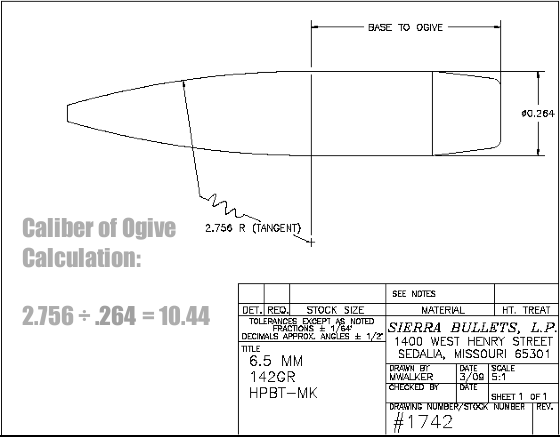
Next let’s look at the print (below) of our 6.5mm 142gr HPBT #1742 bullet for comparison. The actual radius of the ogive is 2.756. Like with the .30 caliber 175 gr HPBT bullet #2275, if you divide 2.756 by the diameter (or caliber) of the bullet you get 10.44 “calibers of ogive”.
Some people would say why not just compare the actual ogive radius dimensions instead of using the “caliber of ogive” figure. If we were comparing only bullets of the exact same diameter, then that would be a reasonable thought process. However, that idea falls apart when you start trying to compare the ogives of bullets of different diameters. As you can see with the two bullets presented above, if we compare the actual ogive radius dimensions of both bullets the difference is not much at all.
However, once again, testing has shown that the 6.5mm 142 gr HPBT #1742 has a significantly higher BC. The only way that this significant increase shows up, other than when we fire the bullets in testing, is by comparing the “caliber of ogive” measurement from both bullets.
Hopefully this will help explain what we mean when we talk about “caliber of ogive” and why it’s a handy number to use when comparing bullets. This information will help you to make an informed decision the next time you are in the market to buy bullets.
Story tip from Grant Ubl. We welcome reader submissions.
AMP Annealing, the New Zealand-based manufacturer of advanced, computer-controlled annealing machines, has some new items in the works. First, AMP is bringing out a new, jumbo-sized pilot for the large .50 BMG case, which has a fat base diameter of 0.804″ (20.44 mm). The folks at AMP say: “The new 50-Caliber pilot is as large as the boss it screws into. We also had to add some insulation to the grip to stop it from heating up. We know a lot of your have been patiently waiting for the .50 Cal unit and we are on track for release early next year [2018].”
Along with the creating more pilot holders for brass, AMP is working on enhancing the performance of its annealing machines, offering even greater precision and efficiency. Here AMP engineers at the Auckland University of Technology test upgrades with AMP Annealing machines. AMP says: “Exciting times ahead… What’s new? We can’t say at this stage. But it will involve the use of your USB cable.”
.50 BMG — Just for the Fun of It All…
But back to the .50 BMG. Why would anyone want to shoot this beast? Well, because you can. It also offers excellent extreme long range performance. And nothing (well as least nothing civilians can purchase readily) beats the knock-down power of a big 50. This video shows what the .50 BMG can do to a truckload of pumpkins.
At the request of our readers, we provide select “Deals of the Week”. Every Monday morning we offer our Best Bargain selections. Here are some of the best deals on firearms, hardware, reloading components, optics, and shooting accessories. Be aware that sale prices are subject to change, and once clearance inventory is sold, it’s gone for good. You snooze you lose.
1. MidwayUSA — Black Friday SALE Begins Monday 11/20/2017
MidwayUSA is kicking off its Black Friday Sale early. Midway says this is “our biggest sale of the year!”. We can confirm there are dozens of great bargains on quality products. There is also a Sweepstakes with over $1800.00 worth of gear. Hundreds of items are on sale. Here are some of the best MidwayUSA deals we spotted today:
2. EuroOptic.com — Vortex 13% Off & Gift Cards up to $250.00
EuroOptic.com is running a Super Sale on Vortex Optics. Now through December 1st, use promo code VTX13 to receive 13% off ALL Vortex Optics products at EuroOptic.com. Here’s the real incentive — qualifying Razor HD Gen II, Golden Eagle HD, PST, and HST Vortex riflescope purchase will earn you a EuroOptic Gift Card worth up to $250.00. Call today at 570-368-3920, for gift card details. Here are the models qualifying for Gift Card Specials:
3. Whittaker Guns — Howa Lightning 6.5 Creedmoor Rifle, $329.99
With this deal you can get a complete 6.5 Creedmoor Howa 1500 Rifle with HACT 2-Stage Trigger for just $329.99. That’s $88.00 less than the price of a Howa 1500 barreled action by itself! ($418.00 at Brownells). This is a no-frills rifle, but its hard to beat the $329.99 price for a solid, multi-purpose rifle. Use “As-Is” for hunting or drop it into a modular stock for tactical/practical games.
4. Cabela’s — Nikon Laser RangeFinder Binoculars $200 Off
As part of its week-long Black Friday promotion, Cabela’s is offering big discounts on Nikon optics. One truly outstanding deal is the 10x42mm Nikon LaserForce rangefinder binoculars — the price has been slashed $200 from $1199.99 down to $999.99. Yes these highly-rated LRF binocs do sell elsewhere for around $1200. These Nikons offer performance rivaling expensive European rangefinding binoculars (Leica, Swarovski) for hundreds less. Clarity is excellent. Ranging ability is very good. Note: This $999.99 price is good for one week starting Wednesday, 11/22/2017. You have to wait until 11/22 to get the $999.99 price.
READ Field Test of Nikon LaserForce 10×42: “This is a truly remarkable hunting optic, especially when price is taken into consideration ($1199.95 MSRP). With a powerful, full-featured laser rangefinder married to an excellent quality binocular… LaserForce performance is on par with comparable units costing 2-3 times more.” — Tony Martins
5. Dick’s Sporting Goods — Black Friday Gun Safe Sale
Need a Gun Safe? Head down to Dick’s Sporting Goods on Black Friday (11/24/2017). The giant, 64-gun Stack-On Sentinel vault will be marked down from $1499.99 to $699.98, a $800 savings, and a killer deal on a BIG vault! A medium-sized 24-gun safe will sell for just $399.98 — $300 off the regular price. NOTE, if you cannot wait until Black Friday, you can still save with pre-Black Friday sale pricing right now. You’ll pay more than on Black Friday, but there are still some significant savings. For example, right now you can get the Field & Stream Pro 36-gun safe for $699.98, marked down from $899.99. NOTE: The illustrated Sale prices are for BLACK FRIDAY ONLY, 11/24/17.
6. Cabelas.com — Sig Kilo 2200 RangeFinder $349.99
This Sig Sauer Kilo 2200 is a very good laser rangefinder that performs as well as some other brands costing nearly twice as much. You’ll get performance on par with a Zeiss Victory or Leica CRF for hundreds less. User reports on the Sig Kilo LRF have been very positive. The $349.99 Sale Price is a great deal.
7. Midsouth — Hornady Auto Charge Dispenser, $148.99
As a pre-Black Friday promotion, Midsouth Shooters Supply is discounting the Hornady Auto Charge electronic Scale/Dispenser down to $148.99. The Auto Charge is accurate to 0.1 grains of powder and can hold up to 1000 grains of powder in its hopper. As a bonus, if you purchase this Auto Charge this week, Midsouth will provide FREE Shipping on your entire order — including any other items you might buy (HazMat charges extra).
8. Amazon — MTM AC4C Ammo Crate with 4 Ammo Boxes
Here’s a very cool product from MTM at a great price. The versatile MTM AC4C Ammo Carrier features four, lockable polymer ammo cans in a fitted, four-slot 23.5” x 11.3” x 7.5” carry crate. This makes it easy to haul four full ammo cans. Actual purchasers have raved: “Moments after I received this storage box set I ordered another. Very well built and great design. Awesome and a steal at the price.” Right now this is on sale at Amazon for just $29.99 with free prime shipping. The system includes four lockable, O-Ring 11.3″ x 7.2″ x 5″ ammo cans (AC30T) for multi-caliber ammo storage. The crate even includes tie-down points for transport in a cart or ATV. NOTE: Earlier this summer this MTM AC4C system sold for $39.99. The current $29.99 price represents a 25% savings! See price chart below.
9. Brownells — Federal .45 ACP 1000 Rounds $224.50 with Rebate
We love to shoot .45 ACP, but it is expensive to reload compared to smaller calibers. Here’s a great deal for .45 ACP fans. Brownells is selling 1000 rounds of brass-cased Federal American Eagle .45 ACP for $299.80, or just $224.85 after manufacturer’s rebate. NOTE: This Federal 25% Off Rebate applies to other American Eagle brass-cased pistol ammo carried by Brownells including: 25 ACP, 32 ACP, .380 ACP, .38 SPL, .357 Magnum, 9mm Luger, and .40 S&W. American Eagle ammo is reliable and the brass is reloadable. SEE All Rebate-Eligible Ammo.
The anvil is the tripod-shaped thin metal piece protruding above the bottom of the primer cup. Getting the primer sitting fully flush on the bottom of the case primer pocket, without crunching it too much, requires some keen feel for the progress of primer seating.
In two recent Midsouth Blog articles, Glen Zediker offers helpful advice on priming. First he examines what happens to the primer itself as it is seated in the cup. Glen explains why some “crush” is important, and why you never want to leave a high primer. Glen also reviews a variety of priming tools, including his favorite — the Forster Co-Ax Bench Primer Seater. Then he offers some key safety tips. Glen provides some “rock-solid” advice about the priming operation. You’ll find more great reloading tips in Glen’s newest book, Top-Grade Ammo, which we recommend.
Priming Precision vs. Speed
Glen writes: “The better priming tools have less leverage. That is so we can feel the progress of that relatively very small span of depth between start and finish. There is also a balance between precision and speed in tool choices, as there so often is.”
Benchtop Priming Tools — The Forster Co-Ax
Glen thinks that the best choice among priming options, considering both “feel” and productivity, may be the benchtop stand-alone priming stations: “They are faster than hand tools, and can be had with more or less leverage engineered into them. I like the one shown below the best because its feeding is reliable and its feel is more than good enough to do a ‘perfect’ primer seat. It’s the best balance I’ve found between speed and precision.”
Load Tuning and Primers
Glen cautions that you should always reduce your load when you switch to a new, not-yet-tested primer type: “The primer is, in my experience, the greatest variable that can change the performance of a load combination, which is mostly to say ‘pressure’. Never (never ever) switch primer brands without backing off the propellant charge and proving to yourself how far to take it back up, or to even back it off more. I back off one full grain of propellant [when I] try a different primer brand.”
Priming Safety Tips by Zediker
1. Get a good primer “flip” tray for use in filling the feeding magazine tubes associated with some systems. Make double-damn sure each primer is fed right side up (or down, depending on your perspective). A common cause of unintentional detonation is attempting to overfill a stuffed feeding tube magazine, so count and watch your progress.
2. Don’t attempt to seat a high primer more deeply on a finished round. The pressure needed to overcome the inertia to re-initiate movement may be enough to detonate it.
3. Don’t punch out a live primer! That can result in an impressive fright. To kill a primer, squirt or spray a little light oil into its open end. That renders the compound inert.
4. Keep the priming tool cup clean. That’s the little piece that the primer sits down into. Any little shard of brass can become a firing pin! It’s happened!
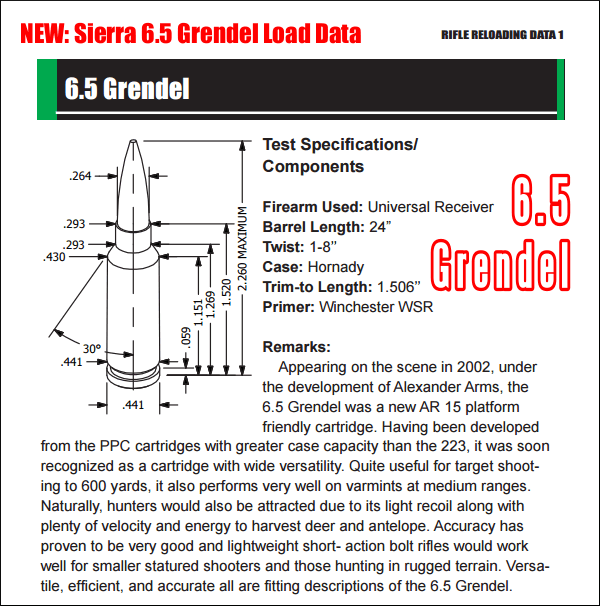
Sierra Bullets has just released load data for the 6.5 Grendel, a popular cartridge that works equally well in bolt guns and AR15-platform gas guns. Sierra published comprehensive 6.5 Grendel load data, covering 19 powders and eight (8) different bullets from 85 to 130 grains. NOTE: Hornady-brand brass (see below) was used for Sierra’s 6.5 Grendel tests, not the stronger Lapua 6.5 Grendel brass. Hand-loaders using Lapua 6.5 Grendel brass may need to adjust their loads. Also Winchester WSR primers were used. We imagine most precision hand-loaders will prefer CCI or Federal primers.
Sierra Bullets Tested for 6.5 Grendel Load Data
85gr HP (#1700)
100gr HP (#1710)
107gr HPBT (#1715)
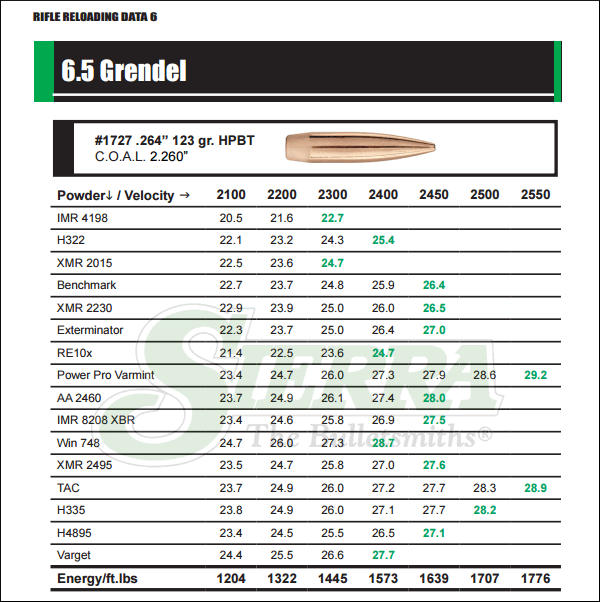
In developing its 6.5 Grendel load data, Sierra tested a very wide selection of propellants, 19 in all. For the 85gr to 100gr varmint bullets, modern powders such as XMR 2230, Power Pro Varmint, and Ramshot TAC offered the best velocity in the 24″ test barrel. For the heavier 120gr to 130gr match bullets, Sierra tested a selection of powders. Highest velocities came with Power Pro Varmint and TAC. If you’re looking for best accuracy, consider the slower burn-rate powders such as IMR 8208 XBR and Varget — but you’ll sacrifice some speed. Overall, Sierra’s latest 6.5 Grendel load data is an excellent addition to the 6.5 Grendel knowledge base. Thanks Sierra!
Here are Sierra’s 6.5 Grendel Load Data Charts for Sierra’s 123gr HPBT, 130gr HPBT, and 130gr TMK. There are a five other tables for lighter-weight Sierra bullets.
History of the 6.5 Grendel Cartridge
The 6.5 Grendel originated as a 6mm PPC necked up to 6.5 mm. After Alexander Arms relinquished the “6.5 Grendel” Trademark, the 6.5 Grendel was standardized as an official SAAMI cartridge. It has become popular with target shooters and hunters alike because it is accurate, efficient, and offers modest recoil. Good for small to medium game, the 6.5 Grendel is becoming a popular chambering in lightweight hunting rifles, such as the Howa Mini Action Model. It is one of the most accurate cartridges you can shoot in the AR-15 platform.
For some applications, we prefer a non-bushing FL die over a bushing die. Shown here are three Forster full-length sizing dies, with necks honed to three different dimensions: 0.265″, 0.266″, and 0.267″.
The Honed Full-Length Sizing Die Option
There are many good options in full-length (FL) sizing dies. Most precision hand-loaders prefer FL dies with neck bushings. These let you adjust the “grip” on your bullet by using larger or smaller bushings. FL bushing dies are available from Whidden Gunworks, Forster, Redding and other makers.
Conventional, non-bushing full-length sizing dies can create ultra-accurate ammo with very low run-out. But many conventional non-bushing FL dies have an undersized neck diameter so you end up with excess neck tension, and you work the brass excessively.
There is another effective option, one that promises extremely low run-out. The honed FL die is a full-length sizing die that has the necked honed to provide a precise fit to the case-neck. When done right, honed FL dies produce extremely straight ammo — as there are no issues with bushing alignment (or bushings that are not perfectly concentric). This Editor owns honed dies from Forster, Redding, and Whidden. They all perform extremely well, delivering match ammunition with extremely low run-out measured with a 21st Century Concentricity Gauge.
In one of the most popular articles we’ve ever published, Bugholes from Bipod, California shooter “Froggy” explained why he prefers honed dies for his tactical ammo.
Q: Do you FL size every time? Do you use custom dies?
Absolutely, I full length resize all of my brass every time I reload. And guess what? I’ve never had a feeding problem.
I do use a modified sizing die, without bushings. My FL resizing die has been custom-honed in the neck area to give .0015″ press fit on the bullet. I also put a slightly larger radius at the neck shoulder junction. I feel that this helps to seal the chamber. With this die, I get consistent neck tension every time–without bushings. Bushings are useful when you’re fishing around for a good load. But once you find the right amount of sizing for ideal neck tension, you can do this better with a customized FL die.
6.5 Guys Review Forster Honed Full-length Dies
The 6.5 Guys recently reviewed honed FL sizing dies from Forster, explaining the pros and cons of this type of reloading die. They explained that, if you load a wide variety of bullets from different manufacturers, you many want to stick with a Bushing FL die. However, if you have settled on a particular bullet and found the “ideal” neck tension, then a honed die may make sense.
In this Gear Update, the 6.5 Guys discuss a service offered by Forster Products to custom hone the neck diameter of its full-length sizing dies to the customer’s specifications (to the thousandth). Whidden Gunworks also offers custom-honed FL dies.
Sierra Bullets has recently released load data for the 6mm Creedmoor cartridge, a necked-down version of the 6.5 Creedmoor, a popular PRS, tactical, and hunting cartridge. Sierra has released very comprehensive 6mm Creedmoor load data, covering fifteen (15) different bullets from 55 to 110 grains. NOTE: Hornady-brand brass was used for Sierra’s 6mm Creedmoor load tests, not the newer, stronger Lapua 6.5 CM brass with small primer pockets. Hand-loaders using Lapua 6.5 Creedmoor brass necked to 6mm may have to adjust their loads.
Sierra writes: “As soon as the 6.5 Creedmoor was released in 2007, a 6mm version was being envisioned. After the 6mm Creedmoor demonstrated its worth at 1000 yards it began to catch the attention of Precision Rifle Series (PRS) competitors. The 6mm/6.5 Creedmoor is a great fit for those looking for an AR platform-friendly cartridge. It delivers velocities very similar to the .243 Win and yet fits the AR10 magazine length[.] The 30-degree shoulder makes this a very efficient case and helps prolong case life as well. The 6mm/6.5 Creedmoor works well with powders such as H4350, RE-17, and Ramshot Hunter for heavier long-range bullet weights. Slightly faster powders such as RE-15, Win 760, and Vihtavuori N540 work well with lighter weight bullets.”
Sierra Bullets Tested for 6mm Creedmoor Load Data
55gr BlitzKing (#1502)
60gr HP (#1500)
70gr HPBT (#1505)
70gr BlitzKing (#1507)
75gr HP (#1510)
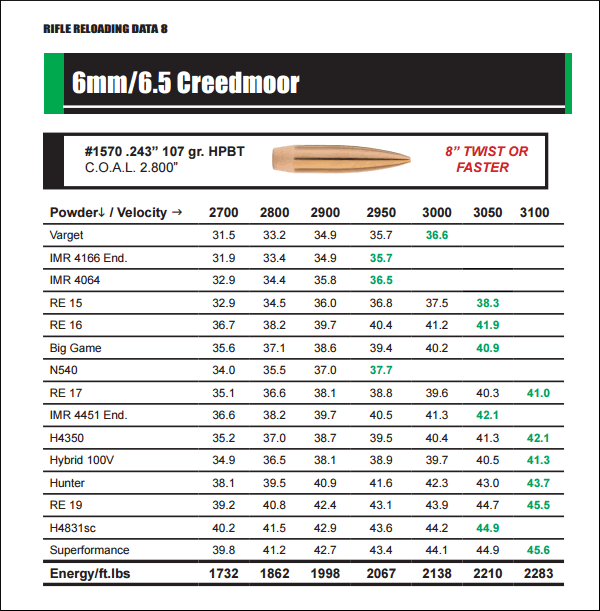
In developing its 6mm Creedmoor load data, Sierra tested a very wide selection of propellants, two dozen overall. For the smaller bullets, fast-burning powders such as Benchmark, H4895, and CFE223 were tested. For the heavier 100+ grain bullets, Sierra tested a selection of medium-burn-rate powders including H4350, Reloder 16, Reloder 17, Varget, and Superformance. Sierra did a very thorough job. We know this information will be welcomed by 6mm Creedmoor shooters.
Don’t know what powder to try first? For the 107-110 grain bullets, if you want best accuracy and low ES/SD, our Forum members recommend Alliant Reloder 16 and Hodgdon H4350. If you are seeking max velocity with the 110-grainer, look at Hodgdon Superformance and Reloder 19.
Here are Sierra’s 6mm Creedmoor Load Data Charts for the 107gr MK and 110gr MK. There are a half-dozen other tables for lighter-weight bullets.
IMR, a Hodgdon Powder Company brand, will soon release a new, slow-burn-rate magnum powder, IMR Enduron® 8133. This new powder is designed for large, magnum cartridges, such as .300 Win Magnum, .300 Remington Ultra Magnum, and 28 Nosler, among others. With the slowest burn rate among Enduron powders, 8133 has burn properties similar to Hodgdon Retumbo. The new Enduron 8133 powder will be available in 1-lb and 8-lb canisters starting in February 2018. Load Data for this new powder is already listed on the Hodgdon Reloading Data Center.
IMR® Legendary Powders now offers five (5) Enduron powders: IMR 4166, IMR 4451, IMR 4955, IMR 7977, and IMR 8133. “It was always our intent to fill out the Enduron line with a magnum powder and we could not be happier with how 8133 performed in development and testing,” says Ron Reiber, Hodgdon ballistician. “This powder delivers the [slow burn rate] magnum-caliber reloaders require and adds all of the performance characteristics of the Enduron line of powders”. These qualities include temp stability, significantly reduced copper fouling, and optimal load density.
Modern Powder Technology for Enhanced Performance
Copper fouling reduction – these powders contain an additive that drastically reduces copper fouling in the gun barrel. Copper fouling should be minimal, allowing shooters to spend more time shooting and less time cleaning a rifle to retain accuracy.
Temperature change stability – the Enduron line is insensitive to temperature changes. Whether a rifle is sighted in during the heat of summer, hunted in a November snowstorm or hunting multiple locations with drastic temperature swings, point of impact with ammunition loaded with Enduron technology will be very consistent.
Optimal load density - Enduron powders provide optimal load density, assisting in maintaining low standard deviations in velocity and pressure, a key feature for top accuracy.
Environmentally friendly - Enduron technology is environmentally friendly, crafted using raw materials that are not harmful to the environment.
The Enduron Line-Up of Five Powders
IMR now offers FIVE Enduron powders that cover a broad range of burn rates. They are suitable for a wide variety of cartridges, from small varmint cartridges all the way up to the .338 Lapua Magnum.
IMR 4166 possesses the fastest burn rate in the Enduron lineup. It is the perfect burn speed for cartridges such as .308 Win, 7.62mm NATO, 22-250 Rem and 257 Roberts. A versatile, match-grade propellant, IMR 4166 is comparable to Hodgdon® Varget.
IMR 4451 is a mid-range burn speed powder, ideally suited for cartridges such as .270 Winchester, .30-06 and 300 Winchester Short Magnum. This powder is comparable to Hodgdon H4350.
IMR 4955 is a medium burn speed powder, falling in between IMR 4451 and IMR 7977 in burn speed. It provides top performance in big game cartridges such as 25-06, 280 Remington and 300 Winchester Magnum. This powder is comparable to Hodgdon H4831.
IMR 7977 has the second slowest burn rate among the Enduron Technology powders. It yields great performance in .300 Winchester Magnum, 7MM Remington Magnum, and .338 Lapua Magnum. IMR 7977 is comparable to Hodgdon H1000.
IMR 8133 is designed specifically for magnum calibers, such as .300 Remington Ultra Magnum, 28 Nosler, or the .264 Winchester Magnum, among many others. This new powder has the slowest burn rate among the Enduron powders and compares in burn rate to Hodgdon Retumbo.