|
|
October 16th, 2014

Conventional brass jags work great — except for one thing. They can react to solvents, leaving a blue “false positive” on patches. In recent years, jag-makers have experimented with many different materials in an effort to cure the solvent-reaction problem. Today we have polymer jags, nickel-plated jags, and stainless steel jags. And the latest innovation is the aluminum jag from Dewey.
 J. Dewey Mfg. is now producing a series of “Copper Eliminator” jags and brush adapters made from aircraft-grade aluminum with the same hardness as brass. Dewey claims that its new aluminum jags will not become embedded with grit or particles that could harm your bore. At the same time, Dewey’s aluminum jags will not react to ammoniated bore solvents that can turn patches blue green when used with brass jags. Dewey aluminum jags are offered with either male OR female 8/32 threads. The $4.95 aluminum jags and $3.50 brush adapters are offered in a wide variety of calibers. You can order from Dewey Mfg. or Sinclair Int’l. J. Dewey Mfg. is now producing a series of “Copper Eliminator” jags and brush adapters made from aircraft-grade aluminum with the same hardness as brass. Dewey claims that its new aluminum jags will not become embedded with grit or particles that could harm your bore. At the same time, Dewey’s aluminum jags will not react to ammoniated bore solvents that can turn patches blue green when used with brass jags. Dewey aluminum jags are offered with either male OR female 8/32 threads. The $4.95 aluminum jags and $3.50 brush adapters are offered in a wide variety of calibers. You can order from Dewey Mfg. or Sinclair Int’l.
Story Tip from Boyd Allen. We welcome submissions from our readers.
October 13th, 2014
by Philip Mahin, Sierra Bullets Ballistic Technician
This article first appeared in the Sierra Bullets Blog
The ANSI / SAAMI group, short for “American National Standard Institute” and “Sporting Arms and Ammunition Manufacturers’ Institute”, have made available some time back the voluntary industry performance standards for pressure and velocity of centerfire rifle sporting ammunition for the use of commercial manufacturers. [These standards for] individual cartridges [include] the velocity on the basis of the nominal mean velocity from each, the maximum average pressure (MAP) for each, and cartridge and chamber drawings with dimensions included. The cartridge drawings can be seen by searching the internet and using the phrase ‘308 SAAMI’ will get you the .308 Winchester in PDF form. What I really wanted to discuss today was the differences between the two accepted methods of obtaining pressure listings. The Pounds per Square Inch (PSI) and the older Copper Units of Pressure (CUP) version can both be found in the PDF pamphlet.

Image by ModernArms, Creative Common License.
 CUP Pressure Measurement CUP Pressure Measurement
The CUP system uses a copper crush cylinder which is compressed by a piston fitted to a piston hole into the chamber of the test barrel. Pressure generated by the burning propellant causes the piston to move and compress the copper cylinder. This will give it a specific measurable size that can be compared to a set standard. At right is a photo of a case that was used in this method and you can see the ring left by the piston hole.
PSI Pressure Measurement
What the book lists as the preferred method is the PSI (pounds per square inch or, more accurately, pound-force per square inch) version using a piezoelectric transducer system with the transducer flush mounted in the chamber of the test barrel. Pressure developed by the burning propellant pushes on the transducer through the case wall causing it to deflect and make a measurable electric charge.
Q: Is there a standardized correlation or mathematical conversion ratio between CUP and PSI values?
Mahin: As far as I can tell (and anyone else can tell me) … there is no [standard conversion ratio or] correlation between them. An example of this is the .223 Remington cartridge that lists a MAP of 52,000 CUP / 55,000 PSI but a .308 Winchester lists a 52,000 CUP / 62,000 PSI and a 30-30 lists a 38,000 CUP / 42,000 PSI. It leaves me scratching my head also but it is what it is. The two different methods will show up in listed powder data[.]
So the question on most of your minds is what does my favorite pet load give for pressure? The truth is the only way to know for sure is to get the specialized equipment and test your own components but this is going to be way out of reach for the average shooter, myself included. The reality is that as long as you are using printed data and working up from a safe start load within it, you should be under the listed MAP and have no reason for concern. Being specific in your components and going to the load data representing the bullet from a specific cartridge will help get you safe accuracy. [With a .308 Winchester] if you are to use the 1% rule and work up [from a starting load] in 0.4 grain increments, you should be able to find an accuracy load that will suit your needs without seeing pressure signs doing it. This is a key to component longevity and is the same thing we advise [via our customer service lines] every day. Till next time, be safe and enjoy your shooting.

October 12th, 2014
 Effects Of Cartridge Over All Length (COAL) And Cartridge Base To Ogive (CBTO) – Part 1 Effects Of Cartridge Over All Length (COAL) And Cartridge Base To Ogive (CBTO) – Part 1
by Bryan Litz for Berger Bullets.
Many shooters are not aware of the dramatic effects that bullet seating depth can have on the pressure and velocity generated by a rifle cartridge. Cartridge Overall Length (COAL) is also a variable that can be used to fine-tune accuracy. It’s also an important consideration for rifles that need to feed rounds through a magazine. In this article, we’ll explore the various effects of COAL, and what choices a shooter can make to maximize the effectiveness of their hand loads.
Sporting Arms and Ammunition Manufacturers’ Institute (SAAMI)
Most loading manuals (including the Berger Manual), present loading data according to SAAMI (Sporting Arms and Ammunition Manufacturers’ Institute) standards. SAAMI provides max pressure, COAL and many other specifications for commercial cartridges so that rifle makers, ammo makers, and hand loaders can standardize their products so they all work together. As we’ll see later in this article, these SAAMI standards are in many cases outdated and can dramatically restrict the performance potential of a cartridge.
Bullet seating depth is an important variable in the accuracy equation. In many cases, the SAAMI specified COAL is shorter than what a hand loader wants to load their rounds to for accuracy purposes. In the case where a hand loader seats the bullets longer than SAAMI specified COAL, there are some internal ballistic effects that take place which are important to understand.
Effects of Seating Depth / COAL on Pressure and Velocity
The primary effect of loading a cartridge long is that it leaves more internal volume inside the cartridge. This extra internal volume has a well known effect; for a given powder charge, there will be less pressure and less velocity produced because of the extra empty space. Another way to look at this is you have to use more powder to achieve the same pressure and velocity when the bullet is seated out long. In fact, the extra powder you can add to a cartridge with the bullet seated long will allow you to achieve greater velocity at the same pressure than a cartridge with a bullet seated short.

Figure 1. When the bullet is seated farther out of the case, there is more volume available for powder. This enables the cartridge to generate higher muzzle velocity with the same pressure.
When you think about it, it makes good sense. After all, when you seat the bullet out longer and leave more internal case volume for powder, you’re effectively making the cartridge into a bigger cartridge by increasing the size of the combustion chamber. Figure 1 illustrates the extra volume that’s available for powder when the bullet is seated out long.
Before concluding that it’s a good idea to start seating your bullets longer than SAAMI spec length, there are a few things to consider.
Geometry of a Chamber Throat
The chamber in a rifle will have a certain throat length which will dictate how long a bullet can be loaded. The throat is the forward portion of the chamber that has no rifling. The portion of the bullet’s bearing surface that projects out of the case occupies the throat (see Figure 2).

The length of the throat determines how much of the bullet can stick out of the case. When a cartridge is chambered and the bullet encounters the beginning of the rifling, known as the lands, it’s met with hard resistance. This COAL marks the maximum length that a bullet can be seated. When a bullet is seated out to contact the lands, its initial forward motion during ignition is immediately resisted by an engraving force.
Seating a bullet against the lands causes pressures to be elevated noticeably higher than if the bullet were seated just a few thousandths of an inch off the lands.
A very common practice in precision reloading is to establish the COAL for a bullet that’s seated to touch the lands. This is a reference length that the hand loader works from when searching for the optimal seating depth for precision. Many times, the best seating depth is with the bullet touching or very near the lands. However, in some rifles, the best seating depth might be 0.100″ or more off the lands. This is simply a variable the hand loader uses to tune the precision of a rifle.
CLICK HERE to Read Full Article with More Info
Article sourced by EdLongrange. We welcome tips from readers.
October 11th, 2014
Sierra Bullets has just added extensive load data for the 300 AAC Blackout (300 BLK) cartridge. Developed for the AR15 platform, the 300 BLK offers AR shooters a large-caliber option in both subsonic and supersonic variants. The 300 BLK can be made from modified .223 Rem brass or necked-up .221 Fireball cases. We like to form our .300 BLK brass by necking-up the excellent Lapua .221 Fireball brass.
CLICK HERE for Sierra Load Data for 300 AAC Blackout (PDF File)
Sierra Has 5 Pages of Load Data for the 300 AAC Blackout. Here is one sample page:
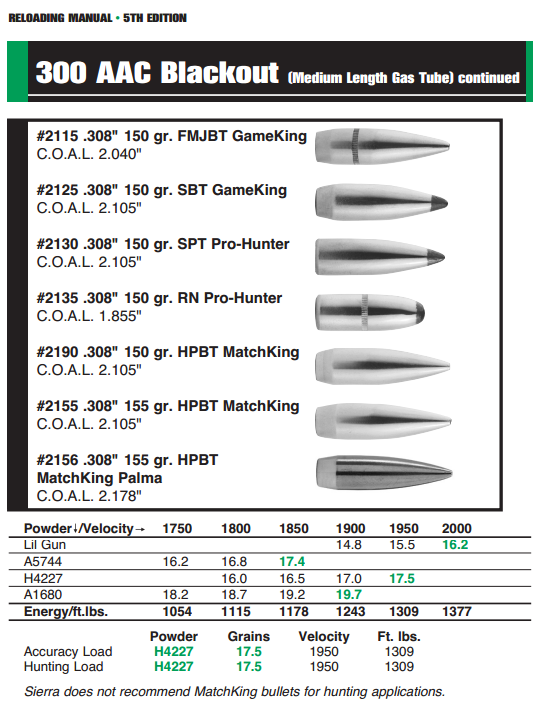
Sierra Cartridge Comments: 300 AAC Blackout
The 300 AAC Blackout (300 BLK, or 7.62x35mm) was created by Advanced Armament Corp. and Remington in order to provide the military with a way to shoot .30 caliber bullets from the M4 platform with only a barrel change. It has since become popular for a wide range of uses including hunting and home defense.

The cartridge shares case-head dimensions and body taper with the .223 Remington. Not only does this allow for compatibility with existing magazines and bolts, but it allows reloaders to form 300 BLK brass from the vast supply of 5.56mm or .223 cases. However, since .223/5.56 cases need to be cut-down and reformed, it can be simpler to neck up .221 Fireball brass.
The 300 AAC Blackout is similar to previous wildcats, such as the .30-221 and .300 Fireball, as well as the proprietary 300 Whisper®. However the 300 BLK was the first SAAMI-approved (and standardized) cartridge of this type. Moreover, any company is free to make firearms or ammunition for the 300 BLK.
300 AAC Blackout is popular with hunters, who may not be allowed to legally hunt with .223 in their state, and who prefer .30-caliber bullets for medium-sized game. It provides similar effectiveness to the 7.62×39mm or the slightly more powerful 30-30 cartridges, while working in the more up-to-date AR15 platform. Effective range for hunting is about 100-150 yards.
October 5th, 2014
We recommend that all hand-loaders have a couple reliable reloading manuals as reference guides. Berger, Hornady, and Sierra all offer well-respected load manuals. These can provide starting load information for a wide variety of cartridge types and bullet selections. We do like to cross-check any printed load recipes with current online data, to ensure you have the latest info.
Along with a good load manual, those getting started in metallic cartridge reloading can benefit from a good basic reloading treatise. There’s a new intro guide from the publishers of Gun Digest.

|
The New Gun Digest Shooter’s Guide To Reloading, by Phillip Massaro, was created for shooters new to reloading. This is a good starting point for those who want to learn to hand-load safely and efficiently. Hundreds of photos illustrate the text — and we all know a picture can be worth a thousand words.
After discussing the benefits of hand-loading, Massaro’s book covers the basics of metallic cartridge reloading, step by step. Along the way Massaro recommends appropriate presses and tools for reloading both pistol and rifle cartridges. Massaro also explains the variations in bullet and powder types, and how they affect ballistics. In addition, Massaro includes a “Specialty Situations” chapter that reveals common reloading mistakes and issues and offers practical solutions. This section on avoiding common mistakes is one of book’s best features. We wish all reloading guides had a similar section. |
|
Editor’s NOTE: This book will be released next week. Accordingly, we have not seen the final, printed version yet. At $14.79, the Gun Digest Shooter’s Guide to Reloading is relatively inexpensive. The sample chapters we reviewed provided good basic information in a well-organized fashion. Certainly, we would not tell advanced reloaders and/or competition shooters to rush out and buy this book. However, for folks getting started in hand-loading, this resource should be helpful.
September 29th, 2014
When you need ammo fast — lots of ammo, it’s hard to beat a progressive reloading press for output. We use progressive presses to load handgun ammo and .223 Rem cartridges for varmint safaris. With good dies, and proper press set-up, today’s progressive presses can produce surprisingly uniform and accurate ammo. No, you won’t see Benchrest Hall-of-Famers loading PPC cartridges on progressives. However, if you need 1000 rounds for your next prairie dog adventure, you should consider getting a progressive. Below you can see a Hornady Lock-N-Load AP configured to load .308 Winchester in bulk.
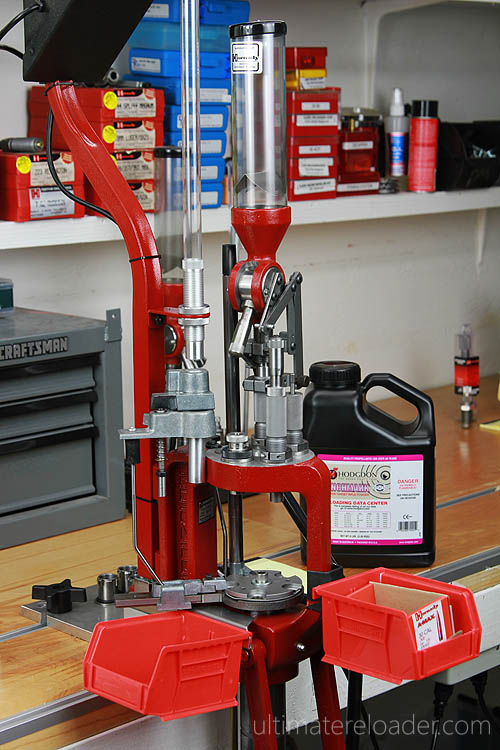
CLICK HERE to Read Full Article

UltimateReloader.com has published helpful Tips to Optimize Progressive Rifle Loading. No matter whether you have a Red (Hornady), Green (RCBS), or Blue (Dillon) progressive, this article can help you load more efficiently and produce better results. Here are some highlights:
Proper Brass Prep
Just like a good paint job requires good prep work, great rifle ammo requires good brass prep. In order to make sure your rifle loading goes smoothly, make sure to perform the following brass prep steps:
- Clean the brass (tumble, ultrasonic, etc.)
- Inspect brass for cracks, deep dents, etc.
- For military brass: de-prime, ream/swage primer pockets, size with small-base sizer die (small base usually optional).
- Measure brass length — if too long, size and then trim.
- Final inspection before loading.
- Cleaning primer pockets may be something you’ll consider (I don’t clean primer pockets except for rare cases or match ammo).
Smooth and Steady Pace
Since you’re loading rifle ammunition on a progressive, you’re already saving a load of time, so there’s no need to rush things! Attention to detail is super-important for safety and for good results. Always keep an eye on powder level (goes down FAST) and what’s happening at each station.
The Right Press and Press Setup
Look for a heavy-duty, well-built press that will stand up to rifle loading. You’ll also want to make sure your powder measure will have the proper capacity (~25 grains for .223, ~50 grains for 308). If you are bulk reloading, ensure you have enough stations for sizing, charging, powder check, bullet feed, bullet seating, and (optional) bullet crimp.
More Ultimate Reloader Resources for Users of Progressive Presses:
September 26th, 2014
If you haven’t visited the Norma website recently, you should click over to www.norma.cc/en/ (the ‘en’ is for English version). There you will find Norma’s “Ammo Academy”, a technical resource that provides information on: Ballistics, Powder Storage, Barrel Wear, and Bullet Expansion. In addition, the Ammo Academy now links to Norma’s Reloading Data Center, where you’ll find loads for nearly 70 cartridge types including: .223 Rem, .22-250, 6mmBR Norma, 6XC, 260 Rem, 6.5-284, 6.5×55, 7mm-08, .270 Win, .284 Win, .308 Win, .30-06, 300 Win Mag, .338 Lapua Mag and dozens more.

The Ammo Academy’s Ballistics section contains some fascinating technical facts:

- After the trigger is pulled, it takes around 0.005 seconds before the firing pin reaches the primer.
- From the firing of the primer it takes 0.0015-0.002 seconds until the bullet exits the muzzle.
- When the bullet leaves the muzzle, the hot gases surround and overtake the bullet, continuing the acceleration for a few centimeters.
- Because the barrel is always angled slightly upwards, the bullet’s flight starts about 3-5 cm below the line of sight.
Norma also offers some good advice about Powder and Cartridge Storage:
To maintain the product quality for as long as possible, you have to keep the powder in a suitable place under suitable conditions. Where possible, store the powder at a constant temperature, ideally between 12 and 15°C (54°F to 59°F), and a relative humidity of 40–50%. If the air is too dry, it will dry out the powder, which will cause the pressure to be higher, thus affecting performance. Also make sure that you close the powder container properly afterwards. Cartridges should be stored under the same ambient conditions to maintain their quality.
For more info on Norma products, CLICK HERE to access Norma’s Catalog Download Page.
Story Tip by EdLongrange. We welcome submissions from our readers.
September 19th, 2014
 Here is a simple technique that can potentially help you load straighter ammo, with less run-out. It costs nothing and adds only a few seconds to the time needed to load a cartridge. Next time you’re loading ammo with a threaded (screw-in) seating die, try seating the bullet in two stages. Run the cartridge up in the seating die just enough to seat the bullet half way. Then lower the cartridge and rotate it 180° in the shell-holder. Now raise the cartridge up into the die again and finish seating the bullet. Here is a simple technique that can potentially help you load straighter ammo, with less run-out. It costs nothing and adds only a few seconds to the time needed to load a cartridge. Next time you’re loading ammo with a threaded (screw-in) seating die, try seating the bullet in two stages. Run the cartridge up in the seating die just enough to seat the bullet half way. Then lower the cartridge and rotate it 180° in the shell-holder. Now raise the cartridge up into the die again and finish seating the bullet.
Steve, aka “Short Range”, one of our Forum members, recently inquired about run-out apparently caused by his bullet-seating process. Steve’s 30BR cases were coming out of his neck-sizer with good concentricity, but the run-out nearly doubled after he seated the bullets. At the suggestion of other Forum members, Steve tried the process of rotating his cartridge while seating his bullet. Steve then measured run-out on his loaded rounds. To his surprise there was a noticeable reduction in run-out on the cases which had been rotated during seating. Steve explains: “For the rounds that I loaded yesterday, I seated the bullet half-way, and turned the round 180 degrees, and finished seating the bullet. That reduced the bullet runout by almost half on most rounds compared to the measurements from the first test.”
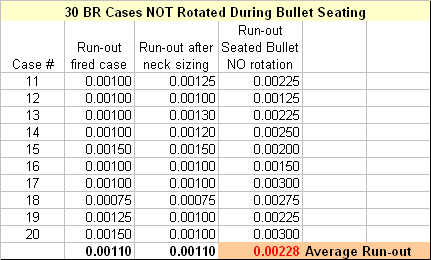
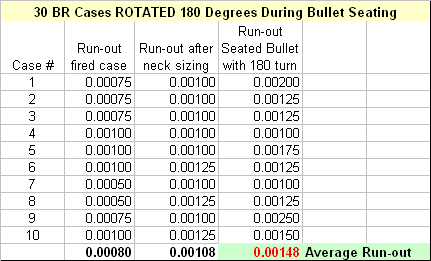
Steve recorded run-out measurements on his 30BR brass using both the conventional (one-pass) seating procedure, as well as the two-stage (with 180° rotation) method. Steve’s measurements are collected in the two charts above. As you can see, the run-out was less for the rounds which were rotated during seating. Note, the change is pretty small (less than .001″ on average), but every little bit helps in the accuracy game. If you use a threaded (screw-in) seating die, you might try this two-stage bullet-seating method. Rotating your case in the middle of the seating process won’t cost you a penny, and it just might produce straighter ammo (nothing is guaranteed). If you do NOT see any improvement on the target, you can always go back to seating your bullets in one pass. READ Forum Thread….
September 8th, 2014
For years, many shooters have coated bullets with Moly (molybdenum disulfide) or Danzac (tungsten disulfide or “WS2″). The idea was to reduce friction between bullets and barrel. In theory, this could lengthen barrel life and extend the number of rounds a shooter can fire between cleanings.

Moly and WS2 both have their fans, but in the last couple of years, some guys have switched to Hexagonal Boron Nitride (HBN), another dry lubricant. The advantage of HBN is that it won’t combine with moisture to create harmful acids. HBN is very slippery and it goes on clear, so it doesn’t leave a dirty mess on your hands or loading bench. Typically, HBN is applied via impact plating (tumbling), just as with Moly.

HBN Results — Both on Bullets and Barrel Bores
Many folks have asked, “Does Hexagonal Boron Nitride really work?” You’ll find answers to that and many other questions on gunsmith Stan Ware’s popular Bench-Talk.com Blog. There Paul Becigneul (aka Pbike) gives a detailed run-down on HBN use, comparing it to other friction-reducers. Paul also discusses the use of HBN in suspension to pre-coat the inside of barrels. Paul observes:
We coated our bullets … how we had been coating with WS2. Now our bullets have a slightly white sheen to them with kind of like a pearl coat. They are so slippery it takes a little practice to pick them up and not drop them on the trailer floor. What have we noticed down range? Nothing different from WS2 other than the black ring on your target around the bullet hole is now white or nonexistent. Our barrels clean just as clean as with WS2. Your hands aren’t black at the end of the day of shooting and that might be the most important part.
Interestingly, Becigneul decided to try a solution of HBN in alcohol, to pre-coat the inside of barrels. Paul had previously used a compound called Penephite to coat the inside of his barrels after cleaning. Paul explains:
If Penephite was used because it was slippery wouldn’t HBN be better? … We called Momentive again (our source for HBN), and talked about mixing HBN and 90% alcohol for a suspension agent to pre-lube our barrels. He though it sounded great but that the Kb>AC6111 Grade HBN would be better for this use. It would stand up in the alcohol suspension and cling to the barrel when passed through on a patch. We got some and mixed it in alcohol 90%. We use about one teaspoon in 16 ounces of alcohol.
We started using it this fall and what we have noticed is that now that first shot fired out of a clean and pre-lubed barrel can be trusted as the true impact point. We use tuners so now I got to the line, fire two shots judge my group for vertical, adjust the tuner as needed or not, and after tune has been achieved go to my record targets. This use has saved us in time at the bench and bullets in the backstop.
You really should read the whole article by Becigneul. He discusses the use of barrel lubes such as Penephite and “Lock-Ease” in some detail. Paul also provides links to HBN vendors and to the Material Safety Data Sheets (MSDS) for the various compounds he tested.
Good Source for Hexagonal Boron Nitride (HBN)
Paul Becigneul (aka PBike in our Forum) has been using HBN for many years with good results. He obtains his HBN from Momentive Performance Materials:
 Momentive Performance Materials Momentive Performance Materials
www.Momentive.com
Sales Contact: Robert Bell
Sales Email: robert.bell [at] momentive.com
Sales Phone: Robert Bell, (980) 231-5404
August 30th, 2014
“Where is all the .22LR ammo?”, “Where did all the rimfire ammo go?” — it seems that litany is all we hear these days. We’ll here’s something to quiet those voice of discontent.
Grafs.com currently has quality 40-grain SK-brand .22 LR ammo in stock. You can get a 500-count brick (10 boxes) ammo for $56.99 (Item #: RSK420101B). Or you can get a 500-round can of 40gr ammo for $54.99 (Item #: RSK420121). There is a limit of 1000 rounds per customer per ammo type (i.e. a customer may order no more than two bricks of boxed ammo, AND two 500-count cans). If you want to sample other types of SK rimfire ammo, individual boxes of SK “High Velocity”, “Rifle Match”, and “Subsonic” ammo are also in stock at Grafs.com (with prices about $8.50/box).

SK rimfire ammo is made in Europe. SK Standard Plus is not benchrest-grade ammo on a par with Lapua Midas+ or Eley Tenex. However it is much, much better than most general purpose rimfire ammo. SK Standard Plus is good enough to win a rimfire tactical match — we can attest to that from our own experience. This is much better than bulk-pack fodder (if you could even find that).
|


