|
|
March 26th, 2014
 On our main AccurateShooter.com site, you’ll find an excellent article by GS Arizona on the Basics of Neck Turning. If you’re new to the neck-turning game, or are just looking for good tips on improving your neck-turning procedures, you should read that article. Below we offer some highlights and photos from the article, but you’ll need to read the whole story to view all the illustrations and follow all the procedures step by step. On our main AccurateShooter.com site, you’ll find an excellent article by GS Arizona on the Basics of Neck Turning. If you’re new to the neck-turning game, or are just looking for good tips on improving your neck-turning procedures, you should read that article. Below we offer some highlights and photos from the article, but you’ll need to read the whole story to view all the illustrations and follow all the procedures step by step.
Why Should You Consider Neck Turning?
Let’s assume that your rifle doesn’t have a tight neck chamber that requires neck turning; if you have a tight neck chamber, of course, the answer to the question is “because you have to”. For the rest of us, and that includes the vast majority of Highpower shooters, neck turning isn’t a requirement, but it can be a useful way to bring your ammunition a small but meaningful step closer to that pot of gold at the end of the rainbow: perfection. I’m not talking about a theoretical improvement, but a real one, an improvement that lies in equalizing and optimizing the neck tension of your loaded rounds. Inconsistent neck tension is a real contributor to increased muzzle velocity variance which itself is a significant factor in increased elevation dispersion at long range. So there’s our basic reason for neck turning: to equalize and optimize neck tension in order to reduce elevation dispersion.
The Tools of the Trade
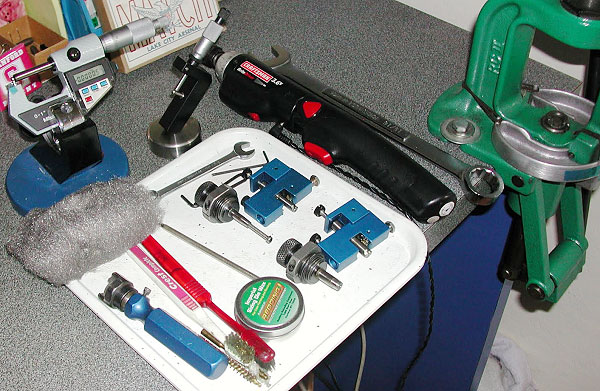
Here you see everything I use and a bit more. The press, a cordless screwdriver (always plugged in, turning is tough on the old battery), a couple of K&M neck turners (one set up for 6mm, the other for .30 caliber) an expander for each size, some Imperial lube, an old toothbrush or two to keep the cutter clean, a handle with a caseholder (for those emergencies when the screwdriver dies and there’s just one more case to go!), steel wool and a tubing micrometer finish the list of tools. Hey, I left the dial calipers out of the picture! They’re always handy, keep them around, but they are useless for measuring neck thickness, so don’t try. I usually use an Optivisor magnifier while I turn necks, very handy for a clear view of what’s happening on the neck.
Expanding the Neck
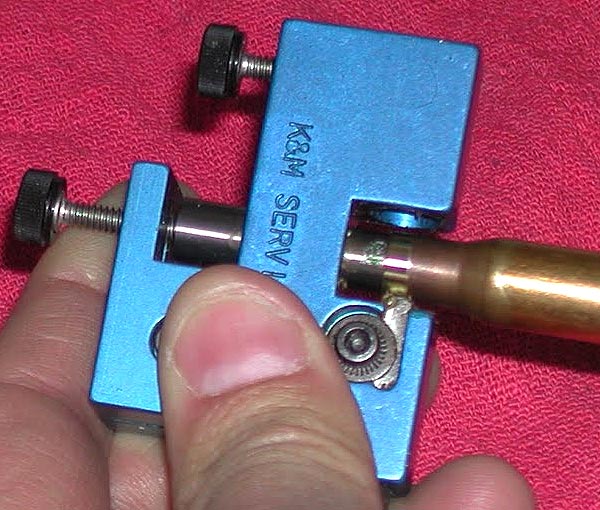
Put some lube on the inside of the case neck and run it into the expander. Really, this isn’t hard. I prefer to expand each case immediately before turning it as opposed to expanding all the cases and then turning them. Brass is somewhat springy and will tend to go back toward its original size; therefore, by expanding and turning immediately, you are more likely to have all cases fit the mandrel with the same degree of tightness and to get a more consistent depth of cut.
Cutter Adjustment for Cut Depth and Length
All the tools I’ve seen have pretty good adjustment instructions. The only thing they don’t tell you is that you should have five to ten spare cases to get it right initially. Anything of the right diameter will do while you learn, for instance, just use that cheap surplus .308 brass to do initial setup and save the precious .30-06 for when you know what you’re doing. Be patient and make your adjustments slowly; you’ll need to set the cutter for thickness as well as length of cut (just into the shoulder). The depth of cut (brass thickness) takes a bit of fiddling, the length of the cut is generally easy to set.
The Finished Product — A Perfectly Uniform Neck
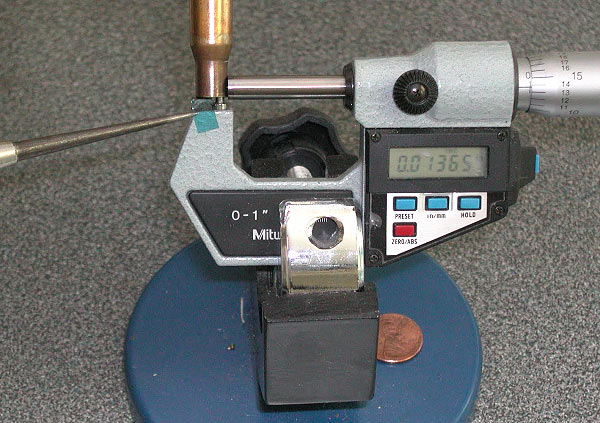
If you read the whole article, and follow the procedures using quality tools, you should get very good results — with a little practice. To demonstrate, here’s an example of my finished, neck-turned brass. You’ll see there is a perfect, 0.0125″ thick neck. It’s very uniform around the circumference, usually I only see 1 or 2 ten-thousandths variance. Now, with the necks uniformed like this, we can select the bushing size that will give us our preferred neck tension and experiment with various levels of tension, secure in the knowledge that all of the cases will actually have the desired neck tension.
March 15th, 2014
Now that Lapua is making very high-quality .221 Fireball brass, those of you who own an AR may be considering a 300 AAC Blackout project. For AR shooters, the 300 Blackout (300 BLK) offers the ability to fire a heavy-weight bullet from standard AR15 magazines. When loaded to supersonic velocities with heavy bullets, this little cartridge packs more punch than a 30-30 round. Alternatively, when loaded to sub-sonic velocities, the 300 Blackout is ultra-quiet when used with a suppressor.

Writing for the CTD Shooter’s Log, CTD Mike has authored a good Beginners’ Guide to the 300 AAC Blackout. This explains the basics of this interesting cartridge, which is a .30-caliber round that works with existing AR15 magazines and upper. You can purchase 300 Blackout factory ammunition or you can load your own. The easiest way to make 300 Blackout cartridges is to neck-up Lapua .221 Fireball brass. But if you have hordes of .223 Rem brass, you can also cut those cases down and reform them into 300 Blackout. But that is much more work. With Lapua .221 Fireball brass, you lube the inside of the necks, expand, and you’re good to go.

300 Blackout vs. 6.8 SPC
AR owners who have considered a dedicated upper in 6.8 SPC, should give serious consideration to 300 Blackout instead. First, with so much .223 Rem available, you have a virtually infinite supply of parent brass. 6.8 SPC brass is not so easy to find. Second, to function optimally, the 6.8 SPC requires dedicated magazines. CTD Mike says: “6.8 SPC II and 6.5 Grendel both require specific magazines [that are] different from the Standard NATO Agreement (STANAG) AR-15 magazine. These magazines are not nearly as common … and of course cost a bit more. On top of that, you lose capacity in those calibers, down to 25 rounds instead of 30, because their casings are fatter and take up more space[.]”
The Sound of Silence — Suppressed 300 Blackout Properties
The 300 AAC Blackout is a great option if you live in a jurisdiction that allows suppressor ownership. A suppressed 300 Blackout is ultra-quiet and very reliable. CTD Mike explains: “Unlike 5.56, subsonic [1000 FPS] loadings that still cycle the AR-15 action reliably are easy to make [with] a 220 grain .308 bullet. At close range, these 220 grain rounds really thump, and the real kicker is that using an AAC suppressor with them in a 9-inch barrel brings the sound level to only 125 decibels. That’s quieter than an MP5SD shooting 9mm rounds, and much quieter than a MK23 pistol shooting .45acp rounds. You have to be there and shoot one of these rifles with a ‘can’ attached to realize that this 220 grain bullet is nearly as quiet as a silenced .22 pistol.”
 AR15 Podcast Talks about 300 Blackout AR15 Podcast Talks about 300 Blackout
If you are intrigued by the 300 AAC Blackout, you should consider listening to an hour-long AR15Podcast hosted by Reed Snyder and co-Host Anthony Hardy. In this Podcast, Reed explains how to re-barrel an AR15 for the 300 Blackout. Step by step, he explains how to remove your .223-caliber barrel and install a .30-caliber barrel chambered for the 300 Blackout. Reed lists the tools you’ll need and he also explains how to tune adjustable gas blocks for best performance with a 300 Blackout upper.
|
AUDIO FILE: AR15 Podcast about 300 AAC Blackout (Warning Loud Volume) |
For those who are undecided about adapting their AR15s for the 300 Blackout, Reed weighs the pros and cons of having a dedicated .30 caliber in your AR arsenal. Here are some of the strong points of this interesting cartridge:
- 300 Blackout cartridges fit and feed in standard AR magazines.
- 300 Blackout rivals 7.62x39mm performance.
- Brass and Bullets are readily available.
- Barrel is only part that needs to be modified.
- Excellent Subsonic Performance — very quiet.
- .30 Caliber suppressors can be used with smaller calibers as well.

About the 300 AAC Blackout (300 BLK)
The 300 AAC Blackout cartridge shares case-head dimensions and body taper with the .223 Remington. Not only does this allow for compatibility with existing magazines and bolts, but it allows reloaders to form their own brass from cut-down 5.56×45 mm or .223 Rem cases. You can also form 300 Blackout cases by necking-up .221 Fireball brass. Take Note: Lapua has started producing .221 Fireball brass — this should be available in the USA by the end of April.

The 300 AAC Blackout is a similar concept to previous wildcats, such as the 30-221 and 300 Fireball, as well as the proprietary 300 Whisper®, except that 300 BLK was the first to be a SAAMI-approved cartridge and any company is free to make firearms or ammunition.
300 AAC Blackout is also finding use with hunters, who may not have been able to legally hunt with .223 in their state, and who prefer .30 caliber bullets for medium-sized game. It provides similar effectiveness to the 7.62×39 or the slightly more powerful .30-30 cartridges except works in the more up-to-date AR-platform rifles. Effective hunting range is about 150 yards. Some innovators, such as Dave Whitford, have also experimented with the 300 BLK for Across-the-Course competition. READ Whitford story in Rifleman’s Journal..
Related RESOURCES:
American Rifleman Article with 300 AAC Blackout AND 300 Whisper Reamer Prints.
.330 AAC Blackout Factory Ammunition Review.
March 8th, 2014
 In our article on Bullet Coating we covered the basic principles of applying dry lubricants to “naked” bullets. This article covered the three main coating options: Molybdenum Disulfide (Moly), Tungsten Disulfide (WS2 or “Danzac”), and Hexagonal Boron Nitride (HBN or “White Graphite”). All three compounds can be impact-plated on to bullets with relative ease, using inexpensive equipment. Moly is still the most popular choice, but many more shooters are considering HBN because it is ultra-slippery, it is less messy, and it offers some advantages over Moly or WS2. In our article on Bullet Coating we covered the basic principles of applying dry lubricants to “naked” bullets. This article covered the three main coating options: Molybdenum Disulfide (Moly), Tungsten Disulfide (WS2 or “Danzac”), and Hexagonal Boron Nitride (HBN or “White Graphite”). All three compounds can be impact-plated on to bullets with relative ease, using inexpensive equipment. Moly is still the most popular choice, but many more shooters are considering HBN because it is ultra-slippery, it is less messy, and it offers some advantages over Moly or WS2.
After we published our Bullet Coating feature, many readers asked for more info on HBN. Some current moly users had questions about switching over to Boron Nitride. Forum member Larry Medler has published an excellent web article discussing the process of applying 70nm HBN using plastic jars and a Thumler’s rotary tumbler. If you are working with HBN currently, or plan to experiment with Boron Nitride, you should read Medler’s HBN-Coating Article.
After coating some bullets for his 6XC, Medler seems “sold” on the merits of HBN. Larry writes: “The coating process is much better than Moly — no black mess. My coating process times are the same as for Moly. Three hours of tumbling in the corn cob and three hours of tumbling in the steel balls with 3.0 grains of hBN Powder. The bullets look something like sugar-coated donuts when I dump the jar of steel balls with the freshly coated bullets into my sieve to separate. The coated bullets wipe clean to the touch with a little towel rub down and remain very slippery. So far I am very pleased with my coated bullets’ smoothness and appearance.”

Field Tests Are Very Promising
Interestingly, Larry’s HBN-coated bullets are shooting flatter, with tighter vertical, than his moly-coated bullets. Since he has also pointed the tips of this batch of bullets, it’s not clear whether the reduced drop is due to the pointing or the HBN coating, but the results are certainly encouraging: “I have shot the HBN-coated bullets a couple of times now at 600 yards and everything seems to be okay or a lot like Moly. Funny thing is the HBN-coated bullets are shooting higher by 7/8 MOA. I have to check the speed and see if it has changed enough for that POI change. Good news is I had a string of 15 shots with less than 1.5 inches of vertical which is the best I have ever seen with my rifles. Is that due to the hBN or bullet pointing?”
Photos courtesy Larry Medler, All Rights Reserved
March 2nd, 2014
What is “Overbore”? That’s a question rifle shooters can debate to no end. This article from our archives proposes one way to identify “overbore cartridges”. We think the approach outlined here is quite useful, but we know that there are other ways to define cartridges with “overbore” properties. Whenever we run this article, it stimulates a healthy debate among our readers — and that is probably a good thing.
Forum Member John L. has been intrigued by the question of “overbore” cartridges. People generally agree that overbore designs can be “barrel burners”, but is there a way to predict barrel life based on how radically a case is “overbore”? John notes that there is no generally accepted definition of “overbore”. Based on analyses of a wide variety of cartridges, John hoped to create a comparative index to determine whether a cartridge is more or less “overbore”. This, in turn, might help us predict barrel life and maybe even predict the cartridge’s accuracy potential.
John tells us: “I have read countless discussions about overbore cartridges for years. There seemed to be some widely accepted, general rules of thumb as to what makes a case ‘overbore’. In the simplest terms, a very big case pushing a relatively small diameter bullet is acknowledged as the classic overbore design. But it’s not just large powder capacity that creates an overbore situation — it is the relationship between powder capacity and barrel bore diameter. Looking at those two factors, we can express the ‘Overbore Index’ as a mathematical formula — the case capacity in grains of water divided by the area (in square inches) of the bore cross-section. This gives us an Index which lets us compare various cartridge designs.”


OVERBORE INDEX Chart
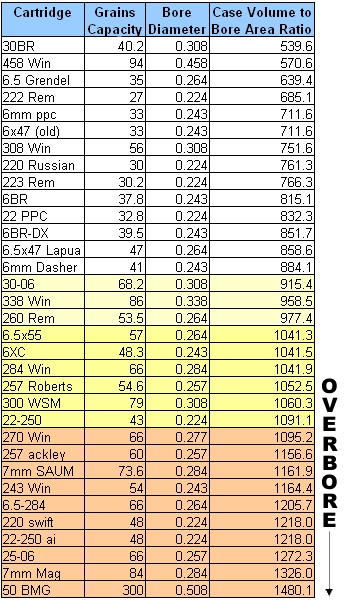
So what do these numbers mean? John says: “My own conclusion from much reading and analysis is that cartridges with case volume to bore area ratio less than 900 are most likely easy on barrels and those greater than 1000 are hard on barrels.” John acknowledges, however, that these numbers are just for comparison purposes. One can’t simply use the Index number, by itself, to predict barrel life. For example, one cannot conclude that a 600 Index number cartridge will necessarily give twice the barrel life of a 1200 Index cartridge. However, John says, a lower index number “seems to be a good predictor of barrel life”.
John’s system, while not perfect, does give us a benchmark to compare various cartridge designs. If, for example, you’re trying to decide between a 6.5-284 and a 260 Remington, it makes sense to compare the “Overbore Index” number for both cartridges. Then, of course, you have to consider other factors such as powder type, pressure, velocity, bullet weight, and barrel hardness.
Overbore Cases and Accuracy
Barrel life may not be the only thing predicted by the ratio of powder capacity to bore cross-section area. John thinks that if we look at our most accurate cartridges, such as the 6 PPC, and 30 BR, there’s some indication that lower Index numbers are associated with greater inherent accuracy. This is only a theory. John notes: “While I do not have the facilities to validate the hypothesis that the case capacity to bore area ratio is a good predictor of accuracy — along with other well-known factors — it seems to be one important factor.”
March 1st, 2014
Many of our Forum members shoot an “improved” 6mmBR cartridge. This might be a 30°-shoulder 6mm BRX, or a 40°-shoulder 6mm Dasher, or the 6mm BRDX, which is very similar to the Dasher, but with a slightly longer neck. This Editor shoots a 6mm BRDX and has found it very accurate, and maybe a bit easier to fire-form than a standard Dasher. Speaking of fire-forming, in our Shooters’ Forum, we often see questions about fire-forming BRX/Dasher brass. For those who need a large number of BRX or Dasher cases, one option to consider is using pistol powder in a dedicated fire-forming barrel. Here’s an explanation of how this process can work.
Forum member Skeeter has a 6mm Dasher falling block varmint rifle. The Dasher case is based on the 6mm BR Norma cartridge with the shoulder blown forward about 0.100″ and out to 40°. This gives the Dasher roughly 3.5 grains added capacity compared to the standard 6BR.
A few seasons back, Skeeter needed to form 300 cases for varmint holiday. Skeeter decided to fire-form his brass without bullets. This method avoids barrel wear and saves on components. There are various ways to do this, but Skeeter chose a method using pistol/shotgun powder, some tissue to hold the powder in place, Cream of Wheat filled to within an 1/8″ of top of the neck, and a “plug” of tissue paper to hold it all in place. Shown below are cases filled with a pistol/shotgun powder charge topped with Cream of Wheat and then a tissue paper plug.


To ensure the case headspaced firmly in his Dasher chamber, Skeeter created a “false shoulder” where the new neck-shoulder junction would be after fire-forming. After chamfering his case mouths, Skeeter necked up all his cases with a 0.257″ mandrel (one caliber oversized). Then he used a bushing neck-sizing die to bring the top half of the neck back down to 0.267″ to fit his 0.269″ chamber. The photo below shows how the false shoulder is created.

After creating the false shoulder, Skeeter chambered the cases in his rifle to ensure he could close the bolt and that he had a good “crush fit” on the false shoulder, ensuring proper headspace. All went well.

The next step was determining the optimal load of pistol powder. Among a variety of powders available, Skeeter chose Hodgdon Titewad as it is relatively inexpensive and burns clean. The goal was to find just the right amount of Titewad that would blow the shoulder forward sufficiently. Skeeter wanted to minimize the amount of powder used and work at a pressure that was safe for his falling block action.
Working incrementally, Skeeter started at 5.0 grains of Titewad, working up in 0.5 grain increments. As you can see, the 5.0 grain charge blew the shoulder forward, but left it a hemispherical shape. At about 7.0 grains of Titewad, the edge of the shoulder and case body was shaping up. Skeeter decided that 8.5 grains of Titewad was the “sweet spot”. He tried higher charges, but the shoulder didn’t really form up any better. It will take another firing or two, with a normal match load of rifle powder and a bullet seated, to really sharpen up the shoulders. Be sure to click on the “View Larger Image” link to get a good view of the cases.


The process proved to be a success. Skeeter now has hundreds of fire-formed Dasher cases and he hasn’t had to put one bullet through his nice, new match-grade barrel. The “bulletless” Cream of Wheat method allowed him to fire-form in a tight-necked barrel without neck-turning the brass first. The only step now remaining is to turn the newly Dasher-length necks down about .0025″ to fit his 0.269″ chamber. (To have no-turn necks he would need an 0.271″ or 0.272″ chamber).
Skeeter didn’t lose a single case: “As for the fire-forming loads, I had zero split cases and no signs of pressure in 325 cases fire-formed. Nor did I have any misfires or any that disbursed COW into the action of the firearm. So the COW method really worked out great for me and saved me a lot of money in powder and bullets.” To learn more about the COW fire-forming process, read this Dasher Fire-Forming Forum Thread.
Skeeter did have a fire-forming barrel, but it was reamed with a .269 chamber like his 10-twist Krieger “good” barrel. If he fire-formed with bullets, he would have to turn all 300 necks to .267″ BEFORE fire-forming so that loaded rounds would fit in the chamber. Judging just how far to turn is problematic. There’s no need to turn the lower part of the neck that will eventually become shoulder–but how far down the neck to turn is the issue. By fire-forming without bullets now he only has to turn about half the original neck length, and he knows exactly how far to go.
February 19th, 2014
Want to get great gear for rock-bottom prices? Then visit www.Shooters-Supply.com. After 25 years Russ Haydon is retiring, and closing down his shooting supplies business. Virtually all remaining inventory is now 25% off (through the end of February). Much of the merchandise is being offered “at cost”. Call (253) 857-7557 for more information.
Russ Haydon’s Shooter’s Supply — A Quarter Century in Business
A quarter century at a single job is a good, long career for anyone, but even more so when it has been as the head of your own successful small business. Such is the case for Russ Haydon of Russ Haydon’s Shooters’ Supply. Russ is retiring after 24+ years of selling high quality precision shooting products to benchrest, target and varmint shooters. Now Russ and Marsha are moving toward another of life’s milestones, retirement.
Russ and Marsha Haydon Say “Thank You” to Their Customers:
 Russ’s operation grew out of a life-long passion for shooting. Like so many youngsters, he started plinking in junior high and was always a good shot. He pursued his interest through brief employment in a gunshop and later competitive smallbore and benchrest shooting, but always as an aside to his regular job. With the support of his wife Marsha, Russ turned his firearm hobby into a fulltime business. More than once Russ has been complimented on his “candy store” gunshop called Russ Haydon’s Shooters’ Supply. Russ’s operation grew out of a life-long passion for shooting. Like so many youngsters, he started plinking in junior high and was always a good shot. He pursued his interest through brief employment in a gunshop and later competitive smallbore and benchrest shooting, but always as an aside to his regular job. With the support of his wife Marsha, Russ turned his firearm hobby into a fulltime business. More than once Russ has been complimented on his “candy store” gunshop called Russ Haydon’s Shooters’ Supply.
The predominantly mail-order business became widely known through magazine ads and word-of-mouth in the early 1990s. The advent of the internet added an international clientele for Haydon’s reloading products geared to high accuracy shooters. The Haydons have built a reputation for trustworthiness based on their fast, friendly, knowledgeable service.
With the operation winding down, nearly all inventory is being sold at 25% off the regular low prices. The website, www.shooters-supply.com, is continuously updated to display only in-stock items.
Of particular note is the remaining selection of Redding threaded dies and L.E. Wilson hand dies in various calibers and styles. At 25% off, the prices are near wholesale level. Other great buys are: Butch’s Bore Shine cleaning solvent, Sweets copper remover, and Dewey cleaning rods.
The rock-bottom prices are a means for Russ & Marsha to close out their inventory while saying “Thank You” for the many years of patronage of their business by the shooting public.
February 18th, 2014
 Hodgdon has rolled out a completely updated online Reloading Data Center for pistol, rifle, and shotgun reloaders. Check out the enhanced Data Center at www.HodgdonReloading.com. Hodgdon has rolled out a completely updated online Reloading Data Center for pistol, rifle, and shotgun reloaders. Check out the enhanced Data Center at www.HodgdonReloading.com.
As before, you’ll find thousands of load recipes for pistol, rifle, and shotgun. Rifle shooters will find dozens of loads for their favorite Hodgdon, IMR, and Winchester powders such as H4198, Varget, H4350, and IMR 8208 XBR. And Hodgdon’s Reloading Center is now faster and easier to use. Navigation is simplified and the whole interface is more user-friendly.
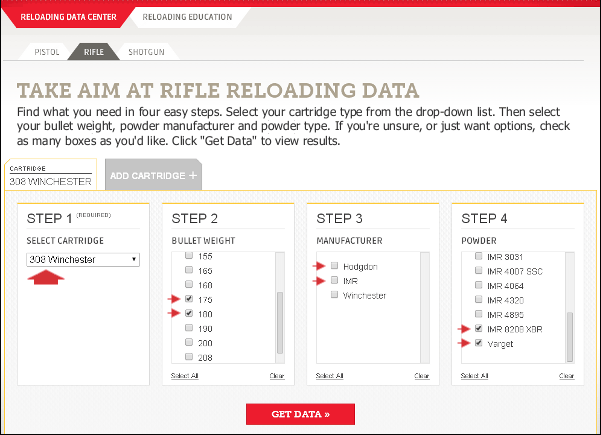
You’ll notice changes in the way the online Data Center works. Now you have more control over the results. After choosing a cartridge, you can pre-select specific bullet weights and powder types. That quickly delivers just the information you want and need. You won’t have to scroll through scores of entries for bullets or powders you don’t use.

Mobile users will notice that the updated/enhanced Reloading Center is much more “user-friendly” for smart-phone and tablet users. Controls have been optimized for touch-screens, and buttons are large and easy to use. Likewise the results are displayed in a large, easy-to read format.
Hodgdon tip from EdLongrange. We welcome reader submissions.
February 14th, 2014
Interest in the .222 Remington cartridge has revived following Lapua’s decision in 2009 to resume production of .222 Remington Brass. If you’re thinking of chambering a rifle in this very accurate caliber, or if you already have a .222 Rem, we’ve found a useful resource on the web for you.

Forum member Peter Simonsen has created a content-rich website, TripleDeuce.Net, with plenty of valuable info for .222 shooters. Peter tells us: “I started a little informative (non-commercial) web site about the .222 Remington, TripleDeuce.Net. You’re welcome to visit and share your thoughts and ideas.” Peter’s site includes extensive reloading advice, a list of recommended components, plus links to the major bullet-makers and powder manufacturers. His Reloading Page includes load data for a wide selection of bullets, while Peter’s photo archive shows cartridge diagrams and targets shot with Peter’s .222 Rem rifles. There is even an extensive section dedicated to the 20-222 Wildcat, an excellent varmint cartridge. The 20-222 is very efficient and very accurate.
Peter offers this advice for those getting started with the Triple Deuce cartridge:
“I religiously use the load data right off the Hodgdon web site. Recently I have gravitated toward using the old tried and true IMR4198 and H4198 powders for hunting using 40gr bullets. These two powders provide a velocity edge over the other powder choices while still maintaining safe and acceptable pressure levels. You can see this in the Hodgdon data where a max load of IMR4198 yields 3583 fps whereas H322 produces 3313 fps. So for hunting where higher velocity and terminal performance are important and accuracy is as good or close I would choose one of the two 4198 powders. This situation is similar, although not as dramatic, with 50gr bullets.
For target shooting H322 works extremely well. H4895 also provides impressive results and is a chosen powder for accuracy baseline testing by some manufacturers. I have begun experimenting with Vihtavuori N133 and Accurate 2015. Both seem very promising. But H322 and H4895 are two [dependable choices.]”
February 1st, 2014
 Content of all kinds is going digital, and that includes Reloading manuals. Now Hornady is offering an eBook version of the Hornady Handbook of Cartridge Reloading (9th Edition). Priced at $18.99, the eBook version of the Hornady Reloading Manual is now available for iOS (Apple) devices, for Android devices, and for Kindle eReaders. Content of all kinds is going digital, and that includes Reloading manuals. Now Hornady is offering an eBook version of the Hornady Handbook of Cartridge Reloading (9th Edition). Priced at $18.99, the eBook version of the Hornady Reloading Manual is now available for iOS (Apple) devices, for Android devices, and for Kindle eReaders.
For Apple products such iPads and iPhones etc., you can source Hornady’s manual from the iTunes iBook store. For Android tablets and Kindle readers, you can get the Kindle edition from Amazon.com. (NOTE: Android users must install a free Kindle App.)
Hornady’s latest Handbook of Cartridge Reloading features over 900 pages of information, including much new data for the 9th Edition. For many cartridge types, load recipes for new propellants such as Power Pro Varmint, AR-Comp, and CFE-223 have been added in the 9th Edition. Cartridge additions include the 17 Hornet, .327 Federal, .356 Winchester, .416 Barrett and .505 Gibbs. You’ll also find expanded data on over 20 favorite cartridges including: .223 Rem, 300 Whisper/AAC Blackout, .308 Win, .25-06, .257 Wby Mag, and many more. And of course the load recipes provide cover popular Hornady bullets V-MAX, SST, InterBond, InterLock, A-MAX, XTP, NTX and more. Each cartridge write-up features applicable Hornady bullets along with velocity/powder charts for quick and easy reference.
In addition to the comprehensive reloading charts, this reference manual provides helpful explanations of internal, external and terminal ballistics. To learn more about the eBook versions of Hornady’s latest Reloading manual, visit iTunes or Amazon.com.
eBook Tip from EdLongrange. We welcome reader submissions.
January 31st, 2014
Looking to start a new enterprise? How about entering a field where consumer demand greatly exceeds supply right now — the ammunition business. If you have $38,000 or so you can get your own automated ammo-making machine from Ammo Load Worldwide, Inc., an American-run business located in Lewiston, Idaho. There’s also an 11-station, computer-controlled “Mark L” rifle ammo machine that’s a bit pricier — $77,000 with accessories. Sure that’s a tad more expensive than a Dillon XL650, but with a Mark L you can produce three thousand .223 Rem rounds per hour with the push of a button.

Watch Ammo-Loading Machines in Action:
Mark X Pistol Cartridge Loading Machine (about $38,000)
For over 30 years Ammo Load machines have served ammunition manufacturers, commercial loaders, private shooting ranges, and numerous law enforcement agencies. The Mark X Ammo Load machine (for pistol cartridges) has a maximum production rate of just over 5,000 cycles per hour. Many users produce between 3,000 and 5,000 rounds per hour. The primary factors governing the quality and quantity of ammunition produced are the components (particularly the cases), the caliber, and the capabilities of the operator.

The Mark X Ammo Load machine for pistol cartridges has nine (9) stations: Case Check, Size and Deprime, Primer and Primer Disk Check, Belling, Powder Feed, Powder Check, Bullet Seating, Bullet Crimp, Final Sizing. There are checks (with shut-offs) for case feed, primer feed, bullet feed, and powder load. The Mark X comes complete with shell case feeder, primer feed tube, powder flask, and bullet feed tube.
Mark L – Automatic Rifle Ammunition Loader (About $77,000)
In 2009 Ammo Load Worldwide introduced the Mark L automatic rifle ammunition loader in .223 and .308. Many proven features from the Mark X pistol machine have been incorporated into the Mark L to provide precise and consistent rifle cartridge loading at approximately 3,000 to 3,600 rounds per hour. All of the sensors and switches use fiber optic technology to increase precision and reduce maintenance. The Mark L utilizes a 3-station powder drop; the manufacturer claims this maintains charge weights to within 1/10th of a grain.


| Mark L Rifle Cartridge Loading Machine has 11 stations: |
1. Sizing/Checking*
2. Mouth Flare
3. Priming
4. Primer Check / 1st Powder Drop
5. 2nd Powder Drop
6. 3rd Powder Drop
| 7. Powder Check
8. Initial Bullet Seating
9. Final Bullet Seating
10. Crimp & Bullet-in-Case Check
11. Eject |
*Along with sizing, this first stage performs Flash-Hole Check, Ringer Check, and Case Check.
|


