|
|
December 20th, 2013
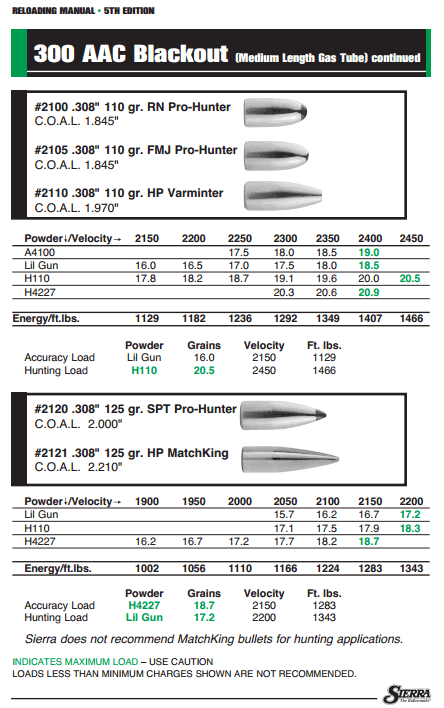
The 300 AAC Blackout (300 BLK, or 7.62x35mm) was created by Advanced Armament Corp. and Remington in order to provide the military with a way to shoot .30-caliber bullets from the M4 carbines with only a barrel change. It has since become popular with AR shooters for a wide range of uses including hunting and home defense. With the increased popularity of this cartridge, folks have been looking for reliable 300 BLK load information. Now, thanks to Sierra Bullets, we have some good load data for the 300 AAC Blackout. Sierra has released a FREE 6-page Load Guide for this cartridge, as part of the Sierra Reloading Manual (5th Edition).
CLICK HERE for Sierra 300 AAC Blackout Load DATA (PDF Format).
Here is ONE of SIX Pages in the Sierra Load Sheet for 300 AAC Blackout

About the 300 AAC Blackout (300 BLK)
The 300 AAC Blackout cartridge shares case-head dimensions and body taper with the .223 Remington. Not only does this allow for compatibility with existing magazines and bolts, but it allows reloaders to form their own brass from cut-down 5.56×45 mm or .223 Rem cases. You can also form 300 Blackout cases by necking-up .221 Fireball brass. Take Note: Lapua has started producing .221 Fireball brass — this should be available in the USA by early April.

The 300 AAC Blackout is a similar concept to previous wildcats, such as the 30-221 and 300 Fireball, as well as the proprietary 300 Whisper®, except that 300 BLK was the first to be a SAAMI-approved cartridge and any company is free to make firearms or ammunition.
300 AAC Blackout is also finding use with hunters, who may not have been able to legally hunt with .223 in their state, and who prefer .30 caliber bullets for medium-sized game. It provides similar effectiveness to the 7.62×39 or the slightly more powerful .30-30 cartridges except works in the more up-to-date AR-platform rifles. Effective hunting range is about 150 yards. Some innovators, such as Dave Whitford, have also experimented with the 300 BLK for Across-the-Course competition. READ Whitford story in Rifleman’s Journal..
December 16th, 2013
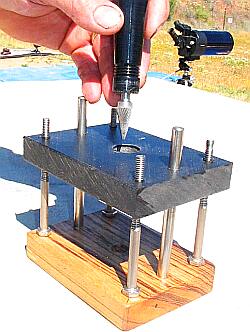
California shooter Mark LaFevers has come up with a slick, adjustable fixture that delivers a precise, repeatable inside-neck chamfer every time. He uses a Holland Case Mouth Chamfer Tool with a 14° cutter, but this set-up works equally well with other chamferers with an extended handle. With Mark’s tool jig, the Holland Tool inserts through the top, indexing vertically off a shoulder. A small recess is cut in the center of the wood base for the case head. The tool mount can be raised or lowered with the adjusting bolts on all four corners. Simply slide a trimmed-to-length case in the middle, give the Holland Tool a few spins, and you get a perfect, identical chamfer every time. Now that’s ingenuity! Mark isn’t planning to produce these commercially, but he’s happy if someone wants to copy his jig design.
 |
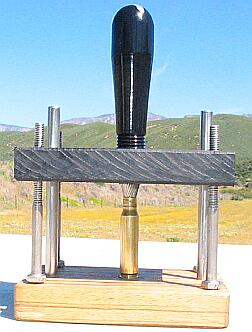 |
NOTE: In the photos above, you see an older version of the tool. Hollands has improved the design of its current 14° Chamfer Tool. The cutting head now has a 3-flute design that provides a smoother, chatterless cut. The head is now made of carbide so it cuts faster and holds its cutting edge longer. This tool is available from Holland’s Shooters Supplies for $32.00 (item CMCT-CAR).

December 6th, 2013
 Norma USA has released the new Norma Reloading Manual Expanded Edition. To mark Norma’s 110 years in the ammunition industry, Norma is publishing its second reloading handbook (the first was released in 2004). The Norma Reloading Manual has been updated with new cartridges, components, and recipes. This hard-back book now covers hundreds of cartridges for hunters and target shooters. Load data (using Norma bullets and powders) is presented for most American cartridges and many European cartridges. In addition, you’ll find an extensive discussion of the history and science of smokeless powders. The new Norma Reloading Manual is designed for all handloaders — from novice to advanced. Inside the book you’ll find solid reloading advice, plus a history of Norma, one of the world’s leading producers of brass, bullets, and loaded ammunition. If you employ Norma brass or bullets or use Norma powders, this new Reloading Manual can be the “go-to” reference book on your loading bench. Priced at $34.99, the Norma Reloading Manual is available from Norma-USA’s authorized dealers. It is not yet listed on Amazon.com, but we to see it there within a few months. Norma USA has released the new Norma Reloading Manual Expanded Edition. To mark Norma’s 110 years in the ammunition industry, Norma is publishing its second reloading handbook (the first was released in 2004). The Norma Reloading Manual has been updated with new cartridges, components, and recipes. This hard-back book now covers hundreds of cartridges for hunters and target shooters. Load data (using Norma bullets and powders) is presented for most American cartridges and many European cartridges. In addition, you’ll find an extensive discussion of the history and science of smokeless powders. The new Norma Reloading Manual is designed for all handloaders — from novice to advanced. Inside the book you’ll find solid reloading advice, plus a history of Norma, one of the world’s leading producers of brass, bullets, and loaded ammunition. If you employ Norma brass or bullets or use Norma powders, this new Reloading Manual can be the “go-to” reference book on your loading bench. Priced at $34.99, the Norma Reloading Manual is available from Norma-USA’s authorized dealers. It is not yet listed on Amazon.com, but we to see it there within a few months.

December 2nd, 2013
 When neck-turning cases, it’s a good idea to extend the cut slightly below the neck-shoulder junction. This helps keep neck tension more uniform after repeated firings, by preventing a build-up of brass where the neck meets the shoulder. One of our Forum members, Craig from Ireland, a self-declared “neck-turning novice”, was having some problems turning brass for his 20 Tactical cases. He was correctly attempting to continue the cut slightly past the neck-shoulder junction, but he was concerned that brass was being removed too far down the shoulder. When neck-turning cases, it’s a good idea to extend the cut slightly below the neck-shoulder junction. This helps keep neck tension more uniform after repeated firings, by preventing a build-up of brass where the neck meets the shoulder. One of our Forum members, Craig from Ireland, a self-declared “neck-turning novice”, was having some problems turning brass for his 20 Tactical cases. He was correctly attempting to continue the cut slightly past the neck-shoulder junction, but he was concerned that brass was being removed too far down the shoulder.
Craig writes: “Everywhere I have read about neck turning, [it says] you need to cut slightly into the neck/shoulder junction to stop doughnutting. I completely understand this but I cant seem to get my neck-turning tool set-up to just touch the neck/shoulder junction. It either just doesn’t touch [the shoulder] or cuts nearly the whole shoulder and that just looks very messy. No matter how I adjust the mandrel to set how far down the neck it cuts, it either doesn’t touch it or it cuts far too much. I think it may relate to the bevel on the cutter in my neck-turning tool…”

Looking at Craig’s pictures, we’d agree that he didn’t need to cut so far down into the shoulder. There is a simple solution for this situation. Craig is using a neck-turning tool with a rather shallow cutter bevel angle. This 20-degree angle is set up as “universal geometry” that will work with any shoulder angle. Unfortunately, as you work the cutter down the neck, a shallow angled-cutter tip such as this will remove brass fairly far down. You only want to extend the cut about 1/32 of an inch past the neck-shoulder junction. This is enough to eliminate brass build-up at the base of the neck that can cause doughnuts to form.

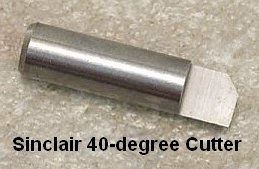
The answer here is simply to use a cutter tip with a wider angle — 30 to 40 degrees. The cutter for the K&M neck-turning tool (above) has a shorter bevel that better matches a 30° shoulder. There is also a 40° tip available. PMA Tool and 21st Century Shooting also offer carbide cutters with a variety of bevel angles to match your case shoulder angle*. WalkerTexasRanger reports: “I went to a 40-degree cutter head just to address this same issue, and I have been much happier with the results. The 40-degree heads are available from Sinclair Int’l for $13 or so.” Forum Member CBonner concurs: “I had the same problem with my 7WSM… The 40-degree cutter was the answer.” Below is Sinclair’s 40° cutter for its NT-1000, NT-1500, and NT-4000 neck-turning tools. Item NT-3140, it sells for $12.95. There is also a 40° cutter for the NT-3000 tool, item NT-3340 ($13.95).
Al Nyhus has another clever solution: “The best way I’ve found to get around this problem is to get an extra shell holder and face it off .020-.025 and then run the cases into the sizing die. This will push the shoulder back .020-.025. Then you neck turn down to the ‘new’ neck/shoulder junction and simply stop there. Fireforming the cases by seating the bullets hard into the lands will blow the shoulder forward and the extra neck length you turned by having the shoulder set back will now be blended perfectly into the shoulder. The results are a case that perfectly fits the chamber and zero donuts.”
* 21st Century sells carbide cutters in: 15, 20, 21.5, 23, 25, 28, 30, 35, 40, and 46 degrees. PMA Tool sells carbide cutters in: 17.5, 20, 23, 25, 28, 30, 35, and 40 degrees.
November 30th, 2013
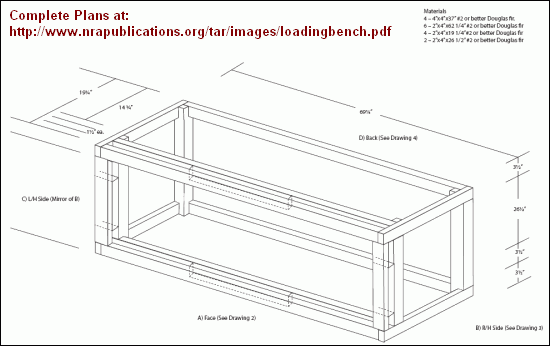
The NRA’s American Rifleman Online website has an excellent article showing how to construct a rock-solid Reloading Bench. There are plenty of photos, and a detailed set of Bench Blueprints showing all dimensions and listing all needed materials. This bench is very well designed, with many deluxe features, such as an upper drawer with fitted slots for die boxes, and large lower drawers with 100-lb rated slides to store heavy materials or tools. If you have good wood-working skills this would be an excellent project.
CLICK HERE to Download Article with Photos | CLICK HERE for Bench Blueprints

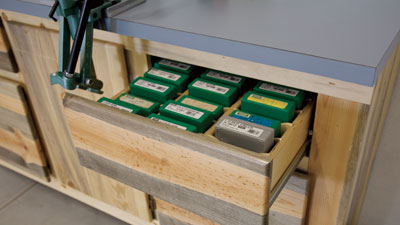
The author, Dave Campbell, offers good advice on building the bench top: “I ripped a sheet of 3/4″ AC plywood into two 24″ wide pieces and cut them to 72″ long. Then I glued them together to form a 72″ long, 1 1/24″ thick top. The trick here is to keep the edges smooth and flat so that the laminate will adhere properly and without voids. I chose a light grey laminate finish for the top because it’s easier to see what I am working on and keep clean. If you have never worked with laminate, remember it’s prudent to glue and rout the edges flush before gluing on the top. The top was attached to the carcass with eight steel L-shaped angle brackets and No. 10×1 1/4″ wood screws.”
Photos Copyright © 2008 The National Rifle Association, used by permission
November 27th, 2013

 Polish off your credit cards boys and girls, the big Brownells Black Friday Sale begins at 12:01 am on Thanksgiving Day, November 28, 2013. You’ll find great bargains on gun parts and accessories, as well as reloading gear and gunsmithing tools. (Brownells is the world’s largest supplier of gun accessories and gunsmithing tools) The special sale prices start on November 28th and continue through the weekend — you have until 11:59 pm CST on December 2, 2013 to grab these Brownells bargains. Polish off your credit cards boys and girls, the big Brownells Black Friday Sale begins at 12:01 am on Thanksgiving Day, November 28, 2013. You’ll find great bargains on gun parts and accessories, as well as reloading gear and gunsmithing tools. (Brownells is the world’s largest supplier of gun accessories and gunsmithing tools) The special sale prices start on November 28th and continue through the weekend — you have until 11:59 pm CST on December 2, 2013 to grab these Brownells bargains.
Here Are Some Currently-Featured Sale Items at Brownells.
Prices May Go Even Lower When the Sale Commences Tomorrow:

November 16th, 2013
Conventional .308 Winchester brass has a large primer pocket with a large, 0.080″-diameter flash hole. Last year, Lapua began producing special edition .308 Win “Palma” brass that has a small primer pocket and a small flash hole, sized 1.5mm (.059″) in diameter. Tests by U.S. Palma Team members showed that the small-flash-hole .308 brass possibly delivers lower Extreme Spread (ES) and Standard Deviation (SD) with some bullet/powder/primer combinations. All things being equal, a lower ES should reduce vertical dispersion at long range.
Why Might a Small Flash Hole Work Better?
The performance of the small-flash-hole .308 brass caused some folks to speculate why ES/SD might be improved with a smaller flash hole. One theory (and it’s just a theory) is that the small flash hole creates more of a “jet” effect when the primer fires. Contributing Editor German Salazar sought to find out, experimentally, whether this theory is correct. German explained: “During one of the many internet forum discussions of these cases, Al Matson (AlinWA) opined that the small flash hole might cause the primer flash to be propagated forward more vigorously. In his words, it should be like shooting a volume of water through a smaller nozzle, resulting in a flash that reaches further up the case. Now that kind of comment really sparked my curiosity, so I decided to see what I could see.”
More Primer Testing by Salazar
You can read more about this test and other primer experiments on RiflemansJournal.com.
Salazar Primer Tests: Small Rifle Primer Study | Large Rifle Primer Study
Large and Small Flash Hole .308 Cases — But Both with Small Primer Pockets
To isolate the effect of flash hole diameter alone, German set up a test with the two types of .308 case that have a small primer pocket: Remington BR brass with a 0.080″ flash hole and Lapua Palma brass with a 0.062″ flash hole. NOTE: German reamed the Lapua brass to 0.062″ with a Sinclair uniforming tool, so it was slightly larger than the 0.059″ factory spec. The Remington brass has a .22 BR headstamp as this brass was actually meant to be re-formed into .22 BR or 6 BR before there was factory brass available for those cartridges.

German set up his primer testing fixture, and took photos in low light so you can see the propagation of the primer “blast” easily. He first tested the Remington 7 1/2 primer, a primer known for giving a large flame front. German notes: “I thought that if there was a ‘nozzle effect’ from the small flash hole, this primer would show it best. As you can see from the photos, there might be a little bit of a flash reduction effect with this primer and the small flash hole, the opposite of what we expected, but it doesn’t appear to be of a significant order of magnitude.”
Remington BR case, 0.080″ Flash Hole, Remington 7.5 Primer.

Lapua Palma case, 0.062″ Flash Hole, Remington 7.5 Primer.

Next German tested the Wolf .223 primer, an unplated version of the Small Rifle Magnum that so many shooters use. German notes: “This is a reduced flame-front (low flash) primer which has proven itself to be very accurate and will likely see a lot of use in the Lapua cases. With this primer, I couldn’t detect any difference in the flash produced by the small flash hole versus the large flash hole”.
Remington BR case, 0.080″ Flash Hole, Wolf .223 Primer.

Palma case, 0.062″ Flash Hole, Wolf 223 Primer.

German tells us: “I fired five or six of each primer to get these images, and while there is always a bit of variance, these are an accurate representation of each primer type and case type. You can draw your own conclusions from all this, I’m just presenting the data for you. I don’t necessarily draw any conclusions as to how any combination will shoot based on the pictures.”
Results of Testing
Overall, looking at German’s results, one might say that the smaller diameter of the small flash hole does not seem to have significantly changed the length or size of the primer flame front. There is no discernible increased “jet effect”.
November 11th, 2013
Earlier this month, Forum Member Steven Blair won the California Long-Range Championship (F-Open Class) shooting a .300 WSM. Here Steve explains the advantages of the .300 WSM cartridge in long-range competition. Steve also discusses the learning process required to shoot the stout-recoiling .300 WSM successfully. Steve cautions: “It took me months to learn how to shoot my .300 WSM rifle well”.
The Argument for the .300 WSM as an F-Open Cartridge
by Steven Blair
There has been much interest lately regarding .300 WSM (Winchester Short Magnum) in F-Open competition. The cartridge is already well-established in 1000-yard benchrest and has been used successfully in F-Open, notably by Derek Rodgers to win the 2010 National Championship. Derek used, as do most .300 WSM BR shooters, a 210-grain bullet.
 The .300 WSM is a modern design, short and fat with a 35° shoulder. It is a slightly rebated and beltless magnum, capable of approaching .300 Winchester Magnum performance with notably less powder. It has an excellent accuracy reputation and I’ve found it very easy to tune. The .300 WSM is a modern design, short and fat with a 35° shoulder. It is a slightly rebated and beltless magnum, capable of approaching .300 Winchester Magnum performance with notably less powder. It has an excellent accuracy reputation and I’ve found it very easy to tune.
Berger introduced the outstanding .30-caliber, 230-grain Hybrid bullet in 2011. This bullet ballistically eclipses all others, caliber .30 and under. Berger rates it as G7 .380 and G1 .743. Trimmed and pointed, the B.C., estimated from elevation adjustments at 300, 600, and 1000 yards, increases to G7 .410. It is also an exceptionally accurate bullet.
The combination of these two items, .300 WSM cases and Berger 230gr Hybrid bullets, and their application to long range F-Class, is what I will discuss in this article.
|
VOICE FILE: Click Button to hear Steven Blair Explain How to Master the .300 WSM. |
.300 WSM Brass — Choices are largely limited to Norma, Winchester and Remington (Lapua, are you listening?). Since I have only used Winchester and Norma brass, I won’t discuss Remington brass, which may also be a viable choice. I found Norma brass to be exceptionally good and have seen no evidence of short life that I’ve heard elsewhere. Winchester brass can produce results equal to Norma, if first sorted, culled, and prepped. There is a significant price difference between the two brands. It is worth noting that Norma manufactures both .270 WSM and .300 WSM brass. Either can be used. Winchester makes .270 WSM, 7mm WSM, .300 WSM, and .325 WSM brass. Again, any can be used but 7mm WSM requires pushing the shoulder back. The other three have the same shoulder dimension.
Bullet Selection — My approach is to use the highest B.C. bullet available that is accurate. As mentioned above, the hands-down, .30-caliber winner is Berger’s 230gr Hybrid. My loads using 230gr Hybrids produce approximately 2865 fps from 34″ barrels. In order to equal the 1000-yard, 10 mph wind deflection, 215 Hybrids must be run at 3030 fps, a fairly stiff load. By contrast, 7mm 180gr Hybrids must start at 3100 fps, not reliably achievable in most conditions. Lapua now makes a 220gr Scenar-L that Erik Cortina has shot a fair bit and reports that it is very accurate. It has a similar profile to the Sierra 220gr MatchKing, another possible candidate, albeit with much lower B.C. than Berger’s mighty 230gr Hybrid.

Barrel Life — After 1126 and 936 rounds shot at F-Class cadence in two barrels, my best guess is at least 2000 rounds accurate barrel life. The barrels look better than any of my .284 Shehane barrels at this point.


 F-Open Rig with Tuner F-Open Rig with Tuner
Steve’s .300 WSM rifle features a BAT 3-lug action (with integral recoil lug and +20 MOA rail), in a Manners F-Class stock. The barrel is a 34″, 1.25″-straight contour Krieger or Brux fitted with an Erik Cortina 1.25″-diameter tuner (shown at right — note Index Marks). Other hardware includes a Bix ‘n Andy trigger, and Nightforce 12-42x56mm NXS scope (NP-R1 reticle). Some of these components were chosen to aid tracking (given the additional recoil). The rifle weighs 21 pounds, 13.5 ounces — just under the 22-pound F-Open limit.
Accuracy and Tuning Ease — The .300 WSM tunes more easily and is more tolerant than any of the four 6mmBR barrels I’ve shot. It is the most accurate large-caliber cartridge I know. A number of 1000-yard benchrest records were set with the cartridge and my experience reinforces that. During my .300 WSM load development, several 100-yard, five-shot groups were in the “ones”, no mean feat for a rifle pushing 230 grains at nearly 3000 fps. The load tolerance window, the powder charge spread where velocity, ES and accuracy are relatively constant, is 0.8 grains in my loading. That means the same load can be fired confidently in many conditions.
Exterior Ballistics — The extent to which the big bullet reduces wind deflection and vertical movement must be experienced to appreciate. I shoot against 7mm cartridges ranging from .284 Win to 7mm WSM, no slouches among them. When they are blown into the 9 Ring, I stay in the 10 Ring. When range vertical pushes them up or down to lose a point, I see it, too, but don’t drop points. However, there is nothing magic about it. The shooter still must point the gun at the right place. The mistakes just cost less and, since F-Class is an Aggregate game, the point spread will accumulate.
Recoil — This is the big downside of the .300 WSM + 230gr Hybrid combination. My rifle weighs 2½ ounces shy of 22 pounds and still pushes me around. My early testing was done with a load that produced 2950 fps. I still cannot shoot it well. The load is very accurate but I cannot manage the recoil consistently. At 2865 fps, it is manageable but always requires careful attention to body position, shoulder pressure, front rest setup, rear bag characteristics and other ergonomic factors. I have learned that shooting a rig with this much recoil places more emphasis on the factors our sling brothers and sisters have managed for many years. It took me months to learn how to shoot the rifle well. I fired over 1000 rounds before I began to feel comfortable. Persist, the results are worth it.
Summary — If you are willing to put the effort into learning how to shoot the cartridge and have a reasonable recoil tolerance, the investment will pay dividends. My scores have increased and become more consistent. My confidence in the rifle has also increased, no small matter in a game with many mental aspects. Be prepared for what could be a long learning curve. If all that sounds like too much, one of the 7mm cartridges is pretty close and certainly competitive in the right hands. My choice, given all the factors listed above, is .300 WSM.
Left to Right: RCBS Chargemaster, Hoover meplat trimmer, Omega trickler, Sartorius GD-503 scale.
Steven Blair has competed in F-Class competition since December of 2010 and F-Open since November of 2011. He placed fifth in the F-Class National Championship this year and is the two-time winner of both the California Long Range F-Class Championship and Twentynine Palms Long Range Regional. Steve shoots on Team Lapua.

Steve says the .300 WSM may offer an advantage at long range: “The weekend of 2-3 November, I won my second straight California Long Range F-Class Championship. Last year, my .284 Shehane performed well against strong competition. This year, the .300 WSM provided a ballistic edge that certainly gained a few additional points. My final 991-50X was at least partly due to the excellent ballistics and accuracy the big cartridge provided.”
November 7th, 2013
Reloaders Rejoice! There’s a new source for bullets, brass, powder, and primers, as well as loaded ammunition. The all-new Bullets.com website offers all these products, plus reloading tools and dies, barrels, gun stocks, scopes, rings, shooting rests, range bags and much more. Primers, you need primers you say? Yes, Bullets.com currently has some types of CCI, Federal, and Remington primers in stock, including the hard-to-find CCI 450 small rifle magnum primers.
You definitely want to include Bullets.com among the vendors you visit when you need components and gun hardware. The new Bullets.com webstore will carry 8,000+ shooting-related products from over 50 top brands such as Lapua, Norma, Federal, CCI, Berger, Sierra, Berry’s, Bald Eagle, Bushnell, Hodgdon, Alliant, Nightforce, Kowa, Vortex, Winchester, MTM, Magpul and many more! Check out the website at www.bullets.com or call 1-800-235-0272 to get a free 60-page color catalog.
POWDERS IN STOCK — Among the popular powders in stock at Bullets.com today are:
- Hodgdon H4895, Hodgdon H4350, Hodgdon H1000, Hodgdon Benchmark (all one-pounders)
- IMR 4064, IMR 4198, IMR 4895, IMR 4350, IMR 7828 SSC (all one-pounders)
- Ramshot Hunter, Winchester 748 (all one-pounders)
NOTE: Powders in stock as of 11/7/2013 at noon Pacific time, one-pound containers only. This is not a complete list. CLICK HERE to see entire Bullets.com Powder Inventory.

Bullets.com carries projectiles from the leading bullet-makers including Berger, Lapua, Sierra, Speer, and Berrys. Yes Bullets.com has premium bullets in stock right now, including the hard-to-find Berger 6mm 105gr Hybrid, and 7mm 180gr Hybrid. Grab ‘em while you can boys!
Along with reloading components, factory ammo, and reloading dies, you’ll find the hardware you need to build a complete rifle. Bullets.com caries Bartlein barrels (in a wide range of calibers and contours), laminated gun stocks, and a full line of optics, including Nightforce, Kowa, and Vortex rifle-scopes and spotting scopes.

Who Are Those Guys? About Bullets.Com
 Bullets.com was launched as a result of the intense passion for shooting by its President, Shiraz Balolia. Shiraz has been shooting pistols, rifles and shotguns for almost 40 years and has been involved in long range rifle shooting at the National and International level for almost 10 years. He served as the Captain of the U.S. F-Class Open Rifle Team for the 2013 World Championship and was a member of the 4-man team that won the 2013 Nat’l 1,000-yard Championship. He has won numerous gold medals in long range shooting and has set several National records. Bullets.com was launched as a result of the intense passion for shooting by its President, Shiraz Balolia. Shiraz has been shooting pistols, rifles and shotguns for almost 40 years and has been involved in long range rifle shooting at the National and International level for almost 10 years. He served as the Captain of the U.S. F-Class Open Rifle Team for the 2013 World Championship and was a member of the 4-man team that won the 2013 Nat’l 1,000-yard Championship. He has won numerous gold medals in long range shooting and has set several National records.
Bullets.com is a division of Grizzly Industrial that was started by Mr. Balolia in 1983. During those 30 years, Grizzly became a powerhouse in the metalworking and woodworking machinery industry serving over a million regular customers and growing its warehouses with 1.2 million square feet of space in three states (WA, PA, MO).
November 2nd, 2013
By popular request, this story has been reprinted from 2011.
 Forum member Al Nyhus is a top-level score shooter who has competed successfully with the 30BR cartridge in VFS (Varmint for Score) matches. Al has been working on an “improved” 30 BR cartridge that delivers extra velocity. Al’s 30 BRX cartridge is inspired by the 6mm BRX cartridge, popular in 600-yard benchrest and across-the-course competition. The 6mm BRX cartridge maintains the same sidewall profile and shoulder angle as the parent 6mmBR case. Likewise, the 30 BRX retains the 30° shoulder used on the popular 30 BR cartridge. Forum member Al Nyhus is a top-level score shooter who has competed successfully with the 30BR cartridge in VFS (Varmint for Score) matches. Al has been working on an “improved” 30 BR cartridge that delivers extra velocity. Al’s 30 BRX cartridge is inspired by the 6mm BRX cartridge, popular in 600-yard benchrest and across-the-course competition. The 6mm BRX cartridge maintains the same sidewall profile and shoulder angle as the parent 6mmBR case. Likewise, the 30 BRX retains the 30° shoulder used on the popular 30 BR cartridge.
Al reports: “Thought you might like to see what I’ll be working with in my VFS gun this season. It’s a true 30 BRX — a 30 BR with the shoulder moved forward 0.100″ with the standard BR shoulder angle. Stan Ware of SGR Custom Rifles built one last season for Steve Grosvenor and I was really impressed by the performance of Steve’s gun. The 30 BR barrel on my VFS gun needed replacing, so the new 30 BRX got the nod.”
30 BRX Delivers 150-200 FPS More Velocity than 30 BR
Al’s testing shows the 30 BRX gives a solid 150-200 fps speed gain over the 30 BR at the top, while needing just 2.5-3.0 more grains of Hodgdon H4198 to do so. A 30 BR case holds on average 40.8 grains of water, while the 30 BRX holds 42.3 grains (roughly 4% more). So the 30 BRX delivers a 7% increase in velocity with a mere 4% increase in H20 capacity. That’s pretty good efficiency. [Editor’s Note: Assuming 34 grains of H4198 is a typical 30BR match load, Al’s increase of 2.5-3.0 grains for the 30BRX represents roughly a 7.5-8.5% increase in actual powder burned. That explains the higher velocities.]
Why did Nyhus decide to try an “improved” 30 BR? Al explains: “The 30 BRX was created to operate at a [higher] velocity level than can be achieved with the standard 30BR case, while at the same time keeping the easy-tuning characteristics of the standard 30BR case. We also wanted to use the same powders currently used with the 30BR and maintain similar operating pressures.” Is the 30BRX harder to shoot because of the increased velocity? Al doesn’t think so: “In a 13.5-lb HV gun, the 30 BRX case is a pleasure to shoot with just a flea bite of recoil.”
Will the 30 BRX Replace the 30 BR in Score Competition?
The 30 BR is already an exceptionally accurate cartridge that dominates short-range Benchrest for Score competition. Will the 30 BRX make the standard 30 BR obsolete? Nyhus doesn’t think so. However, Al believes the 30 BRX offers a small but important edge in some situations: “On any given day, it’s the shooter that hits the flags best and makes the fewest mistakes that ends up on top. No amount of velocity will save you when you press the trigger at the wrong time. Missing a switch or angle change at 200 yards that results in 3/4″ of bullet displacement on the target can’t be compensated for with another 200 fps. That’s the hard fact of benchrest shooting. But on those days when, as Randy Robinett says, ‘our brains are working’, the BRX may offer enough of an advantage to turn a close-but-no-cigar 10 into an ‘X’ at 200 yards. Or turn a just-over-the-line 9 into a beggar 10.” Given the fierce competition in Score matches, an extra 10 or another X can make the difference between a podium finish and also-ran status.
|


