|
|
December 15th, 2012

Midsouth Shooters Supply is now taking advance orders for the new Accurate LT-32 Powder, with initial deliveries expected in January 2013. Price for a 1-lb container is $25.12, while an 8-lb jug runs $190.50. Produced by Western Powders, LT-32 is an extruded powder with extremely small kernels (roughly .0275″). This powder is designed to perform like the legendary “T-322″ powders which worked brilliantly in short-range benchrest cartridges, especially the 6mm PPC. Early testers report that Accurate LT-32 meters superbly and is easy to tune. Western claims LT-32 exhibits very low standard deviation. (Photos below by Speedy Gonzalez).

Speedy Says Accurate LT-32 is Very Promising
Benchrest Hall-of-Famer and noted gunsmith Thomas ‘Speedy’ Gonzalez tested the prototype LT-32 powder from Western Powder earlier this year. Speedy stated: “It pains me to say it, but the new LT-32 out-shot my best lots of [the original] IMR 8208 (T-322)”.

Speedy reports: “I must say that I was quite surprised by the results of my initial testing of the new Western Powder LT-32. Shooting this morning over my Oehler 35P triple screen chronograph yielded some very unexpected results. My best lot of ‘T’ powder continues to exhibit its age as it continues to lose velocity (as it ages). While the new Western LT-32 demonstrated this morning velocities equal to what my old ‘T’ powder used to shoot like 30 years ago.
This new powder goes through the measure like a ball powder. (Note: I have always felt that one of the reasons ‘T’ powder shot so well was due to the fact it measured so well as compared to other powders. This is a definite advantage for us that rely on consistent volume instead of weight.) I will have to shoot it over a season to see if it is as temperature and humidity insensitive as ‘T’, but it looks very promising from what I saw today.
It has yet to be seen if the new LT-32 proves to not be affected by temperature and humidity like the old T-322. But from these short tests it very much mimics my T-322 of old. My ‘T’ powder was always a blessing to me in the fact that when I went to a match I did not have the same problems everyone else was having [i.e. having] to tune up and down over the course of a weekend or week. I got to shoot and concentrate on the conditions instead of making it a tuning competition. It was always kind of funny watching everybody going up and down on their powders trying to accommodate the changes in weather as the days went on. Hopefully this will allow all to become better shooters by being able to concentrate on shooting and not re-turning every time one comes back from the bench.”
Statement from Western Powders
The Accurate LT-32 is an exact copy of the original T-32 manufactured in the same plant and on the same machinery as the original. Lou Murdica has been extensively testing it and he tells us it is the easiest powder to tune that he has seen in 40 years.
 According to Lou, the chamber that everybody was using in the 80s will work with this powder. The bullets do not need to be seated way out in order to get more powder in the case. In testing the powder in our Bond Universal receiver against the original “T” powder, SDs were about 30% lower with the new powder versus the “T” powder. Lou and Don Nielson donated 16 lbs. of the original T-32 lot of powder for our quality control and that is what the new powder is shot against. According to Lou, the chamber that everybody was using in the 80s will work with this powder. The bullets do not need to be seated way out in order to get more powder in the case. In testing the powder in our Bond Universal receiver against the original “T” powder, SDs were about 30% lower with the new powder versus the “T” powder. Lou and Don Nielson donated 16 lbs. of the original T-32 lot of powder for our quality control and that is what the new powder is shot against.
All of our powders are allowed to deviate +3% to -5% in pressure from the quality control lot except LT-32 which we cut the deviation percentages in half in order to have the best lot to lot consistency in the industry for this powder[.] We developed this powder specifically for the 6mm PPC and it is QC’d in the 6mm PPC.
Keith Anderson
Western Powders Ballistic Lab
NOTE: Accurate LT-32 should also be available from PowderValleyInc.com in mid-to-late January 2013. Listed Prices are: $24.10 for 1 pound and $182.00 for 8 pounds.
December 13th, 2012
Most of us assume that if we weigh our powder carefully (down to the tenth of a grain or less) we can achieve a uniform powder fill from case to case in our handloads. Weighing does ensure that the weight of the propellant in each case is the same, but is the column of powder the same by volume each time? “Not necessarily” is the answer. An interesting experiment by our friend Boyd Allen demonstrates that the manner in which you place kernels in the case can make a significant difference in the height of the powder column within the brass case.
Using a Gempro 250 scale, Boyd measured exactly 30.6 grains of Vihtavuori N-133 powder. He then inserted this powder in the same cartridge case multiple times. (The case has a fired primer in place.) But here is the key — Boyd used various filling techniques. He did a slow fill, and a fast fill, and he also experimented with tapping and drop tubes. What Boyd discovered was that you can start with the exact same weight of powder (in fact the very same set of kernels), yet end up with vary different fill heights, depending on how you drop the kernels into the case. Look at the photos. Despite variations in lighting, the photos show the same 30.6 grains of powder, placed in the same cartridge, with four different methods.
Boyd Explains the Procedure Used for his Experiment.
EDITOR’s NOTE: So there is no misunderstanding, Boyd started with a weighed 30.6 grain charge. This identical charge was used for ALL four fills. After a fill the powder was dumped from the case into a pan which was then used for the next fill technique to be tried. So, the powder weight was constant. Indeed the exact same kernels (of constant weight and number) were used for each fill.
Boyd writes: “I used the same powder for all fills, 30.6 gr. on a GemPro 250 checked more than once. All fills employed the same RCBS green transparent plastic funnel. The fast drop with the funnel only overflowed when it was removed from the case neck, and 15 granules of powder fell on the white paper that the case was sitting on. The fast-funnel-only drop with tapping, was done with the funnel in place and the case and funnel in one hand, while tapping the case body with the index finger hard, many times (about 20 fast double taps). My idea here was to “max out” the potential of this tapping technique.
The slow drop with the funnel and 10″-long .22 cal. Harrell’s Precision drop tube, was done by holding the scale pan over the funnel and tapping the spout of the pan repeatedly on the inside of the funnel about 1/3 down from the top, with the scale pan tilted just enough so that the powder will just flow. Many taps were involved, again, to max out the technique.
Again, to be clear, after each case filling, the powder was poured from the case back into the scale pan carefully. You may notice the similarity between the fast drop with the drop tube, and the funnel only with tapping. Although I did not photograph it, fast tube drop and tapping (combined) improved on tapping alone, but only to about half as far down the neck as the slow with drop tube. Due to the endless possible permutations, I picked four and left it at that.
I believe that I can make the rough judgment that the scale pan funnel and drop tube technique, which involved a longer drop period, and probably less velocity at the top of the tube, left more room in the top of the case neck than the slow drop from the measure with the same drop tube. You have both pictures, so you can make the comparison.” — Boyd
Does Powder Column Height Variance Make a Difference?
Boyd’s experiment proves pretty conclusively that the method of dropping a given weight of powder can affect the height of the powder column in the case and the degree of powder compression (when a bullet is seated). He showed this to be true even when the exact same set of kernels (of constant weight) was used in repetitive loadings. This raises some interesting questions:
1. Will subsequent cartridge transport and handling cause the powder to settle so the variances in powder column height are diminished?
2. If significant inconsistencies in powder column height remain at time of firing, will the difference in fill level hurt accuracy, or result in a higher extreme spread in velocity?
3. Is there any advantage (beyond increased effective case capacity) for a tight (low level) fill vs. a loose (high level) fill?
We don’t know the answer to these follow up questions. This Editor guesses that, if we tested low-fill-height rounds vs. high-fill-height rounds (all with same true fill quantity by weight), we might see meaningful differences in average velocity. I would also guess that if you fired 10 rounds that exhibited quite a difference in powder column heights, you might see a higher ES/SD than if you shot 10 rounds loaded with a very consistent powder column height (either high or low). But further testing is needed to determine if these predictions are true.
December 12th, 2012
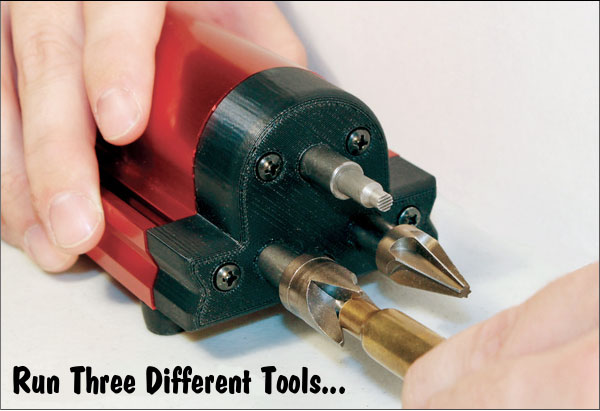
 Hornady offers a handy power case prep tool driver (item 050160) with three power stations. Hornady basically took its previous single-drive Power Case Prep Assistant (item 050155) and added gearing to run three different heads. It took some clever engineering to accomplish this while maintaining the small footprint of the original one-head machine. MSRP for the new Case Prep Trio (item 050160) is $129.39. If you can live with a single power take-off, the older one-head Case Prep Assistant is still offered on “close-out” at some vendors. If you look around you may find one for as little as $79.99. Hornady offers a handy power case prep tool driver (item 050160) with three power stations. Hornady basically took its previous single-drive Power Case Prep Assistant (item 050155) and added gearing to run three different heads. It took some clever engineering to accomplish this while maintaining the small footprint of the original one-head machine. MSRP for the new Case Prep Trio (item 050160) is $129.39. If you can live with a single power take-off, the older one-head Case Prep Assistant is still offered on “close-out” at some vendors. If you look around you may find one for as little as $79.99.

Hornady calls its updated machine, with 3-tool capacity, the Lock-N-Load® Case Prep Trio. With three active stations, you can chamfer, deburr and clean primer pockets without having to change tools. The Case Prep Trio ships with inside chamfer, outside chamfer, and deburr tools. You can also use the machine with other optional 8/32 threaded accessories such as primer pocket reamers and case neck brushes. Conveniently, the Case Prep Trio has on-board storage for your tool-heads.
Story tip by EdLongrange. We welcome reader submissions.
December 9th, 2012
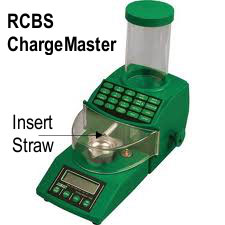 Here’s a clever, easy modification for your RCBS ChargeMaster electronic powder dispenser. Many folks use a McDonald’s straw to smooth kernel flow out of the dispensing tube. Forum member Mike S. (aka in2deep) found that, even with a straw in place, he sometimes got clumps, which dropped 5-6 kernels at once, throwing off his dispensed weight. Here’s a clever, easy modification for your RCBS ChargeMaster electronic powder dispenser. Many folks use a McDonald’s straw to smooth kernel flow out of the dispensing tube. Forum member Mike S. (aka in2deep) found that, even with a straw in place, he sometimes got clumps, which dropped 5-6 kernels at once, throwing off his dispensed weight.
Mike looked at the situation and ingeniously decided to trim the straw into little v-shaped arms or prongs. This helps to break up the clumps, so the kernels flow out the end of the tube more consistently during the dispense cycle. Mike writes:
Soda Straw Modification
This is a further tweak of the popular soda straw modification as the original mod would still allow Varget powder to collect in the straw and dump sometimes as many as 6 or 8 or even more extra kernels in the pan. It would sometimes signal an overcharge, but even when it didn’t there could be as many as 6+ kernels too high or too low (total spread of 12+).
The little arms (prongs) on the straw tend to separate the kernels into groups of 1 or 2 or 3 and prevents piling and many times the throw is now within 1 or 2 kernels of the desired weight.

Straw Cutting Tips — Mike found the shape/angle of the “arms” is very important. If the cuts are too fine or too course it allows the kernels to collect almost like before but the illustrated angle seems to allow an average of only 2 or 3 kernels per trickle input from the machine. This means that more charges are much closer to the actual desired weight and max kernel variances will be cut in less than half and there will be almost no overthrows.
Credit Boyd Allen for sourcing this tip.
December 9th, 2012
While many of us now favor digital photography over “old-fashioned” 35mm film, don’t toss those old 35mm film canisters, especially the clear Fuji-type with secure snap-in lids. Small plastic film canisters have a multitude of uses for the shooter and reloader.

Here Are Some of the Things You Can Do with Film Canisters:
1. If you weigh powder charges after throwing them with a manual powder dispenser, throw the charges first into a film canister and then use that to drop the powder into the measuring pan on your scale. The canister will catch every kernel of powder. If you throw charges directly into a weighing pan, powder can sometimes bounce out. Using the film canister will help keep spilled powder off your loading bench and floor.
2. Store extra sets of foam ear-plugs in the canister. You never want to be without ear protection. This editor has four film canisters filled with plugs. Two go in the range kit, one goes in the car’s glove compartment, and a second stays in a lock box I use to transport pistols. This way I never find myself at the range without ear protection.
3. Place your smaller cotton patches in film canisters, marked by caliber. If you use the water-tight Fuji-style canisters, you can even pre-soak the patches with solvent. You can have one canister for wet patches, another for dry patches. That saves time when you’re at the range, and avoids spillage. One caution–some solvents may react with plastic, so test this first before you put a solvent-filled canister in your range kit.
4. Use film canisters to hold your neck bushings, sorted by caliber. With a permanent marking pen, you can mark the side or top of the canister with the bushing sizes, or caliber.
5. Store your favorite Bolt Grease (for rifles) or anti-seize compound (good for pistol slide rails), in the canister. You don’t need to fill it all the way up — a little dab will do ya. We only recommend this with the snap-top Fuji canisters.
6. During transport, Protect your muzzle with canisters. When shipping a rifle or barrel, slip the film canister over the muzzle, then secure it with electrical tape. This will protect the precious crown of a match barrel from dings or damage.

There are countless other uses for 35mm film canisters. We invite readers to respond with their own tips on using these handy containers. If you don’t have some stashed in your workshop already, you can get empties for free at most film processing centers. The clear plastic Fuji canisters are the best — you can see what’s inside and the lids are watertight.
December 7th, 2012
 Christmas is coming up soon, so today we’re featuring a hand-picked collection of “stocking stuffers” for precision shooters. You can order most of these items online, and if you get your orders in soon, your selections should arrive before December 25th. So as not to bust your holiday budget, all of our selections are priced under $10.00. These items are handy tools that you’ll use over and over again at the range and/or at your loading bench (so you’re allowed to buy them for yourself, even after Christmas). Christmas is coming up soon, so today we’re featuring a hand-picked collection of “stocking stuffers” for precision shooters. You can order most of these items online, and if you get your orders in soon, your selections should arrive before December 25th. So as not to bust your holiday budget, all of our selections are priced under $10.00. These items are handy tools that you’ll use over and over again at the range and/or at your loading bench (so you’re allowed to buy them for yourself, even after Christmas).
Gifts $1 to $5

Surveyors Tape
$1.99 |

Hood Kwik Estimator
$2.50 |

Bifocal 3X/6X Magnifier
$2.75 |

Barrel Mirage Shade
$4.95 |
|
Surveyors’ Tape. Always watch the wind when you shoot. Inexpensive, Day-Glo Surveyors’ Tape (aka “Flagging Tape”), attached to a stake or target frame, makes a good wind indicator. It will flutter even in mild breezes, alerting you to both angle and velocity shifts. This should be part of every range kit. Don’t leave home without it.
Hood Kwik Estimator. Here’s a very handy tool to measure your 6mm groups. Bracket the group within the diverging lines of the Kwik Estimator and you’ll instantly get a good approximation of the actual group size. No more trips to the tool box for calipers. The inexpensive Kwik Estimator fits in a shirt pocket. (Thanks to Boyd Allen for this suggestion.)
Bifocal 3X/6X magnifier. This handy, inexpensive dual-power magnifier is always close at hand on our loading bench, because it helps with so many task. We use a compact magnifier to inspect bullet tips, to check brass chamfers, and inspect the internals of triggers and other parts. Priced at just $2.75, a magnifier like this (or the folding variety) is a “must-have” item for every hand-loader.
Sinclair Barrel Mirage Shade. For high-volume varminters, and competitors who shoot fast in warm weather, a mirage shield is absolutely essential. This prevents hot air rising off the barrel from distorting the image in your scope. The aluminum Sinclair shield can be trimmed to fit, and comes with stick-on Velcro attachments. Two lengths are available: 18″ for short BR barrels, and 24″ for longer barrels.
Gifts $6 to $10

Dewey Crocogator
$6.50 |

Ballistol Aerosol Lube
$8.99 |

Sinclair Barrel Bag
$9.95 |

Sinclair Load Block
$9.99 |
|
Dewey Crocogator. The Crocogator tool, with knurled “teeth” at both ends, is simple, inexpensive, and compact. Yet nothing zips though primer-pocket gunk faster or better. Unlike some cutter-tipped primer pocket tools, the Crocogator removes the carbon quick and easy without shaving brass. One end is sized for large primer pockets, the other for small.
Ballistol Aerosol Lube. Ballistol is a versatile, non-toxic product with many uses in the reloading room. We have found it is ideal for lubricating cases for normal full-length sizing. It is clear, not gooey or chalky like other lubes. It is very, very slippery, yet is easy to apply and just as easy to wipe off. As you lube your cases, the Ballistol will also clean powder fouling off the case necks. For heavy-duty case forming and neck expansion, we’ll still use Imperial die wax, but for every-day case sizing, Ballistol is our first choice. It also helps prevent your dies from rusting and it even conditions leather. Ballistol is a favored bore cleaner for Black Powder shooters because it neutralizes acidic powder residues.
 Sinclair Barrel Bag. If you run a switch-barrel rig, or take spare barrels to a big match, this simple but effective barrel bag will protect your valuable steel. The bag is moisture-resistant vinyl on the outside with a soft, quilted interior to protect the barrel’s finish and delicate crown. There are two sizes: one for barrels up to 26 inches, the other for barrels up to 31 inches. Both sizes are priced at $9.95 per bag. That’s cheap insurance for those priceless barrels. Sinclair Barrel Bag. If you run a switch-barrel rig, or take spare barrels to a big match, this simple but effective barrel bag will protect your valuable steel. The bag is moisture-resistant vinyl on the outside with a soft, quilted interior to protect the barrel’s finish and delicate crown. There are two sizes: one for barrels up to 26 inches, the other for barrels up to 31 inches. Both sizes are priced at $9.95 per bag. That’s cheap insurance for those priceless barrels.
Sinclair ‘Poly’ Loading Block. We’ve tried wood and injection-molded loading trays, and we prefer Sinclair’s white polyethylene loading blocks. They featured chamfered holes properly sized for the particular case you reload. The blocks are heavy enough to be stable on the bench, and the “dishwasher-friendly” material is easy to clean. The standard Poly Loading Block holds 50 cases, while the Competition Loading Block holds 25 cases with a tray for empties. For a bit more money, there’s also a Heavy-Duty 50-case model with an extra-thick 1″ base.
December 6th, 2012
Even with high-quality brass from Lapua, Norma, and RWS, occasionally you may find one or two cases per box which have a small flake or obstruction in the flash-hole. This will appear like a thin crescent on one side of the flash hole (see photo). You should inspect ALL new brass before loading to identify any pieces with a partially-obstructed flash hole. It’s a good idea to remove any flake or thin crescent left as an artifact of the flash-hole forming process. Because the flash-hole itself is normally centered and of the correct diameter, it is not necessary to ream the flash-hole to a larger diameter. All you really need to do is remove the small obstruction(s). This can be done quickly with inexpensive tools.

Use a Small Pin Vise to Remove Flash-Hole Obstructions
Folks have asked if there is a tool that can remove obstructions from a Lapua small, BR-sized flash hole without opening the hole size. The Lapua PPC/BR flash hole is spec’d at 1.5mm, which works out to 0.059055″. Most of the PPC/BR flash-hole uniforming tools on the market use a 1/16″ bit which is nominally 0.0625″, but these often run oversize — up to 0.066″.
If you want to just clear out any obstructions in the flash hole, without increasing the flash hole diameter, you can use an inexpensive “pin vise” with an appropriate drill bit. For $1.00, eHobbyTools.com sells a 1.5mm drill bit, item 79186, that matches the Lapua flash hole exactly. Other vendors offer a #53 pin vise drill bit that measures .0595″ or .060″ (depending or source). An 0.0595″ bit is close enough. You can find pin vises and these small-diameter drill bits at hobby stores.

For quite some time, Sinclair Int’l has sold a similar device for small (PPC and BR-size) flash holes. Like the new 07-3081 unit for large flash holes, the 07-3000 Reamer for small flash holes works from the outside, so it can index off the primer pocket. It reams to .0625″, and also costs $45.99. The standard dimension for Lapua 220 Russian and 6mmBR flash holes is 1.5mm or .0590″. This tool will permit standard-size decapping rods with .0625″ tips to work without binding. However, note that both Forster and Redding normally supply .057″ decapping pins with their PPC and BR dies. So, it is NOT necessary to ream your Lapua BR/PPC flashholes, unless you prefer to do so for uniformity. It IS, however, a good idea to check BR/PPC flash holes for burrs before loading the first time.
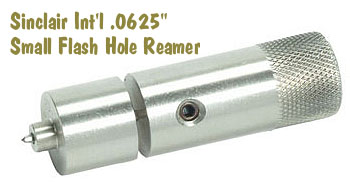
NOTE: If you purchase either the 07-3081 or 07-3000 Sinclair Flash Hole Reamer tools, we recommend you mic the cutter tip before you process a bunch of cases. Sometimes a tip comes through that is oversize. This will ream the flash holes larger than you may intend.
December 4th, 2012
 In his Riflemans Journal Blog, German Salazar has authored an excellent article on IMR 4320 — The Forgotten Powder. German tested IMR 4320 and found that it produced outstanding results both in the .308 Winchester and the 30-06. This means that shooters have another very effective propellant option for their .308 and 30-06 match rifles. With H4895 and Varget being hard to obtain lately, you may want to give IMR 4320 a try. In his Riflemans Journal Blog, German Salazar has authored an excellent article on IMR 4320 — The Forgotten Powder. German tested IMR 4320 and found that it produced outstanding results both in the .308 Winchester and the 30-06. This means that shooters have another very effective propellant option for their .308 and 30-06 match rifles. With H4895 and Varget being hard to obtain lately, you may want to give IMR 4320 a try.
German writes: “IMR 4320 falls right between 4895 and 4064 on the burn rate scale for most cartridges — in other words, right where Varget falls. Yet, despite having a very useful burn rate, 4320 has languished for decades while newer powders of similar burn rate have gained in popularity. I was interested in seeing what current production IMR 4320 would do in the .308 with the 155gr Palma bullets. My interest was sparked by the obvious fact that Varget and H4895 have been very hard to get lately while IMR 4320 sits on the shelves.”
German loaded up some .308 Win loads with IMR 4320 and moly-coated Sierra 155gr Palma bullets. German’s “practical max” load delivered 2990 fps in his long-barreled Palma rifle. This is certainly competitive speed-wise.
German observed that: “IMR 4320 has very small granules and throws very consistently from the powder measure — it is very much like Reloder 15 in granule size — so for those who prefer to throw charges it’s a good choice.”
Satisfied with the chron results, German loaded more rounds with the two most promising charge weights and used them in a 500-yard prone match at Ben Avery (ambient temps were 60s-80s F). Here is his report:
“As in the chrono tests, all IMR 4320 loads were with moly-coated Sierra 155 Palma bullets, Winchester brass and PMC primers. Powder charges should be reduced at least 1.0 grain for bare bullets. The load with 45.0 grains of IMR 4320 gave me a 199-12X with the single 9 being a high shot just off the 10 ring line at 12:00. Overall, I would rate that load as good, very useable for the intended purpose of 500 or 600 yard shooting (it’s 2844 fps) but no better than my H4895 load for that purpose.
Next I fired the heavier 47.0 grains ‘practical max’ load and that was an eye opener. The score was 200-15X in conditions that were windier than those in which the first load was fired. Elevation was noticeably tighter and shots were exactly on call. This load gives 2990 fps, so it has real potential as a Palma load. While no 500-yard test can ensure results at 1000, given the MV and reasonably low SD of this load as well as the good performance at 500, I won’t hesitate to shoot it at 1000 at the first opportunity. Warning: this was a STRONG LOAD and may not be safe in your gun.
Overall, I’m very satisfied with what I’ve seen in these past few days from IMR 4320 and plan to shoot it in some of our upcoming Palma and 1000-yard matches with the 155s. It appears to be a very useful alternative to some of the harder to get powders.”
CLICK HERE to Read Complete IMR 4320 Story (includes chron data and match test results).
December 1st, 2012
Bill Gravatt, President of Sinclair International, has chosen to leave his current position with Sinclair International, where he has served for 22 years. Bill told us “I sold Sinclair International to Brownells, Inc. in 2007 and have completed my five-year contract as part of the transition process. I had the opportunity to remain as President after my contract expired but, after giving the matter a great deal of thought over the past six months, I felt it was time to move in a new direction. I wish everyone at Sinclair International and Brownells all the best in the future.”
In Sinclair’s Reloading Press Blog*, Bill thanks Sinclair customers for their patronage and assures readers that Sinclair will continue to provide same high level of customer service.
Message from Bill Gravatt
 As you know, I sold Sinclair International to Brownells a while back. Pete and Frank Brownell and I had known each other for years, and we all agreed that the two companies would be a good fit, both in the way we treat customers as valued friends and the way our respective customer bases are complementary, similar but not identical. We also agreed that I would stay on as President of Sinclair for five years to help manage the transition. As you know, I sold Sinclair International to Brownells a while back. Pete and Frank Brownell and I had known each other for years, and we all agreed that the two companies would be a good fit, both in the way we treat customers as valued friends and the way our respective customer bases are complementary, similar but not identical. We also agreed that I would stay on as President of Sinclair for five years to help manage the transition.
The five years ended last summer, and now under the Brownells stewardship, Sinclair will continue to serve its customers — you — with the same care and consideration my father-in-law Fred Sinclair and I would give you. I consider it a privilege and a pleasure to have been able to serve you over the years.
Now it’s time to move on with the next (actually the third) phase of my adult life (some of you may know the first phase was the nuclear power industry). I’m certainly going to be around… I plan to continue working in the firearms industry, and you’re going to still see me at competitions and events — maybe more than before. I hope to see you at an NRA Show[.]
In the meantime, I plan to spend Christmas the way I hope you do — with friends and family, relaxing and celebrating the blessings of this life. And maybe getting started on that big winter reloading project. Wouldn’t it be great to head into the 2013 shooting season with your ammo loaded up and ready to go? Spring is closer than you think! But first [comes] Christmas — all my best wishes to you and those close to you.
Good Shooting — Bill Gravatt
*Geoff Esterline, a key member of the Sinclair team for over 15 years, has agreed to take over as Contributing Editor of the Reloading Press Blog. Bill has “every confidence” in Geoff’s capabilities.
November 30th, 2012
In the wintertime, it’s common to encounter problems with static electricity when throwing your powder charges. The static can cause powder kernels to cling to the surface of reloading components, and can cause powder clumping. Clumped or sticky powder may make your measure bind or grab in the middle of the cycle, which can throw off your charge weight. Here are a couple simple ways you can minimize the effects of static electricity and improve the consistency of your powder measuring.
Ground Your Powder Measure — If you’re throwing powder charges in the fall or winter and have problems with bridging or sticking powder, use a ground wire. Bullet-smith Victor Johnson (Johnson Precision Bullets) tells us: “I have a 25-foot piece of real small wire with alligator clips on each end. It’s that long so I can run it down the hall to a water pipe. Use the wire tie from a bread bag to hold it in a small roll to put in the range box. When using it at the range use a 6″ nail from the co-op or Lowe’s / Home Depot and just push it into the ground.”
Use Bounce Dryer Sheets — A quick pass with the thin sheets used in dryers will eliminate “static cling” on your plastic reloading parts like powder throwers, powder funnels, and reloading press guides. Thanks to Doc76251 for this tip.
Reduce Electronic Scales’ Drift with Anti-Static Spray
Reloading Tip by German Salazar from RiflemansJournal.com
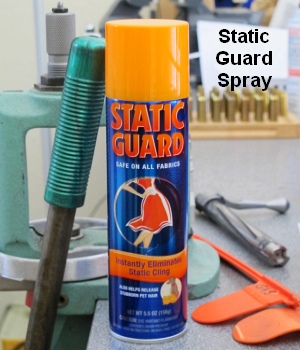 Apparently reducing static charges on and around electronic scales can reduce their propensity to drift, lessening the problem of “wandering zero”. Just how and why static charges interfere with scale performance is unclear, but many shooters have noticed that static electricity can cause electronic scales to behave strangely. So how do you reduce static charges around your digital balance? German Salazar has found a very simple solution — an anti-static aerosol spray — that, by all indications, actually works. When this “spray-can solution” was suggested to German by a fellow shooter, German was skeptical. However, German tried the stuff and he says that it really does help the scale maintain zero over time, with much less observed drift. Apparently reducing static charges on and around electronic scales can reduce their propensity to drift, lessening the problem of “wandering zero”. Just how and why static charges interfere with scale performance is unclear, but many shooters have noticed that static electricity can cause electronic scales to behave strangely. So how do you reduce static charges around your digital balance? German Salazar has found a very simple solution — an anti-static aerosol spray — that, by all indications, actually works. When this “spray-can solution” was suggested to German by a fellow shooter, German was skeptical. However, German tried the stuff and he says that it really does help the scale maintain zero over time, with much less observed drift.
On his Rifleman’s Journal website, German explains that the use of “Static Guard” spray helped mitigate the problem of a drifting zero on his Ohaus Navigator electronic scale. German writes: “My electronic scale… suffers from drifting zero (as they all seem to). I’ve read dozens of forum posts about drift and how to minimize its occurrence, so I know this problem isn’t limited to my scale or my workshop. Sometime last year, John Lowther mentioned the use of anti-static spray as a solution to the drift problem. John stated that the spray had virtually eliminated drift for him.”

German found that the Static Guard actually worked: “The spray works great, just as John said it would. I spray all surfaces that I touch with my hands and arms as well as the pan (top and bottom), the metal tray on which the pan rests and the table under the scale. In six months or so of using the spray I’ve re-applied it about two or three times; it certainly isn’t something that you need to do each time you sit down to load. Before using the spray, it was not uncommon for me to re-zero the scale 10 times in the course of loading 72 rounds; now it might need it once during a session.”
READ Full Story on RiflemansJournal.com
|


