Forum member Darrel Evans from the UK pulled off a remarkable feat recently. He set multiple 600-yard UK benchrest records shooting a true, military-type tactical rifle, an Accuracy International AW chambered in 6.5×47 Lapua. The gun had a custom 24″ fluted Border barrel, and bag-riding accessories, but other than that, Darrel’s gun was very much “as-issued” by the factory. Darrel pulled off this fine display of precision shooting at the December 27th 600-yard benchrest comp at England’s Diggle Ranges. (The Diggle, as you may know, is notorious for difficult conditions.)
Report by Darrel Evans
Just thought that you all might like to know how I have been getting on with my Accuracy International AW chambered in 6.5×47 Lapua. To make a long story short, I broke three UK records: smallest group of the day — 1.8″ at 600; smallest Agg for the day — 2.8″; and smallest Agg for the Light Gun class — 2.8″. All these records can be viewed on the UKBRA and TargetShooter websites.
To say that I was ‘over the moon’ would be an understatement. I was happy that all of my hard work had paid off. I was delighted to set records on the rifle’s first outing since [adding bag riders]. The 600-yard benchrest comps over here are run as a winter competition and the winds at the Diggle are not very forgiving. I knew that the group was small as the markers were over lapping each other when the target board came back up. But when they told me that it was 1.823″ I knew that I had got a record, as the last record of 2.225″ was set by myself in 2009 on the first Comp with the 6.5×47 barrel on, this was then broken with a 2.18″ on a calm day later that year. Later I received an email from Vince Bottomley telling me that I also had the best factory Agg record and the Agg record for Light Gun class.
About Darrel’s 6.5×47 Accuracy International
My Accuracy International AW (AI-AW), a military rifle system, started life as a .308 Winchester when I first bought it. But after a lot of reading I decided to buy a 6.5×47 Lapua barrel for it. As you know the AI-AW rifle system is a very good switch-barrel design, so after a phone call to Graeham Clark at Sporting Services I bought a Border Barrels 24″ fluted barrel in 6.5×47 Lapua. My .308 barrel is now in my gun safe. After seeing how the 6.5×47 barrel shoots, I doubt the .308 tube will ever go on again.
The rifle falls in the Factory Class for our 600-yard BR comps. This also qualifies in the Light Gun class. Most folks say that a factory rifle will never beat the custom lads in the Light Gun class…. Well, sometimes it’s nice to see this happen. To help the rifle’s bench manners, I made a plate for the front so that it would sit on my compact front rest with a Farley joystick top. I also made a bar to fit on the bottom of the buttstock for the rear sandbag.
Load Development and Accuracy Testing After a lot of testing with different powder and bullet combos, I settled on 38.2 grains of Hodgdon Varget, with 130gr JLK bullets and CCI 450m primers. Velocity is 2914 fps. Seems that this is where it likes to be. In the photo below, you can see the results of a few different powders, but all with the fantastic JLK 130gr bullets. The 38.3 Varget load had all four rounds in nearly one hole and I pulled the fifth, so this was pretty much the load that I went with for my 600-yard Comp. The JLKs are really good, consistent bullets, and I think that the next barrel that I buy will be set up for these bullets and no other — they are that good. I seat the bullets at 2.157″ OAL, just kissing the lands. I could not go any further out as the bearing surface is short.
Wrapping up his success story, Darrel added: “I hope that this is of some help to people who have a 6.5×47 or are thinking of building one. All the best for 2012.”
Forum member Skeeter has a 6mm Dasher falling block varmint rifle. The Dasher case is based on the 6mm BR Norma cartridge with the shoulder blown forward about 0.100″ and out to 40°. This gives the Dasher roughly 3.5 grains added capacity compared to the standard 6BR.
Last year, Skeeter needed to form 300 cases for varmint holiday. Skeeter decided to fire-form his brass without bullets. This method avoids barrel wear* and saves on components. There are various ways to do this, but Skeeter chose a method using pistol/shotgun powder, some tissue to hold the powder in place, Cream of Wheat filled to within an 1/8″ of top of the neck, and a “plug” of tissue paper to hold it all in place. Shown below are cases filled with a pistol/shotgun powder charge topped with Cream of Wheat and then a tissue paper plug.
To ensure the case headspaced firmly in his Dasher chamber, Skeeter created a “false shoulder” where the new neck-shoulder junction would be after fire-forming. After chamfering his case mouths, Skeeter necked up all his cases with a 0.257″ mandrel (one caliber oversized). Then he used a bushing neck-sizing die to bring the top half of the neck back down to 0.267″ to fit his 0.269″ chamber. The photo below shows how the false shoulder is created.
After creating the false shoulder, Skeeter chambered the cases in his rifle to ensure he could close the bolt and that he had a good “crush fit” on the false shoulder, ensuring proper headspace. All went well.
The next step was determining the optimal load of pistol powder. Among a variety of powders available, Skeeter chose Hodgdon Titewad as it is relatively inexpensive and burns clean. The goal was to find just the right amount of Titewad that would blow the shoulder forward sufficiently. Skeeter wanted to minimize the amount of powder used and work at a pressure that was safe for his falling block action.
Working incrementally, Skeeter started at 5.0 grains of Titewad, working up in 0.5 grain increments. As you can see, the 5.0 grain charge blew the shoulder forward, but left it a hemispherical shape. At about 7.0 grains of Titewad, the edge of the shoulder and case body was shaping up. Skeeter decided that 8.5 grains of Titewad was the “sweet spot”. He tried higher charges, but the shoulder didn’t really form up any better. It will take another firing or two, with a normal match load of rifle powder and a bullet seated, to really sharpen up the shoulders. Be sure to click on the “View Larger Image” link to get a good view of the cases.
The process proved to be a success. Skeeter now has hundreds of fire-formed Dasher cases and he hasn’t had to put one bullet through his nice, new match-grade barrel. The “bulletless” Cream of Wheat method allowed him to fire-form in a tight-necked barrel without neck-turning the brass first. The only step now remaining is to turn the newly Dasher-length necks down about .0025″ to fit his 0.269″ chamber. (To have no-turn necks he would need an 0.271″ or 0.272″ chamber).
Skeeter didn’t lose a single case: “As for the fire-forming loads, I had zero split cases and no signs of pressure in 325 cases fire-formed. Nor did I have any misfires or any that disbursed COW into the action of the firearm. So the COW method really worked out great for me and saved me a lot of money in powder and bullets.” To learn more about Skeeter’s fire-forming process, read this Dasher Fire-Forming Forum Thread.
*Skeeter did have a fire-forming barrel, but it was reamed with a .269 chamber like his 10-twist Krieger “good” barrel. If he fire-formed with bullets, he would have to turn all 300 necks to .267″ BEFORE fire-forming so that loaded rounds would fit in the chamber. Judging just how far to turn is problematic. There’s no need to turn the lower part of the neck that will eventually become shoulder–but how far down the neck to turn is the issue. By fire-forming without bullets now he only has to turn about half the original neck length, and he knows exactly how far to go.
Robert Whitley of AR-X Enterprises, LLC builds match-grade uppers for AR-platform rifles. Many of Robert’s favorite chamberings are based on the 6.5 Grendel case necked-down to 6mm. Until 2011, Lapua was the only source for 6.5 Grendel brass. As you’d expect, Lapua’s Grendel brass is truly excellent, but it is also pricey, and sometimes hard to find. Now Hornady is producing USA-made 6.5 Grendel brass. Robert Whitley has worked with the Hornady 6.5 Grendel brass for over a year now and he is able to assess its performance compared to the original Lapua version. Writing in our Shooters’ Forum, Robert reveals: “It’s decent brass but hot loads will loosen the primer pockets fast. With moderate loads you will get good case life and service from the brass and it can deliver excellent accuracy as well. Not Lapua but not bad either.”
Robert reports: “I was able to get my hands on some of Hornady’s 6.5 Grendel brass. My big question was how it would measure up, particularly the loaded necks, and whether it would be compatible with our existing 6mmAR and Turbo 40 die sets. As it turns out, this brass looks like a perfect fit for our existing die sets (and obviously 6.5 Grendel die sets too). Accordingly, folks with existing die sets will be able to use the Hornady brass without any issues.” However, as the loaded neck on the Hornady brass is .001″ (one-thousandth) slimmer than Lapua brass, you may want to try a smaller bushing when sizing Hornady Grendel brass.
The Hornady 6.5 Grendel brass has a LARGE Flash Hole, about .078″ versus .0591″ for Lapua brass. Dimensionally, the biggest difference is the shoulder diameter, with the Hornady brass measuring 0.428″ vs. 0.424″ for the Lapua brass. The Hornady is actually a better fit for 6mmAR chambers which are about 0.432″ at the shoulder. Interestingly, case H20 capacity is virtually identical. Water capacity of new, unfired Hornady 6.5 Grendel brass is 35.1 grains, while new, unfired Lapua Grendel brass holds 35.0 grains of H20. Both brands of Grendel brass increase to about 36.0 grains H20 capacity after firing and full-length sizing.
Here are some of the particulars of the Hornady cases:
Hornady 6.5 Grendel Brass
Lapua 6.5 Grendel Brass
Flash hole diameter: ~ .078″
OAL of brass: Average 1.515″
Weight of cases: 111.7 to 113.0 grains
Web diameter, unfired: 0.4375″
Shoulder diameter, unfired: 0.428″
Loaded neck diameter: 0.2895″
6mmAR loaded neck: 0.270″
Flash hole diameter: 1.5mm (0.0591″)
OAL of brass: Average 1.515″
Weight of cases: 111.0 to 112.5 grains
Web diameter, unfired: 0.4385″
Shoulder diameter, unfired: 0.424″
Loaded neck diameter: 0.290″
6mmAR loaded neck: 0.271″
if you turn your case-necks, here’s a tool from 21st Century Shooting that can can save time, and help you produce better, more consistent turned necks. 21st Century’s Neck-Turning Lathe system, introduced last spring, may revolutionize the way reloaders turn their case necks. Watch the video and you’ll see why. If you’re never turned cases before, you may become a convert after seeing how quickly and easily the new 21st Century Neck-Turning Lathe does the job.
The mini-lathe has unique fittings on the left and right sides that allow both the case-holder and the neck-turning tool to float. As a result this tool maintains near-perfect concentricity during the cut. 21st Century’s John Perkins explains: “The floating design of the neck turner and the case driver allows the case mouth (bore) to run on the arbor absolutely concentric, therefore allowing O.D. to be turned concentric with I.D. The tailstock creates a horizontal inline support for the base of the case. This also allows the operator to keep both hands on the power screw driver or drill, making it very easy to control the feed rate and to produce a very fine, turned finish.” Having the system float at both ends was key, according to John: “By allowing both the turner and the case to float, everything self-aligns. This maintains concentricity and allows the unit to work with very low torque.”
Neck-Turning Lathe is Fast Yet Precise
Using power from a drill or electric screwdriver, this tool will turn necks fast — in a matter of a few seconds. And it produces beautiful, smooth necks that are extremely uniform. Tests show that the lathe, used with the 21st Century Neck-Turning Tool, will hold 0.0002 (two ten-thousandths) neck wall tolerances. And it will do that time after time.
Turn Necks in a Single Pass
Using traditional hand-methods, turning case necks can be time-consuming and fatiguing. Many folks will experience hand pain or cramping after just a dozen cases. Watch the video, you’ll see how fast and easy neck-turning can be with the new mini-lathe. You get an exceptionally good cut in seconds. Very importantly, with this system, you may be able to switch from a double-pass cut, to a single-pass cut. Yes, even if you’re making a deep cut, we think there is a good chance you can turn all your necks in a single pass. That can cut your labor time in half!
Why does the 21st Century Neck-Turning Tool cut so well? First, the Neck-Turning Tool employs ultra-sharp carbide cutters that are custom-ground to fit the shoulder angle of your cartridge. This allows you to make a perfect cut extending down the shoulder 1/32 of an inch. Second, the system aligns the case neck on the arbor (mandrel) so well, and the cutter is so sharp, that very little torque is required. This allows the cutting process to go very smoothly. The case-holder is also unique — it features a O-ring so it holds the case firmly in place without marring or bending the case head. The tailstock case-holder adjusts to accommodate cases from 17 Fireball to a .416 Rigby.
More Case Prep Tools for Lathe in Future
In the near future 21st Century will offer additional case prep attachments for the new mini-lathe. 21st Century plans to provide bullet-pointing system and other options. These will all work with the same lathe “chassis”, and will run with power. John states: “This is a modular system, all parts interchange. So if you have an existing 21st Century Shooting Neck Turning Tool or Bracket, everything will fit.”
The 21st Century Neck-Turning Lathe costs $245.00, complete with Neck-Turning Tool ($85.00 value) and one case-holder driver. The Neck-Turning Tool comes with a carbide cutter with user choice of shoulder angle (Arbors and Mandrels are sold separately). Perkins recommends using the Neck-Turning Lathe with power, but it will also work with an optional hand crank. NOTE: Currently the Neck-Turning Lathe works ONLY with the 21st Century Neck-Turner. It will not work with K&M, Sinclair, or Forster tools. But that’s not a real drawback because the 21st Century tool is certainly one of the best on the market today. You can purchase the Neck-Turning Lathe (complete with Neck-Turner and Case-Holder) through the 21st Century website, or call (260) 273-9909.
Disclosure: 21st Century Shooting advertises with AccurateShooter.com.
RCBS rolled out some handy new products at SHOT Show 2012. The first item will be welcomed by AR and Service Rifle shooters who reload inexpensive military .223 Rem (5.56×45) and .308 Win (7.62×51) brass. RCBS now has a Primer Pocket Swager Bench Tool that removes military primer pocket crimps quickly and easily. Watch the video and you can see how effortlessly it does the job in just seconds. A hardened steel rod supports the case from the inside allowing the case to float for perfect alignment with the swager head. The RCBS Swager comes complete wtih hardened steel small and large swaging heads and rods to accommodate cases 22-caliber and larger.
We think the RCBS Swager certainly rivals Dillon’s Super Swage 600 which performs the same task. The Dillon employs a vertical (up/down) lever, while the new RCBS Swager uses a horizontal lever arm, with a nice cushioned handle. MSRP on the RCBS Swager is $106.00 compared to $100.95 for the Dillon Super Swage. Either tool will pay for itself by allowing you to reload inexpensive milsurp brass.
RCBS Adds Universal Shell-Holder to Trim Pro
RCBS has also updated its popular Trim Pro® case trimmer with the addition of a spring-loaded universal shell holder. This has spring-loaded jaws that can hold anything from a 17 Fireball case up to the large magnums. No more fiddling around with cartridge-specific shell-holders — you just snap your cases (of any size) in and out of the spring-loaded jaws. The system works well and the jaws hold cases securely during the trimming process. Again, watch the video to see the system in action.
Pistol Bullet-Feeder Kit
Last but not least, RCBS has released an inexpensive, gravity-fed bullet feeding system. Much cheaper and simpler than a motor-driven feeder, this system, which combines a tube with a special die, reliably drops pistol bullets, one by one, as you operate your progressive press. Importantly, this manual bullet-feeder works with jacketed, plated, cast or swaged lead bullets. (Some other bullet feeders cannot handle lead bullets). This device should be a major time-saver for those who load a lot of pistol rounds.
This Editor was sufficiently impressed with the gravity-fed bullet feeder that I ordered one for my own RCBS Pro 2000 Progressive. Note, however, the RCBS feeders work on Dillon and Hornady presses also — these Bullet Feeder Kits are designed to be used with ANY 7/8″-14 threaded progressive press. Each clear tube holds 20-25 bullets depending on weight and profile. Two bullet tubes are included with each unit. Extra bullet tubes sold separately. MSRP is just $36.00.
RCBS 2012 Rebate — $10 Off $50.00 Order
RCBS has a “Get Green” Rebate Offer that runs through December 31, 2012. When you purchase $50.00 of any RCBS product, you qualify for a $10.00 mail-in rebate. Then, earn a bonus $5.00 mail-in rebate when you purchase one of the following: 5 sleeves of Federal Premium or CCI primers, 1 pound of Alliant Powder, 1 box of Speer Bullets, 1 bag of Federal Premium brass. There is also a $50.00 Rebate on a purchase of $300.00 worth of RCBS Products.
Video Report by Robert Whitley Redding Reloading Equipment unveiled some new products at the 2012 SHOT Show. In this video, Dave Dibble, staff engineer for Redding, showcases some of Redding’s new items. These include the new small-caliber drop tube adapter, the Micrometer Seating Stem Retrofit kit, and Redding’s New Imperial BioGreen Case Lubricant (for pad application).
17-20 Caliber Drop Tube Adapter
This is a Lexan replacement fitting that goes on the bottom of a Redding powder measure drop tube to provide a better fit on small cases. The adapter is a simple friction fit and works with all Redding powder measures and the Redding powder funnel. The adapter simply slides onto the existing drop tube. The adapter should fit any Redding drop tube of 1960s vintage or newer.
Micrometer Seating Stem Retrofit Kit
Redding offers a unit that upgrades existing Redding standard seating dies to a micrometer-top seating die, with hash marks corresponding to .001″ (one-thousandth) movements in bullet seating depth. Note, before you order, check the part number on top of your existing standard seating die, and find the corresponding upgrade kit.
Imperial Bio-Green Case Lube
This new, non-petroleum lube, said to be “as slippery as traditional Imperial Die Wax”, can be used on any pad type-lubricant applicator. Clean-up is easy because the lube is water-soluble and the lube won’t stain your brass. Redding recommends this for folks who use ultrasonic cleaners as there is no petroleum to contaminate the ultra-sonic cleaning solution. Redding says reloaders should be able to “clean a lot more cases before changing the [ultrasonic] fluid.”
When Alliant’s Reloder 17 was introduced, it represented a real break-though in propellant technology. In some cartridges, Reloder 17 delivered significantly more velocity than any other propellant on the market. The secret was a new method of impregnating the powder kernels with burn-controlling compounds. This delayed the initial pressure spike, allowing a longer, more constant powder burn. This effectively delivered more energy over the powder’s full burn cycle, and the extra energy produced higher velocities than could be attained with conventional powders. READ Reloder 17 test report.
New Reloder 33 Delivers More Speed in Big Magnums
Now Alliant is introducing a new powder, Reloder 33, that uses the same kernel-impregnation technology first pioneered in Reloder 17. Alliant Reloder 33 is a new powder created by Rheinmetall Nitrochemie in Switzerland (Nitrochemie also makes Reloder 17). Like Reloder 17, Alliant’s new Reloder 33 powder employs a proprietary process by which the powder kernels are impregnated with burn-rate controlling elements. This delays the peak pressure spike and smooths out the pressure curve. Effectively, this allows the powder to deliver energy at a more constant rate, producing more overall velocity for the bullet — as much as 150 fps more than with any other powder. Reloder 33 was designed for the .338 Lapua Magnum but it is suitable for other large magnums and ultra-magnums.
In this video, Allliant’s Dick Quesenberry explains the properties of Reloder 33, noting that it should “raise the bar” of velocity for the .338 Lapua Magnum and other ultra-magnums. Outstanding velocities have been achieved in initial tests with the .338 LM. This has attracted the interest of the U.S. Military, which has already placed orders for Reloder 33 in bulk. Reloder 33 should hit the consumer market in mid-April to mid-May, the actual release date depending on DOT transport certification. Expect vendors to have the new powder in stock by the end of May, if not sooner.
Power Pro 1000 for High-Volume Reloaders
In addition to Reloder 33, Alliant is introducing Power Pro 1000. This is a new spherical (ball) powder with a burn rate similar to Alliant 10X. Power Pro 1000 is designs for varmint shooters and .223 Rem shooters who load large quantities of ammo on progressive presses. Power Pro 1000 meters exceptionally well through progressive press powder measures, and it should provide good load density in cartridges such as the .223 Remington. Alliant hopes to release Power Pro 1000 in early- to mid-April.
At SHOT Show, we had the chance to meet with German software engineer Hartmut Broemel, creator of QuickLOAD software. This software program, while not a substitute for conventional load manuals, allows shooters to evaluate a wide range of powders and bullets, comparing potential loads on the basis of predicted pressures, velocities, load density and projectile in-barrel time.
We took the opportunity, in the video below, to explain some of the fine points of QuickLOAD for our members. QuickLOAD, sold by Neconos.com, helps reloaders understand how changing variables can affect pressures and velocities. It can predict the effect of changes in ambient temperature, bullet seating depth, and barrel length.
In the video below we explain how to adjust the program for true case capacity, bullet seating into the lands, and other important factors. If you are a new QuickLOAD user, or are contemplating buying the $152.95 program, you should watch the video. The program isn’t perfect, but it can accelerate the load development process, and it can save you money by narrowing down the list of appropriate powders for your cartridge.
No other product currently available to serious reloaders offers as much predictive power as QuickLOAD, and you’ll find your money well spent just for the vast collection of data on bullets and cartridges. With a couple mouse-clicks you can instantly get the specifications of hundreds of bullets and cartridges. Likewise, in a matter of seconds, you can compare load density for a half-dozen powders, or compare the projected velocities of one cartridge versus another.
Hodgdon Powder has introduced a new spherical (ball) powder called CFE™223. Hodgdon claims that this new powder “greatly deters copper fouling” compared to other propellants. Originally developed for U.S. rapid-fire military systems, CFE™223 incorporates a proprietary chemistry named “Copper Fouling Eraser”. Based on tests with extended shot strings, Hodgdon claims that, by using CFE™223, match shooters, varmint hunters, and AR shooters can maintain accuracy for longer periods, with less barrel-cleaning time.
Load Data Now Available Online for CFE™223
Reload data for CFE™223 is available for 27 different cartridges with 147 loads. It is suitable for loading in many popular chamberings including: .204 Ruger, .223 Rem, 22-250, 6mmBR, .243 Win, 6.5 Creedmoor, .260 Rem, 7mm-08, and .308 Win. Maximum velocities are obtained in the .204 Ruger, .223 Rem, 22-250, and .308 Win with load data found at Hodgdon’s Reloading Data Center. CFE™223 is a spherical (ball) powder, so it meters well. The new powder will be available in one- and eight-pound containers starting in January, 2012. For more info, call (913) 362-9455 or write to: Hodgdon Powder, 6231 Robinson, Shawnee Mission, KS 66202.
We dropped by the Stiller Precision Firearms SHOT Show booth to see the latest product roll-out from Jerry Stiller and his crew. Jerry showed off some of his hot new action designs, including the long-awaited Copperhead rimfire benchrest action. Along with two rimfire actions, Jerry unveiled his hot-selling P1000 Benchrest Action, and his new TAC30 AW bottom metal system for Rem-clone actions.
The advanced Copperhead rimfire BR action, “in development” for years, is finally a reality. This is a pure benchrest-quality action, built from the ground up to deliver the smallest groups with today’s rimfire ammo. The Copperhead’s innovative design features DUAL firing pins at 6 and 12 o-clock. This serves to make rimfire ignition as consistent as possible. This action also has an Anschutz-style feed ramp to aid feeding of single-shot rounds. Being very complex to manufacture, the Copperhead commands a fairly high pricetag — roughly $1300.00. For those in the highly competitive rimfire benchrest game, who demand the very best rimfire receiver available, the high price is can be justified by the action’s superior performance. Prototypes have already earned top places ijn many notable rimfire BR matches.
Along with the Copperhead, Stiller Precision offers a nicely-detailed, smooth-running 40x clone rimfire action that will fit any stocks inletted for the Remington 40 Rimfire rifles. This 40X Rem clone action is in stock and available know for about $950.00.
Yet another unique action from Stiller Precision is the Tac-30 AW. This is a Rem-footprint action made as a purpose-built tactical rifle foundation. It has beefy #8 screws for scope base attachment along with the ability to add rail pins to a picatinny rail to reduce the possibly of any screw failures. Along with that, it is specifically made to work in concert with Stiller’s detachable magazine bottom metal and Accuracy International AW magazines. The entire action, bottom metal and magazine combination is available for about $1,100.00. The AW magazine is superior to the standard AICS mag; the AW design is easier to load, and it holds ten rounds in a more compact (shorter) box.
Last but not least, Stiller showed us a P1000 action which is becoming more popular in the long range benchrest realm and is available in standard and magnum bolt faces for short and long action calibers. This dual-port action is only available in a right-bolt, left-port, right eject configuration. It is also available in 2 diameters – 1.350” and 1.550” in case weight is an issue. Interestingly, the P1000 is made to work without the standard recoil lug as you can see it has recesses cut in the bottom that will act as a recoil lug surface. Similar to other Stiller’s actions, the P1000 has a small size (0.068″ diameter) firing pin for enchanced accuracy.
Stiller Precision is working hard to catch up on existing orders as well as continuing to develop innovative, state-of-the-art actions for discerning customers. Most of the actions on display at SHOT show are in stock and ready to ship. In addition, Stiller hopes to resume production of his popular Viper and Diamondback actions in just a few months. Jerry cautions “be patient” if you are looking for a drop-port or other classic benchrest not currently in inventory.


 After a lot of testing with different powder and bullet combos, I settled on 38.2 grains of Hodgdon Varget, with 130gr JLK bullets and CCI 450m primers. Velocity is 2914 fps. Seems that this is where it likes to be. In the photo below, you can see the results of a few different powders, but all with the fantastic JLK 130gr bullets. The 38.3 Varget load had all four rounds in nearly one hole and I pulled the fifth, so this was pretty much the load that I went with for my 600-yard Comp. The JLKs are really good, consistent bullets, and I think that the next barrel that I buy will be set up for these bullets and no other — they are that good. I seat the bullets at 2.157″ OAL, just kissing the lands. I could not go any further out as the bearing surface is short.


 Turn Necks in a Single Pass
 Why does the 21st Century Neck-Turning Tool cut so well? First, the Neck-Turning Tool employs ultra-sharp carbide cutters that are custom-ground to fit the shoulder angle of your cartridge. This allows you to make a perfect cut extending down the shoulder 1/32 of an inch. Second, the system aligns the case neck on the arbor (mandrel) so well, and the cutter is so sharp, that very little torque is required. This allows the cutting process to go very smoothly. The case-holder is also unique — it features a O-ring so it holds the case firmly in place without marring or bending the case head. The tailstock case-holder adjusts to accommodate cases from 17 Fireball to a .416 Rigby.

 Pistol Bullet-Feeder Kit
 17-20 Caliber Drop Tube Adapter

 New Reloder 33 Delivers More Speed in Big Magnums
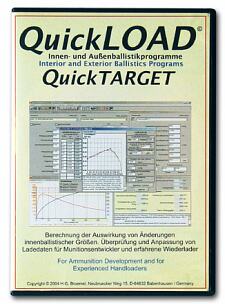 At SHOT Show, we had the chance to meet with German software engineer Hartmut Broemel, creator of QuickLOAD software. This software program, while not a substitute for conventional load manuals, allows shooters to evaluate a wide range of powders and bullets, comparing potential loads on the basis of predicted pressures, velocities, load density and projectile in-barrel time.


