GS Arizona, a top small-bore and centerfire shooter, uses the 6XC cartridge in some long-range matches. He has tried a variety of different types of brass for this cartridge, including necked-up 22-250 brass and Norma 6XC brass from David Tubb’s (Superior Shooting Systems). German’s measurements reveal significant differences in water capacity, as well as neck-wall thickness.
6XC Source Brass Dimensions
Case Capacity and Pressure Issues
GS has noted significant variances in capacity among the different “flavors” of brass. Norma-headstamp 6XC brass has 49.3 grains of H20 capacity, while Norma 22-250 brass holds only 47.8 grains of H20. Third-generation Tubb-brand 6XC brass is somewhere in the middle, with 48.6 grains of capacity. The tester did not have a chance to measure the high-quality Lapua 22-250 brass introduced in 2010. NOTE: These differences in case capacity are large enough that you MUST adjust your load to the brass type.
We ran a 6XC QuickLOAD simulation with 115gr bullets and H4350 powder. QuickLOAD predicted that the observed difference in case capacity can result in pressure differentials as much as 4,500 psi! In other words, if you switch from Norma 6XC brass to a lesser-capacity brass type, your pressures could rise 4,500 psi (using H4350 and 115gr bullets).
We recommend sticking with the Norma 6XC brass. It is available from DavidTubb.com for a reasonable $69.00 per 100 cases. These days, that’s cheaper than many other types of premium imported cartridge brass.
Neck Thickness and Chambering Issues
German noted that the different types of available brass varied quite a bit in neck-wall thickness — from 0.0121″ (Norma 22-250) to 0.0140″ (Tubb 3rd Gen). Consequently the diameter of loaded rounds also varied. Depending on the brass you chose, your loaded rounds could be 0.267″ at the neck or 0.271″ (with no-turn brass). That’s a huge difference and it’s something you need to take into account when you have your chamber cut for a barrel. For a cross-the-course rifle, you might want a chamber with at least .003″ total clearance over a loaded round. Obviously, to achieve that clearance, you’ll need to set chamber dimensions base on your preferred type of brass.
NOTE: The research for this story was conducted in 2010. Dimensions may have changed with more recent production, so you should double-check the case capacity of your own 22-250 or 6XC brass.
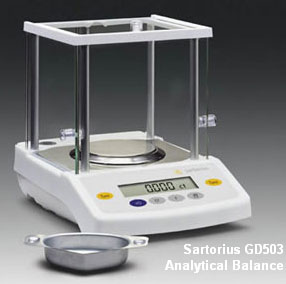
Successful long-range shooters know that careful weighing of powder charges helps them achieve superior long-range accuracy. By maintaining powder charges within very narrow weight tolerances, hand-loaders can produce ammo with more consistent muzzle velocities from shot to shot. Low Extreme Spread (ES) and Standard Deviation (SD) numbers translate directly to reduced vertical dispersion at very long ranges (although velocity is not the only contributing factor to vertical spread). In pursuit of load weight uniformity, many of our top long-range aces have invested in the latest, high-tech magnetic force restoration (MFR) digital scales (such as the Sartorius GD503). These laboratory-grade MFR scales are extremely stable (with minimal drift) and they can reliably measure to .005 grain, that is five thousandths of a grain. That is less than the weight of one kernel of typical extruded powder. For example, with Varget, there are three to four kernels in one-tenth of one grain of Varget. That means each kernel weighs .025 to .035 grains.
With the capability of modern modern MFR scales to measure less than one-hundreth of a grain, we have a new frontier in precision reloading. You’ll note, in the preceding paragraph, we said that one-tenth of one grain of Varget is three or four kernels. Well, “which is it?” you might ask. The answer is that it might be three, or it might be four, depending on the size of the individual kernels. That’s a disturbing uncertainty that we simply had to accept… until now.
Powder Kernel Uniforming — A Breakthrough
We now have the tools and the methodology to resolve the inherent uncertainty in individual kernel weight. Using the new technique of powder kernel uniforming, first pioneered by German Salazar, we can now, for the first time, ensure that every kernel of powder that goes into a cartridge is virtually the same weight — the same, in fact, within 0.01 grain (one-hundredth of a grain) TOTAL spread.
For a reloader looking to achieve “perfect” load weight uniformity, powder kernel uniforming offers the ultimate control over powder weight. The method we devised to uniform individual kernels consists of kernel core-drilling. The propellant we chose for this kernel-uniforming test was a new prototype (not yet commercially available) EuroChemie RL “X” propellant. This was chosen because it offered relatively large, can-shaped kernels that could be drilled relatively easily.
Core-Drilling Kernels with Micro Drill-Bits
The center of each kernel was bored out with a micro-drill. But here’s the key. Before drilling, we first weighed each kernel. Then we selected a micro drill bit of appropriate diameter to achieve uniform weights. With the heavier kernels (in the 0.04 gr range) we used a larger micro-bit. With the lighter kernels (in the 0.02 range), we selected a smaller diameter micro-bit that removed less material from the center of the kernel. Obviously, many kernels were ruined while we perfected the drilling process. It required great patience and a very steady hand. But after a few dozen hours of drilling, we had a batch of uniformed kernels that were all within plus or minus .005 grains (.01 grain ES). Now we were ready to do some testing.
Proof That It Works
All this time-consuming work to drill holes in individual kernels would be pointless, of course, if it did not produce meaningful accuracy gains. The proof, as they say, is “on the target”. We were curious to see if our uniformed powder kernels would out-perform unmodified kernels, so we did some field testing. We prepared two batches of 6mmBR ammo in Lapua brass, with full case prep, and bullet base to ogive sorting (we wanted to eliminate as many variables as possible). Bullets were Lapua 105gr Scenar Ls, which proved to be some of the most consistent projectiles we’ve ever measured.
One set of rounds was loaded with a carefully-weighed charge of unmodified kernels. Case to case charge weight was held to .05 grain (half a tenth uniformity). Then we prepared a second batch of cartridges with uniformed kernels, using the exact same charge weight, also held to .05 grain (half a tenth) tolerances. We took these rounds to the range, and did a “round-robin” test at 800 yards, shooting one of each type in sequence (i.e. one uniformed on right, then one non-uniformed on left) until we had two 10-round groups. The test was done with a rail gun fitted with a 1:8″ twist, 28″ Krieger 0.236″ land barrel. The uniformed-kernel ammo was shot at the right diamond, while the non-uniformed rounds were shot at the left diamond. Conditions were good, so we simply “held center” on every shot. No attempt was made to correct for wind as our primary concern was vertical dispersion.
Ammo with Uniformed Kernels Shows Significantly Less Vertical Dispersion at Long Range
As you can see, the uniformed-kernel ammo out-performed the non-uniformed ammo. The difference is quite clear. The rounds with non-uniformed kernels (on the left) produced a 10-shot group with roughly 3.0 inches of vertical dispersion. On the right, our ammo with uniformed kernels produced a group with 9 of 10 shots showing roughly 1.75 inches of vertical dispersion (we did have one high flier among the uniformed-kernel rounds). Additionally, we had a lower 10-shot ES and SD with the uniformed-kernel ammo. We repeated this test two more times and the results were similar. The targets speak for themselves. If you are looking for ultimate long-range accuracy, powder kernel uniforming is a “new frontier” you may wish to explore. With all other factors held constant, we were able to reduce vertical dispersion by more than an inch at 800 yards by drill-uniforming our NitroChemie powder. That’s huge in the long-range game.
Yes, the kernel-uniforming process is incredibly time-consuming and tedious, and a set of micro-drills is not cheap. We also freely acknowledge that the process may be much less productive with narrow-kernel propellants that are hard to drill. (Also EuroChemie powders are preferred because the burn rate controlling compounds are impregnated throughout the entire kernel — not just the outside.) But the potential for significant accuracy gains is there. We proved that.
Is it worth the huge investment of time to drill your powder kernels? That’s a question each reader must ask himself. But if you know the competitor on the next bench over has uniformed his kernels, can you afford not to do the same? Sometimes the extra effort is worth it, just for the peace of mind you get knowing you’ve done everything possible to achieve “ultimate accuracy”.
Now through April 6, 2012, Sinclair’s Stainless Micrometer “Ultimate Trimmer” system is on sale for $159.99. That’s a $20.00 savings off the normal $179.00 price. This unit comes complete with micrometer cut-length control, stand, Shark Fin clamp for the case-holder, and a stainless Wilson cutter housing. NOTE: Caliber-specific case-holders are sold separately.
The Sinclair Micrometer head allows reloaders to easily adjust trim length in .001″ increments with an adjustment length of over 2″. The micrometer features easy-to-read, engraved unit markings and may be locked in place. The Ultimate Trimmer can trim cases from 22 Hornet up to 416 Rigby.
The Sinclair Stainless Ultimate Trimmer comes with Sinclair Mounting Stand and handy Shark Fin Clamp. This system makes easy work of installing and removing your trimmer case holder in a smooth “swing-arm” motion. The Shark Fin trimmer clamp secures the case head firmly against the micrometer adjustment head for a quick and accurate, chatter-free trim. NOTE: We have found that you will get the most accurate, repeatable trim lengths if you set the shark fin to a firm tension and do NOT hold the case-holder with your hand — let the Shark Fin clamp do the job. The video below shows how to use a Wilson case trimmer (with micrometer, stand and Shark Fin).
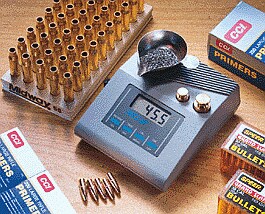
Here’s a tip that can help you score higher at matches and get more predictable results when weighing loads with an electronic scale. Kelly Bachand, a top prone shooter and electrical engineering major at the Univ. of Washington, tells us that all digital scales can drift. Therefore Kelly recommends re-calibrating electronic scales often. In addition — and this is key — Kelly recommends that you shoot the ammo in the exact order in which it was loaded. Arrange your loaded ammo in a box in the order of loading and shoot it first-loaded to last-loaded. (Or, if you prefer, shoot it last-loaded to first-loaded.) The important thing is to maintain the order and not mix everything up. That way, if your scale drifts, the effect of drift on charge weight will be incremental from one loaded round to the next, so point of impact change should be negligible. Conversely, if you shoot your last-loaded round right after your first-loaded round, the effect of scale drift is at its maximum, so powder charge varience is maximized. And that can produce a different point of impact (POI) on the target.
Tips on Loading with Electronic Scales by Kelly Bachand
If you use a digital scale to measure powder charges, recalibrate the scale often. I like to do this about every 25 rounds or so. Additionally, most electronic scales rely on eddy currents for their precision. Eddy currents are easily disrupted by static electricity so keep a cloth or ground strap nearby to remove any static currents should the scale start acting up; I usually just use a fabric softener sheet that has gone through the dryer once.
Shoot Ammo in Order of Loading
I shoot my rounds in the same order or reverse order as I load them. If the charge weight varies due to scale drift during use, the difference will be gradual if I shoot in the same order as production (or reverse order). I should be able to adjust for the slight varience in charge weight without having any wildly high or low shots (see the charts below for a graphical demonstration). I usually load my ammunition just 100 rounds at a time. Give yourself plenty of time and remember that you will make your best ammunition when you are fully awake and alert.
This graph demonstrates the effect a .01% (that’s 1/100th of 1 percent) difference in scale measurement would have over the course of 100 rounds assuming the desired load is somewhere between 46 and 47 grains. The final round made would have almost 1% less (or more) powder than the first, that’s almost an 0.5 grain difference from the first. If shot back to back, these rounds will invariably have different points of impact on the target.
This graph demonstrates the same .01% difference in scale measurement but this time with a recalibration every 25 rounds. By recalibrating the scale every 25 rounds the furthest a weighed charge ever gets from the original is less than 0.25%. Again if the charge being weighed is between 46 and 47 grains then the 26th round made would vary from the 1st by .12 grains. Even that small difference would likely show on target.
Either way it is important to note that if the bullets are shot in the same (or reverse) order as they are made, the biggest difference from bullet to bullet in this example is less than .01 grains.
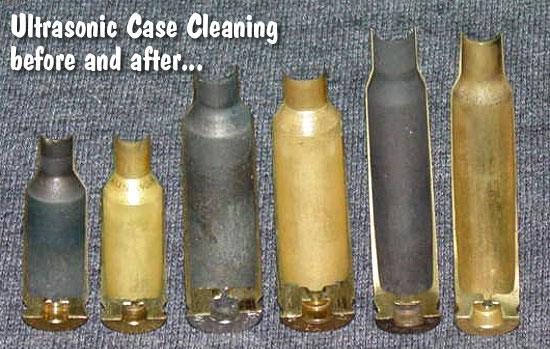
With the price of premium brass topping $90/100 for many popular cartridges, it makes sense to consider annealing your brass to extend its useful life. Forum member Darrell Jones offers a full range of brass prep, brass forming, and brass restoration (annealing, ultra-sonic cleaning) at very affordable prices. Starting at just $15 per 100 cases, Darrell’s company, DJ’s Brass, will anneal your used brass using state-of-the-art Bench-Source annealing machines. He can also ultrasonically clean cases for $15 per 100 ($20 per 100 for magnum cases larger than 0.473″ rim).
Custom Neck-Turning Services
Another great service DJ’s Brass provides is precision neck-turning. He can neck-turn any size case to your specified neck-wall thickness. The price is $0.30 per case (normal size) or $0.40 (magnum size) with a $20.00 minimum order. And if you’ve got a bucket of brass to neck-turn, that’s fine with Darrell — he recently neck-turned 1500 pieces of brass for one customer!
DJ’s Brass can process everything from .17 Fireball all the way up to the big magnum cases. And the job gets done quickly. Darrell has a 10-day turn-around guarantee. For most jobs, Darrell tells us, he gets the processed brass to the Post Office within three business days. DJ’s Brass charges only actual shipping fees, using USPS flat-rate boxes.
• Ultrasonic Cleaning + Annealing ($25.00/100 normal or $30/100 magnum)
• Ultrasonic Cleaning and Polishing ($15.00/100 normal or $20/100 magnum)
• Anneal Case Necks (after checking for splits) ($15.00/100 normal or $20/100 magnum)
• COAL Trim and Chamfer Case Mouths ($0.20 per case, $20.00 minimum order)
• Uniform and Square Primer Pockets ($0.15 per case, $20.00 minimum order)
• Expand Case Necks and Anneal brass (Call for Price)
• Create False Shoulder for Fire-Forming (Call for Price)
Muzzle Brake Tax Break Special: FREE cleaning of up to two (2) Stainless Muzzle Brakes with a minimum $50.00 order. Special good through April 17, 2012 (Tax Return Deadline for 2012).
DJ’s Brass Offers Specialized Custom Services
Darrell tells us: “At DJ’s Brass, we can handle all your brass refurbishing needs. From ultrasonic cleaning to custom annealing for specific wildcat cartridges. We can expand your necks from .22 caliber to .30 caliber and anneal shoulders for consistent bump-back. We can turn your case-necks and trim the brass to your specs. For some cartridge types, I can pre-form cases to assist in fire-forming a wildcat cartridge. We also remove the carbon build-up in muzzle brakes. Don’t lose your accuracy by having carbon build up and close off the clearance required for the most accurate bullet release through a muzzle brake.” Note: Extra charges apply for neck-turning and neck expansion operations, or specialized cartridge-forming operations. Please call 205-461-4680 for special services pricing.
Muzzle Brake – Tax Break Special for AccurateShooter.com Readers
Now through April 17, 2012 (Tax Due Date), Darrell is offering a Muzzle Brake – Tax Break Special for our readers. For all case prep/restoration orders of $50.00 or more, Darrell will ultrasonically clean one or two stainless muzzle brakes for no extra charge (offer does not apply to blued or coated muzzle brakes). For more info, visit DJsBrass.com or call Darrell Jones at 205-461-4680. IMPORTANT: Contact Darrell for shipping instructions BEFORE sending any brass for processing. ALL BRASS MUST BE DE-PRIMED before you send it.
Darrell has cleaned and annealed cases for shooters from across the country. Here are recent testimonials (this Editor reviewed all the original emails so I can confirm these are real):
“Your services were good with a quick turn-around time. Quality of the case annealing looked great[.]” — Tom, in Alaska
“The [300 Win Ackley] batch you did for me came back looking great.” — Chuck, in Arizona
“Since I started using Lapua brass, I’ve gotten gotten enough reloads out of them to notice that the necks were no longer sealing as well as I’d like. A friend suggested annealing them. I remembered seeing DJ’s ad on AccurateShooter.com and thought I’d give him a try. Not only did my [.308 brass] come back sorted exactly as I had sent them out, all had been so thoroughly cleaned that I realized I had been leaving lube on them after forming. DJ had taken the time to enclose a note cautioning me to brush the inside case necks and do a full-length resize for the first loading. And all 200 cases were back in my hands in DAYS, not weeks! Great service, great price, great follow up.” — Jim, in Alabama
We are often asked: “What size neck bushing is best for Lapua 6mmBR brass in a ‘no-turn’ chamber?” The questioner planned to purchase a Redding Type ‘S’ full-length sizing die with neck bushings. The quick answer is that one should probably get both 0.265 and 0.266 bushings and see what works best. With the current “blue box” Lapua brass, a loaded 6BR round with an unturned neck will typically run about 0.268″ (depending on the bullet). A 0.266″ neck bushing, after springback, will give about 0.0015″ tension which can work well in a bolt gun. In a gas gun, we recommend running .003″ (or more) neck tension.
Alternative to Bushings — Honed Full-Length dies
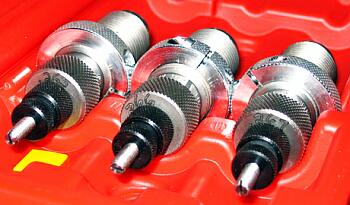
Conventional, non-bushing full-length sizing dies can create ultra-accurate ammo with very low run-out. For some applications, we prefer a non-bushing FL die over a bushing die — so long as the neck tension is correct. But many FL dies have an undersized neck diameter so you end up with excess neck tension, and you work the brass excessively. Forster offers a simple, inexpensive solution — honing the neck diameter to whatever size you want.
If you purchase a Forster non-bushing, full-length sizing die, Forster will hone the neck dimension to your specs for about $10.00 extra. This way you can have a FL die that provides the right amount of tension for your particular load. Forster dies are relatively inexpensive so you can afford to have a couple of FL dies with necks honed to different diameters — such as 0.265″ and 0.266″ for a no-turn 6mmBR. The die itself is very affordable — currently Sinclair Int’l charges $33.95 for a Forster 6mmBR full-length sizing die (item FP6BRFL).
Forster FL dies, necks honed to .265″, .266″, and .267″.
Steve Rasmussen of IowaHighPower.com gave this a try. In fact, he had three dies made — each with a different neck dimension. Here’s his report: “My original Forster 6BR FL die sized the necks down a lot, less than 0.260″, .256″ if I recall correctly. I sent my die in and asked if they could supply two more FL dies (for three total) to have the necks honed to 0.265″, 0.266″, and 0.267″. The cost was $10 for my supplied die and $38.50 plus $10.00 honing fee for each additional die. Return shipping was $11.00 via USPS Priority Mail.”
The table below shows the neck diameter range of ten (10) sized cases using each die. Brass springback after sizing runs 1 to 1.3 thousandths. Steve was using the older, “brown box” Lapua brass with thicker necks so he needed the .267″ bushing. The older Lapua 6mmBR brass measures about 0.2695″ with bullet in place. Steve explained: “My loaded rounds are running 0.2697-0.2699 using [brown box] Lapua 6BR brass. So far the dies are working well. I sized 80 cases with the 0.266″ necked die. The shoulder is running 0.4582″ and 0.300″ up from the base is 0.4684″. I spun 20 of ‘em and 16 had a runout of one thousandth (0.001) and the other 4 at 1.5 thousandths (0.0015).” That shows that these honed Forster FL dies produce exceptionally straight sized cases.
by James Calhoon
(First Printed in Varmint Hunter Magazine, October, 1995)
In the course of talking to many shooters, it has become clear to me that the manufacturers of primers have done a less than adequate job of educating reloaders on the application of their primers. Everybody seems to realize that some primers are “hotter” than others and some seem to shoot better for them than others, but few reloaders know that primers have different pressure tolerances.
Primer Pressure Tolerance
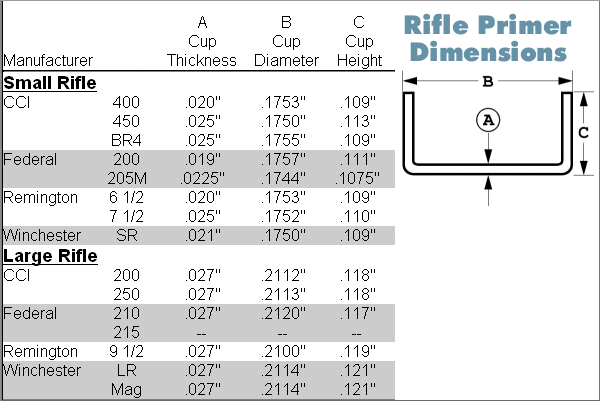
When loading a .223 to the maximum, I was getting primer piercing before I reached case overloading. I don’t know what prompted me to try CCI 450s instead of the 400s which I had been using, but I did. Presto! No more piercing! Interesting!? A primer that has a hotter ignition and yet withstands more pressure! Thats when I decided that it was time to do a dissection of all primers concerned. The chart below shows my results.
By studying the numbers (Cup “A” thickness), one can see which primers in the small rifle sections should be more resistant to primer cratering and/or piercing. Primer cup diameters are all similar and appear to follow a specification, but check out the cup thickness in the small rifle primers (Dimension “A”). Some cups are quite a bit thicker than others: .025″ for CCI 450 vs. .0019″ for Fed 200. Large rifle primers all appear to have the same cup thickness, no matter what the type. (As a note of interest, small pistol primers are .017″ thick and large pistol primers are .020″ thick.)
If you are shooting a 22 Cooper, Hornet, or a Bee, the .020″ cup will perform admirably. But try using the .020″ cup in a 17 Remington and you will pierce primers, even with moderate loads.
Considering that cup thickness varies in the small rifle primers, it is obvious that primer “flatness” cannot solely be used as a pressure indicator.
Another factor which determines the strength of a primer cup is the work-hardened state of the metal used to make the primer cup. Most primers are made with cartridge brass (70% copper, 30% zinc), which can vary from 46,000 psi, soft, to 76,000 psi tensile strength when fully hardened. Note that manufacturers specify the hardness of metal desired, so some cups are definitely “harder” that others.
What does all this mean to the reloader? - Cases that utilize small rifle primers and operate at moderate pressures (40,000 psi) can use CCI 400, Federal 200, Rem 6 1/2, or Win SR. Such cases include 22 CCM, 22 Hornet and the 218 Bee. Other cases that use the small rifle primer can use the above primers only if moderate loads are used. Keep to the lower end of reloading recommendations.
– Cases that utilize small rifle primers and operate at higher pressures (55,000 psi) should use CCI 450, CCI BR4, Fed 205 and Rem 7 1/2.
– All the large rifle primers measured have the same thickness. Therefore choose based on other factors, such as accuracy, low ES/SD, cost, cup hardness, and uniformity.
Hope this clears up some primer confusion. If you want more information about primers, priming compounds, or even how to make primers, the NRA sells an excellent book called “Ammunition Making” by George Frost. This book tells it like it is in the ammo making industry.
Hey folks, here’s a very good deal if you want a combo electronic powder dispenser/scale. The Hornady Lock-N-Load AutoCharge typically retails for around $240 (currently it’s $229.99 at Cabelas and $249.99 at MidwayUSA). Right now, ManVentureOutpost.com has the AutoCharge for just $186.01 (plus shipping). That’s over $50 off typical retail. NOTE: You MUST use Coupon Code SPR2012 during checkout to get that $186.01 price. Act quickly — supplies are limited at that price.
3/5/2012 UPDATE — ManVentureOutpost.com Sold Out of this item, which is now back-ordered. ManVenture is still (apparently) honoring the $186.01 price (with SPR2012 Coupon Code).
Hornady AutoCharge Is Much Less Expensive than RCBS ChargeMaster
That price for the Hornady unit is about $155.00 less than typical pricing for the RCBS Chargemaster (Sinclair sells the Chargemaster for $340.99 plus shipping). For most tasks the Hornady performs quite well. However, RCBS ChargeMaster fans will be quick to note that there has been more accumulated knowledge on tweaking the RCBS machine. But if you want a bargain, consider the “red option” — the Hornady AutoCharge.
This Youtube video shows the Hornady Lock-N-Load AutoCharge in action.
If you want to learn more about the Hornady AutoCharge, there is a detailed review in Shooting.com.au, a popular Aussie gun forum. This product review features actual test results along with lots of sharp, jumbo-sized photos. Here is the summary of the reviewer’s test results: “Weighing [20 charges of a stick powder] on a Redding beam scale (the only other scale I have) showed that 12 were spot on and the remainder we fairly equally split between 0.1 grain under and 0.1 grain over according to this scale. I consider this to be more than adequate for me.”
Here’s a good deal for you 50 BMG shooters. Wideners.com has NEW 8-lb jugs of military ball (spherical) powders on sale for just $39.00 per jug. That works out to just $4.88 per pound. Two types are offered at this price: WC867 and WC872. Both types are NEW never-loaded powders, not re-claimed or “pull-down” propellants. Wideners notes: “There is almost no difference between WC867 and WC872 powder and the same loading data is used for both. The slight differences will depend on the bullet used, the neck tension, whether you are shooting a bolt action or semi auto. Use loading data for AA8700, work loads up accordingly.”
While these powders are optimized for the 50 BMG, WC867 and WC872 can be used for other maxi-sized cartridges that require a very slow-burning propellent. To make this an even better deal, Widener’s will waive the Hazmat fee if you purchase six (6) 8-lb jugs: “Buy in Increments of 6 and we will pay the Hazardous Material Fee for you. That is 6, 12 or 18 Kegs etc.; if you buy less than 6, you will pay the Hazardous Materials Fees.” To order, visit Wideners.com or call 1-800-615-3006.
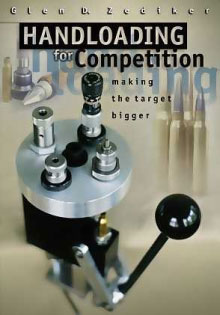
Forum member Danny Reever and this Editor recently discussed how novice reloaders can struggle with the fine points of reloading, making errors in seating depth, bushing choice, or sizing their cases. We agreed that a good resource covering more than “Reloading Basics” is sorely needed. Danny reminded me that Glen Zediker’s excellent Handloading for Competition book has been available since 2002. Danny says this may still be the best guide in print for those getting started in precision reloading, though the book is not without flaws.
Danny observed: “I consider this still the best book out there on the subject. I’ve bought a lot of other books only to be sorely disappointed after spending $30-$40 of my hard-earned cash. This book is not one of those! I’ve read and re-read Zediker’s treatise at least four times and refer to it often for advice while reloading. My number one suggestion for those who buy the book is to sit down with a highlighter and read it cover to cover. It’s well-written with a bit of humor and it is not boring.”
Extremely comprehensive, Zediker’s book covers nearly all of the key factors involved in accurate reloading: case sorting, brass prep, load development, neck-sizing, full-length sizing, bushing selection/use, tool selection, priming, powder measurement, and bullet seating. The book also explains how to test and evaluate your ammo, and how to monitor and interpret pressure signs.
There are many “must-read” sections in Zediker’s book, according to Danny: “The section beginning on page 161 dealing with concentricity (and how to achieve it) is excellent. Likewise the Load Limits section discussing pressures offers very valuable advice and info. You should also read Zediker’s commentaries about load testing, powders (burn characterics etc.), and the effects of temperature.”
Zediker has conveniently provided a detailed summary of his book on the web, complete with table of contents, sample pages (PDF format), and dozens of illustrations. Shown above is just one small section that covers ejectors.
Overall, we recommend Glen Zediker’s Handloading for Competition, though the book definitely could use some updating. Danny says: “Plunk down the $34.95 and buy this book, you won’t be sorry.” Zediker’s book is available from Amazon.com, Sinclair Int’l, and Zediker Publishing.


 We ran a 6XC QuickLOAD simulation with 115gr bullets and H4350 powder. QuickLOAD predicted that the observed difference in case capacity can result in pressure differentials as much as 4,500 psi! In other words, if you switch from Norma 6XC brass to a lesser-capacity brass type, your pressures could rise 4,500 psi (using H4350 and 115gr bullets).
 Successful long-range shooters know that careful weighing of powder charges helps them achieve superior long-range accuracy. By maintaining powder charges within very narrow weight tolerances, hand-loaders can produce ammo with more consistent muzzle velocities from shot to shot. Low Extreme Spread (ES) and Standard Deviation (SD) numbers translate directly to reduced vertical dispersion at very long ranges (although velocity is not the only contributing factor to vertical spread). In pursuit of load weight uniformity, many of our top long-range aces have invested in the latest, high-tech
  For a reloader looking to achieve “perfect” load weight uniformity, powder kernel uniforming offers the ultimate control over powder weight. The method we devised to uniform individual kernels consists of kernel core-drilling. The propellant we chose for this kernel-uniforming test was a new prototype (not yet commercially available) EuroChemie RL “X” propellant. This was chosen because it offered relatively large, can-shaped kernels that could be drilled relatively easily.
 Core-Drilling Kernels with Micro Drill-Bits
 Proof That It Works


 The Sinclair Stainless Ultimate Trimmer comes with Sinclair Mounting Stand and handy Shark Fin Clamp. This system makes easy work of installing and removing your trimmer case holder in a smooth “swing-arm” motion. The Shark Fin trimmer clamp secures the case head firmly against the micrometer adjustment head for a quick and accurate, chatter-free trim. NOTE: We have found that you will get the most accurate, repeatable trim lengths if you set the shark fin to a firm tension and do NOT hold the case-holder with your hand — let the Shark Fin clamp do the job. The video below shows how to use a Wilson case trimmer (with micrometer, stand and Shark Fin).
 Here’s a tip that can help you score higher at matches and get more predictable results when weighing loads with an electronic scale. Kelly Bachand, a top prone shooter and electrical engineering major at the Univ. of Washington, tells us that all digital scales can drift. Therefore Kelly recommends re-calibrating electronic scales often. In addition — and this is key — Kelly recommends that you shoot the ammo in the exact order in which it was loaded. Arrange your loaded ammo in a box in the order of loading and shoot it first-loaded to last-loaded. (Or, if you prefer, shoot it last-loaded to first-loaded.) The important thing is to maintain the order and not mix everything up. That way, if your scale drifts, the effect of drift on charge weight will be incremental from one loaded round to the next, so point of impact change should be negligible. Conversely, if you shoot your last-loaded round right after your first-loaded round, the effect of scale drift is at its maximum, so powder charge varience is maximized. And that can produce a different point of impact (POI) on the target.

 With the price of premium brass topping $90/100 for many popular cartridges, it makes sense to consider annealing your brass to extend its useful life. Forum member

 We are often asked: “What size neck bushing is best for Lapua 6mmBR brass in a ‘no-turn’ chamber?” The questioner planned to purchase a Redding Type ‘S’ full-length sizing die with neck bushings. The quick answer is that one should probably get both 0.265 and 0.266 bushings and see what works best. With the current “blue box” Lapua brass, a loaded 6BR round with an unturned neck will typically run about 0.268″ (depending on the bullet). A 0.266″ neck bushing, after springback, will give about 0.0015″ tension which can work well in a bolt gun. In a gas gun, we recommend running .003″ (or more) neck tension.




 Forum member Danny Reever and this Editor recently discussed how novice reloaders can struggle with the fine points of reloading, making errors in seating depth, bushing choice, or sizing their cases. We agreed that a good resource covering more than “Reloading Basics” is sorely needed. Danny reminded me that Glen Zediker’s excellent


