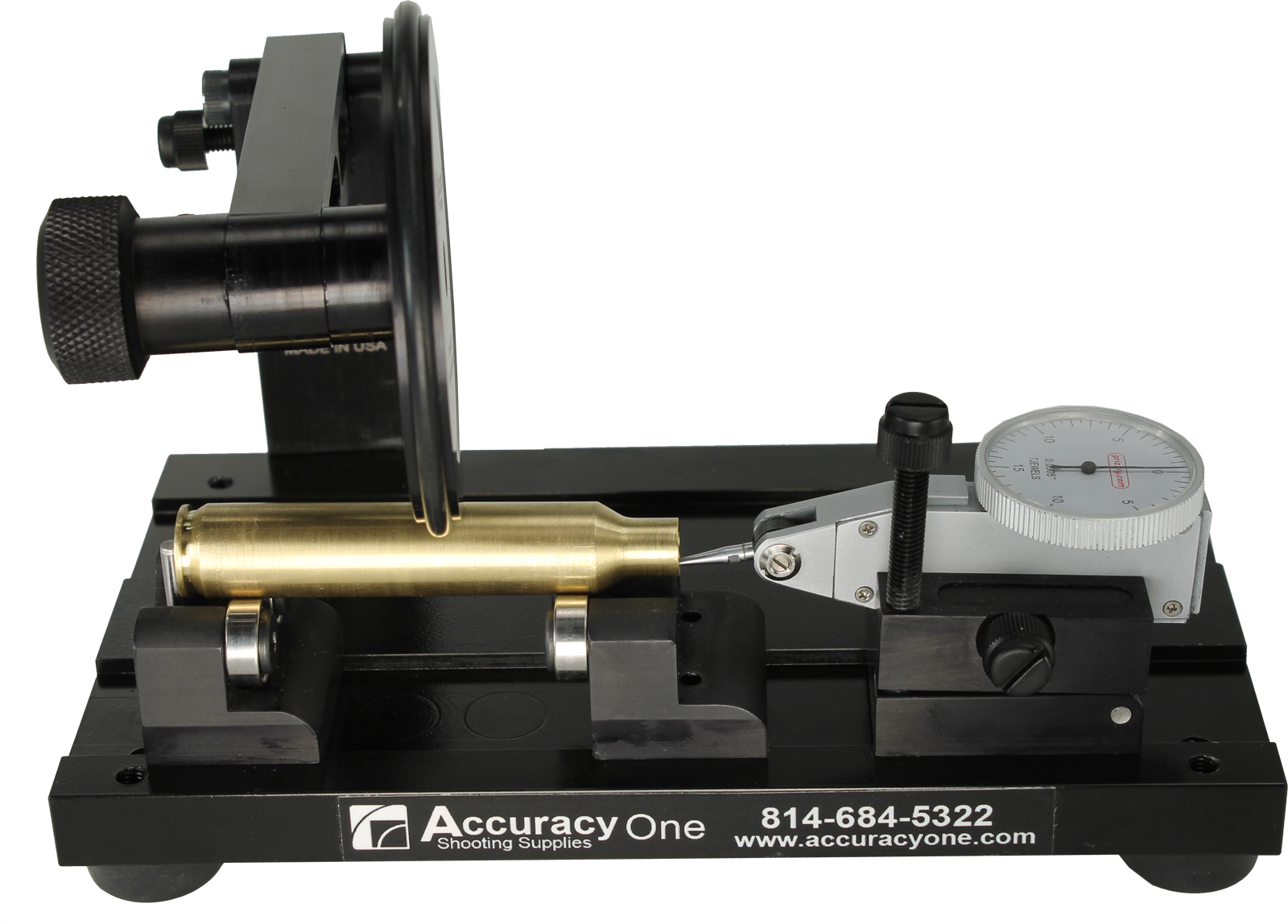
Talented tool-maker Curt Knitt has designed a better mousetrap — a new Concentricity Gauge that makes it easier than ever to get fast, repeatable results when measuring case and bullet run-out (aka “eccentricity”). The breakthrough design feature is the large-diameter wheel which spins the case. With most other concentricity gauges you must rotate the case with your finger(s). Anyone who has tried this knows that it is difficult to get a full, 360° rotation of the case without disturbing the indicator. Typically you can get two-thirds of a rotation or so, but then you have to reposition your finger to complete the rotation. Moving your finger often causes the case to jiggle or move slightly, and more often than not, the dial indicator jumps a bit, interrupting your measurement. Been there, done that.
Drive Wheel Smoothly Spins Cases for Fast, Error-Free Readouts
With the new Accuracy One Concentricity Gauge from CTK Precision, the rubber-rimmed drive wheel has a much larger diameter than any cartridge case (7:1 diameter ratio on magnums). So, when you rotate the drive wheel just a half-turn or so (using knurled knob on the wheel axis), you can easily and smoothly turn the cartridge three (or more) full rotations. The drive wheel maintains a constant, even load on the case, so the case doesn’t wobble and the dial indicator gives a continuous, un-interrupted read-out. What’s more, clever cartridge support design geometry pulls the case back against the rim stop as you engage the drive wheel. This holds the case in position laterally during measurement. Morever, this allows very fast one-handed operation. You don’t have to hold the case down with your fingers while maintaining side force against the case rim stop.
Watch Video Showing Concentricity Gauge Used with Small and Large Cartridges
The Accuracy One Concentricity Gauge works with the full range of cartridges — everything from .22LR to .50 BMG. Adjusting the tool for different-length cases is incredibly easy, because the roller blocks (case supports) are held in place by magnets. You just slide the blocks to the desired position — no tools needed! The indicator stand is also held by magnets so it can slide to any position you want along the case body or bullet. And, the indicator can be moved to the front rail and rotated 90°. This way you can measure on the inside of the case neck.
Does this new design really work? Absolutely — it works brilliantly and it’s FAST. Watch the video and see for yourself. We could do two-rotation (720°) measurements on cases in a third the time it takes to do a one-rotation gauging operation with other tools. And the actual measuring operation can be done one-handed, leaving your free hand to pic up the next case (or bullet) to be measured. And yes, this tool can also measure bullet concentricity — measured from tip, ogive, bearing surface, and/or boatail.
1. Directional Drive Wheel pushes the cartridge or bullet into the stop for accurate, repeatable readings with equal pressure. The replaceable rubber drive ring will not harm cartridges or bullets.
2. Two-position bullet and cartridge stop.
3. Precision ball bearings provide friction-free movement.
4. Heavy steel base with E-coat finish and bolt-on rubber feet.
5. Indicator stand and roller blocks ride in machined slots and are held in place by N42 Neodymium magnets. This allows rapid, smooth, tool-free adjustments.
6. Indicator stand can be place in front OR rear machined slots. This allows for both internal and external measurements.
7. Fine-Adjustment Horizontal Indicator Stand allows very precise indicator angle/load adjustments.
8. Indicator Stand will accept horizontal indicators that are .350″ wide or narrower, and are 1.75″ to 2.25″ from the indicator contact point to the center of the main body.
9. Adjustable mechanical arm stop holds the arm up for one-handed operation.
10. Precision Drive Wheel has a 13:1 ratio for .22 rimfire, 7:1 for magnums, and 3.7:1 for 50BMG.
11. Concentricity Gauge accepts cartridges from .22LR rimfire to .50 BMG.
The Accuracy One Concentricity Gauge is available from BulletTipping.com. Price for the unit, complete with quality horizontal indicator, is $325.00. Price, without indicator, is $280.00. The initial run of Concentricity Gauges is now in final production. Gauge sets should hit the market in 4 to 6 weeks. To place an advance order, fill out the PDF Order Form, or call (814) 684-5322. To learn more about setting up and using this new tool, read the Concentricity Gauge Instructions, and watch the video above.
Vihtavuori has updated the loading information for a number of popular rifle chamberings. You can find the updated reloading data online in the Vihtavuori Reloading database. The updated online information supplements the Vihtavuori Reloading Guide (10th Edition) print version (and its PDF version). The online Reloading Database has been revised with updated and enhanced loading data (including some new powder options) for the following cartridges:
.22-250 Remington
.260 Remington
6.5×55 Swedish
6.5×55 SKAN
6.5-284 Norma
7mm-08 Remington
7x57R
.30-06 Springfield
.300 WSM
.300 Win Mag
.300 RUM
.338 Lapua Magnum
9.3×62
NOTE: Vihtavuori promises that: “The updated PDF for the downloads section and the printed version of the guide will be available at the end of the year 2012″.
Story Tip by EdLongrange. We welcome reader submissions.
To achieve best accuracy with a rifle, you must control bullet seating depth very precisely, so all bullets end up in the same place relative to the entrance of the lands, every time. There may be multiple cartridge OALs which prove accurate. However, with each, you first need to determine a “zero” point — a reliable, and repeatable OAL where the bullet is “just touching” the lands.
There are tools, such as the Hornady (formerly Stoney Point) OAL Gauge, that will help you find a seating OAL just touching the lands. However, the tool requires that you use a special modified case for each cartridge you shoot. And, while we find that the Hornady OAL Gauge is repeatable, it does take some practice to get in right.
Make Your Own Length-to-Lands Gauge with a Dremel
Here’s an inexpensive alternative to the Hornady OAL tool — a slotted case. Forum member Andris Silins explains how to create a slotted case to measure length to the lands in your rifle:
“Here’s what I did to find length to lands for seating my bullets. I made four cuts into the neck of fire-formed brass. Then I pressed the bullet in lightly and chambered the entire gauge. As the cartridge chambers, the bullet slides back into the case to give you length to lands. It took less than five minutes to get it cut and working. A little light oil in the barrel just past the chamber helps ensure the bullet does not get stuck in the lands. It works great and is very accurate.
I made the cuts using a Dremel with a cut-off wheel. You can adjust tension two ways. First, you can make the cuts longer or shorter. Longer cuts = less tension. If you used only three cuts instead of four you would get more tension. The trick is to be gentle when you open and close the bolt. If you ram the bolt closed you may wedge the bullet into the lands. When you open the bolt it helps to keep a finger or two near by to guide the case out straight because the ejector wants to push it sideways.”
Redding is releasing a dedicated small-case powder measure with a charge weight range of 1 to 25 grains. This specialized Model 10X powder measure should work well for small varmint cartridges such as the .221 Fireball, .20 Vartarg, and the 17 Hornet. The powder cavity and micrometer settings put the charge for a 17 Hornet right in the middle of the powder measure’s capacity — the most accurate part of its range. That’s good news for small rifle cartridge reloaders.
In addition, 17 Fireball and 17 Hornet shooters will be pleased to not that Redding has introduced a 17-caliber drop tube adapter that fits the small-diameter necks of these compact varmint cartridges. With this 17-cal adapter (Redding part #03817), you can throw charges directly into 17-caliber cartridge brass, without the need for separate small-neck funnels.
Features of New Redding 10x Powder Measure:
• Micrometer-controlled powder metering chamber
• Hemispherical Cup for smoother operation
• Cast iron and hard chrome construction
• Positive metering chamber lock
• Adjustable powder baffle
The 17 Hornet is based on the venerable rimmed .22 Hornet case. However, the case is not just necked-down from .22 caliber. The case designers reduced body taper, moved the shoulder, and changed the shoulder angle to 25°. This effectively modernized the old .22 Hornet case, improving efficiency while retaining the max OAL, so that the 17 Hornet can work in any action big enough for the .22 Hornet. Hornady’s “Superformance” 17 Hornet loaded ammo is designed to push a 20gr bullet at an impressive 3650 fps.
MidwayUSA has knocked $1.50 off the prices of LoadBooks reload manuals for three of the most popular centerfire calibers: .223 Rem, .308 Win, and .30-06. As discounted, these manuals now cost $5.49 (regular price $6.99). In addition, the most popular pistol load manuals are also marked down to $5.49 (9mm, .38 Spl, .357 Mag, 40sw, and .45 ACP, .45 Colt).
All of these caliber-specific reloading guides are packed with information from major US bullet- and powder-makers including Accurate, Alliant, Hodgdon, Hornady, IMR, Lyman, Nosler, RCBS, Sierra, Speer and Winchester. LoadBook manuals are printed on heavyweight paper and spiral-bound so they will lay flat on any surface. Most load manuals have about 54 pages. NOTE: since most of these manuals have not been updated within the last 5 years, you won’t find the latest bullet designs or recently-introduced powders such as Hodgdon Hybrid 100V or Alliant Reloder 17.
7mm has become the caliber to beat in F-Class open division. The dominant performances of UK shooters with 7mm cartridges at the 2009 F-Class World Championship, following the South African team’s success with 7mms at the previous Worlds, has shown the strength of 7mm chamberings for long-range competition. After losing to the Team Britain, the U.S. F-Open Team decided to switch to a 7mm for the next World Championship. While most of Britain’s top F-Class shooters were using WSM-based 7mm cartridges, you don’t need a short magnum to enjoy the wind-bucking abilities of a 7mm.
With a standard .284 Winchester, or better yet, a .284 Improved, you can drive the high-BC Berger 180gr bullets to competitive velocities. A .284 Improved will shoot well inside a 6.5-284, and you’ll probably get 40-60% longer barrel life (at least 2000 rounds vs. as little as 1200).
The straight .284 Win is a good cartridge, but in most barrels, it can’t push the 180s at 2900-2950 fps velocity levels*. A lot of barrels will top out at about 2850. That’s where the .284 Shehane comes into play. The .284 Shehane is a slightly modified wildcat that retains the same 35° shoulder as the parent case. However, by blowing the sidewalls out 0.010″, the .284 Shehane picks up about 3.3 grains of extra case capacity. That enhancement makes a BIG difference. The extra boiler room is enough to drive the 180s at 2900-2950 fps with H4831sc. With N560 or Reloder 17 you can go even faster.
Scotland’s Grant Taylor used the .284 Shehane to finish 3rd overall in the 2009 individual F-Class World Championships at Bisley, England. Grant reports: “I have a .284 Shehane and it’s very accurate with superb vertical spreads at 1000 yards. I have to thank Jim Hardy for putting me onto the caliber, it has awesome accuracy. I’m getting 2930-2950 fps with spreads in the 3-5 fps range. I use Hodgdon H4831sc powder, CCI BR2 primers, and pointed 180gr Bergers.”
Forum member Jim Hardy has shot the .284 with great success. He tells us: “In my humble opinion, the .284 Shehane is the best balanced long range round there is — bar none. I (perhaps_ have shot more of this chambering than anyone else, and it has proven better than I ever expected. Here is why:
You have to shoot a 30 Cal magnum with a 240gr bullet to equal the performance of most 7mm chamberings with the 180 Berger VLD. With the .284 Shehane, you have a .308 bolt face, medium action, and Lapua brass. You use less powder than the 7 mags, and have great accuracy and ballistics even while fire-forming. The .284 Shehane shoots inside the 6.5 AND the straight 284, the 300 WSM, and the 300 Win Mag with less recoil. The .284 Shehane offers twice the competitive barrel life of the 6.5-284, an easy 2950 fps with H4831 SC, [and it] can run 3000+ with N560 and Reloder 17, which is right there with the 7mm WSM. What is not to love about the 284 Shehane? It is a no-brainer for long range — F-Class or Prone or 1000-yard Benchrest.”
*Some exceptional barrels chambered in straight .284 Win can reach 2900 fps with the 180s. Ryan Pierce, who recently set a 450-24X Pending F-Open record, has a 32″ Brux barrel that is delivering 2900 fps with the straight .284. However, Ryan acknowledges that his velocities are not typical: “A lot of .284 Win barrels top out at around 2850 fps with the 180s.”
Alliant’s Powder for 50-Caliber Applications
In 2009 Alliant unveiled Reloder 50, a new powder designed for long-range, 50-caliber rifle shooters. According to Alliant, the burn rate is “a little slower than Winchester 860″ and the powder is showing excellent lot-to-lot consistency. Load density is optimized for the 50 BMG and similar cases. Like Reloder 17, Reloder 50 employs a process which penetrates the kernels with the burn-rate-controlling chemical. This should allow a longer, flatter pressure curve, yielding more velocity than conventional powders can deliver. Alliant says that Reloder 50 offers “superior velocity and the ability to burn cleaner (with less residue).” Reloder 50 comes in both 1-lb (#150527) and 8-lb (#150528) containers.
Giraud 50 BMG Case/Bullet Comparator Giraud Tool makes a comparator for 50-Cal cartridges. The double-ended comparator is quite versatile. In one orientation you can measure base-to-ogive bullet length and also measure cartridge OAL from rim to bullet ogive. When reversed, you can use the comparator to measure cartridge headspace. The $30.00 Giraud 50 BMG Comparator gauge is constructed of 303 stainless and fits most any vernier, dial, or digital caliper. CLICK HERE for more info.
Lyman 50 BMG AccuTrimmer and Forster 50 BMG Trimmer
50 BMG enthusiasts asked for a reasonably-priced 50 BMG case trimmer and Lyman responded with an Accutrimmer designed specifically for that cartridge. Easy-to-use course and fine cut-length adjusters are positioned on the right side (by the handle). The shell head fits into a special holder which centers the case. The unit comes complete the 50-Caliber neck pilot. This case trimmer, including pilot, costs $59.99 at MidwayUSA.com.
Forster Products also makes a dedicated 50 BMG trimmer. Forster’s cutter tip is much sharper than the cutter on the Lyman AccuTrimmer. However, with the Forster tool you will pay more for that superior cutting ability — Forster’s 50 BMG trimmer costs $92.95 at Sinclair International.
Quite a few popular powders have been hard to get lately. Some folks have been worried about shortages in anticipation of the fall elections. However major vendors are reporting that the brown trucks have arrived with large shipments from Alliant, Hodgdon, and Western Powder. Most of the most popular powders for precision reloaders are now in stock. If you’ve been waiting on your favorite powder, now is time to stock up.
Grafs.com is showing good availability of the most popular Hodgdon powders including Varget, H4350, H4831SC, H4198, and the new Superformance powder developed with Hornady. Grafs.com also has 1-lb containers of the new CFE-223 powder in stock, but 8-lb CFE-223 jugs are currently sold out. This powder is working well for the AR and varmint shooters who have tried it.
Midsouth Shooters Supply reports that Ramshot TAC is back in stock in large quantities. Ramshot TAC is a versatile double-based rifle powder. TAC has the ability to provide some of the industry’s highest velocities for 80gr bullets in the .223 Rem chambering while adhering to SAAMI pressure guidelines. TAC is known for ease of metering and good load density. It is well-suited for both .223 Rem, and .308 Winchester.
Powder Valley Inc. (PVI) tells us that it just received a large shipment of Alliant powder. Alliant (an ATK company) produces popular rifle powders including Reloder 15, 17, 19 and 22, AR-Comp, Power Pro 2000, and Power Pro Varmint. All these are in stock now at PVI.
They have been on the market for nearly a year, but you may not know that Redding sells a line of Micrometer Seater assemblies, which can be used to upgrade Redding’s standard ½-20 thread seater dies. These replacements allow you to enjoy the ease-of-use and precision of a micrometer seater, without buying a whole new die. Redding states that “the new Bullet Seating Micrometers are a direct [retro-fit] replacement for the original seating plugs and can easily be changed from one die to another.” Unfortunately, these add-on micrometer stems haven’t started shipping yet, and Redding has not provided a firm delivery date (or price). We are hoping the products will start arriving by mid-summer.
NOTE: the seater assemblies are a component of the bullet seating die. These are not the dies themselves. It is the top portion of the die that contains the plunger, which pushes the bullet into the case. And here is something important: these new Bullet Seating Micrometers are available for both traditional tangent ogive bullet shapes as well as for VLD (secant ogive) bullets.
That’s right, Redding now offers micrometer seater assemblies made specifically for Berger VLD bullets. These Seating Micrometers allow you to convert a standard seater to a Micrometer seater optimized for VLDs. That’s great news for VLD fans. Eric Stecker of Berger Bullets tells us: “We have confirmed with Redding that each of the new micrometer plugs in the VLD group were designed based on Berger VLD bullets. We provided all of our VLD bullets to Redding, from which they took deliberate measurements and made these new plugs.”
New VLD-specific Seater Stems Improve Bullet Seating Depth Consistency
Stecker explains how the new VLD-specific seater assemblies produce better, more accurate ammo: “Many shooters have problems getting the VLD bullets to shoot because of the bullet seater die they are using. VLD bullet noses are so long and sharp that, in many dies, the bullet tip bottoms out in the bullet seater stem instead of touching on the side of the ogive like it should. Seating depth inconsistencies up to .025″ can occur if the seater stem bottoms out on the bullet tip. The worst part is that many shooters have no idea that this is the root cause of their poor performance. This new product can help turn a frustrating shooting experience into an enjoyable one.”
Story tip from Edlongrange. We welcome submissions from our readers.
A handy eBook version of the popular resource ABCs of Reloading is now on sale for $1.99. That’s right — for the price of a cup of coffee at Starbucks, you can get a very useful 288-page introductory reloading treatise, complete with hundreds of photos. The print version of this book costs $17.81 at Amazon.
This eBook will not tell you about some advanced reloading methods used by benchrest shooters. However, you’ll find good basic information on important topics such as: powder storage, proper handling of primers, how to set full-length dies, press mounting and set-up, trimming brass, and measuring for run-out. For those who are new at reloading this is a very useful guide that contains the fundamentals you need to know to be a safe and productive reloader. If you have friends who are getting started in reloading, you can send this eBook to them. It’s a thoughtful, inexpensive gift.
Please note: This $1.99 edition is a digital book, NOT a paperback. It does have hundreds of photos and many charts. We found the text very easy to read on a Kindle, and most of the photos were plenty big. You can download a sample for free if you’re curious to see how the book displays before you buy.
What’s an eBook?
An eBook is a digital file with text, photos and graphics. You download the file from Amazon.com to your Kindle (hand-held) eReader, home computer, lap-top computer, iPad or smartphone. You may have to install a free eReader App on your computer or phone before you can access the file. Once the file is loaded you can search text, make bookmarks, and highlight text.
Do I Need a Kindle?
No. Even if you do not own an Amazon Kindle, you can read the eBook on any kind of computer, or you can read the eBook on a smartphone or iPad. But you may have to install a program (App) before the file can be opened. The reading Apps are FREE.
Amazon Prime Members Can Get eBook for FREE
If you have an Amazon Prime membership, you can download this eBook for FREE — provided you haven’t used up your “one book a month” allotment. Certain Amazon titles (like this) are in the Prime Member Lending Library. Each month, you’re allowed to download one Lending Library eBook for free. If you haven’t “borrowed” an eBook this month, and you’re an Amazon Prime member, you can get the digital edition of the ABCs of Reloading for FREE.


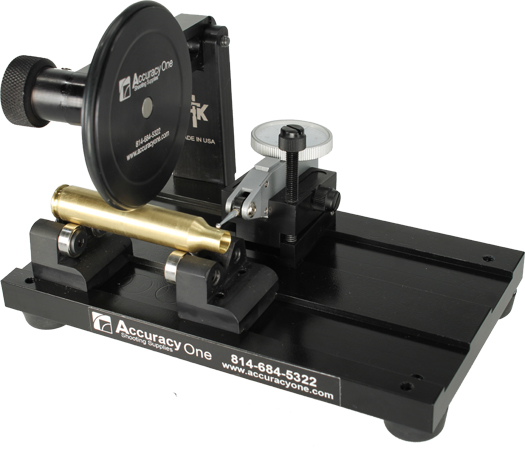
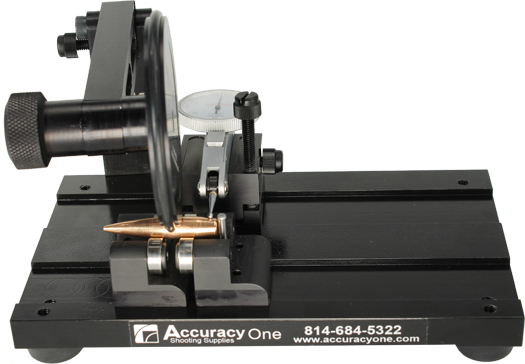
 The Accuracy One Concentricity Gauge works with the full range of cartridges — everything from .22LR to .50 BMG. Adjusting the tool for different-length cases is incredibly easy, because the roller blocks (case supports) are held in place by magnets. You just slide the blocks to the desired position — no tools needed! The indicator stand is also held by magnets so it can slide to any position you want along the case body or bullet. And, the indicator can be moved to the front rail and rotated 90°. This way you can measure on the inside of the case neck.
 Vihtavuori has updated the loading information for a number of popular rifle chamberings. You can find the updated reloading data online in the
 Redding is releasing a dedicated small-case powder measure with a charge weight range of 1 to 25 grains. This specialized Model 10X powder measure should work well for small varmint cartridges such as the .221 Fireball, .20 Vartarg, and the 17 Hornet. The powder cavity and micrometer settings put the charge for a 17 Hornet right in the middle of the powder measure’s capacity — the most accurate part of its range. That’s good news for small rifle cartridge reloaders.

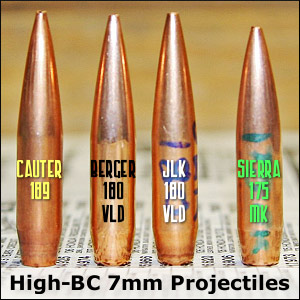 With a standard .284 Winchester, or better yet, a .284 Improved, you can drive the high-BC Berger 180gr bullets to competitive velocities. A .284 Improved will shoot well inside a 6.5-284, and you’ll probably get 40-60% longer barrel life (at least 2000 rounds vs. as little as 1200).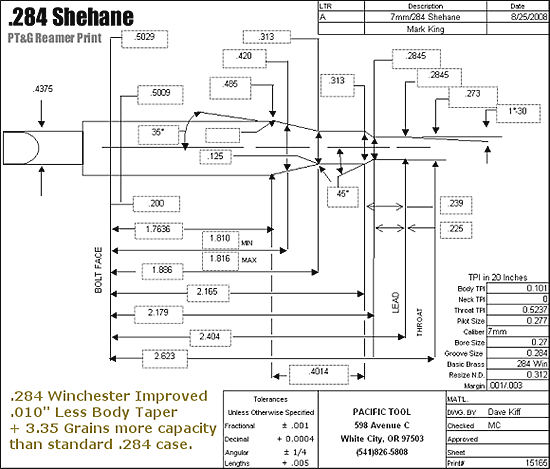
 Alliant’s Powder for 50-Caliber Applications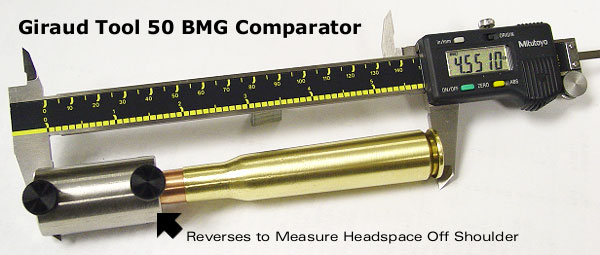


 Quite a few popular powders have been hard to get lately. Some folks have been worried about shortages in anticipation of the fall elections. However major vendors are reporting that the brown trucks have arrived with large shipments from Alliant, Hodgdon, and Western Powder. Most of the most popular powders for precision reloaders are now in stock. If you’ve been waiting on your favorite powder, now is time to stock up.


 They have been on the market for nearly a year, but you may not know that Redding sells a line of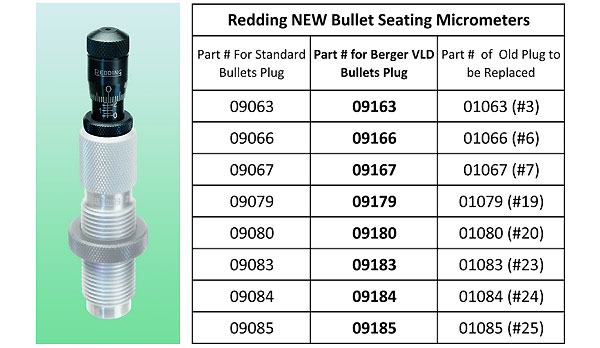
 That’s right, Redding now offers micrometer seater assemblies made specifically for Berger VLD bullets. These Seating Micrometers allow you to convert a standard seater to a Micrometer seater optimized for VLDs. That’s great news for VLD fans. Eric Stecker of Berger Bullets tells us: “We have confirmed with Redding that each of the new micrometer plugs in the VLD group were designed based on Berger VLD bullets. We provided all of our VLD bullets to Redding, from which they took deliberate measurements and made these new plugs.”
 Amazon Prime Members Can Get eBook for FREE


