A while back, we featured a portable reloading bench built on a Black & Decker Workmate. That proved a VERY popular do-it-yourself project so we’re showing it again, in case you missed it the first time.
Texan Robert Lewis made himself a great portable reloading bench from plywood mounted to a Black & Decker Workmate. The bench, roughly 22″ x 19″ on top, folds up to fit easily in your car’s trunk or behind the seats in a pick-up truck cab. Four recessed bolts hold the wood top section to the collapsible B&D Workmate.The sides and back of the unit are attached to the base with small nails. There is a small shelf (also nailed in place) which can be used to clamp a powder measure or hold a scale. Shown in the photo is a Harrell’s Benchrest measure and Harrell’s single-stage “C” press.
The whole unit can be built for about $65.00 with pine, or $80.00 with oak (as shown). Robert explained: “The Workmate was $40. If someone bought a 2’x4′ sheet of 3/4″ oak plywood, I think it is around $30. Using pine plywood would be about half that. Fasteners were $3. Spar Urethane would be $5.”
Robert told us: “I used a couple ideas I found on the web. The Larry Willis website gave me the idea to use the Black and Decker Workmate as a base. I found the Workmate on sale for $40 and the top is made from oak plywood I had in my shop. I sealed the wood with three coats of Spar Urethane. The whole thing folds into a nice package for transportation to and from the range.”
Editor’s NOTE: In the time that’s transpired since we first ran this story, the price of a Black & Decker workmate has gone up. However you can still pick a WM225 Workmate for under $60.00. Target is currently selling WM225 Workmates for $59.99.
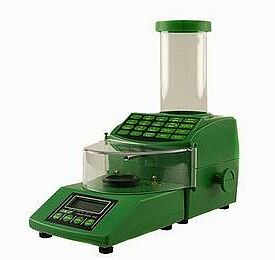
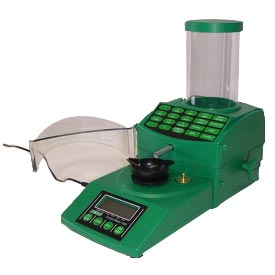
The RCBS ChargeMaster 1500 electronic powder scale and dispenser is the most popular product of its kind on the market. In our original Electronic Powder Dispenser Comparison Test, the ChargeMaster normally dispensed most kinds of powder faster than competitive units from Lyman and PACT. However, after the initial release of the ChargeMaster 1500, RCBS “tweaked” the software a bit to achieve more consistent charge-throws. This slowed down the process somewhat. Some owners have wanted to speed up their ChargeMaster. This IS possible with a relatively simple reprogramming. Most of the internal parameters of the Chargemaster can be modified, under guidance from the tech staff at RCBS.
Gunsmith and Forum member NAT Lambeth reports: “I thought My RCBS ChargeMaster 1500 Combo was fast enough. But I still called RCBS and asked for the programing changes to see if I could speed it up. It was a lot easier than I thought. My 1500 Combo was taking from 15-30 seconds to dispense the powder to the tenth of a grain. I reprogrammed the numbers and now it takes between 7 and 15 seconds to dispense to a tenth. This effectively doubled my loading speed. I only changed the HSB_A1, HSB_B1, and BSP_C1 settings.”
Key ChargeMaster Parameters with Default Settings
HSB_A1 (15.68) Grains under target weight to go from full to high speed
HSB_B1 (3.42) Grains under target weight to go from high to slow speed
BSP_C1 (1.08) Grains under target weight to go from slow to final trickle speed
Nat cautions that you should talk to a RCBS tech before attempting to re-program your ChargeMaster: “You will benefit from talking to the RCBS tech. I have now gone back and played with the numbers a couple of times. (The numbers given to me by the tech at RCBS were still a little conservative.) I think each machine may have its own likes and dislikes. If you get too aggresive with lowering your numbers it will over-throw your intended load.”
Source for ALL the Parameters
There is an extensive discussion of RCBS ChargeMaster programming on the South Africa Hunting Rifle Shooting Assn. (SAJSV) Forum. In this SAJSV Forum ARTICLE, Jaco Brink lists virtually all the programming codes. Importantly, Jaco also provides the default values for various parameters. This is very important, because the ChargeMaster does not have a “return to default” option. Once you change any value, if you want to return to the original value you must enter it manually.
Jaco cautions: “I have to advise you to only make changes to your scale if you are confident to do so, and remember that there is not a ‘return to default’ setting in the scale. If all else fails return your scale to the default settings [I have listed].”
Use a McDonald’s Straw to Reduce “Over-Throws”
Jaco Brink provided another useful tip to avoid “over-throws” (excess charge weight): “The RCBS employee advised me to take a McDonnell’s straw (because it is thicker than a normal straw), cut off about a half inch piece and put it into the tube where the powder exits. This caused the last part of an extruded powder to clutter less, and reduced the amount of overthrows dramatically.”
Choosing the right-diameter bullet can have a big effect on accuracy in match rifles. “Wait a minute”, you might say, “doesn’t one simply choose a 6mm bullet for a 6mm barrel and a 7mm bullet for a 7mm barrel, what’s the big deal?” Well… it’s not that simple. Not all bullets of the same nominal caliber actually have the same true diameter. We’ve seen different-brand 6mm bullets vary by as much as a full thousandth (.001″) in diameter. We have seen undeniable evidence that a poor “fit” of bullet diameter to bore dimensions can result in a poor-shooting gun, even one with a high-grade barrel.
Conversely, if you find the bullet diameter you barrel likes, that may instantly improve your accuracy. The accuracy gain may be more significant than making changes to the bullet seating depth or even powder charge. The importance of bullet diameter is compounded by the fact that 6mm match barrels are available with both .236″ and .237″ land diameters. Some barrels prefer “fat” bullets while other barrels prefer “skinny” bullets.
Last year, Jason Baney measured 12 different sets of 6mm Match Bullets, including a couple different lots of the same bullet design. Interestingly, Jason did measure the “old” Berger 105 VLD, the new-generation Berger 105 VLD (first lot from the new die), and the “new, improved” Berger 105 VLD from the new die, after it was polished. Ten (10) Bullets were measured per type. Each bullet was measured three times (3X) around the largest circumference, normally where a pressure ring would be located (some bullets have a pronounced pressure ring, others do not). NOTE: We provide the numbers from Jason’s tests, but remember that bullets from different production runs may have slightly different dimensions. You should augment our findings with your own measurements from later-produced bullets.
The first two columns of the chart show the smallest and largest bullet diameters measured for each 10-bullet sample. The third column shows the extreme spread over each 10-bullet set. Note, these numbers are NOT averages, but represent the “low” and “high” diameters for each set. (FYI: Jason noted that while the Lapua Scenars were very consistent, an earlier 2005 “JEVDAK” lot had smaller meplats than 2007 and 2008 lots.) A Mitutoyo Micrometer was used, zero-checked for each bullet.
Last month, Sally Bauer set a pending new International Benchrest Shooters (IBS) Score Heavy Gun (HG) record for 1000-yard competition. Her score was 100-5X with a 3.495″ tie-breaker group. Sally shot the group on August 19, 2012 at the Gopher Rifle and Revolver Club in Harris, MN. If this record is approved, Sally will be the first female shooter to hold an IBS 1000-yard benchrest record. Sally’s handsome 67-lb Heavy Gun, “Stars & Stripes”, is painted with an American flag theme.
Sally Sets a Record
At the end of the Heavy Gun match #10 Sally was directed by Range Officer Gordy Mitchell to leave all of her equipment and rifle setting on her bench. Sally was perplexed by Gordy Mitchell’s direction but he assured her “It is a good thing”. Rumors swirled and Dave Holland was summoned to the pits.
Dave and Gordy brought the target back to the scoring shed and had club officials and some respected competitors measure and sign the target. All agreed Sally had just shot an IBS record score. Sally’s rifle and equipment were measured and photographed and the target sent off to the IBS for final measurement and verification.
Gun Specifications
Sally’s 67-lb Heavy Gun was originally purchased from Bill Shehane, and it uses Bill’s Maxi-Tracker stock. The gun was originally chambered for the 6-6.5×47 Lapua Improved. But the gun didn’t shoot like the Bauers wanted, so it was rechambered to 6mm Dasher by Gordy Gritters. The action is a 2″-diameter, round, chrome moly, 3-lug, 7 ½” BAT. The barrel is a 28″, 1:8″-twist Krieger, with 1.45″-diameter straight tube. The barreled action is secured in the stock with a 9″-long barrel block. The gun uses a 12X42 Nightforce BR scope and a Jewel BR trigger. Gordy Gritters smithed the rifle. Jim Sauer states: “We have known Gordy for years now and trust every phase of our gun projects — all of them are mechanical works of art. When we get our guns from Gordy we know we can put our focus on brass prep and load development and don’t have to worry about the guns being right. That really helps save time.”
Reloading Procedure for Sally’s “Stars & Stripes” Maxiby Jim Sauer
With every new rifle we start with new brass. The first step is to run them through a full length sizing die, then over an appropriate expander mandrel. Since we use a .270 neck on our 6 Dasher chambers, neck turning amounts to a 80% cleanup of the new Lapua brass necks. We do the normal primer pocket and flash-hole uniforming.
We fire-form two times to make sure we get nice sharp shoulder corners before competition. We then separate them according to weight using 1/10th of a grain differences for each box. Much of our loading process is geared around time savings. We look for easy-to-use, consistently good products and don’t vary from them unless we have a problem or results aren’t to our standards. We have chosen to shoot Clay Spencer’s 103gr 6mm bullets. We weight-sort and bearing-surface sort them and that’s it. I gave up trimming and tipping simply because it didn’t improve how Clay built them. We also use only one primer, the CCI 450.
We use one of four different powders. Our “go-to” powder is RL15, next we try Varget, then IMR 8208, and if that doesn’t work we try H4895. We have found that these bullets usually shoot best at 2970 fps. This is not an absolute, just what normally works best. We always try higher and lower velocities looking for that special load. Once we find the powder and quantity that works the best we play with the seating depth. Usually this is a fine-tune method and most of the time 15 thousandths into the rifling works the best. But don’t be afraid to jump the bullets as much as 0.100″. When we use this procedure we usually find a combination that will shoot nice, round ¾” groups at 400 yards.
Our reloading regimen starts with ultra-sonic cleaning our brass, then tumbling until shiny. We anneal the brass every time. We proceed to full-length resizing, repriming, and lubing the inside of the necks with graphite. We then charge with our selected powder and seat the bullets. We measure for concentricity, [shooting] the best ones for the record and the others for sighters. The load that Sally shot the record with is 33.0 grains of IMR 8208 XBR, CCI 450 primers, Spencer 103gr bullets, Lapua brass, bullet seated 15 thousandths into rifling, Velocity 2980 fps.
About Sally Bauer – This is the third year of competitive shooting for Sally. She listened to proper and basic instruction and learned at her pace. She developed her own style and discipline. Not wanting to be dependent on others Sally learned to set up her rests and carries Stars & Stripes to the bench by herself.
Sally and I would like to thank the kind people we have met in this crazy frustrating game of shooting. For the most part fellow competitors have been helpful and giving of the time, experience and knowledge. Every range owner and operator we have come across has treated us like family and friend. I can think of no other sport where the participants give so freely. We would also like to thank Dave Holland, Gordy Mitchell and all the others at GRRC for the professional way they handled the target and situation. — Jim and Sally Bauer
As an interesting historical note, Gordy Mitchell observed that there was an all-star line-up at the match when Sally set her record: “After checking our bench roster I noticed we had three national champions (2009-Ed Nazy, 2010-Jim Bauer, 2011-Todd Soeby) and current top five Shooter of the Year points leaders (Al Forbes, Sally Bauer, Jim Bauer, Shannon Lowman, and Larry Bryant) all at one match.”
Hodgdon Powder Company, Inc. launched a Facebook Page earlier this month. The new page, launched September 10, gives Hodgdon customers an outlet to discuss reloading, hunting, target shooting and other powder-related topics. “We envision this page as a community for our friends, fans, and experts to get together and talk shop. If you have a question, a great hunting story to tell, or just want to brag about a nice tight group this is the place for you”, said Chris Hodgdon, the company’s Public Relations Manager. “While so much of handloading is in the data and details, we also know there’s a huge social component to it as well.”
We’re pleased to see that Hodgdon’s Facebook page is regularly updated. Much to our amazement, Chris Hodgdon himself is answering user reloading and product questions. How many companies let you communicate directly with a top company decision-maker?
New Content Daily
Unlike some companies that roll out a Facebook page with much hooplah but then let it languish, Hodgdon has been adding new, interesting content daily, including cartridge histories, product release info, hunting stories, and even match reports. Just today, Hodgdon posted an informational diagram for the .30-06 cartridge:
This article first appeared in 2011.
JayChris, AccurateShooter.com’s IT “guru”, has tested three different digital scales. The first is the relatively inexpensive ($150.00) GemPro 500, the second was the $333.00 Sartorius AY123, which is very similar to the Denver Instrument MXX123 and Acculab-123. Lastly, JayChris tested his $1225.00 Sartorius GD503 lab scale. The 3-way comparison test produced interesting findings. We learned that the AY123 had some serious shortcomings when used to weigh powder. The GemPro 500 performed well for the price, but was quite a bit slower than the big GD503. In speed of response, accuracy of measurement, resistance to drift, and overall reliability, the GD503 was the clear winner in our comparison. Sometimes you do get what you pay for. CLICK HERE for GD503 Review with Videos.
BATTLE of the BALANCES
Three-Way Comparison Test: GemPro 500, Sartorius AY123, Sartorius GD503 Testing Report by JayChris
Precision Weighing Balances, www.balances.com, an authorized Sartorius Distributor, shipped me an AY123 (same as Denver MXX123, Acculab 123, etc.) along with a high-end GD503 force restoration scale. I had purchased the GD503, while the AY123 was a loaner for this comparison test. I included in this test a GemPro 500 scale that I already had. My key objective in this comparison test was to test each scale for measurement drift over time. We wanted to see if the displayed weight of a given object (here a certified test weight), would change over time, or with repeated measurements.
The first test was a “quick” test, where I measured the same weight ten (10) times, in the same order, about every 30 seconds or so. I did this at about the same speed as weighing out powder, maybe a bit slower. This took about 5 or 6 minutes. The second test was more-or-less an overnight test, where I measured the same weight in lengthening intervals, starting every 10 minutes, then every 30, then every 60, and so on. You can see the time series on the included graphs.
TEST SETUP:
– I used the same 100 GRAM Sartorius certified check weight for every test (see photo). Note: 100 GRAMS = 1543.233 GRAINS
– I calibrated each scale within 30 seconds of each other before starting the test.
– I tare’d each scale within a few seconds of each other
– All three scales are connected to the same line conditioning PDU and are located in the same environment (right next to each other)
Measurement Resolution and Display Increments
– The Sartorius AY123 measures to the nearest hundredth of a grain (.00). Increments are in 0.02 grain divisions, i.e. the nearest two hundredth of a grain.
– The Sartorius GD503 measures to the nearest thousandth of a grain (.000). Increments are in 0.005 grain divisions, i.e. the nearest five thousandth of a grain.
– The GemPro 500 measures to the nearest half-tenth of a grain (.05).
NOTE: When weighing powder, I weigh to the nearest .05 grain so any of these provide adequate (or more-than) resolution.
FIRST SERIES Quick Test:
* X-axis is weighing series iteration
SECOND SERIES Time-based:
* X-axis is a time series in minutes-from-0.
THIRD SERIES AY123 “Stable” vs. “Unstable”:
* X-axis is a weighing series iteration
This is a test of the AY123 in “Stable” vs. “Unstable” environment mode. The GD503 was used for comparison. I ran this test to compare the AY123 in “Stable” conditions mode (default) vs. “Unstable” conditions mode, based on anecdotal reports that the “Unstable” mode produces more consistent results. I did not find that to be so. In addition, I found that the weighing time for the “Unstable” mode was extremely slow — taking nearly 5 – 7 seconds per instance to complete a measurement. It then takes a few seconds to return to zero. In the AY123’s default “Stable” mode, it takes a second or so. Based on my testing then, there is no advantage to running the AY123 (or similar clones) in the “unstable mood”. It will simply slow you down.
Observations and Conclusions
Overall, the GD503 was the most consistent, never varying more than .005 (five-thousandths) of a grain, which is about ten times less drift than the next closest scale. The GemPro was “close” behind, never varying more than .05 of a grain. The AY123 was consistently variable and lost significant resolution over time. It was difficult to plot the AY123 results because it rarely settled at a weight for longer than a few seconds — it would routinely come up with a different weight every few seconds, varying by as much as .04 of a grain. I selected the first reading it “settled” on as the “official” reading.
The one thing this test does NOT demonstrate is trickling — our previous Review of the GD503 has a video that shows that nicely. The GD503 gives you near instantaneous read-outs when trickling. By contrast, both the AY123 and GemPro 500 require a “trickle-and-wait-for-update” plan. The GD503 is really dramatically better in its ability to return a “final” weight very quickly. This allows efficient trickling. CLICK HERE for GD503 Review with Videos.
[UPDATE: One of our readers observed that there is a setting which can make the AY123 more responsive (and accurate) when trickling charges: “Note that the video shows the 123 jumping as powder is added. The reason is the scale is in the default setting, which is for single weightings. When changed to ‘Filling’ mode, the scale reacts very quickly, and in my case accurately. Trickling is easy in the ‘Filling’ mode. My experience is that the AY123 is an excellent scale, but is sensitive to environmental factors. The GD503 is way better and is also way more expensive.” — Matt P.]
GemPro 500 Performed Well — Drift Was Usually Minimal and Charges Settle Fairly Quickly
I’ve used the GemPro 500 for quite a while now and have found it to be fairly reliable. However, over one previous loading session I have seen it drift as much as .150 of a grain. I had to go back and re-weigh charges because of this. Therefore, I tend to tare it every five (5) weighings or so which is probably overkill based on one case. I’ve not had that problem since so I am guessing something happened environmentally (maybe I bumped it or something). Overall, the GemPro is not overly sensitive to environment and settles fairly quickly and reliably.
Charges Weighed by SD503 Have More Consistent Velocities, with lower SDs
I’ve loaded a few hundred rounds with the GD503 now. I have not found it to drift more than .010 of a grain in that time. So, now, I only tend to tare it once at the beginning of a load session. I have gotten extremely consistent velocities from charges loaded with this scale, with single-digit standard deviations. By contrast, previously, my best efforts usually resulted in standard deviations (SDs) in the low teens.
Based on my experience testing the AY123, I would not choose this scale to load powder with. The readings are just too variable. The slightest environment factors (breathing, hand movement, etc.) cause large changes in results. I tried to load some rounds using this scale (backed by my GD503 to verify) and I couldn’t do better than a few tenths of a grain, and that was with considerable effort. The Sartorius AY123 is really the wrong tool for the job when it comes to measuring powder.
Thanks to Precision Weighing Balances for providing the AY123 for comparison. The other two scales, the GemPro 500 and GD503, I purchased on my own nickel. [Editor’s Note: When purchased in 2011, Jay’s GD503 cost approximately $900.00. The current 2012 price at Balances.com is $1225.00.] All three of these digital scales can be purchased through the Precision Weighing Balances webstore:
by Robert Whitley After Accurate Shooter published the July 31, 2010 Daily Bulletin feature on 6mm BRX Myth-Busting With Bob Crone, further research reveals that there’s more to tell about the BRX, its origins, and its original specifications.
6 BRX Myth-Busters Follow-Up Challenge
I wanted to obtain a print reflecting the true original dimensions of Bob Crone’s 6mm BRX reamer. I hoped to verify the head spacing of the reamer to be .100″ longer than a 6mm BR, and I also wanted to see how Bob’s original print compares to 6mm BRX match reamers currently considered to be the “standard in the industry”.
Recreating the Original 6mm BRX Reamer Print
Clymer Precision was contacted to obtain a print of Bob’s original reamer. Todd Wilms, the current owner of Clymer Precision (and a heck of a nice guy as well) went back in the Clymer archives and pulled the records of the dimensions of Bob Crone’s 6mm BRX reamer. Todd then entered them into Clymer’s current reamer drawing program and has generated a current drawing reflecting the original 6mm BRX reamer. The print (see below) confirms the head space of the 6mm BRX to be .100″ longer than a 6mm BR (i.e. 1.267″ min at a shoulder datum diameter of .350″).
Comments on Bob’s 1996 Clymer Reamer
In many ways, the print dimensions are very close to what is currently recognized as the “standard in the industry” for 6mm BRX reamers, however in other ways there have been some definite changes:
A. Body Diameter: A chamber body diameter of .470″ is still in wide use today with 6mm BRX reamers (that’s measured .200″ forward of the bolt face). The current Lapua 6mm BR brass has a web diameter very close to this diameter and one should be wary of trying to tighten this dimension. If anything, running a little looser (like the .4708″ dimension similar to that used with the 6mm Dasher) would not hurt the performance of the 6mm BRX cartridge a bit.
B. Shoulder Diameter: Bob’s original reamer had a shoulder diameter of .4609″ (the same as a 6mm BR Norma), however many current 6mm BRX reamers now use a .460″ shoulder diameter which helps avoid overworking the brass there if readily available commercial dies are used.
C. Max Chamber Length: Bob’s original print had a “max chamber length” of 1.570″ (the same as a 6mm BR Norma), however many of the current 6mm BRX reamers have shortened this up a little. This is because, when 6mm BR brass is fire-formed into 6mm BRX brass, typically the brass shortens. Indeed, this author’s 6mm BR brass shrinks in OAL from around 1.555″ to around 1.547″ when it is fire-formed to 6mm BRX brass. A max chamber length in the range of 1.560″ – 1.565″ is seen often with 6mm BRX reamers these days.
D. Neck Diameter: While Bob’s reamer has a .262″ neck, this has for the most part given way to either a .269″ (sometimes .268″) turned neck, or a .272″ (sometimes .271″) no-turn neck, with the neck diameter typically selected based on the actual dimensions of the brass to be used.
E. Throat Angle: Bob’s throat angle was one and a half degrees, which seems to be standard and in wide use today with the 6mm BRX.
F. Freebore: Bob’s freebore length was 0.00″ because his smith used a separate throater to set the throat length Bob wanted for specific bullets. These days, a built-in freebore in the range of .104″ – .125″ seems to be very common with 6mm BRX reamers. Freebore in that range is seen by many as a good choice for the readily available 105- to 108-grain 6mm bullets.
6mm BRX — Real World Specs
Here are measurements on Robert Whitley’s 6mm BRX brass, as fire-formed, full-length sized and ready to load in a no-turn chamber.
Base to shoulder = 1.170″
Base to neck/shoulder junction = 1.333″
Overall case length (fired 2x and re-sized 2x) = 1.547″
Shoulder diameter (resized) = .459″
Diameter .200″ forward of base (resized) = .470″
Neck diameter loaded = .269″
The updated and enhanced 13th Edition of Cartridges of the World, will be released September 7th. This important reference can now be pre-ordered through Amazon.com for $19.75. Cartridges of the World, the most widely-read cartridge reference book, is now even more comprehensive, with 55 new cartridges added since the last edition. The 13th Edition now contains descriptions of over 1500 cartridges including popular wildcats and the new offerings for AR-platform rifles.
The 13th Edition of Cartridges of the World (ISBN: 9781440230592) includes updated cartridge specs, plus essays by leading writers on the topics of SAAMI guidelines, wildcatting, and new cartridge design trends. Cartridges of the World is the most authoritative cartridge reference guide in print. If you are a cartridge collector or are interested in the history of cartridge development, this book is a “must-have” resource.
Bonus CD for Old and Obsolete Cartridges
For the first time, Cartridges of the World now comes with a bonus CD. The publishers explain: “While this newest and most comprehensive 13th Edition, just like its predecessors, contains information on many rounds that are no longer in production, we made room for new rounds by compiling data on the esoteric, odd, and truly obsolete and moving them to this bonus CD. Best of all, the CD is FREE with your purchase of this completely updated volume.”
Cartridges of the World by author Frank C. Barnes was first published in 1965. The 13th Edition is edited by Richard Mann, a contributing editor for Shooting Illustrated and American Rifleman magazines. Frank Barnes (1918-1992) began collecting information on handgun cartridges at the early age of 12, thanks to his father, a police officer. Frank Barnes was an innovative cartridge designer, who invented the original 308 x 1.5″ Barnes, predecessor of the 30BR case. Before Frank began a law enforcement career, he was a college professor. Frank was also a pilot, and a race-car driver. Learn more about Cartridges of the World (13th Ed.) at www.gundigest.com.
Brownells now offers a full line of name-brand reloading equipment and supplies — all backed by Brownells unconditional lifetime guarantee. The new Brownells reloading product line features Dies, Presses, and Tools from RCBS, Lee Precision, Lyman, Redding, Sinclair International, and many more. Along with reloading tools and equipment, Brownells will offer reloading components (Brass, Bullets, Primers, Powder, etc.) from major manufacturers including Hornady, Nosler, Sierra, Hodgdon, Remington, Winchester, and others.
To kick off the launch of its new Reloading product line, Brownells is running a limited-time promotion. For orders containing reloading products, customers can receive a $10 discount on orders totaling more than $99, a $20 discount on orders totaling more than $199, or a $30 discount on orders totaling more than $299. Don’t delay. These special discounts are valid Thursday, August 16, 2012 through Monday, August 20, 2012. Use product codes DRR ($99+), DRS ($199+), or DRT ($299+) during check-out.
“We are excited to launch our new reloading category,” said Pete Brownell, President/CEO of Brownells. “Much like the addition of our ammunition line last year, the ‘You asked, we listened’ philosophy played a major part in our decision. We found that many of our customers enjoy reloading and find it to be a cost saver, so we’re happy to provide them with the supplies they want.”
This report was first published in 2011. Due to numerous requests, we are republishing the story. The time is right because the Giraud Annealer is currently on display on vendors’ row at Camp Perry. Doug Giraud will be at Perry through the morning of August 4th.
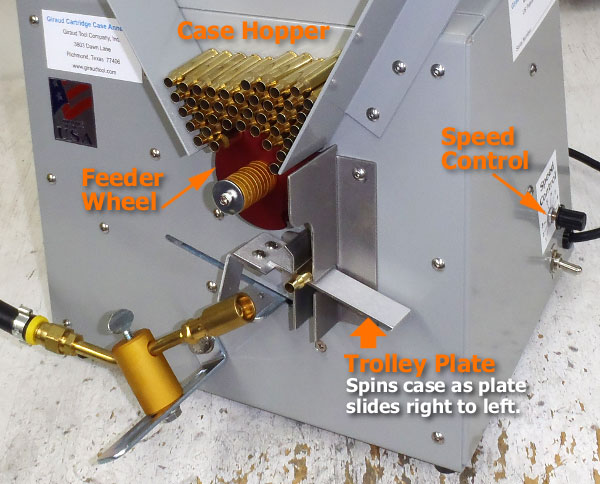
Doug Giraud of Giraud Tool Company has created a new bulk Cartridge Annealing Machine that uses an innovative vertical hopper feed. Giraud’s patent-pending design allows the machine to process as many as 700 .223 Rem cases with no hand-feeding required. The new Giraud Cartridge Case Annealer, using a single propane torch, will anneal most cases in 6-8 seconds (that dwell time will melt 750° Tempilaq inside the neck). Annealing dwell times can be adjusted using a simple rotary knob on the right side of the machine. During annealing, each case is rotated in the flame through the motion of a Trolley Plate which moves right to left under the case. At the left-most limit of Trolley Plate movement, each case drops vertically down for air cooling. CLICK HERE for Giraud Annealer Users’ Manual (PDF)
The Giraud annealer uses a large, V-shaped hopper to hold up to 700 .223 Rem cases or 450 .308 Win cases for annealing. You can switch from small cases to larger cases by swapping out the rotary Feeder Wheel below the hopper. Changing Feeder Wheels takes a couple minutes. Five available Feeder Wheels (with different size cartridge slots) let you anneal pretty much any size cartridge — from .17 Remington all the way up to .50 BMG. The common .223 Rem and .308-sized cases used by High Power shooters are served by the Red Feeder Wheel and Blue Feeder Wheel respectively. The Blue Wheel will also work with 6mmBR, .243 Win, and .30-06 cases. The three other Feeder Wheels are: Black (.300 Win Mag); Purple (WSM, RUM, RSAUM, Lapua and Norma Mags); and Green (.50 BMG). For the large mags you also need to switch to a wider Trolley Plate.
Watch Video to See Giraud Annealer in Action
Giraud Annealer Can Process Hundreds of Cases in One Session
The biggest advantage of this machine is its ability to run with minimal user “intervention”. Once you’ve determined the right dwell time for your cartridge type, you can stack hundreds of cases in the V-shaped hopper, turn on the torch and let the machine do its thing. With a typical 8-second dwell time, the Giraud annealing will process about 450 cases an hour. While other multi-torch annealing machines may be faster, Giraud prefers the single-torch design: “With a single torch, you can control total heat input over a longer time. You don’t over-cook the case in a half-second — you have a lot more leeway with a 6-9 second dwell time.”
Yes the case spins in the flame — the Trolley Plate running under the case rotates it. The user may wish to experiment with the speed control knob on the right side panel near the power switch. Typical annealing operations will require the cartridge cases to be positioned in the torch flame for between 6 and 9 seconds.
Much smart thinking went into the Giraud Annealer design. Doug Giraud tells us: “We went through a couple different ideas. Our key goal was to vertically stack a large quantity of cases that would self-feed. The automatic feeding capability of the machine means that the operator can perform another task while the machine is running. The user doesn’t have to load cases one by one. I would caution, however, that you don’t want to turn on the annealer and just walk out of the room… but you can be doing some other reloading task while the annealer is running nearby.”
Giraud wanted a machine that could process lots of cases cheaply and efficiently. The machine’s single torch is optimized to run on inexpensive propane gas. Doug says: “You can process 15,000 cases on a single $2.00 disposable propane bottle.” If the user wants faster processing, the torch is rated for MAP gas, but Doug cautions that, “with more heat, you’ll have to adjust the dwell time accordingly.”
Giraud Annealer Impresses High Power Shooters
The new Giraud Cartridge Case Annealer has already attracted considerable interest. Doug took some early production models to Camp Perry in 2011, and he immediately got orders for 50 machines. Doug told us: “The response from the High Power guys was amazing. There was a pent-up demand for a simple, robust annealer that can process hundreds of cases without having to feed them one by one, and that’s what we created. We’re selling these units as fast as we can build them.”
Giraud Annealers Cost $435.00 — Delivery in Six Weeks from Order Date
Doug has components for 100 more machines, and he’s producing them at a rate of 15 units per week. He’s been back-ordered, but if you order soon, Doug believes he can ship the Annealing machines in about six weeks from date of order. The basic price, with one Feeder Wheel and one Trolley Plate, is $435.00. Additional Feeder Wheels cost $20.00 while extra Trolley Plates are $10.00. For more information, visit GiraudTool.com. To place orders, call (281) 238-0844 Monday through Friday between 9am and 5pm CST. You can also email doug [at] giraudtool.com.
Giraud Tool Company, Inc.
3803 Dawn Lane
Richmond, Texas 77406
281-238-0844 (orders)
281-232-0987 (fax)
Website: www.GiraudTool.com


 A while back, we featured a portable reloading bench built on a Black & Decker Workmate. That proved a VERY popular do-it-yourself project so we’re showing it again, in case you missed it the first time.
 The RCBS ChargeMaster 1500 electronic powder scale and dispenser is the most popular product of its kind on the market. In our original
  Source for ALL the Parameters

 Sally Sets a Record


 After Accurate Shooter published the July 31, 2010 Daily Bulletin feature on