Do you know what the inside of a rifle chamber (and throat zone) really looks like? Do you understand the concept of headspace and why it’s important? If not, you should read the Brownells GunTech article Gauging Success — Minimum Headspace and Maximum COL. This article explains the basics of headspace and shows how to measure headspace (and length to lands) in your barrels with precision. The article also explains how to adjust your full-length sizing dies to “bump the shoulder” as needed.
Why is headspace important? The article explains: “Controlling headspace and setting proper C.O.L. also represent improved safety and reduced cost of handloading. Excessive headspace can cause case head separation and gases in excess of 60,000 PSI escaping from a rifle’s chamber. Too little headspace can result in a chamber forced bullet crimp and a bullet that becomes an obstruction more than a properly secured projectile. Excessive C.O.L. can result in a rifling-bound bullet, a condition that could result in spikes of excessive pressure.”
[Editor’s NOTE: It is common for competitive benchrest shooters to seat bullets into the rifling. This can be done safely if you reduce your loads accordingly. With some bullets we often see best accuracy .010″ (or more) into the lands. However, this can generate more pressure than the same bullet seated .010″ away from initial lands contact. As with all reloading, start low and work up gradually.]
Headspace is a measurement from the bolt-face to a point in the chamber. This point of measurement will vary based on the type of cartridge. Improper headspace, either excessive or (conversely) under SAAMI specifications, can cause a variety of problems, many serious.
How is headspace specified? Most cartridges used within the United States are defined within ANSI/SAAMI Z299.3-4. Brownells explains: “In the case of the .243 Winchester, as an example, there are pressure specifications, cartridge drawings and, as pictured above, chamber drawings. Armed with a chamber drawing, each manufacturer producing a firearm for the .243 Winchester knows the proper standard dimension to cut chambers and set headspace. Notice there are two headspace reference dimensions for the chamber. The upper is a place in the chamber where the shoulder is .400″ in diameter; the “datum” or “basic” line. The lower is the 1.630″~1.640″ minimum – maximum dimension from the breech face (bolt face) to that point in the chamber that measures .400″.”
The actual headspace of any firearm is the distance from the breech face to the point in the chamber that is intended to prevent forward motion of a cartridge.
Finding Cartridge Length to Lands with OAL Gauge
Using a comparator on a set of calipers, you can quickly determine cartridge base-to-ogive length. This is the measurement from the base of the case to the forward-most full diameter section of the bullet, which is for convenience called the ogive. (Technically, the “ogive” is the full curve from bullet tip back to full-diameter ring). Shown here, that ogive is 0.243″ diameter.
The next step is using a modified (threaded) case with a Hornady OAL tool to determine Length-to-Lands (LTL) in your rifle’s chamber. During this measurement process, the modified case, with a bullet in its neck, is inserted in the chamber. Go slow, take your time. Here are 5 tips that will help you get repeatable and reliable LTL measurements:
1. Start with a clean chamber and clean barrel throat.
2. Make sure the modified case is fully screwed down and seated on the OAL Gauge. It can sometimes unscrew a bit during repeated measurements.
3. Insert the modified case slowly and gently, but ensure the shoulder of the modified case is fully seated on the end of the chamber.
4. Push the gray plastic rod GENTLY. It is common for the bullet to be tilted a bit. You want to allow the bullet to self-center in the throat BEFORE you apply much pressure. Then tap a couple times and push until you feel resistance. Do NOT push too hard — that will jam the bullet in the lands.
5. Repeat the measurement at least 3 more times. If you follow our instructions, you should, typically, get a repeatable measurement, within 0.0015″ or so, 3 out of 4 times.
SUMMARY: Powder can have a very long shelf life. You need to watch for changes in smell and color. A reddish tinge, almost like rust on the powder, is a bad sign, as is a foul odor, not to be confused with a normal chemical smell. Either of these signs indicate it is time to dispose of your powder by means other than shooting.
Ever wondered about the stability of the propellants in your reloading room? There are some important things you should know about powder storage, to ensure consistent powder performance and safety. Western Powders (which has been acquired by Hodgdon) published an informative Q & A series entitled Dear Labby: Questions for our Ballistics Lab. Here are some excerpts that pertain to powder storage and shelf life. Worried that your powder may be too old? Western’s experts explain how to check your propellants for warning signs.
Proper Powder Storage
Q: I live in southern Arizona where it is very hot. I am told powders will become unstable if stored in an area not air-conditioned. My wife says no powder or primers in the house. Can powder be stored in a refrigerator? What about using a fireproof safe? I would appreciate your ideas. — M.C.
Lab Answer: SAAMI guidelines are pretty clear on issues of storage. They recommend storing smokeless powder in containers that will not allow pressure to build if the powder is ignited — ruling out gun safes and refrigerators.
In their original containers, the lifespan of smokeless powders is quite long, even in hot, arid climates. In fact the lifespan is typically longer than the average handloader would need to store them. Stored safely in a garage or outbuilding, your powder should last years. If you see the powder developing a reddish tint, or giving off a foul odor, it is time to discard it.
Clumps in Powder Container
Q: I ordered some of your Accurate 1680 powder back about in December. I just now opened it … and it is full of clumps. My knowledge tells me that means moisture. Am I wrong? I just now broke the seal and it has been stored in a ammo can with desiccant packs around it and a dehumidifier running 14-16 hours a day. I can’t imagine this being my fault, if this does indicate moisture. I don’t know if the pink part on the label is suppose to be red or not, but it is definitely pink, so if it was red I am wondering if I was shipped an old container? I hope that this isn’t bad and I am stuck with it…
Lab Answer: All powder contains a certain amount of moisture. When the powder is stored or during shipping, it can go through temperature cycles. During the cycling, the moisture can be pulled to the surface and cause clumping. Clumping can also be caused by static electricity if too dry or the powder has limited graphite content. You can break up the clumps before metering and they shouldn’t be a problem. This will not affect the powder performance, so your product is fine. Accurate 1680 labels are designed in Pink. As a side note, specification for testing powder is at 70° F and 60% humidity.
Shelf Life and Packaging Dates
Q: Does powder ever get to old to use and what identifying marks does your company put on the canister for when it is made, You have helped me out a while ago when I asked about keeping my cowboy shooting under 950 fps and it works great less stress on the hand and the recoil is very minimum. — R.B.
Lab Answer: On one pound bottles, the number is on the corner in a silver box. If the powder was poured today, it would read 012815 followed by a lot number. The whole number would look something like 012815749. Eight pound bottles have a sticker on the bottom with an obvious date code. The lot number appears above the date.
One of our Forum members complained that he wasn’t able to set his primers flush to the rim. He tried a variety of primer tools, yet no matter what he used, the primers still didn’t seat deep enough. He measured his primers, and they were the right thickness, but it seemed like his primer pockets just weren’t deep enough. He was mystified as to the cause of the problem.
Well, our friend Boyd Allen diagnosed the problem. It was the decapping rod. If the rod is adjusted too low (screwed in too far), the base of the full-diameter rod shaft (just above the pin) will contact the inside of the case. That shaft is steel whereas your case is brass, a softer, weaker metal. So, when you run the case up into the die, the shaft can actually stretch the base of the primer pocket outward. Most presses have enough leverage to do this. If you bell the base of the primer pocket outwards, you’ve essentially ruined your case, and there is no way a primer can seat correctly.
The fix is simple. Just make sure to adjust the decapping rod so that the base of the rod shaft does NOT bottom out on the inside of the case. The pin only needs to extend through the flash hole far enough to knock the primer out. The photo shows a Lyman Universal decapping die. But the same thing can happen with any die that has a decapping rod, such as bushing neck-sizing dies, and full-length sizing dies.
Whenever you use a die with a decapping pin for the first time, OR when you move the die to a different press, make sure to check the decapping rod length. And it’s a good idea, with full-length sizing dies, to always re-check the height setting when changing presses.
There are a variety of decapping dies currently on the market, with models available from LEE, Lyman, Hornady, RCBS, Redding, and Sinclair Int’l.
LEE Universal Decapping Die Costs Just $11.49
Speaking of decapping tools, Midsouth Shooters Supply sells the LEE Universal Decapping Die for just $11.99 (item 006-90292), a very good deal. There are many situations when you may want to remove primers from fired brass as a separate operation (prior to case sizing). For example, if your rifle brass is dirty, you may want to de-cap before sizing. Or, if you load on a progressive press, things will run much more smoothly if you decap you brass first, in a separate operation.
Decapping Dies for Cases with Smaller Flashholes
TAKE NOTE: Some Euro Small Flash Holes are spec’d at 1.5mm or 0.059″, and max out at about .062″, so these need a smaller die pin.
The low-cost LEE Universal Decapping Die will work with cartridges from 17 Fireball all the way up to big Magnums. However, NOTE that the decapping pin supplied with this Lee die is TOO LARGE for LAPUA 220 Russian, 6mmBR, 6.5×47, 6.5 Creedmoor, .308 Win (Palma) and Norma 6 PPC flash holes. Because the pin diameter is too large for these brass types, you must either turn down the pin, or decap with a different tool for cases with .059-.062″ flash-holes.
Sinclair Int’l offers a Stainless Decapping Die that comes with BOTH .080 and .060 Pins. The $46.99 die ships with three decapping pins for standard .080″ flash holes, and two pins for .060″ flash holes.
Redding makes a Universal Decapping Die with an optional smaller-diameter decapping rod for the smaller .059-.062″ flash holes found on the BR and PPC cases. The use of this die is explained in the video below:
This shocking Revolver Kaboom resulted from “user error”. Our friends at Midsouth Shooters provided this cautionary tale, noting that you must ALWAYS be careful when hand-loading any ammo. Check your loads and don’t have multiple powder containers in your reloading area.
“Ever wonder what happens when you don’t pay attention to detail? A word of advice from the reloader who brought this in — always double-check the load data.
Thankfully, the shooter was unharmed in the explosion. A live round we recovered from the remaining portions of the cylinder contained 12.8 grains of powder. The shooter had multiple powders on his bench and was unable to recall which one had been used while loading.” — Midsouth Shooters
How to Avoid Kabooms
1. Never have more than one powder container open on your reloading bench at the same time — when you are finished with a powder, seal the bottle and put it away.
2. If there is already powder sitting in your dispenser, and you’re not 100% sure what it is — throw it out. We suggest, whenever you fill a powder hopper, put a piece of paper in the powder hopper with the name of the powder and the date.
3. When loading a new cartridge or when using a new powder, get load data from more than one source. Always load conservatively to start!
4. Always double-check your Load Data before starting the loading process.
5. In short handgun cases, bullet seating depth can make a BIG difference in pressure levels. Be sure to check your Cartridge OAL.
For today’s Saturday at the Movies special, we provide a selection of videos showcasing rifle and pistol cartridge types — from tiny .17 caliber cases to huge 20mm cases. Two of the videos use advance computer animation to provide 3D views of dozens of cartridge types. Then there are some expert commentaries by Jerry Miculek and Ron Spomer discussing the characteristics and performance of various cartridge types. Finally, we provide two videos that discuss rimfire cartridges and show how .22 LR rounds are produced in a modern CCI factory.
90 Different Rifle Cartridge Types in Computer Animation
In this rifle ammunition comparison animation there are 90 different cartridge types, from very small (.22 Flobert) to very, very big (20mm Vulcan). This video employs sophisticated, 3D CAD animation to showcase 90 different rifle cartridges, one after the other, in sequence. It covers from .17 Caliber up to 20mm. Obviously a lot of time and effort went into this video, but it really is cool to see so many different cartridge types in one 3.5-minute video.
After the full line-up is complete at 1:41, the video then provides other smaller comparison, such as multiple large hunting cartridges (2:15) and .22 Caliber cartridges (2:45, see above). All the cartridge models are made using Autodesk Inventor software, and then the “line-up” animation was completed with Autodesk Showcase.
Cartridge Types Included (in Caliber Order, then Metric Order):
1) .17 HM2
2) .17 HMR
3) .204 Ruger
4) .218 Bee
5) .22 Flobert
6) .22 Hornet
7) .22 LR
8) .22 Magnum
9) .22 PPC
10) .22 Short
11) .220 Jaybird
12) .223 Rem/5.56x45mm
13) .223 WSSM
14) .224 Weatherby Magnum
15) .225 Winchester
16) .240 Weatherby Magnum
17) .243 Winchester
18) .25 Remington Auto
19) .250 Savage
20) .25-06 Remington
21) .256 Winchester Magnum
22) .257 Roberts
23) .260 Remington
24) .264 Winchester Magnum
25) .270 Weatherby Magnum
26) .270 Winchester
27) .280 British
28) .280 Remington
29) .284 Winchester
30) .30 Carbine
31) .300 H&H Magnum
32) .300 Rem Ultra Magnum
33) .300 Savage
34) .300 Winchester Magnum
35) .300 Win Short Mag (WSM)
36) .30-06 Springfield
37) .303 British
38) .30-30
39) .308 Norma Magnum
40) .308 Winchester
41) .32 Winchester Special
42) .325 WSM
43) .338 Lapua Magnum
44) .35 Whelen
45) .350 Remington Magnum
46) .375 H&H Magnum
47) .376 Steyr
48) .408 Cheyenne
49) .416 Remington Magnum
50) .416 Weatherby Magnum
51) .444 Marlin
52) .450 Marlin
53) .450 Nitro Express
54) .458 Win Magnum
55) .45×70
56) .460 Weatherby Magnum
57) .465 H&H Magnum
58) .470 Nitro Express
59) .50 BMG / 12.7×99 NATO
60) .500 jeffery
61) .505 Gibbs
62) .577 Nitro Express
63) .577 Tyrannosaur
64) .600 Nitro Express
65) .700 Nitro Express
66) .950 JDJ
67) 4.6×30 mm
68) 4.6x30mm
69) 5.6×50 Magnum
70) 5.7x28mm
71) 5mm/SMc
72) 6mm LEE
73) 6.5×55 Swedish
74) 6.5×6 mm Schuler
75) 6.8mm Remington SPC
76) 6mm PPC
77) 6×45 mm
78) 7mm Weatherby Magnum
79) 7mm Remington Magnum
80) 7mm Rem Ultra Magnum
81) 7.62×39 mm FMJ
82) 7.7×58 Arisaka
83) 7.95×57 Mauser
84) 8mm Remington Magnum
85) 9.3×62 mm
86) 9.3×64 Brenneke
87) 14.5×114 mm
88) 20mm Vulcan
89) 25mmx137mm
90) 30mmx173 mm
Ammunition Size Line-Up — from Tiny to Massive
This animation video shows the size comparison of ammunition from a 2.34mm rimfire caliber to the massive 800mm caliber shell of the Schwerer Gustav railway cannon used by German forces in World War II. This video includes many common rifle and pistol cartridges/calibers, but also includes large artillery ammunition. This video has very good CGI Graphics. Below is part of the line-up from the .17 Remington Fireball (far left) to the famed .50 BMG (far right):
Ammunition Types Showcased in this video:
2.34mm rimfire
2.7mm Kolibri
3mm Kolibri
4.25 mm Liliput
.17 Hornady Mach 2
.17 Remington Fireball
.17 Hornady Magnum Rimfire
.22 Long Rifle
.22 Winchester Magnum Rimfire
HK 4.6×30mm
4.6×36 Loffelspitz
5.45mmx18 MPTs
5.7×28mm SS190
.280 British 7×43
.297/230 Morris Short
.297/230 Morris Long
.30 Pedersen 7.65×20mm
7.92×33mm Kurz
.300 Winchester Short Magnum
8×50mmR Mannlicher
.499 LWR
.577/450 Martini–Henry
.600 Nitro Express
.470 Nitro Express
.50 Beowulf
.50 BMG
20×102 M55A3
25×137 M793
Popular Cartridges/Calibers for Self-Defense and Hunting
This video focuses on popular calibers/cartridges used for self-defense and hunting. It provides a quick but informative overview of the capabilities (and intended uses) of many types of pistol, rifle, and shotgun ammunition. The video discusses the pros/cons of various cartridge types and explains how you would select ammo for a particular purposes (e.g. skeet loads vs. defense shotshells). If you are considering buying a carry pistol and are undecided about caliber choice, this is a good video to watch.
Flattest-Shooting Cartridges by Caliber (Ron Spomer)
In this 15-minute video, hunting expert Ron Spomer examines a variety of standard and wildcat cartridges from .17 caliber all the way to .338 caliber. For each caliber, Ron picks a flat-shooting “winner” and provides some ballistics comparison tables. This video is quite popular, with over 550,000 views on YouTube.
Ammo Types and Calibers — Jerry Miculek Explains the Basics
In this video, legendary shooter Jerry Miculek talks about popular types of pistol and rifle ammunition and the various bullet options used for plinking, competition, and self-defense. Jerry, one of the greatest pistol shooters on the planet, provides useful insights on cartridge selection and bullet choices. Jerry notes: “There are a TON of different types of ammunition” so he explains the basics. And Jerry answers common questions such as: “What is the difference between ball and hollow-point bullets?” and “What type of gun takes rimmed cartridge versus rimless?”.
.22 Caliber Rimfire Cartridges — Some Key Facts Revealed
We recommend all .22 rimfire shooters watch this video from Old English Outfitters. It explains some important facts and clarifies some common misconceptions about to .22 caliber ammunition. To learn more about modern .22 LR rimfire ammo, we also recommend the video below, which shows how CCI .22 LR ammunition is manufactured, start to finish.
BONUS Video — How .22 LR Ammunition Is Made
YouTube host 22Plinkster toured the CCI/Speer production facility in Lewiston, Idaho. While touring the plant, 22Plinkster was allowed to capture video showing the creation of .22 LR rounds from start to finish. This is a fascinating video, well worth watching.
This revealing video shows all phases of .22 LR ammo production including cupping, drawing, annealing, washing, drying, head-stamping, priming, powder charging, bullet seating, crimping, waxing, inspection, and final packaging. If you’ve got ten minutes to spare, we really recommend you watch the video from start to finish. You’ll definitely learn some new things about rimfire ammo.
Wouldn’t it be nice to have a print resource that has hundreds of true-size cartridge illustrations, plus technical descriptions of thousands of popular cartridge types? That could be a real time-saver. It’s no wonder this Ammo Encyclopedia book is an Amazon category best-seller.
If you’re a serious shooter, the latest 7th Edition of the Ammo Encyclopedia belongs in your library. This 928-page book by Charles Priore Jr. and Lisa Buening is probably the most comprehensive and up-to-date book in print covering current and classic cartridges and shotshells. The Ammo Encyclopedia is a massive resource work. The 7th Edition, released in October 2022, now boasts 100+ chapters, covering thousands of handgun, rifle, and shotgun cartridges. This 928-page softcover book sells for $39.99 on Amazon (#ad). That’s a good deal — 20% off list price.
One of the best features is a full-color section depicting actual size drawings of over 300 current rimfire/centerfire cartridges and shotshells. You won’t find that many “life-size” cartridge drawings in one place even on the internet. Cartridge profiles and ballistic charts have been expanded to include many new factory cartridges. An expanded Trademark Index lists contact information for all current ammunition manufacturers.
For the 7th Edition, over 150 cartridge types have been added. And dozens of previously proprietary cartridges now have individual profiles. An expanded color section shows current centerfire, rimfire, and shotshell cartridges in full color. Plus updated Ballistic Tables provide muzzle velocity, dimensions, and page numbers for the corresponding cartridge profile pages.
Comments from guys who bought the book:
“[The Ammo Encyclopedia is] better than Cartridges of the World. Much better editing and more accurate.” — John Guibert
“The amount and depth of detail provided is beyond impressive. An enormous amount of time and thought went into this latest version of the Ammo Encyclopedia.” — BW Kreisler
“I have many books on firearms and ammunition acculmulated over a few decades. This is by far the best and most comprehensive book on ammunition that I have ever seen. It is a must have reference source for everthing ammunition whether for current or obsolete and the history behind them.” – Eric
Photo 1: Three Near-Equal-Weight 7mm Bullets with Different Shapes
TECH TIP: Bullets of the same weight (and caliber) can generate very different pressure levels due to variances in Bearing Surface Length (BSL).
This article, from the USAMU Facebook Page, concerns reloading safety. In the relentless quest for more speed and flatter ballistics, some hand-loaders load way too hot, running charges that exceed safe pressure levels. Hint: If you need a mallet to open your bolt, chances are your load is too hot. Stay within safe margins — your equipment will last longer, and you won’t risk an injury caused by over-pressure. In this article, the USAMU explains that you need to account for bullet shape, diameter, and bearing surface when working up a load. Don’t assume that a load which is safe for one bullet will be safe for another even if both bullets are exactly the same weight.
How Bullet Profile and Bearing Surface Affect Pressure Levels
Today, we continue our handloading safety theme, focusing on not inadvertently exceeding the boundaries of known, safe data. Bullet manufacturers’ loading manuals often display three, four, or more similar-weight bullets grouped together with one set of load recipes. The manufacturer has tested these bullets and developed safe data for that group. However, seeing data in this format can tempt loaders — especially new ones — to think that ALL bullets of a given weight and caliber can interchangeably use the same load data. Actually, not so much.
The researchers ensure their data is safe with the bullet yielding the highest pressure. Thus, all others in that group should produce equal or less pressure, and they are safe using this data.
However, bullet designs include many variables such as different bearing surface lengths, hardness, and even slight variations in diameter. In fact, diameters can occasionally range up to 0.001″ by design. Thus, choosing untested bullets of the same weight and caliber, and using them with data not developed for them can yield excess pressures.
This is only one of the countless reasons not to begin at or very near the highest pressure loads during load development. Always begin at the starting load and look for pressure signs as one increases powder charges.
Bullet Bearing Surface and Pressure
Bullet bearing surface length (BSL) is often overlooked when considering maximum safe powder charges and pressures. In Photo 1, note the differences in the bullets’ appearance. All three are 7 mm, and their maximum weight difference is just five grains. Yet, the traditional round nose, flat base design on the left appears to have much more BSL than the sleeker match bullets. All things being equal, based on appearance, the RN/FB bullet seems likely to reach maximum pressure with significantly less powder than the other two designs.
TECH TIP: Bullets of the same weight (and caliber) can generate very different pressure levels due to variances in Bearing Surface Length (BSL).
Bullet 1 (L-R), the RN/FB, has a very slight taper and only reaches its full diameter (0.284 inch) very near the cannelure. This taper is often seen on similar bullets; it helps reduce pressures with good accuracy. The calculated BSL of Bullet 1 was ~0.324″. The BSL of Bullet 2, in the center, was ~0.430″, and Bullet 3’s was ~ 0.463″. Obviously, bullets can be visually deceiving as to BSL!
Some might be tempted to use a bullet ogive comparator (or two) to measure bullets’ true BSL for comparison’s sake. Unfortunately, comparators don’t typically measure maximum bullet diameter and this approach can be deluding.
Note: Due to time constraints, the writer used an approximate, direct measurement approach to assess the bullets’ different BSLs. While fairly repeatable, the results were far from ballistics engineer-grade. Still, they are adequate for this example.
Photo 2: The Perils of Measuring Bearing Surface Length with Comparators
In Photo 2, two 7mm comparators have been installed on a dial caliper in an attempt to measure BSL. Using this approach, the BSLs differed sharply from the original [measurements]. The comparator-measured Bullet 1 BSL was 0.694” vs. 0.324” (original), Bullet 2 was 0.601” (comparator) vs. 0.430” (original), and Bullet 3 (shown in Photo 2) was 0.602” (comparator) vs. 0.463” (original). [Editor’s comment — Note the very large difference for Bullet 1, masking the fact that the true full diameter on this bullet starts very far back. You can use comparators on calipers, but be aware that this method may give you deceptive reading — we’ve seen variances just by reversing the comparators on the calipers, because the comparators, typically, are not perfectly round, nor are they machined to precision tolerances.]
Thanks to the U.S. Army Marksmanship Unit for allowing the reprint of this article.
Shiny brass — it may not shoot more accurately, but it does make you feel better about your hand-loaded ammo. While it’s not necessary to get brass “bright and shiny” after every firing, it is a good idea to clean powder residue, grime, and grit off your brass before you run cases into sizing dies. There are many ways to clean cartridge cases. A quick wipe with solvent on a patch may suffice for recently-shot cases. Older brass with baked-on carbon may require lengthy tumbling. Ultrasonic cleaning is another popular option that gets your brass clean inside and out.
Sinclair International has a series of helpful videos on brass cleaning. These short “how-to” videos, hosted by Bill Gravatt, Sinclair’s past President and current Creedmoor Sports President, cover the various processes you can use — tumbling, ultrasonic cleaning, chemical cleaning, and cleaning by hand.
Video ONE — Cleaning Brass in Vibratory or Rotary Tumbler
TIP: Brass that has recently been shot will clean more easily than brass that has been sitting many days or weeks. If your tumbling media is fresh the job should be done in an hour or less. It’s your choice whether to tumble with primers removed or with primers still in the cases. If you choose to tumble with primers out, we suggest you deprime with a depriming die, rather that put dirty brass into your sizing die. Some people like to add a teaspoon of liquid polish to the media. This does work, cutting tumble time, and making your brass more shiny. However, if you add liquid polish, do that BEFORE you add the brass and let the tumbler run for a 15 minutes to get the polish completely mixed into the media. Otherwise you can else up with gooey gunk inside your cases — a very bad thing.
Video TWO — Ultrasonic Case Cleaning
TIP: There are many different types of solutions you can use. Soapy water suffices for some folks, particularly if you add a little Lemi-Shine. The Hornady One-Shot Sonic Clean and Lyman Turbo Sonic solutions both work well, and can be used multiple times, provided you strain the solution to remove dirt and grit after cleaning sessions. Many ultrasonic cleaning machines have timers. Experiment with dwell time to see how long you need to immerse your brass. A very small amount of Ballistol in the solution will help lubricate your necks on the inside. This can make bullet seating go more smoothly, with more consistent neck tension.
Video THREE — Chemical Cleaners (Soaking without Ultrasound)
TIP: After using chemical cleaners, such as the Iosso solution, you need to water-rinse your brass thoroughly. A kitchen strainer helps with this (see video at 0:20). Also, don’t forget your brass in the chemical solution — follow the manufacturers recommendations and don’t exceed the recommended dwell time. Chemical cleaners work surprisingly well to remove grease and grime, and the solution can be re-used multiple times. However, if you want your cases to look bright and shiny (like new brass), you will probably have to tumble. [Editor: A very effective new chemical cleaner is the Brass Monkey product from the makers of Wipe-Out and Carb-Out. Add a teaspoon to a gallon of water then soak your brass for 20-30 minutes. It really works — the cases clean up dramatically].
Video FOUR — Manual Cleaning (By Hand)
TIP: Keep some oversize patches in your range kit. At the end of your shooting sessions, wipe off your fired brass with a patch dampened with a mild, non-corrosive solvent (once again Ballistol works well). Before the carbon sets up on your brass it is very easy to remove. For tougher jobs, you can use 0000 Steel Wool (as Bill recommends in the video). You may find that timely hand-cleaning lets you avoid tumbling altogether — or you may choose to tumble (or ultra-sound) your brass only after a half-dozen or so firings.
If you want smoother bullet seating, inside neck lube can help. Forum member Ackleyman II likes to add a little Mica powder inside his case necks before seating bullets. This is easily done with the Forster three-brush neck lube kit. Ackleyman tells us: “Many loads that I have will not shoot well with a dry neck compared to a neck that is cleaned and lubed with this [Forster Dry Lubricator] — the best [$17] you have ever spent.”
The Forster Case Neck Lubricator features three brushes attached to a tough, impact-resistant case with holes for bench mounting. The brushes accommodate all calibers from 22 to 35 caliber. The kit includes enough “motor mica” to process 2000 to 3000 cases and has a cover to keep dust and grit from contaminating the mica. By moving the case neck up and down on the correct mica-covered brush, the neck can be cleaned and lubricated at the same time.
Function: Lubricate case necks for easier resizing
Contents: Kit with base, lid, and three nylon brushes
Lubricant: Includes 1/10 oz. of Motor Mica, enough to process 2000-3000 cases
Neck Lubrication After Ultrasonic Cleaning or Wet Tumbling with Pins
If you wet-tumble your cases with stainless media and solvents or ultrasonically clean your brass, you may find that the inside of the case necks get too “squeaky clean”. The inside surface of the neck looses lubricity. In this situation, applying a dry lube can definitely be beneficial. CLICK HERE to see story about ultrasonic cleaning.
Are you curious about bullet stabilization? Do you understand why bullets can tumble or become unstable if the velocity gets too low or if the twist rate is inadequate. Here is an excellent video from Gunwerks that explains Bullet Stabilization.
This animated video starts by showing the design/shape differences between an older-style rifle bullet and a newer VLD-style bullet with higher BCs (Ballistic Coefficients). Generally speaking, the longer a bullet gets relative to diameter, the more RPM is required for stability. And to achieve that higher RPM you need more barrel twist and/or more RPM. The video illustrates where the Center of Gravity and the Center of Pressure are located. These are farther apart (in relative terms) for a VLD or Hybrid-style, long-nose bullet.
When the bullet is in flight there is an angle of attack. This is exaggerated in the animation for illustration purposes, but it is important to understand the the attack angle affect stability. The rotation rate (Revolutions Per Minute) is a function of bullet velocity as it leaves the muzzle and the twist rate of the barrel. Since long VLD-style bullets need more stability, the barrel twist rate needs to be higher than with shorter, fatter bullets. This is pretty much try for all calibers.
The importance of adequate barrel twist rates for bullet stabilization is further discussed in this next video featuring Bryan Litz of Applied Ballistics:
Bullet Stability and Twist Rates
In this video, Bryan Litz talks about bullet in-flight stability and how to calculate barrel twist-rate requirements for long-range bullets. Bryan explains that bullet stability (for conventional projectiles) is basically provided by the spinning of the bullet. But this spin rate is a function of BOTH the nominal twist rate of the barrel AND the velocity of the projectile. Thus, when shooting the same bullet, a very high-speed cartridge may work with a slower barrel twist rate than is required for a lower-speed (less powerful) cartridge. For match bullets, shot at ranges to 1000 yards and beyond, Bryan recommends a twist rate that offers good stability.


 Finding Cartridge Length to Lands with OAL Gauge




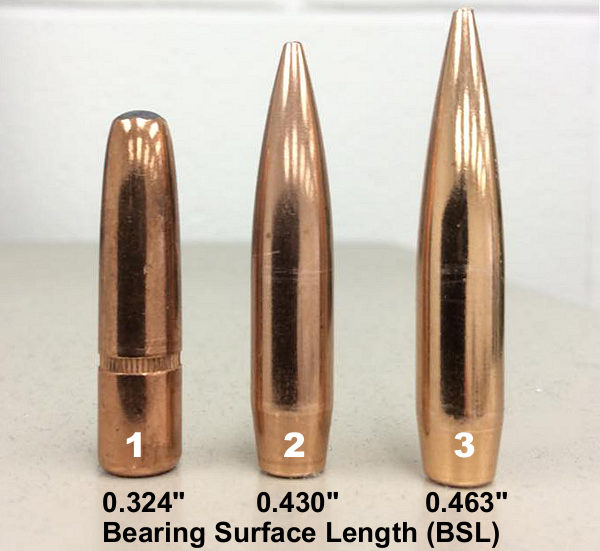 Bullet 1 (L-R), the RN/FB, has a very slight taper and only reaches its full diameter (0.284 inch) very near the cannelure. This taper is often seen on similar bullets; it helps reduce pressures with good accuracy. The calculated BSL of Bullet 1 was ~0.324″. The BSL of Bullet 2, in the center, was ~0.430″, and Bullet 3’s was ~ 0.463″. Obviously, bullets can be visually deceiving as to BSL!

 Shiny brass — it may not shoot more accurately, but it does make you feel better about your hand-loaded ammo. While it’s not necessary to get brass “bright and shiny” after every firing, it is a good idea to clean powder residue, grime, and grit off your brass before you run cases into sizing dies. There are many ways to clean cartridge cases. A quick wipe with solvent on a patch may suffice for recently-shot cases. Older brass with baked-on carbon may require lengthy tumbling. Ultrasonic cleaning is another popular option that gets your brass clean inside and out.


