In the wintertime, it’s common to encounter problems with static electricity when throwing your powder charges. The static can cause powder kernels to cling to the surface of reloading components, and can cause powder clumping. Clumped or sticky powder may make your measure bind or grab in the middle of the cycle, which can throw off your charge weight. Here are a couple simple ways you can minimize the effects of static electricity and improve the consistency of your powder measuring.
Ground Your Powder Measure — If you’re throwing powder charges in the fall or winter and have problems with bridging or sticking powder, use a ground wire. Bullet-smith Victor Johnson (Johnson Precision Bullets) tells us: “I have a 25-foot piece of real small wire with alligator clips on each end. It’s that long so I can run it down the hall to a water pipe. Use the wire tie from a bread bag to hold it in a small roll to put in the range box. When using it at the range use a 6″ nail from the co-op or Lowe’s / Home Depot and just push it into the ground.”
Use Bounce Dryer Sheets — A quick pass with the thin sheets used in dryers will eliminate “static cling” on your plastic reloading parts like powder throwers, powder funnels, and reloading press guides. Thanks to Doc76251 for this tip.
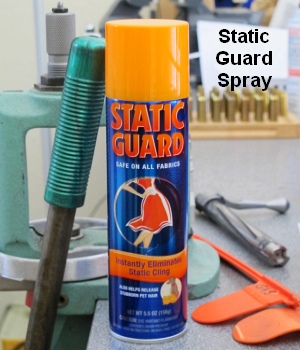
Reduce Electronic Scales’ Drift with Anti-Static Spray
Very sadly, GS Arizona, the creator of the Rifleman’s Journal website, passed away unexpectedly in June of 2022. Here is one of the many great tips he provided to handloaders through that website.
Apparently reducing static charges on and around electronic scales can reduce their propensity to drift, lessening the problem of “wandering zero”. Just how and why static charges interfere with scale performance is unclear, but many shooters have noticed that static electricity can cause electronic scales to behave strangely. So how do you reduce static charges around your digital balance? GS Arizona has found a very simple solution — an anti-static aerosol spray — that, by all indications, actually works. When this “spray-can solution” was suggested by a fellow shooter, GS was skeptical. However, he tried the stuff and he says that it really does help the scale maintain zero over time, with much less observed drift.
GS explains that the use of “Static Guard” spray helped mitigate the problem of a drifting zero on his Ohaus electronic scale: “My electronic scale… suffers from drifting zero (as they all seem to). I’ve read dozens of forum posts about drift and how to minimize its occurrence, so I know this problem isn’t limited to my scale or my workshop. Sometime last year, John Lowther mentioned the use of anti-static spray as a solution to the drift problem. John stated that the spray had virtually eliminated drift for him.”
GS found that the Static Guard actually worked: “The spray works great, just as John said it would. I spray all surfaces that I touch with my hands and arms as well as the pan (top and bottom), the metal tray on which the pan rests and the table under the scale. In six months or so of using the spray I’ve re-applied it about two or three times; it certainly isn’t something that you need to do each time you sit down to load. Before using the spray, it was not uncommon for me to re-zero the scale 10 times in the course of loading 72 rounds; now it might need it once during a session.”
Hunting season kicks off this month in many parts of the USA. If you have a new hunting rifle or need to develop a load for your rig with a new choice of bullets and/or powder, this article can help. Ace shooter Keith Glasscock explains how to develop a good load for a hunting rifle or varmint rifle.
Keith is an outstanding competitive shooter, who has finished second at the F-Class National Championships (F-Open) multiple times. Keith is also a skilled wind coach who runs the popular Winning in the Wind YouTube Channel. Along with his interest in mid-range and long-range F-Class competition, Keith also enjoys game hunting and varmint adventures.
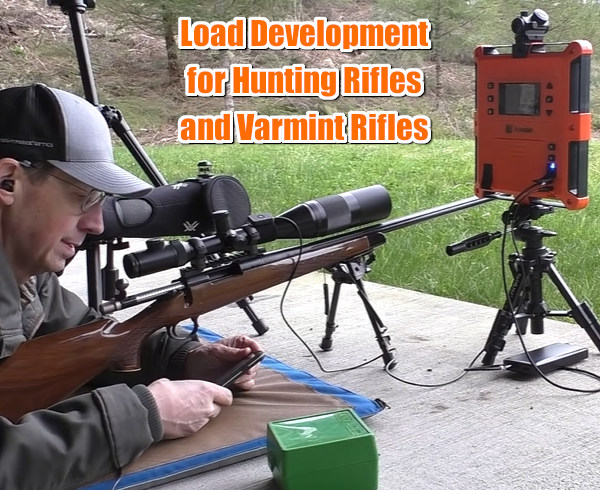
Developing accurate hand-loaded ammo for hunting and varmint rifles involves procedures that may be a bit different than load testing for a match rifle. You want to be efficient, and use the types of brass and bullets you’ll be using on the hunts. In two recent videos, Keith shows how he developed good, accurate loads for a .223 Rem varmint rifle and a .308 Win hunting rifle.
.223 Rem Load Development — Powder Charge and Seating Depth
In the first video, Keith covers the load development process for a Remington 700 bolt-action varmint rifle chambered in .223 Remington. Keith starts by full-length sizing the brass. Then he experimented with powder charge weights, and came up with a promising load of 24.7 grains of Alliant AR Comp with Hornady 50gr A-Max bullets.
Next Keith experimented with seating depths (see 5:30-6:100) and found that accuracy improved as he changed OAL length in .005 increments. Keith ended up with 2.270″ with a 3-shot group in the twos! This video shows the importance of testing your bullet choice at various seating depths. Keith shoots this rig prone off bipod, which is similar to the bipod shooting he does in the varmint fields. Keith explains key factors to consider when optimizing the .223 Rem cartridge in a varmint rig. Velocity readings are made with a LabRadar unit.
Load Development for .308 Win Hunting Rifle
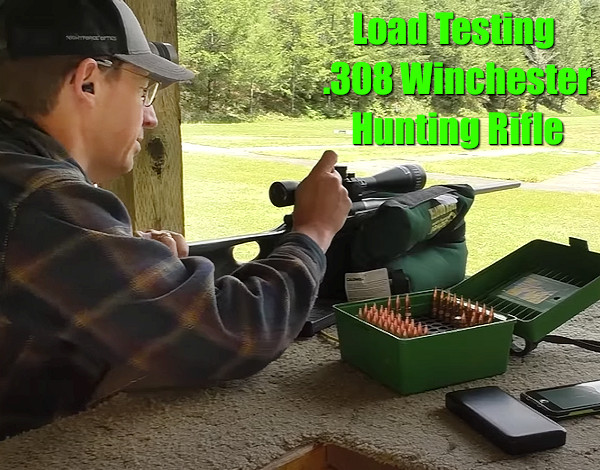
In a second video, Keith shows the process for load development with a .308 Winchester hunting rifle. Here Keith uses a large X-type sandbag for a front support. Again, he was shooting a Remington 700 bolt-action rifle, this time with Barnes TSX solid copper bullets, PPU Brass, Federal 210m primers, and AR Comp powder. Keith said the Barnes bullets were excellent — he commented that these bullets were “match quality in terms of precision”. Keith achieved some very small three-shot groups with AR Comp and the TSX projectiles. Keith did note that point-of-impact shifted up significantly with increases in charge weight (see 6:20-7:10). With thinner-contour hunting barrels, this is not unexpected. But POI change should be observed carefully during load development, as you may need to adjust your zero after completing testing.
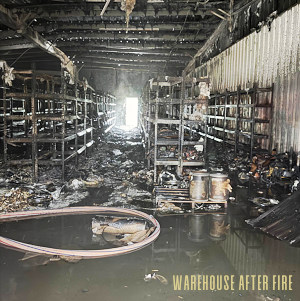
Powder Valley Outdoors (“Powder Valley”) is one of the leading reloading component and shooting supplies vendors in the country. Powder Valley has also been a strong supporter of AccurateShooter.com for over a decade. However, as you may have heard, Powder Valley suffered a warehouse fire recently. Thankfully no one was injured and Powder Valley is now fulfilling orders for customers.
Powder Valley is making great progress after the warehouse fire. The company now has a variety of products back in stock — powder, primers, brass, bullets, and more — and Powder Valley is fulfilling orders through trusted industry partners while Powder Valley gets its own warehouse back up and running. Orders can be placed now through the Powder Valley website. The staff at Powder Valley tells us: “Powder Valley would like to say thank you to the entire community for their incredible support and prayers through this time.” To support Powder Valley and place an order, visit PowderValley.com.
Powder Valley: Rising from the Ashes
When a devastating fire tore through Powder Valley’s main warehouse and offices, the loss was total. Everything melted, burned, and destroyed. But through it all, the Powder Valley team is standing strong — grateful that everyone is safe and determined to come back better than ever.
In the immediate aftermath, the team rallied to take care of customers. Kim and Kort from Customer Service worked to make sure orders and support didn’t stop. Jacob, laptop in hand, quickly transitioned to remote operations. Beau jumped in to handle inventory assessments in what was left of the office area. Owners Bryan and Noel Richardson also stepped forward, sharing their story with local news outlets about the impact of the fire and what Powder Valley means to their family and community.
The damage to the facility was extreme, and while Powder Valley is insured, dealing with insurance will take time. In the meantime, the company has partnered with trusted industry allies to fulfill orders, ensuring customers can still get what they need while keeping revenue flowing to sustain operations.
“Right now, working with industry partners was the fastest way to get back up and running,” the team explained. “It allows us to continue serving our customers and keep business moving while we navigate insurance and begin planning for our long-term home.”
The road ahead will be long — finding or building a new facility, reorganizing operations, and reestablishing full capacity. But the Richardson family and the entire Powder Valley team are unwavering in their commitment to the shooting sports community. “We’re going to get up and we’re going to keep swinging. We’re going to keep swinging”, Bryan said.
For now, every order placed with Powder Valley helps keep the lights on and supports the rebuild. And the company couldn’t be more grateful for the overwhelming outpouring of support from shooters and reloaders across the country. “This incredible community has given us strength and optimism to keep forging ahead,” the team shared. “From the bottom of our hearts — thank you.”
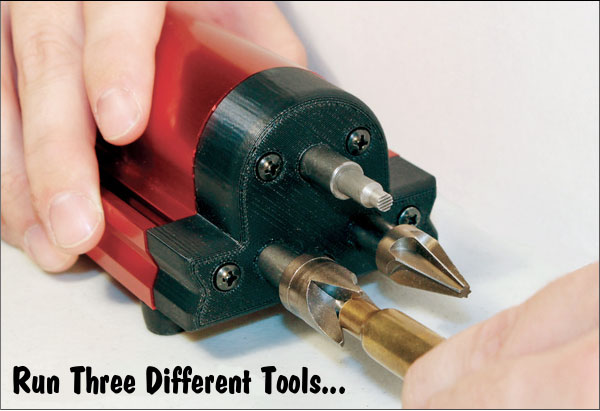
Nobody likes to spend hours manually chamfering cases and cleaning primer pockets. There are simple hand tools that will perform these tasks, but the process is time-consuming and tedious after a couple dozen cases. To speed up case prep duties, you can get one of the large, powered case prep centers. These function well, but frankly we didn’t want to give up that much precious space on our reloading bench. One good solution is Hornady’s compact Lock-N-Load Case Prep Trio (item 050160). This triple-threat tool packs a lot of functionality in a small package.
This cleverly-designed powered tool has a small footprint, yet it can perform three tasks as well as much more expensive, tower-style case prep units. The Hornady Case Prep Trio $139.99 at Midsouth, $144.65 at Precision Reloading, and $146.99 on Amazon. We’ve used this machine and it works well. The only negative is that you will get metal shavings on your bench (unlike some of the larger case prep centers). We’ve seen some guys put a small pan under the power head — then you can just dump the shavings out of the pan.
With three active stations, you can chamfer, deburr and clean primer pockets without having to change tools. The Case Prep Trio ships with inside chamfer, outside chamfer, and deburr tools. You can also use the machine with other optional 8/32 threaded accessories such as primer pocket reamers, primer pocket uniformers, and case neck brushes. CLICK HERE to see all tool options. Conveniently, the Case Prep Trio has on-board storage for your tool-heads. User reviews have been very positive.
At the request of our readers, we provide select “Deals of the Week”. Every Sunday afternoon or Monday morning we offer our Best Bargain selections. Here are some of the best deals on firearms, hardware, reloading components, optics, and shooting accessories. Be aware that sale prices are subject to change, and once clearance inventory is sold, it’s gone for good. You snooze you lose.
NOTE: All listed products are for sale to persons 18 years of age or older. No products are intended for use by minors.
1. EuroOptic — Tikka T3x Hunting Rifle Sale, Major Savings
⏺️ » Save up to 39% on quality rifles with accuracy guarantees
The Tikka T3x is a quality hunting rifle at an affordable price. Currently EuroOptic is running a major closeout sale, offering T3x bolt-action rifles with a wide variety of chamberings and stock styles. At $580 you can get a T3x Lite, a very good deal. If you prefer a wood stock, that’s offered in the T3x Hunter for $730. At the top end, consider the $1100 Tikka T3x Roughtech Cerca which adds some serious upgrades. The stock is composed of Roughtech material, and is modular, with an interchangeable pistol grip allowing the angle to be modified for different shooting positions.
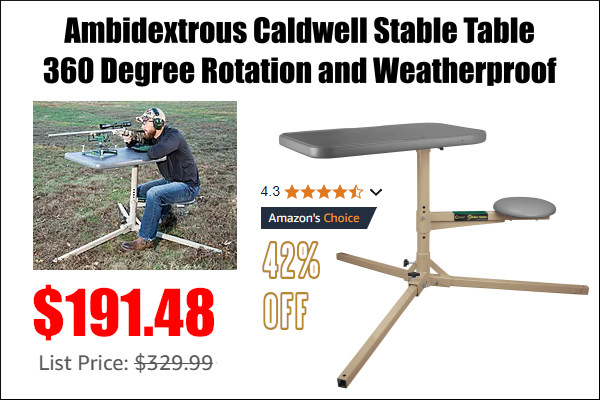
2. Amazon — Caldwell Stable Table Deluxe, $191.48
⏺️ » Positive user reviews — good set-up for varminting and home ranges
If you want a good supported shooting option that can be transported in your vehicle, check out the Caldwell Stable Table Deluxe (#ad). Now discounted 42% to $191.48, this rotating range bench is stable and comfortable. The seat and tabletop pivot (rotate) around a center axis as a single unit so you can easily swing laterally from one target to the next — that’s great for P-dog adventures. A bolt in the base allows angle adjustment of a single leg, letting you align the top parallel with the horizon. This is great unit for varmint hunting with very positive owner reviews.
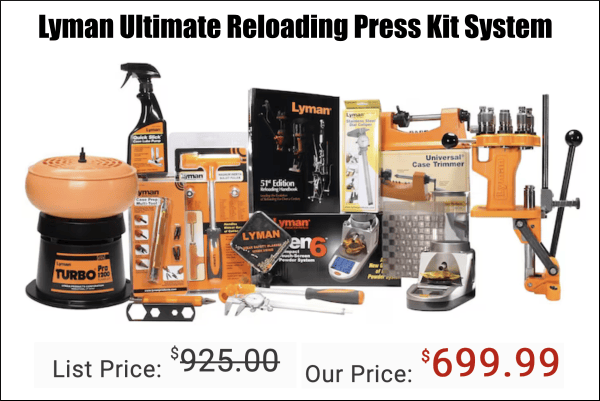
3. Amazon — Lyman Turret Press Kit, $699.99
⏺️ » Complete reloading system with 8-station turret press
The Lyman Ultimate Reloading System is a very complete multi-product kit with all the tools required to accomplish all steps in the reloading process. On sale for $699.99 ($225 discount), this combo kit includes the excellent Lyman Brass Smith 8-Station turret press ($365 MSRP), Lyman Gen 6 Electronic Scale/Dispenser ($320 MSRP), Universal Case Trimmer, Pro 1200 Turbo Tumbler, and case prep tools and more. This is a great package deal for someone getting starting in reloading.
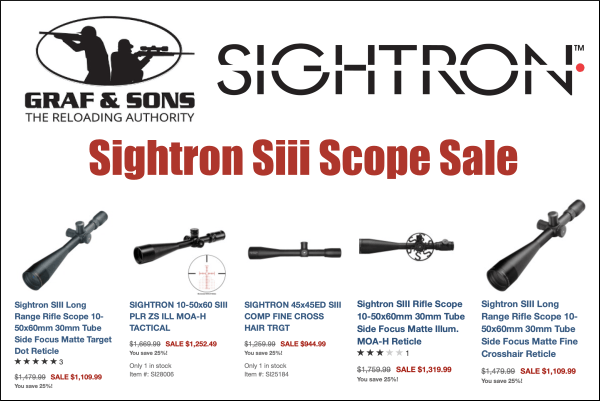
4. Graf’s — Sightron SIII Scope Sale, MOA and MIL, Save 25%
⏺️ » Major discounts on excellent competition scopes
If you need a new competition scope, definitely check out the Sightron SIII Scope Sale at Graf & Sons. There are a wide variety of scopes on sale including 45X fixed power, 6-25x50mm, 8-32x50mm, and 10-50x60mm. Many offer precision 1/8 MOA adjustments. For short-range benchrest, 600- and 1000-yard benchrest, F-Class, and PRS/NRL matches you’ll find a good scope on sale, with your choice of MOA and MIL reticles and MOA or MIL clicks. Most scopes are now 25% off, so you can save $300 to $440.
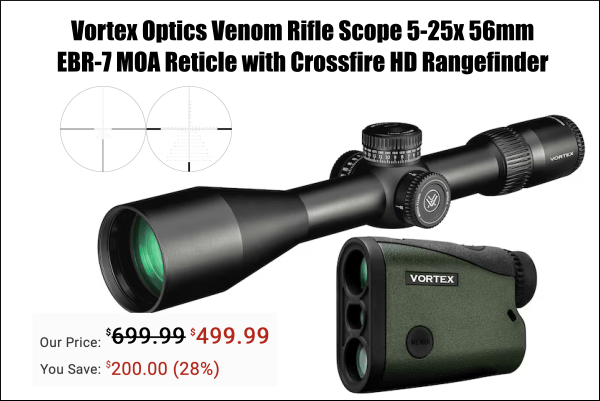
⏺️ » Very affordable combo for hunters and varminters
Here’s a good Vortex FFP scope plus rangefinder combo for matches, varmint hunting, and more. The Vortex Venom 5-25x56mm scope features a 34mm main tube, ample turret travel, and RevStop Zero System. The First Focal Plane EBR-7C reticle gives you accurate holds at any magnification. This $499.99 combo includes a Vortex Crossfire HD 1400 Laser Rangefinder, a handy, reliable unit. Right now you save $200 on this scope/LRF combo with this MidwayUSA sale.
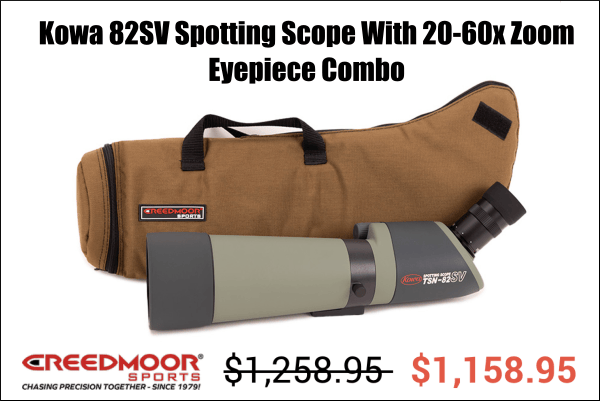
⏺️ » Popular spotting scope favored by competitors
The Kowa 82SV Spotting Scope is favored by many top competitors. The 82mm lens is bright and sharp and the glass is multicoated, ensuring sharp images and a clear visual range. This combo comes with an excellent 20-60 zoom eyepiece. This Kowa 82SV spotter offers optical performance as good or better than many other spotting scopes costing much more. This Kowa spotter ships with a nice Creedmoor Sports padded cover. Save $100 now with this deal.
7. Midsouth — Nosler Ballistic Tip Ammo Sale
⏺️ » Major savings on ballistic tip hunting ammo
Need good ammo for your fall hunt? Consider picking up some Nosler Ballistic Tip Ammunition, offered for a wide selection of hunting cartridge types including .260 Rem, .270 Win, .308 Win, .30-06 Springfield, and .300 WinMag (and more). The Nosler bullets in this ammo have a heavily-jacketed base that ensures wide expansion while the boat-tail design enhances long-range accuracy. These quality hunting rounds deliver the accuracy and down-range punch required for clean kills in the field.
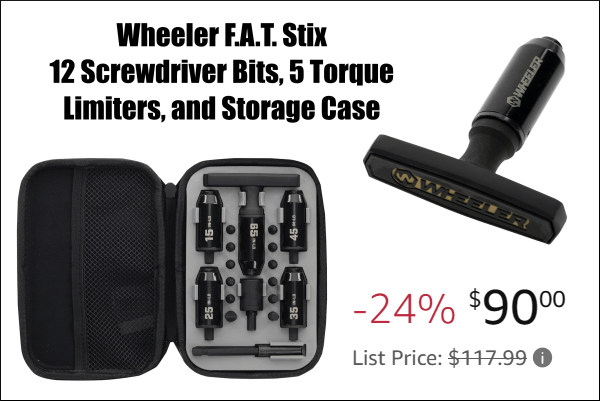
8. Amazon — Wheeler F.A.T. Stix, $90.00
⏺️ » Unique tool set for setting torque precisely
Proper torque settings for your scope rings and action are critical for accuracy. For this, we like the Wheeler F.A.T. Stix (#ad) with 12 screwdriver bits, 5 torque limiters, and storage case. This compact torque wrench set, now 24% off, takes the guesswork out of setting the correct torque. Simply attach the preset torque limiter to the t-handle, insert the desired bit, and set your screw to the right specs.
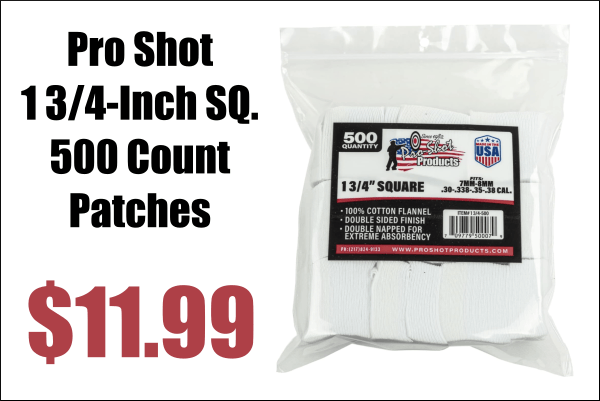
9. Amazon — Pro Shot 7mm/.38 500ct Patches, $11.99
⏺️ » 500 patches good for rifles and pistols
Cleaning barrels properly requires good patches (and plenty of them). Right now you can get 500 Pro-Shot Rifle Patches for just $11.99 on Amazon (#ad). These American-made 100%-cotton patches work great. The 100% cotton flannel fabric holds solvent well and is finished on both sides for optimal cleaning of powder and carbon residue. These patches can also be used to clean inside actions and muzzle brakes.
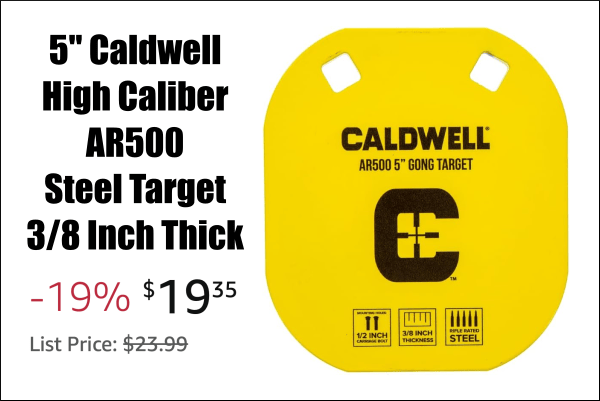
10. Amazon — Caldwell High Caliber AR500 Steel Targets, $19.35
⏺️ » Good, durable Steel gong target under $20
Available in a variety of shapes and sizes, Caldwell Gong targets are made of tough AR500 steel. These bright yellow steel targets can withstand thousands of rounds. Rated up to 3000 FPS impact velocity these will work with most common rifle types. Right now the 5″ Gong (3/8″ thick steel), is just $19.35, a 19% savings. A wide variety of other Caldwell AR500 steel targets are available including 8″ Gong, 10″ Coffin, 13″ Octagon, and Full-size IPSC.
As an Amazon affiliate, this site can earn revenues through sales commissions.
Here’s an inexpensive product that can make your case prep and loading tasks easier. We use and recommend the cleverly-designed Lyman Bleacher Blocks. These multi-level (stepped) cartridge holders save space on your bench AND make it easier to select a particular case/cartridge from a full block. Each row is a different height for convenience. With Bleacher Blocks it’s also easier to check for powder levels, or place bullets before the seating process.
Lyman’s Bleacher Block cartridge holders have many advantages over conventional, single-level blocks. Use the different levels for sorting brass. Or, migrate the brass from top to bottom as you proceed through case prep stages. If you are assembling loads with different bullets for load testing, you could arrange the loaded rounds on different levels for easy recognition. For example put V-Max loaded rounds on the top tier, and Berger Hybrid loaded rounds on the bottom tier. Or, if you are experimenting with neck tension, you can use different rows for cases processed with different bushings.
Made of durable orange polymer, Lyman Bleacher Blocks are now molded in five sizes — small pistol, large pistol, and three rifle sizes. The smallest rifle block (with 0.388″-diam holes) fits .223 Rem-size case heads. The middle size rifle block (with 0.485″-diam holes) fits .308 Win-size case heads. That works for 6mmBR/Dasher sized cases perfectly. The biggest rifle Bleacher Block has 0.565″-diameter recesses for magnum-size cases. There are also two pistol blocks — .445″ hole size for 9mm/.357 size and .565″ diameter for larger .44/.45 pistol cartridges.
Here’s what Lyman says about its innovative cartridge block design: “Our [stepped] loading blocks allow for easier handling of cases in and out of the loading block. Our stepped design allows you to easily grip a single case without jamming your fingers down into a group of cases like in traditional loading blocks, and allows for a smaller ‘footprint’ on your bench.”
Lyman Bleacher Blocks are among the Reloading Tools reviewed in this helpful video:
Our friend Gavin Gear has just released an excellent video showing how to make a threaded Modified Case for use with the Hornady Lock-N-Load Overall Length Gauge. You can watch Gavin make a Modified Case start to finish in the video below:
Video Shows How to Drill and Tap Modified Case
Gavin has some clever tricks. First he uses a sizing die to hold the cartridge case during the threading process. Second he uses two drill bits in sequence — a smaller bit to ream out the primer pocket, and then a larger “M” bit to increase the hole diameter before threading the brass. Finally he leaves the threading tap IN the brass, locks the tailstock, and then “gently pulls on the quill” to remove the brass from the die held in his lathe (See 5:46 timemark).
Get the Correct 5/16″-36 RH Tap
Unfortunately, Hornady has selected an uncommon thread type for OAL Gauges. You probably won’t be able to buy the correct 5/16″ – 36 RH HSS Tap at your local hardware store. However you CAN order this special tap from Amazon for $9.99.
Modified Case Q & A — TECH TIPS
Why do I need a Modified Case?
Every serious reloader should have a Modified Case for each cartridge type they shoot. The reason is that this allows you to get very precise measurements of the length-to-lands in your chamber. When used with the Hornady OAL Gauge, with some practice, you should be able to get repeatable length-to-lands measurements within about 0.0015″. We generally do 4-5 measurements with the OAL Gauge and usually 3 or 4 will be “on the money”. NOTE: We recommend a gentle, easy pressure on the plastic pusher rod. Don’t push too hard or you will jam the bullet hard into the lands, which produces inconsistent results.
Can’t I Just Buy a Modified Case?
Hornady makes a variety of Modified Cases sold on Amazon and through retailers such as Midsouth. While Hornady makes modified cases for many standard cartridges, if you shoot a wildcat such as the 6mm Dasher or .284 Shehane, you’ll need to create a custom modified case. And even if you shoot a standard cartridge such as the .308 Win, you can get more consistent measurements with a custom Modified Case.
If you do decide to make your own modified case, you’ll want to start with a case that’s been fired in your rifle. That way you get the best fit to YOUR chamber. Also, you won’t need to expand the neck to provide bullet clearance. Then you need to drill out the primer pocket and tap the base of the case to match the threads on the Hornady OAL Gauge tool. Make at least two modified cases, as you’ll probably misplace one at some point.
MORE INFORMATION: Want to learn more? We published a much longer story in which Erik Cortina explains in greater detail how to made the Modified Case. That article illustrates the 5/16″ – 36 RH HSS Tap required and shows how to set up the lathe to drill and tap your case. If you are serious about making your own Modified Cases, you should Read the Full Article.
Labor Day 2025 (September 1st) is just 5 days away. Soon we’ll be enjoying a major 3-day holiday weekend. We know many of our readers will be out on the road visiting friends or enjoying end-of-summer getaways. How do you do your reloading chores while traveling on holiday? Here’s a solution from Forum member Dave Gray (U.S. Army Retired).
Dave is a self-declared “full-time RVer” who spends most of his time on the road. Behind his Ram 3500 pickup, Dave tows a huge 41-foot Heartland Cyclone toy hauler featuring a 12X8 foot garage in the rear. In the rear garage area, which holds a compact Smart Car, Dave has set up a removable reloading bench complete with RCBS Rockchucker single stage press and Dillon progressive press.
Reloading Bench Mounts to RV Wall with Brackets
Dave explains: “I used a 2″X6″X5′ board for the bench. It’s perfect for my needs, and is easy to disassemble. I made it this small so that I can park my Smart Car in the garage during travel to my destinations. The bench, attached to the wall frames, is very solid. The presses’ centers are 3″ and 6.5″ from the brackets. [There are] four bolts on the wall into aluminum wall frame and 3 bolts in the bench. If I ever have to replace the current board, I’ll do so with oak or birch or hickory. When I’m not reloading, I remove the presses and store them in a protected space. I can easily attach other equipment to the bench by using C-Clamps.” Dave’s “rolling reloading room” looks very well thought-out. We commend Dave for his inventiveness.
At the request of our readers, we provide select “Deals of the Week”. Every Sunday afternoon or Monday morning we offer our Best Bargain selections. Here are some of the best deals on firearms, hardware, reloading components, optics, and shooting accessories. Be aware that sale prices are subject to change, and once clearance inventory is sold, it’s gone for good. You snooze you lose.
NOTE: All listed products are for sale to persons 18 years of age or older. No products are intended for use by minors.
1. EuroOptic — Sauer 100 Hunting Rifle Sale, $499.99 and up
⏺️ » Excellent hunting rifle with savings up to 49%
Hunting season is coming soon. If you’re looking for a handsome, reliable, and accurate hunting rig, check out the Sauer 100 rifles at EuroOptic. Many models have close-out pricing with discounts up to 49%. Choose among 10 standard and magnum chamberings including .223 Rem, .243 Win, 6.5 Creedmoor, 6.5 PRC, .270 Win, 7mm-08, 7mm Rem Mag, .308 Win, .30-06, and .300 Win Mag. Both synthetic and handsome wood stock options are offered.
2. Midsouth — RCBS Promo FREE Hazmat and FREE Powder
Here’s a great offer if you need reloading hardware, such as a press, powder scale/dispenser, or reloading tools. With the RCBS Buy Green Get Black Promo you get FREE HazMat with purchase of $200+ of RCBS products, you get FREE Powder if you spend at least $350 on RCBS items. NOTE: This offer expires at 11:59 PM CST on Thursday, August 28, 2025. Here are the terms:
1. Buy $200-$349.99 in RCBS Products and get FREE HazMat on an order with Hodgdon, Ramshot, Accurate, IMR, or Winchester Powders.
2. Buy $350-$549.99 in RCBS Products and get FREE HazMat and 1 FREE pound of select Hodgdon, Ramshot, Accurate, IMR, or Winchester Powders.
3. Buy $550+ in RCBS Product and FREE HazMat plus 2 FREE pounds of select Hodgdon, Ramshot, Accurate, IMR, or Winchester Powders.
3. Grafs.com — Frankford Arsenal F-1 Press, $124.99
⏺️ » Versatile press, good primer exit, plus built-in light
Here’s a handy, single-stage press with some cool features. The new Frankford Arsenal F-1 press has an open front for easy case placement, plus a built-in LED lamp at the top (great for inspecting cases). And after decapping, spent primers go straight down a tube into a handy, clear, twist-off catch cylinder (as on a Forster Co-Ax). We think this would be an excellent secondary press used for decapping or bullet seating. This intro price — just $124.99 at Graf & Sons — is a great deal. NOTE: This press does NOT have priming capability — you must prime cases with a separate tool. Also, the power cord for the LED light is NOT included. For more details see Frankford Arsenal F-1 Press Review.
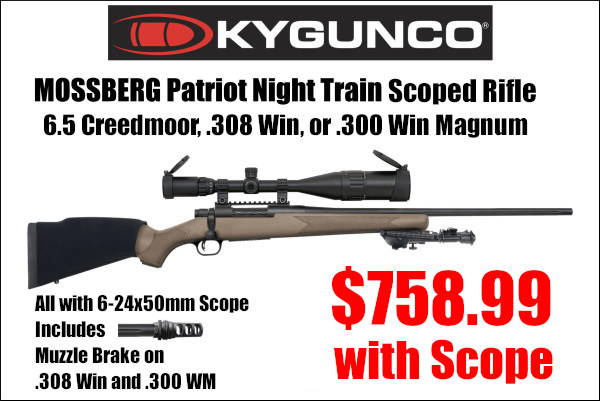
4. KYGUNCO — Mossberg Night Train Rifle Combo, $758.99
⏺️ » Good hunting rifle, complete with 6-24x50mm scope
Here’s good hunting rifle package — rifle AND 6-24X scope — at a very attractive price. For $758.99, you can get a Mossberg Patriot Night Train Rifle and Scope combo package in 6.5 Creedmoor, or .308 Win. For a few bucks more ($768.76) more get the .300 Win Magnum version. A high quality 6-24x50mm scope and rings are included with all three models, and the .308 Win and .300 WinMag models include a fitted muzzle brake. This is a nice, complete package with good chamberings for deer and elk.
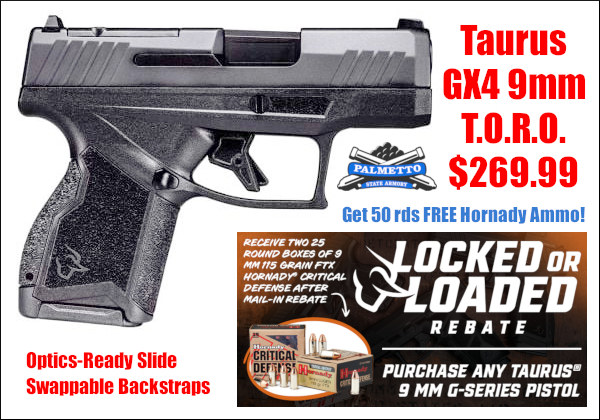
5. Palmetto SA — Taurus GX4 T.0.R.O. 9mm Pistol, $269.99
⏺️ » Great Value plus FREE 50rds of Hornady 9mm ammo
Here’s a compact modern 9mm carry pistol with great owner reviews and a bargain $269.99 price. The Taurus GX4 T.O.R.O. can mount modern red/green dot optics on the slide. The trigger is good and the grip adjusts with swappable backstraps. Here’s one buyer review: “My new and favorite EDC pistol. Paired it with a Holosun green dot and love it… perfect compact.” BONUS AMMO: If you purchase a G-series Taurus this month you get two FREE 25rd boxes of Hornady Critical Defense HTX 9mm ammo. Qualifying purchases must be made between August 1st, 2025 and August 31st, 2025.
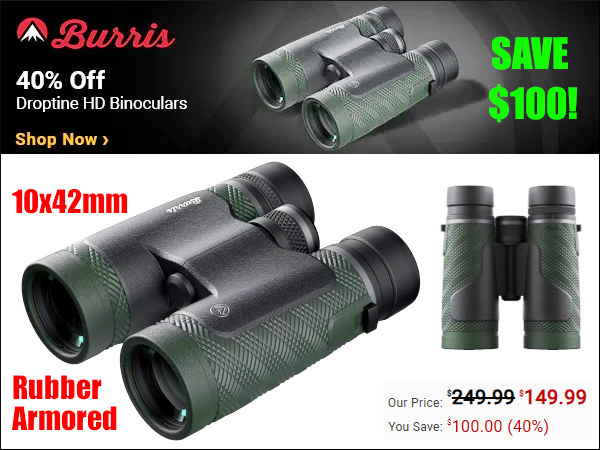
⏺️ » Save $100 (40%) on good armored 10X bioculars
Hunting season is just around the corner. Here’s a good set of 10-power HD Burris Binoculars for just $149.00. That’s $100 discount off the regular price — a massive 40% savings. These Burris Droptine Binocs feature fast focus, plus a durable rubber armored coating. The optics chambers are nitrogen filled for waterproof and fog-proof performance in harsh weather.
7. Precision Reloading — Frankford Arsenal Tumbler Lite, $99.99
⏺️ » Good compact tumbler under $100 with FREE Shipping
You can save $18 on a good tumbler at Precision Reloading AND get free shipping. The Frankford Arsenal Tumbler Lite features a clear viewing window, simple ON/OFF switch, and leak-proof cap design. The 3.3L capacity holds up to 300 cases of .223 brass. This unit is big enough for most popular varmint and match rifle cartridge types. And it’s plenty big for pistol cases. Sold elsewhere for $118 or more, this is on sale for $99.99 with FREE Shipping.
⏺️ » Popular NRR24 electronic ear plugs now 60% Off MSRP
Protecting your hearing is vital when at the range. One popular option is the NRR24 Walker’s Silencer 2.0 Bluetooth Electronic Ear Plugs. These have a good 24-dB sound reduction rating, are pretty comfortable, and can communicate with your smartphone via wireless BlueTooth. Auto-Shut off helps preserve battery life (6-8 hours). Available in black, FDE, or Olive Drab, these rechargeable electronic ear plugs feature a free control App for your SmartPhone. These $99.99 plugs come with: USB Charging Dock with rechargeable lithium battery, 3 sizes of Sure-Lock fins and foam tips, and cleaning brush.
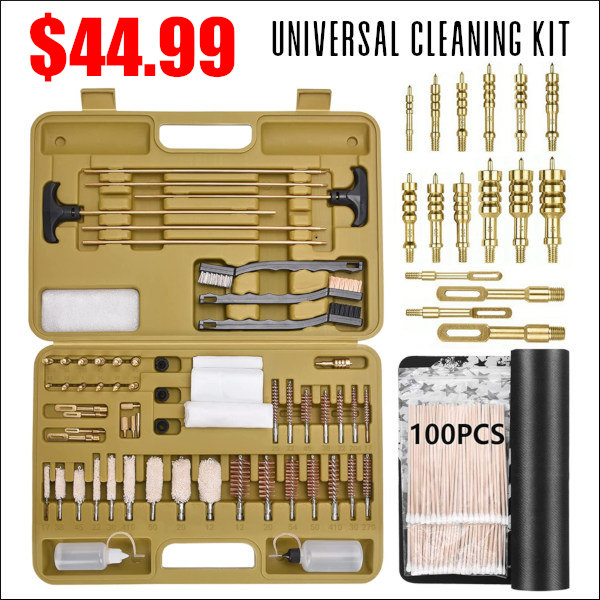
9. Amazon — Universal Gun Cleaning Kit, $44.99
⏺️ » Great value for cleaning kit for pistols, rifles, and shotguns
This Universal Gun Cleaning Kit (#ad) has just about everything you need to clean any firearm, all packed in a handy case. This $44.99 kit includes jags, brushes, bore mops, slotted tips, and lots more. The fitted jags and slotted tips are made from solid brass and marked by caliber. The cleaning rods and accessory adapters are also made from brass. Included in this easy-to-carry kit are: 6 gun rods, 13 gun jags, 4 slotted tips, 9 gun mops, 14 bore brushes, 3 muzzle guards, 3 utility brushes, 3 accessory adapters, 4 polishing cloths, 100 cleaning patches, 2 oil bottles (empty), and even a gun cleaning mat. NOTE: For competition rifles, we recommend using high-quality ONE-PIECE cleaning rods.
10. Amazon — Digital Trigger Pull Gauge, $18.99
⏺️ » Cool sub-$20 tool that works really well — great buy
The Pridefend Professional Digital Trigger Pull Gauge (#ad) offers great performance for a very low price. We’ve used this “smart” pull gauge with success on match rifle triggers. This gauge measures in 1 oz. increments from 0 to 12 pounds. The gauge display is easy to read and you can choose ounce, pound, or Kg units. Though it costs just $17.99, this digital gauge offers better consistency than many conventional spring-type gauges. Plus, when you do a sequence of multiple pull tests on one gun, the unit automatically calculates maximum, minimum, and average pull weights.
As an Amazon affiliate, this site can earn revenues through sales commissions.
Close-up view of a sectioned case. This one here was “fixin’ to pop”, observed Glen Zediker.
Here are highlights from an article Glen Zediker wrote for the Midsouth Blog. In that article Glen, who sadly passed away in 2020, focused on cartridge brass. Glen identified the most common failures that appear with brass that has been shot multiple times, or which has been fired at excessive pressures. Glen explained some simple ways to check your cartridge brass to detect “early warning signs” of case failure, particularly case head separation, which can be very dangerous.
How Cases Degrade with Multiple Firings By Glen Zediker
This article explains when, and then how, to check after the progress of changes commencing with the firing on a new case. It’s the “progress of degeneration,” in a way of looking at it because the concern is getting a handle on when enough change in the brass has come about to require attention. Or abandonment. As said then, for me that’s 4 firings. That, as said last time, is when I might see changes that need attention. Also as said, that figure didn’t come out of a hat, but from my own notes in running my competition NRA High Power Rifle loads. [Editor’s Note: With Lapua brass, using moderate loads, in bolt-action rifles, we typically get about 10 good (match-worthy) firings. But if you anneal your Lapua brass, and run modest pressures, Lapua brass can perform well for 20 or more load cycles.]
The areas most affected are the case neck and case head area. Case neck walls get thicker [but] the case head area body walls get thinner. Primer pockets get shallower and larger diameter.
This case shows a cracked neck AND a crack (separation) above the case head. Zediker says it is “rare to see one case with both of the most common failures. [This case] was attacked by an M14.”
Case Head — Causes of Separation and Cracking
When a case is under pressure during firing, the brass, like water, flows where it can, where it’s more free to move. Of course, the chamber steel limits the amount it can expand. The case shoulder blows fully forward and the case base is slammed back against the bolt face. There is, therefore and in effect, a tug on both ends — it gets stretched. The shoulder area is relatively free to expand to conform to the chamber, but the other end, the case head area, is not. Since that’s the area of the case with the thickest walls, it doesn’t expand “out” much at all. What it does is stretch. The “case head area,” as I refer to it here, is the portion of the case above the web, which is just above the taper that leads in to the extractor groove. The “area” extends approximately an eighth-inch up the case body.
Here’s a “pressure ring.” You’ll see this after firing, if you see it. And, if you see it, that case is done. The bright ring indicates excessive stretching, which indicates excessive thinning. If you see a ring circling the case, noticeable because it’s lighter color than the case body, and it’s in this area, I’d say that case is done. And that’s right where a “head separation” occurs. It can crack and also blow slap in two, and that’s the “separation” part of case head separation.
Photo courtesy GS Arizona.
This is a spot to keep close watch on as cases age. It is also the area that is more “protected” by sizing with less case shoulder set-back. That is, pretty much, where the freedom for the stretching movement in this area comes from (the case shoulder creates a gap). If you’re seeing a sign that a head separation [might happen with relatively few firings], chances are the shoulder set-back is excessive, and also… the load pressure level.
Bent Paper Clip Case-Wall Gauge
Editor: You can use a bent paper clip to detect potential case wall problems. Slide the paper clip inside your case to check for thin spots. GS Arizona explains: “This simple little tool (bent paper clip) will let you check the inside of cases before you reload them. The thin spot will be immediately apparent as you run the clip up the inside of the case. If you’re seeing a shiny line on the outside and the clip is really hitting a thin spot inside, it’s time to retire the case.” Photo by GS Arizona.
Monitor Primer Pocket Dimensional Changes
Another case-head-area and pressure-related check is the primer pocket. As said, the primer pocket will get larger in diameter and shallower in depth each firing. As with many such things, the questions are “when” and “how much,” and the main thing, “how much?”
If the pocket gets excessively shallow, and that’s judged by a primer that seats fully but isn’t at least a tick below flush with the case base, there could be function issues. There’s a risk of a “slam-fire” with a semi-auto that uses a floating firing pin, and, if there is actual protrusion, that has the same effect as insufficient headspace. A primer pocket uniformer can reset the depth of a shallowed primer pocket to what it should be, but the real test for me is how easily the next primer seats into it. If it’s significantly less resistance, I’ll say that case is done. Shallower can be refurbished. That’s a primary function of a primer pocket uniformer. Larger diameter, though, can’t be fixed. I’ve mentioned in another article or two that, any more at least, my main gauge of load pressure has become how much primer pocket expansion there’s been.


 Apparently reducing static charges on and around electronic scales can reduce their propensity to drift, lessening the problem of “wandering zero”. Just how and why static charges interfere with scale performance is unclear, but many shooters have noticed that static electricity can cause electronic scales to behave strangely. So how do you reduce static charges around your digital balance? GS Arizona has found a very simple solution — an anti-static aerosol spray — that, by all indications, actually works. When this “spray-can solution” was suggested by a fellow shooter, GS was skeptical. However, he tried the stuff and he says that it really does help the scale maintain zero over time, with much less observed drift.










 Labor Day 2025 (September 1st) is just 5 days away. Soon we’ll be enjoying a major 3-day holiday weekend. We know many of our readers will be out on the road visiting friends or enjoying end-of-summer getaways. How do you do your reloading chores while traveling on holiday? Here’s a solution from Forum member Dave Gray (U.S. Army Retired).
 Reloading Bench Mounts to RV Wall with Brackets