|
|
March 27th, 2009
The 6mm Dasher is based on the 6mm BR cartridge with the shoulder blown forward about 0.100″ and “improved” to 40°. Case capacity is raised to about 41.0 grains. This allows the Dasher to drive 105-108gr bullets comfortably at 2970-3000 fps without over-stressing the brass. A popular load used by many successful Dasher shooters is 33.3 grains of Reloder 15, CCI 450 primers, with 105gr Berger VLDS, .010″ in the lands. This is a “warm load” and should only be used with fire-formed brass. As with any load, start 10% low and work up. You may also have good luck jumping the bullets .020″ or more.

Robert Hoppe is one of the top 600-yard shooters in the country. Last fall, shooting a 6 Dasher, Robert nailed a 0.5823″, 5-shot group. At the time it was the smallest group ever shot in 600-yard registered benchrest competition. Just last weekend, John Lewis shot even smaller with an IBS Heavy Gun, but Robert’s 0.5823″ still remains the NBRSA 600-yard record, and the smallest group ever shot at 600 by a 17-lb class rifle. Robert has been very successful in the 600-yard game, and he finished 5th recently at the NBRSA 600-yard competition. He knows how to wring the best accuracy out of the 6mm Dasher cartridge. Here Robert offers some tips on load development and tuning for the 6mm Dasher.

March 22nd, 2009
We know many of our readers shoot the 6 BRX, 6 Dasher, 6mm Rem AI, .243 Ackley and other “improved cartridges” that require case-forming. These wildcat designs move the shoulder forward, or alter the shoulder angle and/or body taper. Traditionally, these cases are fire-formed, i.e. a charge of powder is used to blow the shoulder forward and casewalls out. There are different methods of fire-forming. Some guys use a full load of rifle powder, with bullets seated hard in the lands (setting up a false shoulder helps too). Other shooters successfully fire-form without bullets, using fast pistol powders (and a much-reduced charge). Typically, with this bulletless fire-forming, a filler such as Grits is used, along with some kind of plug or wad to hold the powder in the case.
Fire-forming takes time, and consumes expensive powder, primers, and (typically) bullets. Unless you have a dedicated fire-forming barrel, the fire-forming process can use up a significant amount of your useful barrel life, particularly if you are a varminter needing hundreds of re-formed cases. What if you could form your cases at home, at your reloading bench, without burning powder or wasting barrel life? Well you can…
Hydraulic Case-Forming with Hornady Die
Now, thanks to Hornady, shooters who need to “improve” their cases have a bonafied alternative to fire-forming. Hornady’s custom shop offers a hydraulic case-forming kit that allows you to form cases just using water and a conventional reloading press.

Because fluids, such as water, are not compressible, you can use hydraulic action to change the shape of your brass in a die. As a ram or piston moves the fluid in the die, hydraulic pressure pushes the shoulder and case walls out to match the “improved” case profile machined into the Hornady die. What you’ll get is a re-formed case with a near-perfect neck-shoulder junction, but with slightly rounded edges where the case body meets the shoulder. However, the edges of the shoulder will normally sharpen up once you shoot the brass for the first time with a full load.
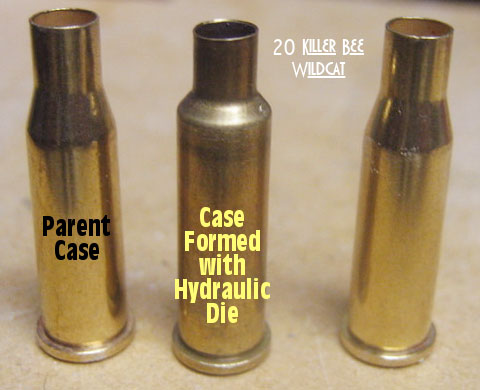
Tips for Hydraulic Case-Forming
The process works well… as long as you understand that it will take a final fire-forming stage to fully “blow out” the brass. The hydraulic process gets you 95% of the way there. Lonnie Hummel, technician of Hornady’s Custom Shop, uses a hydraulic forming die himself to produce his wildcat varmint cases. Lonnie recommends using regular water as the hydraulic fluid, but other shooters have used isopropyl alcohol, and some guys have used light machine oil. The different fluid choices have pros and cons. With water, you have to be careful to dry out the forming die so it doesn’t rust. With oil you have to make sure you remove ALL the oil from the case before firing. That’s very important for safety and to ensure you don’t “kill” your primers. Alcohol seems to work well, but again you want to make sure residues are removed, so that any residual alcohol does not contaminate primers or powder.
Ordering a Hydraulic Forming Die
Hornady hydraulic forming dies are produced on a custom basis. You need to supply a reamer print or some “finished” cases that have been fully fire-formed in your chamber. Then Hornady can build a die that matches your improved or wildcat chamber. Also, after heat-treating, each die is custom-honed so there is a super-close fit with the shaft of the hydraulic piston.
How much will it cost? Prices vary depending on the size of the parent cartridge: for cases up to 2.6″, the cost is $165.00; for cases over 2.6″ up to 2.9″ the price is $185.00. These prices are for the complete Hornady Hydraulic Forming Kit, which includes Die Body, Lock Ring, Hydraulic Piston, and a special shellholder (without a center hole).
For more information contact Lonnie Hummel at Hornady. Call (308) 382-1390 and ask for the Custom Shop or email: lhummel [at] hornady.com. NOTE: You will NOT see this product listed or illustrated on Hornady’s website. Hydraulic form dies are special order items.
Photos courtesy Forum member SongDogHunter
March 19th, 2009
Imagine if you could have a powerful Windows-based portable PC that would run your ballistics programs, sync with your chronograph, run Excel spread sheets (with reloading logs), connect wirelessly to the internet for weather info and load data, AND provide built-in GPS Navigation. OK, now imagine having all those capabilities (plus a camera) in a 1.4-pound computer with a compact 9.65″ x 4.72″ footprint!

Sound impossible? Not any more. The new Sony Vaio P-Series can do everything we’ve described and still fit easily inside a range-bag or vehicle glove-box. About as thin as a deck of cards, this remarkable little computer can perform a myriad of tasks for the shooter and outdoor sportsman. On the way to the range, you can use it for in-vehicle navigation — with its built-in GPS it provides turn-by-turn instructions (no internet connection needed for GPS services). Once you get to your destination you can then hook it up to your chronograph, or use it to run ExBal or other ballistics program.

Pros and Cons of Vaio P
We really like that fact that the Vaio P is so small and light. The portability means the device gets used much more, providing a web connection nearly everywhere you go (in urban areas). This editor has a 9-lb laptop with a 17″ screen. It’s a nice unit, but it rarely gets used because it’s so darn big and heavy. Conversely, I can easily bring the Vaio P anytime I’m in the car.

The screen on the Sony Vaio P, though it offers 1600 x 768 resolution, is quite small, and won’t display most web pages without scrolling vertically. If you have a target-cam, you’ll be much happier using a standard-size laptop for a display. The 1600×768 resolution stuffs so many pixels in a small space that words are hard to read and there’s no quick path to change the resolution. However, when you’re on the web, you can use the browser’s zoom function to enlarge font size.
The Vaio P comes with a 60 gig conventional hard drive. We wish a Solid State Drive (SSD) was standard. A SSD is more shock-resistant and would consume less power. However, Sony does offer 64 GB or 128 GB SSDs as extra-cost options. As it is, the Sony Vaio P is pretty expensive at $899.00 street price.
For operating systems you have a choice of Windows Vista Premium or Vista Home for the Vaio P. We wish Sony gave buyers an XP or Linux OS option. Dell offers these choices with the Dell Mini laptop.
A Unique Product
The Vaio P is not a perfect product. At about $900.00, it’s expensive as mini-laptops go. However, when you consider that this can replace a GPS Navigation unit, a PDA (for your ballistics program), a Blackberry, and a digital camera, the Vaio P is an attractive alternative. Since it’s small enough to be truly portable, we think a device like this will actually get used a lot more than a big, heavy laptop. And if the Vaio P proves to be something you use virtually every day (like your cell-phone), then it’s well worth the investment. The Vaio P was a CNET “Best of CES” Award winner for 2009.

March 14th, 2009
 The folks at Berger Bullets have just released an interesting technical bulletin that describes methods for optimizing bullet seating depths with Berger VLDs. The document explains how to find the OAL “sweet spot” for VLDs in your rifle. Interestingly, while VLDs commonly work best seated into the rifling .010″ or more, Berger’s research indicates that, in some rifles, VLDs perform well jumped .040″ or more. This is a significant finding, one that’s backed-up by real-world testing by many shooters. The folks at Berger Bullets have just released an interesting technical bulletin that describes methods for optimizing bullet seating depths with Berger VLDs. The document explains how to find the OAL “sweet spot” for VLDs in your rifle. Interestingly, while VLDs commonly work best seated into the rifling .010″ or more, Berger’s research indicates that, in some rifles, VLDs perform well jumped .040″ or more. This is a significant finding, one that’s backed-up by real-world testing by many shooters.
The key point in Berger’s report is that: “VLD bullets shoot best when loaded to a Cartridge Overall Length (COAL) that puts the bullet in a ‘sweet spot’. This sweet spot is a band .030″ to .040″ wide and is located anywhere between jamming the bullets into the lands and .150″ jump off the lands.”
CLICK HERE to download Berger VLD Tuning Tips
Writing in the report, Berger’s Eric Stecker observes: “Many reloaders feel (and I tend to agree) that meaningful COAL adjustments are .002 to .005. Every once in a while I might adjust the COAL by .010 but this seems like I am moving the bullet the length of a football field. The only way a shooter will be able to benefit from this situation is to let go of this opinion that more than .010 change is too much (me included).”
For target competition shooters (for whom it is practical to seat into the lands), Berger recommends the following test to find your rifle’s VLD sweet spot.
Load 24 rounds at the following COAL:
1. .010″ into (touching) the lands (jam) 6 rounds
2. .040″ off the lands (jump) 6 rounds
3. .080″ off the lands (jump) 6 rounds
4. .120″ off the lands (jump) 6 rounds
Berger predicts that: “One of these 4 COALs will outperform the other three by a considerable margin. Once you know which one of these 4 COAL shoots best then you can tweak the COAL +/- .002 or .005.”
OBSERVATION and WARNING
Berger may definitely be on to something here, and we applaud Berger’s testers for testing a very broad range of seating depths. However, we want to issue a STRONG WARNING to reloaders who may be inclined to try the 4-step method listed above.
Be aware that, as you load your cartridge progressively shorter, putting the bullet deeper into the case, you will be reducing the effective case capacity dramatically. With smaller cases, such as the .223 Rem and 6mmBR, moving from .010″ into the lands to .080″ and .120″ off the lands can CAUSE a dramatic pressure rise. So, a load .010″ into the lands that may be safe can be WAY OVERPRESSURE with the bullet seated .120″ off the lands (i.e. .130″ deeper in the case, the difference between .010″ in and .120″ out).
To illustrate, using a QuickLOAD simulation for the 6mmBR cartridge, moving the bullet 0.130″ deeper into the case can raise pressures dramatically. With the Berger 105 VLD seated .010″ in the lands (with 0.220 of bearing surface in the neck), and a charge of 30.0 grains of Varget, QuickLOAD predicts 60,887 psi. (This is using ADI 2208 data, and a 5500 psi start initiation value). If we move the bullet back 0.130″ further into the case, QuickLOAD predicts 64,420 psi (even after we drop start initiation pressure to the “default” non-jammed 3625 psi value). The 64,420 psi level is way higher!
| Cartridge & Load |
COAL |
Jam/Jump* |
Start Pressure |
Max Pressure |
6mmBR, 30.0 Varget
Berger 105 VLD |
2.354″ |
+0.010″ in lands |
5500 psi |
60,887 psi |
6mmBR, 30.0 Varget
Berger 105 VLD |
2.324″ |
-0.20″ JUMP |
3625 psi |
59,645 psi |
6mmBR, 30.0 Varget
Berger 105 VLD |
2.264″ |
-0.80″ JUMP |
3625 psi |
62,413 psi |
6mmBR, 30.0 Varget
Berger 105 VLD |
2.224″ |
-0.120″ JUMP |
3625 psi |
64,420 psi |
* As used here, this is the variance in OAL from a load length where the bullet ogive just touches the lands (first jacket to barrel contact). Loading bullets to an OAL beyond that point is “jamming” (seating bullet into lands), while loading to an OAL shorter than that is “jumping” (seating bullet away from lands).
NOTE: This is only a software simulation, and the real pressures you encounter may be different. But, the point is that moving the bullet 0.130″ further down in a 6mmBR case can raise pressures more than 3,000 psi! Therefore, you must employ EXTREME CAUTION when moving your bullets that much in a relatively small case. Remember that going from .010″ jam to a very long jump will probably increase pressures in your cartridge so you MUST adjust your load accordingly.
March 9th, 2009
Quite a few portable, electronic reloading scales have been introduced in the last year or so, and now Hornady has joined the game. Hornady’s new compact (3″x5″ footprint) GS-1500 portable scale will weigh up to 1500 grains — offering more capacity than most other portables. 1500 Grain capacity means that this compact scale can handle just about any reloading task for calibers all the way up to 50 BMG.

The GS-1500 scale features a 2.5″ x 3″ weighing platform, an aluminum measuring pan, and a 100-grain calibration weight. The scale will run on two (2) regular AAA batteries, which are included. The new GS-1500 scale is ON SALE this month for just $26.65 at Midsouth Shooters Supply, item 005-050107. This is a good deal. By comparison, MidwayUSA’s price for the GS-1500 is $34.99.
Editor’s NOTE: This product is so new that we have not yet been able to test it for function. Hornady usually can be counted on to do its homework before introducing new reloading tools. Hornady also stands behind their products when it comes to warranty repair.
CLICK HERE for Hornady 2009 Reloading Product Brochure
February 22nd, 2009
 The TECH TIPS shared in this Daily Bulletin are very popular. We know there are many clever folks out there who have developed interesting tricks and procedures to load better ammo or shoot tighter groups. To share some of these “bright ideas” with our readers, we’ve decided to run a contest, rewarding the best reader-submitted Daily Bulletin TECH TIPS. The TECH TIPS shared in this Daily Bulletin are very popular. We know there are many clever folks out there who have developed interesting tricks and procedures to load better ammo or shoot tighter groups. To share some of these “bright ideas” with our readers, we’ve decided to run a contest, rewarding the best reader-submitted Daily Bulletin TECH TIPS.
Bulletin TECH TIPS Contest
We are soliciting TECH TIPS from our readers. These can include reloading advice, ways to optimize the use of tools, pointers on how to maintain/repair rifles, or even advice on how to set up your rifle better on the bags. You might also explain how to craft a simple, inexpensive tool or gadget to assist with reloading. One popular TECH TIP was from a reader who built a portable reloading bench using a Black & Decker Workmate as a base. Another guy crafted a custom jig to control cut depth with a neck chamferer. One popular reader-supplied TECH TIP explained how to fit a mirror and magnifying glass to make it easier to use a balance-beam scale. There are all kinds of good ideas… so come on and share your best tips with us.
 Contest Rules Contest Rules
To enter the contest, you must have an original idea (no copies from somebody else’s post or article), and original photos. You must submit at least 400 words explaining your TECH TIP, and provide at least three (3) good, sharp digital photos (or technical diagrams). The photos should be 640×400 or more pixels. 1024×768 is ideal. Any TECH TIP without photos/diagrams will be ineligible for prizes.
Entrants MUST supply their name, address, email address, and phone number. We must have that information for fact-checking purposes and to notify the winners.
We will select the top TECH TIPS in late April. All submissions (text and photos) become the property of 6mmBR.com | AccurateShooter.com. We will run the best TECH TIPS in the Daily Bulletin over the next few months.
Contest Prizes
The writers of the Best Four (4) TECH TIPS will each receive a prize. First Prize is an RCBS CaseMaster ($100.00 value), Second Prize is a 100-ct box of Berger Bullets (.204, .224, 6mm, 6.5mm calibers), Third and Fourth Prizes will be AccurateShooter.com T-Shirts (Large or X-Large only).
Contest Deadline
To be considered in the Contest, you must submitted your TECH TIP (500 or more words plus at least 3 photos), no later than April 10, 2009. While 500 words + 3 photos is the minimum, you can submit longer articles and more photos. It is OK to submit multiple entries.
February 18th, 2009
The winners of the 2009 NRA Golden Bullseye Pioneer Award are Robert E. Hodgdon and J.B. Hodgdon, officers of Hodgdon Powder Company. For nearly six decades the Hodgdon brothers have worked in the Kansas-based company founded by their father, Bruce E. Hodgdon.

The Golden Bullseye Pioneer Award, now in its seventh year, honors outstanding personal achievement. “The award spotlights the exemplary achievement and cumulative body of work of an individual, members of a team or partnership, or family who were responsible for the development and introduction of shooting equipment that has made a profound, positive and enduring impact on the way Americans shoot and hunt,” said Joe Graham, Executive Director of NRA Publications. “This year’s winners are legend in our industry.” NRA Publications will present its annual Golden Bullseye Awards and Golden Bullseye Pioneer Award at an invitation-only reception during the 2009 NRA Annual Meetings & Exhibits, May 15-17, in Phoenix, Arizona.
Expanded Product Line Now Includes Goex, IMR, and Winchester Powders
In the last decade, Hodgdon Powder Company has grown rapidly. In 2008, Hodgdon acquired the Goex line of Black Powder and Black Powder substitute products. In 2006, Hodgdon Powder Company and Winchester® Ammunition announced that Winchester® branded reloading powders would be licensed to Hodgdon. In 2003, Hodgdon purchased IMR® Powder Company. IMR powders continue to be manufactured in the same plant as before the company’s acquisition by Hodgdon. Today Hodgdon meets the needs of shooters, reloaders and hunters around the world with an extensive array of smokeless and blackpowder substitute propellants, and the company continues to bring innovative new products to market.
February 11th, 2009
Credit this find to ace British benchrest shooter Vince Bottomley, United Kingdom 1K record-holder and publisher of the excellent Precision Rifle website.
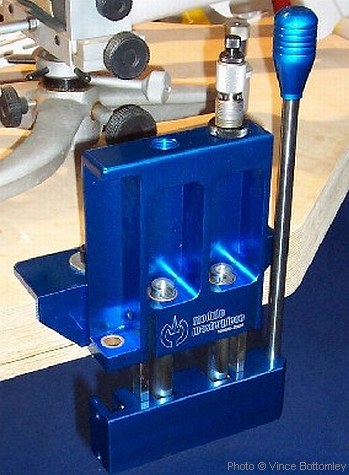
Vince writes: “This beautiful compact press is made by an Italian company, BCM Europearms, run by Vittorio Taveggia. Vittorio builds some superb rifles but he also has a very useful range of accessories for accuracy aficionados. I’m sure you’ll be interested in Vittorio’s loading press — this is offered in several configurations for normal dies, Wilson-style hand-dies, or both. The press is superbly made. Vittorio also crafts very nice Weaver-style rings and bases. Again they are beautifully-finished and very strong. Vittorio also makes stocks and actions. At present, there is no UK importer for the press, but there could be very soon. If you are at all interested in any of the products please drop me an e-mail at vinceb [at] 6ppc.fsnet.co.uk and I’ll pass your interest onto the ‘soon to be’ UK importer.” The top photo shows the original Modulo Masterpiece version, which had three stations. There are other versions, as seen in the photo below.

Editor’s note: We don’t know of a US importer, but you can contact Vittorio directly. Information for his company in Torino, Italy is found on the BCM Europearms website. Send email to: info [at] info@bcmeuropearms.it.
Photo © Vince Bottomley, used by permission
February 7th, 2009
 Credit German Salazar for this smart tip. 6XC dies tend to be pretty expensive. If you already have a 6BR neck-sizing die, you can use it to neck-size 6XC brass. Redding Reloading sells a set of three washers that raise the die in the press, part number 80901. Each kit includes three spacers: (.062) No-crimp or partial resizing, (.125) 44 Spl/44 Mag spacer, (.135) 38 Spl/357 Mag spacer. If you buy two sets ($7.11 each at Midsouth Shooters Supply) and use both 0.125″ spacers and one 0.135″ spacer then you can neck size 6XC cases with your 6BR neck sie without messing with the lock ring setting. You can also use the same spacers to switch pistol dies (e.g. between .38 Special and .357 Magnum). Hornady also sells inexpensive .135″ spacers to switch from .38 spl to .357. Credit German Salazar for this smart tip. 6XC dies tend to be pretty expensive. If you already have a 6BR neck-sizing die, you can use it to neck-size 6XC brass. Redding Reloading sells a set of three washers that raise the die in the press, part number 80901. Each kit includes three spacers: (.062) No-crimp or partial resizing, (.125) 44 Spl/44 Mag spacer, (.135) 38 Spl/357 Mag spacer. If you buy two sets ($7.11 each at Midsouth Shooters Supply) and use both 0.125″ spacers and one 0.135″ spacer then you can neck size 6XC cases with your 6BR neck sie without messing with the lock ring setting. You can also use the same spacers to switch pistol dies (e.g. between .38 Special and .357 Magnum). Hornady also sells inexpensive .135″ spacers to switch from .38 spl to .357.
Norma 6XC brass at Bruno’s
Speaking of the 6XC, Bruno Shooters Supply now has Norma-brand 6XC brass, item XCNB. Price is $0.68 per case, or $68.00 per hundred. This is very good brass that uses a large rifle primer, whereas the 6-6.5×47 Lapua uses small rifle or small rifle magnum primers.
February 3rd, 2009
 If you’re using a body die or a full-length sizing die, try using Ballistol (in the aerosol can) as a lube. It works GREAT without the tacky or gooey residue left by most case lubes. It will also clean off carbon residues on the neck as you lube the case. Just spray a little on a cotton patch (or your fingertips) and wipe each case before you run it up into the die. If you are using a steel neck bushing, be sure to wipe the neck as well. You can usually do a 6-10 BR-sized cases before you need to re-apply Ballistol on the patch. Ballistol is non-toxic, non-petroleum based, and will not harm your skin. It is very slippery, but can easily be removed with a rag or paper towel. Try it–you may retire your One-Shot. Derived from Pine Oil, Ballistol can also be used to protect wood stocks. If you’re using a body die or a full-length sizing die, try using Ballistol (in the aerosol can) as a lube. It works GREAT without the tacky or gooey residue left by most case lubes. It will also clean off carbon residues on the neck as you lube the case. Just spray a little on a cotton patch (or your fingertips) and wipe each case before you run it up into the die. If you are using a steel neck bushing, be sure to wipe the neck as well. You can usually do a 6-10 BR-sized cases before you need to re-apply Ballistol on the patch. Ballistol is non-toxic, non-petroleum based, and will not harm your skin. It is very slippery, but can easily be removed with a rag or paper towel. Try it–you may retire your One-Shot. Derived from Pine Oil, Ballistol can also be used to protect wood stocks.
Use Heavier Lube for Case-Forming
Note, for heavy case-forming or necking up case necks, we still recommend a thicker lubricant, such as Imperial die wax. But for normal case sizing, after your neck has been expanded, Ballistol will do the job, and you won’t need to tumble the brass afterwards. All you need is a very thin layer of Ballistol, and this easily wipes off with a paper towel.
 Neck-Turning Lubes Neck-Turning Lubes
For lubing the neck-turning tool mandrel while turning case necks, many folks use a blend of STP® Oil Treatment and Mobil 1 lube. Chuckw2 reports: “Try STP and Mobile 1 Synthetic oil in a 50/50 mixture. Very slick, but it sticks so you will need to tumble your cases after turning.” STP is a very thick lubricant, that flows and clings almost like honey. Jason reports the STP blend comes off easily in an ultra-sound bath, using a bit of detergent. STP is also now available in a convenient 7-ounce tube, so you don’t have to buy a large bottle. Another even cheaper option is assembly lubricant. For turning his case necks, RStreich uses assembly lube from an auto parts store. He notes: “The brand I have is reddish in color and kind of sticky like honey. It’s far better than the Imperial die wax I was using before.”
|


