|
|
June 18th, 2009
 The full line of K&M reloading tools and accessories is now offered by PrecisionReloading.com. The popular K&M Arbor press (with optional seating force measurement gauge) is in stock. The K&M arbor costs $78.00, or $115.00 with the force measurement system. This clever design uses a Belleville washer stack and linkage to show the force required to seat your bullet on a standard dial indicator mounted on the top (dial indicator is $22 extra.) In addition, Precision Reloading offers K&M neck-turning tools, primer seaters, expanders, neck reamers, and flash-hole uniformers. The full line of K&M reloading tools and accessories is now offered by PrecisionReloading.com. The popular K&M Arbor press (with optional seating force measurement gauge) is in stock. The K&M arbor costs $78.00, or $115.00 with the force measurement system. This clever design uses a Belleville washer stack and linkage to show the force required to seat your bullet on a standard dial indicator mounted on the top (dial indicator is $22 extra.) In addition, Precision Reloading offers K&M neck-turning tools, primer seaters, expanders, neck reamers, and flash-hole uniformers.
This editor has tried out many different arbor presses. The K&M is my favorite. For me, the force measurement system acts like a warning light, telling me if something is way off in the bullet seating process. If you see the dial indicator needle jumping around wildly, or spiking too soon, you know that case has excessive neck tension, or perhaps the bullet is oversize in diameter (it happens). Currently, the K&M is the only arbor press with a seating-force gauge. The only down-side to the K&M arbor is that you must adjust multiple bolts to set the ram height. By contrast, the Sinclair Int’l Arbor and some other arbors feature a quick-release lever that lets you adjust ram height quickly and easily.

Based in Mitchell, South Dakota, Precision Reloading is run by active, knowledgeable shooters. In addition to centerfire reloading supplies and tools, Precision Reloading offers a full line of shotshell components and shotgun reloading equipment, plus optics, cleaning supplies, gun cases, and hunting gear. This month Precision Reloading is running an optics sale on Bushnell, Sightron, and Vortex scopes, binoculars, and spotting scopes.
June 3rd, 2009
Many folks use battery-powered screwdrivers for case prep work. A powered screw-driver is a convenient, inexpensive power source for case-neck chamfering and other tasks. However, if you have been using an older screwdriver, you may want to consider an upgrade to the latest generation of rechargeable screwdrivers with Lithium-Ion batteries. The Lithium-Ion powerpack is a new technology that significantly outperforms the old NiCad batteries.

The new Li-Ion screwdrivers are much smaller, hold their charge for longer periods of time, and the batteries will last longer. These units cost about $30-$50, are lightweight, and fit in the palm of your hand. We think this pistol grip design is easier to hold that the first-generation cordless screwdrivers. They certainly run longer… that’s for certain. We get about two hours on a charge. If you buy a spare battery you can just swap it in and keep working.
The Li-Ion Black & Decker SmartDriver™ powered screwdriver comes complete with 20 accessories for $48.29. Black & Decker claims its compact screwdriver delivers 20% more power verses a regular rechargable screwdriver and lasts longer.
Toolbarn has a SKIL Cordless Palm Size Screwdriver that comes with a 34-bit accessory kit, for $42.00. The tool is very light and comfortable to hold. SKIL claims the Lithium-Ion battery will hold its charge for up to 18 months.
June 1st, 2009
Many Forum members are putting together their first custom or semi-custom precision rifle this season. These folks often ask us, “What kind of accuracy can I expect from my first 6mmBR?” Of course there are no guarantees, but a 6BR with a good custom barrel, good chambering job, and a nice bag-riding stock should be able to shoot well under half-MOA (1/2″ at 100 yards), maybe even approach quarter-MOA. Forum member Eric (aka Exercion) provided this interesting report on his new 6BR:
Love at First Group by Eric
Well, I took my new stick to the range for the first time today. It features a Savage single shot target action in RBLP configuration, 28″ Broughton 5C barrel, Sharp Shooter Supply Dogtracker stock with adjustable buttplate, and Nightforce scope.
 Now, I have never owned a 6mmBR before, but from reading here and seeing them in action I decided to build one. Its main purpose in life is mid-range F-Class shooting, mainly at 600 yards, and if the winds are favorable, at 1,000. (I already have a 6.5 for “normal” conditions.) I am most grateful for all the info here, and especially the load data. I picked Reloder 15 under the 107gr SMKs for my first loads, starting at 29.0 grains, and proceeding in half grain increments to 30.0 grains. Jumped the bullets 0.015″. Ran the Lapua brass through the neck-sizer bushing die, and was concerned at the force needed to pull the expander button through the virgin brass necks but figured this was a once per case deal to round them out for initial loading. When I measured the runout on the loaded rounds, I was appalled as they had more wobble than anything I personally loaded before, but I kept reminding myself that this was the fireform/chronograph/scope and gun trial stage. Now, I have never owned a 6mmBR before, but from reading here and seeing them in action I decided to build one. Its main purpose in life is mid-range F-Class shooting, mainly at 600 yards, and if the winds are favorable, at 1,000. (I already have a 6.5 for “normal” conditions.) I am most grateful for all the info here, and especially the load data. I picked Reloder 15 under the 107gr SMKs for my first loads, starting at 29.0 grains, and proceeding in half grain increments to 30.0 grains. Jumped the bullets 0.015″. Ran the Lapua brass through the neck-sizer bushing die, and was concerned at the force needed to pull the expander button through the virgin brass necks but figured this was a once per case deal to round them out for initial loading. When I measured the runout on the loaded rounds, I was appalled as they had more wobble than anything I personally loaded before, but I kept reminding myself that this was the fireform/chronograph/scope and gun trial stage.
Three Shots in 0.335″ Edge to Edge
So off to the range this morning. No wind here at the house, so life was good … until I got to the range and the wind started to blow. So I set up everything, leveled the gun in the bags, leveled the scope to the gun, made sure the bore was in the center of the chronograph and bore-sighted. First couple of rounds were off to the right, so I moved the scope over 5 MOA and fired another shot, hit paper with it, so I shot 2 more and stopped because I couldn’t tell what was happening. A walk down to the hundred yard berm revealed a nice hole that measures 0.335″ at its absolute widest edge to edge! That’s the smallest 3-shot group I’ve ever fired with anything. I am so in love!

SDs Improve with Heavier Charge and Run-out Disappears
I kept going ’til I worked my way through my first 100 rounds.Given the conditions, I was more interested in the chrony numbers than group, (though 20-shot strings yielded nice quarter-sized holes) and found that as my charges got heavier the SD was coming down (the 30 grain load gave me an SD of 9). I can’t wait to see what will happen with some load tinkering, as well as bullet trials (have Bergers, Hornady A-Maxs, and Lapua Scenars waiting for the next trip). Also, as I had hoped, fire-forming “cured” the run-out problem. I ran the fired but un-sized cases over my concentricity tool and saw less than 0.001 runout on the necks now.
June 1st, 2009
Lapua brass is so good that you’ll be tempted to just load and shoot, if you have a “no-turn” chamber. However, some minimal case prep will ensure more uniform neck tension. This will produce better accuracy, more consistent bullet seating, and lower Extreme Spread and Standard Deviation (ES/SD). Lapua brass, particularly 6BR, 6.5×47, .243 Win and .308 Win comes from the factory with tighter-than-optimal necks. Before you seat bullets, at a minimum, you should inside chamfer the case mouths, after running an expander mandrel down the necks.
The expander mandrels from both Sinclair and K&M will leave the necks with enough neck tension (more than .001″) so you can then seat bullets without another operation. Put a bit of lube on the mandrel before running it down the necks — but remove any lube that gets inside the necks before seating bullets.

Both Sinclair and K&M Tools make a die body specifically to hold expander mandrels. Sinclair’s Generation II Expander Die Body (item 05-3000, shown above) completely captures the mandrel within the die so the mandrel cannot pull out. An O-ring in the die cap allows the mandrel to float a bit and find its own center within the case neck. This $24.95 unit fits caliber-specific expander mandrels (item E-XX, $8.75) which measure approximately .001″ less than bullet diameter for each caliber. Once you run the Sinclair expander mandrel down the necks of Lapua brass, after you account for brass spring-back, you’ll have about .002″ neck tension. This will make the process of seating bullets go much more smoothly, and you will also iron out any dents in the case mouths. Once the case mouths are all expanded, and uniformly round, then do your inside neck chamfering/deburring. The same expander mandrels can be used to “neck-up” smaller diameter brass, or prepare brass for neck-turning.
Forum member Mike Crawford adds: “These expanders can also reduce runout from offset seating. Prior to bullet seating, expand the sized necks to force thickness variance outward. With the Sinclair system, the necks will springback fine, and will not be pulled out of center. This leaves plenty of tension, and bullets seated more centered. I do this, even with turned necks, to get improved seating.”
Mandrels vs. Expander Balls on Decapping Rods
If you haven’t acquired an appropriate expander mandrel for your brass, but you DO have a full-length sizing die with an expander ball, this will also function to “iron out” the necks and reduce tension. However, using a die with an expander ball will work the necks more — since you first size them down, then the ball expands them up again. Typically (but not always), run-out is worse when using an expander ball vs. an expander mandrel.
May 24th, 2009
We all know that certain popular powders are very hard to find right now, and the situation for rifle primers is even worse. With increased demand from various sources, available supplies of Varget and other powders have dried up, creating incentives for some folks to resell powder and primers at windfall prices.

Recently, one 8-lb jug of Hodgdon Varget sold for $680.00 on Gunbroker.com. You read that right — SIX hundred eighty dollars. Add $35 for shipping and hazmat fees and you’re talking $715.00 for a jug of Varget, or $89.38 per pound, nearly four times the going price before the “panic buying” started.
Eighty-nine bucks for a pound of powder is crazy. We caution our readers not to get caught up in such nonsense. First, if you can’t find a particular powder, such as Varget, there are good alternatives available at reasonable prices. Norma 203B is an outstanding powder, very similar to Reloder 15, that works well in place of Varget. Grafs.com has plenty of 1-lb cans of Norma 203B in stock, Item Number: NP203B1, priced at $24.99 per pound. (That price includes shipping but not Haz Mat fees.)
We also expect the supply situation to stabilize in the next few months. Hodgdon recently received 22,000 pounds of Varget powder. Those supplies (along with other Hodgdon powders) should make their way to vendors soon, and that should relieve some of the shortages which encourage price-gouging.
As for the primer situation, things should remain tight for a while. All the primer makers are running at full capacity, but it could be some months before we see normal primer inventories at most large retailers.
May 21st, 2009

Many of our readers have reported difficulty obtaining many of the popular Hodgdon powders such as H4895, H4350, and Varget. Well, here’s some good news. Natchez Shooters’ Supply recently received a large shipment of Hodgdon powder. Unfortunately Varget and H4350 are still out, but Natchez has Benchmark, H4895, Hybrid 100V, and Retumbo in stock. Natchez also has IMR 4198 and IMR 4007ssc. IMR powders are now distributed by Hodgdon.
NOTE: These products are listed in stock as of 8:00 am 5/21/09. They may sell out before you read this.
Hodgdon/IMR Rifle Powders In Stock at Natchez:
HDBM1 – BENCHMARK 1LB: $19.99
HDH3808 – H380 8LB: $124.98
HDH48951 – H4895 1LB: $19.99
HDHY1001 – HYBRID 100V 1LB: $18.49
HDHY1008 – HYBRID 100V 8LB: $128.99
HDRET1 – RETUMBO 1LB: $19.99

DU41981 – IMR 4198 1LB: $19.49
DU4007SSC8 – IMR 4007ssc 8LB: $134.49
Try 4007ssc for H4350 applications
Since H4350 is still hard to find, shooters may also want to consider substituting IMR 4007ssc for H4350. IMR 4007ssc is a very accurate powder in the 22-250, 6-6.5×47, 6XC, and Rem 260. Natchez has 8-lb kegs of IMR 4007ssc in stock and Powder Valley has 1-lb. containers of IMR 4007ssc in stock, as well as 1-lb bottles of H322, and Hybrid 100V.
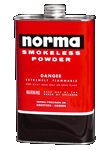 Norma 203B Available from Grafs.com — Replaces Varget or RL15 Norma 203B Available from Grafs.com — Replaces Varget or RL15
For those folks desperate to find Hodgdon Varget or Alliant Reloder 15, we suggest you try Norma 203B. This is a very accurate powder very close in performance to Reloder 15 (it is produced by the same manufacturer, Bofors). It should give slightly more velocity than Varget, but it is somewhat more temperature sensitive.
In a 6mmBR or .308 Win, start with your Varget load with 203B. You may, then, be able to increase the load slightly, unless you’ll be shooting in very hot weather. Grafs.com has plenty of 1-lb cans of Norma 203B in stock, Item Number: NP203B1, $24.99 per pound.
May 12th, 2009
Forum Member Jim (Falconpilot) recently completed “Yeller”, a stunning new F-Class rig, chambered as a 6mm Dasher. Built with a BAT RBLP right-eject action, the gun features a Robertson Composites F-Class stock and Krieger 28″ barrel. With Berger 108gr VLDs, Reloder 15 and Wolf primers, “Yeller” has shot in the ones and low twos at 100 yards.

Jim’s new Dasher has already proven itself in competition. This past weekend, Jim took “Yeller” to Camp Robinson. In the very demanding 1000-yard F-class division, Jim shot 197/6X, 197/0x, and a 199/10X. Yeller’s proud owner tells us: “On the final 199/10X relay the one shot that drifted to the 9 rings was about 1″ out — I called the shot, so the gun performed beautifully! Still learning the right ‘hold’ for this stick, but I can tell you that…having a gun that you have complete confidence in makes a huge difference.”

We asked Falconpilot about his bright yellow color choice. “The stock came in a basic dark gray and I wanted something that I couldn’t lose on the firing line! The color turned out better than I hoped. The paint is PPG Lemon Ice Yellow, with PPG Clear. I shot a base coat of white, then the Lemon Ice, then clear. Special thanks to Howard Pitts at Pitts Precision for chambering another perfect chamber. A huge thanks to my shooting buddy and friend, Matt Owens of ARKCO Customs for helping me pillar bed the stock, and the use of his equipment. His gun is next, mine was the test subject for us, as neither one of us had ever pillar-bedded a rifle before. The result shown on the target (below) show that we got it right!”

 “Yeller” Dasher Gun Specs: “Yeller” Dasher Gun Specs:
6mm Dasher, .269″ neck, .104 freebore
BAT MB Right Bolt, Left Port, Right Eject
Kreiger 28″, 1.250″ straight, 1:8″ twist
Robertson SG&Y F-Class Stock
Jewell Trigger, Bat Trigger Guard
Nightforce NXS 12-42×56, CH-3, Bat Rings
Loading Tips for the 6mm Dasher
Jim reports: “I’ve found that using Varget while fire-forming forms the cases a little more evenly, but Reloder 15 is my ‘go to’ powder once fire-formed. I resize the brass and bump the shoulders back .0015-.002″ after every firing. Then I’ll tumble-clean the brass. I then use a .265″ bushing in my Redding neck die to resize the necks about 3/4 way down, clean the primer pockets, and reload from there.” As for bullets, Jim adds: “Every Krieger 6mm .237 barrel that I’ve had has shot the 108 especially well.”
April 27th, 2009
 We’ve learned that many first-time visitors to AccurateShooter.com may come in via a link to the Daily Bulletin rather than through our home page. As a result, they may not be aware that there is a wealth of other content available to our readers. Our Shooters’ Forum, with nearly 8,000 registered members, is one of the best places on the web to discuss precision shooting and advanced reloading. We also offer FREE Forum Classifieds. On the editorial side, AccurateShooter.com offers hundreds of pages of content, with thousands of photos. Our Cartridge Guides are considered definitive sources of tech info for popular match calibers, and our Guns of the Week articles provide in-depth reports on outstanding custom rifles, most of which have competition pedigrees. In addition, we offer videos, gear reviews, book reviews, an event calendar, and even FREE downloadable targets. We’ve learned that many first-time visitors to AccurateShooter.com may come in via a link to the Daily Bulletin rather than through our home page. As a result, they may not be aware that there is a wealth of other content available to our readers. Our Shooters’ Forum, with nearly 8,000 registered members, is one of the best places on the web to discuss precision shooting and advanced reloading. We also offer FREE Forum Classifieds. On the editorial side, AccurateShooter.com offers hundreds of pages of content, with thousands of photos. Our Cartridge Guides are considered definitive sources of tech info for popular match calibers, and our Guns of the Week articles provide in-depth reports on outstanding custom rifles, most of which have competition pedigrees. In addition, we offer videos, gear reviews, book reviews, an event calendar, and even FREE downloadable targets.
If you’re a new visitor to AccurateShooter.com, you should check out all that we have to offer. There are hundreds of informative articles to read … and they’re all free.
 AccurateShooter.com Features: AccurateShooter.com Features:
 Shooter’s FORUM Shooter’s FORUM
FREE Classified Ads
ARTICLES Archive
CARTRIDGE Guides
FREE Targets
GUNS of the Week
TECH Articles
Gun VIDEOS
Gear Reviews
Book Reviews
Event CALENDAR
COMPETITION Resources
April 12th, 2009
Asst. Editor Jason Baney recently commenced load testing with our 6-6.5×47 Lapua project rifle. (Built as a dual-caliber, switch-barrel test bed, this gun also has a 6.5×47 barrel). Our goal at this stage is to find basic starting points and max loads for a variety of popular powders. This is important because the 6-6.5×47 is a wildcat cartridge and very little “official” load data is currently available from the powder makers. We initially hope to give our readers a starting point when loading for the 105-108gr class of BT match bullets. Later we’ll work up load points for both heavier and lighter bullets.

Thus far, Jason has tested 6 powders: Alliant Reloder 17, Hodgdon Hybrid 100V, Hodgdon H4350, Norma N204, and Vihtavuori N160 and N550. With these powders, Jason shot ladders with charges in 0.5 grain intervals. All initial testing was done with Berger 105gr VLD bullets. Jason will continue testing next week with other bullets, including 115gr DTAC, 107gr Sierra MK, 105gr Hornady A-Max, 95gr Berger VLD, and 80gr Berger FBHP. He will also try some faster powders (Varget and Reloder 15) with the lighter bullets.
 Reloder 17 Very Impressive and H4350 Performed Well Reloder 17 Very Impressive and H4350 Performed Well
Thus far, the most promising powders, in terms of velocity, accuracy, and vertical dispersion, have been RL17 and H4350. According to Jason, “N204 was also very intriguing, displaying tight vertical, but it showed a lot of horizontal–though it was windy during that testing phase”. Shooting ladder tests at 200 yards, RL17 exhibited very tight vertical over a wide velocity spread, and 4 out of 6 loads went into a 1/2″ group at 200. Max RL17 velocity in our 30″ Bartlein barrel was 3199 fps. H4350 topped out above 3150 fps, but some pressure signs appeared at about 3120 fps. To top 3100 fps with H100V, Jason needed a compressed load. Velocities with N160 were quite slow compared to the other powders, and N550 maxed out at 3095 fps.
CAUTION: Jason was shooting with a 30″ barrel and a strong, custom BAT action. You may not be able to achieve the stated velocities in your barrel. When we’ve completed testing we will publish suggested starting loads for these powders.
March 28th, 2009
 Harrell’s Precision sells “semi-custom” full-length bushing dies for the PPC and 6BR chamberings. While the Harrell brothers do not cut the die to spec, they carry a large selection of dies made with slightly different internal dimensions. When you send in your fired brass, the Harrells choose a die from inventory with just the right amount of sizing (diameter reduction) at the top and bottom of the case. Given the quality, and precise fit, Harrell’s full-length dies are a good value at $70.00 plus shipping. Harrell’s Precision sells “semi-custom” full-length bushing dies for the PPC and 6BR chamberings. While the Harrell brothers do not cut the die to spec, they carry a large selection of dies made with slightly different internal dimensions. When you send in your fired brass, the Harrells choose a die from inventory with just the right amount of sizing (diameter reduction) at the top and bottom of the case. Given the quality, and precise fit, Harrell’s full-length dies are a good value at $70.00 plus shipping.
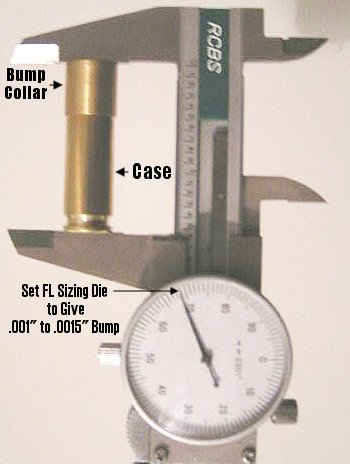
 Bump Measuring Collar Bump Measuring Collar
The Harrell brothers provide a nice bonus item with each full-length die — a neat, little shoulder bump measuring device as shown in the photo at right. Hornady/Stoney Point sells a stand-alone tool that does the same job, but the Harrell’s bump collar is simpler and faster. To measure your shoulder bump, simply place the Harrell’s bump collar over the front of your deprimed case (before sizing) and measure the OAL with your calipers. Then size the case in your full-length die, replace the collar and repeat the measurement. You want to set your die so the shoulder moves back about .001″ to .0015″ for most applications. (With semi-auto guns you may want more bump.)
When measuring for shoulder bump, you need to remove the primers first. Our friend Boyd Allen explains: “Use a decapping tool or die to remove the fired primer before taking the initial measurement. When working to thousandths, even the raised edge of a crater or a slightly raised primer can throw you off by a significant amount.”
|


