Intro: Ron Dague wanted a new gun that was similar to his trusty .223 Rem rifle, but which fired 6mm bullets. There is a superb choice of bullets in this caliber, and Ron found that the 95gr Berger VLD could be driven to a healthy 2604 FPS by the small .223 Rem case. This 6mm wildcat based on the common .223 Remington offers excellent accuracy and very low recoil — something very important in the cross-the-course discipline. In addition, Ron’s 95gr load with Alliant Reloder 15 delivered an ES of just 4 fps over ten shots. That exceptionally low ES helps achieve minimal vertical dispersion at 600 yards.
I have watched a change in thinking for NRA High Power across the course in match rifles and calibers. There are several [popular chamberings]: 6mm AR, 6.5 Grendel, 6XC, and 6.5 Creedmoor. I have seen these rifles perform and all have done very well.
When I started this project I was looking for a cartridge that shoots and feeds well from a magazine[.] I had shot the .223 Rem in my 722 Remington and knew it had fed well so I chose the .223 Remington necked up to 6mm.
The 6mm-223 gives me what I have in the standard .223 only with a better selection of bullets. I wanted a better 600-yard bullet with a higher BC than provided by the 80 and 82 grain bullets. I also wanted a 600-yard line bullet with a .500 or better B.C. for those shots that should be 10 ring or better but seem to find the 9 ring no matter how well I held and broke the shot.
Putting the 6mm-233 Project Together
My project started with ordering a 6mm barrel from Bartlein with a 1-8″ twist. I called Pacific Tool and ordered the 6mm-223 reamer. I found a used Remington 700 action at a local gun shop and already had a Remington 40X stock. I then started putting the gun together.
I already had a .223 Remington match rifle, and I wanted the 6mm-223 to be as close to the same as I could make it. I installed the barreled action in a wood 40X stock to work up load data and work out any magazine feeding issues. While I was working on that, I looked for a McMillan Baker Special stock and finally found one to finish this project. I bedded the action and stock, then took the rifle to the range to check zeros on the sights and scope. I was surprised that I didn’t have to change anything on the sights. I thought changing the stock would cause sight changes. The thought went through my head, “Maybe the 40X stock isn’t all that bad”.
Here’s line-up of 6mm bullets. The Berger 95gr VLD is in the middle.
I took the new rifle to the first match of the year, a National Match Course match, and my off-hand score was 83, rapid sitting 95, rapid prone 95, and slow fire prone 197 — for total aggregate 470. This may not be my best work, but on match day the wind was blowing about 15 mph and the temp was around 40° F, with rain threatening. This was a reduced course of fire — we shot at 200 and 300 yards on reduced targets.
I used 70gr Berger bullets for this match, loaded in Remington brass with 25 grains of VihtaVuori N540 and Federal 205M primers. When I worked up loads for this rifle, N540 gave the best accuracy with the best extreme spread — 2,950 fps with an extreme spread of 20 fps on a 10-shot string. The load for 600 yards was with a 95gr Berger VLD bullet, with 23.0 grains of Reloder 15, Lapua cases, and the same Federal 205M primers. This load is 2,604 fps, with an extreme spread of 4 fps over a 10-shot string. I’ve shot this load at several 3×600 yard matches, and the accuracy has proven to be very good. At the last 3×600 match, my scores were as follows: 199-10x and 198-11X with scope, and 193-10X with iron sights. Best 600-yard score so far with iron sights was 198-12X.
6mm-223 Rem Rifle Specifications: 700 BDL action and floor plate, Bartlein 6mm 1:8″ twist, McMillan Baker Special stock in Desert Camo, Centra front and rear sights, Ken Farrell bases with stripper clip guide, Sinclair hand stop, and Jewell trigger. Gunsmith Neil Keller helped me with the metal work and instructed me on the action work and rebarreling.
Big news for the shooting world — Vista Outdoor (NYSE:VSTO) is planning on selling its outdoor sporting products business to Czechoslovak Group A.S. (“CSG”) for $1.91 billion. This will involve transfer of some of the biggest names in the shooting/reloading world including: Federal, CCI, Remington Ammo, Speer, and Hevi-Shot. The sale and take-over is expected to be completed in 2024. We believe Alliant Powder will also be sold but that was not mentioned in the news release.
This represents a big change for the United States. Soon America’s largest commercial powder and ammunition manufacturer will be controlled by a European enterprise. CSG had previously acquired Fiocchi in 2022, and soon it will hold a very large segment of the total global ammunition market with the $1.91 billion deal to take over Vista Outdoor’s ammunition enterprises. READ Official Transaction Report.
Vista Outdoor’s current Sporting Products CEO Jason Vanderbrink will continue to lead the Sporting Products business and the U.S. headquarters will remain in Anoka, Minnesota. Vanderbrink stated: “We are confident that CSG is a great home for our leading ammunition brands. The company is fully committed to our iconic American brands and expanding our legacy of U.S. manufacturing, support for military and law enforcement customers, and investments in conservation and our hunting and shooting heritage.”
We are told that the approximately 4,000 Vista Outdoor employees now employed at four American factories will continue to work at those facilities to produce CCI, Federal, HEVI-Shot, Remington, and Speer products. According to SGB Media: “To effect the transaction, Vista Outdoor will separate its Outdoor Products business from its Sporting Products business, and CSG will merge one of its subsidiaries with Vista Outdoor (holding only the Sporting Products business), with current public stockholders of Vista Outdoor receiving shares of Outdoor Products … and approximately $750 million in cash in the aggregate. The transaction will be treated as a taxable sale of a stockholder’s Vista Outdoor shares for the Outdoor Products shares and cash consideration they receive in the merger, allowing stockholders to recover tax basis and recognize built-in gain and loss in their Vista Outdoor shares.”
David Štěpán, Member of the CSG Board and Investment Director for CSG International Projects, stated: “Vista Outdoor’s Sporting Products business is vertically integrated, has excellent financial results and is well invested. Thanks to this acquisition, CSG will become one of the most important ammunition manufacturers in the world with a comprehensive portfolio across all calibers.”
According to the Business Wire: “The proposed transaction would be CSG’s largest acquisition to date after a long series of smaller acquisitions focused on the European market, including the acquisition of Fiocchi Munizioni in 2022. It also represents the largest acquisition in the history of the Czech defense industry. The transaction is expected to close in calendar year 2024, subject to shareholder approval, receipt of necessary regulatory approvals and other customary closing conditions. Upon closing, Sporting Products will become a wholly owned subsidiary of CSG, operating as a private company. Jason Vanderbrink will remain CEO of the Sporting Products business and the U.S. headquarters will remain in Anoka, Minnesota.”
About Czechoslovak Group
Czechoslovak Group (CSG) is an international industrial technology holding company building on the tradition of the Czech and Slovak industry, owned by Michal Strnad. CSG supports the development of Czech and Slovak companies engaged in defense and civil industrial production and trade. More than 10,000 people are employed by CSG companies and affiliates. In 2022, the holding’s consolidated revenues reached 25 billion CZK. CSG operates across five strategic business segments covering aerospace, ammunition, defense, mobility and business projects.
About Vista Outdoor Inc.
Vista Outdoor (NYSE: VSTO) is the parent company of more than three dozen renowned brands that design, manufacture and market sporting and outdoor products. Brands include Bushnell, CamelBak, Bushnell Golf, Foresight Sports, Fox Racing, Bell Helmets, Camp Chef, Giro, Simms Fishing, QuietKat, Stone Glacier, Federal Ammunition, Remington Ammunition and more. Our reporting segments, Outdoor Products and Sporting Products, provide consumers with a wide range of performance-driven, high-quality and innovative outdoor and sporting products. For more information, visit www.VistaOutdoor.com.
If you want smoother bullet seating, inside neck lube can help. Forum member Ackleyman II likes to add a little Mica powder inside his case necks before seating bullets. This is easily done with the Forster three-brush neck lube kit. Ackleyman tells us: “Many loads that I have will not shoot well with a dry neck compared to a neck that is cleaned and lubed with this [Forster Dry Lubricator] — the best $15 you have ever spent.” You can order from Midsouth, MidwayUSA, or Precision Reloading starting at $15.46.
The Forster Case Neck Lubricator features three brushes attached to a tough, impact-resistant case with holes for bench mounting. The brushes accommodate all calibers from 22 to 35 caliber. The kit includes enough “motor mica” to process 2000 to 3000 cases and has a cover to keep dust and grit from contaminating the mica. By moving the case neck up and down on the correct mica-covered brush, the neck can be cleaned and lubricated at the same time.
Function: Lubricate case necks for easier resizing
Contents: Kit with base, lid, and three nylon brushes
Lubricant: Includes 1/10 oz. of Motor Mica, enough to process 2000-3000 cases
Neck Lubrication After Ultrasonic Cleaning
If you wet-tumble your cases with stainless media and solvents or ultrasonically clean your brass, you may find that the inside of the case necks get too “squeaky clean”. The inside surface of the neck looses lubricity. In this situation, applying a dry lube can definitely be beneficial. CLICK HERE to see story about ultrasonic cleaning.
At the request of our readers, we provide select “Deals of the Week”. Every Sunday afternoon or Monday morning we offer our Best Bargain selections. Here are some of the best deals on firearms, hardware, reloading components, optics, and shooting accessories. Be aware that sale prices are subject to change, and once clearance inventory is sold, it’s gone for good. You snooze you lose.
NOTE: All listed products are for sale to persons 18 years of age or older. No products are intended for use by minors.
1. Sportsman’s WH — Savage Axis w/ Scope Combo, $399.99
⏺ Great price on hunting rifle with scope
Need an affordable scoped rifle for a fall hunt? Check out the Savage Axis w/ Bushnell Combo. For just $399.99, you get the Savage Axis XP Rifle with mounted Bushnell 4-12x40mm scope. Chose from a variety of popular chamberings including: .223 Rem, .243 Rem, 6.5 Creedmoor, ,270 Win, .308 Win, 350 Legend, and .30-06 Springfield. Most feature a 22″ barrel, but some come with 18″ or 20″ barrels. The AXIS XP features a tough synthetic stock and detachable box magazine.
2. Amazon — Kestrel 1000 Wind Meter, $79.00
⏺ Excellent basic Kestrel at a great price
Sometimes all you want to know is the windspeed so you don’t need other fancy wind meter features. The Kestrel 1000 is a great no-frills wind meter. This unit measures and displays maximum, current and average wind speed in m/s, ft/min, km/h, mph, and knots on a large, clear LCD screen. Priced at just $79.00 on Amazon, this rugged unit floats, is waterproof (IP-67), and is drop-tested to military standards (MIL-STD-810G).
3. Precision Reloading — Ammo Sale Up To 37% Off
⏺ Major savings on big-name hunting and match ammo
If you need quality ammunition for that fall hunt, check out the October Ammo Sale at Precision Reloading. You’ll find a large range of cartridge types from Federal Hornady, Berger, Winchester and more with discounts up to 37%. This is a great opportunity to get quality ammo for that deer or varmint rifle. Precision Reloading also has Fall Hunter discount codes: CODE 1623 for $10 off $100 and CODE 2623 for $25 off $250.
4. Midway USA — Vortex Viper PST 5-25x50mm, $659.99
⏺ Save $440 on good scope for PRS/NRL matches and varminting
Looking for first focal plane (FFP) scope for PRS/NRL competition? Here’s a great deal on the Vortex Viper PST 5-25x50mm FFP scope. The sale price is just $659.99, marked down from $1099.99. That’s a whopping $440 savings — a full 40% off. This Viper PST scope features zero stop and illuminated reticle. The 5-25X magnification range is just about ideal for PRS/NRL competition. Vortex offers one of the best scope warranties around, so buy with confidence.
⏺ Very affordable option for a good, basic Black Rifle
AR15-platform rifles are great for self-defense, varminting, and service rifle competition. This week Palmetto State Armory, a leading AR vendor, is offering complete finished PSA PA-15 rifles for just $469.99. You could pay that much for an upper alone. Listed as “Blem” models, with slight finish imperfections, these PA-15 rifles are durable and function well. The forged 7075-T6 aluminum lower mounts an 6-position adjustable buttstock. The hard-coat anodized upper features a full-length upper rail and lightweight M-Lok free float handguard. The barrel is 1:7″ twist.
6. EuroOptic — U.S. Optics Scope Sale
⏺ Very high-quality scopes with huge savings
U.S. Optics makes some great optics but they usually come with a hefty price tag. But right now EuroOptic is running a sale U.S. Optics TS Scopes with some incredibly low prices. Select among three power ranges: 1-8X, 3-12X, and 5-25X. If you’re putting together a PRS/NRL competition rig we recommend the U.S. Optics TS 5-25x50mm FFP scope. The sale price is just $499.00, HALF the regular $995.00 price.
7. Amazon — ShootingTargets7 AR500 Steel Targets
⏺ Good selection of AR500 steel targets with durable zinc coating
Steel targets are great for fun shooting and tactical training. Right now Amazon offers a line of USA-made Zinc-plated, laser-cut AR500 Steel Targets starting at just $7.97 (for 3″ diameter gong). Choose from a variety of sizes ranging from 3″ to 16″ diameter and thicknesses 1/4″, 3/8″, or 1/2″. There’s also a 12″x23″ torso target. The Zinc plating on the steel prevents rust. The maker says the zinc “is far more durable than paint or powder coat.”
⏺ Popular hunter’s target with grid and deer image
Before you head out hunting, you should sight-in your rifle and do some practice. A good target option is the Pro-Shot Products 25″ x 25″ Whitetail Deer Sight-in Target. Priced at just $9.19 for a 5-pack, this is a good sight-in target with a grid background and four prominent sighting diamonds. This target shows key animal vitals and the deer image is very realistic — providing good preparation for your hunt.
9. Amazon — Lyman Universal Case Prep Set, $63.95
⏺ Handy kit with 8 useful tools with molded handles
Proper brass prep includes deburring, chamfering, cleaning primer pockets and more. The Lyman Universal Case Prep Tool Kit has all the key prep tools you’ll need. This kit includes both large and small primer pocket reamers, primer pocket cleaners, outside deburring tool, inside (VLD) chamfer tool and large and small primer pocket uniformer tools. All individual items have their own molded handle with rubber insert for sure grip. The kit includes a nice, zippered case for storage and/or transport. For $64.88 you can get all the same tools in a rugged Lyman Hard Case Prep Tool Kit.
10. Amazon — Hornady One Shot Lube, $22.99
⏺ Very effective case lube, popular with our Forum members
Sizing brass can be a chore without the right lube. One of our favorites is Hornady One Shot. This lube spreads evenly and works well with sizing dies. Many top shooters use this lube both with single stage and progressive presses.
This article originally appeared in the Sierra Bullets Blog.
Sierra Bullets asked a few hand-loaders to reveal their favorite reloading tool or accessory: “What is your favorite ‘don’t know how you ever lived without it’ piece of reloading equipment?” Some of the answers are listed below. We were interested to see some high-tech, micro-processor items mentioned, such as the AMP Annealer, and the AutoTrickler powder dispenser. Old standbys, such as the rugged RCBS Rockchucker and Dillon 650, also made the favorites list.
What Is Your Favorite Piece of Reloading Equipment?
Bill, Editor of Rifleshooter.com, answered: “I have so many favorite reloading tools, it’s hard to pick one. But if I had to, it would be my Forster Co-Ax press. I like the ease [with which] you can change dies and that it doesn’t require traditional shell holders. It’s a great tool to have!”
Sierra Bullets Ballistic Technician Philip Mahin answered: “A comparator gauge to measure from the base of a case to the ogive of the bullet. This bypasses the tip of the bullet, so I can repeat the same seating depth the next time I visit a specific combination.”
Ballistic Technician Carroll Pilant answered: “Dillon 550 and 650 presses.”
Ballistic Technician Rich Machholz answered: “My universal decapping die is as handy as a pocket on a shirt.”
Ballistic Technician Philip Mahin answered: “A comparator gauge to measure from the base of a case to the ogive of the bullet. This bypasses the tip of the bullet, so I can repeat the same seating depth the next time I visit a specific combination.”
Jon Addis answered: “Putting an A&D FX-120i scale with AutoTrickler and Auto-Throw on the bench has changed the way I reload. It’s kernel accurate in about 15 seconds. Saves time and reduces a variable. And of course, the system is made better by the Area 419 Billet Adjustable base for the trickler and Billet Powder Cup.”
This video shows the AutoTrickler V3 System
Ballistic Technician Paul Box answered: “The Lee hand priming tool.”
Former Ballistic Technician Robert Treece answered “My homemade dental pick. I use it to check incipient case-head separations. We all see the ‘bright ring’ down close to the case head, that’s natural, but after several firings could be starting to split apart. If the pick hooks into a crevice — DON’T TRY TO SIZE THE CASE. It will pull apart in your die.”
Dan Blake answered: “My Annealing Made Perfect (AMP) annealer. With consistent neck tension being one of the largest contributions to small Extreme Spread on muzzle velocities, I believe this induction annealer is truly the best on the market.”
This manufacturer-produced video shows how the AMP annealing machine operates:
Process Engineer David Palm answered: “Homemade case lube.”
Plant Engineer Darren Leskiw answered: “Beyond the normal equipment, I’d say my electronic scale. Using the beam balance for the past 9 years was ok, but nowhere as easy as using an electronic scale.”
There were many votes for the classic RCBS Rock Chucker single-stage press:
Ballistician Gary Prisendorf answered “RCBS Rockchucker Press, it’s built like a tank, and it will last me a lifetime.”
Production Manager Chris Hatfield answered: “RCBS single stage reloading press.”
Maintenance & Machine Shop Lead Craig Westermier answered: “RCBS Rock Chucker.”
Production Resource Manager Dan Mahnken answered “RCBS Rock Chucker! Buy one and it lasts a lifetime.”
Sierra Bullets Ballistic Technician Duane Siercks answered: “I don’t know that you would actually call this equipment, but the item that comes to mind would be my reloading room/shoot house. I had always had to squeeze everything into a corner or even an unheated shed. After we bought our current house, I built a garage and placed it so that I had a window looking down a 250-yard range. I built a dedicated room with heat and A/C. It contains my reloading bench and a shooting bench. The shooting bench lets me slide open the window and shoot down the range. It is very handy to not have to load everything up to go to the range. It also makes load development a lot simpler and efficient. I don’t know how I ever got along without it.
I also wonder what I did before I acquired the Lyman 1200 DPS Powder Dispenser. This has made the process so much simpler and much easier. I also have a Lee Precison Universal Decapping Die that I would gladly spend the money on again. This may be a small thing, but it certainly is handy. The Lee would accommodate some very large cases that some of the others were too small for.”
Close-up of the Tri-Way Trimmer with clear plastic chip guard removed.
Giraud Tool offers a case trimmer/chamferer device that works with a power drill (or other power source). Giraud’s patented Tri-Way Trimmer is a self-contained unit powered by your drill or motor. Using a sharp carbide blade it will trim your cases to length, deburr, and cut both inside and outside chamfers — all in one pass. That’s pretty impressive for a $110.00 tool that fits in the palm of your hand.
Product Features
1. Fully adjustable for cartridge length (and depth of chamfer).
2. Carbide blade cuts a 15° inside case mouth chamfer and 45° outside chamfer.
3. Case holder supported by sealed ball bearing raceway.
4. Tool includes removable, transparent plastic chip guard.
5. Tool can work in any orientation (vertical, horizontal, or any angle).
The Giraud Tri-Way Trimmer is designed to be powered by a portable hand drill, drill press, or other dedicated rotating power source. The tool indexes off the shoulder of your cases, but the blade adjusts so that cartridge overall length (COAL) can be controlled with precision. Constructed out of 6061-T6 aluminum and 303 stainless steel, the Tri Way tool should last a lifetime. Note: This tool is not universal. The Tri Way is dedicated to a single cartridge and “related” cartridges with similar body dimensions. Thus you need a specific tool for each cartridge family. For example, the .308 Win tool will also trim .243 Win, .260 Rem, and 7mm-08.
Cartridge Sizes Available for Giraud Tri Way Trimmer:
.223 Remington (Also trims .17 Remington, .204 Ruger, .222 Remington, .222 Remington Magnum)
7.62 x 39mm (Russian)
.300 Blackout (Also trims .17 Rem Fireball, .20 Vartarg, .221 Fireball)
.308 Winchester (Also trims .243 Winchester, .260 Remington, 7mm-08)
.30-06 Springfield (Also trims .25-06, .270 Winchester, .280 Remington)
.300 Winchester Mag (Also trims Also trims .264 Winchester Magnum, 7mm Remington Magnum, .308 Norma Magnum)
Product Tip from EdLongrange. We welcome reader submissions.
When your cases become hard to extract, or you feel a stiff bolt lift when removing a cartridge, it’s probably time to full-length size your cases, and “bump” the shoulder back. We generally recommend bumping shoulders each time you reload, after the initial fire-forming. Benchrest and F-Class benchrest shooters, running relatively high pressures, typically full-length size every load cycle, bumping the shoulder .001-.003″. High Power shooters with gas guns generally full-length size every time, and may need to bump the shoulders .003″ or more to ensure reliable feeding and extraction.
Use Shims for Precise Control of Shoulder Bump
Some shooters like to set the “default” position for their full-length die to have an “ample” .003″ or .004″ shoulder bump. When they need less bump, a simple way to reduce the amount of shoulder movement is to use precision shims in .001″ (one-thousandth) increments.
Here are reports from Forum members who use the shims:
“Great product. I have my die lock ring(s) adjusted for the shortest headspace length on my multiple chambers 6BRs and 6PPCs. When needing a longer headspace, I just refer to my notes and add the appropriate shim under the lock ring. Keep it simple.” — F.D. Shuster
Mats Johansson writes: “I’ve been using [shims] since Skip Otto (of BR fame) came out with them. I set up my dies with the .006″ shim, giving me the option of bumping the shoulder a bit more when the brass gets old and hardens while still having room to adjust up for zero headspace, should I have missed the original setup by a thou or two. Hunting rounds can easily be bumped an extra .002-.003″ for positive, no-crush feeding. Being a safety-oriented cheapskate, I couldn’t live without them — they let me reload my cases a gazillion times without dangerous web-stretching. Shims are a must-have, as simple as that.” — Mats Johansson
Sinclair Die Shim Kit — Seven Shims for $14.99
Sinclair Int’l (through Brownells) offers a seven-piece set of Sizing Die Shims that let you adjust the height of your die (and thereby the amount of bump and sizing) in precise .001″ increments. Sinclair explains: “Some handloaders will set their die up to achieve maximum sizing and then progressively use Sinclair Die Shims between the lock ring and the press head to move the die away from the shellholder. Doing this allows you to leave the lock ring in the same position. These shims are available in increments of .001″ and work very well.”
Seven Shims from .003″ to .010″
Sinclair’s $14.99 Die Shim Kit (item 22400) includes seven shims in thicknesses of .003, .004, .005, .006, .007, .008, and .010. For ease of use, shim thickness is indicated by the number of notches cut in the outer edge of each shim. Even without looking you can “count” the notches by feel.
Do you often load at the range? Or maybe you need to transport loading gear when you travel in your RV. Well here is a smart transport option — a metal box that holds tools, dies, arbor press, case-trimmer, even a ChargeMaster.
Some guys have built their own loading tool-boxes from wood. Other may stuff gear in a couple of plastic range boxes. But clever Chris Covell came up with an even better solution. Chris sourced a handsome, sturdy metal Horse Grooming Box from eBay. Chris reports the multi-feature metal box “works perfectly for reloading. My ChargeMaster is now out of the wind.”
Bullets, Trickler, and Priming Tool on Top
On top, below the hinged metal lid, is a large compartment that holds Covell’s funnels, scales, priming tool, trickler and other vital gear (photo on right). This top compartment is deep enough to handle wide-mouth funnels with no problem.
Slide-Out Drawer with Dividers
Below the top level is a handy sliding drawer with multiple dividers. This is perfect for holding Covell’s inline seating dies, case-neck deburring and chamfering tools, among many other smaller bits and pieces.
In the bottom of the Horse Grooming box is a large compartment that holds bigger gear. In the bottom section, Covell places his RCBS Chargemaster Lite, along with a case-trimming tool, an arbor press, and various other bulky tools. Check it out:
Folks who load at the range need to bring a lot of gear — reloading presses, powder dispensers, scales, funnels, sizing/seating dies, brass prep tools and more. And there may be other important items to transport — such as ammo caddies, LabRadar mounts, over-size rest feet, and even barrel fans. With this metal box you can easily organize (and protect) al that gear. This box was sourced affordably via eBay.
Chris Covell’s Range Box was featured on the Benchrest Shooting and Gunsmithing Private Group Facebook Page. You may want to sign up for this Group — with membership you can access a wealth of information for accuracy-oriented shooters.
RCBS, a leading manufacturer of reloading equipment and tools, celebrates its 80th anniversary this year, marking eight decades of equipping handloaders with quality, American-made reloading gear. “After 80 years of operation, RCBS is still delivering top quality reloading products backed by world class customer service,” said Justin Smith, product line manager for RCBS. “The brand has never lost the essence that Fred championed back in 1943 and the men and women in Oroville today truly do bleed green. You’ll be hard pressed to find another group who cares more about the quality of products they produce and the consumers who depend on them.”
The RCBS story began in 1943 in the backroom of Fred T. Huntington’s father’s laundry and dry-cleaning business in Oroville, California. A dedicated shooter, Huntington sought to make his own high-quality .22 caliber bullets for shooting local varmints known as rock chucks. He designed and crafted his own “Rock Chuck Bullet Swage” dies, a name later shortened to RCBS.
In the decades following becoming a business, RCBS rapidly grew from a small shop into the nation’s leading maker of reloading equipment. Now using state-of-the-art equipment in large manufacturing facilities, RCBS has stayed near its roots in Oroville.
Product manager and R&D engineer, Steve Koch, has witnessed RCBS’s impressive growth firsthand. He’s been with the company for over 40 years and knows personally how passionate the employees are in Oroville. “Wow, 80 years, a lot has changed. I’m very proud to say that I’ve spent 45 years at this great establishment,” said Koch. “Everyone is extremely proud of what we have here in Oroville. The pride and dedication of the people that produce, assemble and package the finest reloading equipment in the world is the key to our success. Quality is the RCBS motto, and we will continue to ensure we provide our customers with the finest reloading equipment possible.”
In honor of its 80th anniversary, RCBS will soon be introducing a limited-edition Summit single-stage reloading press. This American-made press will feature a special red, white and blue design, and will be limited to only 1,000 pieces. Stay tuned to RCBS social media channels and RCBS.com for more info on this special Summit press release.
To learn more about the RCBS 80th anniversary, check out the video below. For more information on RCBS products and 80-year company history visit RCBS.com.
Here are two different bullet types, seated to the same CBTO length, but different COAL. Note the shiny scratches on the bullets made by the comparator tool which indicates a point on the bullet ogive near where the ogive will engage the rifling.
Effects Of Cartridge Over All Length (COAL) And Cartridge Base To Ogive (CBTO) – Part 2 by Bryan Litz forBerger Bullets. Part One of this series focused on the importance of COAL in terms of SAAMI standards, magazine lengths, seating depths, and pressure levels. Another measure of length for loaded ammunition is highly important to precision, namely Cartridge Base to Bullet Ogive Length (CBTO).
Figure 2. Chamber throat geometry showing the bullet jump to the rifling or lands.
Look at Figure 2. Suppose the bullet was seated out of the case to the point where the base of the bullet’s nose (ogive) just contacted the beginning of the riflings (the lands) when the bolt was closed. This bullet seating configuration is referred to as touching the lands, or touching the riflings and is a very important measurement to understand for precision hand-loading. Due to the complex dynamics of internal ballistics which happen in the blink of an eye, the distance a bullet moves out of the case before it engages the riflings is highly critical to precision potential. Therefore, in order to systematically optimize the precision of his handloads, it’s critically important that the precision hand-loader understands how to alter bullet seating depth in relation to the barrel rifling. Part of the required knowledge is understanding how to accurately and repeatably measure the Cartridge Base To Ogive (CBTO) dimension. This is explained in the FULL ARTICLE.
Bryan Litz offers an extended discussion on how to measure CBTO using different tools and methods, including the Hornady OAL gauge. You can read this discussion in the full article found on the Berger Bullets website. CLICK HERE to Read Full Article.
Why Not Use CBTO as a SAAMI Standard?
If CBTO is so important to rifle accuracy, you might ask, “Why is it not listed as the SAAMI spec standard in addition to COAL?” There is one primary reason why it is not listed in the standard. This is the lack of uniformity in bullet nose shapes and measuring devices used to determine CBTO.
Benefits of Having a Uniform CBTO
There is another aspect to knowing your CBTO when checking your COAL as it pertains to performance. With good bullets, tooling, and carefully-prepared cases you can easily achieve a CBTO that varies less than +/- .001″ but your COAL can vary as much as .025″ extreme spread (or more with other brands). This is not necessarily bad and it is much better than the other way around. If you have a CBTO dimension that varies but your COAL dimension is tight (within +/- .002″) then it is most likely that your bullet is bottoming out inside the seater cone on the bullet tip. This is very bad and is to be avoided. It is normal for bullets to have precisely the same nose shape and it is also normal for these same bullets to have nose lengths that can vary as much as .025″.
Summary of Cartridge Base To Ogive (CBTO) Discussion
Here are four important considerations regarding bullet seating depth as it relates to CBTO:
1. CBTO is a critical measurement to understand for handloaders because it’s directly related to precision potential, and you control it by simply setting bullet seating depth.
2. Tools and methods for measuring CBTO vary. Most of the measurement techniques have pitfalls (which may give rise to inconsistent results) that you should understand before starting out.
3. A CBTO that produces the best precision in your rifle may not produce the best precision in someone else’s rifle. Even if you have the same rifle, same bullets, same model of comparator gauges, etc. It’s possible that the gauges are not actually the same, and measurements from one don’t translate to the same dimension for another.
4. Once you find the CBTO that produces the best precision in your rifle, it’s important to allow minimal variation in that dimension when producing quality handloads. This is achieved by using quality bullets, tooling, and properly preparing case mouths and necks for consistent seating.


 By Ron Dague, Sinclair Reloading Tech
 Putting the 6mm-233 Project Together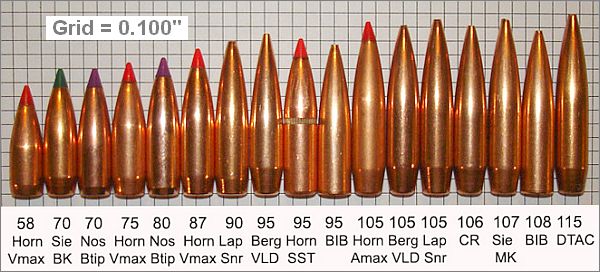


 Plant Engineer Darren Leskiw answered: “Beyond the normal equipment, I’d say my electronic scale. Using the beam balance for the past 9 years was ok, but nowhere as easy as using an electronic scale.”


 Bullets, Trickler, and Priming Tool on Top


 Effects Of Cartridge Over All Length (COAL) And Cartridge Base To Ogive (CBTO) – Part 2


