Tomorrow is the first day of August, the beginning of National Shooting Sports Month (NSSM). Each August, throughout the month, America’s shooters come together to celebrate our sport and get newcomers involved. To help grow the ranks of shooters, the National Shooting Sports Foundation (NSSF) asks you to bring a new shooter to the range in August. That’s a good mission — adding to the ranks of shooters is the best way to preserve our Second Amendment rights.
This month, newcomers can take their first shots, and experienced shooters can invite someone new to the range or help an older shooter rediscover the fun of target shooting. This month-long event involves all the shooting sports — rifle, pistol, and shotgun.
Find Shooting Sports Events Near You
The NSSF’s ShootingSportsMonth.org website offers a comprehensive, searchable database. This lets you search by state, to find ranges, events, and sales promotions near you. Visit the NSSF online database of NSSM shooting events to find matches, clinics, training sessions, special sales — and much more.
Great FREE Targets for Fun at the Range
To promote National Shooting Sports Month, the NSSF offers 17 FREE Downloadable Targets. There are regular bullseyes, as well as Darts, Golf, and more. We really like the Billiards target and kids love the Water Balloons target. You can download all 17 targets for free, and then print them out, ideally with a color printer. Below are six of our favorite targets. Click HERE to download these six targets (3.5 mb ZIP).
What Shooters Can Do to Promote National Shooting Sports Month:
The NSSF says: “As shooters, you serve a critical role in the continued growth of gun ownership and shooting sports participation. We urge you to join us this August for National Shooting Sports Month.” There are a variety of ways you can help this August:
— Introduce a family member, friend, or group of friends to the shooting sports by taking them to a local range that’s hosting an event.
— Spread the word to family/friends and encourage them to get out to the range in August.
— Encourage the ranges and retailers near you to host an event this August and add them to the official events calendar at www.ShootingSportsMonth.org.
Find Shooting Ranges Throughout the USA
The NSSF offers a directory of shooting ranges online. Visit Wheretoshoot.org to get info on thousands of shooting ranges and facilities around the country. In addition, there is a FREE WheretoShoot Mobile App you can install on your phone. Versions are available for both Android and iOS (Apple) users.
The Tactical Rifle Shooters Facebook Group recently showcased tools used to measure case headspace before and after “bumping” the shoulder. After a case is fired, hand-loaders who full-length size their cases will typically bump the shoulders back anywhere from .001″ to .0035″, depending on the rifle and application. With our 6mmBR and Dasher cases we like about .0015″ bump.
You want the amount of case sizing and bump to be the same for all your brass. To ensure uniformity, it makes sense to measure your cases before and after the FL sizing process. When we have time, we check every case. Other folks will simply check the first 3-4 cases coming out of the FL sizing die to ensure the FL die setting is correct and delivering desired headspace/bump.
Whidden Gunworks Shoulder Bump Gauge
There are a variety of tools that can be used to measure shoulder bump. Our favorite is a special cartridge-specific bushing made by Whidden Gunworks. This handy $24.00 Whidden Shoulder Bump Gauge enables you to adjust your sizing die to the desired measurement. The bump gauge is attached to your calipers with a set screw and determines the measurement from the base to the shoulder of the case. The photo below, from Tactical Rifle Shooters, shows the Whidden Bump Gauge for the .375 CheyTac cartridge.
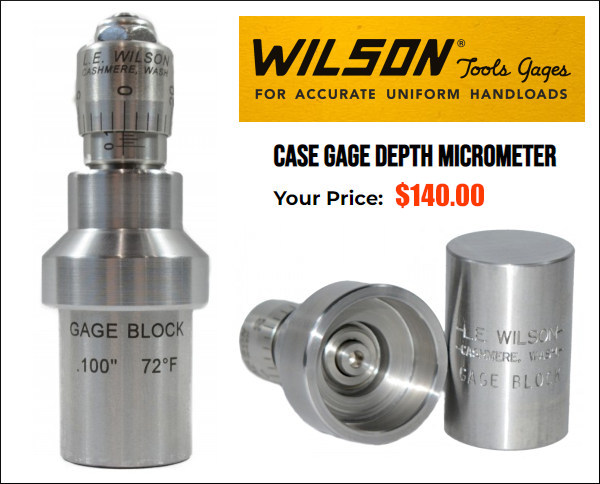
L.E. Wilson Case Gage Depth Micrometer
If you are looking for precise “bump” measurements without having to mess with calipers and clamp-on gauge blocks, you may want to consider the L.E. Wilson Case Gage Depth Micrometer (currently $140.00). This takes very precise, repeatable measurements, but you need to know your starting point. The manufacturer explains: “Every reloader should know exactly how much your Full Length Sizing Die is pushing back the shoulder. With the NEW Case Gage Depth Micrometer you can do just that! It has never been easier to measure you cases headspace before and after sizing. The Depth Mic allows you to slip the micrometer perfectly over the top of the Gage with your case inserted into the Gage and take a measurement. Micrometer has graduations of .001″. The Case Gage Depth Micrometer is set to a zero of .100″ on the scale at our factory. Because of differences in ‘feel’ and temperature, we include a the Gage Block for you to test Zero and to adjust if necessary.”
Dave Manson Vertical Comparator with Dial Read-Out
Dave Manson states: “This tool was designed to make life easier for the advanced shooter and re-loader by allowing precise measurement of ammunition, case, and chamber headspace. With this information, the re-loader will be able to fine-tune clearances and fits between his ammunition and chamber, with resultant improvements in accuracy and case life.” The functions of the Manson Dial Cartridge Comparator are:
1. Measure headspace of factory or reloaded ammunition
2. Quantify chamber headspace by measuring headspace of a fired case
3. Ensure minimal shoulder set-back when setting up re-loading dies
4. Compare base-to-ogive length to ensure consistent bullet-to-rifling relationship.
In addition to the Dial Indicator and Stand, the $180.00 Dial Cartridge Comparator is supplied with multiple Datum Blocks of precise length and inside diameter (.3300″/.3750″/.4000″/.4375″). MORE INFO HERE.
Hornady L-N-L Headspace Comparator System
Hornady’s Lock-N-Load Headspace Comparator system is easy-to-use and handy. You can get a kit with Red bushing-holder body and 5 bushings for $45.99 at MidwayUSA. Hornady explains: “The Lock-N-Load® Headspace Comparator… gauge measures variations in brass before and after firing or re-sizing. It allows for headspace comparison between fire-formed brass and re-sized brass.” IMPORTANT: Hornady states: “To determine the proper bushing diameter for your cartridge, simply add the neck diameter and the shoulder diameter and divide that number by two. Use the bushing closest to that number.” Hornady offers seven: .188″, .240″, .330″, .350″, .375″, .400″, and .420″.
One tip — We have found the Hornady gauges may vary a little from unit to unit even with the same nominal size. If you have more than one gauge for the same cartridge, test each on your brass — you may then note a slight difference in your bump measurements. Mark one and use that consistently. There is also an Anvil Base Kit that mounts to the opposite blade on the caliper. This provides a more stable surface for the base of your case.
Pistol Brass Case DIY Bump Gauge
Last is a “field expedient” set-up if you do not have any of the comparator tools shown above. A sized .45 ACP case (or other suitable pistol case) can be used to measure shoulder bump. The mouth of the pistol case sits on the shoulder of your rifle cartridge brass.
Make sure the .45 ACP case is trimmed square and that it is round. We recommend you first run it through an expander, then size it, trim it and chamfer. Next, take the .45 ACP case and slip it over the neck of a fired, unsized rifle case with the primer removed. Align the two cases between the jaws of your calipers and note the length from rim to rim (See left photo below).
OK, now you have the length for a fired rifle case BEFORE sizing. Next, take a full-length sized rifle case (without primer) and do the same thing, placing the .45 ACP case over the neck of the FL-sized case (Right Photo). The difference between the two numbers is the amount of “bump” or set-back you are applying to the shoulder. Here the difference is .0015″. The amount of bump you need varies with your chamber and your load, but .0015-.002″ is a good initial setting.
Efficient cartridges make excellent use of their available powder and case/bore capacity. They yield good ballistic performance with relatively little recoil and throat erosion.
Cartridge Efficiency: A Primer (pun intended!)by USAMU Staff
The U.S. Army Marksmanship Unit (USAMU) published a series of reloading articles on its Facebook Page. In this article, the USAMU discusses cartridge case efficiency and its benefits. While this is oriented primarily toward NRA High Power Rifle and Long Range (1000-yard) competition, these factors also apply to medium/big game hunters. Assuming one’s rifle and ammunition are accurate, key considerations include ballistic performance (i.e., resistance to wind effects, plus trajectory), recoil, and throat erosion/barrel life.
Efficient cartridges make excellent use of their available powder and case/bore capacity. They yield good ballistic performance with relatively little recoil and throat erosion. A classic example in the author’s experience involved a featherweight 7x57mm hunting/silhouette rifle. When loaded to modern-rifle pressures, just 43-44 grains of powder pushed a 139gr bullet at 2900 fps from its 22″ barrel. Recoil in this light rifle was mild; it was very easy to shoot well, and its performance was superb.
An acquaintance chose a “do everything” 7mm Remington Magnum for use on medium game at short ranges. A larger, heavier rifle, it used ~65 grains of powder to achieve ~3200 fps with similar bullets — from its 26″ barrel. Recoil was higher, and he was sensitive to it, which hampered his shooting ability.
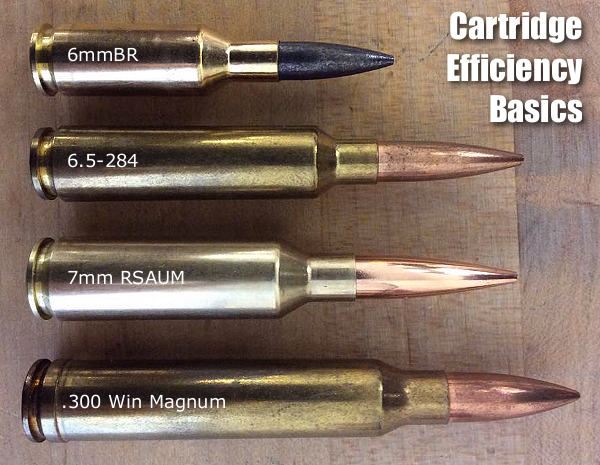
Similarly efficient calibers include the 6mm BR [Norma], and others. Today’s highly-efficient calibers, such as 6mm BR and a host of newer developments might use 28-30 grains of powder to launch a 105-107gr match bullet at speeds approaching the .243 Winchester. The .243 Win needs 40-45 grain charges at the same velocity.
Champion-level Long Range shooters need every ballistic edge feasible. They compete at a level where 1″ more or less drift in a wind change could make the difference between winning and losing. Shooters recognized this early on — the then-new .300 H&H Magnum quickly supplanted the .30-06 at the Wimbledon winner’s circle in the early days.
The .300 Winchester Magnum became popular, but its 190-220gr bullets had their work cut out for them once the 6.5-284 and its streamlined 140-142gr bullets arrived on the scene. The 6.5-284 gives superb accuracy and wind performance with about half the recoil of the big .30 magnums – albeit it is a known barrel-burner.
Currently, the 7mm Remington Short Action Ultra-Magnum (aka 7mm RSAUM), is giving stellar accuracy with cutting-edge, ~180 grain bullets, powder charges in the mid-50 grain range and velocities about 2800+ fps in long barrels. Beyond pure efficiency, the RSAUM’s modern, “short and fat” design helps ensure fine accuracy relative to older, longer cartridge designs of similar performance.
Recent design advances are yielding bullets with here-to-fore unheard-of ballistic efficiency; depending on the cartridge, they can make or break ones decision. Ballistic coefficients (“BC” — a numerical expression of a bullet’s ballistic efficiency) are soaring to new heights, and there are many exciting new avenues to explore.
The ideal choice [involves a] balancing act between bullet BCs, case capacity, velocity, barrel life, and recoil. But, as with new-car decisions, choosing can be half the fun!
Factors to Consider When Evaluating Cartridges
For competitive shooters… pristine accuracy and ballistic performance in the wind are critical. Flat trajectory benefits the hunter who may shoot at long, unknown distances (nowadays, range-finders help). However, this is of much less importance to competitors firing at known distances.
Recoil is an issue, particularly when one fires long strings during competition, and/or multiple strings in a day. Its effects are cumulative; cartridges with medium/heavy recoil can lead to shooter fatigue, disturbance of the shooting position and lower scores.
For hunters, who may only fire a few shots a year, recoil that does not induce flinching during sight-in, practice and hunting is a deciding factor. Depending on their game and ranges, etc., they may accept more recoil than the high-volume High Power or Long Range competitor.
Likewise, throat erosion/barrel life is important to competitive shooters, who fire thousands of rounds in practice and matches, vs. the medium/big game hunter. A cartridge that performs well ballistically with great accuracy, has long barrel life and low recoil is the competitive shooter’s ideal. For the hunter, other factors may weigh more heavily.
Cartridge Efficiency and Energy — Another Perspective
Former Lapua staffer Kevin Thomas explains that efficiency can be evaluated in terms of energy:
“Cartridge efficiency is pretty straight forward — energy in vs. energy out. Most modern single-based propellants run around 178-215 ft/lbs of energy per grain. These figures give the energy potential that you’re loading into the rifle. The resulting kinetic energy transferred to the bullet will give you the efficiency of the round. Most cases operate at around 20-25% efficiency. This is just another way to evaluate the potential of a given cartridge. There’s a big difference between this and simply looking at max velocities produced by various cartridges.”
Planning a Prairie Dog hunting adventure this summer? Consider bringing a .17 HMR rimfire rifle. Of course, for long shots you’ll definitely want a centerfire. We like the 20 Practical in an AR and a 22 BR/BRA in a bolt-action. That will have you covered out to 700 yards. But for shorter shots on small critters — say inside 150 yards — it makes sense to have an accurate .17 HMR rimfire rig. Today’s 17 HMRs are capable of surprising accuracy, rivaling a good centerfire rig, but with less recoil and much lower cost per shot. And the .17 HMR offers more than double the velocity of a .22 LR — up to 2650 fps with a 17-grain bullet.
Top Shot former Champion Dustin Ellerman likes his Volquartsens, and we can see why. With one of his favorite .17 HMR rimfire varmint rigs, he’s seen some outstanding accuracy with CCI ammo. A few seasons back, on his Facebook page, Dustin reported: “Prepping for prairie dogs and I’m floored by this cold, sub-half-inch group shot with the Volquartsen Custom .17 HMR at 100 yards.” This thumbhole-stock rifle features a Bowers Group USS suppressor, and 3-12x56mm Meopta Scope. Dustin tried different types of CCI .17 HMR ammo. This small group was shot with CCI A17 ammo.
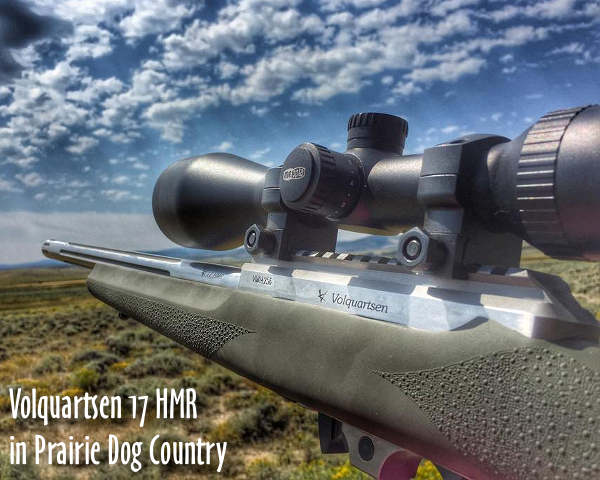
What’s the effective range of a .17 HMR on prairie dogs? You might be surprised. in 2015, Dustin took another Volquartsen .17 HMR on a Prairie Dog hunt in Wyoming. He was impressed with the rifle (shown below) and the little rimfire cartridge. Dustin says the effective range of the .17 HMR is farther than one might expect: “I made hits out to 300 yards. 200 yards was easy as long as the wind wasn’t too bad.”
Here’s the Volquartsen .17 HMR Dustin used in Wyoming in 2015:
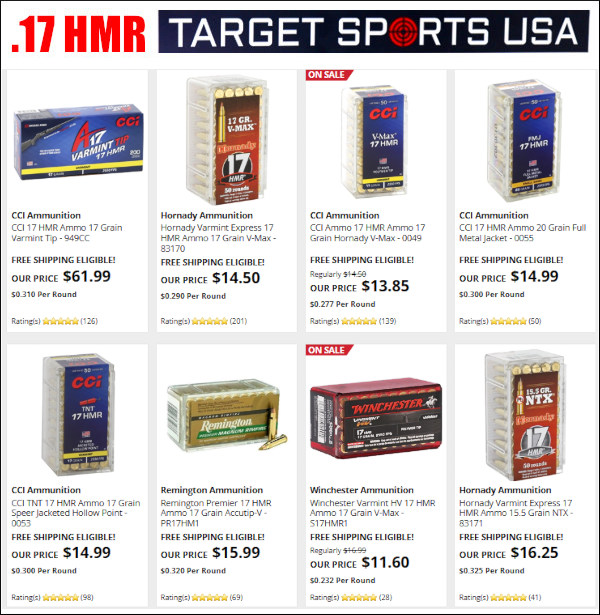
After that 2015 P-Dog expedition, Dustin became a fan of the .17 HMR cartridge: “Never paid it much attention before now because the ammo is five times more expensive than .22 LR and I mostly target shoot. However, for prairie dogs, the .17 HMR is amazing!” Consider this — Hornady’s .17 HMR ammo pushes a 17gr V-Max bullet at 2550 fps, twice as fast as typical .22 LR rounds.
Prairie Dog Adventure with Savage A17
This video shows a successful Prairie Dog hunt. Watch and you’ll see hits out to 160 yards (00:50), proving the effective range of the .17 HMR cartridge. The host is shooting a Savage A17 semi-auto .17 HMR rifle in a Boyds laminated stock.
Things to Know about .17 HMR Ammunition
Bullet Type & Weight: The standard bullet weight for .17 HMR is 17 grains, with options up to 20 grains for improved wind resistance and penetration. Polymer-tipped bullets expand rapidly on impact, while jacketed hollow points (JHP) offer deeper penetration.
Which is more powerful, .22 Mag or .17 HMR? While the .22 WMR (Magnum) may offer slightly more raw energy, .17 HMR delivers superior velocity and flatter trajectory, giving it better accuracy at long distances. For precision shooting, .17 HMR generally has the edge.
How does .17 HMR ammo compare to other rimfire cartridges? Compared to .22 LR or .22 WMR, .17 HMR shoots flatter, faster (typically 2500+ fps), and with greater accuracy at extended distances. It’s a top choice for rimfire shooters who demand high performance beyond 100 yards.
What is the effective range of .17 HMR? Good .17 HMR ammo is highly accurate up to 150–200 yards for small game and varmints. Some experienced shooters can push it beyond 200 yards with the right optics and wind conditions.
What is the best barrel length for .17 HMR rifles? A barrel length between 20–22 inches is optimal for .17 HMR, balancing velocity, maneuverability, and accuracy. Shorter barrels are lighter but may lose some velocity, while longer barrels offer slightly better ballistics at the cost of weight.
Is the .17 HMR good for beginners? Yes .17 HMR has low recoil, flat trajectory, and simple handling for new shooters. It’s an easy-shooting round that offers good performance with low recoil.
Here’s a simple task you can do that will give your seater die a more perfect fit to your match bullets. You can lap the inside of the seater stem so that it matches the exact profile of the bullet. This spreads out the seating force over a larger area of the bullet jacket. That allows smoother, more consistent seating, without putting dents, creases, or sharp rings in your bullets.
This process is demonstrated here by our friend Erik Cortina of Team Lapua-Brux-Borden. Erik, one of the nation’s top F-Class shooters and a skilled machinist, explains: “Here I’m lapping my new seater die stem with lapping compound. I chuck up a bullet in the lathe and lap the inside of the seating stem. I put lapping compound on the bullet and also in the stem. You can do the same with a hand drill and bore paste. You can see in the piture below how much contact area the stem has on the bullet after being lapped. This bullet is a Berger 7mm 180-grain Hybrid. ”
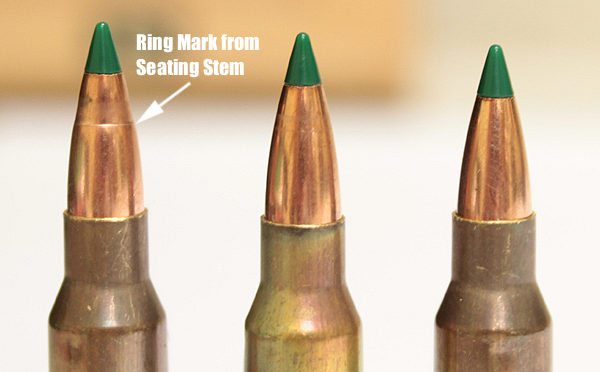
It can be helpful but it’s not necessary to make your seating stem an exact match to a bullet, particularly if you’re loading hunting or varmint rounds. But it is helpful to do some mild internal stem polishing. This should eliminate any ring (or dent) that forms on the bullet jacket during seating.
Sharp edges on a seating stem can cause a ring to be pressed into the bullet jacket — especially with compressed loads that resist downward bullet movement.
Q2: Is there any down-side to the process?
Not really. However, if you shoot many different bullet types for a particular cartridge, you may not want to conform the stem aggressively to one particular bullet design. Lightly lap the inside of the stem to remove burrs/sharp edges but leave it at that. A light lap will prevent a ring forming when seating bullets.
Berger Twist-Rate Stability Calculator
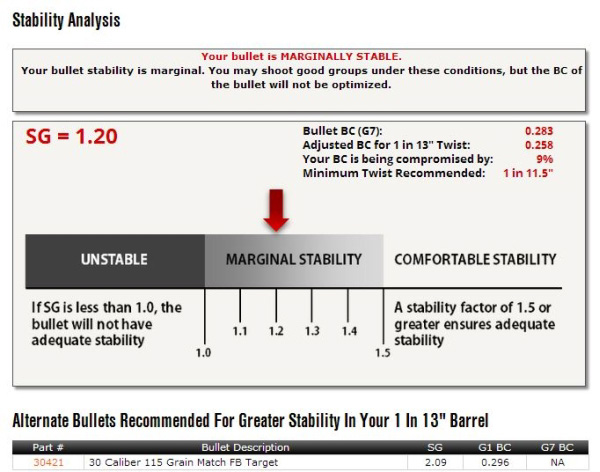
On the Berger Bullets website you’ll find a handy Twist-Rate Stability Calculator that predicts your gyroscopic stability factor (SG) based on mulitiple variables: velocity, bullet length, bullet weight, barrel twist rate, ambient temperature, and altitude. This cool tool tells you if your chosen bullet will really stabilize in your barrel.
How to Use Berger’s Twist Rate Calculator
Using the Twist Rate Calculator is simple. Just enter the bullet DIAMETER (e.g. .264), bullet WEIGHT (in grains), and bullet overall LENGTH (in inches). On its website, Berger conveniently provides this info for all its bullet types. For other brands, we suggest you weigh three examples of your chosen bullet, and also measure the length on three samples. Then use the average weight and length of the three. To calculate bullet stability, simply enter your bullet data (along with observed Muzzle Velocity, outside Temperature, and Altitude) and click “Calculate SG”. Try different twist rate numbers (and recalculate) until you get an SG value of 1.4 (or higher).
Gyroscopic Stability (SG) and Twist Rate
Berger’s Twist Rate Calculator provides a predicted stability value called “SG” (for “Gyroscopic Stability”). This indicates the Gyroscopic Stability applied to the bullet by spin. This number is derived from the basic equation: SG = (rigidity of the spinning mass)/(overturning aerodynamic torque).
If you have an SG under 1.0, your bullet is predicted not to stabilize. If you have between 1.0 and 1.1 SG, your bullet may or may not stabilize. If you have an SG greater than 1.1, your bullet should stabilize under optimal conditions, but stabilization might not be adequate when temperature, altitude, or other variables are less-than-optimal. That’s why Berger normally recommends at least 1.5 SG to get out of the “Marginal Stability” zone.
In his book Applied Ballistics For Long-Range Shooting, 3rd Ed., Bryan Litz (Berger Ballistician) recommends at least a 1.4 SG rating when selecting a barrel twist for a particular bullet. This gives you a safety margin for shooting under various conditions, such as higher or lower altitudes or temperatures.
Story idea from EdLongrange. We welcome reader submissions.
An Oregon anti-hunting ballot initiative opposed by NSSF®, The Firearm Industry Trade Association, failed to gather enough certified signatures to be considered by voters. Oregon’s Initiative Petition 28 (IP 28), called the “People for the Elimination of Animal Cruelty Exemptions (PEACE) Act,” was proposed to prohibit and criminalize hunting, trapping and livestock production.
The proposed ballot initiative was disqualified by the Oregon Secretary of State’s Elections Division for consideration by voters on November 3, 2026, after it gathered just 104,262 valid signatures, below the threshold requirement of 117,173 required signatures.
“This radical anti-hunting plan was clearly, and correctly, rejected by Oregonians who wanted no part of this attack on the heritage of outdoorsmanship and proven conservation efforts that managed hunting requires,” said Lawrence G. Keane, NSSF Senior Vice President & General Counsel. “The proposal would have, without question, destroyed Oregon’s rural communities, outdoor economy and abundant wildlife. Hunters are the original wildlife conservationists and are crucial to sustained propagation of managed wildlife for future generations. Oregonians are correct to reject this short-sighted and politically-driven agenda that would have annihilated over a century’s work to restore wildlife across Oregon’s landscape.”
NSSF strongly opposed IP 28, which was pitched to voters as a measure to strengthen state animal cruelty laws. However, Oregon already punishes animal cruelty. IP 28 would have removed legal protections for regulated hunting, fishing, ranching and other lawful activities that are critical for wildlife management, culturally rooted and economically important across the state.
Further, IP 28 would have threatened the funding structure that supports wild game and nongame species alike. In fact, 85 percent of Oregon’s wildlife money comes from the combination of excise taxes paid by firearm and ammunition manufacturers and hunting license, permit and stamp fees. The U.S. Fish and Wildlife Service (USFWS) apportioned $1.3 billion to state wildlife agencies last year. Over $804 million of that is sourced directly from the Pittman-Robertson excise tax paid by firearm and ammunition manufacturers. Oregon received over $9.7 million from that apportionment.
The Oregon Department of Fish and Wildlife (ODFW) reports that hunting, fishing and wildlife watching accounted for $1.2 billion in spending in 2019, or $1.47 billion when adjusted for inflation. Oregon’s outdoor recreation economy generated $9 billion in economic impact in 2024, supporting more than 76,000 jobs and accounts for 2.7 percent of state gross domestic product.
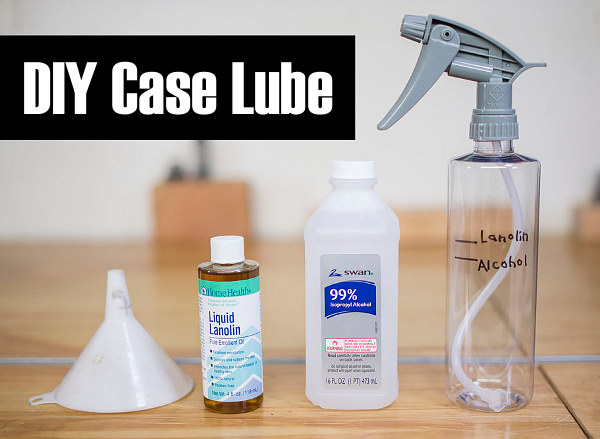
Tired of spending $15-$25 for a can of spray lube that doesn’t last that long? For about the same price as a single 10 oz. can you can make your own effective spray lube that should last for multiple seasons and lube thousands of cases quickly and easily.
In the YouTube video embedded below, our friend Gavin Gear of UltimateReloader.com shows how to make your own case lube using simple, inexpensive ingredients. As recommended by the 6.5 Guys, this Liquid Lanolin + Isopropyl Alchohol mix works well and is very cost-effective. You can make a pint of this home-brew Lanolin case lube that will lube thousands of cases — many more than a typical commercial aerosol spray can (that’s mostly compressed air).
Gavin describes the exact mixing process on his Ultimate Reloader website. Gavin says this lube mix is a good complement to the Hornady One-Shot (pistol) and Dillon DCL (rifle) lubes he has used for pistol and rifle reloading sessions. CLICK HERE to read more.
Do you compete in rimfire benchrest, silhouette, or NRL22 matches? Then you’ll want to check out the Shooting Sports USA .22 LR Ammo Roundup on the SSUSA.org website. That article covers .22 LR ammunition from Lapua, ELEY, SK, RWS, Norma, Wolf, and Aquila. Notably there’s a detailed discussion of Lapua’s new Long Range and Super Long Range ammo. In addition, SSUSA confirms that SK ammo (made in Germany by Nammo, parent of Lapua) and Wolf Match Target ammo (made by ELEY) both offer quite good performance for a moderate price.
The article notes that there is a much wider range of .22 LR ammo types available now than a few years ago. It’s not just a choice between cheap products and high-end match ammo. As SSUSA explains: “It used to be that .22 LR was either quite expensive match grade ammo, or it was cheap plinking or hunting ammo. Today, competitors have choices in grades of .22 LR match ammunition to suit their pocketbook or firearms.” We’ve seen good results with relatively inexpensive Norma Tac-22, and the SSUSA article says that SK performs well above its price level.
Seven Brands of .22 LR MATCH AMMUNITION
Lapua Super Long Range and Long Range .22 LR
Lapua Super Long Range and Long Range ammunition comes from Finland, and is designed for the growing long-range rimfire disciplines with targets at 100-300 yards. Lapua says this ammo delivers very low ES and SD numbers. Our friend F-Class John has tested this ammo and confirmed it performs very well (SEE video above). “Each production lot of Lapua’s new rimfire products are test-fired in 50-round groups for dispersion”, Capstone’s Marketing Director, Geoff Esterline, said. “The results determine whether it makes Super Long Range or Long Range packaging.”
ELEY .22 LR Ammunition
ELEY has long been a top choice for .22 LR competition — both position shooting and benchrest. ELEY now offers 11 different varieties of .22 LR match ammunition, ranging in price from $8.50 (Benchrest Outlaw) to $20 (ELEY Tenex). If you compete in the rimfire benchrest, you should definitely try some ELEY ammo.
SK .22 LR Ammunition
Numerous .22 LR ammunition types are offered by SK, suitable for a variety of disciplines — from NRL22 to Biathlon. Generally cheaper than ELEY Match ammo, SK offers good “bang for the buck”. F-Class John says it performs great considering the price. The SSUSA article notes that: “German manufacturer SK has eight match-grade .22 LR offerings, including two for pistols, one for semi-automatic rifles, and one for frigid, wintertime conditions.”
RWS .22 LR Ammunition
Sometimes hard to locate at vendors in the USA, RWS is popular among European competition shooters. The top-tier RWS ammo is a choice of many competitive shooters. RWS currently offers nine Premium Line .22 LR varieties and three Professional Line offerings. The SSUSA tester noted that RWS Rifle Match ammo shot great in his Bergara BMR, shooting one-ragged-hole groups at 50 yards and about one MOA at 100 yards. That’s great performance for $10/box ammo.
Norma .22 LR Ammunition
Norma also offers XTREME LR-22, a new type of competition rimfire ammo with a radical new bullet. This unique, patented bullet design has a special base with a cone (see diagram). Norma claims that this “rocket tail” design reduces drag by creating less negative pressure at the back end of the bullet. It will be interesting to see how this new bullet design works in rimfire ELR competition.
Wolf .22 LR Ammunition
SSUSA says that Wolf Match Target is a top performer in the under-$10 per box category. This is because, according to SSUSA: “It is manufactured by ELEY in England (and loaded with Vihtavuori powder) and re-branded, if online information is correct.” Wolf Match Target is available from Target Sports USA for $70.83 for a 500-pack ($0.142 per round). Or you can get single 50-rd boxes from Champion’s Choice for $7.50/box ($0.15 per round).
Aguila .22 LR Ammunition
Made in Mexico, Aguila .22 LR rimfire ammo is the bargain item among the seven ammo-makers featured by SSUSA. It is usually available at very affordable prices.
We wouldn’t choose Aguila for a benchrest or three -position match, but it could work for a local NRL-22 match or a steel-target competition at relatively short range. Aguila .22 LR ammo starts at under $3.80 per box. Right now many low-cost Aguila .22 LR ammo types are out-of-stock. But you can still find some more expensive varieties such as the Aguila Interceptor High Velocity HP, available for $8.99/50 rounds from Midsouth.
We are re-publishing this article at the request of Forum members who found the information very valuable. If you haven’t read this Safety Tip before, take a moment to learn how you can inspect your fired brass to determine if there may be a potential for case separation. A case separation can be dangerous, potentially causing serious injury.
On the highly-respected Riflemans’ Journal blog, created by our late, dear friend German Salazar*, there was an excellent article about Cartridge Case-Head Separation. In this important article, Salazar (aka GS Arizona) examined the causes of this serious problem and explained the ways you can inspect your brass to minimize the risk of a case-head separation. As cases get fired multiple times and then resized during reloading, the cases can stretch. Typically, there is a point in the lower section of the case where the case-walls thin out. This is your “danger zone” and you need to watch for tell-tale signs of weakening.
The photo below shows a case sectioned so that you can see where the case wall becomes thinner near the web. You can see a little arrow into the soot inside the case pointing to the thinned area. This case hadn’t split yet, but it most likely would do so after one or two more firings.
Paper Clip Hack for Detecting Problems
The article provided a great, easy tip for detecting potential problems. You can use a bent paper clip to detect potential case wall problems. Slide the paper clip inside your case to check for thin spots. GS Arizona explains: “This simple little tool (bent paper clip) will let you check the inside of cases before you reload them. The thin spot will be immediately apparent as you run the clip up the inside of the case. If you’re seeing a shiny line on the outside and the clip is really hitting a thin spot inside, it’s time to retire the case. If you do this every time you reload, on at least 15% of your cases, you’ll develop a good feel for what the thin spot feels like and how it gets worse as the case is reloaded more times. And if you’re loading the night before a match and feel pressured for time — don’t skip this step!”
* Sadly, German Salazar passed away unexpectedly on June 21, 2022 at age 62. German was a great inspiration to this site who helped guide the creation of the AccurateShooter Forum. A brilliant man, expert attorney, and top-tier marksman, German will be sorely missed in the shooting sports world.

















 On the highly-respected Riflemans’ Journal blog, created by our late, dear friend German Salazar*, there was an excellent article about Cartridge Case-Head Separation. In this important article, Salazar (aka GS Arizona) examined the causes of this serious problem and explained the ways you can inspect your brass to minimize the risk of a case-head separation. As cases get fired multiple times and then resized during reloading, the cases can stretch. Typically, there is a point in the lower section of the case where the case-walls thin out. This is your “danger zone” and you need to watch for tell-tale signs of weakening.


