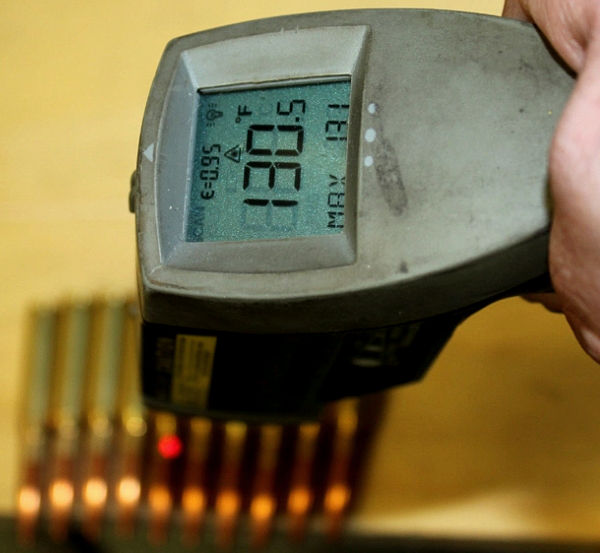
In this .308 Win test, 70° F ammo shot 96 FPS slower than ammo heated to 130.5° F. And the 130.5° ammunition was 145 fps faster than ammo taken right out of the freezer (at 25.5° F). That’s a huge difference…
Today is the first day of August. That means most parts of the country will soon be encountering peak summer heat. Some ranges in the Western states have already recorded temperatures well over 100 degrees F during matches. When dealing with extreme summer heat, you should make a serious effort to keep your ammo at reasonable temperatures. When possible, keep ammo in a cooler in the shade.
Never leave boxes of ammo out in the hot sun. Even with powders advertised as “temp stable” you can see significant velocity increases when ambient temps reach 90 degrees and above. This article explains how temperature extremes (both hot and cold) can alter bullet velocities. The velocity differences between very cold ammo and very hot ammo can be very large, as this article explains.
EDITOR’s NOTE: The Sierra tester does not reveal the brand of powder tested here. Some powders are much more temp sensitive than others. Accordingly, you cannot extrapolate test results from one propellant to another. Nonetheless, it is interesting to see the actual recorded velocity shift with ammo temperature variations in a .308 Win.
Written by Sierra Chief Ballistician Tommy Todd This story originally appeared in theSierra Bullets Blog
A few weeks ago I was attending the Missouri State F-Class Match. This was a two-day event during the summer and temperatures were hot one day and hotter the next. I shot next to a gentleman who was relatively new to the sport. He was shooting a basically factory rifle and was enjoying himself with the exception that his scores were not as good as he hoped they would be and he was experiencing pressure issues with his ammunition. I noticed that he was having to force the bolt open on a couple of rounds. During a break, I visited with him and offered a couple of suggestions which helped his situation somewhat and he was able to finish the match without major issues.
He was shooting factory ammunition, which is normally loaded to upper levels of allowable pressures. While this ammunition showed no problems during “normal” testing, it was definitely showing issues during a 20-round string of fire in the temperatures we were competing in. My first suggestion was that he keep his ammunition out of the direct sun and shade it as much as possible. My second suggestion was to not close the bolt on a cartridge until he was ready to fire. He had his ammo in the direct sunlight and was chambering a round while waiting on the target to be pulled and scored which can take from a few seconds to almost a minute sometimes.
This time frame allowed the bullet and powder to absorb chamber [heat] and build pressure/velocity above normal conditions. Making my recommended changes lowered the pressures enough for the rifle and cartridge to function normally.
Testing Effects of Ammunition Temperature on Velocity and POI
After thinking about this situation, I decided to perform a test in the Sierra Bullets underground range to see what temperature changes will do to a rifle/cartridge combination. I acquired thirty consecutive .30 caliber 175 grain MatchKing bullets #2275 right off one of our bullet assembly presses and loaded them into .308 Winchester ammunition. I utilized an unnamed powder manufacturer’s product that is appropriate for the .308 Winchester cartridge. This load is not at the maximum for this cartridge, but it gives consistent velocities and accuracy for testing.
I took ten of the cartridges and placed them in a freezer to condition.
I set ten of them on my loading bench, and since it was cool and cloudy the day I performed this test I utilized a floodlight and stand to simulate ammunition being heated in the sun.
I kept track of the temperatures of the three ammunition samples with a non-contact laser thermometer.
The rifle was fired at room temperature (70 degrees) with all three sets of ammunition. I fired this test at 200 yards out of a return-to-battery machine rest. The aiming point was a leveled line drawn on a sheet of paper. I fired one group with the scope aimed at the line and then moved the aiming point across the paper from left to right for the subsequent groups.
NOTE that the velocity increased as the temperature of the ammunition did.
The ammunition from the freezer shot at 2451 fps.
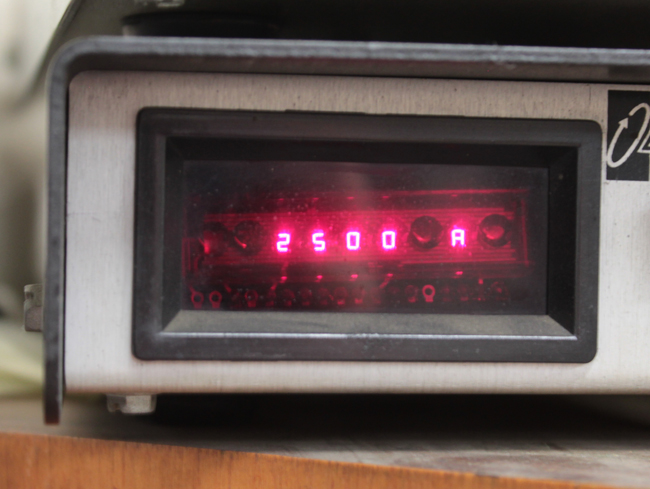
The room temperature ammunition shot at 2500 fps.
The heated ammunition shot at 2596 fps.
The tune window of the particular rifle is fairly wide as is shown by the accuracy of the three pressure/velocity levels and good accuracy was achieved across the board. However, notice the point of impact shift with the third group? There is enough shift at 200 yards to cause a miss if you were shooting a target or animal at longer ranges. While the pressure and velocities changed this load was far enough from maximum that perceived over pressure issues such as flattened primer, ejector marks on the case head, or sticky extraction did not appear. If you load to maximum and then subject your ammunition to this test your results will probably be magnified in comparison.
This test showed that pressures, velocities, and point-of-impact can be affected by temperatures of your ammunition at the time of firing. It’s really not a bad idea to test in the conditions that you plan on utilizing the ammo/firearm in if at all possible. It wouldn’t be a bad idea to also test to see what condition changes do to your particular gun and ammunition combination so that you can make allowances as needed. Any personal testing along these lines should be done with caution as some powder and cartridge combination could become unsafe with relatively small changes in conditions.
Keith Glasscock is one of America’s greatest F-Class shooters, as well as a highly respected wind coach. A High Master, Keith finished second overall at the 2021 NRA F-Class Long Range Championship in F-Open division. He also finished second at the 2020 Nationals, tied with F-Open winner Pat Scully on points, but with fewer Xs. And he took second also at the 2019 Nationals. His consistency is unrivaled, which means he definitely knows the secrets of long range wind calling and loading ultra-accurate ammo.
Keith has a popular YouTube Channel with new content every week. On Keith’s Winning in the Wind channel, Keith offers 60+ informative videos on a wide range of topics including wind reading, reloading, component selection, load development, and training. For today’s Video Showcase, we offer four of our favorite Keith Glasscock videos. Each video has important points that can benefit any competitive rifle shooter, whether you shoot in local 100-yard fun matches or compete at the National Level in F-Class, LR Benchrest, Palma, or High Power.
How to Find (and Fine-Tune) Seating Depth
This is Keith’s most popular video. Keith definitely knows how to maximize accuracy by finding the optimal seating depth for each particular barrel. He is achieving groups in the high Ones for three shots. That would be good for a short-range benchrest cartridge, but Keith is achieving that with a .284 Winchester which has much more recoil. If you shoot F-TR or F-Open or even PRS, you should watch this video.
How to Lower your ES/SD and Reduce Vertical at Long Range
This is Keith’s first video in a series on how to improve long range groups, precision, and accuracy by reducing velocity Extreme Spread (ES) and Standard Deviation (SD). To achieve the lowest ES you need to look at multiple processes, including precision powder weighing, careful seating, brass annealing, and primer selection. Another factor is bullet selection. Not all bullets of the same nominal caliber and weight class have exactly the same bullet diameter or shape. Sometimes you can get better accuracy AND lower ES by trying a different brand of bullet. We have found bullet diameters, of the same stated caliber, can vary by up to .0008″ (eight ten-thousandths). Some barrels like the fatter bullets, while other barrels may favor the skinny bullets.
How to Find Bullet-to-Rifling Touch Point
Before you even start to load for a new rifle you need to know the point at which the bullet in a loaded round will first touch the rifling. (This will be a base to ogive measurement on your round). Beyond that point you are “in the lands”. If you load shorter than that base-to-ogive length you are “jumping” your bullets. Some cartridge/bullet combos typically shoot best in the lands, while with other bullets and cartridges, jumping is the way to go. Additionally, with some disciplines it is wise to jump your bullets since you may have to unload a chambered round while on the firing line. In this video Keith shows a number of methods to determine “length to lands” with repeatable precision.
Field Test and Review of SEB Mini-X Coaxial Front Rest
While gear reviews are not the primary focus of Keith’s YouTube Channel, Keith does talk about products he likes and uses. In this video. Keith reviews the SEB Mini-X, the newest coaxial tripod rest from SEB Rests. The Mini-X offers fast, precise windage and elevation adjustment with the joystick control. The unit is much easier to pack and transport than a large, heavy front rest such as a SEB NEO or Farley. The latest Mini-X also has upgraded foot controls that make it easier to level the rest on uneven ground. For more info, see our SEB Mini-X Report.
It’s great to be able to access online load data for your cartridges. You can quickly get load data for a particular powder and bullet weight. However, there are times when we prefer to consult old-fashioned printed/bound load manuals. The primary reason is that manuals produced by bullet- and tool-makers will, for a particular cartridge, include data for powders from multiple manufacturers. Having a single source can save you time and trouble. For example, if you want to find 6.5 Creedmoor loads using H4350 (Hodgdon), Reloder 16 (Alliant), and N150 (Vihtavuori) you would have to visit three different powder-maker websites, one after another. OR you can pick up a modern load manual and find everything in one place.
There are many excellent printed load manuals on the market. We have used the Berger Manual, Sierra Manual, Speer Manual, Lyman Manual, and Hornady Manual. We like the Berger and Sierra manuals for match rifle cartridges, and the Lyman and Hornady manuals for hunting loads and pistol cartridges. Unfortunately, the popular binder-format Sierra Manual is currently back-ordered. Get one if you can.
The Lyman Reloading Manuals have earn praise over the years:
“Every other reloading book I’ve used favors their own bullets over every other manufacturers. With Lyman you get an honest representation of a wide variety of different… manufacturers. [Lyman has] a ton of reloading data on just about any bullet style you can imagine. I’ve tried a wide range of their recipes and everyone I’ve tried has been spot on. The overall breadth of information this book covers is impressive.” Review by RangetoReal.com.
Nosler #9 Manual Features New Cartridges
If you are looking for up-to-date cartridge/bullet/powder information, in late 2020 Nosler released the Nosler Reloading Guide #9, the latest in a respected series of Nosler load manuals.
This 800-page guide covers 101 cartridge types. New in this edition you’ll find the popular 6mm Creedmoor, 6mm XC, 6.5 PRC, and 7.62×39, along with 20 Nosler, 22 Nosler, 24 Nosler, 27 Nosler and 33 Nosler. This manual is a good resource for PRS shooters and hunters. The Nosler #9 book draws from thousands of hours in the Nosler Ballistic Lab, along with the experience of many respected experts.
The book is available for $28.99 at Midsouth or $29.95 on Amazon. Keep in mind that much of the book’s latest load data is available for free on the Nosler.com online LOAD DATA Center. But to get ALL the data, PLUS all the technical articles, you’ll need to buy the book.
Along with the new Nosler #9 Manual, here are four other recommended Reloading Manuals:
Here Are Four General Instructional Books That Cover Reloading Procedures:
POWDER BURN RATE TABLE
Here is the most recent powder burn rate chart from Hodgdon/IMR that we could find. Click links below to access printable PDF. Note, some readers have suggested a couple powder ranking issues in the table. However, this is the latest official version from the IMR website, released in November 2019.
At the request of our readers, we provide select “Deals of the Week”. Every Sunday afternoon or Monday morning we offer our Best Bargain selections. Here are some of the best deals on firearms, hardware, reloading components, optics, and shooting accessories. Be aware that sale prices are subject to change, and once clearance inventory is sold, it’s gone for good. You snooze you lose.
1. Midsouth — Birthday Sale on Rifle Kits, Ammo, Bullets, Mags
⏺ Big Savings on AR Kits, Hornady Bullets, Pistol Load Packs
Right now Midsouth Shooters is celebrating its 52nd year in business with a big Birthday Sale. Save $70 on a full AR kit — everything you need but the Lower. Or get a great 9mm Reloaders Pack with 1000 115gr Bullets and 500 pieces of new, unprimed brass. Midsouth also has a wide selection of Hornady Bullets on sale in 500-ct “sleeves”. There are both pistol (9mm, .38, .45) and rifle bullets (.224, .308) at huge savings. You’ll also find 9mm Luger and 5.56×45 (.223 Rem) loaded ammo on sale. Last but not least you can get ten (10) 30rd AR magazines for just $99.00.
2. Sportsman’s Warehouse — Winchester .22 LR Wildcat, $219.99
⏺ Removable lower receiver, Picatinny rails, good trigger, great price
Here is a fun little semi-auto .22 LR rifle at a crazy low price — $219.99 at Sportsman’s Warehouse. The Winchester Wildcat takes Ruger 10/22 mags, and has some great features, such as field-removable lower receiver, ambidextrous controls, integral Picatinny rails and rear barrel access. It has a good trigger and shoots well. In many respects the Wildcat beats the Ruger 10/22 while costing considerably less. The lower receiver assembly is easily removed from the upper assembly by pushing a button — no tools required.
⏺ Reliable — nice shielded design with side port, good value
Like the RCBS ChargeMaster, this Lyman Gen6 Powder System will automatically dispense and weigh powder charges. This unit features a touch screen, rapid warm-up, anti-static/anti-drift technology, and electronic shielding to resist interference from other electronic devices. One notable feature is a side port to quick-drain the powder. Right now this Lyman Gen6 Scale/Dispenser is on sale at Midsouth for $218.99. That’s a very good deal as this same Lyman unit sells for $293.99 elsewhere.
4. Grafs.com — Leupold SX4 Spotting Scopes, $699.99 or $899.99
⏺ Save $100 on Angled or Straight spotters, 65mm or 85mm objection
Graf & Sons is running a sale on Leupold SX4 Pro Guide Spotting Scopes. Choose straight or angled, either big 85mm front objective or the smaller 65mm. Save $100 on any and all SX4 models. We prefer the smaller version for hunting/varminting, and the bigger 85mm for competition spotting duties. This is a high-quality optic with an outstanding warranty. If you shoot prone, you’ll want the angled version.
5. Midsouth — Lyman Tac-Mat Shooting Mat, $56.63
⏺ Thick padded mat offers more comfort with good length and carry handle
Comfort counts when you’re on the ground for hours. We like this Lyman Tac-Mat 71″ x 36″ shooting mat. It has more padding than most mats on the market, providing better comfort. Now $56.63 at Midsouth, this is a VERY good deal. This same Lyman shooting mat is $89.89 on Amazon.
6. Amazon — Frankford Case Tumbler Master Kit, $73.99
⏺ We’ve used this Combo Kit for many seasons — very good value right now
Keeping your brass clean is one of the best ways to keep your dies (and reloading presses) clean as well. If you’re looking for a new, affordable setup to clean cartridge brass, consider the Frankford Arsenal Quick-N-EZ Case Tumbler Master Kit. You get everything needed to dry-tumble your brass and remove the media. This is all available now for a very low $73.99. You could pay that much for a good vibratory tumbler alone.
7. LAXAmmo — TulAmmo 9mm Ammo 1000 rounds, $319.89
⏺ Great deal on 9mm Luger ammo — $16 per 50rd box
This TulAmmo 9mm ammo will work for pistol practice. The big appeal of this Russian-made steel-cased ammo in PRICE. Get 1000 rounds for $319.89 — that works out to $16 per 50rd box ($0.32/round), a third of the price some vendors are asking for 9mm Luger ammo. You can also purchase 500 rounds for $169.95. NOTE: This ammo is non-corrosive. However it has STEEL cases so it is NOT reloadable.
8. Amazon — Bluetooth Digital Anemometer, $25.99
⏺ Measures wind velocity with Bluetooth connection to Smartphone App
To shoot successfully at long range, you need precise wind speed readings. This “smart” Digital Anemometer (windmeter) records Max/Min/Average wind speeds and ambient temperature which display on-screen. Importantly, the unit also outputs wind readings to your smartphone via Bluetooth. This allows you to mount the wind meter downrange and view wind speeds via a smartphone App. The unit’s base is threaded for tripod mounting. This is a pretty impressive system for under thirty bucks.
9. Amazon — EILIKS Multi-Tool Kit, $32.99
⏺ Very versatile kit for vehicle and camping
The 24-piece EILIKS Multi-Tool Kit it a great item for your vehicle. This contains a nice survival knife and flashlight, plus 22 other emergency survival tools: paracord bracelets, wire saw, water bottle clip, emergency blanket, flint stone, scraper, blow fire tube, 4pcs fire tinder, whistle, saber card, survival pen, multi-use spoon fork, 2 carabiners, 4pces ishing tools and box. The full 8″x4″x2″ kit will fit in most vehicle glove compartments, and can be attached to belt or pack with included ranger band. List price was $48.99, so the $32.99 price is 33% Off.
⏺ Quality name-brand shooting eyewear — buy multiples at this price
Every shooter needs eye protection EVERY TIME you go to the shooting range. Right now Midsouth has the good Radians clear Lens Outback Shooting Glasses for just $5.88. These ANSI Z87.1 Radians Shooting Glasses provide 99.9% UVA/UVB protection with the coated lenses. These offer excellent wrap-around protection and are fairly light and comfortable. A handy neck cord is included. With this low $5.88 price, you can buy 3 or 4 sets and keep spares in your vehicles, so you always have protective eyewear for yourself and your friends.
At the request of our readers, we provide select “Deals of the Week”. Every Sunday afternoon or Monday morning we offer our Best Bargain selections. Here are some of the best deals on firearms, hardware, reloading components, optics, and shooting accessories. Be aware that sale prices are subject to change, and once clearance inventory is sold, it’s gone for good. You snooze you lose.
1. Amazon — LongShot LR-3 Target Camera System, $724.08
⏺ Best Long Range Target Camera you can buy — save $75 now
This superb Longshot LR-3 Camera system combines a high-definition camera with a special receiver. This set-up delivers sharp, live images at distances up to two miles with excellent 2688 x 1512 HD resolution. Integrated software lets you mark your shots. This is a good deal — other vendors are selling the LR-3 for $799.00. NOTE: If you want the BulletProof Warranty, we recommend you buy direct from LongShot. You can get the LR-3 System WITH Warranty for $838.00. We do recommend purchasing the BulletProof Warranty — that way LongShot will repair or replace your unit if it is damaged by gunfire or other hazard.
2. Midsouth — LEE 60th Anniversary Challenger Kit, $197.58
⏺ Excellent kit with Press, Priming Tool, Powder Measure, and much more
It’s been a while since we’ve seen reloading gear both in-stock and at reasonable prices especially for starting kits. Check out this LEE 60th Anniversary Challenger Kit which features a Breech Lock Challenger Press with Large and Small Primer Lever Arms, Deluxe Perfect Powder Measure, Safety Powder Scale, Modern Reloading 2nd Edition, Deluxe Quick Trim, Bench Prime, Priming Tool Shell Holder Kit, Case Conditioning Kit, Powder Funnel and some Lee Case Lube. This is really a great starting kit for anyone looking to get into reloading and probably won’t last long. This is great bargain — the Press alone is worth $100, and the priming tool and powder measure both worth very well.
3. Brownells — Blackhawk Gun Case and Holster Sale
⏺ Significant discounts on quality Gun Cases, Mats, Holsters
If you’re in the market for shooting gear head over to Brownell’s for their sitewide Blackhawk Sale. Blackhawk has been an industry leader for decades and for good reason. They make everything from gun cases to holsters to slings. With this sale, you’ll find significant discounts on very good gun cases, and we like the multi-functional Blackhawk Stalker Drag Mat. This double-duty item works as a rifle carry case AND a padded shooting mat — great product.
4. Roger’s — Federal XM193 5.56x45mm Ammo, 400rd $279.99
⏺ Quality mil-spec AR15 ammo at good price with ammo can
Bulk .223 Rem (5.56×45) ammo has been hard to find these days at reasonable prices. But Roger’s Sporting Goods now has Federal XM193 5.56×45 ammo on sale. Get 400 rounds of 55gr XM193 NATO Rifle Ammunition for just $279.99 ($.70/rd). This is high-quality, ultra-reliable new production ammo shipped in a military-grade metal ammo can. XM193 is rated at 3165 FPS.
5. Sportsman’s WHSE — Savage 6.5 CM Rifle + Scope, $359.99
⏺ With scope included, it’s like getting rifle for $220!
Here’s a stellar deal on a decent 6.5 Creedmoor hunting rig. Get the rifle PLUS the scope for just $359.99. Sportsman’s Warehouse is selling the Savage Axis XP Scope Combo for only $359.99. The rifle comes complete with a Bushnell 4-12x40mm scope. The rifle boasts a rugged black synthetic stock and is fitted with a carbon steel, 22″ sporter-contour, button-rifled barrel chambered in 6.5 Creedmoor. This package rifle is ready to shoot, right out of the box, thanks to the mounted and bore-sighted Bushnell optic.
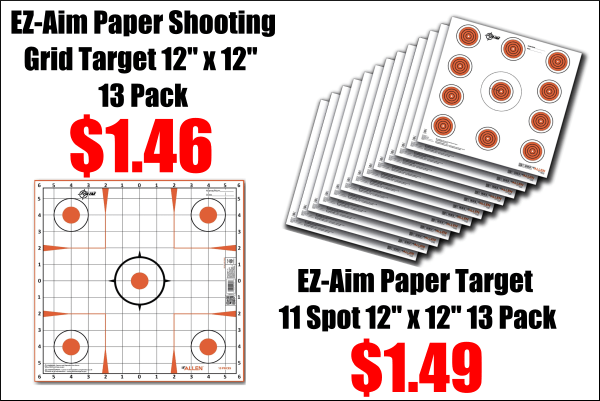
6. Amazon — EZ-Aim Targets, Grid or Bullseye, 13pk $1.46/$1.49
⏺ Incredible deal on 13-packs of Grid or Bullseye targets
This may be the deal of the year on quality targets. Why print targets at home and waste your ink when you can pick up a 13-pack of these EZ-Aim Sight-in Grid Targets for only $1.46! These are nicely sized 12″x12″ grid targets with a large center bull and 4 other orange aim points in the corners. These targets are great for sight-in and/or load development as the 1″ grid provides a quick reference for scope clicks and group sizes. If you prefer multiple small bulls, try the EZ-Aim 11-Spot Target Pack. There are 11 orange bulls on each 12″x12″ sheet. A 13-pack costs $1.49.
7. EuroOptic — 15% OFF Holosun Sights
⏺ Significant 15% discount on All Holosun Sights at EuroOptic.com
It’s hard to deny the impact that holosights have had on the pistol market. They’re lightweight, easy to use. and help shooters get on target faster and more accurately than ever. If you looking to upgrade a pistol, consider Holosun sights. Right now, at EuroOptic, you can get 15% off with code HOLO15. Features include Holosun’s Green Super LED with up to 50k hours battery life, Multi-Reticle System, Solar Failsafe, and Shake Awake.
8. Graf & Sons — Nikon Laser Rangefinder Sale
⏺ Good, reliable basic rangefinders on SALE 12-22% Off
Knowing how far you’re shooting is critical both when hunting and target shooting. Thankfully, you don’t need to spend big money on a Laser rangefinder. Right now Graf & Sons has slashed prices on Nikon Laser Rangefinders. There are a variety of models starting at just $149.95 for the Prostaff 1000 6x20mm. The yellow body Forestry Pro II model can range and then display the angles of multiple targets.
9. Amazon — Front and Rear Shooting Bags Set, $12.92
⏺ Handy low-cost bags for varmint work or NRL22 competitions
Sometimes all you need is a simple front bag rest and squeeze bag in the rear and we found a great deal. These bags will suffice for basic varmint duties, sight-in for a hunting rifle, or barricade work in an NRL22 match. The Ace Hunter Front and Rear Bag Combo is available in 3 colors (Black, Green, and Camo). For just $12.92 you get both front and rear bags, which can be linked for transport.
These bags ship unfilled so must add your preferred fill material (depending on application) — try lighter fill such as rice for field carry, with heavier sand for bench work.
The anvil is the tripod-shaped thin metal piece protruding above the bottom of the primer cup. Getting the primer sitting fully flush on the bottom of the case primer pocket, without crunching it too much, requires some keen feel for the progress of primer seating.
Sadly, Glen Zediker passed away on October 1, 2020. But his technical insights and helpful advice live on thanks to his written works — his books and articles. In two informative Midsouth Blog articles, Glen Zediker presented helpful advice on priming. First he examined what happens to the primer itself as it is seated in the cup. Glen then explained why some “crush” is important, and why you never want to leave a high primer.
Glen also reviewed a variety of priming tools, including his favorite — the Forster Co-Ax Bench Primer Seater. Then he offers some key safety tips. Glen provides some “rock-solid” advice about the priming operation. You’ll find more great reloading tips in Glen’s Top-Grade Ammo book.
Priming Precision vs. Speed
Glen wrote: “The better priming tools have less leverage. That is so we can feel the progress of that relatively very small span of depth between start and finish. There is also a balance between precision and speed in tool choices, as there so often is.”
Benchtop Priming Tools — The Forster Co-Ax
Glen believed that the best choice among priming options, considering both “feel” and productivity, may be the benchtop stand-alone priming stations: “They are faster than hand tools, and can be had with more or less leverage engineered into them. I like the one shown below the best because its feeding is reliable and its feel is more than good enough to do a ‘perfect’ primer seat. It’s the best balance I’ve found between speed and precision.”
Load Tuning and Primers
Glen cautioned that you should always reduce your load when you switch to a new, not-yet-tested primer type: “The primer is, in my experience, the greatest variable that can change the performance of a load combination, which is mostly to say ‘pressure’. Never (never ever) switch primer brands without backing off the propellant charge and proving to yourself how far to take it back up, or to even back it off more. I back off one full grain of propellant [when I] try a different primer brand.”
Priming Safety Tips by Glen Zediker
1. Get a good primer “flip” tray for use in filling the feeding magazine tubes associated with some systems. Make double-damn sure each primer is fed right side up (or down, depending on your perspective). A common cause of unintentional detonation is attempting to overfill a stuffed feeding tube magazine, so count and watch your progress.
2. Don’t attempt to seat a high primer more deeply on a finished round. The pressure needed to overcome the inertia to re-initiate movement may be enough to detonate it.
3. Keep the priming tool cup clean. That’s the little piece that the primer sits down into. Any little shard of brass can become a firing pin! It’s happened!
SSG Greg Markowski of the USAMU at Camp Perry, Ohio.
Today is the final day of pistol competition for the National Matches at Camp Perry. Many of the best pistol shooters in the country will be on the firing line, including members of the U.S. Army Marksmanship Unit Service Pistol team. Today, July 18th, the handgun phase of the CMP National Matches concludes with the Oliver Hazard Perry Pop-Up Pistol Match, Military & Police Pistol Match, 1911 As-Issued Pistol Match, and Glock Match. After the last match, trophies and awards will be presented to the top shooters.
If you want to compete in top competitions like this, you’ll need good ammo. The following USAMU article provides rock-solid reloading advice, explaining how to load accurate, reliable handgun ammo.
Camp Perry NM pistol firing line from CMP Photo Archives.
The U.S. Army Marksmanship Unit (USAMU) fields pistol teams as well as rifle and shotgun competition squads. Consequently the USAMU’s Reloading Shop loads tens of thousands of pistol rounds every year. In this article, the USAMU’s handgun experts talk about reloading for handguns — with smart tips on how to achieve superior accuracy with 100% reliability. This article, which offers important insights on COAL, primers, crimps and more.
Precision Pistol Reloading — Recommended Methods
Optimize the Taper Crimp
One often-overlooked aspect of handloading highly-accurate pistol ammunition is the amount of crimp and its effect on accuracy. Different amounts of taper crimp are used with various handloads to obtain best accuracy. The amount is based on bullet weight, powder burn rate and charge, plus other factors. It is not unusual for our Shop to vary a load’s crimp in degrees of 0.001″ and re-test for finest accuracy.
Use Consistent Brass
Brass is also important to pistol accuracy. While accurate ammunition can be loaded using brass of mixed parentage, that is not conducive to finest results, particularly at 50 yards. It is important for the serious competitor/handloader to use brass of the same headstamp and ideally one lot number, to maximize uniformity. Given the volumes of ammunition consumed by active pistol competitors, using inexpensive, mixed surplus brass for practice, particularly at the “short line” (25 yards), is understandable. However, for the “long line” (50 yards), purchasing and segregating a lot of high-quality brass to be used strictly for slow-fire is a wise idea.
Importance of Uniform COAL
Uniformity of the Case Overall Length (COAL) as it comes from the factory is also important to achieving utmost accuracy. More uniform case lengths (best measured after sizing) contribute to greater consistency of crimp, neck tension, ignition/burn of powder charge, and so on. Cartridge case-length consistency varies from lot to lot, as well as by maker. Some manufacturers are more consistent in this dimension than others. [Editor’s note: It is easy to trim pistol brass to uniform length. Doing this will make your taper crimps much more consistent.]
Primers and Powders — Comparison Test for Accuracy
Pay attention to primer brands, powder types and charges. Evaluating accuracy with a Ransom or other machine rest at 50 yards can quickly reveal the effect of changes made to handload recipes.
Bullet Selection — FMJ vs. JHP
Bullets are another vital issue. First, there is the question of FMJ vs. JHP. A friend of this writer spent decades making and accuracy-testing rifle and pistol bullets during QC for a major bullet manufacturer. In his experience, making highly-accurate FMJ bullets is much more difficult than making highly-accurate JHPs, in large part due to the way the jackets are formed. Small die changes could affect accuracy of FMJ lots dramatically.
The CMP now allows “safe, jacketed ammunition” in Excellence-in-Competition (EIC) Service Pistol matches, although wadcutter ammunition is prohibited. Thus, the option to use very accurate JHP designs simplifies the life of CMP Service Pistol shooters in pursuit of the prestigious Distinguished Pistol Shot badge.
Hopefully, these tips will be helpful to any pistol shooters interested in accurate handloads, not just “Bullseye” shooters. Small tweaks to one’s normal routine can pay big dividends in improved accuracy and make practice and competition more rewarding.
Stay safe, and good shooting!
TOP IMAGE: SSG Greg Markowski, a shooter/instructor with the U.S. Army Marksmanship Unit and native of Poland, fires his pistol during the 2018 Civilian Marksmanship Program’s National Pistol Matches at Camp Perry, Ohio July 13, 2018. At that event, Markowski claimed the General Mellon Trophy, General Patton Trophy and the General Custer Trophy. U.S. Army photo by Maj. Michelle Lunato/released by Defense Visual Information Distribution Service.
Good news for serious hand-loaders — a large selection of premium-quality Lapua brass is now IN STOCK at Creedmoor Sports and Grafs.com. You’ll find a wide variety of cartridge types available for purchase today at these two leading vendors. Check the lists below.
We’re happy to report that Lapua Brass is IN STOCK, because finding top quality reloading components (brass, bullets, powder, and especially primers) has been a major challenge over the past year. It looks like both Graf & Sons and Creedmoor Sports have received large shipments of Lapua cartridge brass recently. So if need good brass, check the availability list below, and then place your orders. Sorry, no 6mmBR, 6.5 Grendel, 6.5×55, 7mm-08, or .30-06 brass at either vendor right now.
As of 9:00 am on Saturday July 17, 2021, here are some of the rifle cartridge types we found in stock.
Lapua .220 Russian Brass $128.29
Lapua .223 Rem. Brass $68.99
Lapua 6mm Creedmoor Brass Small Primer Pocket $55.99 (50 ct)
Lapua .243 Win Brass $120.99
Lapua 6.5×47 Lapua Brass $134.99
Lapua 6.5 Creedmoor Brass Small Primer Pocket $103.99
Lapua .260 Rem Brass $120.99
Lapua .284 Winchester Brass $144.99
Lapua 7.62×39 Brass $85.99
Lapua 7.62x54R Russian Brass $158.99
Lapua 7x65R Brass $119.99
Lapua .300 Norma Magnum Brass $226.99
Lapua .338 Norma Magnum Brass $328.99
Lapua .338 Lapua Magnum Brass $321.99
CLICK HERE for Grafs.com Lapua Brass Sales Page
NOTE: On that page, items IN STOCK are listed first. You can Login to be notified when out-of-stock items are back in stock. Prices subject to change.
Forum member F-Class John is an avid F-Class competitor and expert handloader. John reviews reloading hardware and shooting-related products for his popular F-Class John YouTube Channel, which now boasts 220+ videos. John also does important product testing for AccurateShooter.com. Through his YouTube channel, John has reviewed many of the latest and greatest reloading tools and accessories. For today’s Video Showcase, we selected eight F-Class John tool and reloading product reviews.
If you like these selected videos, consider joining F-Class John’s Patreon Channel for live video meetings, more in-depth videos, and detailed explanations.
21st Century Hydro Press and Standard Arbor Press
John notes: “You can’t really talk about precision reloading without taking about inline dies and arbor presses. For my money there’s nothing better than the lineup from 21st Century Shooting. They offer the Hydro Seater which is hands-down the best manual seater out there as well as their standard arbor press which is great for taking on the road to push back bullets as needed.”
Primal Rights Competition Priming Seater (CPS) Review
If there is a Ferrari of priming tools, it has to be the Primal Rights Competition Primer Seater (CPS). This impressive bench-mounted tool allows very precise control over primer seating depth. A vertical tube holds primers ready for insertion. The action is smooth and precise. John believes that this is definitely the best priming tool on the market, though it may not be for everyone given its premium $600.00 price.
Lyman Powered Case Trimmer Review
The Lyman Case Trim Xpress is an efficient, precise unit that allows easy adjustment of trim length with a click-adjustable collar. The trimmer comes with a set of cartridge-specific bushings that index off the case shoulder. One nice feature is a variable speed control. For the price, $154.99 on Amazon, this trimmer delivers excellent performance. F-Class John has another video review of the Lyman Case Trim Xpress which shows set-up and operation.
Dillon 750 Tips and Tricks
The Dillon XL 750 is a favorite of high-volume reloaders. With the optional case feeder, the XL 750 offers high output with great reliability. And Dillon offers one of the best warranties in the business. In this video, F-Class John features upgrades including the Armanov tool-head holders from Europe. These are drilled and tapped for all FIVE stations allowing the user to put threaded dies in any station.
Gunsmithing Torque Wrench Comparisons
When you are working on custom rifles that might cost $5000+, and mounting scopes that can run $3000 (or more), you need to use very high-quality tools. Precise torque settings are essential, both to avoid damage to valuable parts, and to have the rifle and optic perform optimally. In this video, F-Class John looks at a variety of torque wrenches suitable for gunsmithing duties.
Concentricity Checking with Accuracy One Gauge
Every serious hand-loader needs a quality concentricity gauge. The Accuracy One Concentricity Gauge boasts a smart design that delivers precise, repeatable results. We like the unit’s easy adjustability and its ability to work in a variety of configurations. The Accuracy One Gauge measures internal and external neck runout of cartridge cases as well as seated bullet runout. It can also measure the runout of the ogive, bearing surface, and boat-tail of individual bullets. And it can even measure your primer pocket runout.
Teslong Rigid (Shaft) Borescope with Monitor
Seeing inside your barrel can provide clues to how well you’re cleaning and the bore’s overall health. One of the best tools on the market is the Teslong Rigid Borescope. This features a solid rod for easy use in barrels. Plus it comes with a self-contained high-definition viewing monitor so no smartphones or WiFi tablets are needed. If you’re looking for something more portable and a bit more versatile, try the Teslong Flexible Borescope, $99.99 including monitor. John was impressed with the new rigid Teslong he tested, and he likes having a dedicated monitor (no WiFi required).
Zero Turret Press with Whidden Sizing Die
The new Zero Press from Area 419 is arguably the best turret press ever crafted. It offers unrivaled precision, along with the highest-capacity turret head with NINE die/tool stations. Milled from billet aluminum and stainless steel, this press moves with the help of 14 bearings. In this video, F-Class John shows how to use a Whidden Gunworks full-length sizing die on the Zero Press. And John has two other video reviews of the $1200 Zero Press: 1. Zero Press First Thoughts Video; 2. Loading on a Zero Press.
At the request of our readers, we provide select “Deals of the Week”. Every Sunday afternoon or Monday morning we offer our Best Bargain selections. Here are some of the best deals on firearms, hardware, reloading components, optics, and shooting accessories. Be aware that sale prices are subject to change, and once clearance inventory is sold, it’s gone for good. You snooze you lose.
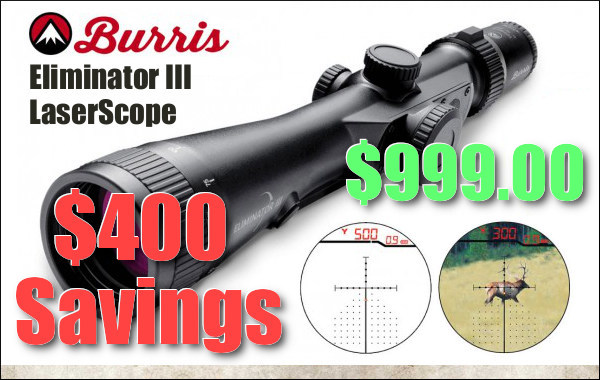
1. EuroOptic — Eliminator III 4-16x50mm LaserScope, $999.00
⏺ Save $400 on popular integrated scope/laser rangefinder
Burris recently released its new, $1699 IV-Series Eliminator LaserScope. That’s good news for bargain hunters because the price of the VERY similar Burris 4-16x50mm Eliminator III is now just $999.00, marked down from $1399.00 ($400 savings). The Eliminator system works great for varmint hunting. Combining optical magnification with laser rangefinding, the Eliminator III ranges out to 1,200 yards with push-button automatic trajectory compensation. You range your target, and the Eliminator III sets a red aiming point. Then just put the red dot on the target and pull the trigger — no drop charts, no knobs to crank. NOTE: EuroOptic also has Demo Model Eliminator IIIs for $899.00.
⏺ Outstanding deal on quality muffs — many color options
Every shooter should have quality ear muffs, both for yourself and any friends/family members you bring to the range. For those on a tight budget, we recommend the Walker’s Razor Slim Passive Earmuffs. These are comfortable and have a good 28dB Noise Reduction rating — very high for slim muffs. These Walker’s Razor Slims are available in a wide variety of colors, starting at just $15.80 on Amazon — a great deal. These muffs fold compactly, making them easy to stow.
⏺ Good press, powder measure plus many tools for crazy-low price
Though reloading tools are in high demand, right now you can get this very complete Lee 50th Anniversary multi-component kit for $147.99, an incredible bargain — the press alone is worth $100! The main attraction is the Lee Breech Lock Challenger Press with quick-change bushing. In addition, you get a Lee Perfect Powder Measure, Safety Scale, Powder Funnel, and Safety Prime. The kit even includes variety of Case Prep tools: Case trimmer, Chamfer Tool, Primer Pocket-Cleaning tool.
4. Midsouth — Hornady .22 Cal Bullet Bulk Packs, 9¢ per bullet
⏺ Get 6000 .22 Caliber bullets for just 9 cents each
5. MidwayUSA — Frankford Large Rotary Tumbler, $143.99
⏺ Big Capacity, Great Deal — save $77 over typical price
If your brass is dirty on the outside or if you want to get it “squeaky clean” before annealing, a Rotary Wet Tumbler is a smart option. Right now the large, full-size Frankford Rotary Tumbler is on sale. Order it now from MidwayUSA for just $143.99 including 5 pounds of 304 stainless media pins and a packet of Frankford Brass Cleaning Solution. NOTE: You must ADD to CART to see that $143.99 price. This a great deal — this tumbler sells elsewhere for $220 or more. Note: if you already have the media, you can also buy the unit by itself from Amazon for $143.99, with free shipping for Prime members.
6. Amazon — Teslong Borescope with Monitor
⏺ Chose Rigid or Flexible model — every rifle shooter needs a good borescope
Seeing inside your barrel can provide clues to how well you’re cleaning and the bore’s overall health. One of the best tools we’ve found is the Teslong Rigid Borescope. This features a solid rod for easy use in barrels. It comes with an self-contained high-definition viewing monitor so no phones or pads are needed. If you’re looking for something more portable and a bit more versatile, try the Teslong Flexible Borescope, $99.99 including monitor. Our Forum members give high praise to both models.
7. Precision Reloading — Hornady Bulk Bullets
⏺ Hornady bullets IN STOCK with great bulk savings
Here’s your opportunity to save big on a huge variety of Hornady bullets in many calibers and various profiles and weights. You’ll find .22, 6mm, and .308 bullets discounted 10-20%. The more you buy the more you save. Precision Reloading is also offering big discounts on a variety of Hornady 9mm and 10mm pistol projectiles.
8. Dunn’s — Norma 9mm Luger Ammo, $18.99/50
⏺ Great Norma 9mm ammo at attractive price in today’s market
9mm Luger ammo remains the most sought-after pistol ammo. Some vendors are charging up to $59.00 for 50 rounds. Now you can get high-quality Norma-brand 9mm ammo for less than one-third that price — just $18.99 for 50 rounds ($0.40/round). Grab it now. If this Norma 9mm ammo sells out, head over to Grafs.com which has Wolf 9mm ammo for $23.49 per 50 rounds. This Wolf ammo features polymer-coated FMJ bullets for reduced copper fouling. NOTE: This steel-cased Wolf ammo is NOT reloadable.
9. Palmetto SA — Taurus 22 Poly 11 oz. Pistol, $279.99
⏺ VERY light and VERY small — for everyday deep concealment
Boasting sleek lines and a lightweight, polymer frame, the 11 oz. Taurus 22 Poly pistol features a blowback action and tip-up barrel for safety/convenience during loading and chambering. Capacity is 8 rounds. The frame is polymer while the barrel and slide are steel. No, this will not run with an 18-round Glock, but is it so small and so light you can literally carry it anywhere in a pants or coat pocket, or a small purse.
⏺ Affordable padded mat rolls up for easy transport
When shooting prone, it’s really important to be comfortable. You need a good mat that offers some padding along with plenty of room for your gear. The Redneck Convent Padded Shooters Mat fits the bill. Measuring 64 inches by 21 inches it boasts plenty of room and features 1/2″ padding top to bottom. This mat rolls up for easy storage/transport (Rolled size is 21″x8″) with handy built-in rolling straps. This is also available in Green for $38.99 or Black for $39.99.


 Today is the first day of August. That means most parts of the country will soon be encountering peak summer heat. Some ranges in the Western states have already recorded temperatures well over 100 degrees F during matches. When dealing with extreme summer heat, you should make a serious effort to keep your ammo at reasonable temperatures. When possible, keep ammo in a cooler in the shade.




 Nosler #9 Manual Features New Cartridges




 Sometimes all you need is a simple front bag rest and squeeze bag in the rear and we found a great deal. These bags will suffice for basic varmint duties, sight-in for a hunting rifle, or barricade work in an NRL22 match. The


 Use Consistent Brass
 Good news for serious hand-loaders — a large selection of premium-quality Lapua brass is now IN STOCK at