Do you shoot a magnum cartridge? Here are two modern-formulation powders you may want to try: Reloder 23 and 26. We have been particularly impressed with Reloder 23. It has worked well in competition for target cartridges such as the 7mm RSAUM. Reloder 23 is like a slower version of Reloder 16 — a very temp-stable powder which has proven a worthy rival to H4350.
Ever heard of Alliant Reloder 23? Or Reloder 26? These two relatively new European-produced Reloder propellants were introduced in 2014. Most folks haven’t tried these Reloder powders because it took quite a while for the first shipments of RL 23 and RL 26 to arrive in the USA. But now these two new propellants are available in the USA, with substantial inventories in stock at some larger vendors. For example, Powder Valley has both RL 23 and RL 26 in stock now at $23.50 per pound. Many other vendors have ample RL 23, but RL 26 is a bit harder to find.
From our Forum members who shoot large magnum cartridge types with heavy bullets, we have heard good things about both RL 23 and RL 26. Reports from the field indicate that both these powders are delivering impressive velocities with low velocity ES/SD.
What are the characteristics of RL 23 and RL 26? That question was answered by Paul Furrier who works for ATK, the parent company of Alliant Powders. Posting in our Shooters’ Forum, Paul writes:
“Let me provide some factual info about these products. Some of the stuff that gets propagated is not correct. Reloder 23 is produced by our Swedish partner Bofors, and Reloder 26 is produced in Switzerland by our extremely capable partner Nitrochemie. I have seen it stated that they are both made by Bofors, so that is incorrect.
I have also noticed people are equating Reloder 23 to Reloder 22, and Reloder 26 to Reloder 25. Both of those statements are definitely incorrect. We do state that the performance of Reloder 23 is similar to Reloder 22, and it is, in general burn speed terms, but they are most certainly not the same. We have worked quite a lot of recipes for Reloder 23, and they are not the same as Reloder 22. Reloder 26 is definitely slower burning than Reloder 25, so there shouldn’t be any confusion there either.”
Furrier says that RL 23 is NOT sensitive to temperature shifts: “Reloder 23 was developed to bring a truly temp-stable powder to the Reloder 22 burn-speed range using Bofors new process technology. This is the second product developed for us with this TZ® process, the first being AR-Comp™. We see terrific efficiencies, SDs, accuracy and flat temp response from these powders. Please try them, I think you will be impressed.”
This Sunday we mark the passing of a prolific writer, High Master marksman, good father, respected colleague, and reloading guru. Glen Zediker, author of many leading treatises on reloading, gun maintenance, and shooting skills, passed away on October 1, 2020, one month ago today. We mourn this loss. Glen helped this website with advice many times and Glen’s classic Handloading for Competition remains one of our favorite reloading resources. Glen was a “leading light” in the shooting sports world for decades. His books and technical articles have helped countless shooters and hand-loaders. His knowledge of the AR15 platform was unrivaled. He will be missed. Rest in Peace Glen.
In 2015 Glen started a series of articles for the Midsouth Shooters Blog, the Reloaders Corner. Here is a section from his introduction to that series:
Glen Zediker — Author and High Master Marksman Glen posted this in 2015…
“I’ve been ‘at this’ for over 40 years now, and ‘this’ is shooting, handloading, and writing about it for the past 25. My background is competitive shooting, primarily NRA High Power Rifle. From that followed my exploration of handloading and education therein. As an NRA High Power Rifle competitor, I earned a High Master classification, and I did it competing in Service Rifle division.
The whole reason I started writing about all this came about because I couldn’t find anything to read that put the pieces together — all the pieces that all the better shooters knew. I wanted to learn more, and I spent a lot of time and effort doing so. I continually got answers from winners and those who built rifles for winners. Unfortunately, those answers were not the same as I had been reading, and none of the authors of the other material I had read had won any championships. I thought there must be others who would appreciate some short cuts, and that’s how I started my publications career.
I think I’ve helped a few folks along the way.”
From Glen Zediker’s Reloaders Corner
Here is Glen’s advice about loading from his first “Reloaders Corner” Blog article in 2015:
“So, the advice that accompanies this first installment is to consider or reconsider your standards, and your evaluation of what is a good load. When I’m testing I choose the best group out of whatever it was I was testing. However, when it’s decision time, I choose the best, worst group. Let me explain. I really don’t consider what the very best any combination can show me is, but rather what is the worst the combination has shown me. Exceedingly tight groups are all too often a combination of luck and a little more luck. We got lucky in our judgment to choose the combination and the bullet fairy tipped her tiara. The more rounds anyone shoots, the bigger the groups are going to get. That’s just math. However, if three or four 10-shot groups are showing X-Ring accuracy, I’m going to ignore the group measurement, pay more attention to the chronograph, and pay very close attention to any over-pressure indicators. I don’t want to see anything outside a golf-ball sized circle at 300 yards, and I’m hoping to keep it that way.
Speaking of which — years ago, I was a golf pro… a legendary golf instructor, Percy Boomer (real name) had a line, ‘The difference between the amateur and professional is not in the quality of their best shots, but in their worst.’ That’s it. The difference between a good load and one that’s almost a good load is that also. The good load stays tight, throughout. A ‘flyer’ is grounds for disqualification. That’s a shot that strays from the herd. Don’t ignore it.”
Glen Dwight Zediker Obituary
June 17, 1959 – October 1, 2020
Glen Dwight Zediker, died on October 1, 2020, at home in Oxford, Mississippi, with his sons at his side.
Glen was born on June 17, in Rifle, Colorado, to Lloyd and Marie Zediker (both deceased) of Grand Valley (now Parachute), Colorado. He attended K-12 in Grand Valley, studied at the University of Colorado, Boulder, and graduated from the University of Mississippi with a B.A. in English.
Glen spent most of his professional career combining his expertise in target shooting with his skill at writing. He became an NRA High Master known for pinpoint accuracy. He wrote and published several books on target shooting and reloading which are highly respected in the precision shooting community.
Glen spent many years in Mississippi and embraced southern culture from the food to Faulkner, but at his core, he remained a Westerner. He loved nothing more than riding over red dirt hills and hiking in the Southwest.
Glen’s two sons, Matthew and Charlie, were the center of his life. In addition to his sons, he is survived by his sister, Diane Zediker-Pastore (Victor) and his former wife, Kris Kunkler Zediker. See more life history and photos on Glen’s Memorial tribute site.
Read Glen Zediker’s Articles on Reloading and Gun Tech
If you haven’t read any of Glen’s works, you will find a selection of shorter articles on the Midsouth Shooters Blog. This is a good way to sample the scope of Glen’s knowledge of reloading, AR15 technical matters, and service rifle shooting. We’ve enjoyed reading Glen’s articles and we know you will too.
In addition, Glen’s website, Zediker.com, has 20 older articles which you can read in PDF format for free. You can find these at Zediker.com/articles/articles.html. Here are three examples:
By Glen Zediker. Folks who read Handloading For Competition know most of this material, but here it is encapsulated for those who want. It’s the run down on how to load at the range, on the spot, and radically improve your success in working up an ammo recipe.
By Glen Zediker. A lot has changed since the original MKII, but then some things really haven’t. There are new triggers on the market and this article will run down what they are and what I think of them. Drop-ins, pins, and lock-time get their spaces too.
By Glen Zediker. There are three articles on this topic that are separated into barrel cleaning, cleaning and lubrication of the rest of the rifle, and a full component on how to run an AR15 as well as store it unharmed.
Royalties from Glen Zediker’s Books go to his surviving sons/family members. Consider purchasing one now:
NOTE: Most of these books are also available from Midsouth Shooters, some at lower cost.
Area 419 has just introduced the all-new ZERO reloading press, a 9-station turret press with some very unique features. This press was designed to be the most precise turret ever created. As tested by Gavin Gear of UltimateReloader.com, the new ZERO turret press delivered very impressive shoulder-bump consistency and ultra-low seated bullet run-out (about +/- 0.0005″). The numbers were as good as you can get from a quality single-stage press, so Area 419 did some impressive engineering. We would expect that, as this is an expensive product — MSRP is $1200.00. SEE FULL REVIEW on UltimateReloader.com.
The ZERO turret press lets you install up to nine (9) different reloading dies in the large top turret, which revolves around a central axis. But unlike most turret presses, the ZERO doesn’t have flex or wobble when you’re loading. This is because Area 419 includes a clever system for locking the turret in position after you’ve selected the die from your array. Area 419 also uses a unique system for securing shell-holders (see video at 12:00). This, likewise, adds to the precision of the press.
In the video above, you can see how the turret is secured with a “wedge clamp”. By loosening the wedge clamp you can index the press easily to any station. Then, when you have selected your die, you tighten the wedge clamp again. You can see this important procedure at 13:20 – 13:35 timemark in the video.
ZERO Turret Press Has Very Smooth Operation
Gavin observed that this ZERO turret is both smooth and very precise, thanks to smart engineering and the use of multiple bearings. Area 419 describes the design features:
— Turret (zero-slop) eliminates variability induced when removing and resetting dies
— The turret head holds nine 7/8×14-threaded dies (1-1/4 thread in future)
— Available ram-stroke here is 4.4″, allowing use of very tall cartridge types.
— Adjustable/interchangeable handle setup for maximizing leverage/feel based on operation
— Internally contained primer-catch system, slide-out drawer
Important Features of ZERO Turret Press
1. Press frame: 6061 Aluminum, clear anodized
2. Wedge clamp (locks turret into indexed position)
3. Turret (7075 aluminum and steel construction)
4. Adjustable handle with roller knob (set either left- or right-handed operation)
5. Bearings: Ball bearing plus roller thrust bearings for side plates
6. Ram riding in self-lubricated linear bearing
7. Spent primer catcher drawer
Milled from American billet aluminum and stainless steel, this press employs 14 bearings, including a self-lubricating linear sleeve bearing for the precision-ground 1.25″ ram. The linkage system also glides on bearings providing smooth operation with near-ZERO slop. The oversized ram features a 0.75″-diameter steel arm and ZERO-friction knob. The turret system is located with an oversized ball-detent system and secured using an over-sized, custom-made ZERO-point pull-stud. Locking the turret after indexing require only a half-turn of the supplied T-handle (see photo above). When indexing the turret, repeatability variance of the system should be less than .0005″.
The opening in the press will allow for sizing and seating of cases up to.338 Lapua Magnum, and will accept standard 7/8″ dies and standard shellholders. NOTE: Area 419 will be making and selling shellholders specifically fit to the system later in 2020.
SUMMARY — Impressive Press Delivers Precise Results
Gavin Gear was very impressed with Area 419’s new Zero Press, which he said offers the precision of a quality single-stage with the versatility of a turret: “There will always be people that prefer a traditional single-stage. Where the ZERO will be compelling is to those who want the precision of a single-stage without the need to screw dies in and out. Leaving your dies set can have benefits for precision as well — everything comes back to the ‘same place’ when dies are indexed into position. Screwing dies in and out can impose variation, and variation is the enemy of the ‘white lab coat shooter’. I plan on testing the ZERO press with ultra-high-end dies, and custom dies that I ream to my own specifications. I’m thinking that will show the true potential of this press!”
Area 419 ZERO Press Video with Operation Instructions
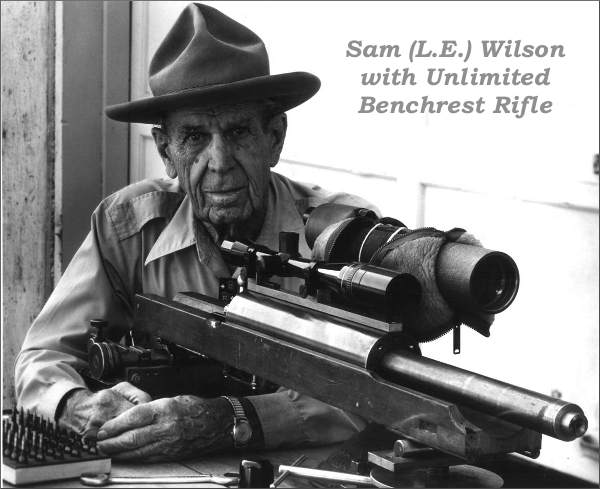
Sam (L.E.) Wilson actively competed in benchrest matches until he passed. He’s shown here with an Unlimited benchrest rifle of his own design.
If you’ve used hand dies with an arbor press, chances are you’ve seen the L.E. Wilson company name. You may not know that the founder of L.E. Wilson Inc. was an avid benchrest competitor who pioneered many of the precision reloading methods we used today. Known as “Sam” to his friends, L.E. Wilson was one of the great accuracy pioneers who collected many trophies for match victories during his long shooting career. His company continues to innovate — bringing out new products such as the Case Gage Depth Micrometer tool we recently reviewed.
The photo above shows Sam (foreground) with all of his children at a shoot. Behind Sam are Jim, Jack and Mary, shooting in the Unlimited Class. What do they say — “the family that plays together stays together”? Note the long, externally-adjusted scopes being used. Learn more about Sam (L.E.) Wilson and his company on the L.E. Wilson Inc. Facebook Page.
Unlimited Class was Sam’s favorite discipline, because in the “good old days” top competitors normally would craft both the rifle and the front/rear rests. This rewarded Sam’s ingenuity and machining/fabrication skills. In the “build-it-yourself” era, one couldn’t just order up an unlimited rail gun on the internet. How times have changed…
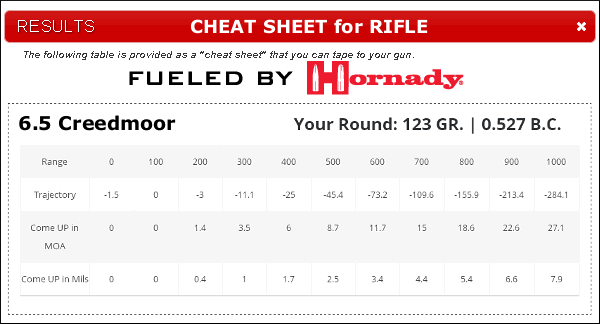
Need a simple, easy-to-use drop chart for your rifle? Something you can tape right to the buttstock? Then check out Hornady’s handy Online Ballistics Calculator. This user-friendly calculator will compute your drops accurately, and output a handy “Cheat Sheet” you can print and attach to your rifle.
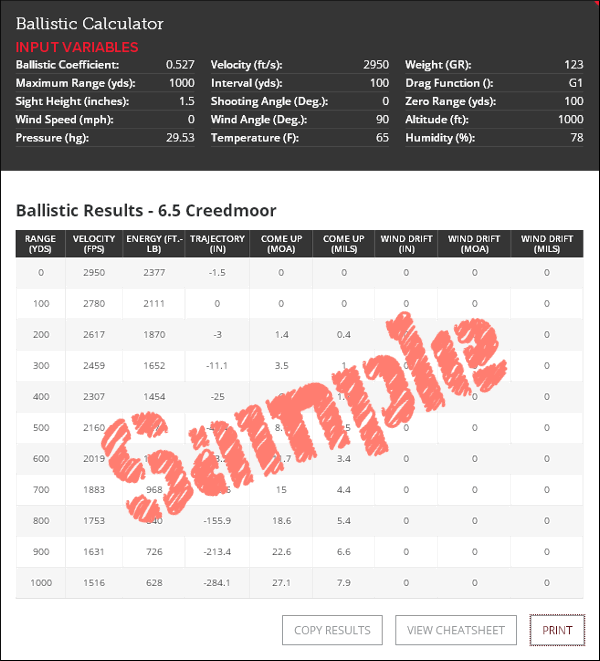
Here’s how it works. From the Ballistics Calculator Page, simply input G1 or G7 BC values, muzzle velocity, bullet weight, zero range, and a few other variables.
Click “Calculate” to view the full chart (shown below). Then click “View Cheatsheet” and the simpler, 4-line Drop Chart (shown above) appears. Click “Print” and you’re done!
The online ballistics caculator is easy to use. You can select the basic version, or an advanced version with more data fields for environmental variables (altitude, temperature, air pressure, and humidity). You can also get wind drift numbers by inputing wind speed and wind angle.
Conveniently, on the trajectory output, come-ups are listed in both MOA and Mils — so this will work with either MOA clicks or Mil-based clicks. There are more sophisticated ballistics solvers available on the web (such as the outstanding Applied Ballistics Online Calculator), but the Hornady Calculator is very simple and easy to use. If you just want a basic drop chart, you may want to check this out.
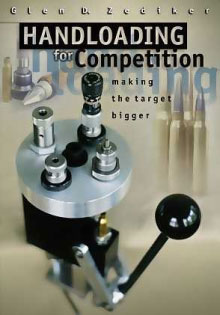
Forum member Danny Reever and this Editor have discussed how novice reloaders can struggle with the fine points of reloading, making errors in seating depth, neck-bushing choice, or sizing their cases. We agreed that a good resource covering more than “Reloading Basics” is sorely needed. Danny reminded me that Glen Zediker’s excellent Handloading for Competition book has been available since 2002. Danny says this may still be the best guide in print for those getting started in precision reloading, though the book is not without flaws.
Danny observed: “I consider this still the best book out there on the subject. I’ve bought a lot of other books only to be sorely disappointed after spending $30-$40 of my hard-earned cash. This book is not one of those! I’ve read and re-read Zediker’s treatise at least four times and refer to it often for advice while reloading. My number one suggestion for those who buy the book is to sit down with a highlighter and read it cover to cover. It’s well-written with a bit of humor and it is not boring.”
Extremely comprehensive, Zediker’s book covers nearly all of the key factors involved in accurate reloading: case sorting, brass prep, load development, neck-sizing, full-length sizing, bushing selection/use, tool selection, priming, powder measurement, and bullet seating. The book also explains how to test and evaluate your ammo, and how to monitor and interpret pressure signs.
There are many “must-read” sections in Zediker’s book, according to Danny: “The section beginning on page 161 dealing with concentricity (and how to achieve it) is excellent. Likewise the Load Limits section discussing pressures offers very valuable advice and info. You should also read Zediker’s commentaries about load testing, powders (burn characteristics etc.), and the effects of temperature.”
Zediker has conveniently provided a detailed summary of his book on the web, complete with table of contents, sample pages (PDF format), and dozens of illustrations. Shown above is just one small section that covers ejectors.
Overall, we recommend Glen Zediker’s Handloading for Competition, though the book definitely could use some updating. Danny says: “Plunk down the [money] and buy this book, you won’t be sorry.” Zediker’s book is available from Amazon.com ($34.99), Midsouth Shooters ($33.49), and Zediker Publishing ($36.95).
Factory-loaded ammunition has become very hard to find, particularly pistol ammo. Concerns over social unrest, personal security, and the upcoming election have spiked demand for loaded ammo. Everyone is asking “where has all the ammo gone?”
Pistol Ammo Hard to Find
In particular, 9mm pistol ammo flies off the shelves as soon as it arrives, and even major online vendors such as Midsouth Shooters, MidwayUSA, and Natchez have very limited supplies.
Need Ammo? Load Your Own…
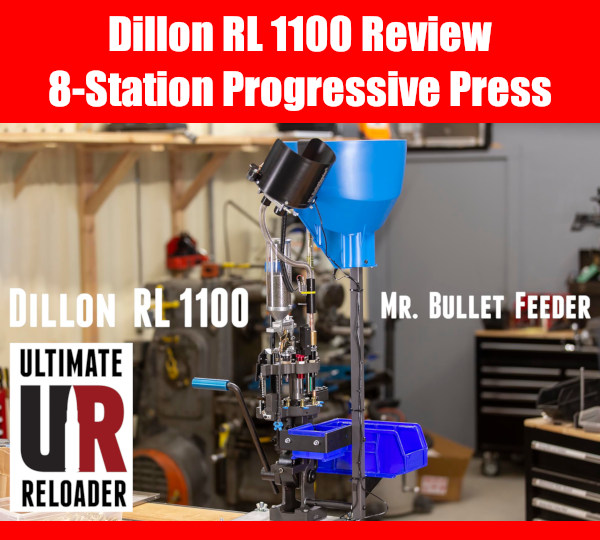
One answer to the ammo shortage is to load your own. And if you want to produce a large quantity of ammo in a short amount of time, the progressive press is the answer. There are many progressive press systems, from modest Lee progressives to high-end, automated systems from Mark 7 (Lyman). In this article we feature the “latest and greatest” progressive press from Dillon — the new eight-station RL 1100 Press with Case-Feeder.
Our friend Gavin Gear of UltimateReloader.com got his hands on Dillon’s impressive new RL 1100. In two videos, Gavin shows how to set up the RL 1100 and then he demonstrates how to produce 9mm pistol ammo with this impressive 8-station press.
Gavin says: “My Dillon RL-1100 is cranking out the 9mm, and in this video we bring it up to ‘full tilt’ speed” [with the MR. Bullet Feeder and the Dillon Case-Feeder]. If you watch the video, you’ll see Gavin produce 9mm ammo at a rate of nearly 50 rounds per MINUTE!
Gavin equipped his new RL 1100 with two cool products from Double Alpha Academy (DAA) — the Mr.Bulletfeeder® as well as an advanced, Magnetic Powder Check. When loading ammo you can never be too safe, so we definitely recommend the use of powder-check dies (we use a conventional RCBS powder-check die on our progressives). The DAA bullet feeding system is an important add-on that significantly increases output rates when used in concert with the Dillon Case-Feeder (blue funnel).
RL 1100 Reloading Stations with Powder Check and Bullet Feeder
RL 1100 Stations shown above:
1. Case inserter
2. Sizer/De-Primer
3. Swager (with hold-down)
4. Priming (no die)
5. Powder charge and expansion (expansion for pistol cartridges only)
6. Double Alpha Magnetic Powder Check
7. Mr. Bullet Feeder bullet feed die
8. Bullet seating and Crimping
Note: In order to accommodate the magnetic powder check die AND the bullet feed die, bullet seating and crimping were combined at the last station.
The RL 1100 has some very impressive features that allow faster and easier ammo production. An Eccentric Roller Bearing Drive System reduces friction. The RL 1100’s heavier frame provides greater rigidity for more efficient cranking. The RL 1100 also boasts an improved shellplate indexing system. Priming is enhanced through a spring-loaded Priming Station Locator and Upgraded Primer Pocket Swager.
Dillon RL-1100 Set-Up Video:
Loading with the “Turbocharged” Dillon RL-1100
Gavin was very impressed with his RL-1100: “This reloading setup is [great]. Every crank of the lever yields a completed cartridge, and the attainable speeds are AMAZING. The case feeder and bullet feeder had no trouble keeping up with my quick pace using this setup. And it is great to know that every powder charge is being checked.
This press is very reliable and smooth, bridging the gap between lower cost home set-ups and six-figure commercial loading equipment packages. What’s next? I’ll be performing a caliber changeover to .308 Winchester.”
The DAA Magnetic Powder Check can be used on a variety of Progressive Presses.
When neck-turning cases, it’s a good idea to extend the cut slightly below the neck-shoulder junction. This helps keep neck tension more uniform after repeated firings, by preventing a build-up of brass where the neck meets the shoulder. One of our Forum members, Craig from Ireland, a self-declared “neck-turning novice”, was having some problems turning brass for his 20 Tactical cases. He was correctly attempting to continue the cut slightly past the neck-shoulder junction, but he was concerned that brass was being removed too far down the shoulder.
Craig writes: “Everywhere I have read about neck turning, [it says] you need to cut slightly into the neck/shoulder junction to stop doughnutting. I completely understand this but I cant seem to get my neck-turning tool set-up to just touch the neck/shoulder junction. It either just doesn’t touch [the shoulder] or cuts nearly the whole shoulder and that just looks very messy. No matter how I adjust the mandrel to set how far down the neck it cuts, it either doesn’t touch it or it cuts far too much. I think it may relate to the bevel on the cutter in my neck-turning tool…”
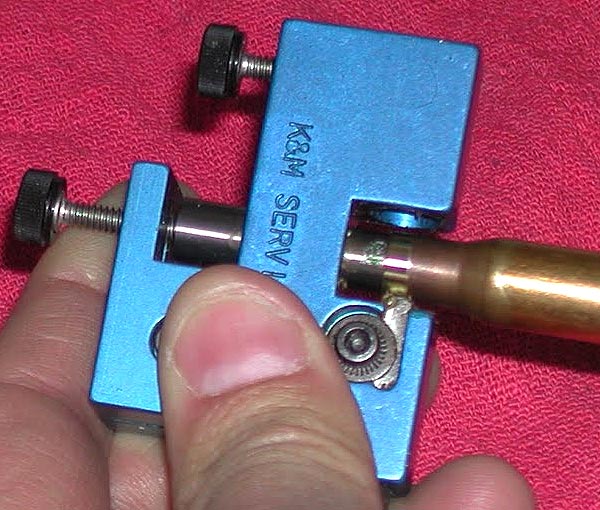
Looking at Craig’s pictures, we’d agree that he didn’t need to cut so far down into the shoulder. There is a simple solution for this situation. Craig is using a neck-turning tool with a rather shallow cutter bevel angle. This 20-degree angle is set up as “universal geometry” that will work with any shoulder angle. Unfortunately, as you work the cutter down the neck, a shallow angled-cutter tip such as this will remove brass fairly far down. You only want to extend the cut about 1/32 of an inch past the neck-shoulder junction. This is enough to eliminate brass build-up at the base of the neck that can cause doughnuts to form.
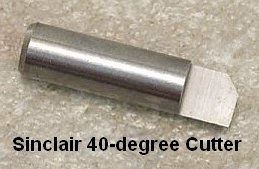
The answer here is simply to use a cutter tip with a wider angle — 30 to 40 degrees. The cutter for the K&M neck-turning tool (above) has a shorter bevel that better matches a 30° shoulder. There is also a 40° tip available. PMA Tool and 21st Century Shooting also offer carbide cutters with a variety of bevel angles to exactly match your case shoulder angle*. WalkerTexasRanger reports: “I went to a 40-degree cutter head just to address this same issue, and I have been much happier with the results. The 40-degree heads are available from Sinclair Int’l for $15 or so.” Forum Member CBonner concurs: “I had the same problem with my 7WSM… The 40-degree cutter was the answer.” Below is Sinclair’s 40° Cutter for its NT-series neck-turning tools. Item NT3140, this 40° Cutter sells for $14.99. For the same price, Sinclair also sells the conventional 30° Cutter, item NT3100.
Al Nyhus has another clever solution: “The best way I’ve found to get around this problem is to get an extra shell holder and face it off .020-.025 and then run the cases into the sizing die. This will push the shoulder back .020-.025. Then you neck turn down to the ‘new’ neck/shoulder junction and simply stop there. Fireforming the cases by seating the bullets hard into the lands will blow the shoulder forward and the extra neck length you turned by having the shoulder set back will now be blended perfectly into the shoulder. The results are a case that perfectly fits the chamber and zero donuts.”
* 21st Century sells carbide cutters in: 15, 17, 20, 21.5, 23, 25, 28, 30, 35, 40, and 46 degrees. PMA Tool sells carbide cutters in: 17.5, 20, 21.5, 23, 25, 28, 30, and 40 degrees, plus special short-neck cutters.
Forum member Nodak7mm has discovered an ideal way to store your rifle cleaning rods in your garage or loading room. Using inexpensive Berkley Horizontal Fishing Rod Racks, Nodak7mm has secured a half-dozen Dewey rods on the back of a door. You could also mount the racks along a wall or on the side of a storage cabinet. This installation takes up minimal space and the Berkley Racks cost just $11.96 at Amazon (select “6 Rod Rack”) or $16.50 per set at Walmart. If you prefer wood, Amazon also sells a pine 6-rod wall rack for $22.45.
Nodak7mm explains: “I was moving some fishing poles around and ended up with an extra pair of Fishing Rod wall racks. I said to myself, ‘I bet this would hold my Dewey cleaning rods’. I mounted the pair on the inside of a closet door in my man cave and put my cleaning rods in it. It works like a charm and is far cheaper than a specially-made rack that only lets the rods hang. One can even slam the door with the rods mounted and they stay put. This rod rack set… is made by a nationally recognized name and does a great job of holding the cleaning rods securely and safely.” These are inexpensive and are easy to mount to a door or wood cabinet.
Stow Your Cleaning Rods on Your Gun Safe
Another option is to make a rod set with a magnetic backing strip. This can be affixed to the sides of your gun safe or steel storage cabinet. Here is a home-made, magnet-affixed cleaning rod holder made by Forum Member “BobM”. This smart installation works great. CLICK HERE for more information.
Three new powder lines have been added to the Hodgdon “family” of propellants. Hodgdon Powder Company (“Hodgdon”) has acquired Accurate and Ramshot smokeless powder brands from Western Powders, along with the Blackhorn 209 muzzleloader brand. This acquisition is effective October 1, 2020. Hodgdon will begin shipping these powders immediately to wholesale and retail customers.
This represents a major expansion of Hodgdon’s powder line-up which also includes the popular Hodgdon, IMR, GOEX, and Winchester propellants. Hodgon’s ADI-produced powders, such as H4895, Varget, and H4350 are among the most “in-demand” propellants for precision hand-loaders and competitors.
“This acquisition is another example of our dedication to the handloader and muzzleloader hunter,” said J.B. Hogdon and Bob Hodgdon, co-owners and sons of the founder of the Hodgdon Powder Company. “We have experience in acquiring the IMR Powder brand in 2003, the Winchester Powder license in 2005 and the GOEX brand in 2009 and we plan to put this experience to use in expanding the reach and customer base of the Ramshot, Accurate, and Blackhorn 209 brands.”
Acquisition Expands Hodgdon’s Ballistics Lab Resources
“This acquisition of the Ramshot and Accurate brands further solidifies our portfolio of smokeless brands and products for our handloading end users,” said Steve Kehrwald, president and CEO of Hodgdon Powder Company. “And the addition of Blackhorn 209 to our world-class muzzleloading brands like Pyrodex and Triple Seven uniquely positions us to serve the muzzleloading consumer. With these brands, we also add the capabilities of an additional ballistics lab to continue developing the data our customers demand from our Reloading Data Center and publications like our Annual and Basic Manuals.”
“Hodgdon has always been a strong competitor in the reloading powders industry,” said Doug Phair of Western Powders. “The Hodgdon family has built a robust company. Ramshot, Accurate, and Blackhorn 209 will make excellent additions to the Hodgdon family of powders.”


 “I’ve been ‘at this’ for over 40 years now, and ‘this’ is shooting, handloading, and writing about it for the past 25. My background is competitive shooting, primarily NRA High Power Rifle. From that followed my exploration of handloading and education therein. As an NRA High Power Rifle competitor, I earned a High Master classification, and I did it competing in Service Rifle division.
 “So, the advice that accompanies this first installment is to consider or reconsider your standards, and your evaluation of what is a good load. When I’m testing I choose the best group out of whatever it was I was testing. However, when it’s decision time, I choose the best, worst group. Let me explain. I really don’t consider what the very best any combination can show me is, but rather what is the worst the combination has shown me. Exceedingly tight groups are all too often a combination of luck and a little more luck. We got lucky in our judgment to choose the combination and the bullet fairy tipped her tiara. The more rounds anyone shoots, the bigger the groups are going to get. That’s just math. However, if three or four 10-shot groups are showing X-Ring accuracy, I’m going to ignore the group measurement, pay more attention to the chronograph, and pay very close attention to any over-pressure indicators. I don’t want to see anything outside a golf-ball sized circle at 300 yards, and I’m hoping to keep it that way.





 Forum member Danny Reever and this Editor have discussed how novice reloaders can struggle with the fine points of reloading, making errors in seating depth, neck-bushing choice, or sizing their cases. We agreed that a good resource covering more than “Reloading Basics” is sorely needed. Danny reminded me that Glen Zediker’s excellent
 Pistol Ammo Hard to Find
 When neck-turning cases, it’s a good idea to extend the cut slightly below the neck-shoulder junction. This helps keep neck tension more uniform after repeated firings, by preventing a build-up of brass where the neck meets the shoulder. One of our Forum members, Craig from Ireland, a self-declared “neck-turning novice”, was having some problems turning brass for his 20 Tactical cases. He was correctly attempting to continue the cut slightly past the neck-shoulder junction, but he was concerned that brass was being removed too far down the shoulder.

 Forum member Nodak7mm has discovered an ideal way to store your rifle cleaning rods in your garage or loading room. Using inexpensive


