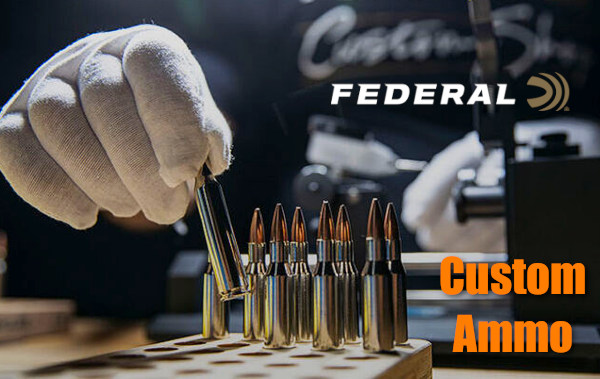
Don’t have time to hand-load your own ammo, or don’t have all the equipment and dies needed? There’s a new option — something that’s actually quite revolutionary in the ammo industry. Federal is now offering custom-loaded ammunition. You choose the cartridge type and bullet type and Federal technicians put the ammo together. Think about it — this could be an interesting option for hunters who only need a few rounds a year, or if you want to try out a bullet/cartridge combo for the first time.
“Each round is painstakingly handloaded to order by our team of expert engineers in our state-of-the-art reloading workshop. Veteran craftsmen combine the best components with extra quality checks at every stage for the most consistent velocity, accuracy, and overall performance. Loads are then hand-checked for final inspection and cleaned before being custom-packed in durable, personalized packaging.”
26 Centerfire Rifle Cartridge Types + Many Bullet Options
Currently, you can choose from 26 rifle cartridge types and a wide selection of quality bullets from Barnes, Berger, Sierra, Nosler, Federal, Hornady, Swift, and more. NOTE: Federal Custom Shop ammo will be sold direct-to-consumer only. Along with rifle ammo, Federal will offer custom TSS Shotshells.
Bullet Types Offered: BARNES TIPPED TSX, BERGER HYBRID HUNTER, HORNADY ELD-X, NOSLER ACCUBOND (and Accubond LR), NOSLER PARTITION, SIERRA MATCHKING, SWIFT A-FRAME, WOODLEIGH HYDRO SOLID; and Federal TERMINAL ASCENT, TROPHY BOND BEAR CLAW, TROPHY BONDED SLEDGEHAMMER, TROPHY COPPER.
Please note: Federal Custom Shop ammunition is built to order — not pulled out of inventory in a warehouse. As such, please allow more time for processing and delivery. Typically, your Custom Shop order will take two weeks to build, plus standard delivery time. The Custom Shop handloading center is located at Federal’s main factory in Anoka, Minnesota. For more information, including how to order, what specific load options are available, and shipping details, visit: FederalPremium.com/custom-shop.html.
“If it’s not in Federal’s vast catalog as factory-loaded ammo, we may have it listed on our website as a load we will custom hand-load for you,” notes Federal Ammunition President Jason Vanderbrink. “For example, Barnes 120-grain Tipped TSX in 6.5-284 Norma and 28-gauge TSS turkey loads aren’t products we list in our catalog, but you can certainly order them through our Custom Shop.”
Bryan Blake, a very clever machinist and gunsmith, has created an ultra-precise and speedy neck-turning machine. Bryan, who runs Blake Machine, Blake Barrel, and F-Class Products has created a system that uses twin precision cutter tips to turn case necks inside and out quickly and efficiently, with superior precision. This advanced IDOD Neck Turning Machine holds cases securely in a precision-machined spindle attached to an electric motor. Twin blades move precisely during the cutting process, milling the necks inside and out. The turned necks come out perfect every time, with the shoulders trimmed exactly (with doughnut removed) as well. If you turn hundreds of cases during a shooting season, you may want to consider getting an IDOD from F-Class Products. Bryan was able to turn 30 cases in just 6 minutes. And there is an even more advanced version, called the AUTODOD, shown in the last video below.
Our friend Erik Cortina recently visited Bryan Blake in Phoenix. Erik saw the IDOD in action and was impressed. Erik notes: “For a very long time, we have been turning brass the exact same way. Use a mandrel as a pilot and have a cutter with a specified gap go around the perimeter and turn the necks to specified thickness. The IDOD uses a technique called ‘pinch turning’ to turn the ID and the OD (IDOD) at the same time.” You can watch how it works in Erik’s video below (action starts at 7:55 time-mark):
The secret to the efficiency of the Blake IDOD is a vibration-free motor, high-mass case-holder, precision OD/ID-adjustable cutter, along with an advanced tracking system that moves the cutter heads towards the case neck (and back again) with absolute, 100% repeatable precision. Watch the video from 8:30 to 10:10 to see Bryan explain how to adjust the system for a perfect result.
This shows how to set up the IDOD Neck-turning machine for a particular cartridge type:
This video shows a close-up of a neck being with perfect neck-wall consistency:
This latest video from Blake Machine shows the new AUTODOD machine with power controls. This speeds up and simplifies neck-turning process.
Many major manufacturers and online vendors are offering great bargains today, Black Friday. Over the past two days we’ve spotlighted vendors worth visiting because they offer a wide range of discounts on a large inventory selection — in some cases, everything in stock is discounted 10%, 15%, even 25%. For our previous 2020 Black Friday Vendor Specials, scroll down or CLICK HERE (11/26) and CLICK HERE (11/25).
In this article we are going to focus on specific Black Friday Bargains. Here are 22 truly exceptional deals on recommended products that you can use in your reloading room and at the range.
MidwayUSA — Cyber Week Sale
Here are six great deals offered through MidwayUSA’s Cyber Week Sale (8 Days of Savings). There are also many other bargains on optics, shooting mats, and reloading gear on MidwayUSA’s Cyber Week Sale Page. Deals are good through November 30, 2020 and you get FREE Shipping with Code FSCYBER49 .
LongShot Cameras
Longshot Target Cameras is running a special sale with discounts on multiple items. Plus there is a special coupon code for AccurateShooter.com Readers and Forum members. After you add the item to your shopping cart, the sale prices appear. These represent $100 off LR-3, $50 off Marksman, and 50% off the Hawk spotting scope camera. You’ll get free shipping with code SENDIT. IMPORTANT — if you purchase the LR-3, you’ll get an additional $50 off with code ACCURATESHOTS (use that code for the LR-3 instead of SENDIT).
Natchez Shooters Supplies — Great Reloading Deals
For Black Friday, Natchez has slashed prices on a large variety of reloading tools and hardware including equipment from Hornady, Lyman, and RCBS. We were most impressed with the savings on RCBS reloading scale/dispensers and press kits. These are the best prices we’ve found on the web, and the RCBS reloading kits have been selling out. Check out these RCBS bargains at Natchez.
Graf & Sons — 25% Off All Sightron Optics
We listed this yesterday, but we wanted to spotlight the exceptional Sightron bargains available right now at Grafs.com. All Sightron Optics are 25% off — Scopes, Spotting Scopes, Binoculars, Red Dots and more. If you are looking for a high-magnification competition scope, or a field Target scope, or a nice HD Glass Spotter, check out these deals.
Palmetto State Armory — Triggers, Optics, Pistols and More
Palmetto State Armory is a go-to source for black rifle fans. For Black Friday, Palmetto has discounted a large number of AR parts/accessories including triggers, uppers, and optics. In addition, Palmetto has discounted S&W handguns and many other products. These are all listed on the Black Friday Sale Page.
Special Bonus — Free Shipping at Whidden Gunworks
Today only, Black Friday (11/27/2020), Whidden Gunworks is offering free 48-state product shipping. This is for orders over $250.00. To get FREE Shipping use Code BF2020 at checkout.
Sierra Bullets has published load data for the 6mm Creedmoor cartridge, a necked-down version of the popular 6.5 Creedmoor. Sierra has released very comprehensive 6mm Creedmoor load data, covering fifteen (15) different bullets from 55 to 110 grains. NOTE: Hornady-brand brass was used for Sierra’s 6mm Creedmoor load tests, not the newer, stronger Lapua 6.5 CM brass with small primer pockets. Hand-loaders using Lapua 6.5 Creedmoor brass necked to 6mm may have to adjust their loads.
Sierra writes: “As soon as the 6.5 Creedmoor was released in 2007, a 6mm version was being envisioned. After the 6mm Creedmoor demonstrated its worth at 1000 yards it began to catch the attention of Precision Rifle Series (PRS) competitors. The 6mm Creedmoor is a great fit for those looking for an AR platform-friendly cartridge. It delivers velocities very similar to the .243 Win and yet fits the AR10 magazine length[.] The 30-degree shoulder makes this a very efficient case and helps prolong case life as well. The 6mm Creedmoor works well with powders such as H4350, [RE-16], RE-17, and Ramshot Hunter for heavier long-range bullet weights. Slightly faster powders such as RE-15, Win 760, and Vihtavuori N540 work well with lighter weight bullets.”
Sierra Bullets Tested for 6mm Creedmoor Load Data
55gr BlitzKing (#1502)
60gr HP (#1500)
70gr HPBT (#1505)
70gr BlitzKing (#1507)
75gr HP (#1510)
In developing its 6mm Creedmoor load data, Sierra tested a very wide selection of propellants, two dozen overall. For the smaller bullets, fast-burning powders such as Benchmark, H4895, and CFE223 were tested. For the heavier 100+ grain bullets, Sierra tested a selection of medium-burn-rate powders including H4350, Reloder 16, Reloder 17, Varget, and Superformance. Sierra did a very thorough job. We know this information will be welcomed by 6mm Creedmoor shooters.
Don’t know what powder to try first? For the 107-110 grain bullets, if you want best accuracy and low ES/SD, our Forum members recommend Alliant Reloder 16 and Hodgdon H4350. If you are seeking max velocity with the 110-grainer, look at Hodgdon Superformance and Reloder 19.
Here are Sierra’s 6mm Creedmoor Load Data Charts for 90-95 grain bullets plus the 107gr MK and 110gr MK. There are five other tables for other bullet types.
BONUS: PRB 6mm Creedmoor and 6.5 Creedmoor Load Survey
The Precision Rifle Blog compiled Load Data from PRS Competitors, for both 6mm Creedmoor and 6.5 Creedmoor. This is a good place to start. PRB surveyed the match loads for “173 of the top-ranked precision rifle shooters in the country”. One cautionary note: These PRS guys may be loading fairly hot, so work up gradually, 0.3 grains at a time. CLICK HERE.
At the request of our readers, we provide select “Deals of the Week”. Every Sunday afternoon or Monday morning we offer our Best Bargain selections. Here are some of the best deals on firearms, hardware, reloading components, optics, and shooting accessories. Be aware that sale prices are subject to change, and once clearance inventory is sold, it’s gone for good. You snooze you lose.
1. Academy Sports — Cannon 64-Gun Safe, $599.99 (Save $400)
⏺ BIG gun safe, good interior, amazing 40% OFF Savings
This is a jumbo-sized, 40″-wide fire-rated safe that holds up to 64 long guns. This big Cannon Valley Forge Gunsafe normally sells for $999.99, but this week you can get it for just $599.99 at Academy Sports. Yep, that’s a whopping $400 off normal retail, a 40% savings! If you need a big safe, don’t hesitate — this deal is good from November 22-28, 2020 only.
⏺ Bargain Price AND get 500 free bullets from Hornady
Need tools to start reloading? Check out the Lock-N-Load Classic Reloading Kit. This Hornady Reloading Kit includes everything you need except brass, powder, and bullets to get started. Don’t forget to use Brownells coupon code VTJ for $20 off, lowering your net price to $299.99. Also, this Lock-N-Load Classic Reloading Kit appears to qualify for 500 FREE bullets through the Hornady Get Loaded Rebate. That Rebate can net you bullets worth 50% of your Kit purchase price, making this a very attractive deal
3. Amazon — Vortex Diamondback HD Spotting Scope, $399.00
⏺ Great Spotting Scope Deal — hard to beat at twice the price
Whether hunting or target shooting, spotting scopes get you on target faster and easier than bare eyes or riflescope. If you need a good HD-grade spotter, check out the Vortex Diamondback HD 16-48x65mm angled spotting scope for $399.00. It offers great clarity and rock-solid lifetime guarantee. Relatively compact and weighing 49.8 ounces, this is a good choice for a hunter. There’s also a straight version for $399.00, with same 16-48X power and 65mm objective. If you need more magnification and low-light performance, Vortex offers the 20-60x80mm Diamondback HD spotter for $499.00.
4. Amazon — All-Weather Case with Anti-Rust Interior, $93.99
⏺ Protect your firearm investment with corrosion-fighting rifle case
Transporting your firearms isn’t just about protecting them from damage, it’s also about keeping them clean and RUST FREE. If you keep long guns in hard cases for significant periods of time, condensation can create rust faster than you realize. A great choice to combat this is the Plano All Weather Gun Case with Rustrictor. This waterproof rifle case fights rust with Vapor Corrosion Inhibitor (VCI) chemicals infused into resin and foam emitters. With its built-in rust-fighter, this case resists corrosion 5x longer than competing products (per lab testing). The 42″ model is $93.99, while the smaller 36″ rustrictor case is just $74.99. There is also a large 52″ wheeled case for $171.90.
⏺ Truly some of the highest-quality soft rifle cases you can buy
Tired of poorly-made soft cases that wear out after one season? If you want to get a top-quality case that will last for years, check out the Creedmoor Blue Deluxe 55″ or 60″ Rifle Case. These are hand-made cases that provide an incredible level of protection with quality fabrics and padding. Smart design, high-grade zippers, and top-quality sewing make a noticeable difference. And right now you can get either the 55″ or 60″ model for $124.45 — a $25 savings off the regular $149.95 price. You will see many of the nation’s top Palma and F-Class shooters using these cases.
6. Bullet Central — Jewell Benchrest Trigger, $169.50
⏺ Jewell triggers hold world records in multiple disciplines
Jewell triggers have set records and dominated firing lines across the country for good reason. They’re about half the price of other top triggers, can be easily tuned and adjusted and they just work without question. If you need a new competition trigger consider the Jewell Remington 700 BR Trigger (No Safety) model from Bullet Central. Upgrade your rifle for a reasonable price.
7. Natchez — RCBS ChargeMaster Lite, $229.99
⏺ Best Deal on popular, speedy Scale/Dispenser
Do you need an electronic powder scale/dispenser? Most vendors charge $290-$300 for the popular RCBS ChargeMaster Lite. But now you can get it for just $229.99 at Natchez. You save $70.00, about 24%! The ChargeMaster Lite features an easy-to-use LCD touchscreen and claimed precision of plus/minus 0.1 grains. The unit comes with twin check weights and a convenient plastic cover for the powder pan. If Natchez sells out, you can get the ChargeMaster Lite for $239.99 at Sportsman’s Warehouse.
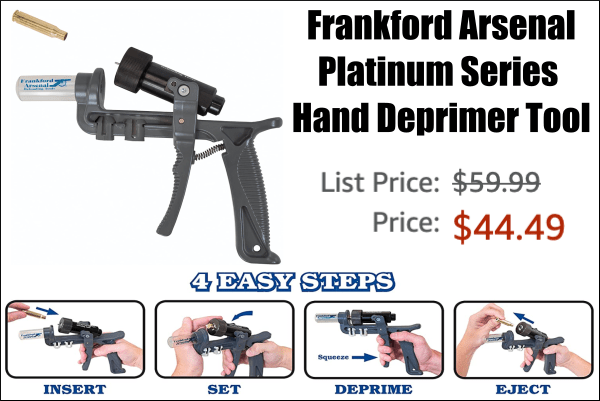
8. Amazon — Frankford Arsenal Hand Deprimer Tool, $44.49
⏺ Deprime fired cartridge brass anywhere — no press needed
Decapping brass can be a tedious and messy chore. Not only does the priming cup come out but so does the anvil and other little bits. Keep it clean and easy but grabbing the Frankford Arsenal Platinum Series Hand Deprimer Tool and deprime in style. This self-contained unit allows you to decap anywhere and keep all the mess in the capture container. It’s easy on the hands too. With this handy tool you can deprime your bases while watching TV.
9. Amazon — TWO Sets of NRR 28dB Earmuffs, $21.24
⏺ Amazing Deal for TWO pairs of NRR 28 muffs
How about a gift for a friend that’s also a gift for you? Pick up this 2-Pack of Mpow Professional Ear Defenders muffs for just $21.24. You can give one set to a buddy and keep one set for yourself. With a 28dB Noise Reduction Rating (NRR), these muffs have good buyer reviews, with positive comments about comfort and noise reduction. You can’t beat this price for TWO sets of muffs with carry bags included.
One of the most important aspects of precision reloading is setting the shoulder bump during the full-length (FL) sizing process. You want the amount of “bump” to be precise and identical for every loaded round. However, when you switch brands of brass you may need to change the die position to get the desired bump and case body sizing. And even with the same brand of brass, you may find that you need to adjust your FL die as the number of brass load cycles increases. Brass that has been fired many times will behave differently than new or near-new brass.
Also, even with the same cartridge type, brass loaded for a semi-auto rifle may need more bump than brass fired in a bolt gun. For example, with .223 Rem ammo, you’ll normally want to push the shoulder back farther if the ammo will be shot in a AR15 as opposed to a bolt-action rig.
So how do you make all these needed adjustments for your full-length dies? You can move a conventional locking ring up and down, but that can be a tedious, trial-and-error process. Some guys use shims in one-thousandth intervals, but that still requires taking your dies in and out of the press. Well there is a better way now…
PMA Tool Micro-Die Adjuster
Wouldn’t it be great if you could precisely adjust your FL die up and down in half-thousandth increments, with a simple indexed click. That is now possible with products offered by PMA Tool and Whidden Gunworks. PMA Tool offers a Micro-Die Adjuster that replaces your existing lock ring and can be used with nearly any 7/8-14 full length sizing die. The engraved marks correspond to approximately .001″ of shoulder bump adjustment. Splitting the engraved marks is therefore approximately equal to .0005″ (half a thousandth). Users love this product, saying it adds precision and saves time.
Whidden Click-Adjustable FL Sizing Die System
Whidden Gunworks offers a complete click-adjustable FL sizer die with a special, indexed ring. With Whidden’s patent-pending Click Adjustable Sizer Die system, the die and lock ring work together to allow rapid, precise bump adjustments. One click changes the bump .001″. It’s simple and fast. Included with the Click Adjustable Sizer Die is a shoulder bump gauge. John Whidden (in video below) explains:
“There has become a need for an easier way to adjust the sizer die properly. Until now there have been few options other than trial and error to get the shoulder setback correct. Anyone who has done this can attest that it’s a slow and imprecise job! Our die and lock ring work together to give the user a clicking feel to the adjustment. Each click moves the shoulder bump .001” so you can easily find the exact shoulder bump that you desire.” — John Whidden
Before you load that nice new cartridge brass for the first time, run an expander mandrel down the case necks. This will iron out dents and provide more uniform neck tension. Chose a mandrel diameter that provides appropriate neck tension.
Lapua brass is so good that you’ll be tempted to just load and shoot, if you have a “no-turn” chamber. However, some minimal case prep will ensure more uniform neck tension. Keeping your neck tension very uniform allows more consistent bullet seating. That, in turn, usually yields better accuracy, and lower Extreme Spread and Standard Deviation (ES/SD). Lapua brass, particularly 6mmBR, 6.5×47, 6.5 Creedmoor, and .308 Win comes from the factory with tighter-than-optimal necks. Before you seat bullets, at a minimum, you should inside chamfer the case mouths, after running an expander mandrel down the necks. The expander mandrels from both Sinclair Int’l and K&M will both leave the necks with enough neck tension (more than .001″) so you can then seat bullets without another operation. We suggest putting a bit of lube on the mandrel before running it down the necks — but remove any lube that gets inside the necks before seating bullets.
Both Sinclair and K&M Tools make a die body specifically to hold expander mandrels. The Sinclair version, is shown above. This $32.99 unit fits caliber-specific expander mandrels ($9.99) which measure approximately .001″ less than bullet diameter for each caliber. This is an updated “Gen II” design that completely captures the mandrel within the die so the mandrel cannot pull out. It also has an O-ring in the die cap that allows the mandrel to self-center within the case neck. Sinclair now offers three sizes of die bodies for expander mandrels: .17 -.338 Caliber (#749-011-715WS $32.99); .357 – .50 caliber (#749-008-843WS, $32.99), and a special .50 Cal die body for large-diameter 50 BMG presses (#749-009-163WS, $39.99). All Generation II dies are machined from stainless steel and the standard diameter 7/8-14 dies include the Sinclair Stainless Steel Split Lock Ring.
Once you run the Sinclair expander mandrel down the necks of Lapua brass, after you account for brass spring-back, you’ll have about .002″ neck tension*. This will make the process of seating bullets go much more smoothly, and you will also iron out any dents in the case mouths. Once the case mouths are all expanded, and uniformly round, then do your inside neck chamfering/deburring. The same expander mandrels can be used to “neck-up” smaller diameter brass, or prepare brass for neck-turning.
Forum member Mike Crawford adds: “These expanders can also reduce runout from offset seating. Prior to bullet seating, expand the sized necks to force thickness variance outward. With the Sinclair system, the necks will springback fine, and will not be pulled out of center. This leaves plenty of tension, and bullets seated more centered. I do this, even with turned necks, to get improved seating.”
Mandrels vs. Expander Balls on Decapping Rods
If you haven’t acquired an appropriate expander mandrel for your brass, but you DO have a full-length sizing die with an expander ball, this will also function to “iron out” the necks and reduce tension. However, using a die with an expander ball will work the necks more — since you first size them down, then the ball expands them up again. Typically (but not always), run-out is worse when using an expander ball vs. an expander mandrel.
* This .002″ tension is what we have observed with Lapua 6mmBR, 6.5×47, 6.5 Creedmoor, and .308 Win brass. This might vary with much smaller or larger cases, and of course a different brand of brass might yield different results. If you get too little tension with your current mandrel, you can get a smaller-diameter mandrel from 21st Century Shooting. 21st Century even offers low-friction Titanium Nitride-coated mandrels.
Top rifle competitors use the AutoTrickler system because it offers a superior combination of speed and precision in dispensing powder loads. With an AutoTrickler fitted to a compatible lab-grade magnetic force restoration scale, you can achieve single-grain weight consistency with your hand-loads. That kind of load weight uniformity does help deliver low ES/SD that translates to reduced vertical at long range. Adam MacDonald’s AutoTrickler system is so good that it can truly be called a “game-changer” in the precision handloading world.
As good as the AutoTrickler may be, there are some simple ways to keep it functioning better, or to improve your productivity. Here are three videos by F-Class John that provide very helpful tips for AutoTrickler owners. The first video shows general set-up and installation. The second video shows a simple but brilliant trick to speed up the process — use two identical powder measure cups shaved to be the EXACT same weight. In third video, F-Class John shows important maintenance tips to keep your AutoTrickler components running smoothly and quietly.
AutoTrickler V3 — General Set-Up and Operational Advice
In this video, John offers some general advice for setting-up the AutoTrickler system. He explains how you can get the machine optimized. For example he notes that you want to set the initial drop weight (from the powder measure) in an optimal range: “When you set the original drop you need it to be about 1 to 1.5 grains below. Some people set it too close to the final weight they want and it actually doesn’t let the trickler unit work as efficiently, consistently and accurately as it will if you start 1 to 1.5 grains low.”
John also explains how to hook up the cords and how to position the trickler unit. John places his AutoTrickler on a 30-lb piece of granite, with a thin polymer “anti-static” pad on top. John also uses a line conditioner and grounding wire to provide the best electrical flow to the scale and trickler. Interestingly, the granite was an inexpensive “surplus” piece taken from a kitchen top installation.
John also shows how the angle of the trickler unit can be adjusted. Another smart tip involves marking the white trickler tube belt bushing. That makes it is easier to discern slow movement and determine when the trickler is completely stopped.
If you own an AutoTrickler or plan to purchase one, we definitely recommend you watch this entire video.
Are you experience chattering when powder is dispensed? John also explains (3:20 – 5:30 time mark) how to replace a small rubber “wiper” part in the dispenser unit. This can help prevent chattering or kernel-cutting as the powder charge drops into the pan from above.
Use Two Identical-Weight Powder Cups to Load Faster
In this second video, F-Class John shows how you can use TWO identical powder cups to speed up your reloading. This is a VERY clever and relatively inexpensive upgrade. You can use 600-grit wet sandpaper to make the weight of the twin cups absolutely identical. John says: “I just lightly sanded the bottom of these until they both weighed exactly the same on my scale.” He can now use one cup to load a case while the other cup is receiving the next powder charge.
AutoTrickler V3 General Maintenance Tips
If you have been running an AutoTrickler for quite some time, you have probably noticed some noise or vibration. This video shows some very simple maintenance procedures that will have your AutoTrickler running great again. F-Class John reveals some components that can get dirty or worn after considerable use. The video identifies the items that may require a cleaning or adjusting. In the video John shows how to do those tasks quickly and easily.
In the last three minutes of the above video John shows an important process involving the trickler unit motor. The motor’s attachment screws tend to loosen slightly over time. After removing the pulley drive wheel, you want to gently tension the four Phillips screws. Then reattach the wheel and drive belt. Doing this simple process should reduce unwanted vibration.
Written by Sierra Bullets Ballistic Technician Duane Siercks
One of the first things new reloaders notice is that load data varies between reloading manuals. The Sierra Bullets Technicians frequently get inquiries asking us to explain why the load data appears to be inconsistent. This article explains five key factors that can influence published load data.
Example of load data variances for two 168 grain bullets:
Here are five reasons why the load data varies:
The Bullet
Basically, the similarities in the .30 caliber 168 grain Match bullets (for example) end with weight and diameter. The bullets likely have dimensional differences such as bearing surface length. Bearing surface has a large effect on pressure and velocity. There are also differences in boat tail, flat base, ogive and over-all lengths, which each help determine the cartridge over-all-length (COAL). With different COAL’s, we can expect changes in pressure and velocity also. In some calibers there are differences in bullet diameter with different bullet manufacturers.
It is also worth noting that bullet manufacturers do not all use the same copper alloy for their jackets. This produces more or less friction that results in load pressures and velocities. The solid copper bullets also vary quite a bit in comparison to a lead core and copper jacketed bullet.
The Gun
Each gun is unique, even if you are using the same make, model, and caliber. Special consideration should be used to consider that not all firearm chambers are the same either, creating more variables that need consideration. There can be drastic differences in the throat length. This controls the amount of “jump” that a bullet experiences when the cartridge is fired.
The Powder
Within normal manufacturing tolerances, you can see some variation in a given powders burn rate between different lots of the same powder. So naturally when two different Manuals are produced, it would be doubtful that the same lots would be tested.
The Cartridge Cases
New cases are almost always near minimum specs in dimension. A load fired in a new case would likely have slightly more pressure that when fired in a re-sized case. This would certainly be true if we were loading into fire-formed cases that have had minimal re-sizing done. Fired cases that are full length resized most of the time be slightly larger than the new unfired cases. This gives you differences in case capacity. The same powder charge placed within a new case and a full length resized case will produce different pressure levels and probably different velocities.
Conditions
Temperature can cause pressure increases or decreases. Hot temperatures tend to cause pressures to increase, while cold temperatures will usually do the opposite. Humidity and altitude can impact pressures and velocities likewise.
Conclusion
As you can see, an amazing number of variables effect any load combination. With the differences in the manuals, you’re just seeing firsthand examples of what took place when the data was collected with that particular set of components and firearm. Think of a reloading manual as a report. In essence, a reloading manual says, “We tried this particular component combination, and these are the results we obtained.”
Remember that you may or may not reach the same maximum load safely. There is no “one load fits all bullets.” The minimum load data offers a safe place to start. The maximum load data listed should always be regarded as a safety guideline and not necessarily a goal! Your gun should shoot accurately without breaching the maximum load data. The best advice is: always start low and work your load up!
If you have questions about variances in load data or other reloading questions, please call our ballistic technicians at 1-800-223-8799 or send us an email at sierra [at] sierrabullets.com.
At the request of our readers, we provide select “Deals of the Week”. Every Sunday afternoon or Monday morning we offer our Best Bargain selections. Here are some of the best deals on firearms, hardware, reloading components, optics, and shooting accessories. Be aware that sale prices are subject to change, and once clearance inventory is sold, it’s gone for good. You snooze you lose.
⏺ With 2 stocks and 2 barrels, this is like having two different 12ga shotguns
Tactical shotguns have been hot sellers in 2020, given the social unrest and need to safeguard home and business. Here is a great shotgun deal. The Black Aces Tactical Pro Series X package features 2 barrels, 2 stocks, and multiple choke tubes. You even get a special fitted carry case. This Pro Series shotgun’s components include: 18.5″ and 24″ Barrels (with 3 chokes included); Standard Full Stock; Additional 6-Position, Side-Folding Tactical Stock; 4+1 standard capacity, +2 extension, and +6 extension. The receiver features Hi-Viz sights and Picatinny rail.
⏺ Good value for everything you need, hard to find right now
With the high price of ammo, more people than ever are loading their own ammo. A good basic package is the RCBS Rebel Master Reloading Kit. On sale for $394.99 at Natchez, this RCBS Package features pretty much all you need to load rifle and pistol ammo: Rebel single-stage Press, Uniflow-III Powder Measure, digital scale, hand priming tool, powder funnel, powder trickler, hex key set, accessory handle with case neck brushes, primer pocket brushes, deburring tool, loading block, and case lube. You even get a Speer Reloading Manual. NOTE: You can buy this same Rebel Master Kit for $399.99 at Cabelas.com.
⏺ These powders deliver winning ammo in many disciplines
Popular powders remain in high demand and hard to find. But Precision Reloading has the excellent Vihtavuori line of powders in stock right now for immediate shipping. You can find nearly every VihtaVuori powder in stock including the harder-to-find N133, N150, and N165 and lots of others. We use clean-burning VV for our pistol loads, and N133 remains the #1 choice of short-range benchrest competitors. Grab some VV powder now while supplies last.
4. Midway USA — Walker Razor Muffs with Walkie-Talkie, $59.99
⏺ Dual-function electronic muffs — great for range communications
Electronic earmuffs protect your hearing while allowing you to hear range commands. With these special Walker Walkit-Talkie muffs you also get long-range communication capabilities. That’s great as you can talk to folks in the pits or friends on a different section of your shooting club. The Walker Razor Slim Low Profile Electronic Earmuffs (NRR 23dB) with Free Walkie Talkie comes with a walkie talkie function that allows you to communicate with other FRS radios. That lets you give range commands or talk with friends without the need for a second radio. You get two-for-one functionality all for just $59.99. This is a GREAT deal.
5. EuroOptic — Bushnell Tactical Scope Sale, Up To 54% off
⏺ Huge Discounts for excellent Tactical scopes for ARs, PRS, Hunting
Picking up a great scope for a steal of a price isn’t always easy but we have one of those deals for you. Check out the Bushnell Tactical Scope Sale over at EuroOptic where there’s a small but mighty selection of scopes at prices up to 54% off. These are great scopes at very attracive prices (up to $750 off) so grab one now before they’re gone.
6. Amazon — Large Digital Display Timer, $12.95
⏺ Use in Matches — Count-Down or Count-UP, handy big buttons
If you shoot in a discipline with time limits, or you time your firing strings during practice, having a reliable and easy-to-read timer is critical. One of our favorite timers is this very affordable Digital Display Timer with both count-up and count-down functions. It boasts an easy-to-read display and LARGE buttons making it perfect for F-Class, Palma, and other matches. This timer comes with both a built-in stand AND a strong magnet so you can position the timer conveniently.
7. Amazon — Tactical Shooting Bags, $23.99
⏺ Versatile 2-Bag Combo set, ready for your choice of filling
To shoot accurately, you want good front and rear support for your rifle. Sandbags offer an affordable support solution that is also easy to transport. Front sandbags are good for sighting in hunting rifles and they are very handy for tactical matches. Check out this Tactical Shooting Bag Set from East TN. Outfitters. For a bargain $23.99 price, you get BOTH front and rear bags. The front bag features handy bullet loops and Molle Web straps. These bags come ready to fill with anything from sand to plastic BBs.
⏺ Great Deal PLUS nice hunting knife with 5 blades
The Bushnell Nitro 2.5-10×44 SFP 30mm Rifle Scope is a solid, reliable optic. And right now if you purchase this riflescope for just $189.99 you get a FREE Havalon hunting knife. This Bushnell Nitro optic features good light transmission and EXO Barrier lens coating that repels water, oil, dust, debris and scratches. Buyers have given this scope very good reviews: “This [scope] is way better than I expected for the money. I liked it so well I ordered another one.” Not only do you get the scope at nearly half off but you also get a free set of Havalon knives with FIVE replaceable blades.
9. Amazon — Tipton Carbon Fiber Cleaning Rods, From $23.99
⏺ Buy 2 or 3 at this price — durable and nice handles
Rifle shooters all need good cleaning rods with appropriate dimensions for their barrel length(s). If you need a new cleaning rod, check out the Tipton 1-Piece Deluxe Cleaning Rods. We own and use these rods, which feature a carbon fiber shaft and multiple bearings for smooth operation. Available in multiple lengths and calibers, you’ll certainly find one that fits your long guns. When shopping on Amazon, use the “SELECT” button to choose your preferred length, from 12″ to 50″. We like the 44″ version for barrels up to 30″. NOTE: Some sizes are cheaper at MidwayUSA.com so check both vendors before you order.






 Tactical shotguns have been hot sellers in 2020, given the social unrest and need to safeguard home and business. Here is a great shotgun deal. The


