For hunters in a tree stand, SFC McPhail recommends a position with your weakside leg pulled up and firmly braced on the front rail of the treestand. You can then rest your support arm on your leg. This provides a rock-solid position when shooting from a stand.
Team USA Olympian and ISSF World Cup Winner SFC Michael McPhail is one of the world’s best smallbore rifle shooters. He is also an avid hunter, who enjoys harvesting game with centerfire rifles. In a USAMU video, McPhail shows how competition shooting positions can be adapted for hunters. McPhail shows how well-established positions can provide a more stable platform for hunters in the field. That can help ensure a successful hunt. McPhail demonstrates three positions: kneeling, supported prone, and sitting in a tree-stand.
Watch SFC McPhail Demonstrate Positions for Hunters (Good Video):
McPhail first demonstrates the kneeling position. Michael notes: “I like kneeling. It’s a little bit of an under-utilized position, but it’s almost as stable as prone. It allows you get up off the ground a little bit higher to [compensate for] vegetation. For kneeling start by taking your non-dominant foot and put that towards the target, while at the same time dropping down to a knee on the dominant leg. At the same time … wrap the sling around wrist and fore-arm, lean slightly into the target and take the shot.”
McPhail shows a nice “field expedient” use of your backpack. He shows how the basic prone position can be adapted, using the pack as a front rifle support. McPhail recommends pulling your dominant (strongside) leg forward, bent at the knee. According to Michael, this takes pressure off the abdomen, helps minimizes heart beat effects, and helps with breathing.
One Pistol, Two Barrels, Two Playing Cards — here’s a trick shot we just had to share. The talented Kirsten Joy Weiss does something we’ve never seen before, splitting TWO (2) playing cards with a unique, twin-barreled 1911-style pistol. Watch the video to see Kirsten pull off this double-barreled doozy of a trick, firing two bullets at the same time.
It took a few tries, but Kirsten makes the shot at the 3:14 time-mark:
Kirsten was enthusiastic about this unique trick: “Splitting two cards with two bullets fired at once? The double-barreled 1911 was just begging for a trick shot application. Arsenal Firearm’s 2011 A1 twin-barrel, 1911-style pistol is a heavy monster to wrangle, but a lot of fun to shoot!”
Hunting season opens soon around the country. What better way to prepare the mind and spirit for your hunting adventure than to read a classic hunting book. We’ve found ten of the best hunting books every written and provided links below. The list of authors is impressive, including Ernest Hemingway and Theodore Roosevelt.
Recommended Books about Hunting
There’s no shortage of good hunting-related reading material. Here are some of the best books written about hunting. You can find all these titles on Amazon.com. Many are offered in eBook format as well as printed versions. Click on the link(s) below to preview a sample from each book.
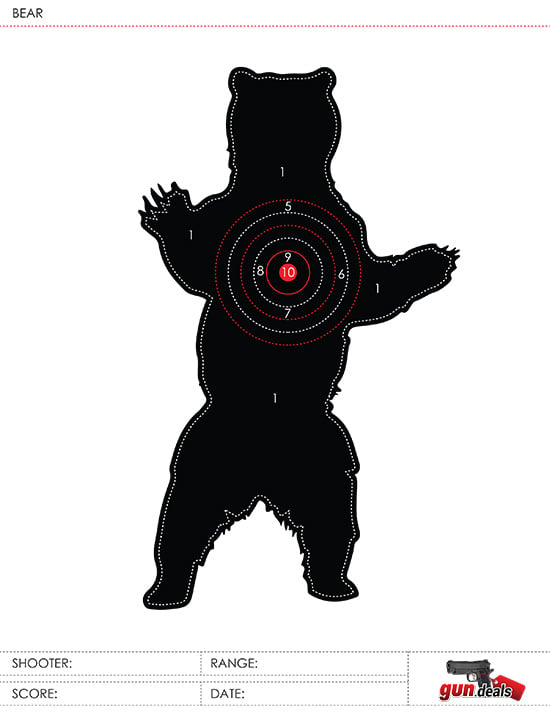
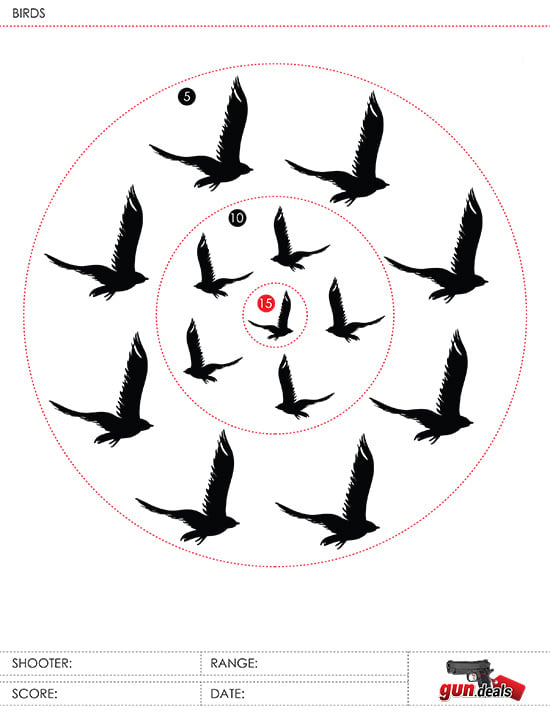
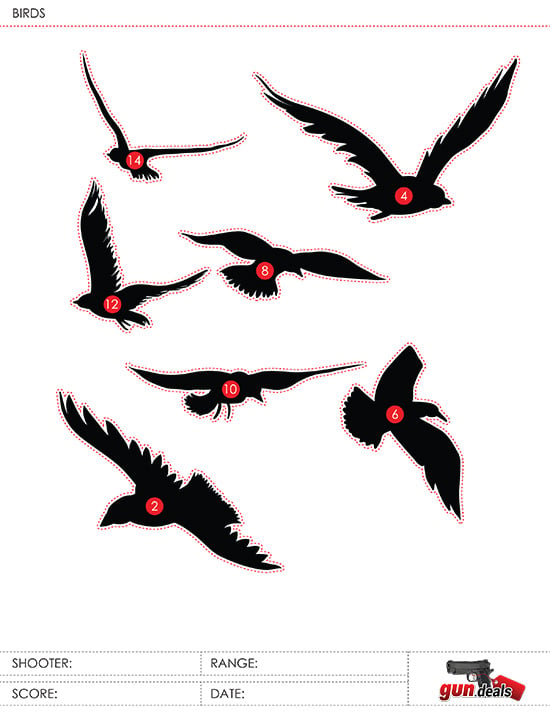
Hunting season is right around the corner. It’s time to sight-in those deer rifles, check the optics, and make sure you’re ready to go. We know some hunters might enjoy shooting game profile targets when at the range for the sight-in process. To that end, here are six animal profile targets from Gun.Deals. Right-click any target to download the printable PDF file, designed to print to standard 8.5″ x 11″ paper. All these targets include entry boxes for Shooter Name, Score, Range (distance), and Date.
Deer Targets with Center Hit Zones Gun.Deals offers two different deer targets, both free to download. We prefer the standing buck with target ring in center mass (left below). Hit the red “10” for maximum points. You can also use this target for rimfire fun practice.
Bear Targets with Center Bulls
Few of us have actually encountered large bears in the wild. But if you do… it can be scary. Work on your bear recognition skills with these two targets, a standing bear, and a bear horizontal profile.
Bird Targets — Rings of Wings
As a fun target to shoot with younger family members (perhaps with a .22 LR) rimfire the bird targets work well. We like the bird circle target (below on left). This has 14 bird images arrayed in rings, providing increasing difficulty as you move from outer ring to center.
Sight-In Target and Bullseye Target
Courtesy of Gun.Deals, we’ve also included a conventional bullseye and a sight-in target. You can augment that sight-in sheet with neon orange Birchwood-Casey Target Spots if you want multiple aim points. A target pack with 160 1.5″ Target Dots is just $4.49 at Amazon.
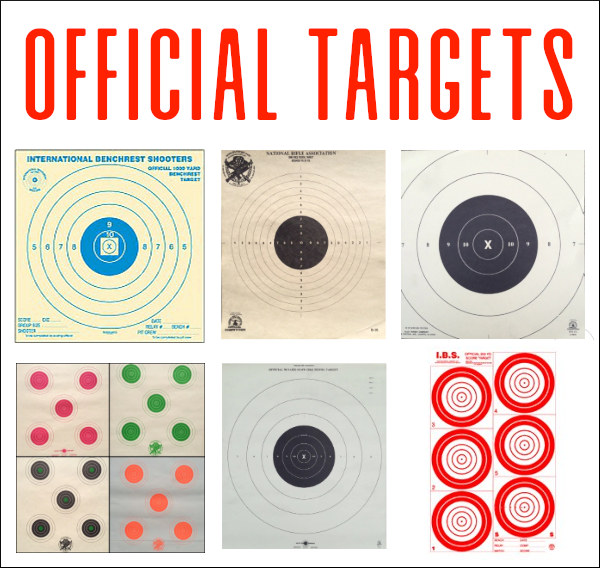
Need targets — not just any old targets, but the correctly-sized targets for specific shooting disciplines (such as NRA Smallbore, F-Class, and 1K Benchrest)? Well you won’t find them at your neighborhood gun store. Precise, dimensionally-correct competition targets are produced by a half-dozen specialty printers. In this article we provide links to the leading target sellers, with a chart showing “who’s got what”. Look for your particular discipline and the vendors will be specified.
Sources for Official Shooting Competition Targets:
AccurateShooter.com offers dozens of FREE, printable targets for target practice, load development, and fun shooting. We also offer a few of the most popular NRA Bullseye targets. One or more of these printable targets should work for most training purposes. However, some readers have asked: “Where can we get the real targets… exactly like the ones used in NRA, IBS, and NBRSA shooting matches?”
All these vendors carry nearly all the NRA High Power and Smallbore targets, including the smaller F-Class targets. National Target has the F-Class and High Power targets, including 100-yard reductions of the 200, 300, and 600-yard military targets.
Germany’s Kruger Targets sells all the important NRA targets, and international (ISSF) air rifle and smallbore targets too.
Orrville Printing currently sells IBS targets for rimfire (50 yard) benchrest, short-range centerfire Benchrest (100, 200, 300 yards), Hunter BR Rifle (100, 200, 300 yards), plus the official 600-yard and 1000-yard IBS targets. National Target Company also has most of the IBS targets. NBRSA short-range, 600-yard, and 1000-yard benchrest targets are available directly from the NBRSA Business Office. Send an email to nbrsa@icloud.com or call (434) 993-9201.
Need Steel, Cardboard Silhouettes or specialty targets? ALCO Target Company in Duarte, California is the USA’s leading producer of the full spectrum of shooting targets including paper targets, cardboard targets, steel targets, and target stands.
William “Tom” Collins earned the CMP’s Distinguished Rifleman Badge #2500 this July. Collins earned his final EIC points at the Washtenaw Sportsman’s Club in Michigan.
One of the highest honors in competitive shooting is earning the Distinguished Rifleman Badge. This Badge was created by the War Department in 1884 to recognize members of the U.S. Army for Excellence-in-Competition (EIC) with the Army’s service rifle. Other U.S. Armed Forces soon adopted a similar program and in 1926 civilians were authorized to participate. This story is about William “Tom” Collins, 50, of Maumee, Ohio, who earned his badge in July 2020. His achievement was a landmark — Civilian Distinguished Rifleman Badge number 2500.
Collins Earns Distinguished Rifleman Badge Number 2500
Story based on Report by Ashley Brugnone, CMP Staff Writer
For over 20 years, the Civilian Marksmanship Program (CMP) has issued Distinguished Badges to competitors who collect at least 30 Excellence-In-Competition (EIC) “leg” points — earned by placing in the top 10% of an EIC match. This story is about Ohio shooter William “Tom” Collins, who recently earned Distinguished Rifleman Badge number 2500. [Editor: To learn more about the history of the Distinguished Rifleman Badge and what is takes to earn it, read Distinguished Rifleman — the Chase for Excellence by Jonathan Ocab.]
For Collins, this fulfilled a dream to join generations of elite marksmen before him. “The Distinguished Rifleman Badge has been a goal of mine since I learned about it,” Collins said. “I like to think back on the history of the badge … It makes me proud to be a part of that.”
Collins earned Distinguished Rifleman Badge #2500 in July. “Shooting is almost like meditation to me”, Collins said. “You really can’t think about anything other than the current shot. It’s very relaxing.”
He gives simple advice to other competitors hoping to one day earn a Distinguished Badge of their own: “Anyone working on it – quit thinking about it. Just shoot.”
Collins is congratulated by his friend Jamie Root after “going Distinguished”.
Collins has been shooting most of his life. Growing up in rural Ohio, he received his first BB gun around seven years old and his first .22 at age 11. It wasn’t until he joined the Army Reserves in 1987 that he received any formal marksmanship training. After he left the Reserves nine years later, he started looking toward organized shooting sports.
One day, back in 2014, he picked up his rifle and took the 45-minute drive to Fremont, Ohio, to fire in his first GSM (Garand-Springfield-Modern/Vintage Military) Match at the Sandusky County Sportsmen’s Club. It was there that he met Jesse Bragg, who was running the event.
Jesse Bragg, a retired staff sergeant from the Marine Corps Reserve Rifle Team, took Collins under his wing and showed him the ropes. Collins says Bragg seemed to want to teach more than run the match. In fact, Bragg was the one who introduced Collins to the idea of pursuing a Distinguished Badge. Collins admits that he had no clue what “going distinguished” meant. Bragg went over the terms – legging out, finishing “first leather” and other related expressions.
In 2015, Collins went to the National Matches at nearby Camp Perry, Ohio, and fired in his first President’s Rifle Match. Watching the elite shooters take their final shots inspired Collins: “Learning about the Distinguished Badge, learning about the President’s Match — I just knew that I had to get this Distinguished Badge on my way to, hopefully, getting into the President’s 100 or even the Top 20.” So Collins began traveling to GSMM competitions with his match rifle in tow, just to get in a little extra practice. It became his main focus. In June 2019, he earned his first set of six leg points at the CMP Viale Range 800 Aggregate and EIC Service Rifle Match at Camp Perry. It was a breakthrough.
When I first started, I was shooting the Garand and the M1A. [But] once I realized I wanted to get my Distinguished Badge, I said, “None of the wood guns. It’s all my match rifle until I go Distinguished”.
He went on to earn eight points at his next match in July, followed by eight more in August. With one more match left in 2019 and only seven points away from the required 30 to earn a badge, his goal was within sight. But it wasn’t until the EIC match at the Washtenaw Sportsman’s Club in Ypsilanti, Michigan, in July 2020 that he was able to conquer his nerves and earn his final points: “The most rewarding thing – it’s when you get there. When you finally earn it, everybody knows it. Everybody at the range celebrates with you. All of your friends are there with you. It’s just rewarding in itself. You’re part of that tradition that spans three centuries.”
Friendships Made on the Road to Distinguished
More so than the time, effort, and skill it took to earn the badge, the journey to become Distinguished was almost as rewarding as the badge itself for Collins, given the relationships he’s made along the way:
“These guys I’ve met and hung out with — we’ve given jobs to each other, we celebrate each other’s birthdays, we know each other’s families. It’s just been a great group of guys. You always are rooting for your friends, regardless of how well you’re doing. If you’re doing bad, you root for them even more.”
Distinguished Badge-Earning Marksmen Will Be Honored in 2021 at Camp Perry
Part of the tradition of earning a Distinguished Badge is walking across the stage at Camp Perry during the National Matches award ceremony. There, badge winners are formally pinned by their peers on a stage that has felt the footsteps of prominent marksmen for over a century.
“Last year, when I got the first points, I told myself, ‘I’m going to walk this stage at Perry next year'”. Collins and all others who earned a Distinguished Badge in 2019 or 2020 will still have the opportunity to take the stage next year at the 2021 National Matches — and that’s just what Collins plans to do.
On the Shooting Sports USA website, there’s a great profile of Kevin Nevius, one of America’s leading competitive marksmen. Kevin is best known for his smallbore success — Kevin won smallbore National Championships in 2008, 2010, and 2014. Kevin also has also an impressive record in long-range centerfire competition. He won the NRA 2018 Long Range Championship, while in 2005 and 2006 he won the Sierra Trophy at Camp Perry in 1000-yard competition. This story, penned by gunwriter Hap Rocketto, covers Kevin’s career, which has included multiple championships and many records.
“My brother got me into long range varmint hunting and I started building my own guns very early,” Nevius told Dan Holmes in a Pronematch.com interview. “I had a hunting friend who shot indoor smallbore who started me in three position and I was hooked.”
At the 2018 NRA Long Range Championships, Kevin Nevius went head to head against the nation’s top long-range aces this past week, and emerged on top. Besting the likes of past multi-time Long Range Champions David Tubb and John Whidden, Kevin Nevius shot superbly at Camp Atterbury to win his first NRA National Long Range Championship.Kevin built his own rifles for the match, using Kelbly centerfire actions in a Grunig & Elmiger smallbore stock. Here is Kevin’s first-hand report of his 2018 LR Championship victory.
Smallbore shooting is where I learned to build a good position, and so much of that carries forward to Long Range High Power. It was a huge shock though, the first time I looked at a 44” aiming black through aperture sights at 1000 yards! Smallbore aiming blacks are twice as big, at one tenth the distance — the fact that we can hit something at 1000 yards with that sight picture still amazes me!
Here are highlights from Hap Rocketto’s Profile of Kevin Nevius:
Champion shooter Kevin Nevius grew up in a household that did not allow firearms, an unlikely beginning for one of the United States’ premier prone rifleman and gunsmiths. Once out on his own he fell in with his brother who enjoyed long-range varmint hunting. His natural bent for things mechanical (he is a professional structural engineer) soon had him tinkering with rifles, which eventually led him to building his own.
Everything fell into line for him in smallbore during the 2008 season. After shooting a series of training matches in which he was most successful, he arrived at Camp Perry at the peak of performance and won his first National Smallbore Rifle Conventional Prone Championship. Kevin came back strong in 2010, winning the inaugural individual National Smallbore Rifle Metric Prone Championship, as well as the team title at Bristol, IN. [Kevin then won the Smallbore Conventional Prone Championship in 2014 with a practically perfect score of 4799-390X (LINK).]
Along the way, Nevius has won some impressive national records. In conventional competition he co-holds the 1200-shot metallic sight aggregate record of 1200-102X. He was just one shot short of perfection in the 480 aggregate, where he holds the civilian record of 4799-412X, just one point behind, and 11 Xs ahead of, Joe Hein’s 4800-401X open record.
Kevin Nevius hopes to build a smallbore rig capable of 3/8-MOA at 100 yards.
Building the Ultimate Rimfire Prone Rifle
Kevin is not just a great trigger-puller. He also smiths his own rifles. His current goal as a gunsmith is to build a rimfire rifle that will shoot 3/8″ groups at 100 yards. That’s a big challenge — 3/8-MOA represents very good accuracy for a centerfire rifle with handloaded ammo. But if any rimfire smith can build a rifle that will shoot that well at 100, it’s probably Kevin.
This feature story comes from 5-time NRA National Long-Range Champion John Whidden. In this article John, who runs Whidden Gunworks, talks about the Palma rifle he has used at the Camp Perry and Camp Atterbury National Matches and other major competitions. This unique .308 Win prone rifle features a Barnard “P” action in a converted aluminum Anschutz “Precise” smallbore (rimfire) stock. The combo of Barnard action and Anschutz ergonomics is hard to beat, says John, who told us: “this is easily the best Palma rifle I’ve ever had.”
As a bonus, the Barnard “drop-in” required no modification of the Anschutz Precise stock. This means John can actually swap in his rimfire barreled action and shoot smallbore with the same stock.
Whidden’s Perfect Palma Match
Whidden secured his 2017 NRA Long Range National Championship title by shooting “clean” (not dropping a point) in the tough Palma competition. In the NRA Palma match, rifles must be .223 Rem or .308 Winchester, with metallic sights (no scopes). The match is conducted at three yardages, 15 shots at each distance of 800/900/1000 yards, with unlimited sighters at 800 and two sighters at 900 and 1000.
Whidden’s Championship-Winning Rifle
Since John captured his fifth Long Range crown with a superb performance in the Palma match, we thought we’d give readers a look at John’s very special Palma rifle. This unique .308 Win prone rifle features a Barnard “P” action in a converted aluminum Anschutz “Precise” smallbore (rimfire) stock. John told us this gun handles like no other: “After recoil, with this Anschutz stock, the sights fall right back on target — better than any other prone rifle I’ve shot”.
As a bonus, the Barnard “drop-in” required no modification of the Anschutz Precise stock. This means John can actually swap in his rimfire barreled action and shoot smallbore with the same stock.
Sling Rifle Evolved: The Ultra-Accurate Hybrid Palma Rifle
by John Whidden
The mental component of Long Range competitive shooting is always challenging but having tremendous confidence in the accuracy of your equipment is a huge benefit. There’s nothing to start your Palma match off well like knowing that you are shooting the most accurate Palma rifle you’ve ever owned.
After winning an NRA Long Range National Championship at Camp Perry, there are always plenty of questions about the equipment used by those at the top. Shooters are always looking to learn what is the best equipment at any given time so that when the time comes to spend our own hard earned dollars we can make the best choices. Even if you shoot an entirely different discipline knowing which manufacturers are making winning gear is very valuable.
Whidden .308 Winchester Palma Rifle
Action: Barnard “P” (three lugs, 60° bolt lift)
Barrel: Bartlein 32″, Light Palma contour, cryo-treated by 300 Below
Stock: Anschutz Precise aluminum smallbore stock, set up for centerfire barreled action
Trigger: Barnard Two-Stage adjustable
Whidden’s Wonder-Gun: German Stock, New Zealand Action, American Barrel
The Palma rifle I shot this year at Camp Perry is one that I have been super pleased with. I built the rifle early this year and the major components are a Barnard P action, Anschutz Precise smallbore stock, and Bartlein barrel. The caliber is .308 Win, as dictated by the Palma rules. Palma matches are fired from 800, 900, and 1000 yards utilizing iron sights only. No optical sights are allowed.
The Anchutz Precise stock is so well-designed that once I finished adjusting the details, I realized that my hold was about 1/3 smaller than with the stocks I shot previously. While in recoil the gun will track vertically and fall back down right on my own target just as it should. In the past, with my other Palma rifles, it was frankly sometimes a struggle to get them to settle back on target after a shot.
Whidden Gunworks has installed a variety of different actions in the Anschutz Precise stocks. Though the stocks are designed for the .22 LR caliber 2013 action rifles, we’ve successfully installed Barnard, Kelbly, Bat, Nesika, and Remington clone actions into them. The Barnard Model P makes a particularly simple installation because there is no modification necessary to the stock at all. A competitor can then shoot both his centerfire rifle as well as his smallbore gun in the exact same stock. The location of the trigger and bolt handle on the Barnard are positioned just right to make this work. Other actions do require at least some amount of modification to the stock, and we have found the Barnard works the best.
Barnard manufactures several models of actions as part of their lineup. All of the actions in the lineup use three lug bolts which give a shorter 60-degree bolt lift when opening and closing. All of the critical surfaces are machined after heat treating. This means that they are exceptionally true and square, more so than other actions. The Model P action is most familiar to Palma and F-Class shooters and are commonly seen on the firing line. The fact that Model P actions include an excellent two-stage trigger makes also the pricing very attractive.
Based on my previous excellent experiences, I selected Bartlein barrels for this rifle. When shooting internationally in the Palma matches we are restricted to 155 grain .308 bullets, but I made the unusual choice of a 1-10″ twist for these bullets. I’ve shot this fast twist for some years with the 155s with good success and it’s pleasing to know that Bryan Litz is finding benefits in some cartridges to shooting faster twist rates than we previously thought we needed. The chamber is the 2011 Palma and the barrel is a Light Palma contour finished at 32” length. The barrel was cryo-treated by 300 Below. The point of impact isn’t changed at all by barrel heating and the accuracy is incredible regardless of the temperature of the barrel. This can’t be said of all the barrels I’ve owned.
Get Your Own Wonder-Gun from Whidden Gunsworks
Like what you see? Whidden Gunworks can build you a rig like this, fitting a centerfire barreled action in the Anschutz Precise stock. John tells us: “Call us to find the current all-up price for a special rifle like this with Barnard or other suitable custom action, and Anschutz stock. We attempt to keep all of the parts except the stock in inventory, so lead time should be under eight (8) weeks.”
Stock Offers Great Adjustability One thing that is quickly noticed about the Anschutz Precise stock is its adjustability. The engineers did a very good job of allowing many of these adjustments to be made while in the shooting position, most notably the cheekpiece adjustments. When a shooter picks up a Precise stock for the first time they also notice how narrow the fore-end is. This really contributes to reducing the pain in the forward hand in prone when shooting with a sling. This stock is, by far, the most comfortable sling stock I’ve ever handled.
This rifle was very accurate right away and very comfortable to shoot. I’ve built some really good shooting Palma rifles but this is easily the best Palma rifle I’ve ever had. The Barnard action with its superb quality and excellent two-stage trigger has been the best choice I could have made. When you can go to the firing line knowing that you have the very best, the foundation for success has been set.
Sniper’s Hide offers a training class for novice shooters getting started in the PRS/NRL precision rifle game. This Precision Rifle Fundamentals course covers equipment selection, using shooting supports, rifle handling, SFP scope basics, and much more. The Precision Rifle Network video below covers a Sniper’s Hide class offered at the Sure Shot Range, near Vinton, Iowa. This video covers the class both in the field and in the classroom, and has interviews with participants.
One participant praised the course: “As a novice shooter, this [Sniper’s Hide Class] was probably the best money I have spent. It helped me learn all my equipment, how to use rear bags, how to figure out dope… and for the dollar, it’s the best money I’ve spent so far.”
Another student concurred: “I’ve been through all kinds of training, including the military and law enforcement, and I have to say the is one of the best, if not THE best class I’ve ever been in.”
Joel from the Precision Rifle Network stated: “At the end of four days, from two back-to-back precision rifle courses, we sent approximately 4500 rounds down-range. All in all, I would say this is some of the finest precision rifle training you can find ANYwhere.”
Another Video from Frank Galli of Sniper’s Hide
Frank Galli, aka “Lowlight”, is the head honcho of Sniper’s Hide. In the video below, Galli offers a series of shooting tips he calls the “Long Range Shooting W.T.F”. No that’s not what you think it is — no cuss words are involved. “W.T.F.” stands for Wind, Trajectory, and Fundamentals of Marksmanship. To shoot well, Frank says, you first must gauge the wind correctly. Second, you must know the trajectory of your load in your rifle — i.e. know your ballistics. If you want to hit a target at long range, you must start with a rock-solid zero, determine an accurate muzzle velocity, and know the Ballistic Coefficient of the bullet. Plug all that into a good ballistic program (along with elevation, temp, and air pressure) and you should have your point of impact (within a click or two) out to 1000 yards.
Watch Video for Tips about Wind-Reading, Ballistics, and Shooting Fundamentals:
The third element of “W.T.F” is “F” for “Fundamentals of Marksmanship”. This actually involves multiple factors — body position (relative to the rifle), finding your natural point of aim, proper head alignment behind the scope, pre-loading the bipod, breathing modulation, trigger control, follow through, recoil management and more. Frank addresses all these “fundamentals” in the second half of the video, starting at the 3:40 time-mark.
Books for Precision Rifle Training
Along with the Videos above, here are two recommended print publications. These both offer a wealth of useful information for PRS competitors and those interested in tactical/practical style shooting. In addition these books will also benefit hunters. They provide good tips on shooting positions, ranging, supports (bipod, tripod, bags) and more.
Practical Shooter’s Guide
Thinking of getting started in the Practical/Tactical shooting game? Looking for ways to be more stable when shooting from unconventional positions? Then you may want to read Marcus Blanchard’s Practical Shooter’s Guide (A How-To Approach for Unconventional Firing Positions and Training). Unlike almost every “how to shoot” book on the market, Blanchard’s work focuses on the shooting skills and positions you need to succeed in PRS matches and similar tactical competitions. Blanchard provides clear advice on shooting from barricades, from roof-tops, from steep angles. Blanchard says you need to train for these types of challenges: “I believe the largest factor in the improvement of the average shooter isn’t necessarily the gear; it’s the way the shooter approaches obstacles and how they properly train for them.”
Long Range Shooting Handbook
Ryan Cleckner’s Long Range Shooting Handbook is the best-selling modern book on practical rifle skills. A former U.S. Army sniper instructor, Cleckner is knowledgeable, and his text is well-organized and chock full of good information. You can view Sample Chapters on Amazon.com.
Ryan Cleckner’s highly-regarded Long Range Shooting Handbook is designed as an intro to important fundamental concepts such as MOA vs. Mils, External Ballistics, and Environmental Effects. Included are personal tips and advice based on Cleckner’s years of experience as a sniper instructor and special operations sniper.
The Long Range Shooting Handbook is divided into three main categories: What It Is/How It Works, Fundamentals, and How to Use It. “What It Is/How It Works” covers equipment, terminology, and basic principles. “Fundamentals” covers the theory of long range shooting. “How to Use It” gives practical advice on implementing what you’ve learned, so you can progress as a skilled, long range shooter. This book will benefit any long-range shooter, not just PRS/NRL competitors.
Here’s a way some smart shooters are dealing with Pandemic Social Distancing requirements. At the Manatee Gun Club in Florida, match organizers devised tall, portable plexiglass barriers between the benches. These barriers shield each shooter from his neighboring competitor. And shooters say there is an added benefit — there is less perceived noise and muzzle blast from nearby fellow competitors.
AccurateShooter Forum member CaptainMal reports: “We just finished a steel shoot at Manatee using ALL the benches with dividers attached to each. Prior to today we were not allowed to use all the benches as they are five feet, not six feet apart [as required by social distancing regulations]. Now we can take more shooters per relay and we found some positive unintended consequences.” READ Forum Thread.
Each divider attaches to a bench. The divider can be easily removed for storage by folding up the legs so it is flat to carry/store. These dividers are relatively light-weight making them easy to put in place. In addition, because the dividers are transparent, Range Safety Officers (and spectators) can view the shooters. Notably, the Manatee competitors also reported that the dividers offered a “dramatic reduction in muzzle blast and some noise reduction also”.
CaptainMal explains: “Most all of us have experienced magnum explosions next to us on the bench and/or muzzle brakes directing a concussion at us as we shoot. GONE. We built all these because of the virus restrictions we had to deal with. Well now we can use all the benches, put on a normal program and reap the benefits of full visibility and no muzzle blast distractions.”
Al Benarroch (Forum member “Alibaba”) designed and built these dividers. Al is happy to share his design with anyone else wanting or needing to have something like this for their range. Here is Al last season BEFORE the COVID-19 range restrictions. To see him now you just look through the divider.
The Southpaw Challenge — How to Position Left-handed Shooters
These dividers were designed for right-handed shooters, but the Manatee group has some thoughts about adapting the system for lefties: “We will work on that at the IBS-style shoot next Saturday. The deal is we have 16 benches. Let us say we have 25 shooters next Saturday. There may be four left-handers. We can put 12 -14 shooters on each relay and just leave open a single bench next to them.” Also with Manatee’s five-foot spacing between benches, there is actually six-foot-plus spacing if the left-hand shooter is always situated on a bench to the RIGHT side of a right-handed shooter’s bench. That provides maximum spacing based on their actual sitting positions.
Credit Boyd Allen for finding this story in our Shooter’s Forum.


 Team USA Olympian and ISSF World Cup Winner SFC Michael McPhail is one of the world’s best smallbore rifle shooters. He is also an avid hunter, who enjoys harvesting game with centerfire rifles. In a USAMU video, McPhail shows how competition shooting positions can be adapted for hunters. McPhail shows how well-established positions can provide a more stable platform for hunters in the field. That can help ensure a successful hunt. McPhail demonstrates three positions: kneeling, supported prone, and sitting in a tree-stand.







 Champion shooter Kevin Nevius grew up in a household that did not allow firearms, an unlikely beginning for one of the United States’ premier prone rifleman and gunsmiths. Once out on his own he fell in with his brother who enjoyed long-range varmint hunting. His natural bent for things mechanical (he is a professional structural engineer) soon had him tinkering with rifles, which eventually led him to building his own.


 One thing that is quickly noticed about the Anschutz Precise stock is its adjustability. The engineers did a very good job of allowing many of these adjustments to be made while in the shooting position, most notably the cheekpiece adjustments. When a shooter picks up a Precise stock for the first time they also notice how narrow the fore-end is. This really contributes to reducing the pain in the forward hand in prone when shooting with a sling. This stock is, by far, the most comfortable sling stock I’ve ever handled.


