We know that many of our readers have never personally participated in a short-range (100/200 yard) benchrest match. That’s understandable — moving backers are required in registered 100/200 benchrest (for group) matches, yet only a small percentage of ranges have that equipment. If you’re curious about the “point-blank” benchrest game, but haven’t had the chance to see it first-hand, check out this video created by youtuber “Taofledermaus”. On his YouTube Channel, you’ll find many other interesting shooting videos, including slow-motion target impact clips. This video shows the LV and HV guns, the flags, the gun-handling, the reloading set-ups, and of course, tiny little groups on targets.
Registered 100/200 Benchrest Match
Viewer Comments on the Video:
“There is a lot more to this game than just pulling the trigger. Record targets are 5-shot groups, 5 averaged together for an Aggregate. Most times the winning Agg is under .250″ for 25 shots at 100 yards. Rifles weigh 10.5 pounds for LV class. Used rifles can be had for about $1500. Then add in another $1000 for rest, bags, loading tools, bullets, powder, not to mention windflags.” — Vmhtr
“Benchrest shooting is sort of an ‘academy of shooting’. Lots of academic thought and measurements, handloading made with anal attention at detail. It’s much more thought than action. Most of those people made their tools themselves. [There are] It’s plenty of seniors because it takes patience, lots of patience. Sure a teenager ain’t gonna bother it.” — THP
“I was surprised they did all their hand loading right there on the spot. — I think you nailed it. It’s a super-precise sport. It’s expensive, it’s slow, and it requires a lot of travel, so it’s well-suited for retired folks. It’s gotta beat golfing!” — Tao
“I used to shoot 6mm PPC in a BR rifle. I spent so much time at the reloading bench that I just gave up on it all and switched to 22 rimfire gallery matches. Saved a lot of my sanity doing that….” — Walt
Magnified 8X view looking down-range at buffalo target.
Could You Hit a Steel Buffalo at 2240 Yards (1.27 miles) … with Iron Sights?
Impossible as that may seem, that’s exactly what Ernie Jimenez did some years back at the North Springs Shooting Range in Price, Utah (elevation 5,627′). Shooting a milsurp Swiss K31 rifle chambered for the 7.5×55 Swiss round, Jimenez placed four hits on a three-foot-high, bison-shaped steel target placed a staggering 2240 yards from the firing line. Not bad for a rifle which Jimenez acquired many years ago for just $99.00. Of course he did have plenty of misses along the way (and Ernie even managed to hit the plate shielding his camera).
This video is set to start half-way through, when the shooter starts making hits:
The whole process was recorded on video and posted on YouTube. The Long-Range Shooters of Utah say this is an official Guinness World Record for longest shot with iron sights. We can’t confirm that, but it still is an impressive feat. Jimenez had to compensate for a huge amount of bullet drop. His K31’s long-range military sights helped but he still had to aim well over the pink bison. To see how far that target is, watch the video at 14:30 — a camera at the firing line zooms all the way back until the bison is nothing but a tiny dot. The photo below show the target at 8X magnification, but it’s still barely visible.
Here’s the unmagnified, “naked-eye” view from the firing line. Can you see a pink buffalo at all?
Bullet Dropped Over 400 Feet along its Trajectory
To roughly gauge the bullet drop, we took a 7.5x55mm Swiss load from the Hodgdon Reloading Center. With max “book” load of H4350, a 168gr Sierra HPBT has a muzzle velocity of 2524 FPS. According to JBM Ballistics, that bullet will drop over 400 feet during its flight. That’s lot of hold-over! Assuming a 100-yard zero, 59° temp, and 5,600′ altitude, JBM calculates that the drop to 2250 yards is a stunning 210.9 MOA — that’s 4969.9 inches, or 414.15 feet!
In the first part of the video, shooter Ernie Jimenez talks about his hand-loads and his K31 rifle. Here is an example of the distinctive straight-pull K31 (Karabiner Model 1931). Image courtesy AIM Surplus.
The prone position demonstrated by two talented Service Rifle shooters. At top is SFC Brandon Green, multi-time High Power National Champion. Below is Tony Chow, a gifted match shooter. NOTE: Current Service Rifle rules allow the use of optics up to 4.5X.
Jay Christopherson, 2020 Berger SW Nationals F-Open Champion, is one of the nation’s best F-Class shooters. When shooting F-Class, Jay uses a Seb Mini front rest and a large rear sandbag to support his big 22-lb F-Open rifle. Though he loves F-Class, Jay is also interested in Service Rifle competition where no external supports are allowed. You hold the rifle with your arms and a sling. Some Service Rifle competitions involve three position (Standing, kneeling/sitting, and prone), while others are prone only. Even in the prone position, the sling is a vital accessory.
Jay dramatically improved his Service Rifle “hard-holding” technique by enlisting the help of Emil Praslick III, former USAMU rifle coach. Emil’s guidance and advice resulted in an immediate increase in Jay’s scores on target, as recorded by his ShotMarker electronic target system. Jay noted: “These targets show the difference between hacking it on your own, and spending an hour with someone who knows what they are doing and can tell you that you are doing it wrong.” These targets show Jay’s “before and after” Service Rifle results shooting slung up prone at 600 yards:
Service Rifle, Prone with Sling at 600 Yards
Here is Jay’s target BEFORE training with Emil Praslick — a 194-3X with lots of vertical.
And here is Jay’s improved target AFTER putting Praslick’s advice to work — impressive 199-8X with significantly less vertical.
You can see on this second target much improved vertical. All 20 shots were in a vertical range much smaller than the vertical height of the 10-Ring. Had shot 16 not gone wide left, this would have been a 200. Shot 16 was OUT of the 10-Ring to the left, but note that vertically it has almost perfect elevation.
Jay stated: “I was pretty amazed at not only the difference on the target, but how much difference the changes Emil suggested made to how my hold felt. The entire feel was different and a ton less stress in my neck and arms compared to what I was feeling before. I was actually feeling pretty good about that 194 yesterday, because I hadn’t slung up in two years and that was my highest score (by one point) after doing some load fixing. But having someone explain what you are doing wrong and why makes a world of difference.
Looking downrange at the 600-yard targets. Camp Perry photo courtesy Dennis Santiago.
Shooting USA TV has an excellent episode this week, with some great features for competitive shooters and fans of historic military rifles. Shooting USA covers the President’s 100 Match at Camp Perry, one of the most prestigious shooting competitions held each summer. In addition, Shooting USA spotlights the M1 Garand rifle. A legendary firearm that helped win WWII, the .30-06 Springfield M1 Garand remains popular in vintage military matches. There is also a major Garand Match each summer at Camp Perry. You can watch Shooting USA Wednesday nights on the Outdoor Channel at 8:00 pm Eastern/Pacific, 9:00 pm Central. Or, you can view each episode the following Thursday (and thereafter) on Vimeo.com
Shooting USA is available On Demand via Vimeo.com. Watch a single episode for $0.99, or get a full-month subscription for $3.99 and watch as many shows as you like with limited commercial interruptions.
» SHOOTING USA Covers the President’s 100 Match
The historic National President’s 100 Match is a huge event. In recent years, there have been over 1000 competitors, making this one of the biggest rifle events of the year. First held in 1878, the President’s 100 match is richly steeped in history. The top 100 competitors overall are designated as the President’s 100. They receive President’s 100 medallions and certificates.
Origins of the President’s Match The National Rifle Association’s President’s Match was instituted in 1878, as the American Military Rifle Championship Match. In 1884, the name was changed to the President’s Match for the Military Rifle Championship of the United States. It was fired at Creedmoor, New York until 1891. In 1895, it was reintroduced at Sea Girt, New Jersey. Today, the match is held at Camp Perry, Ohio.
The President’s Match was patterned after the Queen’s Match for British Volunteers. That British competition was started in 1860 by Queen Victoria and the NRA of Great Britain to increase the ability of Britain’s marksmen following the Crimean War.
The tradition of making a letter from the President of the United States the first prize began in 1904 when President Theodore Roosevelt personally wrote a letter of congratulations to the winner, Private Howard Gensch of the New Jersey National Guard.
After a hiatus in the 1930s and 1940s, The President’s Match was reinstated in 1957 at the National Matches as “The President’s Hundred.” The 100 top-scoring competitors in the President’s Match were singled out for special recognition.
» Shooting USA Features the M1 Garand Vintage Military Rifle
This week’s Shooting USA episode tracks the origins and history of the Garand. An M1 Garand is a great addition to anyone’s personal firearms collection. It is a piece of living history — plus it can be used in Vintage Military rifle matches. Here are some resources for M1 Garand owners.
M1 Garand History
Jean Cantius Garand, also known as John C. Garand, was a Canadian designer of firearms who created the M1 Garand, a semi-automatic rifle that was widely used by the U.S. Army and U.S. Marine Corps during World War II and the Korean War. The U.S. government employed Garand as an engineer with the Springfield Armory from 1919 until he retired in 1953. At Springfield Armory Garand was tasked with designing a basic gas-actuated self-loading infantry rifle and carbine that would eject the spent cartridge and reload a new round. It took fifteen years to perfect the M1 prototype model to meet all the U.S. Army specifications. The resulting Semiautomatic, Caliber .30, M1 Rifle was patented by Garand in 1932, approved by the U.S. Army on January 9, 1936, and went into mass production in 1940. It replaced the bolt-action M1903 Springfield and became the standard infantry rifle known as the Garand Rifle. During the World War II, over four million M1 rifles were manufactured.
Shooting Sports USA (SSUSA) has a good article on the origins and history of the National Rifle Association. This timeline feature covers the first 36 years of NRA history from 1871 to 1907. The NRA was founded in 1871, and 1907 marked the first year of Matches at Camp Perry, Ohio.
SSUSA explains the NRA’s original mission: “The NRA’s program during its youthful years centered mainly on improving marksmanship among the military. Rifle tournaments at ranges in Creedmoor (NY), Sea Girt (NJ), and Camp Perry (OH) captured the country’s spirit of nationalism and resulted in key improvements in rifles and target scoring. NRA also set standards for military rifle training and even inspired the federal government to form its own segment within the War Department to focus on promoting rifle practice among soldiers as well as civilians.”
1871 — A group of New York National Guardsmen founded the National Rifle Association to promote marksmanship training. Figures such as Capt. George Wingate had called for better rifle marksmanship to support the nation’s defense.
1872 — The NRA acquires Creed’s Farm in Long Island, New York for $26,250. Renamed “Creedmoor”, this becomes the NRA’s first range. The first match was held in 1873.
1874 — The NRA hosts its first International Match, shot at the Creedmoor Range in New York.
The First-Ever Creedmoor Challenge Match in 1874
The Irish International Shooting team arrived in New York on the 16th of September and proceeded to “take in the sights”, which was understandable, before some practice at the Creedmoor range. On September 26th they presented themselves for the match with confidence and in high spirits. The crowds that day were reported to be between 5,000 and 10,000 strong, which showed the huge support already growing for the fledgling sport in America.
The course of fire was 15 shots to each man at 800, 900, and 1000 yards. Unfortunately, the details of each mans scores at the individual distances have been lost to time but we do know that the Americans were well ahead after the 800-yard shoot. The Irish then caught up after the 900-yard and finished the 1000-yard shoot ahead by 1 point. The Americans still had one man left to shoot and it came down to his very last shot with which he scored a 4 giving the American team the win over the Irish by 3 points.
1892 — The NRA moves its Annual Matches to the Sea Girt Range in New Jersey, which was less than 60 Miles from New York City, NY. The Sea Girt Range was maintained by the New Jersey State Rifle Association, founded in 1878.
1903 — The U.S. War Department sets up a National Board for the Promotion of Rifle Practice (NBPRP). In 1903, an amendment to the War Dept. Appropriations Bill established the NBPRP to promote both Military and Civilian marksmanship. This government advisory board became the predecessor to today’s Corporation for the Promotion of Rifle Practice and Firearms Safety that now governs the CMP.
1907 — The NRA commences National Matches at Camp Perry, Ohio.
History of Camp Perry
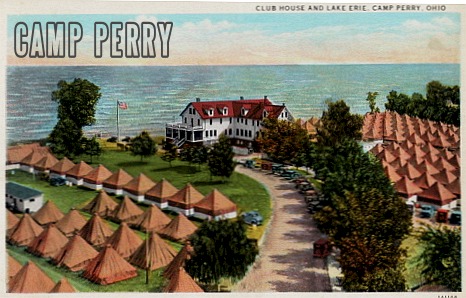
The National Matches have been held at Camp Perry since 1907. The range is located along the shores of Lake Erie in northern Ohio near Port Clinton. The site was first acquired in 1906, in response to the need for a larger facility for military training and the NRA’s shooting programs. In 1906 Gen. Ammon B. Crichfield, Adjutant General of Ohio, ordered construction of a new shooting facility on the shores of Lake Erie, 45 miles east of Toledo, Ohio. The original land for Camp Perry was purchased in 1906, and the reservation was named after Commodore Oliver Hazard Perry, the American naval commander who won the Battle of Put-in-Bay during the War of 1812.
On August 19, 1907, Cpl. L. B. Jarrett fired the first shot at the new Camp Perry Training Site. And that year, 1907, Camp Perry held its first National Pistol and Rifle Championship events. This location has hosted the annual NRA National Matches ever since. Today, over 4,000 competitors attend the National Matches each year, making it the most popular shooting competition in the western hemisphere.
Federal legislation originally launched the National Matches. The 1903 legislation also established the National Matches, commissioned the National Trophy and provided funding to support the Matches.
Are laser sights really useful on a handgun? Yes, and not just in low-light situations. That said, many folks who own laser-equipped handguns do not train effectively with the laser. For many gun-owners, the laser is just a toy, a gimmick that is used a few times and then ignored. Those gun-owners miss out on some of the most important advantages of a laser sights, benefits you can get from formal training with your laser-equipped pistol.
Crimson Trace has produced a series of training videos that may change your mind about lasers. If you shoot a handgun you should watch these videos. They show how laser sights can help diagnose and correct common handgun-shooting errors (such as flinching and anticipating the shot). The videos also show how to improve sight alignment and get your sights on target quickly.
Training with Laser Sights, Full 12-minute Video
Covers Muzzle Awareness, Sight Alignment, Target Acquisition, Trigger Control
This video shows how training with laser sights can: 1) improve muzzle direction awareness; 2) aid with sight alignment; 3) speed up target acquisition; and 4) improve trigger control. The video also demonstrates the obvious advantage of laser sights in low light conditions. Numerous firearms experts are featured in this video filmed at Arizona’s Gunsight Academy.
Training With Lasers — Trigger Control
Training with laser sights helps diagnose and improve trigger control errors by showcasing the importance of “surprise break” and follow-through. Lasers quickly diagnose errors such as recoil anticipation, jerking the trigger, and breaking the wrist.
Training with Lasers — Sight Alignment
Training with laser sights can improve/correct alignment. The laser provides a visual indicator of proper sight alignment, allowing shooters to quickly see any errors before taking a shot. Additionally, lasers can enhance sight alignment on popular sub-compact carry guns with small, low-profile sights.
Muzzle Awareness — All-Important for Safe Shooting
Training with laser sights improves a shooter’s muzzle awareness. A daylight-visible laser shows the gun operator where his or her muzzle is pointing at all times. This helps teach proper safety practices.
CMP-Affiliated Clubs May Continue Sanctioned Matches with Restrictions
While the Civilian Marksmanship Program (CMP) has cancelled its National Events at Camp Perry this summer, the CMP has stated that club-level CMP matches may proceed, provided important health practices are followed.
The Civilian Marksmanship Program recently announced that affiliated clubs may resume CMP-sanctioned rifle and pistol matches those events, provided state and local guidelines and safe range practices are being followed.
The CMP states: “The CMP has canceled all of its match events based on the large volume of participants at its marksmanship events. However, clubs who have relatively manageable numbers of attendees may use discretion in conducting activities for safety reasons. We will continue to monitor the current environment and follow practices in the best interest of our staff, customers and participants regarding future events.”
“In the best interest of everyone involved, the CMP is not opposed to affiliated clubs holding sanctioned matches, as long as they provide a safe environment for participants, range safety personnel and spectators,” said Christie Sewell, CMP Programs Chief.
The CMP Recommends Affiliated Clubs Follow Guidelines to Keep Facilities Safe:
1. Following state and local laws and adherence to health advisories
2. Limiting/spacing the number of participants who congregate for safety briefings, etc.
3. Spacing out firing points, leaving empty firing points between shooters
4. Ensuring participants wear masks, covering their nose and mouth.
5. Washing hands frequently and/or providing disinfectant wipes.
6. Cleaning common surfaces such as shooting benches and equipment.
(Editor: This cleaning should include public restrooms).
“In our sport during this time, we need to practice safety on two fronts – safe firearms handling at all times and providing a healthy place for competitors to hone their skills. That means practicing appropriate social distancing, disinfecting common surfaces and screening participants for health concerns,” added Christie Sewell. Visit the CMP website at www.TheCMP.org for more information.
Do you find that the crosshairs in your scope get blurry after a while, or that you experience eye strain during a match? This is normal, particularly as you get older. Focusing intensely on your target (through the scope or over iron sights) for an extended period of time can cause eye strain. Thankfully, there are things you can do to reduce eye fatigue. For one — breathe deeper to take in more oxygen. Secondly, give your eyes a break between shots, looking away from the scope or sights.
In our Forum there is an interesting thread about vision and eye fatigue. One Forum member observed: “I have noticed recently that if I linger on the target for too long the crosshairs begin to blur and the whole image gradually darkens as if a cloud passed over the sun. I do wear contacts and wonder if that’s the problem. Anyone else experienced this? — Tommy”
Forum members advised Tommy to relax and breath deep. Increase oxygen intake and also move the eyes off the target for a bit. Closing the eyes briefly between shots can also relieve eye strain. Tommy found this improved the situation.
Keith G. noted: “Make sure you are still breathing… [your condition] sounds similar to the symptoms of holding one’s breath.”
Phil H. explained: “Tom — Our eyes are tremendous oxygen hogs. What you are witnessing is caused by lack of oxygen. When this happens, get off the sights, stare at the grass (most people’s eyes find the color green relaxing), breath, then get back on the rifle. Working on your cardio can help immensely. Worked for me when I shot Palma. Those aperture sights were a bear! The better my cardio got the better and longer I could see. Same thing with scopes. Try it!”
Watercam concurred: “+1 on breathing. Take a long slow deep breath, exhale and break shot. Also make sure you take a moment to look at the horizon without looking through rifle or spotting scope once in a while to fight fatigue. Same thing happens when using iron sights.”
Arizona shooter Scott Harris offered this advice: “To some extent, [blurring vision] happens to anyone staring at something for a long time. I try to keep vision crisp by getting the shot off in a timely fashion or close the eyes briefly to refresh them. Also keep moisturized and protect against wind with wrap-around glasses”.
Breathing Better and Relaxing the Eyes Really Worked…
Tommy, the shooter with the eye problem, said his vision improved after he worked on his breathing and gave his eyes a rest between shots: “Thanks guys. These techniques shrunk my group just a bit and every little bit helps.”
Read more tips on reducing eye fatigue in our Forum Thread: That Vision Thing.
To avoid eye fatigue, take your eyes away from the scope between shots, and look at something nearby (or even close your eyes briefly). Also work on your breathing and don’t hold your breath too long — that robs your system of oxygen.
U.S. Olympic shooter Eric Uptagrafft in prone position, LARRC 2012. CC photo by Tony Chow.
Eley sponsors many of the world’s top rimfire shooters, who have shared their Tips from the Top. Five ace smallbore shooters provide advice on how to shoot better, how to train more effectively, and how to stay motivated even when “the going gets tough”. If you’re a competitive shooter (in any discipline) you can benefit from reading these words of wisdom from world-class shooters.
Henri Junghaenel, Past #1 ranked, 50M prone rifle shooter.
Focus on Fundamentals: Good performance requires a solid technical foundation. One can hunt after personal bests or one can try to work on the technical basics. The latter will probably lead to better results sooner.
Stay Motivated Over Time: Be persistent and don’t lose your motivation on your way to success. Shooting, like every other sport, requires a learning process which takes a lot of time.
Don’t Yield to Outside Pressures: Don’t let the expectations from others impact yourself. If some people try to put pressure on you (consciously or unconsciously), don’t let them!
Bill Collaros, 2013 Australian WRABF World Cup (Benchrest) and RBA team captain.
Don’t Skimp on Hardware: Ensure your equipment is a good as you can buy. This includes: rests, bags, rifle, scope, and ammunition.
Tune to Your Ammo: Ensure that the ammunition you have is tested and your rifle is tuned to it, to get the smallest possible group.
Train in All Conditions: Train in all sorts of wind and conditions so you know how your rifle and ammunition react in all circumstances.
Stine Nielsen, 2012 Olympic finalist for 3-Position Smallbore Rifle.
No Excuses: When I train, I train by my motto: “A loser has excuses. A winner has a plan.” And when I shoot in competitions I think about that mantra.
Stay Focused: When I stand at a shooting range, I have a good focus on my shooting and myself. I also have a good will to want to shoot 110%.
Zorana Arunovic, Past world #2 ranked, 25M women’s pistol shooter.
Never give up: No matter how hard it is you should always find something that will inspire you to keep going further. I find my inspiration in the success of other athletes. They inspire me to work more and harder. I would say to any young athletes, never give up, no matter how hard it is.
João Costa, Past world #2 ranked, 50m pistol shooter.
Breathing is Key: In shooting as in life, breathing is of paramount importance. So, when shooting try to be calm and quiet. On the bench in front of me I have my pistol, the scope, the magazine and my choice ammo then I count:
Finally… some good news in the shooting world. One of the most important ranges in the nation re-opens next week. Talladega Marksmanship Park in Alabama will open its gates on Wednesday, May 13, 2020.
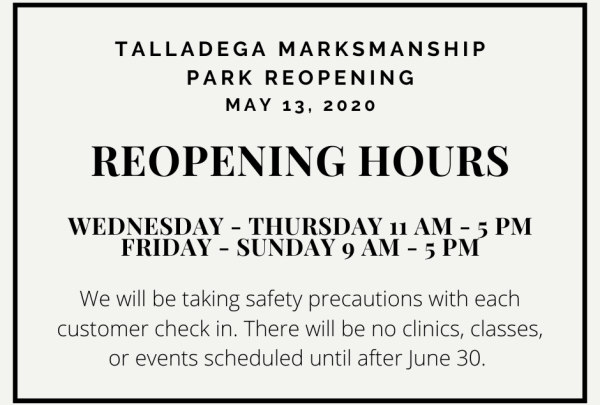
The Civilian Marksmanship Program (CMP) has announced that its outdoor rifle, pistol and shotgun facility in Alabama, the Talladega Marksmanship Park, plans to resume activity in May with updated protocols for staff and guests. These requirements are designed to ensure the public well-being and safety during the ongoing coronavirus pandemic. Starting Wednesday, May 13, the facility will be open to the public Wednesdays and Thursdays from 11 am – 5 pm and Fridays, Saturdays and Sundays from 9 am – 5 pm.
Special Health Procedures
All park visitors will be required to have his/her body temperature checked and will also need to answer questions about current health and recent activities that could relate to COVID-19 before being permitted to use the ranges. The number of guests within the Clubhouse will also be monitored, and those on the ranges will adhere to social distancing guidelines put in place by CMP personnel.
Though staff members of Talladega Marksmanship Park will be equipped with face masks, they will not be required for visitors to the facility. However, for the protection of everyone present, masks are highly recommended. The CMP also asks that guests stay mindful of social distancing and hygiene practices in all areas of the grounds.
No Classes, Clinics, or Matches in May
While the park will be open effective 5/13/20, the regularly-held monthly classes, clinics, and have been cancelled for the entirety of May and June. All activities scheduled after June 30th will be reassessed at a later date. For updates on Talladega status, visit the Talladega Marksmanship Park webpage.
About Talladega Marksmanship Park:
The 500-acre Talladega Marksmanship Park features a 600-yard rifle range, 100-yard multi-purpose range, and 50-yard pistol range, each equipped with Kongsberg electronic targets and scoring monitors that allow shooters on the firing line to review shots in a matter of seconds. The Park also includes 15 action pistol bays and a trap field, 5-stand field, and a 15-station sporting clays field — all with automated trap machines. All firing lines are covered, so competitors and guests stay dry and shaded.


 The National Rifle Association’s President’s Match was instituted in 1878, as the American Military Rifle Championship Match. In 1884, the name was changed to the President’s Match for the Military Rifle Championship of the United States. It was fired at Creedmoor, New York until 1891. In 1895, it was reintroduced at Sea Girt, New Jersey. Today, the match is held at Camp Perry, Ohio.