Most bolt-action rifle shooters work the bolt with their trigger-pulling hand. This is because most rifles sold to right-handed shooters come with right-side bolts, while “lefty” rifles come with left-side bolts. This “standard” configuration requires the shooter to take his dominant, trigger-pulling hand off the stock to cycle the bolt, then re-position his hand on the stock, and “re-claim” the trigger. Often the shooter must lift or move his head to work the bolt, and that also requires him to re-establish his cheek weld after each and every shot. Not good.
This really doesn’t make much sense for precision shooting with fore-end support*. There is a better way. If you leave your trigger hand in position and work the bolt (and feed rounds) with the opposite hand, then you don’t need to shift grip and head position with each shot. All this requires is a weakside-placed bolt, i.e. a left bolt for a right-handed shooter or a right bolt for a left-handed shooter. The video below shows a “Lefty” working a right bolt. Note how efficient this is:
As our friend Boyd Allen explains: “If you think about it, if you are going to work with a factory action where your options are left bolt and left port or right bolt and right port, and you are building a rifle that will only be shot from a rest, using the left/left for a RH shooter or using a right/right for a LH shooter works better than the conventional configuration”.
Shoot Like a Champ and Work the Bolt with Your Weakside Hand
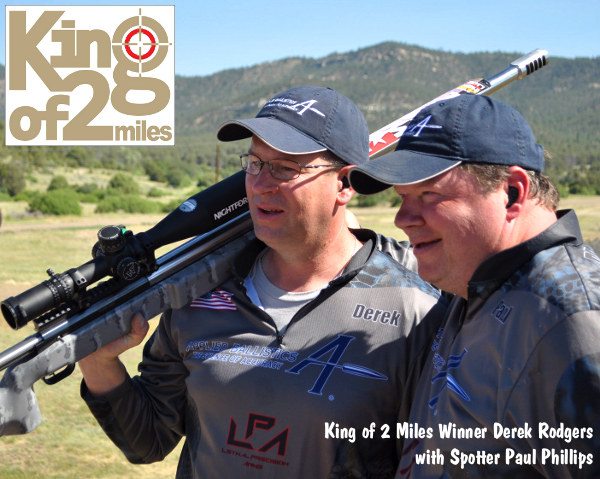
Derek Rodgers, the current F-TR World Champion, the reigning King of 2 Miles, and the only person to have won BOTH F-Open and F-TR U.S. National Championships, runs this kind of “opposite” bolt set-up. Yep, Derek shoots right-handed with a left bolt. Though Derek is a right-hander, he shoots with a Left Bolt/Left Port (LBLP) action. He pulls the trigger with his right index finger, while working the left-side bolt with his left (weakside) hand. This allows him to stay in position, and maintain his cheekweld. He places his right hand on the grip, while manipulating the bolt (and feeding rounds) with his non-trigger-pulling hand.
Current King of 2 Miles (and F-TR World Champion) Derek Rodgers
This is the rifle with which Derek won the 2013 F-TR National Championship.
*For true standing, off-hand shooting (whether in competition or on a hunt), a conventional strongside bolt placement makes sense, since the non-dominant arm must support the front of the rifle all the time. When shooting from bipod or rest, it’s a different story.
“March Madness”, the annual NCAA college basketball tournament, is less than two weeks away — the 2019 Dates are March 19 through April 8. Here’s a clever guest article by Hap Rocketto that examines the game of B-Ball and explains why shooting targets is actually more difficult than shooting hoops. This story originally appeared in the Hap’s Corner section of Pronematch.com. Hap is a rare talent in the gun world — a serious shooter who also has unique insights, and a great sense of humor. We recommend you visit Pronematch.com to enjoy the many other interesting Hap’s Corner postings.
by Hap Rocketto
I know shooting is tougher than basketball…. Come on, just how difficult is it for five tall guys to help each other toss a big ball into a basket? Granted basketball is more physically demanding than shooting a rifle, but I think that blasting a quarter-size group into the center of the target at 100 yards all by yourself is a far more difficult task than working as a team to dunk a ball.
Therefore, in the style of former Late Night talk show host David Letterman, I have constructed a list of ten reasons why rifle shooting is tougher than basketball.
TOP TEN REASONS Why Rifle Shooting is Tougher Than Basketball
10. When you get tired in basketball the coach just calls time out and replaces you with someone fresh. Not so in shooting.
9. When’s the last time a basketball player had to make a shot with the sun in his eyes?
8. How often does a basketball player have a perfectly good shot blown out by the wind?
7. If a basketball player places a shot a little higher than intended, no problem. The backboard causes the ball to bounce into the basket. No such luck in shooting.
6. Rifle matches commonly run all day. When was the last time you saw a basketball game run more than an hour or so?
5. If you’re not making your shots in basketball, you can just pass the ball to someone who is hot. No such convenience in shooting.
4. Rifle bullets travel faster than the speed of sound (roughly 300 meters per second). Basketballs top out at around 15 meters per second.
3. A basketball player can shoot from anywhere on the court that is convenient and comfortable. All riflemen shoot from the same distance.
2. A basketball player may shoot as often as the opportunity arises and is not limited to the number of shots taken. A rifle match requires that each rifleman shoot the same number of record shots. If they shoot more than allowed, then a penalty follows.
1. And the Number One reason why shooting is tougher than basketball is that, if you miss a shot in basketball you, or a team mate, can just jump up, grab the ball, and try again. Try that in shooting.
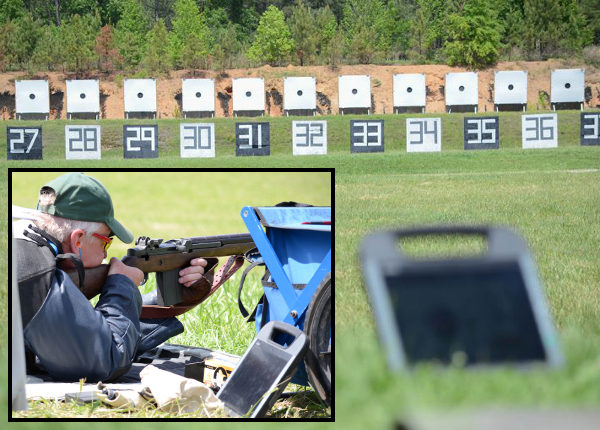
The only real similarity between the two sports is that a competitor attempts to score points by shooting. In rifle it is through a hard-hold and easy squeeze in prone, sitting, kneeling and standing; while in basketball it is via hook shots, jump shots, lay-ups, or the dramatic, ever crowd-pleasing, slam dunk.
About the Author: Hap Rocketto is a Distinguished Rifleman with service and smallbore rifle, member of The Presidents Hundred, and the National Guard Chief’s 50. He is a National Smallbore Record holder, a member of the 1600 Club and the Connecticut Shooters’ Hall Of Fame. A historian of the shooting sports, his work appears in Shooting Sports USA, the late Precision Shooting Magazine, The Outdoor Message, the American Rifleman, the CMP website, and Pronematch.com.
Credit John Puol for finding this article and communicating with Hap Rocketto.
Registration is now open for the Civilian Marksmanship Program (CMP) 2019 Travel Games – a variety of rifle and pistol events held around the country throughout the year. The CMP’s Cup Matches, formerly known as the Creedmoor Cup Matches, will now be a fixture at Travel Games events. Cup Matches include a 4-Man Team Match, an EIC Rifle Match, and three days of 80-Shot events.
2019 Travel Games Schedule:
26 April-5 May – Eastern CMP Cup & Games, Camp Butner, NC
7-9 June – Talladega D-Day Matches, Talladega, AL
16-22 September – New England CMP Cup & Games, Jericho, VT
7-13 October – Oklahoma CMP Cup & Games, Oklahoma City, OK
19-24 November – Talladega 600, Talladega, AL
IMPORTANT: The CMP Travel Games 2019 schedule includes major changes! The Western CMP Travel Games event, usually held in Phoenix in October, will NOT be held 2019. However, the Western Games WILL resume in March 2020. For 2019, the Oklahoma CMP Games event will move from its typical April time-frame to October. Additionally, the Talladega 600 Match has been moved up from December to November.
Oklahoma CMP Cup & CMP Games Matches – The Oklahoma Games were moved from April to October in place of the Western CMP Games & CMP Cup Matches, which will return March 13-22, 2020.
Eastern CMP Cup & CMP Games Matches – The Eastern Games will revert back to a schedule used in the past, with CMP Games matches fired first, followed by Cup Matches to conclude the event.
Take Note: There are NO Western Travel Games in 2019 — Western Games Come Back in 2020.
Competition and Small Arms Firing Schools
Events fired at the Travel Games include a mix of modern and vintage military rifle competitions like the John C. Garand, Springfield, Rimfire Sporter, Carbine and Vintage Sniper Matches. The Travel Games also feature a growing field of pistol opportunities, as well as a Small Arms Firing School for new and experienced marksmen. Other informative clinics are conducted throughout the Games Matches by qualified CMP staff members.
Travel Games Will Employ Electronic Targets
E-Targets Means NO PIT DUTY
Rifle competitions will be fired on CMP Targets, a modern electronic target system that instantaneously produces shot placement and eliminates the need for pit duty. This allows quicker matches, with faster relays, and less wasted time. There is also less physical strain for older competitors.
For more information on the CMP Travel Games and/or to register, visit: CMP Travel Games Page.
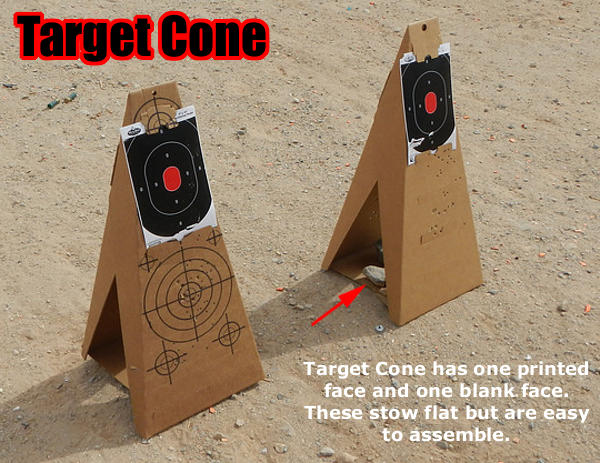
Sometimes you have an opportunity to go shooting but you’re a long way from home and your regular tall target frame(s). Here’s a handy product — a foldable cardboard cone — you can easily carry in your vehicle and deploy any time.
With this innovative Target Cone you can easily carry a target-holder wherever you go. The Target Cone from Re-Nine Safety transports flat so it can be easily stowed in the trunk of your car (or even under a seat). When you’re ready to use it, simply fold the flaps to create a self-supporting cone with pre-printed targets on one side. Place a rock on the base to hold it steady. The Target Cone can be used by itself or, as shown below, you can attach other targets, such as Re-Nine’s Silhouette Target (below right).
We think this is a great innovation. Keep a couple Target Cone flats in the back of your car or truck and you’ll always have a target support. For spur-of-the-moment range sessions, this is much easier than toting around a big target frame. The Re-Nine Safety Target Cones come flat, fold together and interlock forming a sturdy 28″ tall stand-alone target.
In this essay from The Shooting Wire, Tom Gresham states that the anti-gun left seeks nothing less than the eventual confiscation and destruction of all privately-held firearms. The anti-gunners have revealed their goals, says Gresham, through radical legislation recently introduced in Congress, and suggestions that an Executive Order by a future by a Democratic Party President could halt ALL gun sales. Gresham says gun owners must wake up, and take action NOW. Otherwise our rights will be lost. We think every gun owner should read this.
Sometimes understanding what’s going on requires us to connect the dots on things that don’t immediately appear to be connected. Looking at recent events, it’s now possible to see the plans of the gun banners.
It’s much worse than almost anyone imagined.
First, what happened?
H.R. 8, a bill in the House, would end the private sales of guns, would end being able to give a gun to someone, and would criminalize even loaning a gun to someone — unless you got the permission of the FBI each time you want to buy, sell, loan, or borrow a gun. In other words, there could be no legal transfer of a gun in the U.S. unless the government approves each transaction.
House Speaker Nancy Pelosi threatened that a Democrat President could declare a national emergency on gun violence.
A separate bill — H.R. 1112 — would (according to the NRA-ILA) “…eliminate the 3-day safety-valve provision under the federal firearms background check system that prevents the government from enacting an indefinite delay of firearm purchases for law-abiding Americans.”
Currently, if a firearms retailer submits the background check to the FBI, and it is delayed, after three days the dealer is free to legally transfer the firearm. This provision in the current law is the safety valve. It guards against the government shutting down background checks (through incompetence, technical snafu, or even political activism) and stopping gun sales from dealers. (Private sales currently would be untouched.)
Pelosi’s threat didn’t just pop into her head. This idea has been in the works.
Consider those three actions.
The expanded background check provision requires that all gun sales, and gifts, and loans — any transfers — must go through the FBI NICS system.
H.R. 1112 would kill the protection of allowing retailers to sell guns when they don’t get a “denial” from the FBI in three days.
If those two provisions were in place I fully expect a Democrat president to act after a highly-publicized shooting to declare a national emergency and shut down the NICS checks for 90 to 120 days. Maybe even a year.
That would be so that we could have a “national conversation” about gun violence. America’s gun owners would suffer a “mere inconvenience” the banners will say. Except that most privately-owned gun stores could not survive three or four months with no gun sales.
This is not happenstance.
It’s not an accident.
It’s not coincidence.
The gun ban lobby is not dumb.
This has been the plan all along.
1. Kill off all private sales, forcing all legal gun sales to go though dealers.
2. Kill the provision in current law which protect gun owners from a government shutdown of the background check system.
3. Declare a National Emergency and close background checks, which stops all legal gun sales.
Make no mistake. This is part of the larger plan to confiscate (“mandatory buy-back”) your guns.
Naturally, there would be legal challenges. The current makeup of the Supreme Court favors — ever so slightly — the hope that the high court would stop such a thing. If it took months to work its way through the courts, however, massive damage would be done. Thousands of businesses would close and tens or hundreds of thousands of people would be thrown out of work.
Naturally, to the “if it saves one life” crowd, that’s a price they are willing to pay. Well, they wouldn’t pay it. We will. And that doesn’t even touch on the subject that no one wants to talk about … [resistance].
How do we stop this?
We stop it the old fashioned way. We beat it at the polls. We beat it by speaking up in our churches. We beat it with peaceful activism in the streets. We join every single gun rights group — even those which less “pure” by whatever standard is in vogue on any given day.
We spend money. A lot of money. We stop complaining about requests for donations. We donate annually an amount equal to the price of a new gun. How about a dollar a day? We actually do call the offices of our Congressional representatives monthly and talk politely with the staff there about our concerns on Second Amendment matters. We volunteer on campaigns. We go to school board, city council, and state legislature meetings and hearings. We show up.
Two things must happen.
First, you have to look in the mirror and admit you haven’t done enough/much/anything. No one else can do this. Each of us must have the conversation with ourselves and take an honest look at what we have and have not done. And what we can do.
This is a total lifestyle change. It’s a change in where you spend your money and your time.
Second, each of us has to bring along a friend into this activism. I’m not talking about taking someone to the range, though that’s always worthwhile. I’m talking about convincing or more friends that each of you really must donate a buck a day. A lot of dough? Less than many of us spend on coffee. Times a million gun owners.
Jessie Harrison — one of the greatest female pistol shooters on the planet. In the video below, Jessie offers good tips on safe handgun mag changes.
One of our Forum members asked: “Are there any good books on pistol marksmanship? I’m looking for a book that covers techniques and concepts….” Here are six recommended titles that can make you a better pistol shooter. These books run the gamut from basic handgun training to Olympic-level bullseye shooting.
Good Guidebooks for Pistol Shooters
There are actually many good books which can help both novice and experienced pistol shooters improve their skills and accuracy. For new pistol shooters, we recommend the NRA Guide to the Basics of Pistol Shooting. This full-color publication is the designated student “textbook” for the NRA Basic Pistol Shooting Course.
Serious competitive pistol shooters should definitely read Pistol Shooters Treasury a compilation of articles from World and National Champions published by Gil Hebard. You could work your way through the ranks with that book alone even though it is very small. It is an excellent resource.
If you’re interested in bullseye shooting, you should get the USAMU’s The Advanced Pistol Marksmanship Manual. This USAMU pistol marksmanship guide has been a trusted resource since the 1960s. Action Shooters should read Practical Shooting: Beyond Fundamentals by Brian Enos, and Practical Pistol by Ben Stoeger. Brian Enos is a well-known pistol competitor with many titles. Ben Stoeger is a two-time U.S. Practical Pistol shooting champion. Last but not least, Julie Golob’s Shooting book covers pistol marksmanship, along with 3-Gun competition. Julie holds multiple national pistol shooting titles.
How would you like to get marksmanship training from the reigning High Power National Champion? Get yourself to Oregon this June and you can. SFC Brandon Green of the USAMU will be one of the instructors for the CMP Small Arms Firing School in Eagle Creek, Oregon in June. A three-time National High Power Champion, Brandon is one of the greatest marksmen on the planet. Yesterday he posted: “Three of us will be at the SAFS/junior clinic in Oregon. Come check it out!” If you can make it to Oregon June 8-9, we definitely recommend this class. It will be the only SAFS in the Western USA this year.
Along with the June SAFS in Oregon, there will be eight other rifle SAFS programs this year at locations nationwide. Some of these will be held in connection with major matches, such as the Eastern CMP Games in April at Camp Butner.
CMP Rifle SAFS Locations and Dates:
1. Eastern Cup & Games Matches, April 30 | Camp Butner, NC
2. Douglas Ridge Rifle Club, June 8-9 | Eagle Creek, OR (Range Officer Class is Jun 7)
3. Fairfax Rod & Gun Club, June 22-23 | Manassas, VA
4. National Matches, July 27-28 | Camp Perry, Port Clinton, OH
5. Oak Ridge Shooting Assoc., August 24-25 | Oak Ridge, TN
6. Camp Ethan Allen, September 19 | Camp Ethan Allen Training Site, Jericho, VT
7. Fort Hill Rifle & Pistol, September 28-29 | Keyser, WV
8. Oklahoma Cup & Games Matches, October 10 | Oklahoma City Gun Club, OK
9. Talladega 600 Matches, November TBD | CMP Talladega Marksmanship Park, AL
Led by certified military and/or civilian instructors, SAFS programs offers high level training in a safe, supportive setting, with rifles and ammo provided. The school is structured toward teaching new shooters, so no past firearm experience is required, though intermediate and advanced marksmen are also welcome to participate. During the course, students will learn basic instruction and firing practices, competition skills and live range firing, as well as compete in a real M16 EIC Match.
CMP Provides Rifles and Ammo at Small Arms Firing Schools
At each SAFS, equipment, including rifles and ammunition, will be provided. Personal equipment, such as a shooting jacket or glove, will be permitted during the course as well. Participants are required to bring hearing protection and eye protection is strongly encouraged.
For more information or ask additional questions, please contact Amy Cantu at acantu@thecmp.org or (419) 635-2141 ext 602. The Small Arms Firing School (SAFS) has been an instrumental source for individuals to delve into firearm safety and competition technique. The SAFS course has been a staple event in the National Matches at Camp Perry since 1918 and has expanded its outreach to other areas of the country through CMP’s Travel Games matches in recent years.
Why You CANNOT Rely on the MV Printed on the Ammo Box!
When figuring out your come-ups with a ballistics solver or drop chart it’s “mission critical” to have an accurate muzzle velocity (MV). When shooting factory ammo, it’s tempting to use the manufacturer-provided MV which may be printed on the package. That’s not such a great idea says Bryan Litz of Applied Ballistics. Don’t rely on the MV on the box, Bryan advises — you should take out your chrono and run your own velocity tests. There are a number of reasons why the MV values on ammo packaging may be inaccurate. Below is a discussion of factory ammo MV from the Applied Ballistics Facebook Page.
Five Reasons You Cannot Trust the Velocity on a Box of Ammo:
1. You have no idea about the rifle used for the MV test.
2. You have no idea what atmospheric conditions were during testing, and yes it matters a lot.
3. You have no idea of the SD for the factory ammo, and how the manufacturer derived the MV from that SD. (Marketing plays a role here).
4. You have no idea of the precision and quality of chronograph(s) used for velocity testing.
5. You have no idea if the manufacturer used the raw velocity, or back-calculated the MV. The BC used to back track that data is also unknown.
1. The factory test rifle and your rifle are not the same. Aside from having a different chamber, and possibly barrel length some other things are important too like the barrel twist rate, and how much wear was in the barrel. Was it just recently cleaned, has it ever been cleaned? You simply don’t know anything about the rifle used in testing.
2. Temperature and Humidity conditions may be quite different (than during testing). Temperature has a physical effect on powder, which changes how it burns. Couple this with the fact that different powders can vary in temp-stability quite a bit. You just don’t know what the conditions at the time of testing were. Also a lot of factory ammunition is loaded with powder that is meter friendly. Meter friendly can often times be ball powder, which is less temperature stable than stick powder often times.
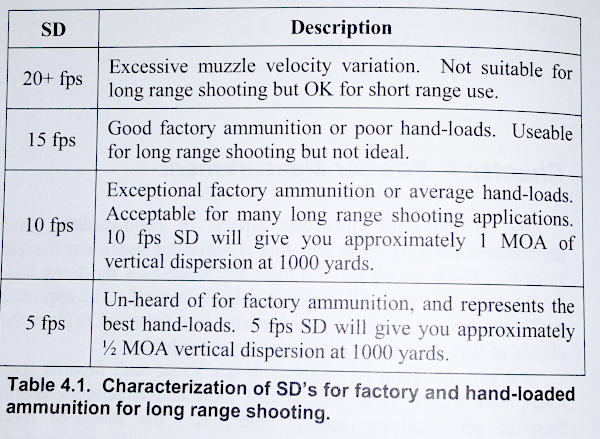
3. The ammo’s Standard Deviation (SD) is unknown. You will often notice that while MV is often listed on ammo packages, Standard Deviation (normally) is not. It is not uncommon for factory ammunition to have an SD of 18 or higher. Sometimes as high as 40+. As such is the nature of metering powder. With marketing in mind, did they pick the high, low, or average end of the SD? We really don’t know. You won’t either until you test it for yourself. For hand-loaded ammo, to be considered around 10 fps or less. Having a high SD is often the nature of metered powder and factory loads. The image below is from Modern Advancements in Long Range Shooting: Volume II.
4. You don’t know how MV was measured. What chronograph system did the manufacturer use, and how did they back track to a muzzle velocity? A chronograph does not measure true velocity at the muzzle; it simply measures velocity at the location it is sitting. So you need to back-calculate the distance from the chrono to the end of the barrel. This calculation requires a semi-accurate BC. So whose BC was used to back track to the muzzle or did the manufacturer even do that? Did they simply print the numbers displayed by the chronograph? What kind of chronograph setup did they use? We know from our Lab Testing that not all chronographs are created equal. Without knowing what chronograph was used, you have no idea the quality of the measurement. See: Applied Ballistics Chronograph Chapter Excerpt.
5. The MV data may not be current. Does the manufacturer update that data for every lot? Or is it the same data from years ago? Some manufacturers rarely if ever re-test and update information. Some update it every lot (ABM Ammo is actually tested every single lot for 1% consistency). Without knowing this information, you could be using data for years ago.
CONCLUSION: Never use the printed MV off a box of ammo as anything more than a starting point, there are too many factors to account for. You must always either test for the MV with a chronograph, or use carefully obtained, live fire data. When you are using a Ballistic Solver such as the AB Apps or Devices integrated with AB, you need to know the MV to an accuracy down to 5 fps. The more reliable the MV number, the better your ballistics solutions.
File photo showing Kestrel 5700 Elite. See video below for 6.5 Creedmoor rifle.
It’s not easy to place a first shot on target at 1500 yards. You must measure the wind speed with precision, know your exact muzzle velocity, and have a sophisticated ballistics solver. In this short video from Ryans Range Report, the shooter manages a first-round hit on a steel silhouette at 1500 yards. He used a Kestrel 4500 NV Weather Meter with Applied Ballistics software to figure out the trajectory for his 6.5 Creedmoor rounds.
The Kestrel recorded a wind velocity, and the internal software calculated a solution of 17 Mils elevation (that’s 928 inches of drop) with 2.5 Mils windage. “Bang” — the shooter sends it, and 2.6 seconds later “Clang” he had a hit (flight time was 2.6 seconds). Bryan Litz observes: “This is the science of accuracy (in the form of an Applied Ballistics Kestrel) being put to good use at 1500 yards”.
Later in the video (1:05-1:15) the shooter places three rounds on steel at 1000 yards in just 10 seconds. The three shots all fall within 10″ or so — pretty impressive for rapid fire. The shooter reports: “[In my 6.5 Creedmoor] I’m using a 136gr Lapua Scenar L. This bullet has impressed me. It screams out of my barrel at 2940 fps and holds on all the way out to 1,500 yards.”
The rifle was built by Aaron Roberts of Roberts Precision Rifles (RPRifles.com). Chambered for the 6.5 Creedmoor, it features a Leupold Mark VI 3-18x44mm scope.
Roberts Precision Rifles
19515 Wied Rd. Suite D
Spring, Texas 77388
Phone: 281-651-5593
Email: rprifles @ gmail.com
The 2019 Berger Southwest Nationals (SWN) are history. It was a great event, with challenging conditions. Forum member Matt Peetz reports: “This year was one of the best — the toughest competitors battling for position in some tough conditions. You never knew how the day was going to end up.” For detailed results and more photos, visit the Desert Sharpshooters Facebook Page.
This Berger SWN brings together sling shooters and F-Class competitors in one of the most popular rifle matches of the year, and definitely the biggest match West of the Mississippi. We congratulate the three divisional champions: Curtis Gordon (Sling), John Myers (F-Open), and Keith Trapp (F-TR)
Keith Trapp won the F-TR division at the Berger SWN with the best overall Aggregate for the week. Keith’s name will be placed on the SWN Nightforce Perpetual Trophy overall. Fellow F-TR Shooter Luke Ramsey won the Berger Trophy for the 600-yard Individual Agg. Phil Kelley said: “It was pretty cool to see good friend Keith Trapp win it all. Our little Butner Club matches just make me smile. That’s 3 SWN champions riding in the same car many days.”
F-TR Top Three
Keith Trapp, 1227-44X; Peter Johns, 1224-40X; Ian Klemm, 1222-51X
(Special Mention: Fritz Braun, 1220-58X, High Senior)
F-Open Top Three
John Myers, 1244-71X; Stephen Potter, 1241-69X; Cody Richardson, 1241-62X
(Special Mention: Sixth Overall and F-Open Palma Match Winner, AccurateShooter System Admin Jay Christopherson, 1239-61X)
Sling (Palma) Top Three
Curtis Gordon, 1241-67X; Kent Reeve, 1241-52X; Oliver Milanovic, 1240-68X
(Special Mention: Tom Whitaker, 1232-55X, High Grand Senior)
F-Open Team Results
Winner: Team Lapua-Brux-Borden, 2375-137X
Alphabetical Order: Jay Christopherson, Erik Cortina (Shooter/Captain), Tod Hendricks, Pat Scully, Bob Sebold (Coach); David Christian (Alt), Steve Harp (Alt)
Second Place: Team Grizzly, 2374-109X
Shiraz Balolia (Shooter/Captain), David Mann, John Meyers, Emil Kovan, Emil Praslick III (Coach)
F-TR Team Results
Winner: Team Texas, 2359-111X
Otis Riffey, Jason Peel, David Parck, Greg Barkley, Randy Littleton, Skip Barkley (Captain), Peter Johns (Coach)
Second Place: Team USA Freedom, 2345-108X
Ian Klemm, Wade Fillingame, Alan Barnhart, Fritz Braun, Kent Reeve (Captain); James Crofts (Coach)
Sling Team Results
Winner: Blazing Saddles, 2347-108X
Thomas Thompson, Andrew Wilde, Mike Kelley (Shooter/Captain), Oliver Milanovic (Shooter/Coach)
Gary Eliseo said: “Congratulations to team Blazing Saddles — Mike Kelley, Tom Thompson, Andrew Wilde, and Oliver Milanovic winners of the gold medal in the team event of the 2019 BSWN matches. Well done!”
Second Place: Team U.S. National Black, 2346-107X
Steffen Bunde, Tony Miller, Yvonne Roberts, Jerry Iliff (Shooter/Captain), Yvonne Roberts (Shooter/Coach)
Friends in Life and on the Podium
Congratulations to Allen Thomas and Gary Eliseo who both shot great in the “Any Rifle” class, a subdivision of the sling division. Both men were shooting Eliseo Chassis Rifles with Pierce Engineering’s new Gen 2 short-cycle Ultra slick actions. Gary noted: “I’m honored to share the podium with my friend and teammate Allen Thomas (first place ‘Any Rifle’) and me (second place ‘Any Rifle’) winners at the 2019 BSWN matches.




 by Hap Rocketto
 About the Author: Hap Rocketto is a Distinguished Rifleman with service and smallbore rifle, member of The Presidents Hundred, and the National Guard Chief’s 50. He is a National Smallbore Record holder, a member of the 1600 Club and the Connecticut Shooters’ Hall Of Fame. A historian of the shooting sports, his work appears in Shooting Sports USA, the late Precision Shooting Magazine, The Outdoor Message, the American Rifleman, the CMP website, and Pronematch.com.



 First, what happened?


 Good Guidebooks for Pistol Shooters



 It’s not easy to place a first shot on target at 1500 yards. You must measure the wind speed with precision, know your exact muzzle velocity, and have a sophisticated ballistics solver. In this short video from


