For the shooting sports to survive, and thrive, we need to bring new shooters into the game. It’s vital that young people get involved in compeitive shooting at an early age. It’s equally important that novice shooters get instruction and encouragement from skilled mentors.
Thankfully the Civilian Marksmanship Program is providing that kind of knowledgeable skills training through programs conducted throughout the country. Recently, at Camp Butner (North Carolina), the CMP offered a Small Arms Firing School (SAFS) taught by U.S. Army Marksmanship Unit (USAMU) experts. The USAMU trainers had a chance to teach members of the Liberty University Shooting Team. Here is the CMP’s report on the successful SAFS:
Liberty University Rifle Team Attends CMP’s Small Arms Firing School Story based on report by Ashley Brugnone, CMP Writer
On a beautiful, sunny morning in North Carolina, over 40 bright-eyed students of all ages set foot on the grounds of Camp Butner Training Facility to take part in a century-old tradition that has trained thousands of new marksmen around the country — the Small Arms Firing School (SAFS). The class was held during the CMP’s Eastern Travel Games at the end of April.
Attending the SAFS were student-athletes of Liberty University, a private institution in Virginia. This year the school launched a new program with four shooting teams: rifle, pistol, shotgun, and three-gun. Among the Liberty University Flames and Lady Flames rifle team member are some accomplished shooters, but others are relatively inexperienced.
Susie Krupp of the Liberty Lady Flames team was the High Non-Distinguished competitor of the event, earning her introductory EIC points.
The SAFS course is a combination of classroom education and hands-on competition and safety instruction on the firing line. At the conclusion, students fire a true M16 rifle match, with the chance to receive Excellence-in-Competition (EIC) points towards earning a Distinguished Rifleman Badge – a prestigious achievement. All equipment is provided by the CMP — even the rifles.
This year members of the U.S. Army Marksmanship Unit (USAMU) trained students. Here SSG Amanda Elsenboss offers pointers to a Liberty University Service Rifle shooter. The USAMU video below features SSG Elsenboss, who has served in the U.S. Army for 8.5 years.
Executive director and head coach of the Liberty University shooting sports program, Dave Hartman, was impressed by the SAFS event and grateful for the education his team received. The university is already looking forward to next year’s Eastern Games: “What’s beautiful about this event is that our competitors can come to this event without any prior knowledge, they don’t need to have a rifle. They go through the classroom portion, and they learn a vast amount of information. And having the USAMU here was fantastic.”
Here’s a simple procedure that lets you get a solid zero for a hunting rifle in just four shots. Of course you probably want to fire a few more rounds to confirm your zero before you head off to your hunting grounds, but this will let you get on-target with a minimum amount of time and ammo expended. (This assumes your scope is securely mounted, and the bases are not drastically out of alignment.)
QUICK-TIP: The Key to this procedure is Dialing to Shot One Point of Impact (POI). Re-aim at center of target after SHOT ONE. Then with the rifle motionless, use the turrets to put the middle of the cross-hair on the first shot location.
1. First, remove the bolt and boresight the rifle. Adjust the position of the rifle so that, looking through the bore, you can see the center of the target with your eyes. Secure the rifle in the rests to maintain its position as boresighted. Then, without moving the rifle, center the reticle. That should get you on paper. With the rifle solidly secured in front and rear rests or sandbags, aim at the center of a target placed at your zeroing distance (50 or 100 yards). Confirm there are no obstructions in the barrel! Then load and fire SHOT ONE. Then, return the gun to the exact position it was when you pulled the trigger, with the cross-hair centered on the target as before.
2. Locate, in the scope, where your first bullet landed on the target. Now, while you grip the rifle firmly so it doesn’t move, have a friend adjust the turrets on your scope. While you look through the scope, have your friend turn the windage and elevation turrets until the cross-hairs, as viewed through the scope, bisect the first bullet hole on the target. In other words, use the turrets to move the center of the reticle to the actual position of shot number one. IMPORTANT: Dial the crosshairs to the hole — don’t move the rifle.
3. After you’ve adjusted the turrets, now re-aim the rifle so the cross-hairs are, once again, positioned on the target center. Keep the rifle firmly supported by your rest or sandbag. Take the SECOND SHOT. You should find that the bullet now strikes in the center of the target.
4. Take a THIRD SHOT with the cross-hairs aligned in the center of the target to confirm your zero. Make minor modifications to the windage and elevation as necessary.
5. Finally, shoot the rifle from a field rest (shooting sticks, bipod, or rucksack) as you would use when actually hunting. Confirm, with SHOT FOUR, that your zero is unchanged. You may need to make slight adjustments. Some rifles, particularly those with flexy fore-arms, exhibit a different POI (point of impact) when fired from a bipod or ruck vs. a sandbag rest.
If you recently cleaned your rifle, you may want to fire two or three fouling shots before you start this procedure. But keep in mind that you want to duplicate the typical cold bore conditions that you’ll experience during the hunt. If you set your zero after three fouling shots, then make sure the bore is in a similar condition when you actually go out hunting.
Can’t get enough gun content on your home computer? Now you can stream informative audio broadcasts to your mobile device. In addition to its popular weekly TV shows, Shooting USA now offers podcasts on gun topics. These podcasts feature interviews with ace shooters, notable gunsmiths, and leading firearms industry executives. There are now 123 Shooting USA Podcast episodes available for streaming. Or you can download a podcast to your mobile device for later listening. All Shooting USA Podcast content is free. Use these links to access all Shooting USA Podcasts (123 audio shows):
Now you can listen to timely and entertaining Shooting USA Podcasts, hosted by Jim and John Scoutten. They are available on both Podbean and iTunes.
Here are four (4) of our favorite Shooting USA Podcasts. These include interviews with legendary shooter Jerry Miculek, and ace pistolero Max Michel, perhaps the fastest handgunner on the planet. Click each graphic to launch the PodBean player page for that Podcast.
Watch Max Michel Speed Drill (This Guy is Blazing Fast!)
Want to learn more about Long Range Shooting? Check out the “Elements of Long Range Shooting” videos from the National Shooting Sport Foundation (NSSF). In this multi-part series, Bryan Litz of Applied Ballistics covers a variety of topics of interest to precision shooters. Today we feature three of these videos. There are five other videos in this series. Watch the entire 8-video “Elements of Long Range Shooting” series on the NSSF YouTube Channel.
Atmospherics and Density Altitude
Bryan Litz explains: “An important element in calculating an accurate firing solution for long-range shooting is understanding the effects of atmospherics on a projectile.” Atmospherics include air pressure, air temperature, and humidity. Bryan notes: “Temperature, pressure, and humidity all affect the air density… that the bullet is flying through. You can combine all those factors into one variable called ‘Density Altitude’.” Density Altitude is used by the ballistic solver to account for air density variables that affect bullet flight.
Bullet Ballistic Coefficients
A bullet’s ballistic coefficient (BC) basically expresses how well the bullet flies through the air. Higher BC bullets have less aerodynamic drag than lower BC projectiles. You will see BCs listed as either G1 and G7 numbers. These correspond to different bullet shape models. Generally speaking, the G7 model works better for the long, boat-tail bullets used for long-range shooting. Notably, a bullet’s drag is NOT constant in flight. The true BC can vary over the course of the trajectory as the bullet velocity degrades. In other words, “BC is dynamic”. That said, you can make very accurate drop charts using the BCs provided by major bullet-makers, as plugged into solvers. However, long-range competitors may want to record “real world” drop numbers at various distances. For example, we’ve seen trajectories be higher than predicted at 500 yards, yet lower than predicted at 1000.
Ballistics Solvers — Many Options
Bryan Litz observes: “When we talk about the elements of long range shooting, obviously a very important element is a getting a fire solution, using a ballistic solver. There are a lot of ballistic solvers out there… Applied Ballistics has smartphone Apps. Applied Ballistics has integrated the ballistic solver directly into a Kestral, and the same solver runs (manually) on the Accuracy Solutions Wiz-Wheel. The point is, if it is an Applied Ballistics device it is running the same solutions across the board.”
About Bryan Litz
Bryan began his career as a rocket scientist, quite literally. He then started Applied Ballistics, the leading company focusing on ballistics science for rifle shooting. A past F-TR Long-Range National Champion and Chief Ballistician for Berger Bullets, knows his stuff. His Applied Ballistics squad was the winning team at the 2017 King of 2 Miles event, and Applied Ballistics recently received a major U.S. defense contract to to execute Phase 1 of the Extreme Sniper Strike Operations (ESSO) project.
The NRA has launched a program to encourage new shooters. Guided by NRA President Pete Brownell, the NRA Mentor Initiative is designed to bring new participants, of all ages, into the shooting sports. The aim is to expand interest in firearms, with the goal of fostering hunting, competitive shooting, and support for Second Amendment rights.
NRA President Pete Brownell states: “May has been designated NRA Mentor Initiative month. We are calling on each of our 5-million-and-growing NRA members, and everyone else in the firearm community, to find someone who has never fired a firearm before, take them to the range and help them put their first rounds on target. It’s been my experience that within minutes of the safety briefing, a lesson on marksmanship and the first pull of the trigger, all of the preconceived notions and media-fueled biases melt away…”
There’s no better way to inform Americans [about] the Second Amendment than to provide a positive, first-hand experience.”
AccurateShooter.com supports the goal of introducing newcomers to the shooting sports. Marksmanship is a fun activity that teaches concentration and self-discipline. It is also a great way to make new friends and get outdoors. While our focus is on precision rifle shooting at targets, we support all firearms disciplines — pistol, rifle, and shotgun.
The NRA has a good resource for mentors (and their students). The NRA’s A Guide for New Shooters contains essential safety information and range etiquette instructions. You’ll want to download this PDF to share with your trainee(s).
Click photo to download PDF Guide for New Shooters.
The NRA has produced a series of helpful, short videos for new shooters. Here are two videos covering basics, with a focus on shooting pistols indoors. We actually prefer to start novices at an outdoor range, shooting .22 LR rimfire rifles. Indoor ranges tend to be dark and noisy. The outdoor experience is more like a day at the park.
Capstone Precision Group will conduct four informative seminars about competitive shooting during the 2018 NRA Annual Meetings & Exhibits. These seminars, designed as introductions to various shooting disciplines, will be led by top competitors. The 147th Annual NRA Convention runs May 3-6, 2018 at the Kay Bailey Hutchinson Convention Center in Dallas, Texas. Visit Capstone at Booth #4517 to learn more about competitive shooting from the experts. The seminars will be held each day in Booth #4517, May 4, 5, and 6 on the schedule listed below.
F-Class Shooting – 10:00-10:30
Join members of the USA Rifle Team to learn about F-Class, what you need to get started and what resources are available to help you learn more. This session will be held by the leaders of the United States F-Open and F-TR Rifle Teams. Made up of over 40 members, the team will be traveling to South Africa in 2021 to represent our country.
F-TR Team USA won the 2017 F-TR World Championship.
Precision Rifle Series (PRS) Shooting – 1:30-2:00
The Precision Rifle Series is one of the fastest growing competitive disciplines. Join two of the top series shooters to learn about all PRS has to offer and how you can join in on the fun. This session is led by Matthew Brousseau of Team Lapua and Missy Gilliland of Team Berger. Matthew is currently #1 in the series, and Missy has won numerous women’s and Top 10 daily awards.
F-TR Team USA won the 2017 F-TR World Championship.
Juniors in Competitive Shooting – 10:45-11:15
Do you have a son or daughter who is interested in competitive shooting? Attend our Juniors in Competitive Shooting educational session to learn how get them started on the right foot. Madison Bramley and her father Dan will lead this discussion. At just 14, Madison has already competed and represented the US around the country, as well as Ireland and Canada.
Madison Bramley at Berger SWN. Erik Cortina Facebook Photo.
Women in Competitive Shooting – 2:15-2:45
This is designed specifically for women who are interested in shooting competitively. Missy Gilliland of Team Berger and Gabby Pitre of Team VihtaVuori will talk about how they got their start in the competitive world and how you can get involved. Missy is a PRS shooter, and Gabby competes in Long Range, Mid-Range, and High Power Across the Course (XTC), so this session will cover many topics.
Missy Gilliland photo courtesy Bushnell.com.
High Power Shooting – 3:00-3:30
Are you interested in High Power Rifle competitions? Let us break down the competition, what you need to get started and how you can get involved with our High Power seminar led by Gabby Pitre and Kevin Thomas. Gabby is a member of Team VihtaVuori and has been competing since she was eight years old. Kevin Thomas is a Capstone employee, and has years of experience both shooting and teaching High Power shooting skills. Both have won distinguished badges and been awarded President’s Hundred, among other accomplishments.
About Capstone Precision Group
Capstone Precision Group is the exclusive U.S. distributor of Berger Bullets, Lapua Components and Munitions, Vihtavuori Propellants, and SK Rimfire products. Capstone Precision Group is a part of Nammo Group.
Great News — There will be serious smallbore rifle competition at Camp Perry this year (though the NRA National Smallbore Championships will still be held at Camp Wa-Ke-De in Indiana). The CMP will host a new series of smallbore events in July at Camp Perry, the Mecca of competitive shooting in the USA. This way smallbore competitors can enjoy the experience of shooting on the famed Camp Perry ranges. Smallbore competitions have been slotted into the Camp Perry National Match schedule July 16-22, 2018. These smallbore events include: 3×40 two-day event; 3P Team Match; Two-Day Prone event; Elimination Prone event; Prone Team Match; USAMU Training Clinic.
The smallbore matches will be fired on Rodriguez Range at Camp Perry under a covered firing line. Shooters Technology will provide a scoring App that allows instant scoring for quick results. Finals will be conducted on the CMP’s Electronic Targets installed on the Camp Perry Petrarca Range.
Learn more about the CMP’s smallbore rifle events at the 2018 National Matches on the CMP website. In addition to an event schedule, the 2018 CMP Smallbore Rifle Competition Rules is also available online. To register for the Camp Perry smallbore events, or to review the 2018 Rulebook, visit http://thecmp.org/competitions/cmp-national-matches/smallbore-matches/.
NATIONAL MATCHES at CAMP PERRY
The National Trophy Pistol and Rifle Matches have been a continued tradition of marksmanship excellence every summer since 1903. Moved to Camp Perry, Ohio, in 1907, the event now draws well over 6,000 annual visitors. For any serious marksman, competing at the National Matches at Camp Perry if a definite “bucket list” item, an experience that creates life-long memories. Participants range from novices to the world’s top smallbore and high power shooters.
Here’s a video from 2011 when the NRA Smallbore Championships were held at Camp Perry. It is great to see smallbore events return to Camp Perry in 2018.
Most of our readers are rifle guys, but it’s fun to shoot a pistol match now and then. You don’t need a lot of equipment, and if you shoot IDPA (Int’l Defensive Pistol Assn.) matches, you can really win with a $400 pistol and $20.00 worth of bulk 9mm ammo. That’s a bargain compared to what you’ll spend on a competitive PRS or F-Class rig and custom hand-loads.
This Editor got his start in competitive shooting with local IDPA matches. I shot a Glock 34, and a SIG Sauer P226, and even did one match with a S&W Snubbie. I eventually settled on the SIG, as it fit my hand better than the Glock, was more accurate, and was every bit as reliable. The P226 also pointed better than the Glock for me — something that helps with target acquisition.
If you want to get into the IDPA game, Shooting Sports USA has a good article that explains the basic rules and classifications. IDPA is not your grandad’s bullseye pistol match. There is movement and action. Stages are timed, and competitors engage targets from cover if available. Singled-handed shooting is sometimes required, as is shooting while moving. You can compete with pretty much any handgun suitable for self-defense — but no $4000 Raceguns with fancy optics. The fact that you can be 100% competitive without spending a ton of money is what makes IDPA so popular.
Shooting Sports USA polled IDPA shooters at the 2016 IDPA Nationals to determine their favorite gun brands and models. The #1 choice was the 9mm Glock 34 for the SSP (Standard Service Pistol) and ESP (Enhanced Service Pistol) Classes. Next most popular was the Smith & Wesson M&P Pro.
Along with SSP and ESP, there are three other main IDPA classes: Custom Defensive Pistol (CDP) for .45 ACPs (mostly 1911 types), Concealed Carry Pistol (CCP), and Revolver (REV). All classes have a minimum power factor. Scores are based on time and shot placement on the IDPA target.
IDPA Scoring System
The official IDPA Target (right) has multiple scoring zones. If you don’t hit the target’s center mass zone or head zone (both appear green in illustration), you drop one or three points. Here’s the formula: Score (in seconds) = Time + Points Down + Penalties. In IDPA, “points down” (and penalties) are added to your time. If you hit the outer edge of the target, you get 3 points down. Nearer center can be 1 point down. Center hit or head shot is 0 points down. See IDPA Scoring for Dummies.
Five Tips for New IDPA Shooters
1. Dry-Fire Practice at Home
You can improve your grip and sight acquisition dramatically with 30 minutes of dry-firing every week. Get some quality snap caps and go to it. One tip — don’t do this in your back-yard if the nosy neighbors can see. We had one friend who was dry-firing in his yard and got an unexpected visit from the local police (with guns drawn). That can turn out badly to say the least…
2. Practice One-Handed Shooting (Both Strong-Hand and Weak-Hand)
Most of the worst misses I saw during IDPA matches were during stages requiring one-handed shooting. A lot of pistol shooters have spent all their time shooting two-handed. That’s the best technique, but in an IDPA match, you may be required to shoot one-handed. If you’re a righty, shooting with the left hand only will feel really weird, and your accuracy will be poor unless you practice. We suggest starting your one-handed training with a rimfire pistol, then transition to your centerfire pistol.
3. For 9mm, Don’t Bother to Hand-load Your Ammo
This may seem like sacrilege, but if you’re only shooting one match a month, it’s probably not worth the time and money to reload 9x19mm. I did reload my 9mm ammo on a progressive for a couple years. After looking at money and time, I just started buying commercial 9mm reloads which worked fine. I was only saving a few cents per round by reloading, and that wasn’t worth the time invested.
4. Get a Good Holster That Fits Right
In IDPA matches you normally draw from holster during the match. I saw a lot of people struggle because they had Kydex holsters that would not release easily, or leather holsters that fit too tight or rocked during draw. Try a few different brands at the local store.
5. Be Smooth, Be Calm, and AIM Your Shots
Many folks come into IDPA thinking it’s all about speed. But there are score zones on the official IDPA target, so you need to focus and AIM. Don’t just “run and gun”. If you stay calm, align your sights in the center of the target for EVERY shot, you will end up with a higher score with fewer “points down”. Speed will come with time. It is better to make sure each one of your shots is a hit.
So many options… How do you select the shooting discipline that’s best for you? Of course, “Fun is number one”. But you also need to consider cost — the “bang for the buck”. Or in more scientific parlance, the “Fun to Cost Ratio”. Yes, shooting a .50 BMG is fun, but you could be spending as much as $5.00 per round for factory loads! By contrast, your cost per shot in a rimfire fun match might be well under ten cents, as decent ammo can be easily found for under $5.00 per 50-count box. Five bucks per box (of fifty) sure beats five bucks per round!
We believe in the benefits of rimfire cross-training. With a rimfire rifle that has the same ergonomics and “feel” as your centerfire rig, you can practice more often and more affordably. You can get decent rimfire ammo now for as little as seven cents per round*. Compare that to centerfire factory ammo at $1.40/round or handloads for about $0.70 (bullet, primer, powder, and brass depreciation). So even your handloads could cost TEN times as much as pretty good rimfire ammo. That’s an order of magnitude boys and girls.
For a tactical cross-trainer, you want a rimfire rig that feels like your centerfire rifle. McMillan now offers a stock that fits the bill. McMillan’s new A5-22 stock shares the same look and feel as McMillan’s popular A5 centerfire stock. The A5-22 is able to accommodate 10/22 type actions including KIDD 10-22 models with rear tang attachments. McMillan says: “The A5-22 is dimensionally the same as our standard A5 with some minor changes in the tang and floor plate areas. It is available in a fixed comb configuration or with an adjustable saddle-type cheek piece.”
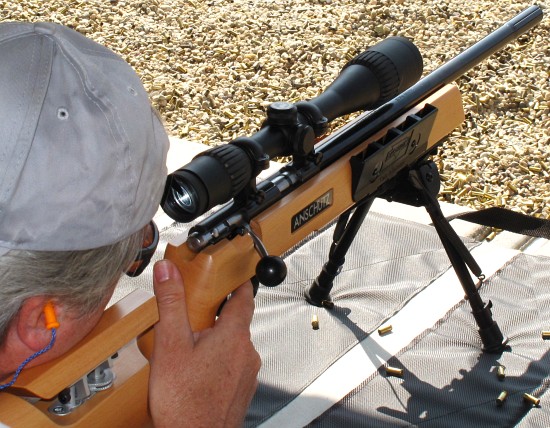
A used Biathlon trainer works great for rimfire practical matches. This is the Anschutz Model 64-R. Note magazine caddy on forearm. This rifle was a dream to shoot.
Targets for Rimfire Training and Fun Matches
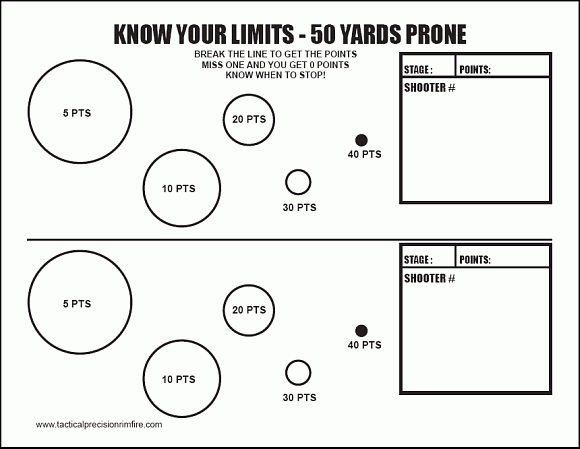
Here’s a rimfire training target with “big to small” target circles. Start with the largest circles, then move to the smaller ones in sequence. This systematic drill provides increasing challenge shot-by-shot. Novices often are quite surprised to see their accuracy improve as they move from bigger to smaller aiming points. That provides positive feedback — always a good thing.
Right Click and “Save as” to download printable PDF versions of target.
Rimfire Practice Targets
SPECIAL BONUS–Rimfire Tactical Precision Targets
These FREE targets by DesertFrog are offered in Adobe Acrobat format for easy printing. CLICK HERE to download all six targets as a .ZIP archive.
Game Theme Commercial Targets — Fun and Colorful
Here are some colorful commercial fun targets, well-suited for rimfire practice. These game-theme targets from Champion should be very popular with kids. You can blast aerial drones, hunt dinosaurs, play a game of “H-O-R-S-E”, or shoot ducks in a Carnival Shooting Gallery. These targets, which cost $5.45-$5.95 per 12-pack, are ideal for younger shooters in your family (and fun for grown-ups too).
* We recently scored 1500 rounds of Norma Match-22 ammo for $99.99 from MidwayUSA. That’s 6.6 cents per round! That deal is gone, but there are other bargains to be found. Use WikiArms.com to find .22LR rimfire ammo bargains.
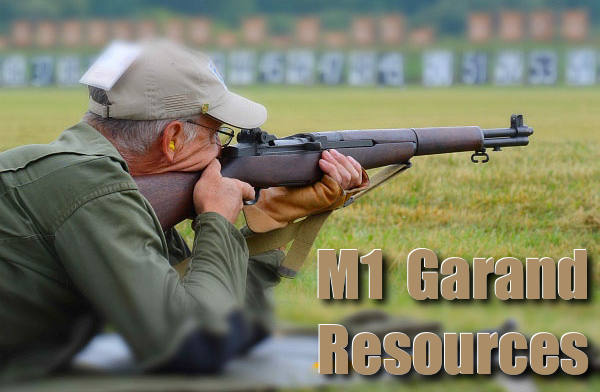
Do you own an M1 Garand? Or perhaps you’re thinking of ordering a Garand, now that the CMP recently received 99,000 of these classic battle rifles — returns from Turkey and the Philippines. An M1 Garand is a great addition to anyone’s personal firearms collection. It is a piece of living history — plus it can be used in Vintage Military rifle matchers. Here are some resources for M1 Garand owners. There are marksmanship tips, plus helpful advice on maintaining your M1 Garand.
Rifle Marksmanship with the M1 Garand Rifle
The film was made in 1942/43 for the War Department. It shows shooting positions and holding techniques for the M1 Garand. This informative video will help both novice Garand shooters as well as experts seeking a “refresher course”. The film focuses on the M1 Garand but the techniques can be applied to any rifle. The narration sounds a bit “corny” by today’s standards, but focus on the techniques shown and you’ll learn plenty.
M1 Service and Maintenance
Shooting Sports USA has published an excellent article on Service and Maintenance of M1 Garand Rifles. This covers basic cleaning and servicing and also explains how to upgrade the performance of your Garands. READ Article HERE.
This popular Tips and Tricks Video has been viewed over 500,000 Times on YouTube.
Recommended M1 Garand Manual
Among the many M1 Garand manuals available, we recommend the CMP’s U.S. Rifle, Caliber .30, M1: ‘Read This First’ Manual. This booklet covers take-down, reassembly, cleaning, lubrication, and operation. The manual comes with CMP rifles or can be purchased for $3.50 from the CMP eStore. The author of Garand Tips & Tricks says: “It’s one of the best firearms manuals I’ve seen and I highly recommend it.” The CMP also offers many other M1 Garand print resources including:



 NRA President Pete Brownell states: “May has been designated NRA Mentor Initiative month. We are calling on each of our 5-million-and-growing NRA members, and everyone else in the firearm community, to find someone who has never fired a firearm before, take them to the range and help them put their first rounds on target. It’s been my experience that within minutes of the safety briefing, a lesson on marksmanship and the first pull of the trigger, all of the preconceived notions and media-fueled biases melt away…”




 Along with SSP and ESP, there are three other main IDPA classes: Custom Defensive Pistol (CDP) for .45 ACPs (mostly 1911 types), Concealed Carry Pistol (CCP), and Revolver (REV). All classes have a minimum power factor. Scores are based on time and shot placement on the IDPA target.