For many, the NRA Annual Meetings and Exhibits is all about the Second Amendment and politics. For others, the main appeal is the Exhibit Hall, with its countless firearm displays and outfitter booths. There will be lots to see this year in Dallas, but just about the most fun you can have at the NRA Convention will be at the Pyramyd Air shooting gallery.
Pyramyd’s Air Gun Range was a hit last year in Atlanta and is set to be a top destination for the entire family at the 147th NRA Annual Meetings and Exhibits in Dallas, Texas. With 16 stations and more than 200 hundred interactive targets, the range will provide shooters of all ages the chance to try out some of the newest and best airguns available. From entry-level break-barrels to high-end, precision air rifles and target pistols, there will be a full range of options.
One NRA range officer noted: “If you see a long line there [at the Dallas Convention Center], odds are that it’s for the air gun range. We have boys and girls, moms and dads, everyone waiting to plink the day away.”
The Air Gun Range is not just for youngsters. Adults can have fun too.
The Pyramyd Air Air Gun range will operate in the Kay Bailey Hutchison Convention Center. We expect it will operate Thursday (May 3) from 2:00 to 6:00 pm; on Friday and Saturday from 8:00 am to 6:00 pm; and on Sunday from 8:00 am to 5:00 pm. But schedule is subject to change.
At the Air Gun Range, you’ll find air rifles and air pistols from: Air Arms, Air Force, Air Venturi, Ataman, Beeman, Browning, BSA, Colt, Crosman, Diana, Kral Arms, SIG Sauer, Umarex USA, and Walther.
Here are two of the precision-type air rifle that will be at the AirGun Range. On top is the Air Arms S400 MPR Precision. On the bottom is the bullpup-style Kral Arms Puncher Breaker SideLever PCP:
The Pyramyd Air Perspective
A long time partner in this experience, Pyramyd sees the NRA Air Gun Range as more than marketing opportunity. “We’re focused on increasing the number of shooters and involving people of all ages in the shooting sports,” said Pyramyd founder and owner Joshua Ungier. “For Pyramyd Air, it isn’t just a business – it’s a passion.”
Thomas Haugland, a Shooters’ Forum member from Norway, is a long-range target shooter and hunter. He has created an interesting video showing how to gauge wind velocities by watching trees, grass, and other natural vegetation. The video commentary is in English, but the units of wind speed (and distance) are metric. Haugland explains: “This is not a full tutorial, but rather a short heads-up to make you draw the lines between the dots yourself”. Here are some conversions that will help when watching the video:
.5 m/s = 1.1 mph | 1 m/s = 2.2 mph | 2 m/s = 4.5 mph
3 m/s = 6.7 mph | 4 m/s = 8.9 mph | 5 m/s =11.2 mph
Shown above is David Tubb, the legendary 11-time National High Power Champion, posing with a very serious rifle used in the Extreme Long Range (ELR) game. David has jumped into the Extreme Long Range discipline in a very big way, producing a .375-caliber, long-barreled ELR version of his famous Tubb rifle, called the Adaptive Target Rifle (ATR). A version of this rifle, piloted by David’s son-in-law Nate Stallter, set the current ELR World Record in January 2018. See video below for a full report.
This video shows Team TUBB setting a new ELR World Record of 2011 Yards using the Tubb Adaptive Target Rifle in .375 CheyTac. Nate Stallter nailed three shots at over one mile — 1768 yards. Then Nate broke his own record, going 3 for 3 at 2011 yards. ELR Central hosted this match, held at the Front Sight gun range, Pahrump, NV on January 21, 2018.
David Tubb will Be Working with Chase Stroud
David has been working with Chase Stroud, a talented young Texan who has competed in tactical rifle competitions and worked with Team Applied Ballistics on ELR projects. Chase has long respected Tubb’s shooting ability as well as his design/engineering talent in developing successful rifle platforms, such as the ground-breaking Tubb 2000.
Recently, Chase had the opportunity to shoot long range with David Tubb. David crafted a left-hand ATR rifle for Chase who will be working with David in the future. Posting on Facebook, Stroud wrote:
“Growing up as a kid I taught myself to shoot long distance from David’s videos. David Tubb was my idol then and still is now. Never in my wildest dreams did I think I would share the line with him much less get to represent his product in the long range community. A literal dream come true for me….
Yesterday we shot some video for the new Tubb ATR system. After pressing him for years he made me a [left-hand ATR] and it shot unreal using his absolute ammo. I thank you … David. It’s time to get some practice under my belt and start shooting again…”
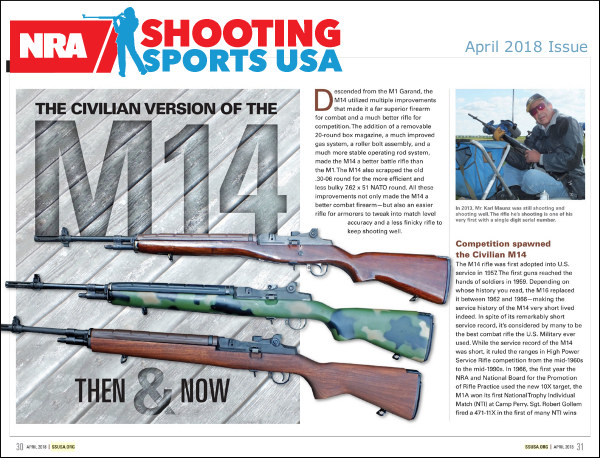
“Descended from the M1 Garand, the M14 utilized multiple improvements that made it a far superior firearm for combat and a much better rifle for competition.” — Dick Jones, Shooting Sports USA.
In the April 2018 issue of Shooting Sports USA, you’ll find a good article on the civilian version of the M14, now sold commercially as the Springfield M1A. An evolution of the battle-proven M1 Garand, the M14 was designed to shoot the 7.62×51 (.308 Win) round instead of the larger .30-06 Springfield cartridge used in WWI, WWII and Korea. While the vast majority of today’s M1As are chambered for .308 Win/7.62×51, Springfield Armory also produces a 6.5 Creedmoor version.
Dick Jones reports that accurized M14/M1As could post remarkable scores: “The accuracy potential of the M14/M1A is unquestionable. During their reign as service rifles, they produced multiple perfect 200 scores at 600 and 1000 yards in the hands of top shooters. This is a difficult feat with a modern, scoped, magnum-caliber rifle and remarkable with an iron-sighted battle rifle. Good competition rifles can group 10 shots under one MOA, and the meticulously-massaged rifles used by the top shooters during my career would consistently put up 10 shots under an inch at 200 yards off a test cradle.”
For many years, the semi-auto version of the M14 was “top dog” in iron sights Service Rifle competition. Now that discipline is dominated by .223 Rem (5.56×45) AR-type rifles, but the bigger .308-caliber rifle, now sold as the M1A, remains popular. The CMP hosts a major M1A Match every year at Camp Perry, sponsored by Springfield Armory. Significant prizes are awarded. M1A Match competitors took home over $25,000 worth of cash and merchandise in 2016.
In this video, YouTube Reviewer Hickok 45 compares the M1 Garand and the M14/M1A:
See how the modern M1A is built in this Springfield Armory Video:
As racing improves automobiles, competition improves firearms, and the current crop of Springfield M1As, from the Basic to the top-of-the-line Super Match and Loaded models, reflects the years of development. The M14 and its variants are still in service today and it’s still considered by many to be the best battle rifle in the history of the U.S. Military. — Dick Jones, Shooting Sports USA
In recent years, the California Legislature has passed a series of laws restricting the rights of California gun owners. The latest example of anti-gun legislation will hit gun owners in their pocketbooks….
If you want to practice your marksmanship in California from now on, get ready to open your wallet and pay the taxman. With the passage of AB 211, recently signed into law by Gov. Jerry Brown, California shooters who use paper targets at indoor ranges will have to pay a fee for every hole they put in paper — literally. This new law, codified in the California Penal Code, states that commercial gun ranges must collect a charge of $0.38 per shot, as established by holes made in approved paper targets. This fee, the “Target Tax”, can be raised in the future at the discretion of the California Dept. of Justice.
Here’s how it will work, starting June 1, 2018, when the new Target Tax law goes into effect at California indoor ranges. First, all shooters must purchase California DOJ-approved paper targets (you may no longer bring your own). When you purchase a certified target at an indoor range, your name and the number of targets you have purchased will be recorded in a state database. Then, after your shooting session, the targets must be scanned, with the number of shot holes recorded. A charge of $0.38 per scanned hole will be added as a line item for your range session, along with the DOJ target-processing fee of $5.00 per target.
With 30 holes, the new California target tax on this left target would be 30 x $0.38 or $11.40. Conversely, the tax on the target on the right would be just 38 cents, because there is only one hole, though five shots went through the same hole. Obviously, exceptional marksmanship skills can help reduce your target tax liabilities.
California Targets Must Be Culturally Tolerant and Non-Discriminatory
AB 211 also includes a series of provisions which specify the types of targets which may be purchased. First, as you might expect, all targets must be printed on recycled paper. Second, no target may contain any “hate speech” or “micro-aggressions”. Third, while targets may still show human silhouette-style outlines, any targets which depict a protected minority type or non-binary gender type are forbidden. Likewise, any target that shows discernable culture, religion, or national origin are forbidden. So, a target showing a bearded male wearing a turban would be forbidden. If you had such a target, the range owner would be required, under AB 211, to confiscate it. Shown below are two types of targets that would be illegal in California under AB 211. NOTE: It is unclear whether a zombie target would be allowed, if the Zombie is unknown gender, ethnicity, or culture.
.009″ — The Record That Stood for 40 Years.
In 1973 Mac McMillan shot an amazing 100-yard, .009″ five-shot group in a benchrest match. The .009″ group was measured with a 60x microscope for verification. Mac McMillan shot the group using a handbuilt prototype McMillan rifle with an early McMillan stock.
Mac’s .009″ group was the “Holy Grail” of rifle accuracy. This .009″ record was considered by many to be unbreakable, a record that would “stand for all time”. Well, it took 40 years, but someone finally broke Mac’s record with an even smaller group. In 2013, Mike Stinnett shot a .0077″ five-shot group using a 30 Stewart, a .30 caliber wildcat based on the 6.5 Grendel. Stinnett’s .0077″ group now stands as the smallest 100-yard group ever shot in registered benchrest competition.* Read About .0077″ group HERE.
Stinnett’s success doesn’t diminish the significance of Mac McMillan’s .009″ group in the history of benchrest competition. For four decades Mac’s group stood as the ultimate standard of rifle accuracy*. For those of you who have never seen Mac McMillan’s .009″ group, here it is, along with the NBRSA World Record certificate. The target now hangs in the McMillan Family Museum.
*Somebody else might claim a smaller group, but unless moving backers or electronic targets were used, it cannot be verified. Moving target backers are used at registered benchrest matches to ensure that five (5) shots are actually fired in each group. That eliminates any doubt.
Kelly McMillan recently released a Video Podcast featuring some very talented shooters including the legendary David Tubb. While Kelly has broadcast scores of audio interviews on his Taking Stock Radio Show, this is something even better — you can see Kelly’s guests on camera during the 68-minute-long Video Podcast:
David Tubb Talks Cartridge Design, ELR, and Much More
The show starts off with legendary marksman, David Tubb, winner of 11 NRA National High Power Rifle Championships as well as multiple National Long Range championships. Kelly notes: “Our first guest, David Tubb, is arguably the … winningest, competitive rifleman in history. Trophies aside, though, David’s biggest contribution to our shooting sports is his innovative mind. The underlying essence behind his company, Superior Shooting Systems, is the continued advancement of the ‘human factor’ in the shooting sports.” During this segment David addresses many topics, including cartridge design (6XC and 6.5 Creedmoor), ballistics, Extreme Long Range (ELR) shooting, optics, stocks and more.
Regina Milkovich — Top PRS and Tactical Competitor Facebook Photo and courtesy WellArmedWomen.
Kelly’s next guest is Regina Milkovich, the first woman in history to win a major practical/tactical precision rifle match outright. (Regina was the overall winner of the 2016 NorCal Tactical Bolt Rifle Challenge.) Regina has been successful in many disciplines, and is now active in the Precision Rifle Series (PRS). Starting at the 44:50 time-mark in the video, Regina shows off her current PRS rifle, chambered for the 6XC cartridge. It features a McMillan stock, Defiance Action, Vortex Razor Gen 2 scope, and Timney trigger. Tactical shooters will want to watch this segment. Regina reviews the many accessories she uses both on and off the rifle. She shows the support bags she favors and discusses how the right choice of equipment can help improve your scores.
“[This is] one of my all-time favorite pictures” Regina told us. “It was taken in Vegas at a Sin City Precision match a couple of years ago.” Facebook photo.
Kelly also chats with Buzz Miller, an industry product development specialist who has worked with large gun-makers including FN USA, and Taurus. Buzz talks about how new gun designs are conceived, proto-typed, tested, and introduced into the marketplace. Buzz also discusses customer service among other topics. The main Buzz Miller segment begins at the 41:20 time-mark.
This helpful video from our friend Kirsten Joy Weiss explains how to avoid “scope bite”. This can occur when the scope, on recoil, moves back to contact your forehead, brow, or eye socket area. That’s not fun. While common sense tells us to avoid “scope bite” — sooner or later this happens to most shooters. One viewer noted: “I have come close. I had a Win Model 70 in .375 H & H Mag and I was shooting over a large rock in a strange position. The scope hit my eye glasses hard enough to bend the wire frames and cause a little pain on the bridge of the nose from the nose piece. [That] made a believer out of me.”
Kirsten offers a good basic principle — she suggests that you mount your rifle-scope so that the ocular (eyepiece) of the scope is positioned at least three inches or more from your eyeball when you hold the rifle in your normal shooting position. From a technical standpoint, optical eye relief is a property of the scope, so you want to purchase an optic that offers sufficient optical eye relief (meaning that it allows you to see the full circle of light with your head at least three inches from the eyepiece). Then you need to position the optic optimally for your head/eye position when shooting the rifle — with at least three inches of eyeball-to-scope separation (i.e. physical eye relief).
NOTE: You should mount the scope to provide adequate eyeball-to-scope separation for the actual position(s) you will be shooting most of the time. For an F-TR rig, this will be prone. For a hunting rifle, your most common position could be sitting or standing. Your head position will vary based on the position. You can’t assume the scope placement is correct just because it seems OK when you are testing or zeroing the gun from the bench. When shooting from a prone or kneeling position you may find your eye considerably closer to the eyepiece.
A few good men (and women) — that’s what the shooting sports need these days. We need skilled, trained personnel to serve as Range Safety Officers (RS0s). Without RSOs, there would be no shooting matches — no F-Class, no High Power, no Smallbore Matches — you get the idea. Thankfully there are now ways to get requisite RSO training without costly travel far from home.
The NRA now offers an online training course for its Range Safety Officer (RSO) program. The online course teaches the skills needs to conduct and supervise safe shooting activities and range operations. Online RSO Course students can access the electronic course materials for 90 days. You can complete the course in multiple sessions. The program will save your progress so you can return later.
• Introduction to the NRA Basic Range Safety Officer Course
• The Role of the NRA Range Safety Officer and Range Standard Operating Procedures
• Range Inspection and Range Rules
• Range Safety Briefing
• Emergency Procedures
• Firearm Stoppages and Malfunctions
Who Can Take the Course?: The Online RSO Course is available to anyone who currently possess a valid NRA Firearms Instructor certification or NRA Coach appointment. Course cost is $125.00. Individuals without a trainer rating must attend the in-person Range Safety Officer course consisting of both classroom time and practical exercises on a range.
Certification Procedure: Students must complete all six lessons and a short electronically administered test in order to become a certified Range Safety Officer. Once the test has been passed, newly certified Range Safety Officers will receive an electronic completion certificate that can be printed or saved to a computer.
The NRA RSO program was developed in response to the demand for a nationally-recognized range safety officer certification. More than 54,000 NRA Range Safety Officers are involved in aspects of target shooting, training, and range supervision around the USA.
Range Safety Officer supervises the line at Berger SW Nationals. Without dedicated RSOs, we could not have matches like these.
It’s March 17th today — St. Patrick’s Day. To help celebrate this traditional day of Irish pride, parades, and green beer, the NRA has created two (2) fun targets you can download, print, and shoot. Try out these free targets and see if you have the “luck of the Irish”. Click each Irish target photo below to open a high-rez PDF file you can download and print.
The first target features a large four-leaf clover in the middle, with 17 other smaller three-leaf shamrocks around the outside. With five black bulls-eyes in the center graphic, that gives you a total of 22 aiming points for shooting fun. For added challenge we suggest you set this target at 100 yards for rimfire rifle and 200 years for a centerfire gun.
CLICK Below for Big PDF Shamrock Target
The second target offers the legendary Pot of Gold at the end of the rainbow. Along with a big bullseye on the pot, there are 15 shamrocks in gold circles, plus five small gold bars with tiny bullseyes. Those smallest bulls will be a challenge even at 100 yards. You’ll need a half-MOA (or better) rifle to “clean” this target, hitting the smallest red dots.
CLICK Below for Big PDF Pot of Gold Target
Whether you’re Irish or not, these targets will hopefully bring you a bit of luck. Click each image above to open a high-rez PDF file that you can print out. Then, this St. Patty’s day, wear your green, grab your gear, and head to range for some fun shooting.


 Pyramyd’s Air Gun Range was a hit last year in Atlanta and is set to be a top destination for the entire family at the 147th NRA Annual Meetings and Exhibits in Dallas, Texas. With 16 stations and more than 200 hundred interactive targets, the range will provide shooters of all ages the chance to try out some of the newest and best airguns available. From entry-level break-barrels to high-end, precision air rifles and target pistols, there will be a full range of options.




 .009″ — The Record That Stood for 40 Years.



 The
The 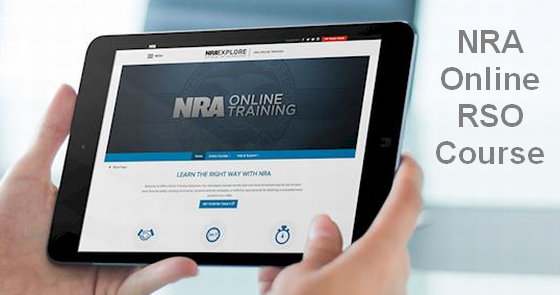
 Certification Procedure: Students must complete all six lessons and a short electronically administered test in order to become a certified Range Safety Officer. Once the test has been passed, newly certified Range Safety Officers will receive an electronic completion certificate that can be printed or saved to a computer.