In this video Bryan Litz of Applied Ballistics offers tips on Big Bore shooting (i.e. .338 caliber and above). Bryan offers advice on bullet selection and he explains the challenge of handling the blast, noise, concussion, and recoil of big boomers such as the .416 Barrett and .50 BMG.
Bryan goes big … very big, shooting a monster .50 BMG bullpup.
Watch the recoil pulse shove Bryan backwards at 1:40 time-mark:
Big Bore Basics — Tips for Shooting Big Boomersby Bryan Litz
There are some unique things to consider with big-bore shooting. One is bullet design. For long-range shooting you want high-BC bullets. You get high BC from heavy bullets and bullets that have low drag. The interesting trade-off in big calibers is that there are a lot more lathe-turned solid bullets in copper and brass available than there are in the smaller calibers. You’ve got bullets that have slightly lower drag profiles but they are made of materials that are slightly less dense (than lead) so they are relatively light for their caliber. With that trade-off, the BCs might not be as high as you think for big calibers, although the bullets are heavy enough that they carry a lot of energy.
Energy really has a lot to do with shooting these big-caliber rifles. As with any kind of shooting, the fundamentals of marksmanship are the most important thing. However, it can be hard to maintain good fundamentals (e.g. trigger control and sight alignment) when you’re burning 100 grains of powder. There’s a lot of concussion (you want a muzzle brake no matter what your cartridge is above .338). It certainly can be challenging with all the muzzle blast and all the energy coming out of the barrel.
For long-range shooting with big bore rifles, you are still looking for the same things that you want with smaller-caliber rigs. You want a high-performance bullet, you want consistent ammunition, and you want a good fire solution to be able to center your group at long range. Basically you’re just dealing with the challenges that the high energy brings, and being smart about your bullet selection.
In the video above, Bryan is shooting the DesertTech HTI bullpup. This rifle can shoot four (4) big bore chamberings, with barrel conversion kits for: .375 CheyTac, .408 CheyTac, .416 Barrett, and .50 BMG. These can be quickly swapped in the HTI chassis, which employs an internal barrel-clamp system.
Here’s the best reason to go to Las Vegas we know — to attend a shooting camp taught by some of the nation’s leading 3-Gun aces. In three weeks, the Clark County ranges will be ringing with the sounds of pistol, rifle, and shotgun rounds on steel…
April 20-23, 2017 NSSF presents its first-ever 3-Gun Shooting Sports Fantasy Camp, to be held at the world-class Clark County Shooting Complex in Las Vegas. This event features shooting instruction from some top pros, including Randi Rogers, Robert Vogel, Tommy Thacker, Dianna Muller, Ryan Muller, BJ Norris and Chris Cheng. You don’t even need to bring your bang-sticks — the program includes guns and all ammo (as well as meals and hotel accommodations). The April 2017 camp is sold out, but the NSSF plans more camps in the future.
During the 4-day session, “campers” will learn from the pros, practice techniques, have some friendly competitions, and, of course, enjoy Las Vegas nightlife (after the shooting stops).
Nevada’s Clark County Shooting Complex, located just North of Las Vegas, is the largest shooting facility in the United States. Opened in 2010, the modern 2,900-acre complex is a deluxe facility with multiple ranges, club-house, and even an RV park.
Hardware for 3-Gun Competition — Guns & Gear
In this NSSF video, Top Shot Finalist Chris Cerino reviews the hardware you’ll need for multi-gun matches. Chris talks about carbine configurations — including barrel, handguard, and optics options. Cerino also demonstrates pistol techniques and explains the key features of a belt/holster rig.
In the hit Hollywood movie “The Patriot”, the hero Benjamin Martin (played by Mel Gibson), tells his sons: “Aim small, miss small”. That advice was given to help his sons survive encounters with the British redcoats, but the “aim small, miss small” mantra can benefit target shooters as well.
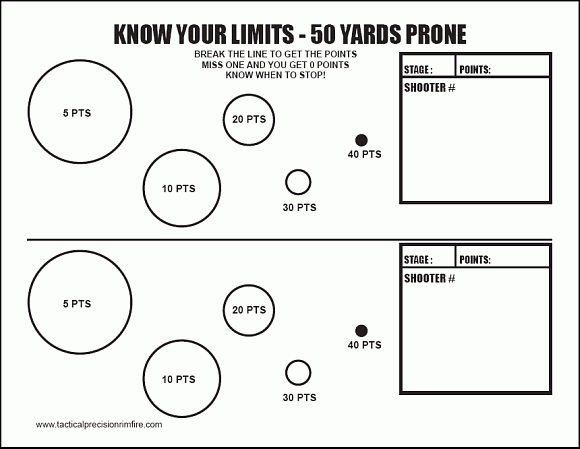
We have found that novice and intermediate shooters can often improve their accuracy simply by using targets with smaller, more precise aiming points. Inexperienced shooters can benefit by starting with a large-size aiming circle, and then progressing to smaller and smaller target dots. This lets the shooter increase the challenge as his gun-handling becomes more steady and his aim improves.
Here are two rimfire training targets with “big to small” target circles. Start with the largest circles, then move to the smaller ones in sequence. This systematic drill provides increasing challenge shot-by-shot. Novices often are quite surprised to see their accuracy improve as they move from bigger to smaller aiming points. That provides positive feedback — always a good thing.
Right Click and “Save as” to download printable PDF versions of these targets.
Read FULL ARTICLE in Midsouth Shooters Blog by Glen Zediker
Most good shooters use mirage as their leading indicator to spot changes in the wind. With well-designed stand, the scope can be set it up where you can see the wind with the left eye and see the sight with the right without anything more than a visual focus shift. That gets the shooter back on the trigger with the least chance of missing another change. In the photo above you can see 11-time National High Power Champion David Tubb using a spotting scope set up for his left eye.
There are resources that give clues or evidence of wind direction and strength: wind flags, observation of grass and trees, and mirage.
Almost always I use mirage as my leading indicator. Mirage (heat waves) is always present but you’ll need a scope to read it. For 600 yards I focus my scope about halfway to the target. Mirage flows just like water and the currents can be read with respect to wind speed as well, but it’s not clearly accurate beyond maybe a 15 mph speed. The thing is that mirage shows changes, increases or decreases, and also direction shifts, really well.
A couple more things about mirage flow: when mirage “boils,” that is appears to rise straight up, either there’s no wind or the scope is dead in-line with wind direction. And that’s a quick and accurate means to determine wind direction, by the way, move the scope until you see the boil and note the scope body angle. It’s also how to know when a “fishtail” wind is about to change, a boil precedes a shift.
You don’t need to spend big bucks for an effective spotting scope to view mirage. You can get the Kowa TSN-601 Angled Body for just $249.00 from B&H Photo. An eyepiece will run another $275.00 or so. Though relatively inexpensive, the TSN-601 is used by many top marksmen.
I use a long-eye-relief 20X to 25X wide-angle eyepiece. That setup shows the flow best. And pay attention to where the wind is coming from! See what’s headed your way, because what’s passed no longer matters. That’s true for any indicator. Right to left wind? Read off the right side of the range.
Once I get on target then all I am doing is watching for changes. It’s really uncommon to make a big adjustment between shots. The fewer condition changes you are enduring, the easier it is to keep everything on center. That’s why I shoot fast, and why I start at the low point in a wind cycle.
Making Corrections with Limited Sighters
Here’s a Tip for NRA High Power matches where only two sighters are allowed: “Make a full correction off the first sighting shot location! Even if there are minor changes afoot, that’s how to know how well you assessed condition influence pre-shot. Don’t second-guess. After the second sighter you should be on target and then simply watching for changes. Pay attention, correlate visible cues to the results of prior shots, and if in doubt, click into the wind.”
Information in this article was adapted from material in several books published by Glen Zediker and Zediker Publishing. Glen is an NRA High Master who earned that classification in NRA High Power Rifle using an AR15 Service Rifle. For more information and articles visitZedikerPublishing.com.
Applied Ballistics has produced a series of YouTube videos about precision long range shooting. Featuring ace long-range shooter and professional ballistician Bryan Litz, these videos address various topics of interest to long-range marksmen. This featured video looks at Long Range mistakes — Bryan Litz reveals the most common ballistics-related shooting errors at Long Range. And then Bryan explains how to improve your shooting (and wind reading) to eliminate those common errors.
Watch Applied Ballistics Video about Common Mistakes in Long Range Shooting:
Bryan Litz of Applied Ballistics often hears the question: “What are the main reasons people miss their target at long range?” To answer that question, in this video, Bryan explains the most important variables in Long Range shooting. Bryan says: “Probably the number one thing is range — you have to have a [precise] range to your target because your bullet is dropping, and to hit the target you need to correct for bullet drop.” Distance may be indicated on the target bay (or berm), but for open ranges you should ascertain distance-to-target with a quality laser rangefinder. Even when the distance to target is shown with a sign or marker, you may want to confirm the distance with your rangefinder. (You may be surprised — we’ve seen marked target distances at commercial ranges off by 25+ yards!) Bryan says: “Get a good laser range to the target and you’ll be within a couple yards”.
After distance to target, the most important variable is the wind. This is the most challenging factor because the wind is constantly changing. Bryan explains: “After 300 or 400 yards, the wind [will] move your shots off the target if you don’t correct for it. The best way to account for the wind is to measure it at your location with a Kestrel. The Kestrel can give you the speed and direction of the wind at your location, which can baseline your wind call for your long-range shot.” Bryan acknowledges that there will still be variables: “The wind isn’t always blowing the same downrange as at your location… and the wind is always changing”. Bryan notes that you need to account for variances in wind between the time you gauge the wind angle and velocity and the time you actually you take your shot.
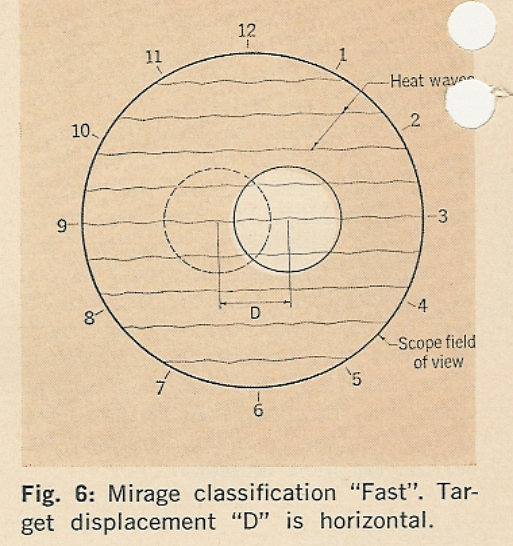
There was an excellent article about Mirage created for the South Texas Marksmanship Training Center (STMTC) website a while back. This article explains what causes mirage and how mirage can move the perceived aiming point on your target. Most importantly, the article explains, in considerable detail, how you can “read” mirage to discern wind speeds and wind directions.
Mirage Is Your Friend
While hot days with lots of mirage can be frustrating, mirage can reveal how the wind is flowing (and changing). If you learn how to recognize and read mirage patterns, you can use that information to shoot higher scores. That’s why many leading long-range shooters tell us: “Mirage is your friend.” As the STMTC article explains: “A mirage condition is not a handicap, since it offers a very accurate method of perceiving small wind changes[.]”
Mirage Illustrated with Diagrams
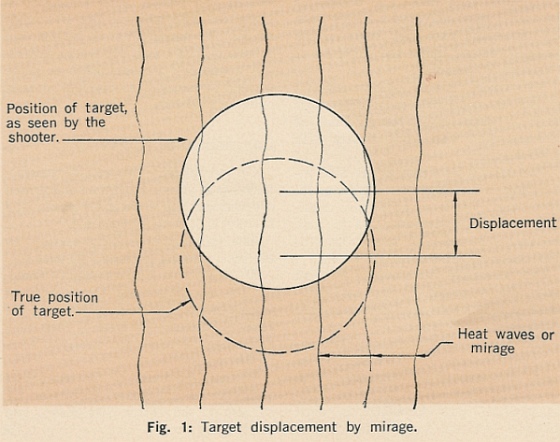
With simple but effective graphic illustrations, this is one of the best explanations of mirage (and mirage reading) we have found on the internet. This is a “must-read” for any serious competitive shooter. Here is a brief sample from the article, along with an illustration. NOTE: the full article is six times longer and has 8 diagrams.
The term “mirage” as used by the shooter does not refer to a true mirage, but to heat waves and the refraction of light as it is bent passing through air layers of different density. Light which passes obliquely from one wind medium to another it undergoes an abrupt change in direction, whenever its velocity in the second medium is different from the velocity in the first wind medium; the shooter will see a “mirage”.
The density of air, and therefore its refraction, varies with its temperature. A condition of cool air overlaying warm air next to the ground is the cause of heat waves or “mirage”. The warm air, having a lower index of refraction, is mixed with the cooler air above by convection, irregularly bending the light transmitting the target image to the shooter’s eye. Figure 1 shows (greatly exaggerated) the vertical displacement of the target image by heat waves.
Heat waves are easily seen with the unaided eye on a hot, bright day and can be seen with spotting scope on all but the coldest days. To observe heat waves, the scope should be focused on a point about midway to the target. This will cause the target to appear slightly out of focus, but since the high power rifle shooter generally does not try to spot bullet holes, the lack in target clarity is more than compensated by clarity of the heat waves.
Story tip from Boyd Allen. We welcome reader submissions.
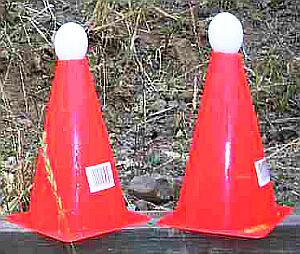
Can you hit an egg at 600+ yards? We mean hit it reliably — not just by luck. To do that you’ll need good shooting skills and a very accurate rifle. How accurate? Well, a chicken egg is, on average, 2 1/4 inches (57 mm) long and 1 3/4 inches (44.5 mm) in diameter. That means to hit an egg (on demand) at 600 yards, you’ll need a rifle capable of 1/3-MOA accuracy (or better). Forum member DukeDuke has such a gun, and he demonstrated its egg-busting prowess in this short video. DukeDuke’s rifle is chambered in 6BRX (a 30° 6BR Improved) and it’s loaded with DTAC 115gr bullets pushed by Alliant Reloder 17. In the video, the eggs are placed on top of poles set 616 yards from the firing line.
See Egg Hit at 38 second mark…
As you can see in the video, that’s a heck of a nice shooting range where DukeDuke scrambled those eggs at 616 yards. The range is situated just outside of Lake Jackson, Texas. As for the gun… the action is a Rem 700 SA BDL, blueprinted and bedded in a Rem/HS Precision PSS stock. The 31″ barrel is 1:8″-twist Broughton. The “P3″ on the barrel stands for Porter’s Precision Products, Lake Jackson, TX. The rifle was built by Kenneth Porter. The load was 33.5 grains of RL-17 at 2950 fps, with 115gr DTAC bullets touching the lands. Cartridge OAL is 2.400″.
How’d you like to locate any rifle range in North America in a matter of seconds? That’s now possible with the Where To Shoot Mobile App, available FREE for both iOS (Apple) and Android devices. The iOS App is designed for both iPhones and iPads.
The Where To Shoot App quickly locates shooting ranges near you, drawing on North America’s most comprehensive directory of shooting ranges. Users can search by current location, state, or zip code and find specifics about each range, including shooting activities offered. Once you locate a range, you can get driving directions to the range.
The app is modeled after NSSF’s popular WhereToShoot.org® website and is updated frequently with range information in every U.S. State and Canadian province. Once you’ve location a place to shoot, the App helps you get directions to the range. The App also includes video tips for shooters, news, and firearm-safety information. Download the app via the links above or by visiting wheretoshoot.org on your mobile device.
The NSSF’s Where To Shoot mobile App has topped 140,000 downloads. The app, which rose to No. 4 on the Apple App Store’s list of free sports Apps, has been a hit with target shooters and gun owners nationwide.
The Berger Southwest Nationals (SWN) kicked off with a two-day shooting clinic held Monday and Tuesday, February 6-7, 2017. Competition at the Ben Avery range begins with a 600-yard Mid-Range Match on Wednesday, followed by long-range matches Thursday through Sunday. Three classes of competitors will be on the firing line: Palma (.308 Win sling), F-TR, and F-Open. This is one of the most popular matches of the year, drawing competitors from around the nation (and a few foreign countries).
The Berger SW Nationals event has become the premier long-range match of the year in the Western United States. This prestigious rifle competition, hosted at the Ben Avery Shooting Facility, outside Phoenix, Arizona, draws the nation’s top F-Class and sling shooters. Over 360 shooters have already registered for the SWN.
2017 Berger Southwest Nationals Schedule of Events
Monday, 6 – Tuesday, 7 February 2017, 9:00 AM
Shooting Clinic: Two-Day clinic includes instruction in both classroom and live fire settings. Instruction will start at 9:00 AM.
Wednesday, 8 February 2017, 9:00 AM
Mid-Range Match – Three, 20-shot matches at 600 yards.
Divisions: Palma, Any Rifle/Any Sight, F-Open, F-TR
Thursday, 9 February 2017, 9:00 AM
4-Man Palma Team Match – 15 shots for record at 800, 900 and 1000 yards.
Divisions: Palma, F-Open, F-TR
Practice available to those not shooting with a team.
Friday, 10 February 2017, 8:30 AM – Start of Grand Agg
Individual Palma Match – 15 shots for record at 800, 900 and 1000 yards.
Divisions: Palma, F-Open, F-TR
Swap Meet – after conclusion of fire at 1000-yard line.
Saturday, 11 February 2017, 8:30 AM
Individual 1000-Yard Matches – Two 20 shots matches at 1000 yards. Any Rifle-Iron Sight (Any sight for F-Class shooters). (Divisions – Palma, Any Rifle-Iron Sight, F-Open, F-TR)
4 Man Team Match – 20 shots at 1000 yards. Any Rifle-Iron Sight (Any sight for F-Class shooters). (Divisions – Palma, Any Rifle-Iron Sight, F-Open, F-TR)
Banquet Dinner – Approximately 5:00 pm at Indoor Range.
Sunday, 12 February 2017, 8:30 AM
Individual 1000-Yard Matches – Two 20 shots matches at 1000 yards. Any Rifle-Any Sight (Any sight for F-Class shooters). (Divisions – Palma, Any Rifle-Any Sight, F-Open, F-TR)
Awards Ceremony at the Indoor Range.
To help you prepare for the Berger SW Nationals, here are some competition tips from Bryan Litz. Bryan knows the Ben Avery range well. He won the Mid-Range and Long-Range F-TR National Championships there in 2015. And twice he has won the sling division at the Southwest Nationals. Here are wise words from Bryan:
Competition TIP ONE. Improving your scores in long range competition is a constant process of self-assessment. After each match, carefully analyze how you lost points and make a plan to improve. Beginning shooters will lose a lot of points to fundamental things like sight alignment and trigger control. Veteran shooters will lose far fewer points to a smaller list of mistakes. At every step along the way, always ask yourself why you’re losing points and address the issues. Sometimes the weak links that you need to work on aren’t your favorite thing to do, and success will take work in these areas as well.
Competition TIP TWO. Select your wind shooting strategy carefully. For beginners and veterans, most points are typically lost to wind. Successful shooters put a lot of thought into their approach to wind shooting. Sometimes it’s best to shoot fast and minimize the changes you’ll have to navigate. Other times it’s best to wait out a condition which may take several minutes. Develop a comfortable rest position so you have an easier time waiting when you should be waiting.
Competition TIP THREE. Actively avoid major train wrecks. Sounds obvious but it happens a lot. Select equipment that is reliable, get comfortable with it and have back-ups for important things. Don’t load on the verge of max pressure, don’t go to an important match with a barrel that’s near shot out, physically check tightness of all important screws prior to shooting each string. Observe what train wrecks you and others experience, and put measures in place to avoid them.
This year, the Civilian Marksmanship Program (CMP) will offer a new Range Officer Training Program. This comprehensive training program will train and certify Range Officers for the CMP phases of the National Matches, CMP Travel (Regional) Games competitions, and CMP 3-position air rifle championships. The first objective of the new program is to train volunteers to serve as Range Officers in the 2017 National Matches. The course fee will be waived for National Matches volunteers.
CMP Chief Operating Officer Mark Johnson explained: “Knowledgeable, fair, effective Range Officers are absolutely essential… The CMP recognizes that the best way to make sure it has excellent Range Officers for its competitions is to train them.”
The CMP held the first-ever New England CMP Games event in 2016.
Range Officer Volunteers will be enrolled in Level I training to be completed in the first months of 2017. Level II courses will be available prior to the start of the National Matches. If you have questions about the RO Training Program, email the CMP Competition Department: competitions [at] thecmp.org.
Level I Range Officer Training
Level I Range Officer instruction covers general topics common to all Range Officer work. Enrollees will receive a Range Officer Handbook titled Becoming a Range Officer and be able to complete an online training course. Enrollees who complete Level I training will receive a certification and CMP Range Officer Vest and be eligible to attend Level II training.
Levels II and III Range Officer Training
Level II courses are discipline-specific, 1-day, in-person sessions taught by CMP-appointed instructors. Level II RO instruction will be offered for four shooting disciplines: 1) Highpower Rifle; 2) Bulls-Eye Pistol; 3) Rimfire Sporter; and 4) 3-Position Air Rifle. The highest Level III certification will be issued after Range Officers who complete Level II training serve as Range Officers in CMP competitions under the supervision of a CMP Master Range Officer. CMP Master Range Officers will conduct/supervise the training of Level II and Level III students. The first Level II courses should begin in March or April.
CMP Rimfire Sporter Competition Level II Training will be offered for this and other specific disciplines.


 In the hit Hollywood movie “The Patriot”, the hero Benjamin Martin (played by Mel Gibson), tells his sons: “Aim small, miss small”. That advice was given to help his sons survive encounters with the British redcoats, but the “aim small, miss small” mantra can benefit target shooters as well.


 Making Corrections with Limited Sighters



 Can you hit an egg at 600+ yards? We mean hit it reliably — not just by luck. To do that you’ll need good shooting skills and a very accurate rifle. How accurate? Well, a chicken egg is, on average, 2 1/4 inches (57 mm) long and 1 3/4 inches (44.5 mm) in diameter. That means to hit an egg (on demand) at 600 yards, you’ll need a rifle capable of 1/3-MOA accuracy (or better). Forum member DukeDuke has such a gun, and he demonstrated its egg-busting prowess in this short video. DukeDuke’s rifle is chambered in 6BRX (a 30° 6BR Improved) and it’s loaded with DTAC 115gr bullets pushed by Alliant Reloder 17. In the video, the eggs are placed on top of poles set 616 yards from the firing line.
 How’d you like to locate any rifle range in North America in a matter of seconds? That’s now possible with the Where To Shoot Mobile App, available FREE for both iOS (Apple) and Android devices. The iOS App is designed for both iPhones and iPads.


