On Ammoland.com, there’s an interesting article about the NSSF’s recent 3-Gun Fantasy Camp in Las Vegas. Author Duncan Johnson attended the Camp last month and wrote an “after action report”. He said the Camp was a great experience, and his shooting improved greatly with the expert tutoring from top pros: “If you have ever wanted to try a 3-Gun competition, just go do it, you will quickly find out why this is the fastest-growing shooting sport today. If you are new to shooting and or just getting started in 3-Gun, I 100% recommend you attend the NSSF Fantasy Camp.”
Here are Four Tips/Observations Duncan learned during the 3-Gun Fantasy Camp:
1. Use a Zoom Rifle Optic – “The LWRC 3-Gun ready rifle [provided for the Camp] was topped with a Leupold Mark 6 1-6x20mm riflescope, which made distance shooting much easier than the AimPoint optic [on my own AR]. 3-Gun competitions have rifle stages that can involve distance shooting out to ranges of 500 yards or more. For that reason, most shooters in the 3-Gun TacOps and Practical divisions use magnified riflescopes like the Leupold Mark 6 or the Vortex Strike Eagle.”
2. Use Your Quads and Core Muscles — “There are also a lot of little things that the pros teach you… For instance, some shooters instinctively bend their knees to enter their stance, but once they start firing they tend to follow the recoil with their shoulders and end up leaning back. In order to avoid that, use your quad muscles in your legs to get a solid stance that will absorb more recoil. Also use your core muscles to maintain a strong stance, especially in shotgun stages. The combination of strong quad and core muscles will contribute to controlling muzzle flip and moving onto your next target more easily.”
3. Vision-Based Target Transitions — “Another pro tip from Randi Rodgers on transitioning from target to target with a pistol was using your eyes rather than your sights to switch targets. So imagine it as pull the trigger, the slide starts to come back, using your eyes find the next target, then point with the front sight, find the sight picture, fire, and repeat.”
Editor’s Note: A few seasons back, I attended an action shooting seminar taught by Randi, and she explained the “move your eyes” technique. For multi-target stages, this really works. Move your eyes from target to target, and you’ll find your arms automatically “pull” the handgun into position. You still need to get the sights on target, but this method yields create smoother, faster stage runs.
4. Trigger Control and Use of Support Hand — If you don’t have good trigger control and pull straight back, you can move your sights during the shot. This is a common problem with novice pistol shooters. The solution is lots of dry fire training. Duncan found out he needed work: “In my case, the biggest area where I need improvement was shooting my pistol. There were two different things I was doing that will guarantee a missed shot every time with a handgun. When I pull/squeeze/depress my trigger I have a tendency to also pull the gun off target, resulting in a miss to the low left of a target. I [also] over-apply pressure with my shooting hand. According to the pros, pistol grip should be 40% shooting hand, and 60% supporting hand.”
This article originally appears on Ammoland.com, reprinted here under Creative Commons License.
The National Shooting Sports Foundation (NSSF) is pleased to announce the launch of its annual grants partnership with the Boy Scouts of America Councils. Through this partnership, BSA Councils can receive a portion of $100,000 in NSSF-provided grant funds to develop or expand their troop activities in target shooting and marksmanship. Target shooting programs continue to rank among Scouting’s most popular activities, teaching firearms and range safety, teamwork building and fundraising skills.
“This seventh year of supporting the BSA Council Grant Program … brings with it a new level of excitement,” said Zach Snow, NSSF Director, Range Services. “Safety and marksmanship training through the Boy Scouts is a time-honored introduction to the shooting sports. We’re looking forward to increased participation from Scouts pursuing [merit] badges in these activities and then taking those new skills afield for a lifetime of enjoyment.”
How Scouting Groups Can Apply for Grants
BSA Councils wishing to apply for grants should visit the grant guidelines and application procedures at nssf.org/bsagrant. Councils awarded funds through NSSF’s BSA Grant Program must use those grants to purchase of equipment and supplies for their shooting sports activities from an NSSF Member Retailer. The full list of these retailers is available at nssf.org/retailers/find. Examples of qualifying purchases are: ammunition, eye and ear protection, firearms, targets and shooting vests. For more information on this special program and qualifications, contact NSSF’s Zach Snow at zsnow@nssf.org or 203-426-1320 ext. 224.
There’s a great interview with Bryan Litz of Applied Ballistics on Mia Rhode’s Life Of A Shooter’s Wife Blog. We recommend you read the full interview. Bryan offers many important insights that can benefit any precision shooter. It’s fascinating to learn about Bryan’s background and how he progressed in competitive shooting, starting with very basic equipment. As a “broke high school kid”, he got started on the cheap, paying for gear with wages from McDonald’s. Now he’s a globally-recognized expert in Ballistics and Long Range precision. You’ll enjoy reading the Full Interview. Here are some highlights…
LOASW: When did you first become interested in shooting?
Bryan: My first memories of shooting were at the age of about 9 or 10. Pellet rifle in the back yard. My Dad taught me to shoot, stressing the importance of accuracy. I was driven to hit targets, mostly small targets at long distance. My grandfather was on the All-Army shooting team back in the ‘50s, and was distinguished in both rifle and pistol. Shooting is part of my family’s DNA and I benefited from that from a young age.
LOASW: What sparked your interest in Competitive Shooting and how old were you when you started competing?
Bryan: Hunting groundhogs in the farm-fields of Pennsylvania through high school is where I truly connected with long-range shooting. My Dad heard of a competition range (The Original Pennsylvania 1000 Yard Benchrest Club in Williamsport, PA). So we visited there one summer and I immediately found my trusty 22-250 inadequate for the job of 1000-yard benchrest shooting. So I saved my McDonald’s wages until I could afford a 7mm Remington Magnum and began competing in my first matches at the age of 15.
Learning with Limited Resources…
… It was a huge mis-match to my situation because benchrest is a highly gear-driven sport, and the winners typically have many $1000s of dollars wrapped up in equipment. I was a broke high school kid who needed my parents to drive me to the range my first year, and my second year, I had to rely on fellow competitors to jump start my old pick-up truck that was always breaking down. Nevertheless I enjoyed the hell out of shooting 1000 yards. I can honestly say that I don’t have any more FUN shooting these days with all the best equipment as compared to those bad ‘ol days when I had maybe $900 total wrapped up in all my gear. Those who remember me from those early days might recall the home-made shooting rest and McDonalds French fry box that I carried all my gear in. Later when I picked up prone/sling shooting, my shooting mat was a piece of carpet (pink, no less), and my shooting coat was a military field jacket with belts sewn in it.
Money was probably my biggest challenge when I started out. I had plenty of fun with my budget kit, but was certainly constrained by lack of access to quality gear. I overcame this with hard work and making the most of what I had. Learning how to mitigate the deficiencies of my equipment was an important stepping stone which has been highly valuable even now when I’ve got better stuff. It’s a good skill to have, to be able to spot something about to come unraveled.
LOASW: What advice would you give to someone new to competitive shooting?
Bryan: Find a mentor, someone who lives near you who has experience and is willing to share it. You will cut years off your learning curve if you can get someone to share their experience with you who’s “been there done that”.
Do you carry a firearm for self-protection, or perhaps keep a handgun in a vehicle during trips? Then you should consider signing up for a new insurance/training program offered by the NRA. Launched this week, the NRA’s Carry Guard program offers up to $1,000,000 in insurance/legal protection. This is combined with a comprehensive training program.
The Carry Guard program offers a 24/7 hotline for members. You get immediate response to secure bail bonds, legal retainers, and counseling. Importantly you can choose your own attorney from a nationwide attorney referral network. Members get up to $1,000,000 in insurance-backed protection for legal fees and will receive emergency support services in case of a self-defense incident. Spouses of NRA Carry Guard members are automatically covered, as are family members who live with a Carry Guard member and defend themselves in the home.
Three levels of protection are offered, with affordable monthly payments. When you consider that the cost of defending a civil lawsuit could easily exceed $150,000 just in legal fees, it’s smart to have some kind of legal insurance plan.
Carry Guard Training
Carry Guard members can access a variety of video tutorials. In addition, CarryGuard offers three-day training programs that combine classroom sessions with range training. The focus is on the real-life scenarios you might face. “We apply those [gun-handling] fundamentals to real-life situations, self-defense tactics and techniques, low-light shooting, force-on-force Air Soft scenarios and more. Students are evaluated on a course of fire where only a passing score earns eligibility to move to the next level.”
If you have questions about the Carry Guard Program, consult the Carry Guard FAQ page, call 1-866-NRA-5050, or use the NRA’s Contact Form.
All 10s and Xs for record — that’s a very impressive 200-10X score card for young Lynzie Graham.
Here’s a “feel-good” story about a talented young shooter. We like to acknowledge the accomplishments of the “rising stars” in our sport. Lynzie Graham, a member of the U.S. F-Class Under-25 Team recently shot a perfect 200-10X at 600 yards, not dropping a point. That’s particularly impressive when you consider Lynzie shot her 600-yard “clean” using a factory rifle — a Savage Arms .308 Win F-TR rig.
Congratulations Lynzie Graham on your first 600-yard “clean” at the Texas State Qualifier in February 2017. Lynzie was shooting the Sierra 180gr MatchKing® #2220 with her Savage F-TR .308 Win. This August, Lynzie and other U.S. F-Class U-25 Team members will be competing at the F-Class World Championships (FCWC) hosted at the Connaught Ranges near Ottawa, Canada. Click image below for more information about the 2017 FCWC.
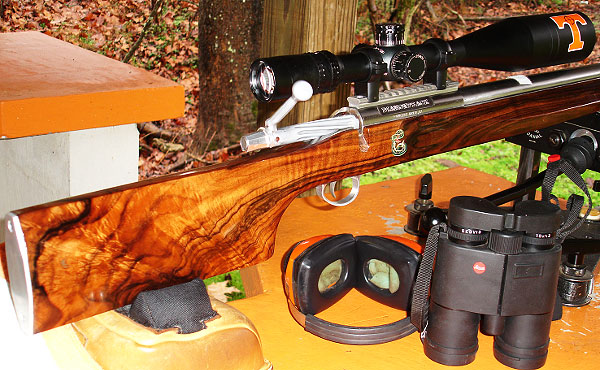
An accurate, self-loading .22 LR rifle, such as this Volquartsen, is our gun of choice for speed shooting with rimfire reactive targets.
Reactive targets offer “instant gratification” — with every hit your target moves, spins, or falls. Shooting reactive targets with a rimfire rifle is fun AND affordable. Times are a-changin’ — rimfire ammo prices have dropped dramatically, so you can now get very good rimfire ammunition for just four bucks a box, such as Norma Tac-22. That works out to a mere eight cents a round. At that price, you can afford to shoot every weekend.
Rimfire Biathlon Target — Tons of Fun RimfireSteel.com offers the unique Rimfire Steel Biathlon Target, a scaled-down Biathlon target designed for use at 50 feet for training and recreational shooting. This is one of our favorite rimfire targets. You can increase the level of challenge by moving it to 25 yards! Watch the video — it shows how to reset the five plates remotely with a lanyard.
Make Your Own Shooting Gallery with Reactive Rimfire Targets
For .22 LR fans, the folks at Action Target have created a whole series of steel rimfire targets. Much lighter than their centerfire counterparts, these rimfire targets are easier to transport and easier to set up. With this wide selection of reactive targets, you can create your own shooting gallery.
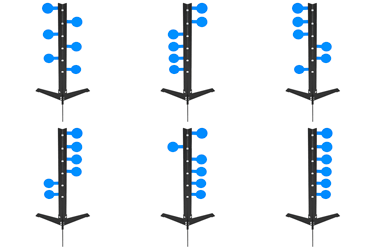
Rimfire Dueling Tree
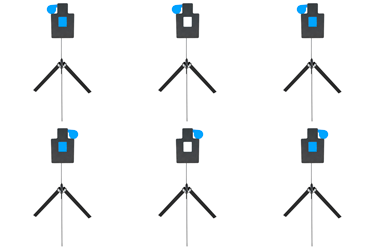
Rimfire Spinning Jack
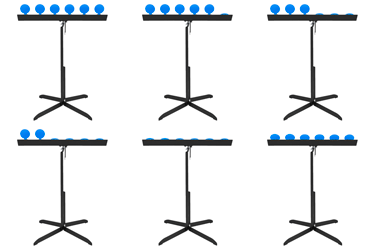
Rimfire Plate Rack
Rimfire Buffalo
In this video, Michael Bane reviews Action Target’s line of rimfire targets, which includes plate racks, spinners, dueling trees, and more. As Michael explains: “This line of targets is very well thought out. For example — dueling trees are a lot of fun. But a centerfire dueling tree weighs a lot, it’s hard to cart it around. A rimfire dueling tree is easy to set up, easy to carry around.”
New PT Target “Walks” When Hit
Action Target has just released a new reactive target that doesn’t even need a stand or base. The patent-pending PT Twist rests on the ground, and flops over or “walks” when hit. Constructed from a single piece of 3/16″-thick A514B steel, the PT Twist has no welds or bolts to break or ricochet. Watch the PT Twist in action:
“Involvement in the shooting sports develops … discipline, patience, self-control, and responsibility.” — Daisy President, Keith Higginbotham
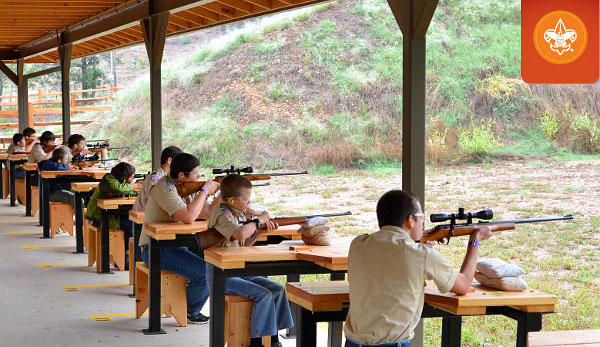
Like many of our readers, your Editor got his first introduction to organized shooting sports through the Boy Scouts. At a Scouting summer camp I participated in competitive target shooting with both airguns and single-shot .22 LR rifles. That experience helped me earn my Rifle Shooting Merit Badge. That marksmanship badge remains one of the most popular non-mandatory Merit Badges. Since 2009, over 350,000 Rifle Shooting Merit Badges have been earned by young scouts.
Given the vital role Scouting plays in developing the next generation of shooters, we’re pleased that Daisy has agreed to partner with the Boy Scouts of America (BSA). This agreement makes Daisy the official airgun of the Boy Scouts of America.
This partnership makes Daisy’s unique inflatable BB Gun ranges available to the BSA’s 274 local councils as well as BSA camp sites across the country. Instructors emphasize shooting safety rules and teach basic marksmanship, including breath control, trigger pull, sight picture and more.
Daisy President Keith Higginbotham stated: “Teaching the basics of marksmanship and shooting safety… continues to be at the core of our mission. Hundreds of millions of adults have been positively affected by Scouting, learning to become responsible citizens, developing character and becoming self-reliant. Involvement in the shooting sports develops similar traits, such as discipline, patience, self-control, and responsibility.”
Daisy Inflatable BB Gun Range
Daisy’s unique inflatable BB Gun Ranges can be deployed at Scout camps, and as well as hunting and conservation events. These mobile ranges allow instructors to teach young poeple gun safety rules and marksmanship skills. When set-up, the range measures 22′ 5″ long by 9′ 6″ wide by 8′ 6″ tall.
This photo is one of Nightforce’s series of picturesque “Gunscapes”. SEE MORE HERE.
This story is not (directly) about firearms, or reloading gear, or any of the little details of our sport. It, instead, is about life… and, sadly, about death. The recent passing of a friend (and fellow shooter) got me to thinking, “I’m sixty — what if I only had ten more years to live — how would I want to live my life? What really counts the most? What things would I do differently? What dreams would I pursue?”
From the demographics of this website, I know we have thousands of readers in their 50s, 60s, and 70s. Hopefully we will all live long, happy, and fruitful lives. But it’s not a bad idea to consider that we are all mortal, and the clock is ticking. Consider this — in the United States, the average male life expectancy is 77 years*. Using that number as a benchmark, I personally may have just 15 more years to enjoy life and to do the things I love — shooting, traveling, sailing, camping, listening to music, being with friends and family. Breaking that down into months, I have 180 more months to do fun and rewarding stuff. Just 180 months — that’s a real number my brain can comprehend all too well. If I live an average lifespan, that means I also only have 780 more weekends to do all that I want to do. With less than 800 weekends remaining, I don’t want to waste a single one.
Living a Life with More Good Times, and Fewer Regrets
Recently, a group of men, very near the end of their lives, were surveyed. They were asked if they would do things differently if they could live their lives over again. The vast majority of these men gave surprisingly similar responses, which fit into five “Life Lessons”. These “Top 5 Regrets of the Dying” were reported in a story by Bronnie Ware, writing for the AARP online magazine. Ware writes: “When questioned about any regrets they had or anything they would do differently, common themes surfaced.” Here are the five regrets most often mentioned by older men:
1. I wish I’d had the courage to live a life true to myself, not the life others expected of me.
“This was the most common regret of all. When people realize that their life is almost over and look back clearly on it, it is easy to see how many dreams have gone unfulfilled. ”
Lesson: Don’t wait to follow your dreams. Be true to yourself.
2. I wish I didn’t work so hard.
“This came from every male patient [surveyed]. All of the men… deeply regretted spending so much of their lives on the treadmill of a work existence.”
Lesson: Don’t let your work crowd out other important aspects of life.
3. I wish I’d had the courage to express my feelings.
“Many people suppressed their feelings in order to keep peace with others. As a result, they settled for a mediocre existence and never became who they were truly capable of becoming.”
Lesson: Express yourself truthfully. Don’t suppress your feelings for decades.
4. I wish I had stayed in touch with my friends.
“There were many deep regrets about not giving friendships the time and effort they deserved. Many [were] so caught up in their own lives that they had let golden friendships slip by over the years.”
Lesson: Take an interest your friends’ lives; keep bonds of friendship strong.
5. I wish that I had let myself be happier.
“This is a surprisingly common [regret]. Many did not realize until the end that happiness is a choice.”
Lesson: Affirmatively pursue the things that bring you happiness. Don’t just stick to old habits.
Turn Off the Computer, and Do Something Memorable with Your Friends Today
How does this all apply to our shooting hobby? Well, if (like me) you are middle-aged (or older), go have some fun this weekend! Load up your rifle and get to the range. Don’t put off doing the things that make you happy. Call those old buddies you may not have seen in a long time. Renew friendships. Get out into nature. And start figuring out how you can live your dreams. As the saying goes, “Time waits for no man”.
*One of our readers pointed out that the numbers actually work out better than this, because once a man survives to later life, men of his surviving age cohort enjoy a projected lifespan longer than the average projected lifespan from birth. For example, using actuarial tables, a man born exactly 60 years ago (still alive today), has a calculated life expectancy of 23.4 years… meaning he would live to age 83.4 years, on average. CLICK HERE to see actuarial-predicted longevity based on your birthdate.
Practicing What I Preach…
As you read this, your Editor will NOT be sitting in front of a computer. Instead he will be on a boat, taking him 30 miles offshore to this beautiful spot. Three days with no internet, no TV, no Schedule Cs, and no traffic. Just good friends and unspoiled nature. Living like a kid again.
The “Holy Grail” of prairie dog shooting is dispatching a dog at ultra-long-range — the farther the better. Here we recount the quest of Forum member VolDoc to nail a Prairie Dog at 1000+ yards with a Savage .20-caliber rifle. If you’re a fan of the “Terrific 20s”, or have an interest in ultra-long-range varminting, you’ll enjoy this story. VolDoc, a dentist by trade, is a seasoned Prairie Dog Hunter who has made many trips to the P-Dog fields in Colorado with his hunting buddies. But until recently he had never managed to nail a P-Dog at 1000 yards with a .20-caliber rifle. Nor, as far as we can determine, had any one else. But VolDoc did it — accomplishing a verified Prairie Dog kill at 1032 yards, possibly the longest recorded with a .20-Caliber rifle.
Modified Hart-Barreled 20BR Savage Does the Job
Shooting Prairie Dogs at extreme long range takes highly specialized equipment. To make his 1032-yard kill shot, VolDoc used a modified Dual-Port Savage chambered in 20 BR. The stock was geometrically-uniformed and pillar-bedded by smith Kevin Rayhill, who fitted a 28″ Hart barrel with a Rayhill muzzle brake. VolDoc loaded his 20BR with 55gr Berger BT LR Varmint bullets (0.381 G1 BC) pushed by a stout charge of Hodgdon Varget.
It took good conditions, and patience to make the successful 1000+ yard shot. Voldoc explains:
“We were out on the Colorado prairie at daylight and the conditions were perfect. The sunrise was at my back and we had about a 10 mph tailwind. I looked through my Leica Geovid Rangefinder Binos and the Prairie Dogs were out for breakfast. I quickly ranged the targets and found a group at about 1,050 yards.
My first shot was very, very close. I added about four clicks up and a couple of clicks left for windage and let another go. That shot threw dirt all over, but the dog didn’t even flinch. On the fourth shot, I saw the dog go belly up and kick its final throws. My quest for the 20-Caliber 1,000-yard Prairie Dog had become a reality. We confirmed the distance with our lasers at 1,032 yards.”
Voldoc’s Accurate Arsenal
In our report on VolDoc’s successful 1K Prairie Dog quest, we spotlighted two of VolDoc’s other accurate varmint guns. First, fans of fine wood will love VolDoc’s switch-barrel, drop-port Stiller Diamondback rifle. The wood on this gun is stunning. The custom stock was crafted from 40-year-old English Walnut to match the profile of a Shehane ST-1000. The rifle has three barrels with three different chamberings: 6BR Brux 1:8″-twist HV; 6BRX Krieger 1:8″-twist HV, and 6mm Dasher Krieger 1:8.5″-twist fluted straight contour (no taper). The scope is a Nightforce 12-42x56mm, with 2DD reticle.
VolDoc’s “Go-To” Prairie Dog Rifle — Big Orange Crush Dasher
Next, check out VolDoc’s “Big Orange Crush” rifle. This features a stainless Nesika ‘J’ action in a painted fiberglass Shehane ST-1000 stock. Originally a 6BR, the gun is now chambered as a 6mm Dasher with a .271″ no-turn neck. The barrel is a 1:12″-twist Krieger fited with Vais muzzle brake. Big Orange Crush shoots 87gr V-Maxs into bugholes at 3,400 fps, according to VolDoc. He tells us that “The barrel now has more than 3,000 rounds down the tube and exhibits little throat fire-cracking and no loss of accuracy. I can’t explain why, it just hasn’t deteriorated yet. This rifle is my best-ever ‘go-to’ Prairie Dog rifle.”
This story involves a match held last fall, but we know many of our readers compete in the Mid-Range (600-Yard) Benchrest discipline and follow developments in this sport. Accordingly we’re offering this report on the 2016 IBS Nationals held at the Big Piney Sportsman’s Club in Houston, Missouri.
The 600-Yard Nationals at Big Piney last September was a great event that drew 82 shooters from 14 different states. Competitors traveled from as far away as Florida, Idaho, and North Dakota to compete in the 2016 600-Yard International Benchrest Shooters National Championship. The weather was great and so was the food. A good time was had by all, and shooters praised the facility and the efficient way the match was run. The IBS offers a big “thank you” to everyone involved in running this excellent match. Their hard work and dedication deserves recognition.
On the forearm of this Heavy Gun was painted: “Give Me Liberty or Give Me Death”
Here are the Class Winners at the 2016 IBS 600-yard Nationals in Missouri
The opening morning for Light Gun class proved to be challenging, as the start time was pushed back one hour due to the fog settling in the firing line. By the second half of the eight targets to be shot, shooters began to settle in and take control of the conditions. The Missouri shooters stayed on top with Ben Peters winning light gun score with a 385. Jason Walker took the group win with a 2.008” through 8 targets. With Tom Jacobs, Darrel Dacus, Jim Bauer, and Carrol Lance rounding out the top 5 in Light Gun overall it was going to be a hard fight to the finish.
Click Image to View Larger Equipment List Look at the Caliber Column — Every Top 10 shooter in Light Gun Class shot either a 6mm BR Norma or a 6mm Dasher, an “Improved” version of the 6mm BR. In Heavy Gun it was 9 of 10 (with one unidentified 6.5mm). Hard to beat the 6mm BR and the Dasher for pure accuracy at 600 yards.
This competitor shot the match with a Labradar chronograph on his bench.
On Sunday the Heavy Gun class started right on time with the clouds keeping Saturday’s fog in check. Relay 3 started the day off strong, putting it on top shelf for everyone to follow. The conditions seemed to stay pretty steady and helped create opportunities for competitors to shoot some amazing groups. Tom Jacobs came through with a 1.685 Heavy Gun group Aggregate. Rookie shooters Jim Kowske and TJ Stroop put on great Heavy Gun performances. Jim was second in Heavy gun group with 1.996” and TJ shot his way to second in score with a 384. Jason Walker hung on winning Heavy Gun score with a 389. This set up Jason as the Heavy Gun overall winner.
The Big Piney Range is a pretty facility surrounded by trees.
Jason dominated the weekend landing himself a 2-Gun Overall Championship. The top Rookie honors went to T.J. Stroop. Sally Bauer won the Overall top female. Rory Jacobs was able to seal the top Junior spot. The Big Piney crew would like to thank everyone for being great friends and great competitors! We could not have done it without everyone!
The match organizers provided tasty BBQ banquets for hungry shooters.
Here competitors relax between relays at the Big Piney facility.


 The
The 
 LOASW: When did you first become interested in shooting?